Entries for November 2018
In an article for MIT Technology Review, Antonio Regalado reports that researchers in Shenzhen, led by He Jiankui, are recruiting couples for a study to produce the first genetically edited human babies. They are hoping to use the CRISPR gene editing technique to “eliminate a gene called CCR5 in hopes of rendering the offspring resistant to HIV, smallpox, and cholera”.
The birth of the first genetically tailored humans would be a stunning medical achievement, for both He and China. But it will prove controversial, too. Where some see a new form of medicine that eliminates genetic disease, others see a slippery slope to enhancements, designer babies, and a new form of eugenics.
“In this ever more competitive global pursuit of applications for gene editing, we hope to be a stand-out,” He and his team wrote in an ethics statement they submitted last year. They predicted their innovation “will surpass” the invention of in vitro fertilization, whose developer was awarded a Nobel Prize in 2010.
A follow-up by the Associated Press indicates that He’s program is already underway and has resulted in a successful birth of twins earlier this month.
The researcher, He Jiankui of Shenzhen, said he altered embryos for seven couples during fertility treatments, with one pregnancy resulting thus far. He said his goal was not to cure or prevent an inherited disease, but to try to bestow a trait that few people naturally have - an ability to resist possible future infection with HIV, the AIDS virus.
He said the parents involved declined to be identified or interviewed, and he would not say where they live or where the work was done.
Update: He is now under investigation for legal and ethical misconduct.
On Sunday, the Shenzhen City Medical Ethics Expert Board said it would begin an investigation of He’s research and released a statement saying that HarMoniCare “according to our findings … never conducted the appropriate reporting according to requirements.” The former medical director of the private hospital, Jiang Su-Qi, told Southern Capital News he had no recollection of approving He’s research while he was on its ethics committee.
“These two children are the guinea pigs. They will go through their whole maturing process having not understood the risks ahead of time,” said Liu Ying of Peking University’s Institute of Molecular Medicine.
Ricky Jay died yesterday, aged 72. He was a master magician with a deck of cards, an actor, writer, and historian. The definitive profile of Jay was written by Mark Singer in 1993 for The New Yorker. It begins like this…just try not to read the whole thing:
The playwright David Mamet and the theatre director Gregory Mosher affirm that some years ago, late one night in the bar of the Ritz-Carlton Hotel in Chicago, this happened:
Ricky Jay, who is perhaps the most gifted sleight-of-hand artist alive, was performing magic with a deck of cards. Also present was a friend of Mamet and Mosher’s named Christ Nogulich, the director of food and beverage at the hotel. After twenty minutes of disbelief-suspending manipulations, Jay spread the deck face up on the bar counter and asked Nogulich to concentrate on a specific card but not to reveal it. Jay then assembled the deck face down, shuffled, cut it into two piles, and asked Nogulich to point to one of the piles and name his card.
“Three of clubs,” Nogulich said, and he was then instructed to turn over the top card.
He turned over the three of clubs.
Mosher, in what could be interpreted as a passive-aggressive act, quietly announced, “Ricky, you know, I also concentrated on a card.”
After an interval of silence, Jay said, “That’s interesting, Gregory, but I only do this for one person at a time.”
Mosher persisted: “Well, Ricky, I really was thinking of a card.”
Jay paused, frowned, stared at Mosher, and said, “This is a distinct change of procedure.” A longer pause. “All right-what was the card?”
“Two of spades.”
Jay nodded, and gestured toward the other pile, and Mosher turned over its top card.
The deuce of spades.
A small riot ensued.
Magic aside, Jay’s performances were master classes in how to entertain. Even in grainy YouTube videos, it is impossible to look away:
In 2002, he threw playing cards at Jackie Chan, Conan O’Brien, and a watermelon on television:
When asked about “a world without lying” by Errol Morris in 2009, Jay replied:
When you’re talking about Kant and trust, it made me think of one of the ways I tell people about the con game. I say, “You wouldn’t want to live in a world where you can’t be conned, because if you were, you would be living in a world with no trust. That’s the price you pay for trust, is being conned.”
The 2012 documentary film about Jay, Deceptive Practices, is streaming for free on Amazon Prime Video…I know what I’m watching tonight. Here’s the trailer to pique your interest:
Update: A poetic remembrance of Jay from his friend David Mamet.
Our great sage Johnny Mercer wrote, “Go out and try your luck / You might be Donald Duck / Hooray for Hollywood.” But Ricky, as the Stoics taught, did not enter that race. He achieved fame and adulation, but like the warrior monk or the Hasidic master, he sought perfection.
He spent five or six hours a day practicing. He did it for 60 years. And, like all great preceptors, he was, primarily, a student. His study was the metaphysical idea of Magic, which found expression not only in performance, but in practice, commentary, design and contemplation. They were all, and equally to him, but expressions of an ideal.
In this short gem of an article for Wired, Virginia Heffernan connects the ecological transformation of the pre-human Americas by beavers to Marshall McLuhan…and then to climate change.
Having gnawed their way across the Bering Land Bridge with their iron-glazed teeth, beavers by the tens of millions straight-up built North America. They worked like rodent Romans, subjugating the deciduous forests with formidable infrastructure: canals, lodges, dams that can last centuries, and deep still-water pools used to float building materials. By clear-cutting trees and blocking streams, the nocturnal, semiaquatic creatures also damaged the environment in some of the same ways humans do. Much later, beavers unexpectedly became the toast of a rarefied academic circle at the University of Toronto, where they inspired, of all things, media theory.
For a cultural program to accompany the 2012 Olympics in London, artist Sue Austin created a video of herself exploring a coral reef in a wheelchair outfitted with motors and wings to help it steer and go through the water.
It’s a tiny bit surreal to see how freely she moves around in something that many of us associate with an absence of a particular type of movement. But as Austin explains in her 2013 TED Talk, she thinks of her wheelchair in terms of freedom of movement, which is highlighted for others by the underwater video. (via colossal)
How old were you when you learned that the Moon in the Southern Hemisphere is upside down? I was today years old…this is my head exploding —> %@*&!$. Ok, the Moon isn’t upside down (that’s Northern-ist) but its orientation changes depending on if you’re north or south of the equator.
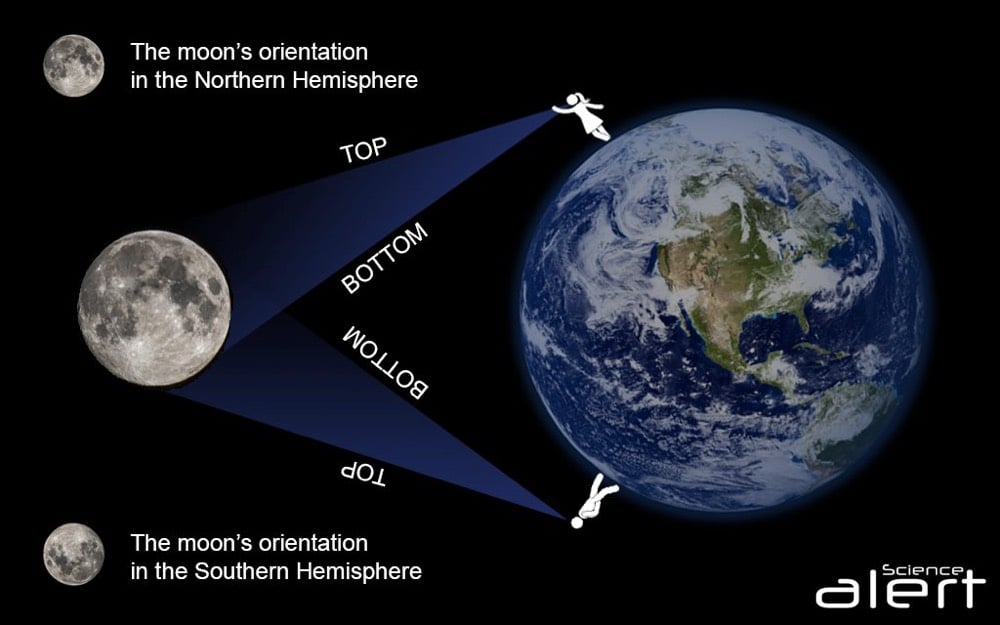
“From our perspective, the Moon and the night sky is actually rotated 180 degrees compared to our Northern Hemispherical friends,” Jake Clark, an astronomer from the University of Southern Queensland in Australia, explained to ScienceAlert.
“In the south we see the Moon’s dark ‘Oceanus Procellarum’ sea in the south-east corner compared to in the north-west corner for a northern observer.”
But why does it look like this? Well, because physically, we’re actually upside down compared to someone standing in the opposite hemisphere.
That makes perfect sense & the explanation is quite simple but it’s still messing with my head. How did I not know this? Here’s how the Moon appears in the Northern Hemisphere (from Wikipedia):

And here’s a photo from Brendan Keene in Australia:

Some good analysis from Gothamist: Does New York’s HQ2 pitch to Amazon make sense? “There are other ways New York could spend its money that would also generate lots of new revenue.”


This is pretty straightforward and hilarious: using a high-speed setup, Christian Vieler photographs dogs catching treats. The photographs also come in book form and as a 2019 wall calendar.
The last time I posted a video by Vladimir Tomin I struggled to describe what it was about, eventually punting with “just give it 5 seconds and you’ll get the idea”. They’re fun augmented reality sketches — like peeling up a road’s center line with a cursor — what’s not to like?! (via colossal)
In this video, a pair of scientists talk about their work in studying the communication patterns of humpback whales to learn more about how we might someday communicate with a possible extraterrestrial intelligence. No, this isn’t Star Trek IV. For one thing, whales have tailored their communication style to long distances, when it may take hours to received a reply, an analog of the length of possible interplanetary & interstellar communications. The scientists are also using Claude Shannon’s information theory to study the complexity of the whales’ language and eventually hope to use their findings to better detect the level of intelligence in alien messages and perhaps even the social structure of the alien civilization itself.
P.S. Fascinating whale facts are sprinkled throughout the video. Humpback whales “have had the Ocean Internet for millions of years” and can communicate directly with each other up to 1000 km away. That means that a whale off the coast of Portland, OR can chat with another whale near San Francisco. (via @stewartbrand)
From XKCD, a reminder that human spaceflight is older than we might think and human flight is more recent.
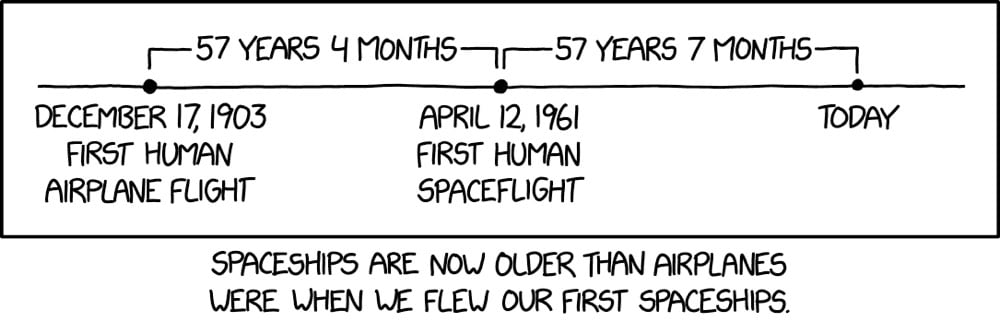
I am a sucker for these sorts of things. Perhaps my favorite is that Cleopatra lived closer to the Moon landing than she did to the construction of the Great Pyramid of Giza. Or maybe it’s that Ralph Macchio is five years older now than Pat Morita was when he played Mr. Miyagi opposite Macchio in The Karate Kid.
See also Timeline Twins, Unlikely Simultaneous Historical Events, and The Great Span.

Lately I’ve been noticing that more and more authors seem to be adapting their adult nonfiction books for younger readers (typically for the middle grade set, ages 8-12). The young readers editions are shorter and often contain more illustrations, photos, graphs, and charts than their adult counterparts, distilling the story and information down into what would be in the movie versions of these books. Here are some of the young readers’ editions I’ve run across.
The Omnivore’s Dilemma: Young Readers Edition by Michael Pollan. “This young readers’ adaptation of Pollan’s famous food-chain exploration encourages kids to consider the personal and global health implications of their food choices.”
A Young People’s History of the United States: Columbus to the War on Terror by Howard Zinn (adapted by Rebecca Stefoff). “Zinn in the volumes of A Young People’s History of the United States presents a radical new way of understanding America’s history. In so doing, he reminds readers that America’s true greatness is shaped by our dissident voices, not our military generals.”
Notorious RBG Young Readers’ Edition: The Life and Times of Ruth Bader Ginsburg by Irin Carmon & Shana Knizhnik, “mixes pop culture, humor, and expert analysis for a remarkable account of the indomitable Ruth Bader Ginsburg: Heroine. Trailblazer. Pioneer.”
Before Columbus: The Americas of 1491 by Charles Mann. “A companion book for young readers based on 1491: New Revelations of the Americas Before Columbus, the groundbreaking bestseller by Charles C. Mann.” See also Mann’s 1493 for Young People: From Columbus’s Voyage to Globalization.
Hidden Figures Young Readers’ Edition by Margot Lee Shetterly, “the powerful story of four African-American female mathematicians at NASA who helped achieve some of the greatest moments in our space program”.
On the Origin of Species: Young Readers Edition by Charles Darwin (adapted by Rebecca Stefoff). “Meticulously curated to honor Darwin’s original text, this compelling edition also provides contemporary insight, photographs, illustrations, and more.” (Having tried to read the original text once, I might recommend this version for everyone who isn’t a biologist.)
Code Girls: The True Story of the American Women Who Secretly Broke Codes in World War II (Young Readers Edition) by Liza Mundy. “Due to the top secret nature of their accomplishments, these women have never been able to talk about their story — until now.”
I Am Malala: How One Girl Stood Up for Education and Changed the World by Malala Yousafzai. “In this Young Readers Edition of her bestselling memoir, which has been reimagined specifically for a younger audience and includes exclusive photos and material, we hear firsthand the remarkable story of a girl who knew from a young age that she wanted to change the world — and did.”
Unbroken (The Young Adult Adaptation): An Olympian’s Journey from Airman to Castaway to Captive by Laura Hillenbrand. “Driven to the limits of endurance, Zamperini would respond to desperation with ingenuity, suffering with hope and humor, brutality with rebellion. His fate, whether triumph or tragedy, would hang on the fraying wire of his will.”
How We Got To Now: Six Innovations That Made the Modern World by Steven Johnson. “This adaptation of his adult book and popular PBS series explores the fascinating and interconnected stories of innovations — like clean drinking water and electricity — that changed the way people live.”
Overview, Young Explorer’s Edition: A New Way of Seeing Earth by Benjamin Grant. “When astronauts look down at our planet and see its vibrant surface shining against the blackness of space, they experience the Overview Effect — a sense of awe, an awareness that everything is interconnected, and an overwhelming desire to take care of our one and only home.”
A 2000 interview with David Foster Wallace previously unpublished in English. “The internet is almost the perfect distillation of the American capitalist ethos, a flood of seductive choices.”
Genetic analysis of rare microbes leads to the development of a new “supra-kingdom” of life. “Hemimastigotes are more different from all other living things than animals are from fungi.”
Instagram influencers are selling Adobe Lightroom presets to their followers. Amazing how social media has turned so many people into wannabe Ansel Adamses.
Tungrus and the Chicken from Hell is a short film by Rishi Chandna about an Indian family who inexplicably have a pet rooster who terrorizes everyone in the apartment, including the cats. He shits on the floor, scratches up the furniture, wakes everyone with round-the-clock crowing.
If anybody wants to adopt a rooster, do your research. And, like all pets, be prepared for life to become hell.
There’s a focus pull right before the 10 minute mark that’s possibly one of the best cinematic moments you’ll see in film all year — it may just make you feel poignant about a rooster. (thx, anna)
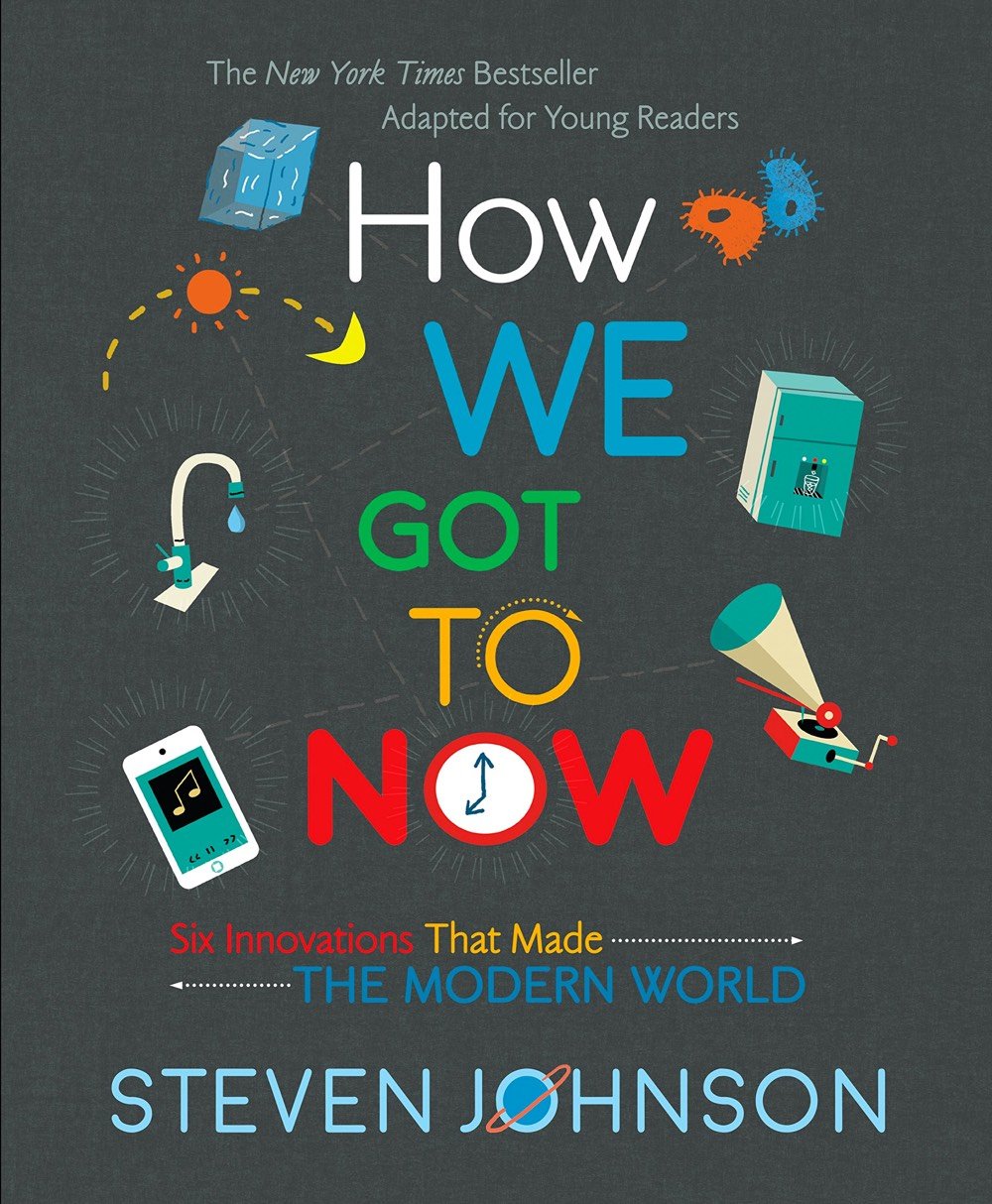
After hearing that the PBS series based on his bestselling book, How We Got to Now, was being watched by grade schoolers at home and in school, Steven Johnson has adapted the book into a version for young readers.
His fascinating account is organized into six topics: glass, cold, sound, clean, time, light. Johnson’s fresh exploration of these simple, single-syllable word concepts creates an endlessly absorbing story that moves from lightning strikes in the prehistoric desert to the herculean effort to literally raise up the city of Chicago to laser labs straight out of a sci-fi movie.
Totally getting this for my kids for Christmas. (Kids, if you’re reading this, act surprised, ok?)
In the Washington Post, Henry Farrell interviews Yochai Benkler, whose recent book with co-authors Rob Faris and Hal Robert, Network Propaganda: Manipulation, Disinformation, and Radicalization in American Politics, presents evidence that right-wing media functions in a completely different way than the rest of the media does.
On the right, audiences concentrate attention on purely right wing outlets. On the left and center audiences spread their attention broadly and focus on mainstream organizations. This asymmetric pattern holds for the linking practices of media producers. Both supply and demand on the right are insular and self-focused. On the left and center they are spread broadly and anchored by professional press.
These differences create a different dynamic for media, audiences, and politicians on the left and right.
We all like to hear news that confirms our beliefs and identity. On the left, outlets and politicians try to attract readers by telling such stories but are constrained because their readers are exposed to a range of outlets, many of which operate with strong fact-checking norms.
On the right, because audiences do not trust or pay attention to outlets outside their own ecosystem, there is no reality check to constrain competition. Outlets compete on political purity and stoking identity-confirming narratives. Outlets and politicians who resist the flow by focusing on facts are abandoned or vilified by audiences and competing outlets. This forces media and political elites to validate and legitimate the falsehoods, at least through silence, creating a propaganda feedback loop.
The authors also argue that Fox News is doing much more harm to our democracy in spreading false information than Facebook or Twitter.
The highly asymmetric pattern of media ecosystems we observe on the right and the left, despite the fact that Facebook and Twitter usage is roughly similar on both sides, requires that we look elsewhere for what is causing the difference.
Surveys make it clear that Fox News is by far the most influential outlet on the American right — more than five times as many Trump supporters reported using Fox News as their primary news outlet than those who named Facebook. And Trump support was highest among demographics whose social media use was lowest.
Our data repeatedly show Fox as the transmission vector of widespread conspiracy theories.
I’ve been beating this drum for awhile and still don’t know why this 2017 study that showed compelling evidence that Fox News moved the 2008 presidential election Republican vote share by 6.3% to the right all by itself isn’t a much bigger deal.
In other results, we estimate that removing Fox News from cable television during the 2000 election cycle would have reduced the overall Republican presidential vote share by 0.46 percentage points. The predicted effect increases in 2004 and 2008 to 3.59 and 6.34 percentage points, respectively. This increase is driven by increasing viewership on Fox News as well as an increasingly conservative slant.
In keeping with Benkler et al’s findings regarding media asymmetry, the study did not identify a similar swing to the left for MSNBC or CNN viewers.
The question is, what the heck do we do about Fox News? Shun Rupert Murdoch? Sleeping Giants and other groups have been effective in hamstringing other right-wing media sources like Breitbart (as well as some Fox News shows), but Fox News has worked hard to position itself as mainstream, so pressuring advertisers would be tough to muster support for. What about a boycott of other Fox properties? If the Disney sale goes through, those properties would include the Fox channel (home of The Simpsons, NFL games, college football, etc., The World Series), Fox Business News, and a number of sports channels (Fox Sports 1 & 2 and Fox Soccer Plus). Are people going to be willing to give up watching The World Series and The Super Bowl to put financial pressure on Fox? And my pals who do startups…are they going to refuse to go on Fox Business News promote their businesses? I have my doubts about that.
Network Propaganda is available on Amazon and also as a free PDF download here.
Film & design legend Pablo Ferro died this weekend at the age of 83. Ferro was known for designing the iconic opening title sequences for Dr. Strangelove and Bullitt (among others).
He also designed what is probably my favorite movie trailer, for A Clockwork Orange:
I wrote about Ferro’s work with Stanley Kubrick in this post 10 years ago. From a piece by Steven Heller that I linked to in the post:
Kubrick wanted to film it all using small airplane models (doubtless prefiguring his classic space ship ballet in 2001: A Space Odyssey). Ferro dissuaded him and located the official stock footage that they used instead. Ferro further conceived the idea to fill the entire screen with lettering (which incidentally had never been done before), requiring the setting of credits at different sizes and weights, which potentially ran counter to legal contractual obligations. But Kubrick supported it regardless. On the other hand, Ferro was prepared to have the titles refined by a lettering artist, but Kubrick correctly felt that the rough hewn quality of the hand-drawn comp was more effective. So he carefully lettered the entire thing himself with a thin pen.
The Art of the Title also interviewed Ferro about the Strangelove opening credits.
The titles for Strangelove were last-minute; I didn’t have much time to produce it. It came up because of a conversation between Stanley and I. Two weeks after I finished with everything, he and I were talking. He asked me what I thought about human beings. I said one thing about human beings is that everything that is mechanical, that is invented, is very sexual. We looked at each other and realized — the B-52, refueling in mid-air, of course, how much more sexual can you get?! He loved the idea. He wanted to shoot it with models we had, but I said let me take a look at the stock footage, I am sure that [the makers of those planes] are very proud of what they did and, sure enough, they had shot the plane from every possible angle.
Update: The Art of the Title also did a huge three-part interview with Ferro as a career retrospective. Great deep dive into a substantial career.
How hackers are stealing high-profile Instagram accounts. “When reached for comment, Brooks replied by email: ‘becauze im a savage bitch Guciiiiii 4 lyyyffeee skrt skrt.’”

At Nieman Lab, Laura Hazard Owen checks in on whether and how people are consuming news on smart speakers and smart displays. It turns out, they aren’t, really:
Smart speaker news briefings didn’t get much love from users in this research. Here are some of the complaints Newman heard:
— Overlong updates — the typical duration is around five minutes, but many wanted something much shorter.
— They are not updated often enough. News and sports bulletins are sometimes hours or days out of date.
— Some bulletins still use synthesized voices (text to speech), which many find hard to listen to.
— Some updates have low production values or poor audio quality.
— Where bulletins from different providers run together, there is often duplication of stories.
— Some updates have intrusive jingles or adverts.
— There is no opportunity to skip or select stories.
Based on my experience with these devices and general trends in news and media consumption, I have a few predictions as to how this will change in the near future:
- Audio news updates will get shorter and more specialized. The New York Times using The Daily as a “flash briefing” is really the ne plus ultra of cramming content not designed for smart speakers into the space. I had to pull them as a news source because of it.
- Audio news updates will move from pull to push. Unless you put it on “do not disturb,” you’ll hear a news update just after it’s posted, rather than having to ask for it.
- In other words, autoplay is coming.
- Video will get more important as more of these devices add screens. And video offers all sorts of extra affordances and business models.
- All of these things will happen faster than the advertisements improving. That’ll happen last if it happens at all.
Inside the world of hacking sleep apnea machines. As we use more devices that collect more data, this trend is only going to grow

For some reason, the only YouTube channels I subscribe to are about hip-hop (with one or two dead design vlogs thrown in), and most of the hip-hop reviews and discussion I consume happens there. Likewise, almost all the podcasts I listen to are about sports, and when I’m looking for sports content, I start with podcasts. Who knows how or why these things happen? When I was a media reporter, I’d have theories about these things. These days, I chalk most stuff up to contingency.
Anyways, a favorite show of mine is Dead End Hip Hop, or DEHH, which is a kind of Around the NBA-ish take on new and old music. It’s four guys, all about my age, who have musical touchstones in common with me and each other, who argue with each other about music. It’s brash and insider-y and a little hater-ish, and I love it.
In their latest episode, the DEHH crew and a couple of younger guests answer a reader question: What will hip-hop look like in twenty years? It turns into a thoughtful (and brash and insider-y and a little hater-ish) discussion of the history of popular music, generational change, the relationship between music, technology, and the broader culture, and the dangers of becoming too popular for too long:
The general consensus boils down to three things:
- Hip-hop has an unusually rich, symbiotic relationship with pop culture in a way other pop music forms just can’t match, with music and culture informing each other;
- The musical dominance of hip-hop has generally been bad for the quality of hip-hop, and the longer this dominance continues, the more degraded the music gets;
- There is no reason to expect this dominance to continue indefinitely, and every reason to expect it will be exchanged for another cultural form.
Now, hip-hop has some advantages. It’s unusually capacious, almost greedy, when it comes to culture. It’s not just music, but dance, fashion, slang, and visual art. Plus, when it comes to interacting with other forms of popular culture, you can pour almost anything into it and get hip-hop back out. (For instance, hip-hop was into superheroes before it was cool. And PS: superheroes’ days at the top are numbered, too.)
But is hip-hop really that much more resilient than jazz, or rock n’ roll, each of which had their turn leading the way before turning into something else besides the most popular music in the world? Seriously: jazz is looking at hip-hop with its eyes all the way to the side, along with boxing, musical theater, and smoking cigarettes.
The harder question to answer isn’t whether something will come next, but what it will look like. In the 90s, techno and dance music were legitimate heirs/threats to hip-hop; in comparison, EDM and what’s left of indie rock seem to be pretty insular corners rather than comers.
The coolest thing to imagine is the future evolution of hip-hop, even if it loses its spot on top of the music/culture heap, into a richer and more personal form of artistic expression. I hope we haven’t seen its full flourishing. But then again, I’m 39. That’s the kind of stuff I like. And the days of hip-hop caring about what guys my age like are waning, if not over.

A surprising number of lottery winners will later tell you that winning the lottery was the worst thing that ever happened to them. It can be the same for many restaurants who win awards and suddenly get more attention than they bargained for, driving away loyal customers in favor of food tourists.
That’s what happened to Stanich’s, a burger joint in Portland, Oregon. Kevin Alexander, who had put Stanich’s on blast by naming it the best burger in America, explains the dynamic in a Thrillist essay titled “I Found the Best Burger Place in America. And Then I Killed It.”
Apparently, after my story came out, crowds of people started coming in the restaurant, people in from out of town, or from the suburbs, basically just non-regulars. And as the lines started to build up, his employees — who were mainly family members — got stressed out, and the stress would cause them to not be as friendly as they should be, or to shout out crazy long wait times for burgers in an attempt to maybe convince people to leave, and as this started happening, things fell by the wayside. Dishes weren’t cleared quickly, and these new people weren’t having the proper Stanich’s experience, and Steve would spend his entire day going around apologizing and trying to fix things. They might pay him lip service to his face, but they were never coming back so they had no problem going on Yelp or Facebook and denouncing the restaurant and saying that the burgers were bad. And then the health department came in and suggested they do some deep cleaning (he still got a 97 rating, he told me), and the combination of all of these factors led Stanich to close down the restaurant for what he genuinely thought would be two weeks.
He also quotes the New Orleans Times-Picayune’s Brett Anderson, who thinks social media and the internet has made things worse:
“Before Bourdain and Fieri and the proliferation of listicles, there was certainly a lot more internal hand-wringing around ‘do we share every last precious secret we have with our readers?’ But now in the social media age, there’s no incentive to withhold. It just takes one Anderson Cooper tweet, and your favorite po’ boy place is packed for months.” He tells the story of Willie Mae’s Scotch House, a soul food restaurant in the Treme neighborhood known for its fried chicken. “It was always delicious, but never really crowded,” he said. “But then it started appearing on all these national lists, and now, no matter the day, you’ve got to get there before 11am if you don’t want to wait two hours.”
There’s a certain amount of hipster wailing in this: almost every restaurant owner would rather the place be packed than empty, and tourist money spends just as well as local. But there really is a limit for some businesses, restaurants among them, to how large they can scale without, at a minimum, fundamentally changing their character. And in many cases, that character change isn’t possible. We’re just not built to become something else so quickly, especially when everything that made us successful in the first place has to be discarded along the way.
This isn’t just about restaurants. This is a parable.
PS: Rob Horning has a really good thread about this. Highlight:
lots of media/communication business models are now built with scale alone in mind; they are also built to assimilate anything into their distribution systems, regardless of whether scale will ruin them—they impose scale on fragile phenomena
Update: Matthew Singer at Willamette Week dug into this story further. It seems the owner’s personal and legal troubles were also to blame:
On April 18, 2014, Stanich was arrested for choking his then-wife in front of their then-teenage son at their home in Northeast Portland.
Documents show his wife, then 57, had been a manager at Stanich’s for 19 years before being diagnosed with stage 4 breast cancer.
Stanich pleaded no contest to charges of misdemeanor harassment and strangulation, and was sentenced to four years of probation.
He was prohibited from owning a gun or contacting his wife. He was required to undergo treatment for his drinking, barred from consuming alcohol and, in a stiff prohibition for a bar owner, prohibited from entering establishments that primarily serve alcohol, except for work.
Abbie Paulhus is selling copies of this great illustrated poster she made featuring a Wes Anderson alphabet on her Etsy shop.
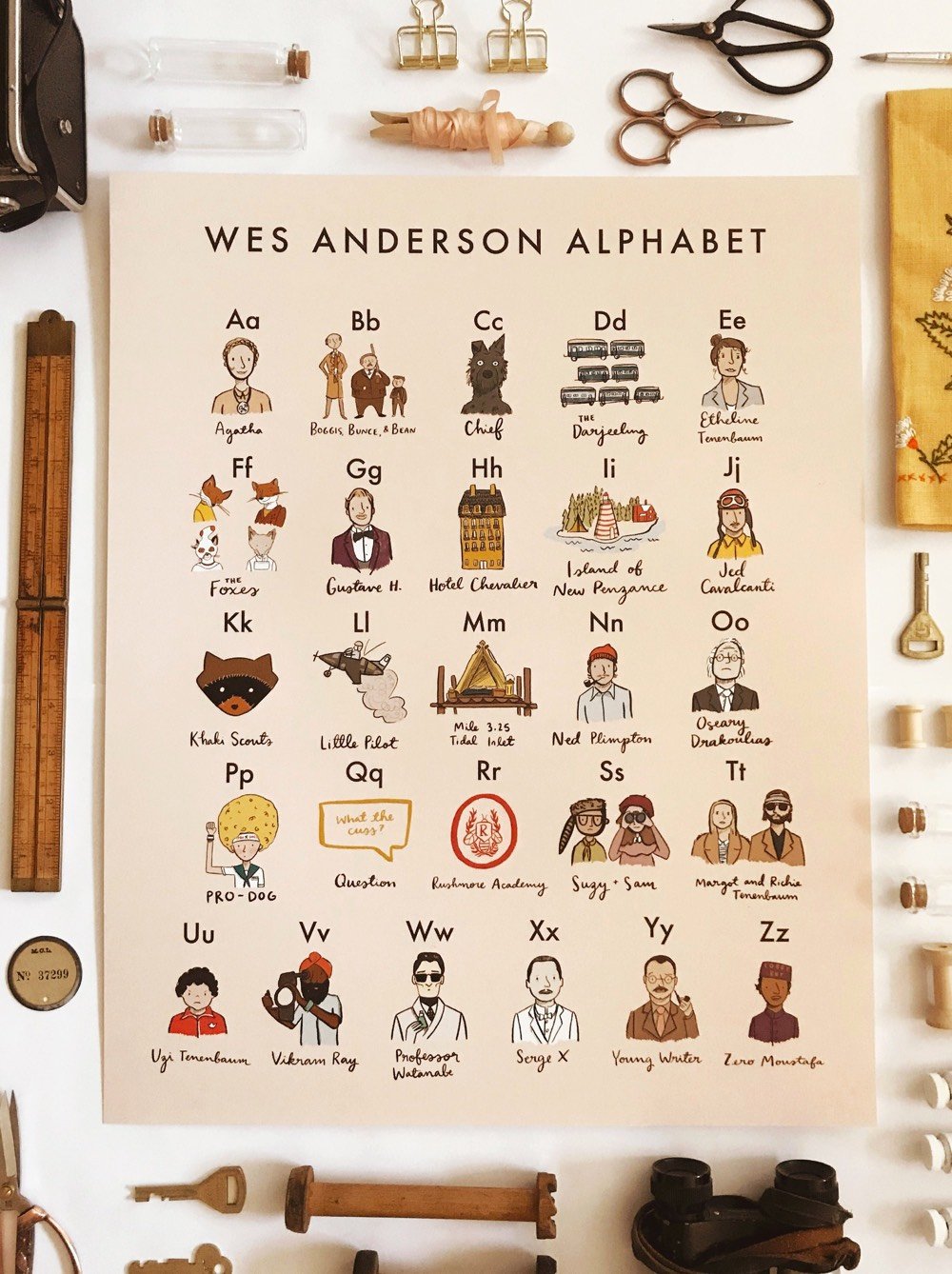
It features people, places, and objects from many of Anderson’s films (I didn’t see any Bottle Rocket references): B is for Boggis, Bunce, and Bean, N is for Ned Plimpton, and T is for Margot and Richie Tenenbaum.

A team of astronomers believe theyve found an exoplanet orbiting Barnards Star, in the solar system closest to ours. The evidence is uncertain, but if its there, its about three times the size of Earth, and orbits much closer to the much dimmer star. This puts it near the snow line, where terrestrial planets like ours are found. This also means its close enough to us and the right distance from our star where we can take a really good look at it. From the paper in Nature:
The candidate planet around Barnards star is a cold super-Earth, with a minimum mass of 3.2 times that of Earth, orbiting near its snow line (the minimum distance from the star at which volatile compounds could condense). The combination of all radial-velocity datasets spanning 20 years of measurements additionally reveals a long-term modulation that could arise from a stellar magnetic-activity cycle or from a more distant planetary object. Because of its proximity to the Sun, the candidate planet has a maximum angular separation of 220 milliarcseconds from Barnards star, making it an excellent target for direct imaging and astrometric observations in the future.
On Twitter, Charlie Loyd wrote this thread, and I cant stop thinking about it:
Assuming its confirmed, this means both the closest star systems have planets. (Okay, the three closest if you count the one were in. Very good.) Thats delightful. But also: as the abstract points out, this new one is an excellent candidate for direct imaging. Check my math, but reasonably conservatively, I think it should be about 0.3 nrad (1.7e-8) across from here.
Theoretically, to resolve that in visible wavelengths, you need a ludicrously large telescope. But! If you think hard enough about the wavefronts of the light that they see, you can use a set of spread-out smaller telescopes to work as one big one. This is an interferometric array, and last I checked the best one was CHARA, in the hills over Los Angeles (https://t.co/Rr3zPT1gpR). It can resolve down to about 1 nrad (5.5e-8). Its seen sunspots on other stars.
So we dont have anything that can see features on the face of the new planet say, continents and weather systems, if any. Even a 0.3 nrad telescope couldnt do that. But were closer than you might think.
If we fund it CHARA was founded with @NSF money odds are fair that well map alien worlds and watch alien weather in our lifetimes. Okay, have a nice day.
What a fantastic project that would be. And if were ever going to send a probe to or make a first-person visit a world outside our solar system, it would be an essential one. Why do space science, if not for things like this?
The NY times recently asked eight artists what art projects they would do if they could fly to the Moon. Here’s Kara Walker’s answer:
Gil Scott Heron wrote that famous poem, “Whitey on the Moon”: “The man just upped my rent last night / Cause whitey’s on the moon / No hot water, no toilets, no lights / But whitey’s on the moon.”
I got thinking about a moon colony, which plenty of people have talked about pretty seriously over the years. So what I’d do is this: For every female child born on Earth, one sexist, white supremacist adult male would be shipped to the moon. They could colonize it to their heart’s content, and look down from a distance of a quarter-million miles. It’s a monochrome world up there; probably they’d love it. The colony would be hermetically sealed. And the rest of us could enjoy the sight of them from a safe distance. Maybe there could be some kind of selection ritual involved, something to do with menstruation and the tides — a touch of nature, to add a bit of irony justice to the endeavor.
For the supremacists, maybe traveling so far from home would help inspire a different worldview. And for the rest of us down on Earth, perhaps this is an opportunity to focus on the nature of our home planet with the same dreamy reverence we once reserved for the moon.
Here’s Scott-Heron’s Whitey on the Moon. In contrast, architect Daniel Libeskind would turn the Moon into a square by painting part of it black:
My son Noam is an astrophysicist at the Leibniz Institute in Germany, and we did some calculations about how it could work. We thought the best way would be to paint sections of it black, so they no longer reflect the sun’s light. To account for the curvature, you’d need to paint four spherical caps on the moon’s surface. That would create a kind of frame that looks square when you see it from earth.
Designer Jacopo Colò has made a video game that allows you to spend an hour inside a 2013 James Turrell installation, The Color Inside.
Turrell’s work is all about the fundamental materials: space, time and light, and is usually focused on permanent installations. His most famous works are the Skyspaces. A Skyspace is (most of the times) a room with a hole in the ceiling that allows to see the sky above, with nothing in between. At specific times during the day — at sunrise and sunset — a hidden strip of LED lights color the room, rotating trough the whole color spectrum. And if during the day the hole in the ceiling simply frames the sky, during the light show, filtered through a cloud of colored light, the view of the sky is altered. The sky can become pink, green, deep blue. It’s a beautiful spectacle.
Here’s a sped-up video that shows the, uh, “game play”:
Sure, I know this is a television commercial for a UK department store and therefore should be afforded a certain level of emotional detachment, but only the most cynical folks out there will still be stone-faced at the end of this holiday advert starring Elton John.
After watching it, I thought back to my childhood for a gift that turned out to be more than just a gift. The closest I could come is a telescope1 my dad got me when I was maybe 8 or 9. While I didn’t grow up to be a celebrated astrophysicist or anything like that, that telescope solidified my love of science, encouraged my curiosity, and fostered my growing worldview that the universe could be wondrous without being magical. I could see sunspots on the Sun, the rings of Saturn, the moons of Jupiter, and shadows cast by craters on the Moon with my own eyes just as well as I could see the blades of grass right in front of me. Those objects moved around out there according to the same simple physical laws as the Earth moved, as did the baseball my dad & I played catch with, the rocket that shepherded astronauts to the Moon, and the waves on the ocean.
Seeing that all of those things were tied together across massive distances by a single system made a powerful impression on me. There was no need to say “well, I don’t know how that works so it must be some magical force or being”. I could go to a book and look up how Saturn’s rings formed, where the Moon’s craters came from, and why we only ever see one side of the Moon from Earth. And if the answer to a question didn’t exist, you could take that curiosity and go find out yourself, no permission necessary, and contribute to the collective human understanding of our existence. I switched away from a career in science shortly after entering grad school, but the spirit of scientific inquiry and curiosity has never left me or my work. I’ve loved being a designer, technologist, writer, and curator who still thinks like a scientist, like a little kid peering through his telescope at the rings of Saturn for the very first time and wanting to know everything about them.
What’s going on in the brains of people who meditate? Anecdotal evidence suggests that meditation does something to people’s minds and bodies…quiets and calms them. In this video, Daniel Goleman reports on research done by his colleague Richard Davidson, a neuroscientist at the University of Wisconsin–Madison. Davidson brought a number of “Olympic level meditators” into his lab and hooked them up to a brain scanner. He found that the brains of these expert meditators have different brain wave patterns than the rest of us.
Perhaps the most remarkable findings in the Olympic level meditators has to do with what’s called a gamma wave. All of us get gamma for a very short period when we solve a problem we’ve been grappling with, even if it’s something that’s vexed us for months. We get about half second of gamma; it’s the strongest wave in the EEG spectrum. We get it when we bite into an apple or imagine biting into an apple, and for a brief period, a split-second, inputs from taste, sound, smell, vision, all of that come together in that imagined bite into the apple. But that lasts very short period in an ordinary EEG.
What was stunning was that the Olympic level meditators, these are people who have done up to 62,000 lifetime hours of meditation, their brainwave shows gamma very strong all the time as a lasting trait just no matter what they’re doing. It’s not a state effect, it’s not during their meditation alone, but it’s just their every day state of mind. We actually have no idea what that means experientially. Science has never seen it before.
Goleman and Davidson have written more about how meditation affects the mind and body in their book, Altered Traits.
Sweeping away common misconceptions and neuromythology to open readers’ eyes to the ways data has been distorted to sell mind-training methods, the authors demonstrate that beyond the pleasant states mental exercises can produce, the real payoffs are the lasting personality traits that can result. But short daily doses will not get us to the highest level of lasting positive change — even if we continue for years — without specific additions. More than sheer hours, we need smart practice, including crucial ingredients such as targeted feedback from a master teacher and a more spacious, less attached view of the self, all of which are missing in widespread versions of mind training.
There’s that pesky deliberate practice popping up again.
Newer posts
Older posts





Socials & More