



A pair of studies shows a correlation between state-wide marijuana legalization and highway crashes. “There has been an increase by up to 6 percent in the number of highway crashes…”

Advertise here with Carbon Ads
This site is made possible by member support. 💞
Big thanks to Arcustech for hosting the site and offering amazing tech support.
When you buy through links on kottke.org, I may earn an affiliate commission. Thanks for supporting the site!
kottke.org. home of fine hypertext products since 1998.
Beloved by 86.47% of the web.
Entries for October 2018
Seven Square Miles
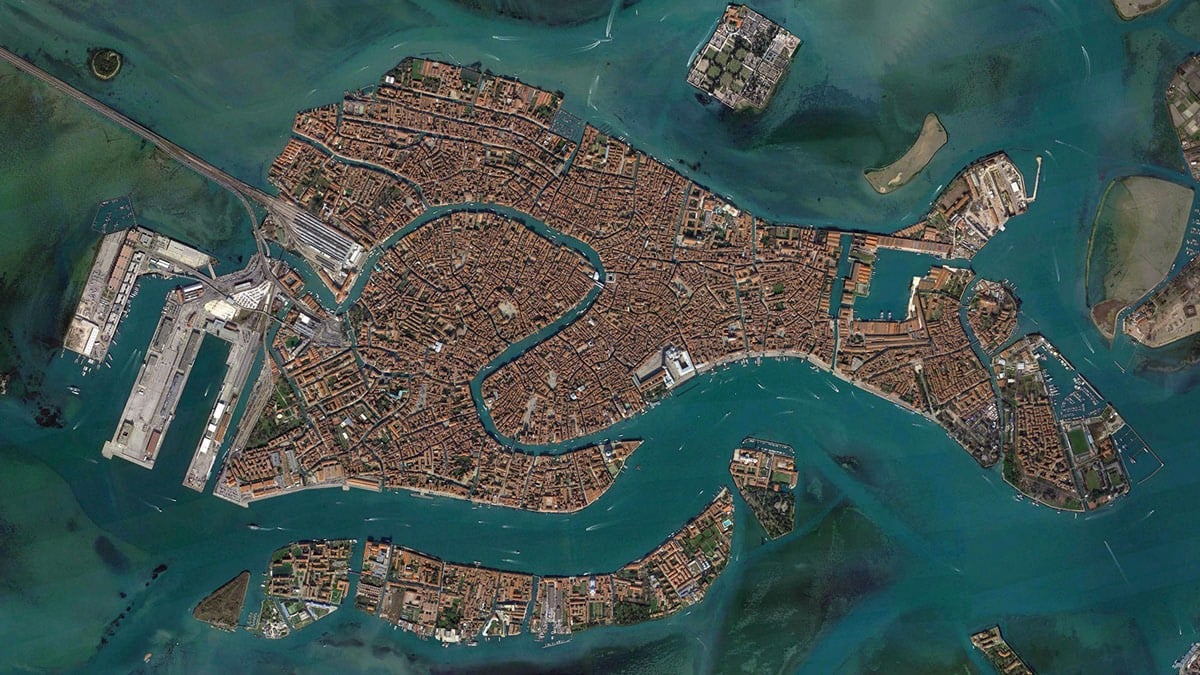


Over at In Focus, still the world’s best photoblog (remember those!?), Alan Taylor is looking at different parts of the world from the same height.
Spending time looking at the varying and beautiful images of our planet from above in Google Earth, zooming in and out at dizzying rates, I thought it would be interesting to compare all of these vistas at a fixed scale-to see what New York City, Venice, or the Grand Canyon would look like from the same virtual height.
Each of the 38 images selected by Taylor shows about seven square miles of the Earth’s surface. The three images I’ve excerpted here are, from top to botton, Venice, Wisconsin farmland, and Manhattan. This planet really is dizzyingly beautiful.
This reminds me of The Jefferson Grid project (showing 1 sq mile satellite photos of the US). There’s another project which I swear I’ve seen recently that shows the grids of streets in cities from around the world and how they vary widely, but I can’t find it. Anyone?
Update: Re: the other project I couldn’t remember, several people sent in Geoff Boeing’s city street orientation project (which I posted about here) but it was probably another project of Boeing’s that I was thinking of: Square-Mile Street Network Visualization. He based the project on the work of Allan Jacobs in Great Streets. (thx, @simiasideris)
Due to record summer heat and strong fall typhoons, some Japanese cherry trees are blossoming out of season. Global weirding, yo.
Take the Ball, Pass the Ball
In his four seasons as manager for FC Barcelona, Pep Guardiola led the club to 14 trophies, including winning the Champions League twice and La Liga 3 times. Sure, he had players like Messi, Eto’o, Xavi, Iniesta, Puyol, Alves, Henry, and Ibrahimović, but as the trailer says, he also knew exactly what to do with them. Take the Ball, Pass the Ball is an upcoming documentary about the Guardiola years at Barca. I’m excited for this…Pep’s first year was right around when I started watching the team in earnest.
Embroidery that Breaks the Fourth Wall

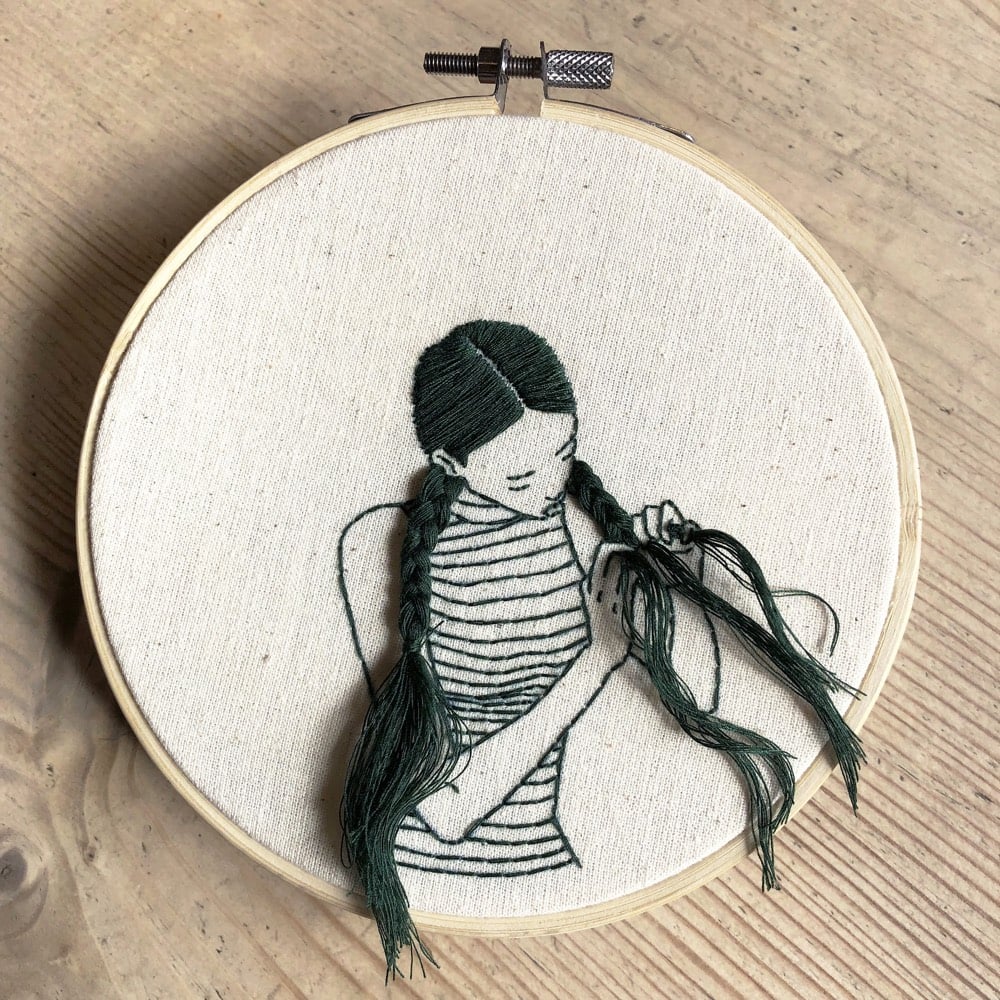
Oh, I love this embroidery art by Sheena Liam that leaps off of the fabric and out of the hoop. Great name too: Times New Romance. (via colossal)
RIP Paul Allen
Tech titan Paul Allen died yesterday at the age of 65 of complications from non-Hodgkin’s lymphoma. His Microsoft co-founder Bill Gates remembered his friend in a short piece called “What I loved about Paul Allen”.
Paul foresaw that computers would change the world. Even in high school, before any of us knew what a personal computer was, he was predicting that computer chips would get super-powerful and would eventually give rise to a whole new industry. That insight of his was the cornerstone of everything we did together.
In fact, Microsoft would never have happened without Paul. In December 1974, he and I were both living in the Boston area — he was working, and I was going to college. One day he came and got me, insisting that I rush over to a nearby newsstand with him. When we arrived, he showed me the cover of the January issue of Popular Electronics. It featured a new computer called the Altair 8800, which ran on a powerful new chip. Paul looked at me and said: “This is happening without us!” That moment marked the end of my college career and the beginning of our new company, Microsoft. It happened because of Paul.
Gates also noted Allen’s love of music. In an interview earlier this year, legendary producer Quincy Jones said Allen “sings and plays just like Hendrix”.
Yeah, man. I went on a trip on his yacht, and he had David Crosby, Joe Walsh, Sean Lennon — all those crazy motherfuckers. Then on the last two days, Stevie Wonder came on with his band and made Paul come up and play with him — he’s good, man.
Here’s a short clip of Allen melting some faces:
The Wrong Color Subway Map

From the orange 123 line to the green ACE to the purple 456, the color designations on the NYC subway lines on the Wrong Color Subway Map will mess with your head. Get the print here. From the folks who brought us the One-Color Subway Map. (via @khoi)
The Death of a Loved One from Opiate Addiction, Plainly & Honestly Told
From an independent newspaper here in Vermont, the heartbreaking and brutally honest obituary of Madelyn Linsenmeir, a 30-year-old mother who died from a drug addiction to opiates that lasted for more a decade.
When she was 16, she moved with her parents from Vermont to Florida to attend a performing arts high school. Soon after she tried OxyContin for the first time at a high school party, and so began a relationship with opiates that would dominate the rest of her life.
It is impossible to capture a person in an obituary, and especially someone whose adult life was largely defined by drug addiction. To some, Maddie was just a junkie — when they saw her addiction, they stopped seeing her. And what a loss for them. Because Maddie was hilarious, and warm, and fearless, and resilient. She could and would talk to anyone, and when you were in her company you wanted to stay. In a system that seems to have hardened itself against addicts and is failing them every day, she befriended and delighted cops, social workers, public defenders and doctors, who advocated for and believed in her ‘til the end. She was adored as a daughter, sister, niece, cousin, friend and mother, and being loved by Madelyn was a constantly astonishing gift.
This is powerfully straightforward writing by Linsenmeir’s family…my condolences are with them. They devoted a few paragraphs at the end of her obit to address addiction and its place in our society:
If you are reading this with judgment, educate yourself about this disease, because that is what it is. It is not a choice or a weakness. And chances are very good that someone you know is struggling with it, and that person needs and deserves your empathy and support.
If you work in one of the many institutions through which addicts often pass — rehabs, hospitals, jails, courts — and treat them with the compassion and respect they deserve, thank you. If instead you see a junkie or thief or liar in front of you rather than a human being in need of help, consider a new profession.
As in many other states, more and more people are dying of opiate overdoses in Vermont even as doctors cut the number of opioid prescriptions they write faster than other areas of the country.
Update: On Facebook, Burlington, VT’s chief of police Brandon del Pozo wrote a response to Linsenmeir’s obituary that is very much worth reading.
Why did it take a grieving relative with a good literary sense to get people to pay attention for a moment and shed a tear when nearly a quarter of a million people have already died in the same way as Maddie as this epidemic grew?
Did readers think this was the first time a beautiful, young, beloved mother from a pastoral state got addicted to Oxy and died from the descent it wrought? And what about the rest of the victims, who weren’t as beautiful and lived in downtrodden cities or the rust belt? They too had mothers who cried for them and blamed themselves.
She died just like my wife’s cousin Meredith died in Bethesda, herself a young mother, but if Maddie was a black guy from the Bronx found dead in his bathroom of an overdose, it wouldn’t matter if the guy’s obituary writer had won the Booker Prize, there wouldn’t be a weepy article in People about it.
Why not?
But if there had been, early enough on, and we acted swiftly, humanely, and accordingly, maybe Maddie would still be here. Make no mistake, no matter who you are or what you look like: Maddie’s bell tolls for someone close to you, and maybe someone you love. Ask the cops and they will tell you: Maddie’s death was nothing special at all. It happens all the time, to people no less loved and needed and human.
(thx, caroline)
Jon Hamm Enters The New Yorker Cartoon Caption Contest. Oof. So unfunny it was hard to watch.
The Twerking Robot
Hot off the heels of their video showing a humanoid robot casually doing parkour, Boston Dynamics has made a clip of their robot dog doing a hip hop dance routine to Uptown Funk.
While the robot in the parkour video looked distinctly un-human at times, I have to say that this dog robot is a much better and more fluid dancer than I expected — it’s got better moves than most of the people I’ve seen dancing at Midwestern weddings. The robot does what looks like the running man and then twerks while mugging for the camera. I don’t know what level of cultural appropriation this is and Boston Dynamics is probably just doing this to distract from the whole Terminator narrative, but was anyone else the tiniest bit jealous of and turned on by (and then deeply ashamed of those feelings) the robot’s moves?
A list of the most influential female designers of the last century. A good starting point, at least.
The Gerontocracy is Driving America into the Ditch
As Eric Levitz writes in a piece called Millennials Need to Start Voting Before the Gerontocracy Kills Us All, younger Americans are under-represented in American political life.
The United States, circa 2018, looks like a place run by people who know they’re going to die soon.
As “once in a lifetime” storms crash over our coasts five times a year - and the White House’s own climate research suggests that human civilization is on pace to perish before Barron Trump — our government is subsidizing carbon emissions like there’s no tomorrow. Meanwhile, America’s infrastructure is already “below standard,” and set to further deteriorate, absent hundreds of billions of dollars in new investment. Many of our public schools can’t afford to stock their classrooms with basic supplies, pay their teachers a living wage, or keep their doors open five days a week. Child-care costs are skyrocketing, the birth rate is plunging, and the baby boomers, retiring. And, amid it all, our congressional representatives recently decided that the best thing they could possibly do with $1.5 trillion of borrowed money was to give large tax breaks to people like themselves.
See also Dear Young People: Don’t Vote. As Levitz says though, one of the reasons that young people don’t vote is that it’s often more difficult for them than for older people. Making it easier for everyone to vote would alleviate many of these concerns and result in higher turnout, more political engagement, and better representation for young Americans.
Millennials in the U.S. are more underrepresented than their peers in most other developed countries. Primary responsibility for this fact lies with our nation’s political parties, which have made America an exceptionally difficult place to cast a ballot. If Democrats wish to increase turnout among the young, they’d be well advised to implement automatic voter registration, a new Voting Rights Act, and a federal holiday on the first Tuesday in November, when and if they have the power to do so.
Inflexible work schedules, lack of transportation, voter ID laws, fewer polling places, etc…it amounts to voter suppression of young people.
Voter suppression is often, correctly, viewed through a racial or class-based lens — however, these same laws also target younger people. A group that tends to vote more often for third-party and Democratic candidates.
For example, states such as Texas and Ohio require voter identification at the polling place — a college or university ID doesn’t qualify. In Wisconsin, voter ID laws permitted college IDs but not out-of-state drivers licenses, which, local news reported, resulted in many university students getting turned away in the April 2016 primary. In North Carolina, another key state in the Electoral College, hundreds of students cast provisional ballots in 2016, unsure whether their vote would even count because of their strict voter ID laws — which were struck down this year by the Supreme Court, but not before disenfranchising potentially thousands of American citizens.
(thx kate & @lauraolin)
How the Sears Catalog Undermined White Supremacy in the Jim Crow South
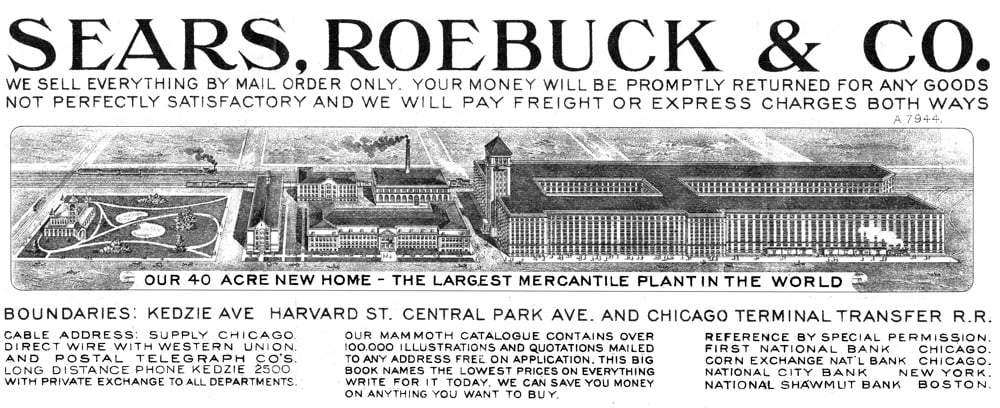
Sears has filed for bankruptcy protection and plans to close hundreds of stores in an effort to keep the company afloat. The Sears catalog is perhaps one of the most important and under-appreciated innovations in American life. Starting in 1888 with a mailer advertising watches and jewelry, Sears introduced millions of Americans to in-home shopping by using the growing networks of the railroad and US Postal Service, much like Amazon and other retailers would using the internet decades later.
The time was right for mail order merchandise. Fueled by the Homestead Act of 1862, America’s westward expansion followed the growth of the railroads. The postal system aided the mail order business by permitting the classification of mail order publications as aids in the dissemination of knowledge entitling these catalogs the postage rate of one cent per pound. The advent of Rural Free Delivery in 1896 also made distribution of the catalog economical.
As historian Louis Hyman explained on Twitter, the way Sears sold goods to their customers also provided new opportunities for black Southerners living under the Jim Crow system.
Every time a black southerner went to the local store they were confronted with forced deference to white customers who would be served first. The stores were not self-service, so the black customers would have to wait. And then would have to ask the proprietor to give them goods (often on credit because…sharecropping). The landlord often owned the store. In every way shopping reinforced hierarchy. Until Sears.
The catalog undid the power of the storekeeper, and by extension the landlord. Black families could buy without asking permission. Without waiting. Without being watched. With national (cheap) prices!
This excellent piece by Antonia Noori Farzan has more info. Reading this, I couldn’t help but think of blind auditions, the practice of auditioning orchestra musicians behind a screen to help cut down on gender bias during the hiring process. While not entirely free of bias — opportunities for discrimination by postal workers and Sears employees were still possible — the Sears ordering process was essentially a blind retail transaction, a screen placed between the store and black customers. (The catalog also advertised racist costumes so obviously Sears wasn’t some bastion of social progressivism…they simply wanted to sell more goods to more kinds of people.)
According to Sears historian Jerry Hancock, Sears also developed a policy to help those who couldn’t read or write that well to be able to place orders:
One of Hancock’s discoveries was Sears’ response to the needs of a rural South in which literacy was rare. For someone who could neither read nor write, placing orders and following written protocols were problematic. Richard Sears responded with a policy that his company would fill any order it received, no matter what the medium or format. So, country folks who were once too daunted to send requests to other purveyors could write in on a scrap of paper, asking humbly for a pair of overalls, size large. And even if it was written in broken English or nearly illegible, the overalls would be shipped.
Music scholar Ted Gioia notes that blues musicians were able to buy instruments from Sears that were unavailable to them from local retailers.
With Sears declaring bankruptcy, it’s worth remembering how much impact this company had on American music. In my research into blues and other traditional styles, I found that many, many musicians started out on Sears instruments.
Even under Jim Crow, music was an avenue for upward mobility for African Americans, and Sears and other mail-order retailers were more than happy to provide them with instruments.
The Microscopic Fabric of Butterfly Wings


Chris Perani takes macro photographs of the delicate microscopic makeup of butterfly wings. When you look at the thumbnails on his site, you almost can’t tell they aren’t woven rugs. The detail on these are incredible…here’s a closeup of the top photo:

(via colossal)
Keep Going, a Guide to Staying Creative in Chaotic Times
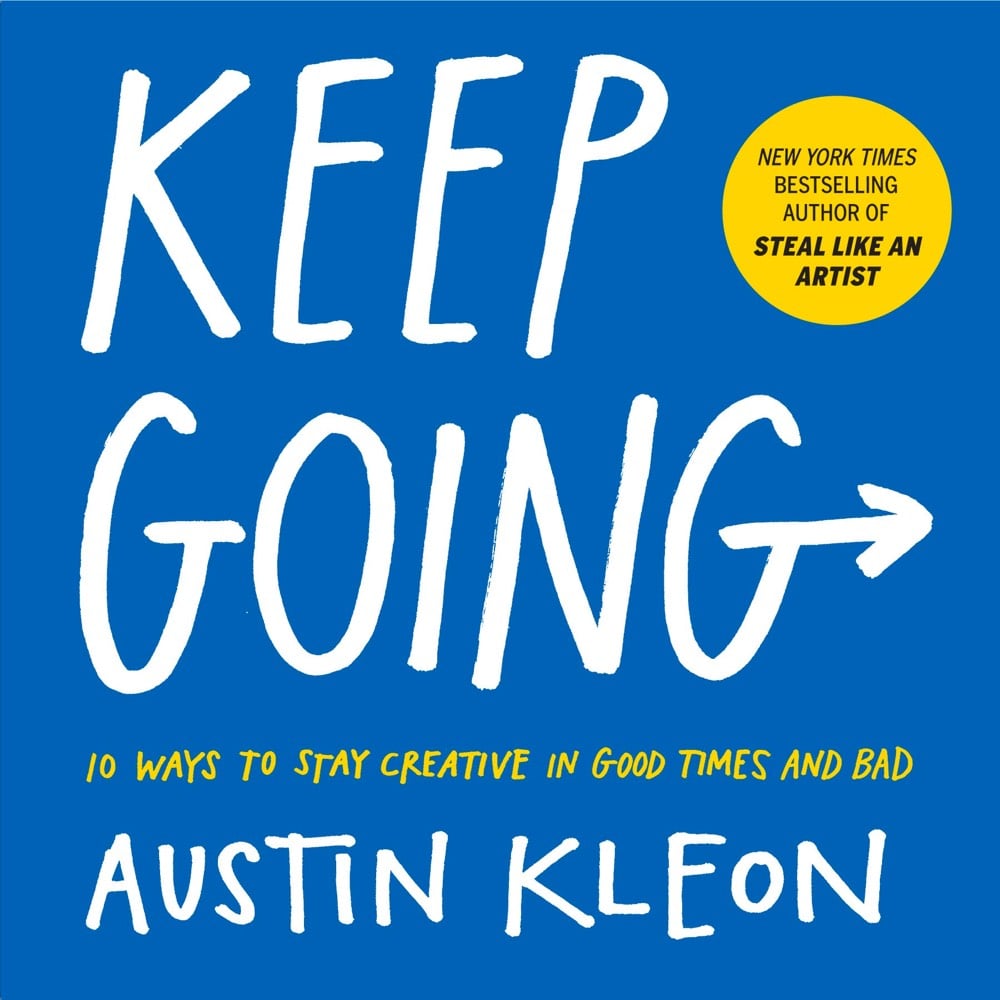
Austin Kleon, whose previous books Steal Like an Artist and Show Your Work you may have seen prominently displayed in book shops around the world, is coming out with a new book this spring: Keep Going: 10 Ways to Stay Creative in Good Times and Bad.
The world is crazy. Creative work is hard. Whether you’re burned out, starting out, starting over, or wildly successful, the question is always the same: How do you keep going?
In my previous books — the New York Times bestsellers Steal Like An Artist and Show Your Work! — I showed readers how to steal their way to a more creative life and then share their creativity to get discovered. In Keep Going, I show you how to stay creative, focused, and true to yourself in the face of personal burnout and external distractions.
The book is based on a talk he gave earlier this year. Here’s the timeline of the book’s production. If you read Kleon’s blog, you know that he has expansive definition of who is and can be creative. This sounds like a book we could all use right about now…I’m excited to read it.
A tiny phone for those who are concerned their giant phone makes their trendy small sunglasses look too small. Zoolander approved!
How the Mercator Projection Distorts the True Sizes of Countries on Maps
Data scientist Neil Kaye made this map to show how much the popular Mercator projection distorts the sizes of many countries, particularly those in the Northern Hemisphere.

The distortion in the animated version is even clearer. Key takeaway: Africa is *enormous*.
See also the true size of things on world maps.

New Social Media Guidelines. “All Twitter users must now check a box indicating whether they’re a white supremacist or a comedian.”
Nationalism Isn’t Patriotism
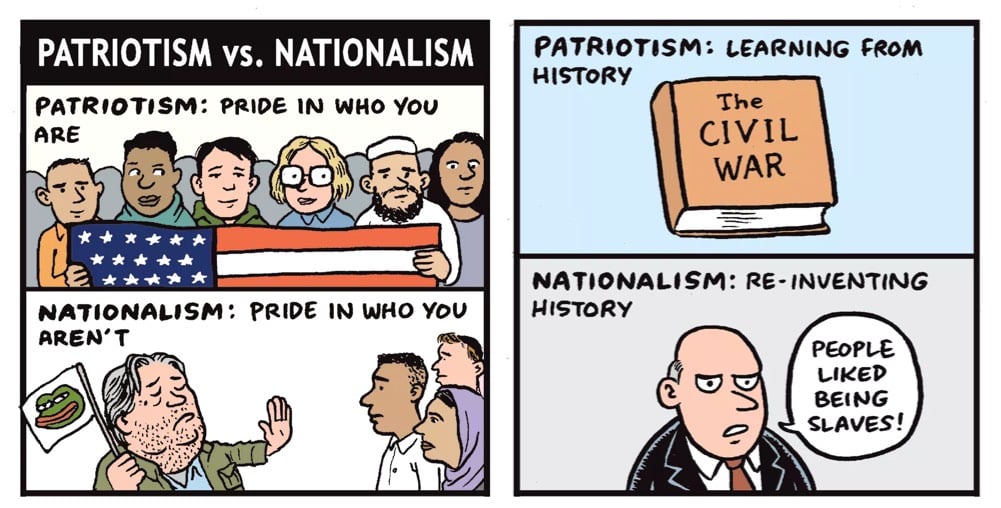
At a time when fascism & authoritarianism are creeping into the global politics of the developed world, it’s useful for us to reacquaint ourselves with the difference between nationalism and patriotism. In the wake of World War II, George Orwell wrote an essay called Notes on Nationalism (available in book form here). The first two paragraphs define nationalism and contrast it with patriotism:
Somewhere or other Byron makes use of the French word longeur, and remarks in passing that though in England we happen not to have the word, we have the thing in considerable profusion. In the same way, there is a habit of mind which is now so widespread that it affects our thinking on nearly every subject, but which has not yet been given a name. As the nearest existing equivalent I have chosen the word ‘nationalism’, but it will be seen in a moment that I am not using it in quite the ordinary sense, if only because the emotion I am speaking about does not always attach itself to what is called a nation — that is, a single race or a geographical area. It can attach itself to a church or a class, or it may work in a merely negative sense, against something or other and without the need for any positive object of loyalty.
By ‘nationalism’ I mean first of all the habit of assuming that human beings can be classified like insects and that whole blocks of millions or tens of millions of people can be confidently labelled ‘good’ or ‘bad’. But secondly — and this is much more important — I mean the habit of identifying oneself with a single nation or other unit, placing it beyond good and evil and recognizing no other duty than that of advancing its interests. Nationalism is not to be confused with patriotism. Both words are normally used in so vague a way that any definition is liable to be challenged, but one must draw a distinction between them, since two different and even opposing ideas are involved. By ‘patriotism’ I mean devotion to a particular place and a particular way of life, which one believes to be the best in the world but has no wish to force on other people. Patriotism is of its nature defensive, both militarily and culturally. Nationalism, on the other hand, is inseparable from the desire for power. The abiding purpose of every nationalist is to secure more power and more prestige, not for himself but for the nation or other unit in which he has chosen to sink his own individuality.
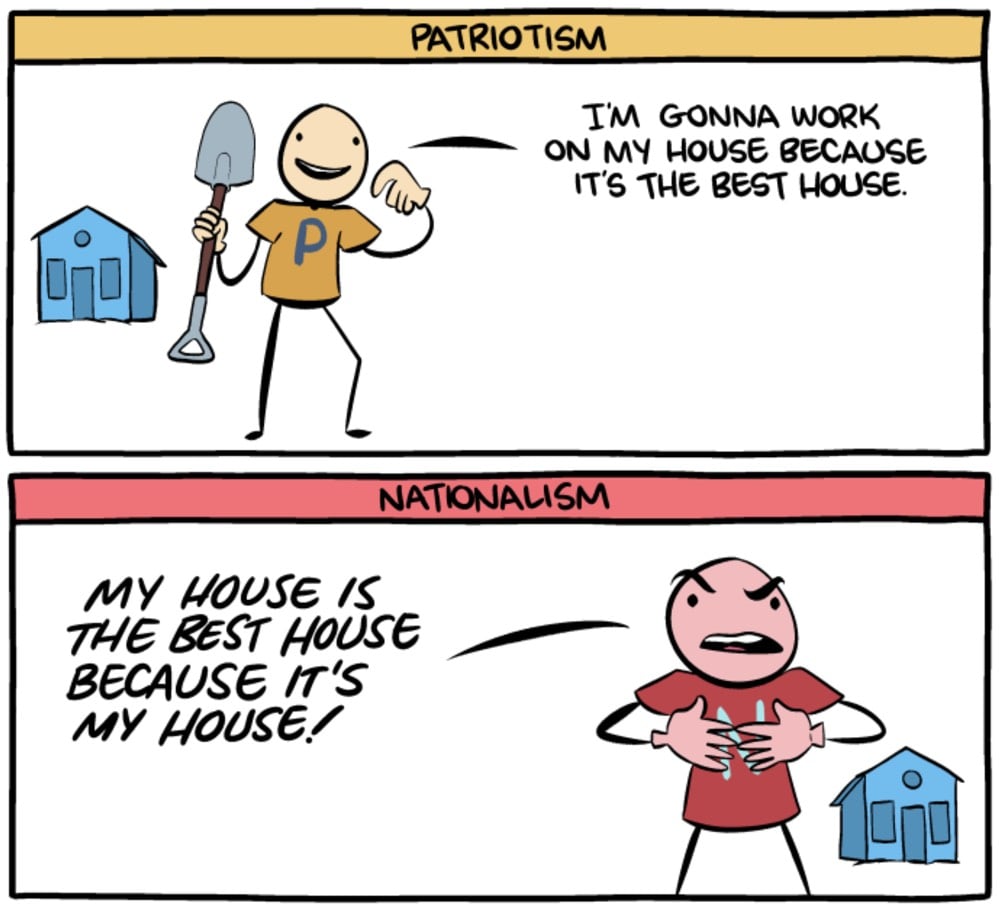
The whole essay is worth a read; you’ll find yourself nodding in recognition at many points. More succinctly, Jen Sorensen’s Patriotism vs. Nationalism comic (excerpted above) and Zach Weinersmith’s An Important Distinction comic (below) cover some of the same ground.
See also a more progressive definition of freedom.
The Bounty of the Public Library
Wonderful writer Susan Orlean1 is out with a new book called The Library Book, which is specifically about a 1986 fire at the Los Angeles Public Library and more generally a love letter to libraries. The New Yorker recently published an excerpt.
Our visits were never long enough for me — the library was so bountiful. I loved wandering around the shelves, scanning the spines of the books until something happened to catch my eye. Those trips were dreamy, frictionless interludes that promised I would leave richer than I arrived. It wasn’t like going to a store with my mom, which guaranteed a tug-of-war between what I desired and what she was willing to buy me; in the library, I could have anything I wanted. On the way home, I loved having the books stacked on my lap, pressing me under their solid, warm weight, their Mylar covers sticking to my thighs. It was such a thrill leaving a place with things you hadn’t paid for; such a thrill anticipating the new books we would read.
Like Orlean and probably many of you readers, I loved the library when I was a kid. Browsing the shelves, I felt like any and all knowledge was literally at my fingertips. My sister and I would each check out a mess of books, read them all in like a day and a half, and then we’d switch and read each others’ — I have read at least the first dozen of The Baby-Sitters Club books and a lot of Nancy Drew as well as all of Judy Blume’s pre-1990 oeuvre. Our family didn’t have a lot of money growing up and Orlean is spot-on with how wonderful & transformative the infinite library felt compared to the fraught retail environment of forbidden Pac-Man notepads, Bazooka Joe gum, and baseball cards.
I am a little biased here (aren’t I always though?) — I designed Susan’s website back in the day…and the design is still hanging in there!↩
Two Great Podcasts About Inanimate Objects

I love things, material objects in all their haecceity, or irreducible thingness. I also love how inanimate things can unspool whole histories of entire worlds.
There are two podcasts I’ve been enjoying that each take things as their focus, but come at them in strikingly different ways. They’re each (so far) just six episodes long.
The first, Articles of Interest, hosted/created by Avery Trufelman, is an offshoot of 99 Percent Invisible, the design podcast. Articles of Interest (or AOI) is all about clothing, with episodes on plaid, pockets, denim, Hawaiian shirts, kids’ clothes, and punk rock. Each episode digs into the history and social fabric (sorry) of the item(s) in question. From the description to the “Pockets” episode:
Womenswear is littered with fake pockets that don’t open, or shallow pockets that can hardly hold more than a paperclip. If women’s clothes have pockets at all, they are often and smaller and just fit less than men’s pockets do. And when we talk about pockets, we are talking about who has access to the tools they need. Who can walk through the world comfortably and securely.
The other podcast, Everything Is Alive, hosted/created by Ian Chillag, takes the form of fictional interviews with each show’s object of choice: a can of cola, a lamppost, a pillow, an elevator, a bar of soap, or a loosened tooth.
INTERVIEWER: What do you imagine an elevator who’s working in the tallest building, what do you imagine they feel?
ANA (an elevator): Probably tired. I mean, I’m tired after a day of work, and I’m just going to 17. But I see all the other buildings they’re making are getting higher and higher…. You know, Frank Lloyd Wright wanted to make a building that was a mile high.
INTERVIEWER: A mile?!
ANA: Yeah, and it was going to have 76 elevators. And they were going to be nuclear powered. But it never got built.
INTERVIEWER: That’s… it’s terrifying in like, every way.
ANA: Yeah.
INTERVIEWER: It’s too tall. It is powered by the most destructive force man has ever known.
ANA: One elevator mishap and that building is gone…. That kind of danger is, like… to be honest, I’m glad it didn’t get built. Also, I think a lot of people would be scared to use me. So… everything happens for a reason, and some things don’t happen for a reason.
So, if you’re looking for a charming podcast that explores history by way of everyday things, you’ve got multiple good options. To each their own taste.
How A 1979 Email Chain Letter Helped Give Birth to Our Social Internet

The Internet connects various bodies of knowledge and enables all sorts of private communication and coordination. It’s also clear in 2018, and has been for twenty-five years, that the Internet supports a variety of social media: public and semi-public communication for entertainment and cultural purposes.
Vint Cerf, co-inventor of the TCP/IP protocol and general internet pioneer, traces the emerging social use of the Internet to an unlikely candidate: a 1979 chain email from MIT’s Artificial Intelligence labs, titled “SF-LOVERS,” that asked Cerf and his colleagues at DARPA and elsewhere in the network of networks called ARPANET to weigh in on their favorite science fiction authors.
Because the message had gone out to the entire network, everybody’s answers could then be seen and responded to by everybody else. Users could also choose to send their replies to just one person or a subgroup, generating scores of smaller discussions that eventually fed back into the whole.
About 40 years later, Cerf still recalls this as the moment he realized that the internet would be something more than every other communications technology before it. “It was clear we had a social medium on our hands,” he said.
The thread was a hit. It also created what might be thought of as the first online social network. Though individuals had been connected via this internet before, this was the first time they were using it for social interactions and, importantly, building a larger community identity through these personal connections. After SF-LOVERS came YUMYUM, another chain email that debated the quality of restaurants in the new Silicon Valley. (In-house gourmet chefs were still decades away.) Then WINE-TASTERS appeared, its purpose self-evident. The socialization also inspired more science with HUMAN-NETS, a community for researchers to discuss the human factors of these proto-online communities.
In the 1980s, these chain emails saw the first use of spoiler alerts, for the death of Spock in The Wrath of Khan (oops, sorry if I spoiled that for you), and emoticons: “:-)” to indicate a joke and “:-(” to indicate a non-joke. (I’d say the semantics of those has drifted over the years.)
And here we are, almost forty years later, still doing the same shit, only with slightly more sophistication and bandwidth, on the commercial successors to those early email threads.
“The average person ‘consumes about 34 gigabytes across varied devices each day’ — some 100,000 words’ worth of information.” What does that do to our brains? How does it change how we read, or how we think?
Contemporary Versions of WPA Public Service Announcement Posters
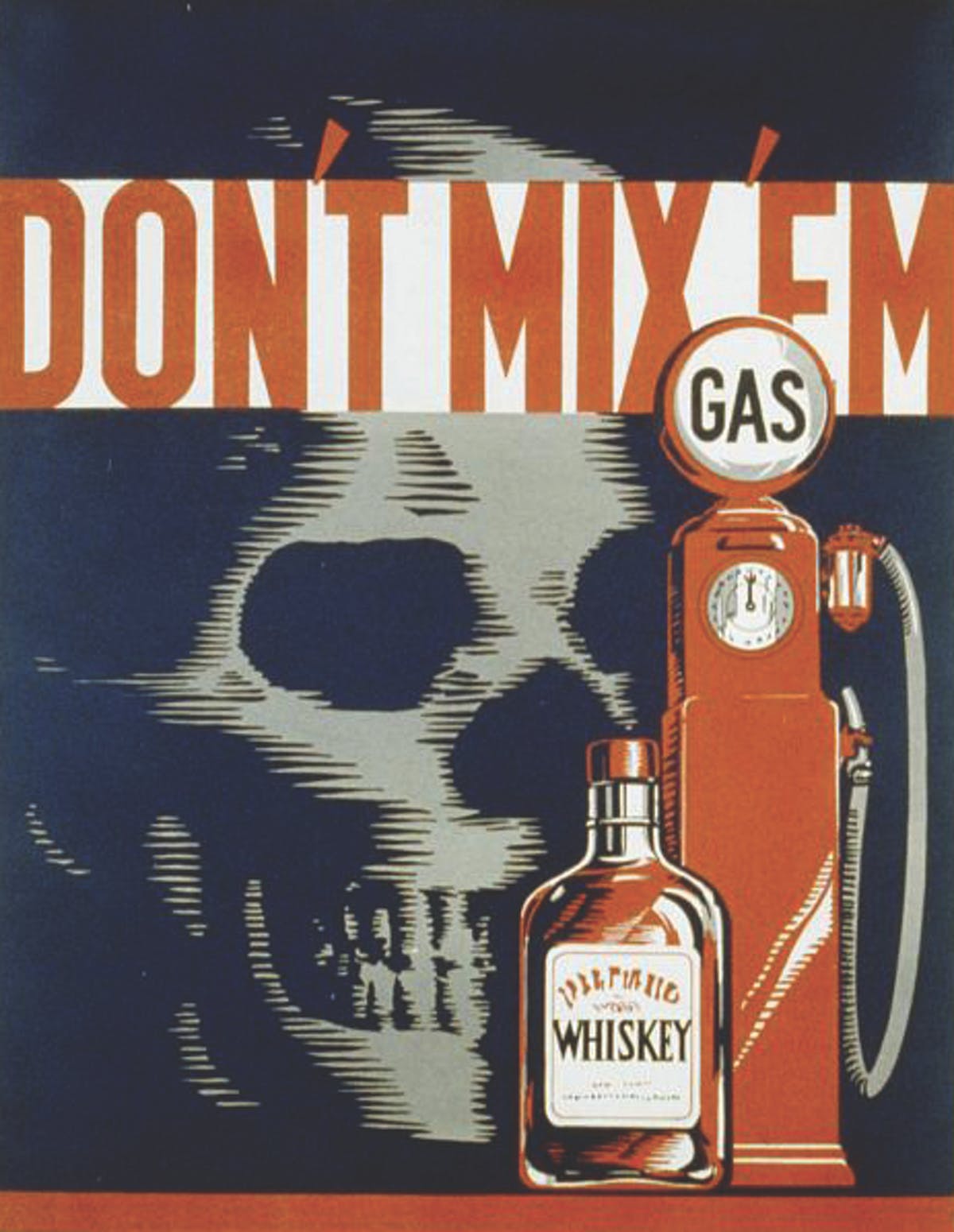
For Topic, MGMT. Design created a series of 2018 updates to the iconic WPA public service announcement posters from the 1930s and 1940s. Some of the posters are directly imitating specific WPA posters; others have a looser inspiration.
For example, here’s a “Don’t Mix ‘Em” WPA poster:
And here’s the corresponding 2018 version:

And the rest of the contemporary series:




In the accompanying essay, the designers write that “we noticed that the advertising of the 1930s and ’40s seemed far less cynical or manipulative than it is today… Today’s distribution methods have created a relentless flood of messages, putting a torrent of information in the palm of your hand. How the public values, rejects, or embraces this version of public information is up to them.”
The other obvious difference is the overall mood of the messages. The WPA posters are direct, imperative, and point towards solutions, even when they’re being particularly grim about it. The contemporary versions are ironic, diffident, and uncertain about solutions — or at least, uncertain about solutions that can be reduced to a bold-type message across a poster. (Except “Don’t Send Dick Pics.” That one, they’ve got nailed.)
At the same time, there’s a yearning for that level of clarity, aesthetically if not intellectually. All of this seems frustrating but basically honest about the mood and limitations of this political moment.
The CDC runs a program called VFC that provides free vaccinations to children who cannot afford them. Doctors & clinics, sign up to be a VFC provider!
Jackson Pollock 51
In 1950, Swiss photographer Hans Namuth took some photos of Jackson Pollock painting some of his drip paintings, which were used to illustrate a 1951 article in ArtNews. Along with photos published alongside a piece in Life in 1949, they made Pollock and his unusual technique famous.
Namuth returned with a film camera and captured the artist painting in full color motion in a short film called Jackson Pollock 51.
In the film, you can see the physicality and performative aspect of Pollock’s work, the near repetition, the footwork, the precise imprecision of his arm movements, the cigarette dangling from his mouth. Pollock narrates part of the film:
I don’t work from drawings or color sketches. My painting is direct. I usually paint on the floor. I enjoy working on a large canvas. I feel more at home, more at ease, in the big area. Having the canvas on the floor, I feel nearer, more a part of the painting. This way, I can walk around it, work from all four sides, and be in the painting, similar to the Indian sand painters of the West.
At one point, Pollock paints on glass and Namuth shoots from underneath, so you can see how it looks from the point of view of the canvas. A 1998 NY Times piece by Sarah Boxer has an account of how the photos and film were captured, including a series of incidents that brought the Namuth/Pollock collaboration (and, some say, Pollock’s life six years later) to an end:
When Pollock and Namuth came in from outside, blue from the cold, the first thing Pollock did was pour himself a tumbler of bourbon. It was the beginning of the end. Pollock had been sober (some say) for two years. Soon Namuth and Pollock got into an argument — a volley of “I’m not a phony, you’re a phony.” Then Pollock tore a strap of cowbells off the wall and started swinging it around.
With the dinner guests seated and food on the table, Pollock and Namuth continued to argue. Finally Pollock grabbed the end of the table, shouting “Should I do it now?” to Namuth. “Now?” Then he turned over the whole table, plates, glasses, meat, gravy and all. (There is a scholarly disagreement about whether it was turkey or roast beef.) The dogs lapped at the glassy gravy. Krasner said, “Coffee will be served in the living room.”
After that night, Pollock never stopped drinking. He didn’t bring in the glass painting (“No. 29, 1950”) until it was covered with rain and leaves. He returned to a more figurative style of painting. Six years later, bloated, depressed and drunk, he drove his car into a tree, killing himself and a friend.
(via open culture)
Oh, the Boston Dynamics Robot Can Do Parkour Now
I’ve watched this a dozen times now and it looks fake and I can’t figure out quite why. Is it the uncanny valley at work? This thing moves mostly like a human would…but not entirely. Look at the robot when it hops over the log. It appears too effortless…not enough recoil on the landing or something. And going up the steps, it looks like it’s levitating, like how CG characters sometimes move, unaffected by actual contact with surfaces. See also the robot’s casual gymnastics.
A Brief History of America’s Shameful Inaction on Climate Change
Vox has updated their video on how US politicians talked about climate change over the past 12 years. Until recently, climate change was more or less a bipartisan issue. Democrats and Republicans alike publicly acknowledged that climate change was happening, that humans were at least partially responsible, and that we needed to do something about it. Perhaps Republicans were a little less sincere in their desire for action and all politicians were not as urgent in their response as the situation required, but at a minimum, they all believed what scientists were saying.
Then, as this video shows, after the election of Barack Obama in 2008 and the Republican victories in the 2010 midterms, things shifted. Republicans increasingly came out saying, well, the science isn’t settled on this, we don’t know what is causing climate change, so we’re not going to do anything about it. They did this in part because their big political donors wanted them to.
Those divisions did not happen by themselves. Republican lawmakers were moved along by a campaign carefully crafted by fossil fuel industry players, most notably Charles D. and David H. Koch, the Kansas-based billionaires who run a chain of refineries (which can process 600,000 barrels of crude oil per day) as well as a subsidiary that owns or operates 4,000 miles of pipelines that move crude oil.
Government rules intended to slow climate change are “making people’s lives worse rather than better,” Charles Koch explained in a rare interview last year with Fortune, arguing that despite the costs, these efforts would make “very little difference in the future on what the temperature or the weather will be.”
I posted about the first installment of this video last year and watching it again hit me about as hard as it did the first time around. The amount of cynicism and lack of integrity & sense of duty here is staggering. What tiny tiny minds. [Insert a lot of swearing about Republicans here that I will get email about so I’ll just save us all some time and skip it. But seriously, fuck these assholes.]
Socials & More