Entries for October 2018
I think we can all agree that Heather Havrilesky is brilliant as Ask Polly, but I’d like to point your attention to her analysis of a prog rock masterpiece.
Today, as an exercise, we’re going to watch this ancient reel of Yes in concert from 1975. Because this is something as far outside of you surrounded by you as it could possibly be. I don’t expect you to enjoy this. Listening will feel like work. That’s the point!
(Whatever you do, do NOT skip to 4:40. Heed the wisdom of Polly.)
She digs in:
Where do we even begin, right? Who starts a song with a four-minute long guitar solo, first of all? And look at that stage design. Is this a local dinner-theater production of Shrek: The Musical! or a major rock tour attended by a massive crowd? Take in the shiny satin prom-dress shirt on guitarist Steve Howe. Take in the notable absence of quality hair-product use. (We didn’t have quality hair products back then. You just poured something like Palmolive on your head and hoped for the best.) Take in the commitment to Peter Pan blouses and flared sleeves. Lead singer Jon Anderson was sort of a timeless hottie, though. He looks like he could be hanging out in a coffee joint in Prospect Heights, smoking weed and reading A Little Life.
I think Anderson always felt like the novice in this group. I mean, what a voice! But look at these other guys with all of their fucking instruments and alternate tunings. How much standing around like an asshole do you think Anderson had to do with these guys around? He had time to visit local gift shops and browse for new super-tight chokers and Robin Hood blouses in between his brief bouts of singing.
She continues:
Now, lyrically, we’ve got journeys and voids and seasons passing you by. There’s a real hobbit energy to Yes. If Zeppelin is like Sauron, Yes is the original hobbit, Bilbo Baggins: humble and connected to the rhythms of the seasons, attached to the comforts of daily life. Hobbits farm the land and sweat and toil, and then they drink a giant pint of beer after a long day’s work. It’s not that they can’t be a little neurotic or a little greedy. They are highly suggestible creatures. But as long as they are, you know, sticking their gross, hairy feet in the mud of the Shire …
And further:
Okay, now let’s skip to 11:44. “Two million people barely satisfied.” This feels like a tribute to the slog. There is suffering in the day-to-day. What do you do? You get up, you get down. Sure, most Yes lyrics are refrigerator-magnet mumbo jumbo of the highest order. But there are loose themes here: We’re connected to nature, to the seasons, and to each other. You can’t resist the bad weather; you can’t turn your back on how connected you are to everything and everyone else, because it’ll make you crazy. We all feel the shame of being regular, flawed humans. We are all BARELY satisfied, dig?
It gets SO much better, so I’ll leave you here to go on the journey of experiencing this classic Ask Polly column in its entirety at your own pace. YMMV, but I find it works just as well read by yourself, late at night in a dark kitchen as it does read aloud to a full car on a family holiday road trip. Oh, and Havrilesky has a new book out, in case it spoke to you: What If This Were Enough? Good read with or without a prog rock soundtrack.
The Hilma af Klint retrospective at the Guggenheim is by far the trippiest thing I’ve seen within the confines of an esteemed art institution. The show is expansive and stunning and truly transcends time (images in her paintings look like things discovered decades later, from a double helix to the 80s electronic memory game Simon). As if to prove she’s a futurist, she envisioned that her major body of work would be displayed in a spiral temple.

Words cannot fully describe the power or style of her pieces, which are botanical, psychedelic, scientific, occult, and truly mystical. Her abstract paintings, which she started producing five years before Kandinsky or any other of the more famous men of her time created something of the sort, were channeled through her spiritualism. She was influenced by Rosicrucianism, Theosophy, and later in life, anthroposophy.

It’s all a bit mind-bending. af Klint knew that the world was not ready for her work, so she specified it not be shown until 20 years after her death. This was likely because, at a visit to her Stockholm studio in 1908, Rudolf Steiner was “unable to decipher the paintings and claims that no one during the coming 50 years will be able to.” She died in 1944, the same year as Kandinsky and Mondrian, and it was over four decades until there was a show that included her paintings.

From The New Yorker:
The art is fearfully esoteric. But something about it resonates with a restlessly searching mood in present culture, hostile to old ideas. Af Klint has a lot of people’s rapt attention. From what I hear, young artists of many stripes are mad for her.
Yes, people are ready for it. Never before have I witnessed so many museum-goers studying paintings so up close (see my top photo, above) and really being with the art. And I’d argue our current #MeToo era is fertile ground for retelling origin stories with more representation of women and those who were otherwise overlooked.
The endlessly inspiring Hilma af Klint: Paintings for the Future is up at the Guggenheim in New York until April 23, 2019.
n.b. You may recall that Acne Studios did a capsule collection using Hilma af Klint prints in 2014. (thx Eviana)
Update: Here’s a good video introduction to af Klint’s work:
Since we don’t often see the treatment side of the opioid crisis, a new campaign from 72andsunny and M SS NG P ECES streamed the first three days of a woman’s detox in Astor Place. The resulting PSA, “Treatment Box,” is hard to look away from.
Will Texas, with five of the 15 largest cities in the U.S., have the first bullet train in the country? Curbed partnered with the Texas Tribune for a deep dive into the land rights and bureaucratic debate around the project that’s already raised $425 million. The goal is a 90-minute ride to cover the 240-miles from Dallas and Houston, and ultimately, a “super economy” created by linking half the state’s population.
At the state Capitol, the bullet train represents the collision of two things that Republicans—who control Texas government—hold dear: private property rights and an unrestrained free market. And for two legislative sessions in a row, the free market has largely come out on top. The project has emerged relatively unscathed after bills aimed at hamstringing or killing it failed to get much traction.
I somehow didn’t know until recently that Piet Mondrian created a whole series of flowers, including charcoals and watercolors.

The chrysanthemum, at least, is very Van Gogh. The amaryllis gives a hint of the primary colors to come in his work.

NASA released this photo of a tabular iceberg. It’s thought to have just split from the Larsen C ice shelf in the eastern side of the Antarctic Peninsula. Some find it “oddly satisfying” though I found it a stark image of the disturbing trend of rising sea levels.
Edith’s post on the long history of lavender as a relaxant reminded me that you can now vape herbs just as you’ve always been able to smoke them.
There’s a long history of lavender being used to combat anxiety and other feelings of distress. In 1551, for instance, naturalist William Turner, in his nature guide Herball, wrote that “flowers of lavender, quilted in a cap, comfort the brain very well.” And herbalist John Parkinson, in his 1640 Theatrum Botanicum, wrote that lavender is of “especiall good use for all griefes and paines of the head and brain,” as well as for “the tremblings and passions of the heart” — and not just drunk as a tonic but “even applied to the temples, or to the nostrils to be smelt unto.”
Yet another way libraries are cool. If you’d rather interact with librarians digitally, @BKLYNlibrary will give cardholders curated recs via the internet
Barbara Kruger, Untitled (Questions)
(1990/2018)

Nine big questions by Barbara Kruger are now on display at MOCA in Los Angeles until November 2020. The museum will also host voter registration events in conjunction with the installation, made possible by an anonymous donor.
It’s worth noting that MOCA is just blocks away from LA’s Skid Row, where about 2,500 people live on the street. It’ll be interesting to see who shows up for their events and how they’ll do outreach.
As the daughter of a trained art conservationist, I find this endlessly fascinating.
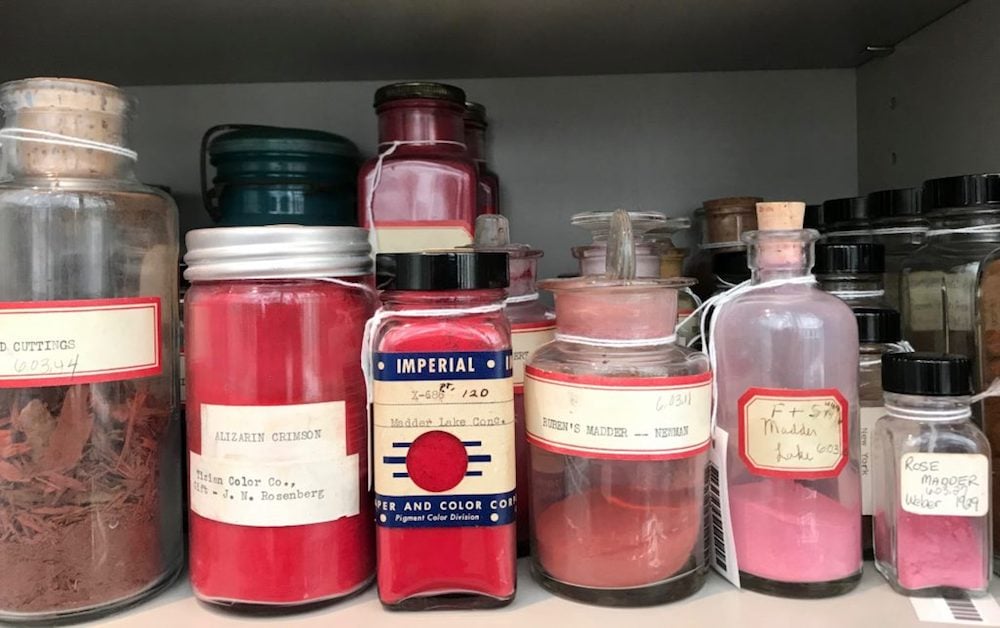
Edward Forbes, the former director of Harvard’s Fogg Art Museums, amassed a collection that is essentially a library of color.
With the help of these rainbow-bright samples, scientists are able to ward off color loss. They can restore faded pieces through identifying what chemical response caused the fading in the first place. They can also reconstruct stories of paintings and people through an examination of the minerals they used to create their colors and the binding materials they sourced from nature. The color library is a working laboratory, one that traces the history of color from ancient stones to twenty-first-century nanotubes.

The library helped with the restoration of Harvard’s faded Rothko mural, the subject of one of my favorite New Yorker essays. Here’s a list of the ten rarest pigments in the Forbes collection.
Well, this sounds dreamy. The Cloud Appreciation Society (exactly what it sounds like) is hosting a gathering on the island of Lundy next spring. There are still slots available for campers.

The tiny island in the Bristol Channel off Wales, named for the Norse word for “puffin,” has a pub, a church, three lighthouses, and craggy waterfront. It sounds pretty idyllic:
In Lundy, the sea is rarely out of sight, and the views are always breathtaking. There will be plenty of time to explore the wild stretches of grassland and heath which give way to natural ponds, steep cliffs and rocky beaches. The granite crags of this dramatic landscape is the perfect frame to the drama of its skies.
The Isle of Lundy’s topography, sparse population (28 as of 2007!), and mention of puffins reminds me of Far Afield, Susana Kaysen’s witty meditation on the Faroe Islands that I read last month. Her opening chapter in the Reykjavik airport is one of the best travel scenes I’ve read in ages.
Brain Pickings is surfacing some gems from their archives in honor of what would have been Ursula Le Guin’s 89th birthday. The novelist, poet, and essayist died in January.

Le Guin on conversation:
“Words are events, they do things, change things. They transform both speaker and hearer; they feed energy back and forth and amplify it. They feed understanding or emotion back and forth and amplify it.”
Le Guin on libraries:
“Knowledge sets us free, art sets us free. A great library is freedom.”
Le Guin on time (hear astrophysicist Janna Levin read the full poem):
Time is being and being
time, it is all one thing,
the shining, the seeing,
the dark abounding.
Le Guin on loyalty:
To break a promise is to deny the reality of the past; therefore it is to deny the hope of a real future. If time and reason are functions of each other, if we are creatures of time, then we had better know it, and try to make the best of it. To act responsibly.
Le Guin on the environment:
“To use the world well, to be able to stop wasting it and our time in it, we need to relearn our being in it.”
I See You, the new short from Jacob Krupnick, is shot on 35mm film and it is beautiful. It features the inclusive yoga community Setu.

In an interview with Chinese anchor Chen Luyu, actor and martial artist Jet Li revealed that he turned down the role of Seraph, guardian of the Oracle, in both sequels to The Matrix after the filmmakers made an unusual request.
“It was a commercial struggle for me,” Li said, “I realized the Americans wanted me to film for three months but be with the crew for nine. And for six months, they wanted to record and copy all my moves into a digital library.”
He added, “By the end of the recording, the right to these moves would go to them.”
Li said back then, he was already worried that future technology would allow US filmmakers to digitally reproduce his moving body and superimpose the face of any actor onto it.
“I was thinking: I’ve been training my entire life. And we martial artists could only grow older. Yet they could own [my moves] as an intellectual property forever. So I said I couldn’t do that,” Li said.
Instead, Li made Hero, which was probably the right call. Still, I wonder whether who else has been in Li’s position, and how often we’ve seen one actor’s face in pantomime over another actor’s body? Or whether requests like these helped kill the short-lived boom in big budget martial arts movies we saw in the late 1990s/early 2000s?
National Screening Room, a project by the Library of Congress, is a collection of early films (from the late 19th to most of the 20th century), digitized by the LOC for public use and perusal. Sadly, it’s not made clear which of the films are clearly in the public domain, and so free to remix and reuse, but it’s still fun to browse the collection for a look at cultural and cinematic history.
There’s a bunch of early Thomas Edison kinetoscopes, including this kiss between actors May Irwin and John C. Rice that reportedly brought the house down in 1896:
Or these two 1906 documentaries of San Francisco, one from shortly before the earthquake, and another just after (the devastation is really remarkable, and the photography, oddly beautiful):
There’s a silent 1926 commercial for the first wave of electric refrigerators, promoted by the Electric League of Pittsburgh, promising an exhibition with free admission! (wow guys, thanks)
There’s also 33 newsreels made during the 40s and 50s by All-American News, the first newsreels aimed at a black audience. As you might guess by the name and the dates, it’s pretty rah-rah, patriotic, support-the-war-effort stuff, but also includes some slice-of-life stories and examples of economic cooperation among working-to-middle-class black families at the time.
I hope this is just the beginning, and we can get more and more of our cinematic patrimony back into the public commons where it belongs.

Simon Winchester, author of The Professor and the Madman, has a new book out called The Perfectionists: How Precision Engineers Created the Modern World. It’s the history of a concept, which makes it tricky to write about, but it’s an uncommonly generative and illustrative concept. James Gleick shares this anecdote in his book review.
North Wales, “on a cool May day in 1776.” The Age of Steam was getting underway. So was the Industrial Revolution—almost but not quite the same thing. In Scotland, James Watt was designing a new engine to pump water by means of the power of steam. In England, John “Iron-Mad” Wilkinson was improving the manufacture of cannons, which were prone to exploding, with notorious consequences for the sailors manning the gun decks of the navy’s ships. Rather than casting cannons as hollow tubes, Wilkinson invented a machine that took solid blocks of iron and bored cylindrical holes into them: straight and precise, one after another, each cannon identical to the last. His boring machine, which he patented, made him a rich man.
Watt, meanwhile, had patented his steam engine, a giant machine, tall as a house, at its heart a four-foot-wide cylinder in which blasts of steam forced a piston up and down. His first engines were hugely powerful and yet frustratingly inefficient. They leaked. Steam gushed everywhere. Winchester, a master of detail, lists the ways the inventor tried to plug the gaps between cylinder and piston: rubber, linseed oil-soaked leather, paste of soaked paper and flour, corkboard shims, and half-dried horse dung—until finally John Wilkinson came along. He wanted a Watt engine to power one of his bellows. He saw the problem and had the solution ready-made. He could bore steam-engine cylinders from solid iron just as he had naval cannons, and on a larger scale. He made a massive boring tool of ultrahard iron and, with huge iron rods and iron sleighs and chains and blocks and “searing heat and grinding din,” achieved a cylinder, four feet in diameter, which as Watt later wrote “does not err the thickness of an old shilling at any part.”
By “an old shilling” he meant a tenth of an inch, which is a reminder that measurement itself—the science and the terminology—was in its infancy. An engineer today would say a tolerance of 0.1 inches.
This corresponding concept of “tolerance” turns out to be equally important. The ancient world was certainly capable of creating complex machinery (see the Antikythera Mechanism above), and the early modern period was able to put together the scientific method and new ways of conceptualizing the universe. But it’s the Industrial Revolution that created — or was created by — this notion that machines could be made in parts that fit together so closely that they could be interchangeable. That’s what got our machine age going, which in turn enabled guns and cars and transistors and computers and every other thing.
Imani Perry’s biography of Lorraine Hansberry sounds amazing. After she popped up for a second in the James Baldwin doc I Am Not Your Negro, I thought, “I need to know more about her.”
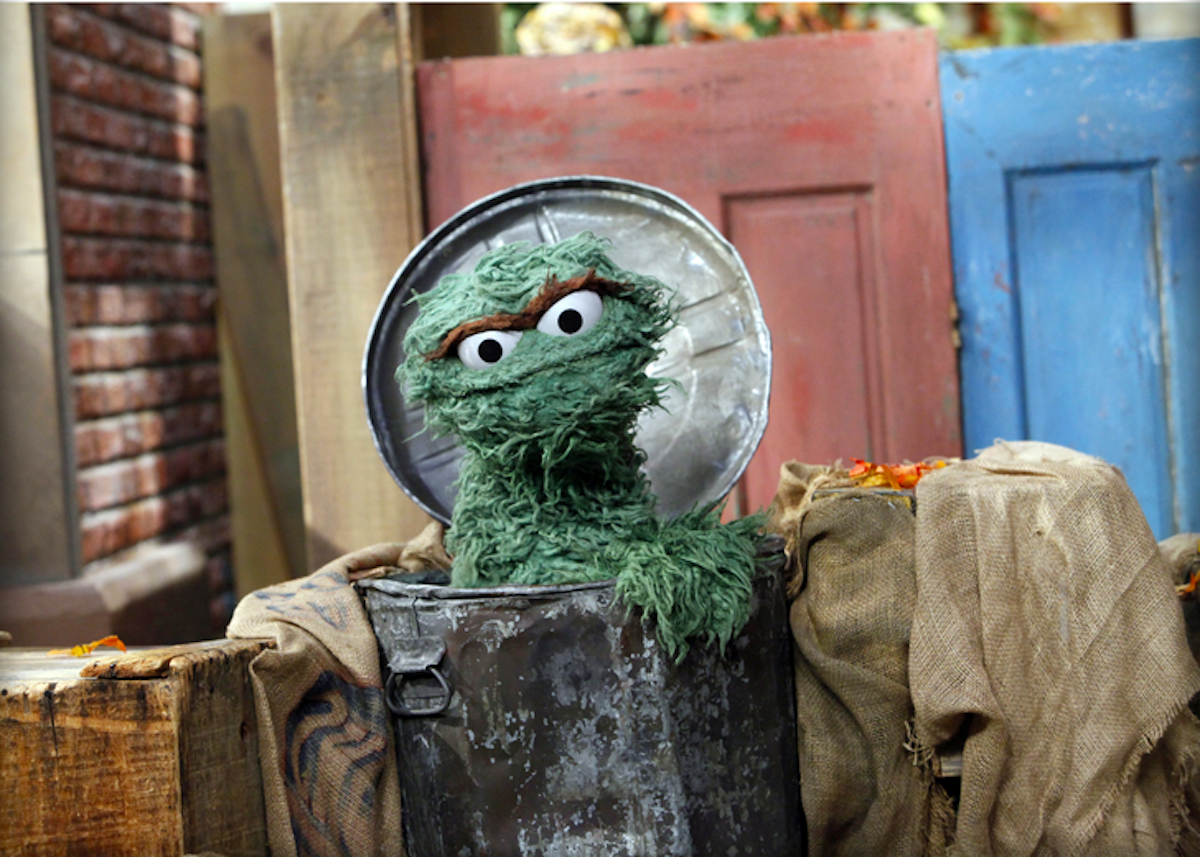
Sesame Street puppeteer Caroll Spinney is retiring after almost 50 years, and everybody is leading with the fact that he played and voiced everybody’s favorite, Big Bird. And then, if they get a chance, they might get around to mentioning that other iconic character he gave a voice and a soul, one of my favorites, Oscar the Grouch.
Karen Zraick writes about Oscar and his origins in the New York Times:
In his book “The Wisdom of Big Bird (and the Dark Genius of Oscar the Grouch),” Mr. Spinney wrote that he based Oscar’s voice on a surly cabdriver from the Bronx who took him to a meeting.
“He was the stereotypical cabby of the time — a guy in his 40s from the Bronx wearing a tweed cap with a little brim — and he kind of growled out of the corner of his mouth, ‘Where to, Mac?’” Mr. Spinney wrote.
He had found “the ideal model” for his new character, and he marveled as the driver “went on and on, colorfully expressing his opinion of Mayor Lindsay with a lot of four-letter words.”
Travis Andrews does the same in the Washington Post:
The purpose of Oscar, according to the Smithsonian National Museum of American History’s description of the character, is to teach “the importance of understanding, tolerance, and diversity.” According to Robert W. Morrow’s book “‘Sesame Street’ and the Reform of Children’s Television,” Oscar acted differently and lived in a different kind of home as a metaphor, “to dramatize tolerance for those who are different. … In segments about conflicts between Oscar and the others on the street, the show taught how children might cope with diversity in the context of school desegregation.”
Ok, sure. Ariane Beeston at Essential Kids more thoroughly spells out Oscar’s character, and its effect and appeal:
1. It’s okay to be different;
2. One man’s trash is another grouch’s treasure;
3. Embrace who you are and be yourself;
4. Just because you’re grouchy, doesn’t mean you can’t also be kind;
5. Emotions can be confusing.
Almost everyone gives credit to Spinney for giving Oscar his emotional complexity, with a simple mandate: Oscar is always grouchy and contrarian, but Oscar is never mean or cruel. In short, Oscar always has a heart. Let’s hope Spinney’s successor can continue to thread that needle. The kids of the present and the future deserve an Oscar who can be everything that he is.
I don’t know how many people under the age of 35 know about the Chicago Tylenol murders, but for a few weeks in 1982, it was a national news sensation. Seven people in the Chicago area died after ingesting Tylenol capsules laced with potassium cyanide. Retro Report took a look back at this episode, with a focus on how Johnson & Johnson and other drug companies modified their packaging to prevent in-store tampering.
The company considered renaming Tylenol, a word that incorporates some of the letters from 4- (aceTYLamino) phENOL, a chemical name for acetaminophen, the drug’s active ingredient. But a name change was rejected.
Instead, a mere six weeks after the crisis flared, the company offered a different solution, a new bottle with the sorts of safety elements now familiar (if at times exasperating) to every shopper: cotton wad, foil seal, childproof cap, plastic strip. Capsules began to be replaced with caplets the following year.
Johnson & Johnson was viewed as an exemplar of corporate responsibility, and enjoyed what some people described as the greatest comeback since Lazarus. Nowadays, all sorts of products come in containers deemed tamper-proof, or at least tamper-evident, meaning that consumers can readily tell if a seal has been broken or something else is amiss.
Incredibly, the case is still unsolved…no one knows who did it or why. Thinking about the amount of in-store surveillance that we have, it seems unlikely that such a crime would go unsolved for long today.
Several recent studies show a “hyperalarming” decline in insect populations. In same cases, the decline was accompanied by a similar decline in animals who eat the insects.
For the NY Times, rabbi David Wolpe writes about the moral courage of Chiune Sugihara, The Japanese Man Who Saved 6,000 Jews With His Handwriting.
In 1939 Sugihara was sent to Lithuania, where he ran the consulate. There he was soon confronted with Jews fleeing from German-occupied Poland.
Three times Sugihara cabled his embassy asking for permission to issue visas to the refugees. The cable from K. Tanaka at the foreign ministry read: “Concerning transit visas requested previously stop advise absolutely not to be issued any traveler not holding firm end visa with guaranteed departure ex japan stop no exceptions stop no further inquires expected stop.”
He wrote the visas anyway…thousands of them.
Day and night he wrote visas. He issued as many visas in a day as would normally be issued in a month. His wife, Yukiko, massaged his hands at night, aching from the constant effort. When Japan finally closed down the embassy in September 1940, he took the stationery with him and continued to write visas that had no legal standing but worked because of the seal of the government and his name. At least 6,000 visas were issued for people to travel through Japan to other destinations, and in many cases entire families traveled on a single visa. It has been estimated that over 40,000 people are alive today because of this one man.
What moral heroism. Fred Rogers often quoted his mother as saying, “Look for the helpers. You will always find people who are helping.” That message was directed at young children who he wanted to help feel secure. For us adults, Rogers might have encouraged us to exercise more moral courage and become those helpers, not just look for them. The world today could use more of that.
The Sordid Truth behind Degas’s Ballet Dancers. “Sex work was a part of a ballerina’s reality, and the city’s grand opera house, the Palais Garnier, was designed with this in mind.”
Stephen Hawking passed away back in March, but left us with a final book that just came out this week: Brief Answers to the Big Questions. There are 10 questions asked and answered in the book:
Is there a God?
How did it all begin?
Can we predict the future?
What is inside a black hole?
Is there other intelligent life in the universe?
Will artificial intelligence outsmart us?
How do we shape the future?
Will we survive on Earth?
Should we colonize space?
Is time travel possible?
Here are a couple of reviews from Physics World and NPR.
Take the chapter on “Can we predict the future?”. Starting with regular astronomical events, it swiftly moves on to scientific determinism, quantum physics, hidden variables and Heisenberg’s uncertainty principle. Under the guise of a simple question, Hawking has managed to take the reader on a whistle-stop tour of the quantum world (bottom line: no we can’t predict everything). It’s a clever ruse. Ask a simple question and you’ll draw in readers who might otherwise not know they’d be interested in complex science.
P.S. The UK cover of this book is so much better than the US cover. Why?? (via open culture)
Tortoise is an interesting new venture by some journalism heavy hitters. “We don’t do breaking news, but what’s driving the news. Not the news as it happens, but when it’s ready.”
It’s snowing right now in Vermont, but fall was extra lovely this year, so I’m sharing some foliage shots I’ve taken over the past month or so.








All photos taken with the iPhone XS. I’ve previously shared some of these on my Instagram account, where you can see, for instance, that my 11-year-old goes the extra mile to get the good photo by polishing the apples on the orchard tree.
Update: For some other views of fall, try this photo series from In Focus: part 1, part 2.
A short history of by-the-slice pizza in NYC. “It’s a safe bet that the custom of making pizzas specifically to sell by the slice began in the 1940s.”
One answer to the question of “How do I help a grieving friend?” is to acknowledge their circumstances…to “join them in their pain” instead of trying to take it away from them. As Megan Devine says in this video:
Cheering people up, telling them to be strong and persevere, helping them move on…it doesn’t actually work. It’s kind of a puzzle. It seems counterintuitive, but the way to help someone feel better is to let them be in pain.
One of the odd things about getting older (and hopefully wiser) is that you stop chuckling at cliches and start to acknowledge their deep truths. A recent example of this for me is “the only way out is through”. As Devine notes, in this video and her book It’s OK That You’re Not OK, there’s no shortcut for dealing with pain…you have to go through it to move past it.
In a new TED podcast, writer Elizabeth Gilbert talked about the grief she felt when her partner and longtime best friend Rayya Elias was diagnosed with and died from cancer.
Grief… happens upon you, it’s bigger than you. There is a humility that you have to step into, where you surrender to being moved through the landscape of grief by grief itself. And it has its own timeframe, it has its own itinerary with you, it has its own power over you, and it will come when it comes. And when it comes, it’s a bow-down. It’s a carve-out. And it comes when it wants to, and it carves you out — it comes in the middle of the night, comes in the middle of the day, comes in the middle of a meeting, comes in the middle of a meal. It arrives — it’s this tremendously forceful arrival and it cannot be resisted without you suffering more… The posture that you take is you hit your knees in absolute humility and you let it rock you until it is done with you. And it will be done with you, eventually. And when it is done, it will leave. But to stiffen, to resist, and to fight it is to hurt yourself.
The only way out is through.
Update: When Gary Andrews’ wife Joy died, he documented his pain and his family’s grief through a daily doodle posted to Twitter. (thx, matt)

Hoefler & Co are selling copies of The Typographic Ticket Book for type nerds on the go. The idea is that when you’re out and about, you can issue citations for “use of display font at text size” or “unironic use of Helvetica” to people and businesses misusing type.
Contains fifty tickets, each neatly perforated for a satisfyingly loud rip prior to presentation. Bound in soul-deadening municipal pressboard, with a heavy-duty 100pt millboard backing, and foil stamped with an official-looking clip art emblem in gold. Police uniform not included, nor recommended. For novelty use only.
Looks like the book contains a few in-jokes as well…I spotted “$TKTK” as the fine for “failure to replace dummy copy” and the kerning on the fine for “improper kerning” looks a liiittle tight to me.
Newer posts
Older posts










Socials & More