



Footage from the 1932 Winter Olympics
Here’s a bit of film footage from the third-ever Winter Olympics, held in Lake Placid, NY in 1932. The ski jumping segment is amazing and terrifying.
Here’s how those Games compare to the modern day Olympics.

This site is made possible by member support. 💞
Big thanks to Arcustech for hosting the site and offering amazing tech support.
When you buy through links on kottke.org, I may earn an affiliate commission. Thanks for supporting the site!
kottke.org. home of fine hypertext products since 1998.
Beloved by 86.47% of the web.
Here’s a bit of film footage from the third-ever Winter Olympics, held in Lake Placid, NY in 1932. The ski jumping segment is amazing and terrifying.
Here’s how those Games compare to the modern day Olympics.
Nicolaus Wegner shot some gorgeous footage of thunderstorms and cloud formations in South Dakota and Wyoming during the summer of 2013.
(via devour)
Photo-sharing community Flickr turned ten years old this week. At Time, Harry McCracken takes a look back.
Earlier photo sites were mostly concerned with letting you put your pictures in front of friends and family. Flickr did that, too. But from the start, it was building a community of photo lovers around the world who wanted to share images with other photo lovers, as well as thousands of special interest sub-communities. It was about storytelling.
I was at Etech when Flickr launched and was one of the site’s first few hundred users. The photo chat room they launched with was not that interesting to me, but when they turned it inside out, I was hooked. Happy birthday, Flickr.
Don’t breathe. That’s the first step to surviving if you fall through ice into near-freezing water.
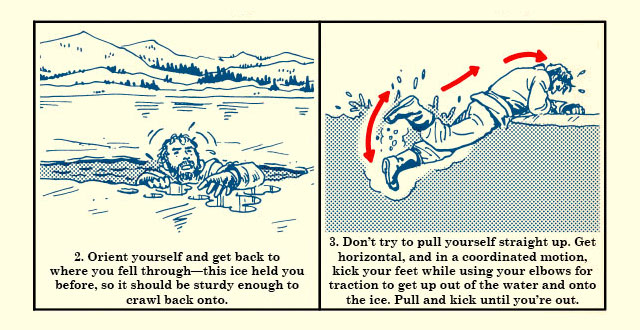
(via mr)
100 years ago, Charlie Chaplin put on some floppy shoes, oversized trousers, a bowler, a mustache and became The Tramp. Within a year or two, he was internationally famous and in two years, he was making $670,000/year, an unprecedented figure in those days.
“It was amazingly fast,” says David Robinson, a film critic who has written a definitive biography of Chaplin (His Life and Art) and is giving an already sold-out talk titled “100 Years of the Tramp” at the festival. “By mid-1914 he was already popular. By 1915 he was international. The speed with which it happened, without the modern media, is astonishing.”
50 years ago, The Beatles were virtually unknown in the US and then, less than a year later, the largest TV audience in history watched them perform on the Ed Sullivan Show.
Consider the following: At the end of 1963, virtually no one in America had heard of the Beatles. Yet on Feb. 9, 1964, they drew the largest TV audience in history — 73 million viewers — when they appeared on “The Ed Sullivan Show.” How could such a conquest have occurred so quickly? I once asked my friend Lenny Kaye that question, and he answered: “Everybody was ready for the ’60s to begin.” There’s some truth to that, but of course there’s much more to the story. The explosion of the Beatles in America was the result of combined forces — artistic, social and technological — as well as persistence, showbiz rivalries and more than a bit of luck. So how did it happen that the Beatles came out of nowhere to become the biggest cultural sensation ever, in six weeks?
This year, an iOS & Android game called Flappy Bird, that was originally released in 2013, suddenly rocketed to the top of the App Store bestseller list. (Seriously, look at how quickly it got popular.) The developer, Dong Nguyen, revealed in an interview with The Verge that the game was making $50,000 a day on ads. He’s since made the game unavailable for download.
On February 1st, reviews exploded to 800 in a single hour. 6,500 iTunes App Store reviews in a single day. February 1st is the day Dong Nguyen woke up, stretched, checked email, checked Twitter, checked iTunes, and witnessed millions of downloads happening.
Millions.
You can only imagine what that must have felt like.
This is the same app no one cared about for more than half a year. Just one month prior, it was a great day if Flappy Bird got 20 total reviews on the App Store. Up until January 9th, there had never been an hour in which Flappy Bird received even 10 reviews (most of the time it was under 5).
Mike Judge has a new series coming to HBO in April. It’s called Silicon Valley and is about startup culture. Here’s a preview:
Snack dick.
For his Classic Movies in Miniature Style series, Murat Palta illustrated scenes from movies using traditional Ottoman motifs. Here’s A Clockwork Orange and Kill Bill:
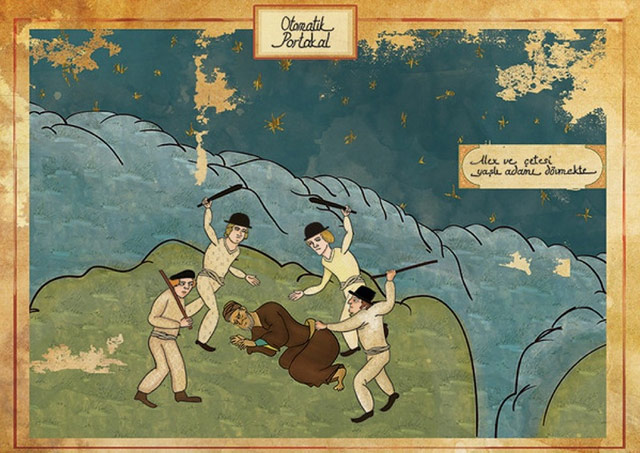
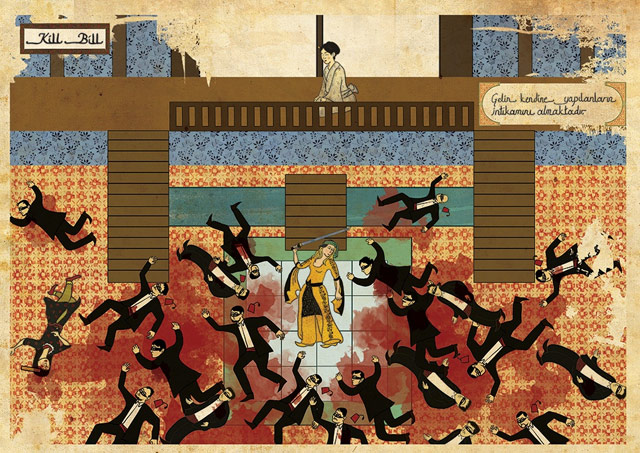
Great stuff. (via @pieratt)
Watch Ferrari’s F1 pit crew do a pit stop in a bit over two seconds:
I wish this were in slow motion because I’ve watched this three times now and I still cannot understand how it’s done. My favorite part is how calm they all are about it. Here’s a longer video that shows the process over and over from several points of view, including from a GoPro mounted on the chest of the wheelgun man:
Watch for the guy on the front jack pirouetting out of the way. I would love to read a long piece on how F1 pit crews train and practice. There are tantalizing bits in shorter articles, like this one from Autosport.com:
With three people per wheel, two jack operators, and a handful of mechanics fulfilling other functions, each pit crew comprises nearly 20 people.
Each is trained for a specific role and teams take their preparation as seriously as drivers’, managing crewmen’s fitness and diet.
They are drilled incessantly at both the factory and during race weekends, with hundreds of pitstop practices until the process is instinctive.
Although problems such as faulty guns are rehearsed, everyone focuses on their own job — in a two-second pitstop, there is no time to see what everyone else is doing. By the time an error has been alerted, the car has often already pulled away, as was the case at the Nurburgring.
And this one from the AP:
Teams now spend huge sums to design their own equipment and improve the fitness of their teams who also work as mechanics. McLaren is working with the English Institute of Sport to hone their 24-member team’s technique while Williams has partnered with Olympic champion Michael Johnson’s Performance Center to work on everything from diet to eye-hand coordination to core strength.
Training has also been ramped up. Most teams have rigs to practice on in the factory and pit stops are practiced as many as 70 times over a typical race weekend. Each stop is timed and videotaped for later review.
“When you had to go from 3.5 seconds down to a lower number, then you really need to be very specific and accurate on how you train because everything needs to be very synchronized to achieve that level of fast time and consistency,” said Williams’ chief race engineer Xevi Pujolar, whose team had its fastest pit stop this season in Spain after making changes to its crew but still is almost a second behind the top teams.
“There still a lot of room for improvement and we are working hard to catch up to these guys that do close to two seconds,” Pujolar said. “If you look at video of pit crew and how they move during pit stop, everything is so well coordinated. To achieve this level of coordination on every pits stop requires a lot of training.”
As well as this series about pit stops by Williams on YouTube. (via digg)
What would happen if a tiny black hole the size of a marble were placed at the center of the Earth? Rest assured, the Earth won’t completely be swallowed up by the black hole but that’s really the only good news to offer.
First of all, not all of the Earth would simply be sucked into the black hole. When the matter near the black hole begins to fall into the black hole, it will be compressed to a very high density that will cause it to be heated to very high temperatures. These high temperatures will cause gamma rays, X-rays, and other radiation to heat up the other matter falling in to the black hole. The net effect will be that there will be a strong outward pressure on the outer layers of the Earth that will first slow down their fall and will eventually ionize and push the outer layers away from the black hole. So some inner portion of the core will fall into the black hole, but the outer layers, including the crust and all of us, would be vaporized to a high temperature plasma and blown into space.
This would be a gigantic explosion — a significant fraction of the rest of the mass of the Earth matter that actually fell into the black hole will be converted into energy.
FYI, that marble-sized black hole would have about the same mass as the Earth. Not that they exist, mind you. Maybe, maybe not. Blackish holes? Dark grey holes? Anyway, really heavy.
Hassan Hajjaj’s photos of female motorbike enthusiasts from Morocco are fun.
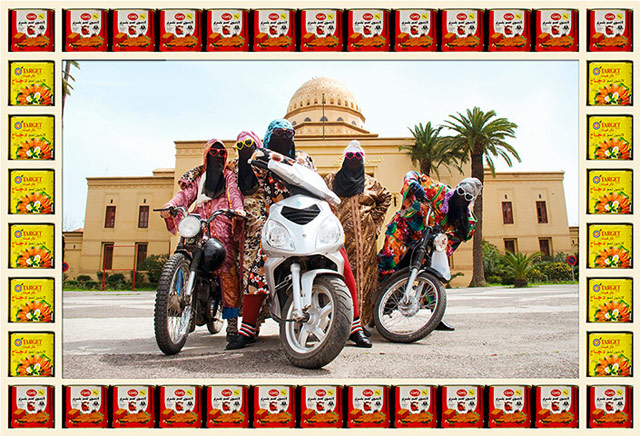
On display at the Taymour Grahne Gallery in NYC through March 7.
This is nutty…by chance, a group of archaeologists found what are believed to be the oldest known human footprints outside of Africa on a beach in England. The footprints are an estimated 800,000 years old and are now completely gone. The tide that uncovered them washed them away in less than a month.
The footprints have been described as “one of the most important discoveries, if not the most important discovery that has been made on [Britain’s] shores,” by Dr Nick Ashton of the British Museum.
“It will rewrite our understanding of the early human occupation of Britain and indeed of Europe,” he told BBC News.
The markings were first indentified in May last year during a low tide. Rough seas had eroded the sandy beach to reveal a series of elongated hollows.
In a presentation for the Visualized conference, Jonathan Corum says that he looks for the “weight of rain” when working on data graphics.
So when I’m looking at data, or working on an explanatory graphic, these are the moments I’m looking for. Little “Aha!” moments that I can point to, and say “Look here, something happened,” and then try to explain. Often those small moments can help lead a reader into the graphic, or help to explain the whole.
The actual non-metaphorical weight of rain is surprisingly heavy; an inch of rain on an acre of land weighs 113.31 tons.
In a clip from The CBS Evening News With Walter Cronkite in 1981, a man in a hooded sweatshirt yelling about the Viet Cong threatened to jump from the 9th story of a building in Los Angeles. Out of nowhere, like a freaking superhero, appears Muhammad Ali, who manages to coax the man back into the building.
(via @DavidGrann)
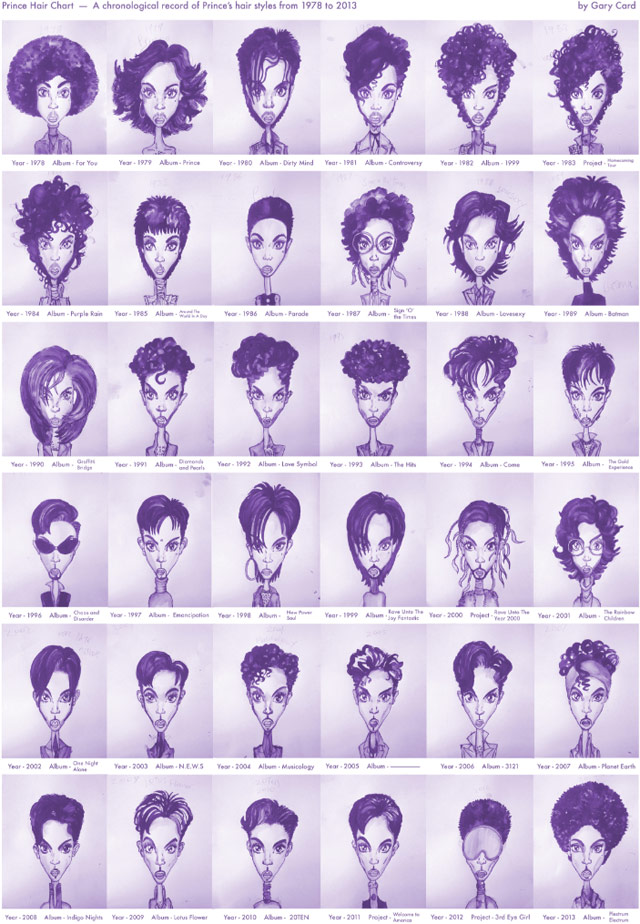
For BEAT magazine, Gary Card drew an illustration of every hairstyle worn by Prince since 1978.
A few months ago, the site featured the BMX tricks of Tim Knoll, which were some of the most unusual tricks I’d seen. (That semi trailer limbo!) Tate Roskelley’s tricks are even weirder, so much so that they seem more like an artistic statement on tricks than tricks themselves:
I think the “artist’s statement” on YouTube is spot on:
Tate’s got just about the most original perspective on BMX you can imagine. I think years ago when Jim C said “I just want to see what’s possible”, Tate took his words at face value. His riding is less about making a statement and more about asking questions. What is a bike trick? What is a street spot? The answers aren’t always pretty (I’m sure he isn’t going to start riding around with his stem bolts loose full time) but they’re always interesting and Tate is always having fun.
This collection of before-and-after photos of NYC’s streets shows how much the Bloomberg administration and former Transportation Commissioner Janette Sadik-Khan transformed the city’s streets.

Constructing our cities around cars is one of the biggest mistakes of the 20th century and we’re still paying for it. As Kaj Pindal cleverly depicted in his 1966 Oscar-nominated short film What On Earth!, it often seems like cars and not people are the Earth’s dominant life form.
(via @anildash)
For Howler Magazine, Sam Markham writes about Diego Maradona’s second goal against England in the 1986 World Cup quarterfinal, aka Probably The Best Goal of All Time. Markham focuses on how a pair of radio commentators — one English, the other from South America — called the goal.
Morales’s ecstatic commentary of Maradona’s second goal is itself iconic in Argentina, and his lyrical expression “Barrilete cosmico!” (Cosmic kite!) is now shorthand in Argentina and much of South America for Maradona. His narration is a frenzied mix of poetry, yelling, and sobbing that ends with a prayer: “Thank you, God, for football, for Maradona, for these tears, for this-Argentina 2, England 0.”
Even if you don’t care about soccer, you should give this a listen…the dude absolutely loses his shit:
An alternate view of the spectacular goal has recently been found. Oh, and my favorite weird thing about this goal: Lionel Messi is considered by many to be Maradona’s heir (both are small, Argentinian, and otherworldly talented) and in 2007, at the age of 19, he scored this goal against Getafe:
As you can see in the side-by-side comparison, it’s extremely similar to Maradona’s goal. Even the commentator loses it in a similar manner.
Think you can distinguish between 80 of the world’s most spoken languages? Play the Great Language Game and find out. (Oof, I am bad at this.)
Oliver Emberton wrote a strategy guide for real life as if it were a video game.
You might not realise, but real life is a game of strategy. There are some fun mini-games — like dancing, driving, running, and sex — but the key to winning is simply managing your resources.
Most importantly, successful players put their time into the right things. Later in the game money comes into play, but your top priority should always be mastering where your time goes.
On his site Truth in Olive Oil, Tom Mueller tells us how to buy great olive oil and, more usefully, which brands to buy at the supermarket.
Unlike many wines, which improve with age, extra virgin olive oil is perishable: like all natural fruit juices, its flavor and aroma begin to deteriorate within a few months of milling, a decline that accelerate when the oil is bottled, and really speeds up when the bottle is opened. To get the freshest oil, and cut out middle-men who often muddy olive oil transparency and quality, buy as close to the mill as possible. If you’re lucky enough to live near a mill — common around the Mediterranean, and more and more so in other areas of the world with a Mediterranean-like climate, like Australia, S. Africa, California, Texas, Georgia — visit it during the harvest to see how olives are picked, crushed, stirred, and spun into olive oil.
Mueller is also author of Extra Virginity: The Sublime and Scandalous World of Olive Oil, which was published a few years after his olive oil exposé in the New Yorker.
In 1997 and 1998, olive oil was the most adulterated agricultural product in the European Union, prompting the E.U.’s anti-fraud office to establish an olive-oil task force. (“Profits were comparable to cocaine trafficking, with none of the risks,” one investigator told me.) The E.U. also began phasing out subsidies for olive-oil producers and bottlers, in an effort to reduce crime, and after a few years it disbanded the task force. Yet fraud remains a major international problem: olive oil is far more valuable than most other vegetable oils, but it is costly and time-consuming to produce-and surprisingly easy to doctor. Adulteration is especially common in Italy, the world’s leading importer, consumer, and exporter of olive oil. (For the past ten years, Spain has produced more oil than Italy, but much of it is shipped to Italy for packaging and is sold, legally, as Italian oil.) “The vast majority of frauds uncovered in the food-and-beverage sector involve this product,” Colonel Leopoldo Maria De Filippi, the commander for the northern half of Italy of the N.A.S. Carabinieri, an anti-adulteration group run under the auspices of the Ministry of Health, told me.
The other day, Bill Nye debated Ken Ham about evolution and creationism. At the event, Matt Stopera asked self-identifying creationists to write question/notes to those who “believe” in evolution. Here’s one:
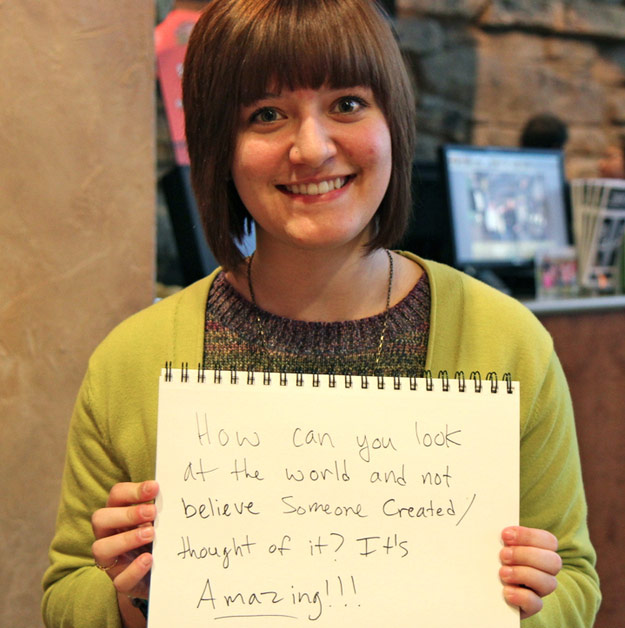
Phil Plait of Bad Astronomy responded to each of the 22 notes/questions from the creationists. Here’s his answer to the comment above:
I agree; it is amazing! I’ve written about this many times. But we know that complexity can arise naturally through the laws of physics. It doesn’t take very complex rules to create huge diversity. Look at poker; a simple set of rules creates a game that has so many combinations it’s essentially infinite to human experience. We can figure out the rules of nature by studying the way processes follow them, and deduce what’s going on behind the scenes. And whenever we do, we see science.
This makes me think of Richard Feynman’s ode to the scientific beauty of a flower:
I have a friend who’s an artist and has sometimes taken a view which I don’t agree with very well. He’ll hold up a flower and say “look how beautiful it is,” and I’ll agree. Then he says “I as an artist can see how beautiful this is but you as a scientist take this all apart and it becomes a dull thing,” and I think that he’s kind of nutty. First of all, the beauty that he sees is available to other people and to me too, I believe. Although I may not be quite as refined aesthetically as he is … I can appreciate the beauty of a flower. At the same time, I see much more about the flower than he sees. I could imagine the cells in there, the complicated actions inside, which also have a beauty. I mean it’s not just beauty at this dimension, at one centimeter; there’s also beauty at smaller dimensions, the inner structure, also the processes. The fact that the colors in the flower evolved in order to attract insects to pollinate it is interesting; it means that insects can see the color. It adds a question: does this aesthetic sense also exist in the lower forms? Why is it aesthetic? All kinds of interesting questions which the science knowledge only adds to the excitement, the mystery and the awe of a flower. It only adds. I don’t understand how it subtracts.
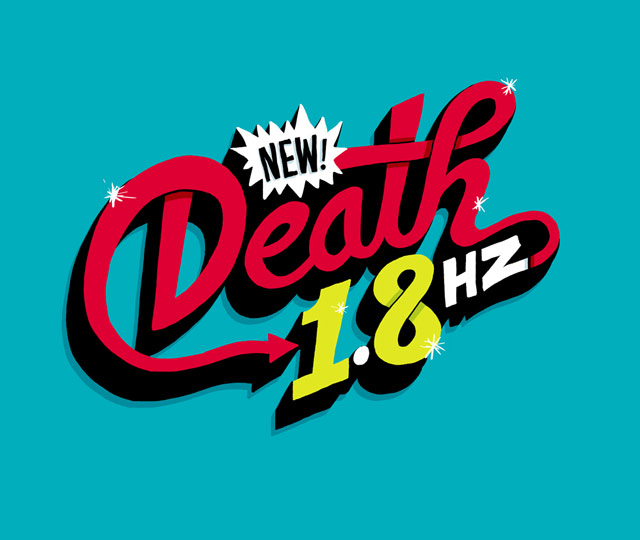
Every day on Earth, an estimated 371,124 people are born and 154,995 people die. When you ask Wolfram Alpha about these rates, the scientifically inclined site returns a curious corresponding quantity: the frequency in hertz (aka the number of cycles/second in a periodic occurrence).

Measurement in hertz is an unusual way to think about living and dying; hertz are typically reserved for things like human-audible sound frequencies (20 to 16,000 Hz), how fast your laptop’s CPU runs (1 to 4 Ghz), or the frequency of the power running into your house (50 to 60 Hz). But if you subtract the death rate from the birth rate, you get a net rate of 216,129 new people a day, or about 2.5 Hz. That’s the frequency of humanity. While that’s a lot slower than your computer, it’s in the same frequency ballpark as a human’s resting heart rate (1.3 Hz), steps taken while walking briskly (1.8 Hz), or moderately energetic dance music (2.25 Hz).
Note: Illustration by Chris Piascik…check out his shop, where you’ll find prints, tshirts, iPhone cases, etc.
Great thread at Reddit about true facts that sound made up. And here’s a similar slightly older thread. A few favorites:
When you get a kidney transplant, they usually just leave your original kidneys in your body and put the 3rd kidney in your pelvis.
IPv6 would allow every atom on the surface of the earth to have its own IP address, with enough spare to do Earth 100+ times.
The Ottoman Empire still existed the last time the Cubs won the World Series.
The United States in World War 2 created a bomb that used bats. The bats would be carrying small incendiary charges and would be released from the bomb in mid air, causing them to fly and scatter to different buildings in the area. The charges would then detonate and set all the buildings on fire. It was tested and proven to be very effective.
Russia is bigger than Pluto. (Surface area of Pluto: 16.7x10^6 km^2; Surface area of Russia: 17.1x10^6 km^2)
If you melted down the Eiffel Tower, the pool of iron would be less than 3 inches deep (in a square area the same dimensions as the tower base).
John Tyler, who became president in 1841, has 2 living grandchildren.
Mammoths were alive when the Great Pyramid was being built.
If an atom was the size of our solar system, a neutrino would be the size of a golfball, to scale.
Humans share 50% of their DNA with… bananas.
That first one still has me shuddering. Also, I have no idea if all of these things are actually true (because internet) but if so, amazing. (via @dunstan)
McDonald’s Canada continues their series on how their business works with a video on how Chicken McNuggets are made.
Best part of the video: the casual reveal that McNuggets come in four standard shapes: the ball, the bell, the boot, and the bow tie:

I had a McNugget over the weekend, the first one in probably more than 10 years, and it tasted and felt like chicken. Not bad for fast food. See also how McDonald’s fries are made and how McDonald’s photographs their food for advertising.
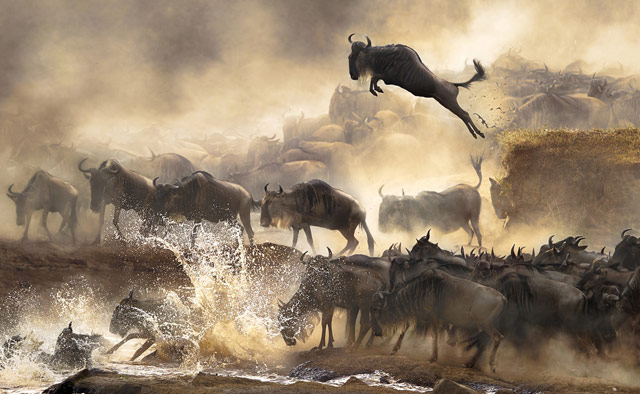
In Focus has posted some shortlisted images from The 2014 Sony World Photography Awards. This wildebeest photo by Bonnie Cheung stopped me in my tracks…it looks like a painting (or a cave painting).
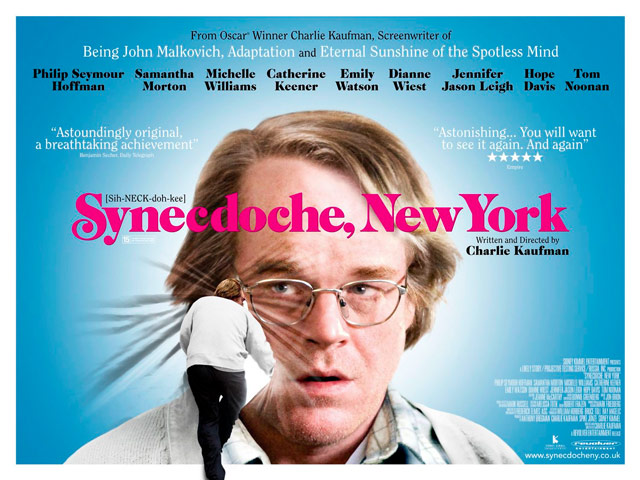
Understandably, lots of folks are wanting to wade into the late Philip Seymour Hoffman’s formidable body of work. Netflix Watch Instantly doesn’t have a whole lot of available titles and Hulu has a mere two, but Amazon has quite a few for rent or purchase. Some of my favorites: The Master, Synecdoche, New York, Almost Famous, Magnolia, and Boogie Nights. I need to find time for a Synecdoche viewing this week.
ps. The links to Amazon include my affiliates code…proceeds from purchases made through those links will be matched by me and will be donated to the Labyrinth Theater Company, which Hoffman co-founded and where he served as creative director for many years.
Ben Saunders and Tarka L’Herpiniere are reaching the end of their 105-day, 1800-mile solo (nearly) unsupported journey to the South Pole and back again. Towing sledges across unchanging icy terrain for 100 days doesn’t exactly make for compelling reading, but it’s been a highlight of each morning during the past three months to read what the boys have been up to. I hope offering my congratulations on a job well done isn’t premature.
Microsoft has a new CEO, Satya Nadella — birthplace: Hyderabad, India; hobbies: cricket, poetry. Here’s a nice succinct piece by John Gruber on Microsoft’s past, present, and future.
“A computer on every desk and in every home” was incredible foresight for 1977. It carried Microsoft for 25 years of growth. But once that goal was achieved, I don’t think they knew where to go. They were like the dog that caught the car. They spent a lot of time and energy on TV. Not just with Xbox, which is alive and well today (albeit not a significant source of income), but with other ideas that did not pan out, like “media center PCs” and the joint ownership of “MSNBC”, which was originally imagined as a sort of cable news network, website, dessert, and floor wax rolled into one.
No surprise: Gruber writes about Microsoft as well as he does about Apple.
37signals announces that they’re focusing on their most successful product, Basecamp.
So here’s the second big announcement: We’re changing our name. 37signals is now Basecamp. “37signals” goes into the history books. From now on, we are Basecamp. Basecamp the company, Basecamp the product. We’re one and the same.
With this change, we renew our long-term commitment to all things Basecamp. Basecamp on the web, Basecamp on iOS, Basecamp on Android, Basecamp via email, and Basecamp wherever else it makes sense. Each one of us will be dedicated to improving Basecamp, extending Basecamp’s reach, expanding Basecamp’s capabilities, and making sure our Basecamp customers are treated like royalty.
Congratulations all around. I’ve been a fan of the company since the beginning and it’s been great fun to see it thrive through dozens of gear shifts.
I love this sort of thing: visualizations of Olympic venues plopped into Manhattan to provide a sense of scale. My favorite is the bobsled run in Times Square:
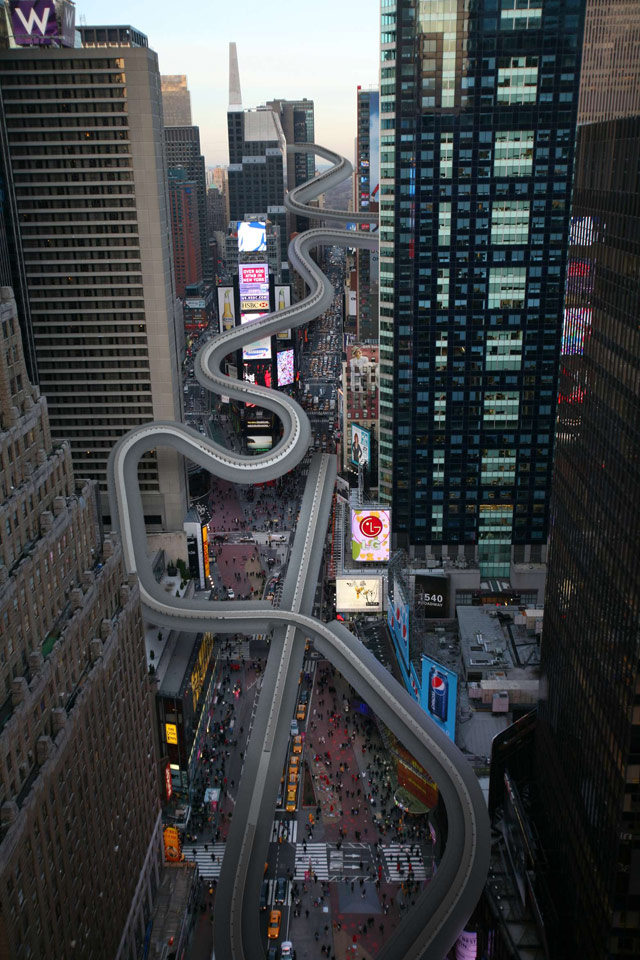
My son and I were just talking about this and when he asked me, I had no idea how big the track actually was. Can’t wait to show him this when I get home tonight.
In other news, the news media has arrived in Sochi and the town doesn’t seem to be ready for the Games. Oopsie!
Fish Tales is billed as the world’s shortest cooking show. Episodes are about 15 seconds long and in each one, you learn how to cook a complete fish/seafood dish. Here’s the latest one, on cooking razor clams:
The death of Philip Seymour Hoffman has turned more attention towards America’s growing heroin problem, where the gateway drug is often a prescription painkiller. From PBS Newshour: “Why more Americans are getting high — and overdosing — on heroin.”
As I mentioned at the time, Vermont Gov. Peter Shumlin devoted his entire State of the State to the “full-blown heroin crisis.”
Facebook’s new Paper app is pretty good. Once you get the hang of the gestures, it feels natural and very Letterpressy and smooth, which isn’t surprising considering Loren Brichter’s involvement. Check out The Verge’s review.
From a new blog, Typeset in the Future, an examination of the typography in Kubrick’s 2001: A Space Odyssey.
It’s Futura again, with an M borrowed from Gill Sans, and a W that I don’t recognize from anywhere.
Socials & More