In a profile this summer from Le Monde, Christopher Tolkien, the 88 year-old son of J.R.R. Tolkien blasted Peter Jackson and The Lord of the Rings / The Hobbit movies. (If you can’t speak French, you should see the translation of the profile.) Tolkien, who drew the maps for the Lord of the Rings books, has spent most of his life protecting the legacy of his father’s works, and the movies are, apparently, a bridge too far.
Invited to meet Peter Jackson, the Tolkien family preferred not to. Why? “They eviscerated the book by making it an action movie for young people aged 15 to 25,” Christopher says regretfully. “And it seems that The Hobbit will be the same kind of film.”
This divorce has been systematically driven by the logic of Hollywood. “Tolkien has become a monster, devoured by his own popularity and absorbed into the absurdity of our time,” Christopher Tolkien observes sadly. “The chasm between the beauty and seriousness of the work, and what it has become, has overwhelmed me. The commercialization has reduced the aesthetic and philosophical impact of the creation to nothing. There is only one solution for me: to turn my head away.”
The average temperature was 55.3 degrees, 1 degree above the previous record and 3.2 degrees more than the 20th-century average. Temperatures were above normal in every month between June 2011 and September 2012, a 16-month stretch that hasn’t occurred since the government began keeping such records in 1895.
Weather-wise, 2012 is Usain Bolt crossing the line in the 100-meter final at the Beijing Olympics, already slowing down, arms out, and still so so much faster than everyone else.
Every minute a new impossible thing is uploaded to the internet and that improbable event becomes just one of hundreds of extraordinary events that we’ll see or hear about today. The internet is like a lens which focuses the extraordinary into a beam, and that beam has become our illumination. It compresses the unlikely into a small viewable band of everyday-ness. As long as we are online - which is almost all day many days — we are illuminated by this compressed extraordinariness. It is the new normal.
That light of super-ness changes us. We no longer want mere presentations, we want the best, greatest, the most extraordinary presenters alive, as in TED. We don’t want to watch people playing games, we want to watch the highlights of the highlights, the most amazing moves, catches, runs, shots, and kicks, each one more remarkable and improbable than the other.
We are also exposed to the greatest range of human experience, the heaviest person, shortest midgets, longest mustache — the entire universe of superlatives! Superlatives were once rare — by definition — but now we see multiple videos of superlatives all day long, and they seem normal. Humans have always treasured drawings and photos of the weird extremes of humanity (early National Geographics), but there is an intimacy about watching these extremities on video on our phones while we wait at the dentist. They are now much realer, and they fill our heads.
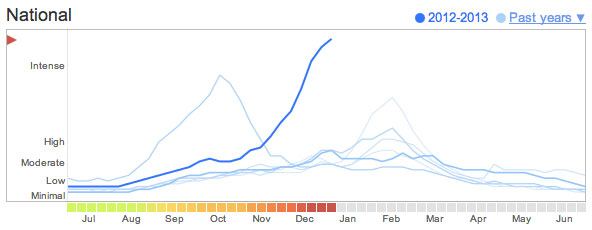
Google’s trends tend to follow the official CDC data closely and indeed the CDC concurs about the scope of the flu this year but their data is lagging behind Google’s by what looks like about 2 weeks. See also my post on how flu vaccines are made. (via @kellan)
Aykroyd spends his free time speeding through outskirts and befriending coroners. Belushi, being Chicago’s favorite son, does anything he wants. Everything about him — his lunch-bucket charm, his utter lack of pretense — makes Belushi a figure of such resounding local popularity that Aykroyd calls him “the unofficial mayor of Chicago.”
A trip to Wrigley Field, home of the Chicago Cubs, boggles Landis. “Like being with Mussolini in Rome,” he remembers. Belushi, having entered one of the stadium’s crowded bathrooms, smiles and shouts, “O.K., stand back!” Everyone retreats from the urinals. Belushi does his business. Then, zipping his fly and beaming, he says, “O.K., back you go!”
“John would literally hail police cars like taxis,” Mitch Glazer says. “The cops would say, ‘Hey, Belushi!’ Then we’d fall into the backseat and the cops would drive us home.”
But the drug habit that would claim his life two years later also made Belushi a weight on the production.
One night at three, while filming on a deserted lot in Harvey, Illinois, Belushi disappears. He does this sometimes. On a hunch, Aykroyd follows a grassy path until he spies a house with a light on.
“Uh, we’re shooting a film over here,” Aykroyd tells the homeowner. “We’re looking for one of our actors.”
“Oh, you mean Belushi?” the man replies. “He came in here an hour ago and raided my fridge. He’s asleep on my couch.”
Only Belushi could pull this off. “America’s Guest,” Aykroyd calls him.
“John,” Aykroyd says, awakening Belushi, “we have to go back to work.”
Belushi nods and rises. They walk back to the set as if nothing happened.
The bureau’s head of climate monitoring and prediction David Jones said the new scale, which also features a pink code for temperatures from 52 to 54 degrees, reflected the potential for old heat records to be smashed.
“The scale has just been increased today and I would anticipate it is because the forecast coming from the bureau’s model is showing temperatures in excess of 50 degrees,” Jones told Fairfax newspapers.
Australia’s all-time record temperature is 50.7 degrees, set in January 1960 at Oodnadatta in the state of South Australia.
The nation as a whole experienced its hottest day on record on Monday with the average maximum temperature across the country hitting 40.33 degrees, surpassing the previous mark of 40.17 degrees set in 1972.
I feel like climate change needs a Steve Jobs to kick everyone’s ass into action on this, iPhone announcement-style. “Unprecedented polar ice cap melt, new colors on Australia’s weather map, massive East Coast hurricanes, are you getting it? These are not three separate incidents. This is one global pattern. And we are calling it anthropogenic climate change. [wild applause]” (via @ftrain)
Shoppers have surprisingly strong feelings about laundry detergent. In a 2009 survey, Tide ranked in the top three brand names that consumers at all income levels were least likely to give up regardless of the recession, alongside Kraft and Coca-Cola. That loyalty has enabled its manufacturer, Procter & Gamble, to position the product in a way that defies economic trends. At upwards of $20 per 150-ounce bottle, Tide costs about 50 percent more than the average liquid detergent yet outsells Gain, the closest competitor by market share (and another P&G product), by more than two to one. According to research firm SymphonyIRI Group, Tide is now a $1.7 billion business representing more than 30 percent of the liquid-detergent market.
Because of this premium status and because laundry detergent is not usually well-guarded in grocery stores, Tide has become a large target for theft and subsequent resale, either for cash or crack on street corners across the nation.
What did thieves want with so much laundry soap? To find out, he and his unit pored over security recordings to identify prolific perpetrators, whom officers then tracked down and detained for questioning. “We never promised to go easy on them, but they were willing to talk about it,” Thompson says. “I guess they were bragging.” It turned out the detergent wasn’t being used as an ingredient in some new recipe for getting high, but instead to buy drugs themselves. Tide bottles have become ad hoc street currency, with a 150-ounce bottle going for either $5 cash or $10 worth of weed or crack cocaine. On certain corners, the detergent has earned a new nickname: “Liquid gold.” The Tide people would never sanction that tag line, of course. But this unlikely black market would not have formed if they weren’t so good at pushing their product.
Please don’t let this be a hoax, it’s almost too good to be true. (via @mulegirl)
John Robb imagines a drone delivery service that will replace UPS, FedEx, the USPS, bicycle messengers, Kozmo-type services, etc. in the short-hop delivery of small items.
Here’s a simplified version of what I’m talking about:
1. I put package onto a landing pad at my home.
2. Drone arrives, takes package and flies away.
3. Drone delivers package to landing pad at delivery location.
There’s almost nothing technically in the way of this happening right now. Here’s how it would work in practice:
- My brother left his iphone at my house. I want to get it to him, but he lives 30 mi away (as the crow flies, 50 by driving).
- I put it into a delivery container and put it on a small landing pad outside my home.
- I order a drone on my phone and put the ID of the container into the order (I could just as easily use a drone I buy to do it P2P).
- A drone arrives 10 minutes later, picks up the container automatically.
- After a couple of hops, it arrives at my brother’s landing pad, where it drops off the container and alerts him with an e-mail/text.
- Costs? Probably less than $0.25 per 10 mi. or so. So, about $0.75 in this instance. Time? An hour or so.
This is a compelling idea but I doubt it’ll happen in a decentralized way. More likely that Amazon will buy a fledgling drone delivery company in the next year or two and begin rolling out same-day delivery of items weighing less than 2 pounds in non-urban areas where drone flights are permitted. Unless the FAA or Homeland Security gets in the way, which they might. But if not, Wal-Mart, Target, and everyone else will follow suit, including (likely too late) FedEx and UPS.
On December 14th, I helped chaperone my daughter’s second-grade-class field trip to a local production of “The Nutcracker,” where I spent most of my time not watching the ballet but marvelling at the calm efforts of the teacher to keep the yelling, excited class quieted down. Teaching was not, I concluded at one point, a profession in which I could survive for even one day. Our buses came back to the school at midafternoon, and I and the other volunteer parents left our children for another hour of wind-down time (for us, not them) before returning for the regular 3-P.M. pickup. I came home, however, not to any wind-down but to the unfolding coverage of the Newtown shooting. Shaken to the core, I returned to the school, where a grim quiet bound myself and the other parents together, the literally unspeakable news sealing our smiles while, at a lower strata, our happy, screaming children ran out of the building into our arms still frothed up by sparkling visions of the Sugar Plum Fairy.
Your addictive iOS game for the week: Hundreds. The concept and gameplay is super-simple…tap to expand circles until you reach a score of 100 without letting an expanding circle touch anything. And then it gets surprisingly difficult. Check out how the gameplay works:
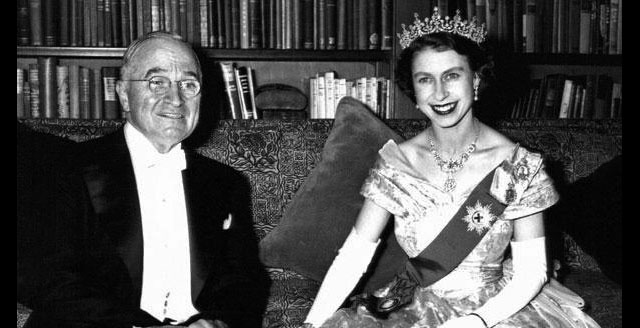
During her reign, Queen Elizabeth II of England has met 10 sitting US Presidents, every one from Eisenhower to Obama except for Lyndon Johnson. She also met Harry Truman as a princess in 1951 and former President Herbert Hoover in 1957.
You can see the entire progression here or here. QEII is more definitely a human wormhole.
BTW, Elizabeth is creeping up on Queen Victoria as the longest-reigning British monarch, just another two-and-a-half years to catch her. Victoria reigned during the terms of 19 different Presidents but never met any of them and had an unfair advantage…lots of short terms and one-term Presidencies back then. (via mlkshk)
If you read the piece on pickpockets in the New Yorker last week (and if not, I encourage you to), you’ve got to check out this video they made of Apollo Robbins taking all sorts of stuff from Adam Green, who plays the bewildered NYer writer part perfectly. Way better than the YT video I embedded last week.
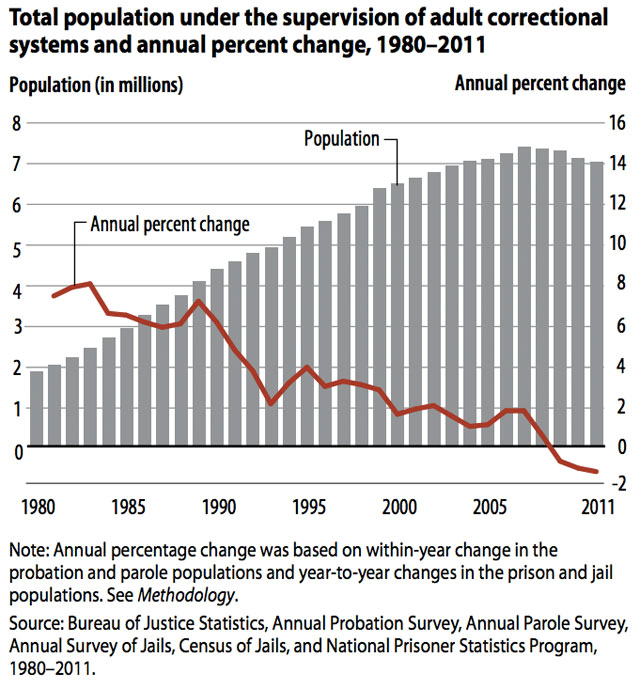
I hereby submit my nomination for the most underreported public policy story of the past year: The continuing decline in the number of Americans who are behind bars or on probation/parole. Both the change itself and low level of attention it has garnered are worthy of reflection.
At the time of President Obama’s inauguration, the incarceration rate in the United States had been rising every single year since the mid 1970s. The relentless growth in the proportion of Americans behind bars had persisted through good economic times and bad, Republican and Democratic Presidents, and countless changes in state and local politics around the country.
If a public policy trend with that much momentum had even slowed significantly, it would have been merited attention, but something far more remarkable occurred: The incarceration rate and the number of people under correctional supervision (i.e., including people on probation/parole) declined for three years in a row. At the end of 2011, the proportion of people under correctional supervision returned to a level not seen since the end of the Clinton Administration.
Commenters over at Marginal Revolution dug into the report a bit more and the decline may have a lot to do with things like state budget cuts and less to do with things like fewer/shorter prison sentences.
It is true that if there exists a “writer’s writer,” Saunders is the guy. “There is really no one like him,” Lorrie Moore wrote. “He is an original — but everyone knows that.” Tobias Wolff, who taught Saunders when he was in the graduate writing program at Syracuse in the mid-’80s, said, “He’s been one of the luminous spots of our literature for the past 20 years,” and then added what may be the most elegant compliment I’ve ever heard paid to another person: “He’s such a generous spirit, you’d be embarrassed to behave in a small way around him.”
In recent years, we’ve seen a pretty steady drop in serious crime in many American cities. There are several theories to explain the drop — better policing strategies, shifting demographics, economic ups and downs — but none of them seems to provide a full and consistent explanation. In Mojo, Kevin Drum thinks he may have found the villain behind crime (and lower IQs and ADHD): Lead. “When differences of atmospheric lead density between big and small cities largely went away, so did the difference in murder rates.” I’m not sure if this is truly the answer, but it’s a very interesting read: America’s Real Criminal Element.
Every evening at 10pm, students living in the Flogsta neighborhood of Uppsala, Sweden stick their heads out the window and scream. No one knows how it started, but most accounts say it began in the 1970s and has been going on every night since.
This is perfect…Riker Ipsum is lorem ipsum dummy text from Commander Riker’s dialogue on Star Trek: The Next Generation.
Our neural pathways have become accustomed to your sensory input patterns. Computer, belay that order. The game’s not big enough unless it scares you a little. When has justice ever been as simple as a rule book? What’s a knock-out like you doing in a computer-generated gin joint like this? Did you come here for something in particular or just general Riker-bashing?
Unsurprisingly, people are continuing to die from guns in the US. Adam Lanza killed 28 people on December 14th, 2012 and since then, 393 more people have died.
This is a silent film from 1926 that shows a call coming in to a Manhattan fire station, a first-person POV shot from the chief’s car as he responds to a call, and then some firemen fighting a blaze consuming a storage warehouse.
The driving through the crowded streets of Manhattan starts at about 2:10 with the BAD TRAFFIC JAMS FORCE USE OF SIDEWALKS title card coming soon after at 2:51. The film is sped up but still, the chief dodges all manner of roadsters, horse-drawn wagons, trolleys, buses, automobiles, and other assorted conveyances.
A nice interview with Wes Anderson. He discusses how he got his start in filmmaking, his prospects as the director of the next Star Wars movie, and his new film with Ralph Fiennes, The Grand Budapest Hotel.
DEADLINE: Star Wars was among the films that influenced you early on. What would the world get if Wes Anderson signed on to direct one of these new Star Wars films Disney will make?
ANDERSON: Well I have a feeling I would probably ultimately get replaced on the film because I don’t’ know if I have all the right action chops. But at least I know the characters from the old films.
DEADLINE: You are not doing a good job of selling yourself as a maker of blockbusters.
ANDERSON: I think you are reading it exactly right. I don’t think I would do a terrible job at a Han Solo backstory. I could do that pretty well. But maybe that would be better as a short.
NASA astronaut Sunita Williams, who has spent almost a year in space, gives us a 25-minute tour of the International Space Station. AKA the nerdiest episode of MTV Cribs.
In the latest issue of the New Yorker, Adam Green profiles Apollo Robbins, by most accounts the world’s best pickpocket. How he goes about engaging his prey is fascinating:
One day, over lunch at a Vietnamese restaurant in a Las Vegas strip mall, Robbins demonstrated his method on me. “When I shake someone’s hand, I apply the lightest pressure on their wrist with my index and middle fingers and lead them across my body to my left,” he said, showing me. “The cross-body lead is actually a move from salsa dancing. I’m finding out what kind of a partner they’re going to be, and I know that if they follow my lead I can do whatever I want with them.”
Robbins needs to get close to his victims without setting off alarm bells. “If I come at you head-on, like this,” he said, stepping forward, “I’m going to run into that bubble of your personal space very quickly, and that’s going to make you uncomfortable.” He took a step back. “So, what I do is I give you a point of focus, say a coin. Then I break eye contact by looking down, and I pivot around the point of focus, stepping forward in an arc, or a semicircle, till I’m in your space.” He demonstrated, winding up shoulder to shoulder with me, looking up at me sideways, his head cocked, all innocence. “See how I was able to close the gap?” he said. “I flew in under your radar and I have access to all your pockets.”
Hard to choose just one passage from this story, so I will also include this bit about attention:
But physical technique, Robbins pointed out, is merely a tool. “It’s all about the choreography of people’s attention,” he said. “Attention is like water. It flows. It’s liquid. You create channels to divert it, and you hope that it flows the right way.”
Robbins uses various metaphors to describe how he works with attention, talking about “surfing attention,” “carving up the attentional pie,” and “framing.” “I use framing the way a movie director or a cinematographer would,” he said. “If I lean my face close in to someone’s, like this” — he demonstrated — “it’s like a closeup. All their attention is on my face, and their pockets, especially the ones on their lower body, are out of the frame. Or if I want to move their attention off their jacket pocket, I can say, ‘You had a wallet in your back pocket — is it still there?’ Now their focus is on their back pocket, or their brain just short-circuits for a second, and I’m free to steal from their jacket.”
This routine is a pretty good demonstration of how Robbins diverts attention for the purpose of theft.
Regular patrons of North American dim sum restaurants will find most, if not all, of the selections pictured here familiar. Newcomers should find the illustrations-which have been grouped by their method of preparation and general type — helpful in identifying some of the more typical offerings. This arrangement will provide even first-time visitors to dim sum restaurants with access to field identification in a clear and rational array.
The first half of the Field Guide introduces steamed items; the second covers fried, baked, and sweet offerings. These general divisions have then been subdivided according to each dim sum’s predominant physical characteristics.
Note: If you are a member and tried to log in, it didn't work, and now you're stuck in a neverending login loop of death, try disabling any ad blockers or extensions. Or try logging out and then back in. Still having trouble? Email me!
















Socials & More