Entries for November 2012
The comedy duo Key & Peele in a sketch that’s Hogwarts meets The Wire.
Other great sketches of theirs: dubstep, civil war reenactors, “I’m retired”, and dungeons & dragons.
Key & Peele also have a fun, meta YouTube series where they critique their own show, in character. If you’re wondering more about the duo, there’s a good interview with them on Marc Maron’s WTF podcast. (last two links both a bit NSFW)
You’d think a radio show broadcasting from inside a psychiatric hospital would be either illegal, demeaning, extorting, or just plain weird, but Buenos Aires’ Radio Colifata (“The Crazy Lady”) is, by all accounts, endearing.
“Green cows run wild,” he says, “milk and milk and milk spilling. Green organs spill. Intestines spill.” An interned leans over and whispers to me, “That’s Dr. Vazquez. He is the only one allowed to interrupt the program. He worked as a surgeon here. His wife, a nurse, lives here too.” Doctor Vasquez leaves and his wife, who wears her nurse’s uniform, runs after him. Maria returns to her poem.
(via @robertashley)
A painter who lost his passion for art after going into treatment for a mental health issue, Patrick Tresset, sought to recapture his creativity by creating a robot who could draw in his style.
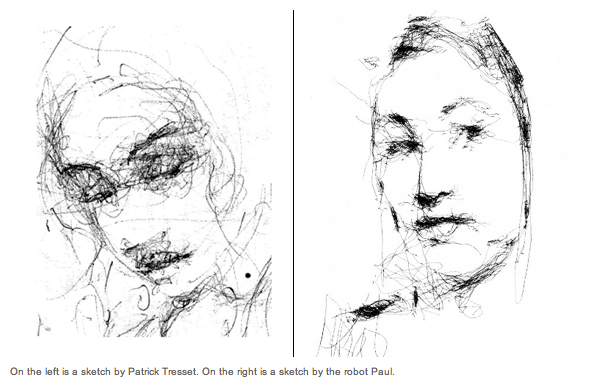
“When we draw, the difficulty is not in making the lines. The difficulty is in the perception of the subject and the perception of the drawing in progress.” But sometimes, it may help to make it seem that the robot has difficulty in making the lines—Tresset has found that people feel more empathy for the machines when they make human-esque mistakes like crooked or tilted lines. (He calls this “clumsy robotics.”) Humans are inclined to want to identify with robots, especially those with faces: Give a person a bot, and he or she will probably name it. But why is that connection important in robots that draw? Tresset believes that if the person being sketched feels something for the machine wielding the pen, he or she will find the 30-minute sketching process “more touching.” Plus, if the sitter assigns a personality to the robot, it might alter the human’s emotional response to the final product.
It’s an interesting feedback loop the robot creates: mechanically induced faults and artificial humanity create empathy in the subject which translates to that genuine emotion being captured by the robot in the sketch.
J. Kenji López-Alt does a long Thanksgiving Q&A on Serious Eats answering all those questions you’ll be babbling in your kitchen around 2 pm this Thursday.
He addresses classic conundrums:
If turkey is roasted well in advance of guests arriving, or there is a delay, what’s the best way to re-heat? To what temperature?
If tented with foil and left in a warm place, a turkey should stay warm for at least a couple hours—at least internally. The real danger is the skin getting soggy and the surfaces getting cold. The best way to fix this? Just pop it in a 550°F oven for 7 to 15 minutes until the skin is crisp and piping hot again. The rest should take care of itself.
As well as more contemporary considerations:
I have a vegan cousin coming to visit this year. Could you suggest any vegan dishes that I could serve that the rest of the family would be able to enjoy as well?
I really love my Vegan Chili made with real dried chilies and chickpeas, and I’d serve a vegan marinated kale salad with sumac onions to anyone, regardless of the carnivorosity.
For a more “holiday”-like approach, how about a stuffed delicata squash? You can totally leave off the parmesan from the breadcrumbs and still make out with a fantastic main course.
Check out all of Kenji’s answers to 50 different Thanksgiving questions over on Serious Eats.
Also on Serious Eats: the ultimate turducken. I made a turducken for Thanksgiving 3 years ago and, considering how much I manhandled it, it came out more delicious than it had any right to be. Duck fat covers a multitude of sins.
For me the best part of this video starts at 2:00 when the toddler wants to put his (her? I’m not great a telling the genders of Norwegian toddlers) toy car on top of the sexy robot/terrifyingly fast insect death machine, then you see at 2:28 the toddler immitating the robot and picking up their remote control for their toy car. Like father, like child.
I don’t remember how I found kottke.org. (This is Sarah Pavis, btw. Hi!)
I know I must have found it at least 4 years ago because it introduced me to almost everyone cool I’ve met on the internet in those years since. Everyone like Jason, Aaron, Deron, and Tim. (Theoretically I should be able to at least ballpark it based on what the kottke.org site design was at the time, but I’m a dirty RSS freeloader.) All I know is kottke.org was my portal to all the coolest stuff and, more importantly, the coolest people on the internet.
After all, the internet is a people connector. At least that’s what Dan Harmon, creator of Community and XOXO speaker, called it.
While I wish I could remember specifically how I found kottke.org, I do vividly remember being newly graduated from college, having moved halfway across the country to a city where I knew no one, sat in an office at a new job, and being unable to get on Gmail. Unable to talk with my friends. (This was 2006, pre-smartphones.) Feeling bereft, I stumbled upon Google Reader and after a short learning curve (“What the hell is RSS?”) I soon had an easy way to at least find interesting stuff to occupy me on slow days. Google Reader’s best feature, though, was the shared linkblogs which allowed you to exchange interesting articles with friends directly in Google Reader. For me these were like little messages in a bottle that I would toss back to the east coast, messages that were mostly cat pics and political rants.
Unfortunately, Google lobotomized Reader last year with the advent of Google Plus, shattering those fragile social networks. Google valued the connector more than the people it was connecting. (Any other Google Reader castaways out there? I’m trying NewsBlur now.)
Long story short: kottke.org led me to clusterflock.org when one day a clusterflock post showed up in my RSS feed that called my name. Literally. Turns out that Google Reader linkblog I was using as a lifeline to my friends back home was being read by other people including cflock’s Andrew Simone. After following Andrew and Tim on Twitter for awhile, I joined clusterflock as a contributor along with Garrett Miller. A few months ago, unbeknownst to each other, Garrett and I both bought tickets to XOXO, and when my housing accommodations fell through Garrett offered to let me crash with him, even though we’d never met. Thankfully, neither of us turned out to be axe-murdering rapists. And as a bonus to not dying, I got to meet a bunch of awesome people, including Jason. Hooray for the internet!
Do you have any cool stories about how the internet has been a people connector for you? Extra credit if you include how you found kottke.org and/or how kottke.org connected you with other people.
Email me at [email protected] by Wednesday night, and I’ll do a roundup post on Thursday of your stories.
I am in [PARtially undIscloSed location] for vacation this week so I’ve asked Sarah Pavis to fill in. Her Tumblr says she’s “a mechanical engineer & writer living in Chicago” and when I met her briefly at XOXO in September she didn’t seem like a dishonest person so I believe that she actually is those things. Sarah has also done some writing for Buzzfeed and some tweeting for herself. She’s also active on Stellar, which is where I noticed that she had a good eye for whatever the hell it is I do here, an eye that spotted this video, which goes from sexy robot to terrifyingly fast insect death machine in about 45 seconds.
Anyway, welcome Sarah!
According to Hasbro, Monopoly was invented by Charles Darrow in 1933 and sold to Parker Brothers soon after. But that’s not quite the whole story.
The game’s true origins, however, go unmentioned in the official literature. Three decades before Darrow’s patent, in 1903, a Maryland actress named Lizzie Magie created a proto-Monopoly as a tool for teaching the philosophy of Henry George, a nineteenth-century writer who had popularized the notion that no single person could claim to “own” land. In his book Progress and Poverty (1879), George called private land ownership an “erroneous and destructive principle” and argued that land should be held in common, with members of society acting collectively as “the general landlord.”
Magie called her invention The Landlord’s Game, and when it was released in 1906 it looked remarkably similar to what we know today as Monopoly.
But it was Monopoly with a significant twist:
The game’s most expensive properties to buy, and those most remunerative to own, were New York City’s Broadway, Fifth Avenue, and Wall Street. In place of Monopoly’s “Go!” was a box marked “Labor Upon Mother Earth Produces Wages.” The Landlord Game’s chief entertainment was the same as in Monopoly: competitors were to be saddled with debt and ultimately reduced to financial ruin, and only one person, the supermonopolist, would stand tall in the end. The players could, however, vote to do something not officially allowed in Monopoly: cooperate. Under this alternative rule set, they would pay land rent not to a property’s title holder but into a common pot-the rent effectively socialized so that, as Magie later wrote, “Prosperity is achieved.”
With a lengthy section on the philosophy underpinning the original version of the game, this is more interesting than an article about a board game has the right to be.
vintage post from Nov 2012
· gift link
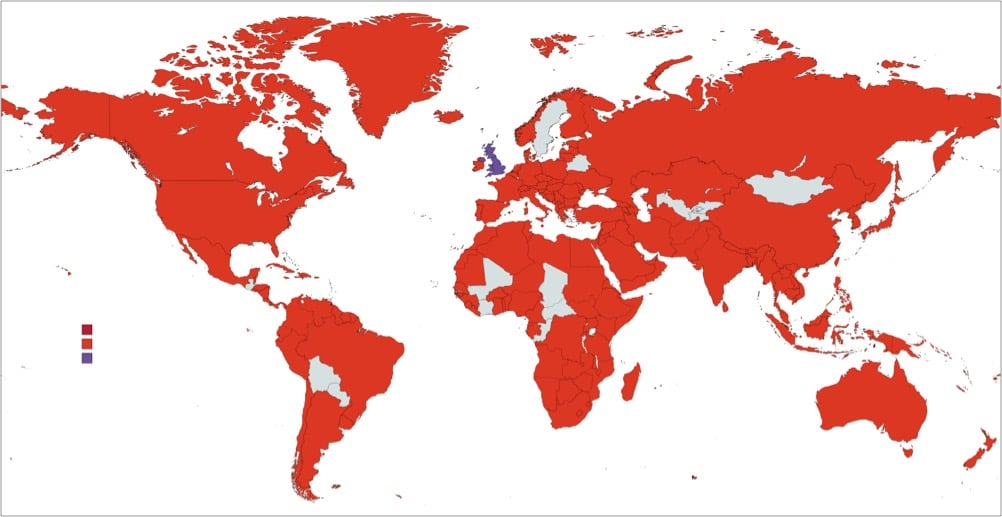
Of the current 200 nations in the world, the British have invaded all but 22 of them. The lucky 22 include Sweden, Luxembourg, Mongolia, Bolivia, and Belarus. The full analysis is available in Stuart Laycock’s book, All the Countries We’ve Ever Invaded.
Stuart Laycock, the author, has worked his way around the globe, through each country alphabetically, researching its history to establish whether, at any point, they have experienced an incursion by Britain.
Only a comparatively small proportion of the total in Mr Laycock’s list of invaded states actually formed an official part of the empire.
The remainder have been included because the British were found to have achieved some sort of military presence in the territory — however transitory — either through force, the threat of force, negotiation or payment.
Incursions by British pirates, privateers or armed explorers have also been included, provided they were operating with the approval of their government.
The US currently has military personnel stationed in all but 43 countries.
For instance, as of Sept. 30, 2011, there were 53,766 military personnel in Germany, 39,222 in Japan, 10,801 in Italy and 9,382 in the United Kingdom. That makes sense. But wait, scanning the list, you also see nine troops in Mali, eight in Barbados, seven in Laos, six in Lithuania, five in Lebanon, four in Moldova, three in Mongolia, two in Suriname and one in Gabon.
But the presence in most of those countries is due to diplomatic usage of military personnel. (thx, aaron)
A little late for Veteran’s Day, but this is a great collection of photography from Vietnam. These two stick out for me (both photos by Horst Faas):
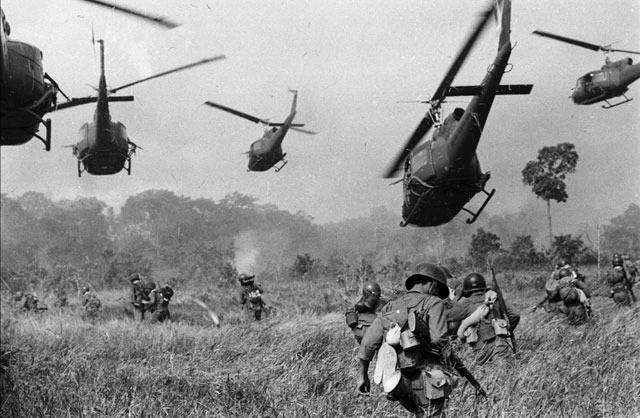

Some images NSFW and may be disturbing, etc. (via @Colossal)
The Blaze has a collection of county-by-county election maps for every US Presidential election since 1900.
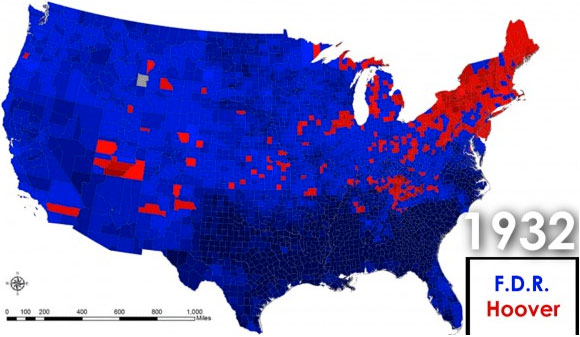
The video at the bottom is worth watching to witness the shift between a north/south divided country to a urban/rural divided country over the past 20 years.
Ashlyn Blocker does not feel pain, a condition called ‘Congenital insensitivity to pain.’ Although she can feel pressure, and warm or cool, she can’t feel extreme heat or cold. In this profile in the NY Times Magazine, though, she seems like a relatively well-adjusted 13 year-old girl, which is a credit to her and her parents. Pretty fascinating story.
Tara and John weren’t completely comfortable leaving Ashlyn alone in the kitchen, but it was something they felt they had to do, a concession to her growing independence. They made a point of telling stories about how responsible she is, but every one came with a companion anecdote that was painful to hear. There was the time she burned the flesh off the palms of her hands when she was 2. John was using a pressure-washer in the driveway and left its motor running; in the moments that they took their eyes off her, Ashlyn walked over and put her hands on the muffler. When she lifted them up the skin was seared away. There was the one about the fire ants that swarmed her in the backyard, biting her over a hundred times while she looked at them and yelled: “Bugs! Bugs!” There was the time she broke her ankle and ran around on it for two days before her parents realized something was wrong. They told these stories as casually as they talked about Tristen’s softball games or their son Dereck’s golf skills, but it was clear they were still struggling after all these years with how to keep Ashlyn safe.
[…]
“It is an extraordinary disorder,” Woods said. “Boys die at a younger age because of more risky behavior. It’s quite interesting, because it makes you realize pain is there for a number of reasons, and one of them is to use your body correctly without damaging it and modulating what you do.”
“You have a secret that can ruin your life.” That’s according to Mat Honan, and he should know. Several months ago he saw much of his online life hacked and deleted in an instant. In this Wired cover story (that includes some valuable tips for protecting yourself online), Honan breaks the news that “no matter how complex, no matter how unique, your passwords can no longer protect you.”
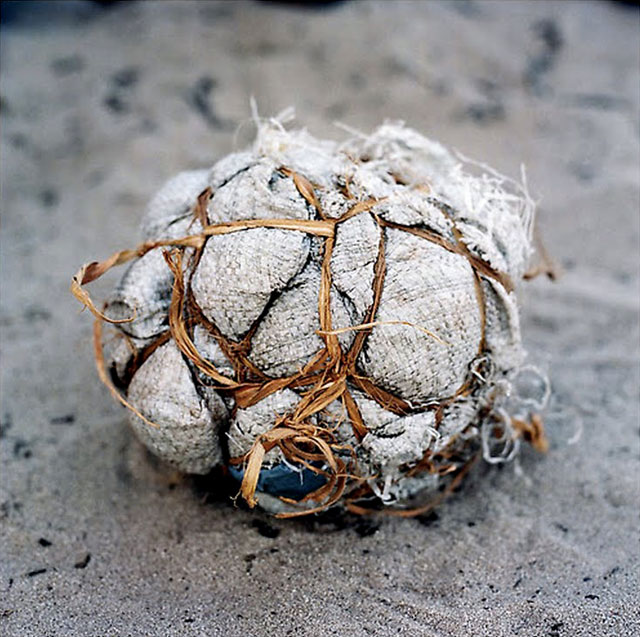
Photographer Jessica Hilltout has documented the game of soccer/football/futbol around the world, from the secondhand footwear to the improvised goals to the makeshift balls:
In October 2011, after 20 years of living legally in the United States, Atanas Entchev and his 21-year-old son were detained by the US Immigration and Customs Enforcement agency, given orange jumpsuits to wear, and held for 65 days. Entchev is writing a book about his experience called My American Lemonade.
Day after day from my bunk, I listened to the immigration stories of my roommates. We all had one. Mine involved over 20 years of countless dollars spent on lawyers who would help me navigate the paperwork and court dates necessary for immigration, based on my request for political asylum. Meanwhile I strived to be tops in my field, starting with a presidential certificate from George H. W. Bush and receiving an Outstanding Professor designation from INS, ICE’s predecessor agency. I started my own company, paid taxes, and raised two children here. But that obviously wasn’t enough. I had failed at giving me and my family what we wanted most: U.S. citizenship. I dug deep, used what my family had taught me about resolve and hope, and thought a lot about my past to remind myself why I’d left Bulgaria. Why I’d bothered. The irony was especially palpable to me lying in that bunk, recalling the moment I knew for sure I must leave.
Entchev is one of kottke.org’s most thoughtful readers…he’s been sending email, links, and typo corrections regularly for more than four years now. From what I understand, he’s completed a book proposal consisting of the first three chapters and is looking for an agent. If you can help him out in that regard, drop him a line.
Sicilian artist Valerio Carrubba takes portraits and modifies them with MOAR HAIR!

(thx, david)
From before the election, which seems like it was several months ago already, a piece from Clayton Christensen about how investors and companies should shift their thinking about allocating capital. Christensen’s gist is that efficiency is creating pools of excess capital which is not being reinvested into the types of industry that create jobs.
The Fed has been injecting more and more capital into the economy because — at least in theory — capital fuels capitalism. And yet cash hoards in the billions are sitting unused on the pristine balance sheets of Fortune 500 corporations. Billions in capital is also sitting inert and uninvested at private equity funds.
Capitalists seem almost uninterested in capitalism, even as entrepreneurs eager to start companies find that they can’t get financing. Businesses and investors sound like the Ancient Mariner, who complained of “Water, water everywhere — nor any drop to drink.”
It’s a paradox, and at its nexus is what I’ll call the Doctrine of New Finance, which is taught with increasingly religious zeal by economists, and at times even by business professors like me who have failed to challenge it. This doctrine embraces measures of profitability that guide capitalists away from investments that can create real economic growth.
Read all the way to end; Christensen offers some suggestions for shifting capital allocation.
Fairy wrens have a cuckoo problem. Specifically, cuckoos lay their eggs in the nest of the fairy wrens and, if undetected, they would end up raising the baby cuckoos to the potential detriment of their own children. But what the fairy wren mother does is after laying her eggs, she sings a unique song to the eggs until they hatch. Having learned the song while in-egg, the hatched baby wrens sing back part of the song to get fed.
She kept 15 nests under constant audio surveillance, and discovered that fairy-wrens call to their unhatched chicks, using a two-second trill with 19 separate elements to it. They call once every four minutes while sitting on their eggs, starting on the 9th day of incubation and carrying on for a week until the eggs hatch.
When Colombelli-Negrel recorded the chicks after they hatched, she heard that their begging call included a single unique note lifted from mum’s incubation call. This note varies a lot between different fairy-wren broods. It’s their version of a surname, a signature of identity that unites a family. The females even teach these calls to their partners, by using them in their own begging calls when the males return to the nest with food.
These signature calls aren’t innate. The chicks’ calls more precisely matched those of their mother if she sang more frequently while she was incubating. And when Colombelli-Negrel swapped some eggs between different clutches, she found that the chicks made signature calls that matches those of their foster parents rather than those of their biological ones. It’s something they learn while still in their eggs.
(via bruce schneier)
Frustrated by the lack of durability of traditional soccer balls and encouraged by an investment by Sting, Tim Jahnigen invented and is selling a more durable ball made out of hard foam.
Tim Jahnigen has always followed his heart, whether as a carpenter, a chef, a lyricist or now as an entrepreneur. So in 2006, when he saw a documentary about children in Darfur who found solace playing soccer with balls made out of garbage and string, he was inspired to do something about it.
The children, he learned, used trash because the balls donated by relief agencies and sporting goods companies quickly ripped or deflated on the rocky dirt that doubled as soccer fields. Kicking a ball around provided such joy in otherwise stressful and trying conditions that the children would play with practically anything that approximated a ball.
“The only thing that sustained these kids is play,” said Mr. Jahnigen of Berkeley, Calif. “Yet the millions of balls that are donated go flat within 24 hours.”
You can buy one online and for every ball that you buy, one will be donated to a community in need.
One of my favorite magazine pieces is Truman Capote’s long profile of Marlon Brando from the Nov 9, 1957 issue of the New Yorker.
He hung up, and said, “Nice guy. He wants to be a director-eventually. I was saying something, though. We were talking about friends. Do you know how I make a friend?” He leaned a little toward me, as though he had an amusing secret to impart. “I go about it very gently. I circle around and around. I circle. Then, gradually, I come nearer. Then I reach out and touch them — ah, so gently…” His fingers stretched forward like insect feelers and grazed my arm. “Then,” he said, one eye half shut, the other, à la Rasputin, mesmerically wide and shining, “I draw back. Wait awhile. Make them wonder. At just the right moment, I move in again. Touch them. Circle.” Now his hand, broad and blunt-fingered, travelled in a rotating pattern, as though it held a rope with which he was binding an invisible presence. “They don’t know what’s happening. Before they realize it, they’re all entangled, involved. I have them. And suddenly, sometimes, I’m all they have. A lot of them, you see, are people who don’t fit anywhere; they’re not accepted, they’ve been hurt, crippled one way or another. But I want to help them, and they can focus on me; I’m the duke. Sort of the duke of my domain.”
In a piece for Columbia Journalism Review, Douglas McCollam details how Capote got access to the reclusive star when he was filming Sayonara in Japan.
Logan had no intention of subjecting his own cast and crew to the same withering scrutiny. In particular, he was concerned about what might happen if Capote gained access to his mercurial leading man. Though Brando was notoriously press-shy, and Logan doubted Capote’s ability to crack the star’s enigmatic exterior, he wasn’t taking any chances. He and William Goetz, Sayonara’s producer, had both written to The New Yorker stating that they would not cooperate for the piece and, furthermore, that if Capote did journey to Japan he would be barred from the set. Nevertheless, Capote had come.
As Logan later recounted, his reaction to Capote’s sudden appearance was visceral. He came up behind Capote, and without saying a word, picked the writer up and transported him across the lobby, depositing him outside the front door of the hotel. “Now come on, Josh!” Capote cried. “I’m not going to write anything bad.”
Logan went immediately upstairs to Brando’s room to deliver a warning: “Don’t let yourself be left alone with Truman. He’s after you.” His warning would go unheeded. Recalling his reaction to Capote, Logan later wrote, “I had a sickening feeling that what little Truman wanted, little Truman would get.”
Alexis Madrigal wrote about Capote’s Brando piece for the first installment of Nieman Storyboard’s Why’s This So Good series about classic pieces of narrative nonfiction.
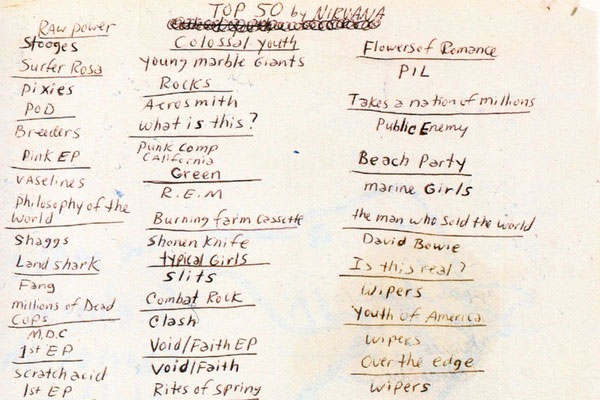
From Kurt Cobain’s journals, a handwritten list of the late Nirvana frontman’s 50 favorite albums, including those from Sonic Youth (duh), Pixies (double duh), and Mazzy Star.
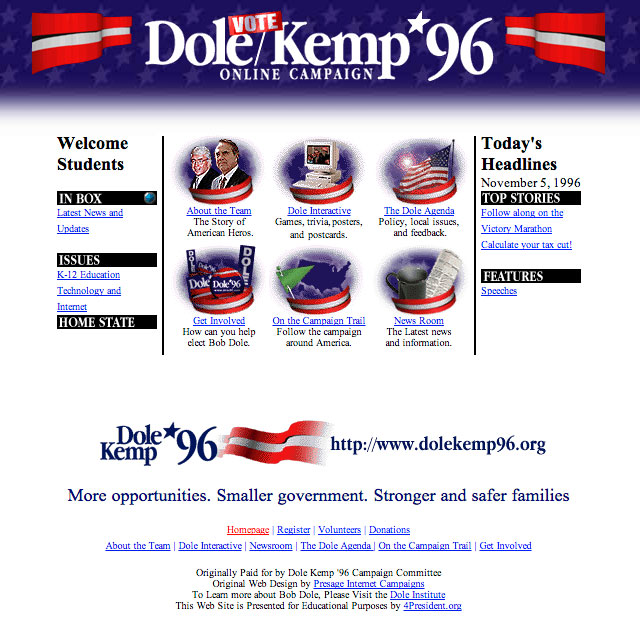
The campaign website for Dole/Kemp ‘96 is still available on the web. The entire front page at its actual size fits in this image…man, screens used to be tiny.
The Clinton/Gore ‘96 site no longer seems to be available (cg96.org is a parked domain, covered with ads), but 4president.us has some archived screenshots and a press release of some remarks by Al Gore on the site’s launch. We’ve come a long way since then.
This is the first thing you see when you go to our home page, and it has a couple of innovative features for those of you who are familiar with the Internet and the World Wide Web. It’s not very common to have this kind of ticker with a changing message at the bottom constantly moving or to have a server pushing new pictures onto the page with regularity right to your own computer.
Anyway, this is the first thing that you see, and then we go to the main menu. Since 1992, Bill Clinton has been working tirelessly to insure that America forges ahead and leads the world in the information age. He has brought technology into our classrooms and libraries, he signed the historic telecommunications reform bill to make sure that all of our cabinet agencies are online. Together, not long after we got into the White House, we became the very first President and Vice-President to have e-mail addresses and to set up a White House Website. I hope all of you have had the opportunity to visit the White House Website.
4president.us also has screenshots from other campaign sites that year, including those of Steve Forbes and Pat Buchanan. (via @kdawson)
Matter, a new publication that raised funds on Kickstarter, has launched and their first story is fantastic. Do No Harm by Anil Ananthaswamy profiles those suffering from Body Integrity Identity Disorder…people who believe that one or more of their limbs don’t belong to them and want them amputated.
Sitting at home in a small, somewhat rural American town not too far from the ocean, Patrick recalled the day his wife found out about his obsession. It was during the mid-’90s. As with almost all BIID sufferers, Patrick was fascinated with amputees, so he began downloading pictures of them off the Internet and printing them out. One day his wife was sitting in front of their computer, while Patrick sat in a wingback chair. She noticed a pile of printouts. They were images of men, but “completely clothed, no nudes or anything like that.” It was an awkward moment. “She was thinking that maybe I was gay,” Patrick recalls. “I must have been crimson.” Patrick asked her to take a closer look. She did, and soon realised that the men were all amputees.
Patrick told his wife that he had felt odd about his leg since he was four years old, a feeling that eventually grew into an all-consuming desire to be rid of it. It was a shock: they had been married for decades, and the revelation that he had been hiding something was hard to take. But his confession also brought relief. For more than four decades he had suffered alone. Growing up in small-town America, with conservative parents, in an era when “people didn’t believe in going and seeing mental health professionals,” Patrick was mystified by what he felt.
The last third of the piece, in which Ananthaswamy accompanies a BIID sufferer to have an amputation in Asia, was really difficult to read…powerful stuff. The piece is 99 cents for web/ePub/Kindle versions.
Last week, the hosts of NFL Kick Off on ESPN, Trey Wingo, Mark Sclereth, and Tedy Bruschi, jammed as many Princess Bride references as they could into their half hour show. Jack Moore collected them. Genuine guffaw at “There will be no survivors” from around :45.
(thx, Alex)
The Dust Bowl is a four-hour documentary by Ken Burns airing on PBS starting this weekend.
The Dust Bowl chronicles the worst man-made ecological disaster in American history, in which the frenzied wheat boom of the “Great Plow-Up,” followed by a decade-long drought during the 1930s nearly swept away the breadbasket of the nation. Vivid interviews with twenty-six survivors of those hard times, combined with dramatic photographs and seldom seen movie footage, bring to life stories of incredible human suffering and equally incredible human perseverance. It is also a morality tale about our relationship to the land that sustains us — a lesson we ignore at our peril.
You can watch the first five minutes of the film on the PBS site.

Photo by @blawndee. This might be the best instance of pareidolia I’ve ever seen.
Motor Trend chose the Tesla Model S as its 2013 Car of the Year, the first time their top prize has gone to an electric car.
The 2013 Motor Trend Car of the Year is one of the quickest American four-doors ever built. It drives like a sports car, eager and agile and instantly responsive. But it’s also as smoothly effortless as a Rolls-Royce, can carry almost as much stuff as a Chevy Equinox, and is more efficient than a Toyota Prius. Oh, and it’ll sashay up to the valet at a luxury hotel like a supermodel working a Paris catwalk. By any measure, the Tesla Model S is a truly remarkable automobile, perhaps the most accomplished all-new luxury car since the original Lexus LS 400. That’s why it’s our 2013 Car of the Year.
The magazine went on to say that “the Tesla Model S is simply a damned good car you happen to plug in to refuel”. This is how environmentally friendly products win, by being better than the less green products they replace.
The Infinite Jukebox analyzes the self-similarity of music to create neverending and everchanging versions of songs.
The app works by sending your uploaded track over to The Echo Nest, where it is decomposed into individual beats. Each beat is then analyzed and matched to other similar sounding beats in the song. This information is used to create a detailed song graph of paths though similar sounding beats. As the song is played, when the next beat has similar sounding beats there’s a chance that we will branch to a completely different part of the song. Since the branching is to a very similar sounding beat in the song, you (in theory) won’t notice the jump. This process of branching to similar sounding beats can continue forever, giving you an infinitely long version of the song.
Love this idea. How could I not with disclaimers like this?
you can get stuck in a strange attractor at the end of Karma Police for instance
Try it out with Call Me Maybe, Scary Monsters and Nice Sprites, or Little Fluffy Clouds. (via waxy)
You’ll be sorry you asked.
Kent Brewster’s Who Likes Mitt allows you to watch Mitt Romney’s Facebook fans unlike him in real time. Before the election, I wondered how either candidate would utilize their social media platforms in the event of their loss, as both Mitt Romney and Barack Obama had several million followers on Twitter and Facebook. We’ll have quite some time to see the answer because at the current and unsustainable rate of abandonment, Mitt’s last follower will unlike him in just over 3 years. *181 Facebook fans left Mitt while this post was written. (via ★akuban)
Update: Now, with graphs! (thx, @colossal)
Again. Venice is flooded again. The flooding happens so often that it’s pretty much business as usual:
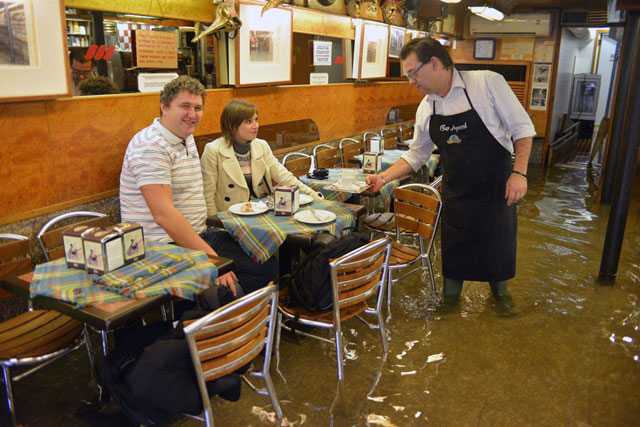
Except that this is a pretty serious long-term issue for Venice. The flooding is called acqua alta and according to a city guide, the current mark of 149 cm means that almost 70% of the city is flooded. And six of the top fifteen high water marks were recorded within the past 10 years.
But a project is underway to ease the flooding: a series of gates intended to protect the city called the MOSE Project.
The New Yorker’s David Remnick urges President Obama to address climate change during his second term in a Kennedy-esque “we choose to go to the Moon” fashion.
Barack Obama can take pride in having fought off a formidable array of deep-pocketed revanchists. As President, however, he is faced with an infinitely larger challenge, one that went unmentioned in the debates but that poses a graver threat than any “fiscal cliff.” Ever since 1988, when NASA’s James Hansen, a leading climate scientist, testified before the Senate, the public has been exposed to the issue of global warming. More recently, the consequences have come into painfully sharp focus. In 2010, the Pentagon declared, in its Quadrennial Defense Review, that changes in the global climate are increasing the frequency and the intensity of cyclones, droughts, floods, and other radical weather events, and that the effects may destabilize governments; spark mass migrations, famine, and pandemics; and prompt military conflict in particularly vulnerable areas of the world, including the Middle East, Southeast Asia, and sub-Saharan Africa. The Pentagon, that bastion of woolly radicals, did what the many denialists in the House of Representatives refuse to do: accept the basic science.
The economic impact of weather events that are almost certainly related to the warming of the earth — the European heat wave of 2003 (which left fifty thousand people dead), the Russian heat waves and forest fires of 2010, the droughts last year in Texas and Oklahoma, and the preelection natural catastrophe known as Sandy — has been immense. The German insurer Munich Re estimates that the cost of weather-related calamities in North America over the past three decades amounts to thirty-four billion dollars a year. Governor Andrew Cuomo, of New York, has said that Sandy will cost his state alone thirty-three billion. Harder to measure is the human toll around the world-the lives and communities disrupted and destroyed.
For the New Yorker, Paul Rudnick imagines a love letter written to Nate Silver by an 11-year-old girl.
I know that you’re openly gay but that’s fine because we can just hang out and you can say things like “I think that Harry from One Direction is 73% cuter than Louis although Louis is 21.8% funnier than Harry and my model predicts that they would both really like you, Emma, even though they both look 100% like Kristen Stewart, only less rugged.” And I could tell you that if you were choosing a boyfriend for yourself Anderson Cooper would be 85.7% smarter and more sardonic than Ricky Martin, but Ricky would be 23% more mature because he has twins by a surrogate, although Anderson does have a more comprehensive wardrobe of election-year eyeglass frames.
The last Kottke.org post about how hot dogs are made was almost 4 years ago, and that video doesn’t event work anymore and I say Saturday is the day to learn stuff anyway.
Two things about this video:
1) The scene of hot dogs shooting out of the hot dog maker and into the pile of hot dogs is mesmerizing. Virtually every ‘How x is made’ video has a similarly awesome shot.
2) These dudes make almost 2.5 million hot dogs per shift, which… Well, there are far, far, far more hot dogs being made in this country everyday than any of us realize.
(via ★andre)
How had I not heard about this before now? The Mind of a Chef is a PBS consisting of sixteen half-hour shows that follows David Chang through his world of food. As far as I can tell, this series is basically the TV version of Lucky Peach. Episode one is about ramen:
In the series premiere, David dissects the roots of his passion for ramen dishes and tsukemen on a trip to Japan. Learn the history of this famous noodle as David visits a ramen factory, has a bowl of the original tsukemen, and examines how alkalinity makes noodles chewier and less prone to dissolving in broth.
Check out an excerpt here, in which Chang reveals how he used to eat instant ramen noodles right out of the bag with the pork flavor powder sprinkled on top. The series starts this weekend…check your local listings, as they say. (via ny times)
Ever since St. Vincent’s closed in 2010 (I walk past it every morning taking my son to school and they are ripping the shit out of the building to turn it into condos), lower Manhattan has been short more than a few hospital beds. In the aftermath of hurricane Sandy, Manhattan has been left with zero high-level trauma centers south of 68th Street.
Now, the nearest Level One trauma centers for residents of lower Manhattan aren’t all that close: New York Presbyterian/Weill Cornell Medical Center is on the Upper East Side at East 68th Street and St. Luke’s/Roosevelt Hospital is on the Upper West Side.
Officials say there’s no reason to think that, for now, trauma victims in lower Manhattan will be any worse off than those in other parts of the city. The response speed is still acceptable, they say. And if a trauma victim is in an immediately life-threatening situation, such as a traumatic cardiac arrest, ambulances bring them to the closest hospital, regardless of whether it’s a trauma center.
But the fear is that there won’t be enough surge capacity at other hospitals if there is a major disaster, or that overworked staff at other hospitals will grow fatigued under the load and patient care could suffer.
Well, I’m sure the free market will sort all of this out. (via @Atul_Gawande)
Last month, celebrated author Philip Roth quietly announced his retirement to a French magazine and no one in the US noticed until Salon picked up on it today.
In an interview with a French publication called Les Inrocks last month — which does not appear to have been reported in the United States — Roth, 78, said he has not written anything new in the last three years, and that he will not write another novel.
“To tell you the truth, I’m done,” Roth told the magazine, in the most definitive statement he has ever made about his future plans. “‘Nemesis’ will be my last book.”
(via @CharlesCMann)
Finally, the answer to the question “what if Wes Anderson directed Star Wars”.
Emeril Lagasse made an appearance on Treme on Sunday. I watched a clip of his scene a few days ago and have been thinking about it on and off ever since. In the scene written by Anthony Bourdain, Emeril takes a fellow chef to the building that used to house Uglesich’s, a small-but-beloved New Orleans restaurant that closed back in 2005. The chef is having misgivings about expanding her business, particularly about all the non-cooking things you have to do, and Emeril explains that the way the owners of Uglesich’s did it was one way forward:
You see, they kept it small, just one spot, just a few tables. There’d be a line around the corner by 10 am. You see, they made a choice. Anthony and Gail made a choice to stay on Baronne Street and keep their hands on what they were serving. They cooked, everyday they cooked, until they could cook no more.
But there’s also another way to approach your business:
The other choice is that you can build something big but keep it the way that you wanna keep it. Take those ideas and try to execute them to the highest level. You got a lotta people around you, right? You’re the captain of the ship. Or what I should say is that you’re the ship. And all these people that look up to you and wanna be around you, they’re living in the ship. And they’re saying, “Oh, the ship is doing good. Oh, the ship is going to some interesting places. Oh, this ship isn’t going down just like all the other fucking ships I’ve been on.” […] You’ve got a chance to do your restaurant and to take care of these people. Just do it.
kottke.org has always been a one-person thing. Sure, Aaron posts here regularly now and I have guest editors on occasion, but for the most part, I keep my ass in the chair and my hands on what I am serving. I’ve always resisted attempts at expanding the site because, I have reasoned, that would mean that the site wouldn’t be exactly what I wanted it to be. And people come here for exactly what I want it to be. Doing the site with other people involved has always seemed unnatural. It would be selling out…that’s how I’ve thought about it, as opposed to blowing up.
But Emeril’s “until they could cook no more” and “you’re the ship”…that got to me. I am a ship. I don’t have employees but I have a family that relies on the income from my business and someday, when I am unable to do this work or people stop reading blogs or all online advertising moves to Facebook or Twitter, what happens then? Don’t I owe it to myself and to them to build something that’s going to last beyond my interest and ability to sit in a chair finding interesting things for people to look at? Or is it enough to just work by yourself and produce the best work you can?
Or can you do both? John Gruber’s Daring Fireball remains a one-man operation…as far as I know, he’s never even had an intern. I don’t have any inside knowledge of DF’s finances, but from the RSS sponsorship rate and the rate for sponsoring Gruber’s podcast, my conservative estimate is that DF grosses around $650,000 per year. And with a single employee/owner and relatively low expenses, a large amount of that is profit. So maybe that route is possible?
I don’t have any answers to these questions, but man, it’s got me thinking. Emeril got me thinking…who saw that coming? Bam!
Occupy Wall Street continues to show that it’s more than just a simple protest movement. They have been doing amazing work with Hurricane Sandy relief and now there’s Rolling Jubilee. Here’s how Rolling Jubilee works:
OWS is going to start buying distressed debt (medical bills, student loans, etc.) in order to forgive it. As a test run, we spent $500, which bought $14,000 of distressed debt. We then ERASED THAT DEBT. (If you’re a debt broker, once you own someone’s debt you can do whatever you want with it - traditionally, you hound debtors to their grave trying to collect. We’re playing a different game. A MORE AWESOME GAME.)
This is a simple, powerful way to help folks in need — to free them from heavy debt loads so they can focus on being productive, happy and healthy. As you can see from our test run, the return on investment approaches 30:1. That’s a crazy bargain!
This has my vote for idea of the year. Well, until the debt sellers catch on and either raise the price due to demand or refuse to sell to untrusted brokers.
Photographer James Balog (the guy behind a new documentary called Chasing Ice) spent years taking pictures of the melting glaciers. In a variety of ways, these photos are quite incredible.

From the March 1979 issue of The Atlantic, a profile of George Lucas, who at the time was only two years removed from creating a cultural movement.
Star Wars was manufactured. When a competent corporation prepares a new product, it does market research. George Lucas did precisely that. When he says that the film was written for toys (“I love them, I’m really into that”), he also means he had merchandising in mind, all the sideshow goods that go with a really successful film. He thought of T-shirts and transfers, records, models, kits, and dolls. His enthusiasm for the comic strips was real and unforced; he had a gallery selling comic-book art in New York.
From the start, Lucas was determined to control the selling of the film, and of its by-products. “Normally you just sign a standard contract with a studio,” he says, “but we wanted merchandising, sequels, all those things. I didn’t ask for another $1 million — just the merchandising rights. And Fox thought that was a fair trade.” Lucasfilm Ltd., the production company George Lucas set up in July 1971, “already had a merchandising department as big as Twentieth Century-Fox has. And it was better. When I was doing the film deal, I had already hired the guy to handle that stuff.”
This article is like a time capsule of how the movie business used to work. Empire Strikes Back was a year away from release and there was no specific mention of it in the article. Star Wars opened in only 25 theaters and made only $9 million in the first two months. Those numbers don’t quite match those from Box Office Mojo but they are close enough, especially when you note that the film’s biggest grossing weekend was 43 weeks after the initial release.
Lucas, if you hadn’t heard, is donating the majority of the $4 billion he got from Disney for Lucasfilm to various charitable foundations.
Now’s probably a good time to remind you of this Flickr set of prominent Republicans Photoshopped to look like clowns.

Before you accuse me of crass and childish partisanship, I will also take this opportunity to urge you to stop what you’re doing to “express your hatred, shame, and outright disgust with anyone you know who voted Democrat”, boycott businesses that accept EBT, and allow your dog to crap on Democrat lawns.
This year’s election reminded me of a piece that Anil Dash wrote almost ten years ago on our culture’s tendency towards liberalism. It’s my favorite thing he’s ever written and is one of the few pieces of writing that instantly shifted my thinking in a significant way.
Our ideas are winning, you see. When Reagan ordered the bombing of Libya in 1986, he didn’t make sure to urge Americans to have tolerance for people of Libyan descent living among us. But a scant 15 years later, President Bush made repeated calls for tolerance towards muslims in this country, not just out of what I see as his genuine motivation to do what was right, but also because the tenor of public discourse has changed that rapidly due to the tolerant influence of liberal philosophy. Gay marriage is still a big point of debate, but the presence of openly gay characters in mass media has changed in the same decade and a half from being scandalous to being clich’ed. It will be the burden of the next generation to hold the today’s conservatives to their record of homophobia, but it’s only a matter of time until that happens.
George W. Bush put out a message from the White House in honor of Kwanzaa. We’re winning.
It’s probably that sense of a slow, inexorable loss that makes conservatives terrified, causing them to respond with a desperate clinging to the past that only serves to further doom their cause. The best solutions, of course, lie in the future.
Tuesday’s election — an event that included reelecting a mixed-race President, legalizing marijuana in some states, legalizing same-sex marriage in some states, electing women to the Senate in record numbers, the election of the first openly gay Senator, and the defeat of many hard-line social conservatives — serves as a reminder that the country continues to move in a more liberal direction.
Early color photography is a particular interest of mine, so Sanna Dullaway’s efforts to colorize historical photos, including those of Abraham Lincoln, Thích Quảng Đức, and Anne Frank, are an intriguing twist on the theme.

Some genius paired 50 Cent’s In Da Club with a video put out by the Jehovah’s Witnesses to encourage deaf people not to masturbate.
(via stellar)
David Brooks argues that over time, people (especially men) have become more emotionally intelligent and that this shift might be responsible for a significant portion of our cultural progress.
In the 1930s and 1940s, the researchers didn’t pay much attention to the men’s relationships. Instead, following the intellectual fashions of the day, they paid a lot of attention to the men’s physiognomy. Did they have a “masculine” body type? Did they show signs of vigorous genetic endowments?
But as this study — the Grant Study — progressed, the power of relationships became clear. The men who grew up in homes with warm parents were much more likely to become first lieutenants and majors in World War II. The men who grew up in cold, barren homes were much more likely to finish the war as privates.
Body type was useless as a predictor of how the men would fare in life. So was birth order or political affiliation. Even social class had a limited effect. But having a warm childhood was powerful. As George Vaillant, the study director, sums it up in “Triumphs of Experience,” his most recent summary of the research, “It was the capacity for intimate relationships that predicted flourishing in all aspects of these men’s lives.”
(via @stevenbjohnson)
It’s been a tough few weeks here in NYC. Sandy. Power outages. Food and gas shortages. The hurricane aftermath. Those two kids murdered by their nanny. The NYPD officer who was planning to kill and cook women. The election has been weighing heavily on my heart, more heavily than I realized. The Presidential campaign has been difficult for me to follow…so little substance and so so so much sound and fury, signifying nothing.
I’ve been pretty apathetic about politics in the past and I’ll never be the type of person to proselytize for one candidate over another (well, not too much anyway) but I would have waited in line for 12 hours today in order to cast my vote. Voting this morning1 felt like the first hopeful thing that’s happened in quite awhile.
[1] For Obama/Biden, I don’t mind telling you, not least because of the Republican Party’s contempt for the rights of the majority of the population, aka our wives, daughters, mothers, grandmothers, aunts, etc. ↩
Publishing on kottke.org is suspended until further notice. The situation in New York and New Jersey is still dire** so posting stupid crap seems frivolous and posting about the Sandy aftermath seems exploitive. Information is not what people need right now; people need flashlights, candles, drinking water, safety, food, access to emergency medical care, a warm place to sleep, etc.
Anyway, we’ll be back in a few days hopefully.
** I say “still dire” because I think the perception among people not in the NY/NJ area is one of “oh, the storm has passed, the flooding is subsiding, and everything is getting back to normal”. But that’s not what I’m hearing. What I’m hearing is that there are large areas that have been without power for 4-5 days, people are running out of food and gas, food and gas deliveries are not happening, etc. Things are getting worse (or certainly have the potential to get worse), not better, especially for those without the resources to care about which cool restaurants are open or how much an iPhone car service is gouging its customers or which Midtown office they’re gonna work on their startup from.
The stories of long time minor leaguers overcoming obstacles to make it to the big leagues are always heartwarming and Tigers pitcher Phil Coke’s story is no different. Minor league players are payed poorly, spend days on buses, and most players never make it. Coke, who pitched fantastically in the 2012 postseason until giving up the winning run in the last game of the World Series, had an interesting road to the majors, as well. He’s got an interesting take on why MLB teams, most of which are swimming in money, make it so hard for minor leaguers.
“It’s part of the psychological effort to find out how mentally tough you really are,” Coke said. “Can you still perform when the rent’s due and you’re out of money? It’s a crazy schedule too, one you’ve never played before. You’re playing every day. You go from not knowing what a weekend is to not knowing what day it is at all. You’re in a town for two to four days, then off on these very, very long bus trips. Your choices are read a book, sleep your face off, or banter and talk with teammates. You figure out who the sleepers are and who are the ones who pull all-nighters. I was drawn to those people. But being away from family, friends, having a life, it’s really tough.”
Newer posts
Older posts






Socials & More