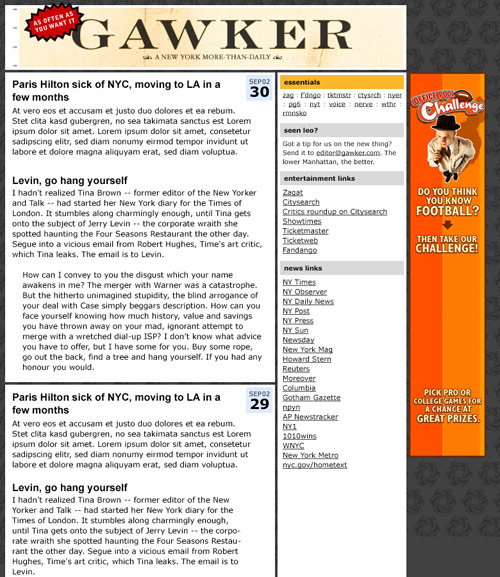
With all the buzz around the new Gawker design, I figured I’d dig out the first design I ever showed Nick for the site back in October of 2002:
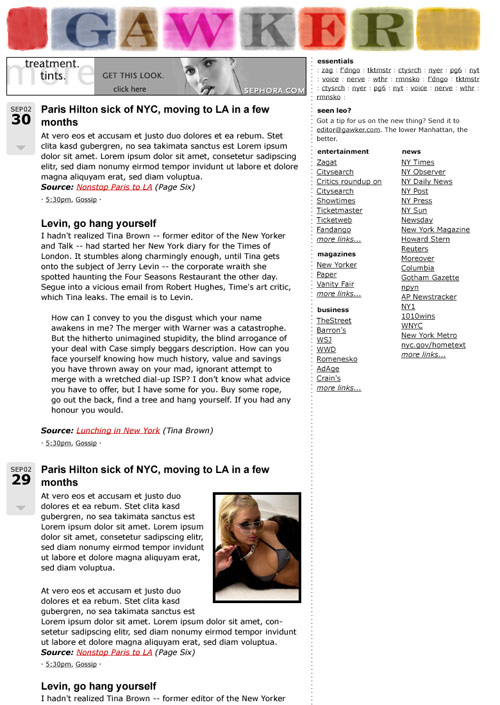
Nick didn’t like it too much. Background too dark, masthead text not logo-y enough. Two weeks later, I sent him this, with a half-assed technicolor logo that I’d dashed off in Photoshop in like 30 minutes:
To my shock, he loved it — so much so that they’re still using the damn thing! — and that design was very close to how the site looked when it launched.
In the 1820s, two Nantucket whaling ships captained by George Pollard sank within three years of each other. The sinking of the first, The Essex, inspired Moby-Dick. Remains of the second ship, the Two Brothers, have recently been found off Hawaii, the first time artifacts from a sunken Nantucket whaler have been found.
“Nantucket whaling captains were renowned for being what was called ‘fishy men,’ meaning that they didn’t care what was involved,” said Nathaniel Philbrick, a maritime historian and author of “In the Heart of the Sea,” the acclaimed account of the Essex’s sinking. “They were hard-wired to bring in whales, because whales meant money.”
Pollard, however, was different, “a little more contemplative,” said Mr. Philbrick, despite earning his first helm — the Essex — at the young age of 28.
“He definitely garnered his men’s respect,” Mr. Philbrick said. “But he was twice unlucky.”
And understandably gun-shy. According to an account by Thomas Nickerson, who had been on the Essex — and nearly starved to death at sea after it sank, but still re-upped for another voyage with Pollard — the captain froze on the deck of the Two Brothers after the ship began to sink, and he had to be practically dragged into a smaller whale-chasing boat.
“His reasoning powers had flown,” Nickerson later wrote.
Dr. Gleason says she was impressed that Pollard even went back on a boat at all, considering, you know, the cannibalism of his first trip.
“You just imagine this man who had the courage to go back out to sea, and to have this happen?” she said. “It’s incredible.”
Speaking of Scientology, P.T. Anderson is working on two movies: 1) a film people are calling The Master about a religious movement similar to Scientology, and 2) an adaptation of Thomas Pynchon’s Inherent Vice.
Last December, this blog was the first to report that Anderson had written a treatment of Pynchon’s seventh novel, and was considering doing a screenplay. Now insiders confirm to Vulture that Anderson has, in fact, obtained the blessing of Pynchon and — in frequent consultation with the eremite novelist himself — has not only written a first draft, but is more than halfway done with a second.
I’m still powering through it, but the Scientology article in the latest New Yorker is a great read. The article focuses on director and screenwriter Paul Haggis (Crash, Million Dollar Baby), who recently left the church after reaching the church’s highest level.
NSIDC reported that ice extent was unusually low in Hudson Bay, Hudson Strait, and Davis Strait in the early winter. Normally frozen over by late November, these areas did not completely freeze until mid-January 2011. The Labrador Sea was also unusually ice-free.
Alan Taylor, late of The Big Picture, is up and running at The Atlantic with his new site, In Focus.
In Focus is The Atlantic’s news photography blog. Several times a week, I’ll post entries featuring collections of images that tell a story. My goal is to use photography to do the kind of high-impact journalism readers have come to expect on other pages of this site. Along the way, I’ll cover a range of subjects, from breaking news and historical topics to culture high and low. Sometimes, I’ll just showcase amazing photography.
This interactive chart from the Washington Post shows how the average body mass index has risen in most countries since 1980. The European men getting comparatively heavier than European women (against the general trend of the rest of the world) is interesting.
Imagine people’s height being proportional to their income, so that someone with an average income is of average height. Now imagine that the entire adult population of America is walking past you in a single hour, in ascending order of income.
The first passers-by, the owners of loss-making businesses, are invisible: their heads are below ground. Then come the jobless and the working poor, who are midgets. After half an hour the strollers are still only waist-high, since America’s median income is only half the mean. It takes nearly 45 minutes before normal-sized people appear. But then, in the final minutes, giants thunder by. With six minutes to go they are 12 feet tall. When the 400 highest earners walk by, right at the end, each is more than two miles tall.
In CASINO ROYALE, James Bond is the Bond girl. Look at the way they even show him emerging from the ocean like Ursula Andress. Sexual torture, too, if less creepy-glam than being stripped and painted gold. Vesper Lynd is Bond: never not in control, never without a plan, seducing to further her goals. She has to die so Bond can become her.
Steven Heller had heard rumors of a Nazi graphics standards manual for years and finally tracked one down.
Published in 1936, The Organizationsbuch der NSDAP (with subsequent annual editions), detailed all aspects of party bureaucracy, typeset tightly in German Blackletter. What interested me, however, were the over 70 full-page, full-color plates (on heavy paper) that provide examples of virtually every Nazi flag, insignia, patterns for official Nazi Party office signs, special armbands for the Reichsparteitag (Reichs Party Day), and Honor Badges. The book “over-explains the obvious” and leaves no Nazi Party organization question, regardless of how minute, unanswered.
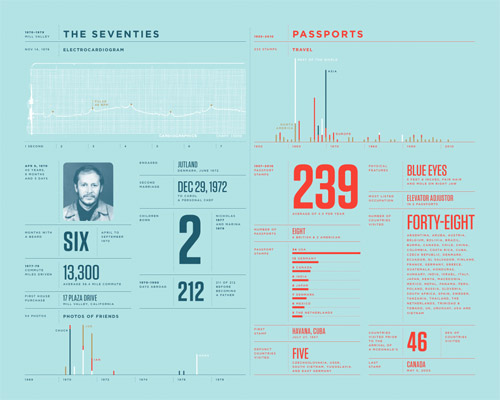
Nicholas Felton has been doing personal annual reports since 2005. But for 2010, he did a report of his late father’s life utilizing various documents (birth certificates, notebooks, slides, etc.).
This is a marvelous document. Here’s a photo of some of the source materials.
The phenomena of path dependence and lock-in can be illustrated with many examples, but one of the most vivid is the gear we use to launch things into space. Rockets are a very old invention. The Chinese have had them for something like 1,000 years. Francis Scott Key wrote about them during the War of 1812 and we sing about them at every football game. As late as the 1930s, however, they remained small, experimental, and failure-prone.
A rocket taking offThere is no way, of course, to guess how rockets might have developed, or failed to, were it not for the fact that, during the 1940s, the world’s most technically sophisticated nation was under the absolute control of a crazy dictator who decreed that vast physical and intellectual resources should be hurled into the project of creating rockets of hitherto unimagined size.
In 2004, the astrophysicist Robin Canup, at the Southwest Research Institute in Texas, published some remarkable computer simulations of the Big Splat. To get a moon like ours to form — instead of one too rich in iron, or too small, or wrong in other respects — she had to choose the right initial conditions. She found it best to assume Theia is slightly more massive than Mars: between 10% and 15% of the Earth’s mass. It should also start out moving slowly towards the Earth, and strike the Earth at a glancing angle.
The result is a very bad day. Theia hits the Earth and shears off a large chunk, forming a trail of shattered, molten or vaporized rock that arcs off into space. Within an hour, half the Earth’s surface is red-hot, and the trail of debris stretches almost 4 Earth radii into space. After 3 to 5 hours, the iron core of Theia and most of the the debris comes crashing back down. The Earth’s entire crust and outer mantle melts. At this point, a quarter of Theia has actually vaporized!
After a day, the material that has not fallen back down has formed a ring of debris orbiting the Earth. But such a ring would not be stable: within a century, it would collect to form the Moon we know and love. Meanwhile, Theia’s iron core would sink down to the center of the Earth.
I tweeted earlier this evening about the Buffalo wings blue cheese dip I made for tomorrow’s football festivities and a couple people were wondering about the recipe, so here you go. Legend has it this is the original recipe from the Anchor Bar (aka the birthplace for Buffalo wings), clipped out of a Buffalo newspaper by Meg’s mother in the 70s and copied out longhand in Meg’s recipe notebook.
2 tbsp finely chopped onion
1 clove garlic, minced
1/4 cup finely chopped fresh parsley leaves
1/2 cup sour cream
1 cup mayonnaise
1 tbsp fresh-squeezed lemon juice
1 tbsp white vinegar
1/4 cup crumbled blue cheese
Salt, black pepper, and cayenne pepper to taste
Combine. Chill. Me? I did the onion and garlic first and then added the lemon juice and vinegar and let that sit while I measured out the mayo and sour cream. Salt and peppers after everything else is mixed. Tastes great! Go Buffalo!
Growing up in abject poverty in Houston, Texas, Donald, his mother, and brother lived, at various times, in a U-Haul, out of a car, and on the streets. As a young teen, Donald used his intelligence, natural dexterity and quick hands to become an extremely effective car thief. He sold the cars to buy drugs, which he then turned around and sold for more money. He believes he stole up to thirty cars, and was only caught once.
This equation’s initial purpose, he wrote, was to put meaningful prices on the terrestrial exoplanets that Kepler was bound to discover. But he soon found it could be used equally well to place any planet-even our own-in a context that was simultaneously cosmic and commercial. In essence, you feed Laughlin’s equation some key parameters — a planet’s mass, its estimated temperature, and the age, type, and apparent brightness of its star — and out pops a number that should, Laughlin says, equate to cold, hard cash.
At the time, the exoplanet Gliese 581 c was thought to be the most Earth-like world known beyond our solar system. The equation said it was worth a measly $160. Mars fared better, priced at $14,000. And Earth? Our planet’s value emerged as nearly 5 quadrillion dollars. That’s about 100 times Earth’s yearly GDP, and perhaps, Laughlin thought, not a bad ballpark estimate for the total economic value of our world and the technological civilization it supports.
Forgive me Internet for I have sinned. It has been several months since I regularly posted addictive Flash games to kottke.org. As penance, I offer up Love, in which you get your spinning square close to (but not too close to) a bunch of squares. More funner than it sounds. Go in peace.
If you run into me on the sidewalk while you are heads-down texting, emailing, IMing, reading, sexting, Angry Birdsing, or whatever elseing on your mobile device, I get to slap that fucking thing out of your hands a la Alex Rodriguez slapping the ball out of Bronson Arroyo’s glove in game six of the 2004 American League Championship Series, except way less milquetoasty. And you do the same for me, ok?
Addendum: If you’re heads-down texting on your phone accompanying a young child in a crosswalk with lots of traffic turning through it, I get to slap the phone out of your hands, punch you in the face, and take your child away from you forever. Seriously, what the fuck is wrong with you people?
This Wikipedia page has HTML hex codes for all of the 133 standard Crayola crayon colors, including Silver, Blue Green, Melon, Wild Strawberry, and Forest Green.
In the past 4 months, I’ve changed my life for the better in three significant ways.
Why?
My relationships changed, and thus my everyday changed. I began eating with someone who ate differently than me. I adopted her eating habits, which spurred me to change how I ate. I also spent more time with Grant, who introduced me to the world of urban cycling. I adopted his lifestyle and his interests. And then I changed myself and started pushing my heart in the gym.
I’m playing Health Month this month, mostly just for the hell of it. The game is built to be social…there are teams, players offer each other support, etc. Just two days in, I can see why this might work for me: it turns private goals into public rules.
I almost stopped reading this about halfway through because she wouldn’t stop having children, but it’s worth sticking it out until the end. (via dooce)
Congratulations! The fact that you’re reading this book means you’re on your way to achieving your WILDEST DREAMS. You want to be a dentist? I’m going to make it happen. And guess what? It only takes four hours. Let me repeat that: in four hours, you will be a dentist. Take a deep breath and get ready for the ride of your life. Welcome to the 4-Hour Dentist.
The big new game will be called Angry Birds Rio. It’s a movie tie-in (blech), but as long as the game features a ton of that trademark bird-flinging action, who cares?
Writer Rob Neyer recently left ESPN for SB Nation and in his first column for SBN, he articulates the difference between “us” (professional journalists) and them (readers).
I’ve never thought of myself as a member of us rather than them.
I’ve got a lot of passions, and generally I won’t bore you with them. But the passion I indulge almost every day of my life is good writing. I crave it, and when I find it, I treasure it. I surround myself with books full of good writing, and I can’t get through the day without scribbling down a brilliant sentence or delightful word in a thick journal that’s always close at hand.
Also, it’s my business. I’m one of the lucky few who gets paid to indulge his first love.
Where the good writing comes from, though, is irrelevant. All that matters is the writing.
You’re paid to write? I know lots of professional writers who either never learned to write well, or have forgotten. You work for a famous website or newspaper? The big boys don’t have a monopoly on good writing, let alone facts.
Sportswriting, like writing about computing or video games, lends itself especially well to amateur participation because you’ve got, what, tens of millions of people who, even at an early age, are basically experts on football, baseball, basketball, hockey, etc. because they’ve grown up playing, watching, and analyzing those sports. The actual writing bit is harder but the passion is definitely there. (via hello typepad)
People whose surnames begin with the first few letters of the alphabet (A-I) seem to react differently to certain situations than those whose surnames begin with the letters at the end of the alphabet (R-Z). Slate reports.
E-mails were sent out to adults offering them $500 to participate in a survey. Average response time was between six and seven hours. The same negative correlation between response time and alphabetic rank was observed, but only when the researchers looked at the names the respondents were born with. When Carlson and Conard looked at married names or names changed for some other reason, the correlation dwindled to insignificance. This, they conclude, demonstrates that the “last name effect” derives from “a childhood response tendency.” Only people who grew up with a name at the back of the alphabet demonstrated truly Pavlovian responses to the $500 offer.
Over the last few years, I’ve been collecting examples of metagames — not the strategy of metagaming, but playable games about videogames. Most of these, like Desert Bus or Quest for the Crown, are one-joke games for a quick laugh. Others, like Cow Clicker and Upgrade Complete, are playable critiques of game mechanics. Some are even (gasp!) fun.
This video shows what various planets (Jupiter, Mars, etc.) would look like in the night sky if they orbited the Earth at the same distance as the Moon.
Note: If you are a member and tried to log in, it didn't work, and now you're stuck in a neverending login loop of death, try disabling any ad blockers or extensions. Or try logging out and then back in. Still having trouble? Email me!












Socials & More