Entries for October 2006
Photographer Philippe Halsman took portraits of people while jumping (the people, not Halsman), as a way to loosen up. Subjects include Marilyn Monroe, Richard Nixon, and the Dule and Duchess of Windsor. (viabb)
Just how much women’s underwear can be stashed in one person’s closet? “Next I discovered two loose pairs of women’s underwear. Next I discovered a Pokemon lunchbox containing 20 pairs of women’s underwear, and next I discovered a blue hardened briefcase containing 73 pairs of women’s underwear.”
Headline of the week: “Horniest male beetles have the tiniest testicles”. Bravo!
Dori Smith had her personalized license plate (“WEB GEEK”) stolen and she wants it back, no questions asked. “I know a lot of people in the San Francisco/Silicon Valley area. I know a lot of Web geeks. The chances are good that whoever ends up with my plate knows someone who knows someone who knows me.”
A collection of artists each picked a page from The Pat Robertson and Friends Coloring Book and “colored” them in. (thx, gk)
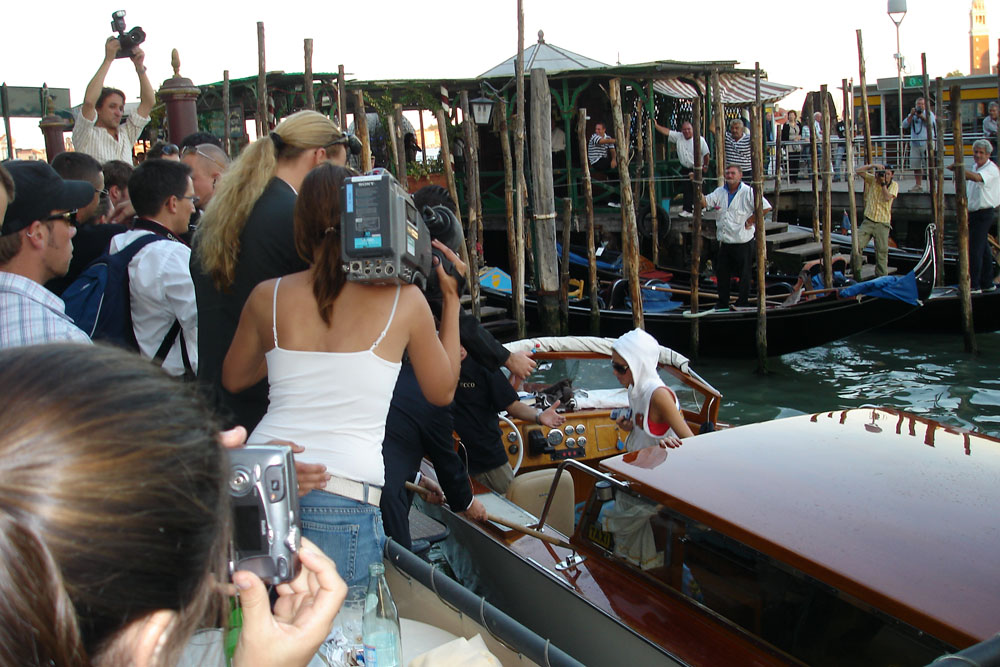
The future of science: celebrity photography. While in Venice for the World Conference on the Future of Science, prominent philosopher Daniel Dennett squeezed off a shot of Paris Hilton arriving at the hotel for, one would assume, activities unrelated to the scientific proceedings.
Tyler Cowen takes a closer look at the recent “600,000 deaths in Iraq” claim. “We all know that the political world judges Iraq by the absolute badness of what is going on (which means Bush critics find a higher number to fit their priors), but that is an incorrect standard. We should judge the marginal product of U.S. action, relative to what else could have happened. In that latter and more accurate notion of a cost-benefit test, U.S. actions probably appear worst when deaths are rising over time, and hitting very high levels in the future.”
Bob Holmes imagines an earth without people in New Scientist. “All things considered, it will only take a few tens of thousands of years at most before almost every trace of our present dominance has vanished completely. Alien visitors coming to Earth 100,000 years hence will find no obvious signs that an advanced civilisation ever lived here.”
Update: Derek Miller notes that even after human traces have vanished from earth, evidence of our civilization would remain on the moon and in space.
Because of his open source programming connection, Hans Reiser’s arrest for his wife’s murder was big news in that community. After his wife disappeared, Reiser bought 2 books on murder, including David Simon’s Homicide. Simon is the creator of The Wire.
The story of Friendster’s failure. By way of illustration, the people involved all blame each other for the debacle. I’ve gotta say, I loved watching Friendster fail…they were the poster child for stupid dot com companies during a time when that crap was all supposed to have been flushed down the toilet. “At MySpace, they rode the wave instead of fighting it [as Friendster did], and encouraged users to do pretty much as they pleased.”
If God didn’t want us to blog, he wouldn’t have created Movable Type, am I right? “Let me emphasize that no one — including adults — should have a blog or personal website.”
Plastic, which has been down for months, seems to be back up again.
YouTube’s popularity and recent sale to Google is hurting Universal Tube and Rollerform Equipment Corp’s business; their web site, utube.com, is getting millions of hits from misdirected video viewers and the companies regular customers can’t get in to purchase equipment.
List of the 7 worst fonts. What, no Hobo or Brush Script? Comic Sans is, of course, #1 with a bullet. (via wider angle)
15 ways to improve your newspaper business. “1. Go out in street, see news, write it up.”
From the perspective of the outside observer, New York’s Little Italy seems like little more than a chunk of Disney World plopped down in the midst of lower Manhattan. On the ground, the reality is not much better, particularly if you’re out to find a good meal. Unlike neighboring Chinatown, Little Italy’s food reputation is not the best. Since we started working in our new office in Chinatown, a number of forays have been made into Little Italy in order to procure take-out to bring back to the office, particularly pizza-by-the-slice. The results have been disappointing; several slices of blah pizza and a deep-fried risotto ball with prosciutto, mozzarella, and peas (sounds fantastic, right?) that was way not fantastic.
Is there anywhere in this whole small country we can get good Italian food to go or pizza-by-the-slice? As it is, Little Italy is reflecting poorly on the mother country and its excellent cuisine, and it would be nice, if possible, to salvage some of that reputation.
Pruned takes us on a short tour of grain elevators. Wonderful old industrial buildings…the small town I grew up in had a huge grain elevator rising from the center of town, like a skyscraper in a cornfield.
There has been a recent rash of technology and creative conferences whose speakers are mostly white males. The lack of diversity caused Jen Bekman to compile a list of women speakers for your conference. If you’ve got a technology or creative arts conference coming up and need some diversity in your speaking lineup, this is a good place to start.
Summary of a talk by Malcolm Gladwell on precociousness. “What a gifted child is, in many ways, is a gifted learner. And what a gifted adult is, is a gifted doer. And those are quite separate domains of achievement.”
The Rotenberg Center is a school for special education students that is essentially a giant Skinner box. Students are hooked to electrical devices and shocked when they misbehave. At once fascinating and disturbing. (via mr)
Mostly positive review of the Sony Reader by David Pogue. That it’s Windows-only is a real bummer for me and my go-go Macintosh lifestyle.
Update: Sorry, the “Windows-only” bit above is confusing. The software to load documents directly to the Reader is only available for Windows, but you can use any old OS you want to put documents on an SD card and then the card into the Reader. (thx, erik)
Jimmy Carter on the North Korean situation: “What must be avoided is to leave a beleaguered nuclear nation convinced that it is permanently excluded from the international community, its existence threatened, its people suffering horrible deprivation and its hard-liners in total control of military and political policy.”
Futurama tidbit: “Groening’s series Futurama is back, thanks to strong DVD sales. Four Futurama DVD movies are scheduled for release and they will be chopped into episodes for broadcast on Comedy Central in 2008.”
Shopping in Chinatown at lunch: pork uterus for $2.99/lb.
Computing is killing cursive writing. My writing was always bad, but now that I write things maybe once every three months, it’s like I don’t even know what a pencil is…most monkeys print better than I can.
Youngna Park has a short wrap-up of going to see Annie Leibovitz speak about her new book, A Photographer’s Life: 1990-2005. “And, so it goes, said Leibovitz, that some of us use words in order to take good pictures, and some of us take pictures, in order that we can be heard.”
The Ghost Map is a book about:
- a bacterium
- the human body
- a geographical map
- a man
- a working friendship
- a household
- a city government
- a neighborhood
- a waste management system1
- an epidemic
- a city
- human civilization
You hooked yet? Well, you should be. As the narrative unfolds around the 1854 London cholera epidemic, author Steven Johnson weaves all of these social, geographical, and biological structures/webs/networks into a scientific parable for the contemporary world. The book is at its best when it zooms among these different scales in a Powers of Ten-like fashion (something Johnson calls The Long Zoom), demonstrating the interplay between them: the way the geography of a neighborhood affected the spread of a virus, how ideas spreading within a social context are like an epidemic, or the comparison between the organism of the city and the geography of a bacterial colony within the human colon. None of this is surprising if you’ve read anything about emergence, complexity, or social scale invariance, but Johnson effectively demonstrates how tightly coupled the development of (as well as our understanding of) viral epidemics and large cities were across all of these scales.
The other main theme I saw in the book is how inherently messy science is. Unlike many biographies, The Ghost Map doesn’t try to tie everything up into a nice little package to make a better story. The cholera epidemic and its resolution was sloppy; there was no aha! moment where everyone involved understood what was going on and knew what had to be done. But the scientific method applied by John Snow to the situation was solid and as more evidence became available over the years, his theory of and solution to cholera epidemics were revealed as actual fact. Johnson reminds us that that’s how science works most of the time; science is a process, not a set of facts and theories. During the recent debate in the US over evolution and intelligent design, I felt a reluctance on the part of scientists to admit to this messiness because it would give an opening to their detractors: “haha, so you admit you don’t know what’s going on at all!” Which is unfortunate, because science is powerful in its nuance and rough edges (in some ways, science is what happens at the margins) in helping us understand ourselves and the world we live in.
[1] Had Mark Kurlansky written this book, it would have been called “Shit: How Human Effluence Changed the World”. ↩
Yossi Vardi shows that data transfer by snail is faster than broadband. “He showed a slide of a snail hitched to a tiny chariot with DVDs for wheels. If each disk contains 4.7 gigabytes of data, and if the snail (chasing a scrap of lettuce) travels at 0.000023 metres per second, the snail-system performance rate is over thirty-seven megabits per second. That blows ADSL out of the water.”
Photos from a visit to Pixar. “Whenever they get an idea for a story and there is something that they aren’t sure they know how to do yet, instead of putting 250+ people on a project and spend millions on something that they are unsure of, they will put 30 people on it and have them to create a short to see if it can be done.”
Atul Gawande on the rise in Cesarean deliveries in the US, which soon may become safer than natural childbirth: “We are losing our connection to yet another natural process of life. And we are seeing the waning of the art of childbirth. The skill required to bring a child in trouble safely through a vaginal delivery, however unevenly distributed, has been nurtured over centuries. In the medical mainstream, it will soon be lost.”
Newer posts
Older posts




Socials & More