kottke.org posts about video
In this NASA promotional film from 1977, Star Trek star Nichelle Nichols takes a tour of the Johnson Space Center with Apollo 12 astronaut Al Bean and urges viewers, especially women and people of color, to sign up to be astronauts on NASA’s Space Shuttle program.
As one of the first black women to play a lead role on television, Nichols was a role model for women and people of color, particularly those interested in science, space, and engineering. When she was she thinking of quitting Star Trek, Nichols met Martin Luther King Jr. at a NAACP fundraiser and he talked her into staying on the show. She recalled King telling her:
Do you not understand what God has given you? … You have the first important non-traditional role, non-stereotypical role. … You cannot abdicate your position. You are changing the minds of people across the world, because for the first time, through you, we see ourselves and what can be.
So when NASA came calling, Nichols used her position well:
She relayed her response to NASA with a mischievous twinkle in her eye, “I am going to bring you so many qualified women and minority astronaut applicants for this position that if you don’t choose one… everybody in the newspapers across the country will know about it.”
Nichols credited Star Trek with the success of her recruiting efforts. “Suddenly the people who were responding were the bigger Trekkers you ever saw. They truly believed what I said… it was a very successful endeavor. It changed the face of the astronaut corp forever.”
Among the recruits drawn to NASA by Nichols’ efforts were Sally Ride, the first American woman in space, Ronald McNair & Judith Resnick, who both died in the Challenger accident, Guion Bluford, the first African-American in space, and Mae Jemison, who was the first black woman in space. The diversity of the latest batch of NASA astronauts-in-training is a testament to Nichols’ and NASA’s joint efforts as well. (via open culture)
From Hiroshi Kondo, a mesmerizing short film called Multiverse of the motorbike-jammed streets of Taiwan. Right around the 50 second mark, Kondo starts to use a clever time lapse technique to highlight individuality within the bustling mass of traffic. It’s a really cool effect and reminded me of this clip art animation by Oliver Laric. (via colossal)
Black Mirror is back for a fifth season on Netflix starting June 5. The season will consist only of three episodes and will star, among others, Miley Cyrus, Topher Grace, Andrew Scott, and Anthony Mackie. Here’s the trailer:
I have to admit that I haven’t watched all of season 4 yet…or Bandersnatch. Living in an episode of Black Mirror isn’t exactly conducive to wanting to watch Black Mirror.
In the latest episode of Last Week Tonight, John Oliver discusses the Green New Deal and carbon pricing. Oliver invited beloved children’s science educator Bill Nye to help him explain a few things and Nye delivered a short but passionate speech about what’s at stake in the political battle over climate change:
I’ve got an experiment for you. Safety glasses on. By the end of this century, if emissions keep rising, the average temperature on earth could go up another four to eight degrees. What I’m saying is: the planet’s on fucking fire!
There are a lot of things we could do to put it out. Are any of them free? No, of course not. Nothing’s free you idiots! Grow the fuck up, you’re not children anymore. I didn’t mind explaining photosynthesis to you when you were 12. But you’re adults now and this is an actual crisis, got it? Safety glasses off, motherfuckers.
The entire segment is worth watching (particularly if you haven’t been keeping up on what the Green New Deal actually is) but Nye’s closing remarks are at ~18:30 for the impatient.
In the spire of a Swedish church built around the end of the 12th century, eight large rafters (that are in spectacularly good shape considering they’re 800 years old) appear to be fashioned from the same tree using a technique that had not been documented before. So, using only medieval woodworking tools and techniques, a team set out to prove that those rafters could have been made in that way.
The woodworkers’ search for a proper tree to use (starting at ~2:55) brings to mind the recent kerfuffle over the replacement beams for the Notre Dame.
Finding a suitable tree for this experiment is not necessarily easy. Where do you find a tall, straight, even pine tree with no branches for at least 13 meters off the ground?
They eventually found a 195-year-old tree with 11 meters of no branches.
The pace of this video is so leisurely that it feels almost meditative at times, watching this massive log slowly yield to the woodworkers’ effort and ingenuity. Recommended if you’re feeling stressed about the pace of the world.
See also How Tree Trunks Are Cut to Produce Lumber with Different Shapes, Grains, and Uses and Watch As a Master Woodworker Turns a Giant Log into an Elegant Dugout Canoe. (via bb)
The development of vaccines against infectious diseases is among the greatest of human accomplishments and has saved ten of millions of people from dying. And yet some are still hung up on their side effects (and also the widely disproved and debunked fraudulent claim that vaccines cause autism). In this video, Kurzgesagt looks at how vaccines work and compares the impact of their side effects (minuscule) to the potential effect of the diseases they protect against (children dying).
The extensive list of sources they used for the video can be found here.
The title of this video is “The Side Effects of Vaccines - How High is the Risk?”, which seems like it’s maximized for clicks and to spread amongst anti-vaxxers on social media. I wish it had a more accurate title — something like “The Absurdly Low Risk of Vaccine Side Effects” or maybe “Vaccines. And Now My Kids Don’t Die.” — but perhaps positioning it this way is a good strategy to get folks who may not be quite so radicalized to watch it.
Running From COPS is a new podcast that examines the cultural influence of the long-running TV show COPS. Vox did a short video on the main themes of the show:
From a Fast Company article about the podcast and its creator, Dan Taberski:
The problem is that Cops is more reality show than documentary, and Taberski, a veteran reality show producer, knows there’s a huge disparity between reality show “reality” and documentary reality. In the course of their investigation, the Running from Cops team discovered that the police had final cut approval for the series. “When you start to look at the contractual relationship between producers and police-and we got our hands on a few of those contracts between Cops and the police departments — I think people will be really surprised how much the police are controlling their own message on the show,” Taberski says. Watching the show in that light, he adds, “It just shows how dicey it is to be using reality-show storytelling techniques for something so real and important as policing, and how your biases can creep in even unintentionally.”
Taberski and the producers also found that while prostitution, drugs, and violence make up 58% of crime depicted on Cops, according to the FBI, those three categories only account for barely 17% of crime IRL.
The first four episodes are available now on your favorite podcasting platform. I binged them over the past week and they’re worth a listen.
Adam and Neil Pearson are identical twins who have neurofibromatosis, a rare genetic disorder that affected the two of them quite differently.
“I was always aware that I had the same condition as him, but also fully aware that he had the facial disfigurement and I didn’t,” Neil says in the film. Adam suffers from benign tumors that began forming on his face when the Pearsons were boys. They grew progressively worse over time. In school, he endured much bullying-“one of the worst things a human can do to another human,” as he describes it in the film. As an adult, Adam explains that he can never go anywhere without being gaped at. Neil, meanwhile, appears physically unscathed but experiences neurological problems that severely impair his memory.
(via @luvmyptcruiser)
Ever since he was a kid, Cameron Smith has wanted to go into space. This desire persisted into adulthood, and the Portland State archaeology professor has spent the past several years constructing a series of homemade pressurized spacesuits to achieve that dream. In this video, Smith talks about his quest and we witness his preparations for testing a spacesuit he built for under $1000 by taking it up in a balloon to a height of 63,000 feet.
You can read more about Smith and his project in the Journal of Critical Space Studies.
Smith’s journey to the upper atmosphere calls to mind the devil-may-care mindset typical of the early days of space exploration, when air force pilots on both sides of the Iron Curtain risked their neck to advance human spaceflight and secure military advantage in orbit. These pilots were the first humans to test experimental new pressure suits that were meant to sustain life in the upper atmosphere and beyond, and there was little assurance that they would ever return from these crucial tests alive.
And yes, you can totally buy old Russian and Soviet spacesuits on eBay.
In 2005, Bobby Henderson wrote an open letter to the Kansas State Board of Education about their decision to allow teaching of intelligent design as an alternative to evolution in public school science classrooms. In it, he introduced the world to the Flying Spaghetti Monster:
I think we can all agree that it is important for students to hear multiple viewpoints so they can choose for themselves the theory that makes the most sense to them. I am concerned, however, that students will only hear one theory of Intelligent Design.
Let us remember that there are multiple theories of Intelligent Design. I and many others around the world are of the strong belief that the universe was created by a Flying Spaghetti Monster. It was He who created all that we see and all that we feel. We feel strongly that the overwhelming scientific evidence pointing towards evolutionary processes is nothing but a coincidence, put in place by Him.
It is for this reason that I’m writing you today, to formally request that this alternative theory be taught in your schools, along with the other two theories.
The Flying Spaghetti Monster quickly became an internet meme and, shortly thereafter, an actual religion. *nudge nudge wink wink*
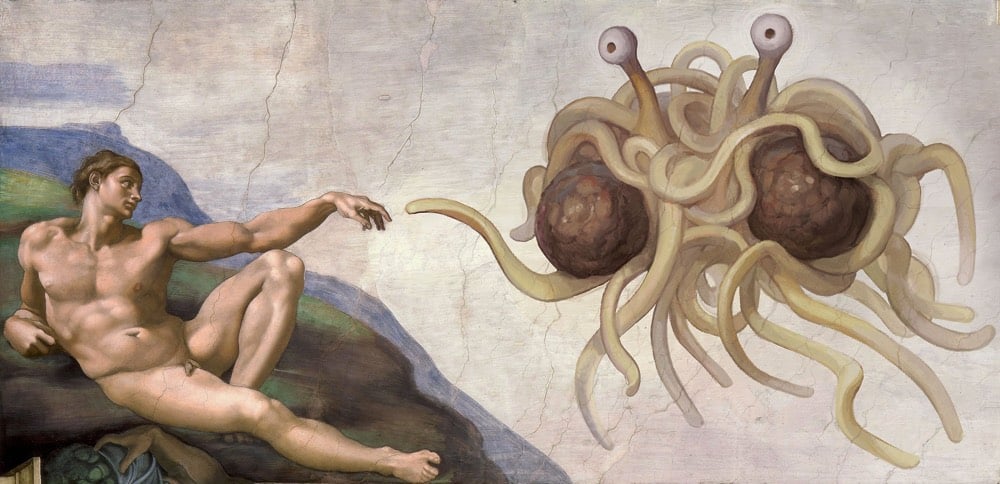
I, Pastafari is a feature-length documentary about the Church of the Flying Spaghetti Monster and its adherents, the Pastafarians.
I, Pastafari is a story about a few brave Pastafarians, evangelizing the message of the FSM, while fighting against intolerant skeptics, for the freedom to access religious privileges in law granted to other “real” religions. In a time of flat-earthers, anti-vaxxers, fake news, and alternative facts, the Pastafarians may be the savior the world has been waiting for. R’Amen.
I have a bad feeling that what started out as a satirical criticism of religion will be an actual religion in the future whose adherents won’t see the irony in or damage done by that shift. That’ll be fun.
From 1973, this is an animated short film version of the classic children’s book The Giving Tree, narrated by author Shel Silverstein. As Wikipedia notes, there are conflicting ideas about the book’s meaning:
This book has been described as “one of the most divisive books in children’s literature”; the controversy stems from whether the relationship between the main characters (a boy and the titular tree) should be interpreted as positive (i.e., the tree gives the boy selfless love) or negative (i.e., the boy and the tree have an abusive relationship).
Silverstein’s narration does little to resolve the complexity of the story, although as someone who has never read The Giving Tree1, I was left feeling not so great about the relationship depicted in the story. (via open culture)
Update: Adam Grant and Allison Sweet Grant wrote about the lessons of The Giving Tree for NY Times Parenting.
We don’t know what motivated Shel Silverstein to write “The Giving Tree.” In a rare interview, he said it was about “a relationship between two people; one gives and the other takes.” But we think it’s best read as a cautionary tale about love. Although the tree seems to take joy in giving to the boy, their relationship is entirely one-sided. The tree is perfectly happy to destroy herself under the guise of “love” for the boy. That’s not love; it’s abuse. Even an editor of the book, Phyllis Fogelman, felt that way. “I have had qualms about my part in the publication of ‘The Giving Tree,’ which conveys a message with which I don’t agree,” she said in an interview. “I think it is basically a book about a sadomasochistic relationship.”
Arctic is a new video from the Beauty of Science crew (previously featured here) that reveals the beauty of crystal formation.
There’s a kinship between how crystals form and how towns & cities develop (as in these generated medieval town maps or Manhattan below 14th Street) or how flowing water interacts with earth:


Crystal, towns, and rivers all act according to similar principles governing the formation of things from points and edges. What a world. (via colossal)
This is neat: Peter Mayhew as Chewbacca speaking English to Harrison Ford’s Han Solo in a scene from Empire Strikes Back:
Mayhew’s dialogue provided context for Ford to play off of. Chewbacca’s more familiar voice was dubbed over the on-set dialogue in post production — listen to Star Wars sound designer Ben Burtt describe how he created Chewie’s voice in this video at ~26:18. Mayhew passed away last week at the age of 74.
See also David Prowse’s on-set dialogue as Darth Vader, or as the other cast members called him, Darth Farmer (at 6:05 in the video). (via laughing squid)
Using geological surveys, geo-referenced road network data, and historic maps drawn the from the collections of the Library of Congress and New York Public Library, Miles Zhang made this time lapse video of the development of the street grid of NYC from 1609 (when Henry Hudson first explored the area for the Dutch) to the present day.
The resulting short film presents a series of “cartographic snapshots” of the built-up area at intervals of every 20-30 years in the city’s history. This process highlights the organic spurts of growth and movement that typify New York’s and most cities’ development through time. The result is an abstract representation of urbanism.
Zhang has written up his research methodology for the video as well as some observations and analysis of the data.
For almost the first half of Manhattan’s history, walking was the primary means of transport. This preference was manifested in the shorter distances between residential, industrial, shipping, and commercial areas — and more frequently their overlap. With street systems, the reliance on the foot is manifested in narrower streets widths not designed to accommodate greater width from carriages, trolleys, and later cars. In fact, the average width of secondary arterial streets increased from 30 feet for streets opened between 1624-1664, to 45 feet for streets opened 1664-1811, and then a uniform width of 60 feet for any cross street opened after 1811. Later widenings increased many of these smaller and pre-1811 streets to width between 100 and 130 feet. In other words, moving from the older networks in the south to newer networks in the north, the width of streets and size of blocks generally increases. These new widths might be influenced by growing population size from only 25,000 in the 1770s, to 64,000 by 1811, and 247,000 by 1834, thereby requiring wider streets for expanding population and higher buildings.
These gradual changes in planning reflected increasing reliance on carriages and horse-drawn trolleys instead of walking. Each mode of transport required a different minimum street width and was associated with different speeds.
(via @john_overholt)
Werner Herzog’s latest film is called Meeting Gorbachev, in which he sits down with former Soviet leader Mikhail Gorbachev for a series of interviews about his life, political career, and his role in ending the Cold War. From a review in the NY Times:
The two men appear to like each other immensely — in narration, Herzog calls Gorbachev “one of the greatest leaders of the 20th century” — but Gorbachev can be a cool customer. He sometimes seems guarded in his assessment of what he might have done differently. He says he believes the Soviet Union should have given its republics more rights instead of dissolving entirely. As for Boris Yeltsin, who became the first president of a post-Soviet Russia, he says, “I should have sent him off somewhere.”
The Bulletin of the Atomic Scientists interviewed Herzog about the film.1
It’s not easy to speak of what I tried to accomplish. I think as a natural concomitant you get the feeling that there should be better times between the West and Russia. The demonization of Russia is a great mistake of the Western media and Western politics, and we should try and seek a climate that was created by Ronald Reagan and Mikhail Gorbachev, the most improbable characters you could ever put together in one room.
Meeting Gorbachev is out in US theaters now, but just barely. Probably best to catch this streaming in a month or two.
Newer posts
Older posts





Socials & More