kottke.org posts about video
Hey there. Sleeping ok? Perhaps not after you watch this microscopic video of a mosquito’s mouthparts searching the flesh of its victim for blood vessels.
I’ve never been shy about killing mosquitos but now I am on a mission.
The Andy Warhol museum has recently set up a webcam pointed 24/7 at Andy Warhol’s grave in a Pennsylvania cemetary. His gravestone is currently adorned with flowers, mylar balloons, and cans of Campbell’s Soup. Peter Schjeldahl wrote about the project for the New Yorker.
I have angled for reasons to snoot the webcam stunt. I can’t think of any. Along with more or less everybody else, I find it Warholian to the, well, life: watching the present habitation of a man who liked to watch. Warhol pioneered motion pictures of motionless subjects; and we have him to thank, or not, for prophesying reality television. His strictly beholding bent became, as it remains, a default setting of artistic and popular culture absolutely everywhere.
The live video feed includes sound, so I imagine it won’t be too long before some enterprising performance artists show up and do something entertaining.
This compilation of videos shot with Vine is surprisingly good and a nice illustration of what Mat Honan is getting at in Why Vine Just Won’t Die.
Vine started from scratch. It built a ground up culture that feels loose, informal, and — frankly — really fucking weird. Moreover, most of what you see there feels very of-the-moment. Sure, there’s plenty of artistry that goes into making six second loops, and there are volumes of videos with high production values. But far more common are Vines that serve as windows into what people are doing right now. Many of the most popular Vines appear to be completely off the cuff. They don’t have to be great or slick or well produced. In some ways, its better that they’re not, because it creates a lower threshold if you just want to, you know, share a video of your cat. They have something that trumps quality, which is authenticity.
That authenticity is driving a distinct emerging culture. One that stars people like Riff Raff and Tyler, the Creator, and an army of kids whose names you’ve never heard of but who can still generate hundreds of thousands of likes and re-Vines, and even large scale in-person meetups. It’s the triumph of the loop, yes, but it’s also the triumph of youth.
Take a moment to stroll through Vine’s “Popular Now” videos, and you’d have to be willfully ignorant to not notice that those on Vine are distinctly younger, distinctly blacker, and distinctly, well, gayer than society in general. In short, it’s cool. It’s hip. It’s a scene. If Instagram is an art museum, Vine is a block party.
I was going to make a joke about this being what TV is going to look like in five years, but I think you could put 30 minutes of this on MTV2 or whatever, with six-second Vine-style ads placed seamlessly in the mix, and you’d have yourself a hit show. (via ★interesting)
Leave it to Werner Herzog to take the driver safety video to new heights. From One Second To The Next is a 35-minute documentary film by Herzog on the dangers of texting while driving.
Powerful stuff. Don’t text while you’re driving, okay? (via @brillhart)
The ultimate in YouTube rubbernecking. Normally a car or truck exploding is very unusual. To see one blow up repeatedly and spectacularly is jaw dropping. It looks like a truck carrying oil drums propane/gas canisters but it’s hard to tell.
Things seem to be all over at 4:50 and people start to slowly approach the site except at 7:01… (via @malki)
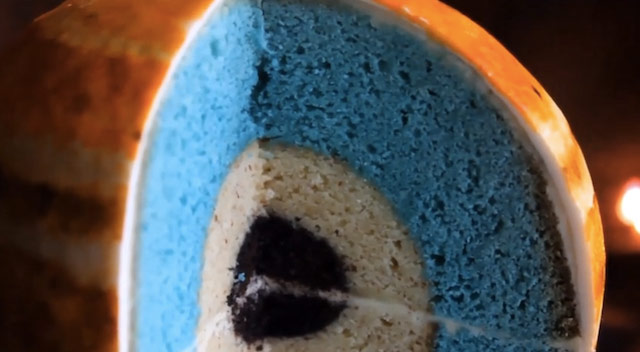
Each layer is different kind of cake which is baked and then pressed into the batter of the next larger cake, covered, and rebaked. The largest of which you bake in halves in two glass mixing bowls.
It’s like a dessert turducken. Mmmm.
(via @rustyk5)
In July, Jay Z rapped Picasso Baby at Pace Gallery in NYC for six hours. The fruits of that labor have been condensed by director Mark Romanek into a 10-minute music video that premiered on HBO last night. Here’s the film:
The idea of performance art came to mind. I was aware of Marina Abramovic’s Artist is Present, even though I was in London shooting ‘Never Let Me Go’ and didn’t get to go. And the idea that Jay-Z regularly performs to 60,000 people at a time, I thought, ‘What about performing at one person at a time?’ He absolutely loved it. He interrupted me and said, ‘Hold on! I’ve got chills. That idea is perfect.’ He thinks, like me, that the music video has had its era. I also wanted to make sure we had Marina’s blessing. So she attended the event and took part in the event. She couldn’t have been more happy or enthusiastic about us using her concept and pushing it forward.
Also, somehow, I have never heard Jay Z talk before. That’s his voice?
These caterpillars in the Amazon rain forest travel together in kind of a treadmill formation, with the whole group able to travel faster than any individual caterpillar.
Here’s the explanation. And I’ve got a thing for treadmills, I guess: here’s the plane on a treadmill problem, Slinky on a treadmill, and a Japanese game show featuring treadmills. (via @stevenstrogatz)
Fabio Di Donato made this fantastic short film about Saturn using hundreds of thousands of images taken by the Cassini-Huygens spacecraft.
I love the editing technique employed here…the film feels like a silent short from the 1920s but also very contemporary. (via ★interesting)
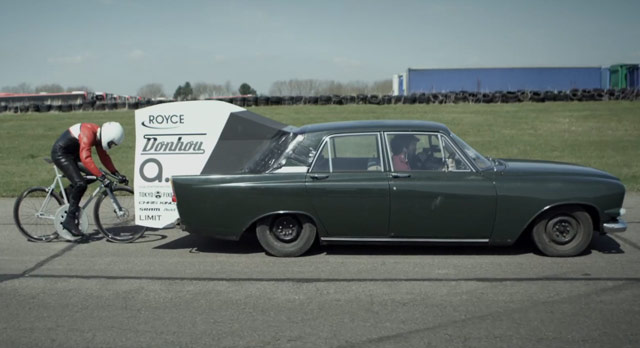
Bike frame builder Tom Donhou, inspired by the home-built cars of yore ripping it up on the salt flats of Utah, wanted to see if he could build a bike in his shop that would do 100 mph. This video documents his quest.
I love everything about this video, but especially the pace car. (via ★interesting)
Meet RHex. He’s a robot built by researchers at the University of Pennsylvania and he can do parkour.
They just have to get him jumping as high as the Sand Flea and they’ll have something. (via digg)
Five-year-old Jack is trials rider Danny MacAskill’s biggest fan. (Don’t know who MacAskill is? Start here.) Inspired by his hero, Jack made a video of himself riding his bike around and doing some tricks.
Oh man, there’s water coming out of my face now. #cryingatwork (thx, meg)
Here’s slow motion video from Smarter Every Day of what it looks like when an AK47 is shot underwater. Not only is the slow motion footage beautiful (best shots at 2:40, 4:30, 7:20), the science behind why the bubbles do what they do is explained. Science! Previously.
Normally the ‘danger in the water’ beat focuses on sharks, but here’s a video of two divers almost getting eaten by two humpback whales. The impatient among you may skip ahead to about :30. The whales would have you believe this was accidental. Youtube commenter tom bill said this was his “number 1 fear,” and I have to say, I spend more than my share of time thinking about things going wrong in the ocean. However, the idea I might be accidentally eaten by whales never even occurred to me, which means I’ve got some more thinking to do.
(via reddit)
Steinway & Sons, the celebrated piano making company, recently produced this video of how their grand pianos are constructed. Their process for building pianos has changed so little that they were able pair 1980s factory tour audio from former chairman John Steinway to contemporary footage of their Astoria, NY factory.
You can see how little has changed as you watch this 1929 film of how a Steinway piano was made:
Some of the shots in the two videos are identical, e.g. the men pulling the piano rim out of the mold or choosing spruce for the sounding boards. It interesting to compare these two videos with Wednesday’s video of how Telsa sedans are made. Together, the three form a view of the progression of automation in manufacturing. I wonder if the Tesla robots could construct a piano that sounds as good as a Steinway? (via open culture)
This is the perfect Friday thing: a man is tricked into thinking he’s bungee jumping at his bachelor party while actually standing in front of a kiddie pool.
I laughed entirely too hard at this. (via ★interesting)
Changing a tire on a car while driving on two wheels is apparently a bit of a thing in Saudi Arabia. Here are a couple of examples:
If you want to try this at home (don’t), here’s how you get a car up on two wheels (don’t).
A nice video from Wired that shows how Tesla’s sedan is made.
Tesla got the factory for a song from Toyota in 2010, spent about a year or so setting up tooling and started producing the Model S sedan in mid-2012. The automaker brings in raw materials by the truckload, including the massive rolls of aluminum that are bent, pressed, and formed to create the car. Those lightweight components are assembled by swarm of red robots in an intricate ballet that is mesmerizing to behold.
(via ★interesting)
Fourth-grader Zachary Maxwell is making a short documentary film about the lunch program at his New York City public school. It’s called Yuck.
In the fall of 2011, fourth grader Zachary Maxwell began asking his parents if he could start packing and bringing his own lunch to school. Unfortunately, they kept insisting that he take advantage of the hot lunch being served at the school. After all, the online menu sounded delicious and the NYC Department of Education (DOE) website assured parents that the meals were nutritious. Zachary wanted to convince his parents that the online menu did not accurately represent what was really being served at his school.
Here’s a short clip in which Zachary compares the special salads concocted by celebrity chefs Rachael Ray and Ellie Krieger for use in NYC public schools to the sad reality.
This is awesome. I mean, the lunches aren’t awesome, but Zachary is.
On one of the world’s most dangerous roads, Pakistani drivers deliver supplies 150 miles into northwestern Pakistan. In 2011, Al Jazeera English made this 25-minute documentary that followed one of the trucks across the Lowari Pass. I didn’t think I was going to watch the whole thing, but it turned out to be worth the time.
Back in October, I wrote a post about the race to win the Igor I. Sikorsky Human Powered Helicopter Competition. To win the $250,000 Sikorsky prize, a human-powered helicopter must fly for 60 seconds, reach a momentary altitude of 3 meters, and stay within a 10 meter square. Last month, after 33 years of collective human effort, someone finally won the prize:
Wow, that helicopter is amazing! Popular Mechanics has more on the winning flight.
Reichert knew that the challenge was to keep supplying enough power through his legs to keep the craft from descending too quickly. On two previous flights in which he’d flirted with the three-meter mark, Reichert had descended too abruptly and fallen afoul of a phenomenon called vortex ring state, in which a helicopter essentially gets sucked down by its own downwash. Both times Atlas had been wrecked. This time, Reichert spent the balance of the flight easing the craft down gently to the ground. “You’re so focused on having the body do a very precise thing,” he told Pop Mech. “If you lay off the power even a little bit, or make any sharp control movement, you can crash.”
(via hn)
Photographer Clayton Cubitt and Rex Sorgatz have both written essays about how photography is becoming something more than just standing in front of something and snapping a photo of it with a camera. Here’s Cubitt’s On the Constant Moment.
So the Decisive Moment itself was merely a form of performance art that the limits of technology forced photographers to engage in. One photographer. One lens. One camera. One angle. One moment. Once you miss it, it is gone forever. Future generations will lament all the decisive moments we lost to these limitations, just as we lament the absence of photographs from pre-photographic eras. But these limitations (the missed moments) were never central to what makes photography an art (the curation of time,) and as the evolution of technology created them, so too is it on the verge of liberating us from them.
And Sorgatz’s The Case of the Trombone and the Mysterious Disappearing Camera.
Photography was once an act of intent, the pushing of a button to record a moment. But photography is becoming an accident, the curatorial attention given to captured images.
Slightly different takes, but both are sniffing around the same issue: photography not as capturing a moment in realtime but sometime later, during the editing process. As I wrote a few years ago riffing on a Megan Fox photo shoot, I side more with Cubitt’s take:
As resolution rises & prices fall on video cameras and hard drive space, memory, and video editing capabilities increase on PCs, I suspect that in 5-10 years, photography will largely involve pointing video cameras at things and finding the best images in the editing phase. Professional photographers already take hundreds or thousands of shots during the course of a shoot like this, so it’s not such a huge shift for them. The photographer’s exact set of duties has always been malleable; the recent shift from film processing in the darkroom to the digital darkroom is only the most recent example.
What’s interesting about the hot video/photo mobile apps of the moment, Vine, Instagram, and Snapchat, is that, if you believe what Cubitt and Sorgatz are saying, they follow the more outdated definition of photography. You hold the camera in front of something, take a video or photo of that moment, and post it. If you missed it, it’s gone forever. What if these apps worked the other way around: you “take” the photo or video from footage previously (or even constantly) gathered by your phone?
To post something to Instagram, you have the app take 100 photos in 10-15 seconds and then select your photo by scrubbing through them to find the best moment. Same with Snapchat. Vine would work similarly…your phone takes 20-30 seconds of video and you use Vine’s already simple editing process to select your perfect six seconds. This is similar to one of my favorite technology-driven techniques from the past few years:
In order to get the jaw-dropping slow-motion footage of great white sharks jumping out of the ocean, the filmmakers for Planet Earth used a high-speed camera with continuous buffering…that is, the camera only kept a few seconds of video at a time and dumped the rest. When the shark jumped, the cameraman would push a button to save the buffer.
Only an after-the-fact camera is able to capture moments like great whites jumping out of the water:
And it would make it much easier to capture moments like your kid’s first steps, a friend’s quick smile, or a skateboarder’s ollie. I suspect that once somebody makes an easy-to-use and popular app that works this way, it will be difficult to go back to doing it the old way.
Or rather, protozoan? Toxoplasma gondii is a protozoan parasite which is transmitted from rodents to cats through a crafty mechanism…it makes mice attracted to the smell of cat urine. Mouse goes near cat, cat eats mouse, T. gondii has a new host. From cats, the parasite can jump into humans, where it may be responsible for all sorts of nastiness:
Well, the behavioral influence plays out in a number of strange ways. Toxoplasma infection in humans has been associated with everything from slowed reaction times to a fondness toward cat urine — to more extreme behaviors such as depression and even schizophrenia. And here’s the kicker: Two different research groups have independently shown that Toxo-infected individuals are three to four times as likely of being killed in car accidents due to reckless driving.
And maybe makes us want to invent networking technology and share cool links? In this five-minute talk, Kevin Slavin cleverly connects viral media with T. gondii:
That video was so good, I watched the whole thing twice.
Karen Cheng learned to dance in a year. Here’s a video of her progress, from just a few days in to her final number:
Here’s my secret: I practiced everywhere. At bus stops. In line at the grocery store. At work — Using the mouse with my right hand and practicing drills with my left hand. You don’t have to train hardcore for years to become a dancer. But you must be willing to practice and you better be hungry.
This isn’t a story about dancing, though. It’s about having a dream and not knowing how to get there — but starting anyway. Maybe you’re a musician dreaming of writing an original song. You’re an entrepreneur dying to start your first venture. You’re an athlete but you just haven’t left the chair yet.
The interesting thing is, Cheng basically did the same thing in her professional life as well.
I decided to become a designer, but I had no design skills. I thought about going back to school for design, but the time and money commitment was too big a risk for a career choice I wasn’t totally sure of.
So I taught myself — everyday I would do my day job in record time and rush home to learn design. Super talented people go to RISD for 4 years and learn design properly. I hacked together my piecemeal design education in 6 months — there was no way I was ready to become a designer. But I was so ready to leave Microsoft. So I started the job search and got rejected a few times. Then I got the job at Exec.
The first few weeks were rough. Everyday I sat in front of my computer trying my damnedest and thinking it wasn’t good enough. But everyday I got a little bit better.
(via hacker news)
YouTuber Chase creates short videos where the faces of celebrities are swapped for other celebrity faces. The results are weird and often hilarious. The best one is probably the most recent video of Natalie Portman and Will Ferrell:
This quick Nicholson/Cruise clip from A Few Good Men is pretty good too:
Co.Create did an interview with the creator.
“When picking the celebrities, I am mainly considering two things. Their relevance and popularity, as well as the availability of unique, high-quality footage in which the actor is looking mostly towards the camera,” Chase says. “Mashing up footage in which the characters are constantly looking side to side is much more difficult and usually results in a less convincing final product.” He adds. “There have a been a few After Effects sessions that ended up in the recycle bin because of this.”
(via @daveg)
Watch as a motorcyclist rescues a coffee cup from the bumper of a SUV and returns it to the driver.
I love the little celebration move right at the end. (via digg)
Douglas Engelbart died at his home in California yesterday at the age of 88. Engelbart invented the mouse, among other things. In 1968, Engelbart gave what was later called The Mother of All Demos, in which he demonstrated “the computer mouse, video conferencing, teleconferencing, hypertext, word processing, hypermedia, object addressing and dynamic file linking, bootstrapping, and a collaborative real-time editor”.
Not bad for a single demo. Truly one of the giants of our age.
Update: Bret Victor urges us to remember Engelbart not for the technology he created but for his vision of how people could collaborate and create together using technology.
The least important question you can ask about Engelbart is, “What did he build?” By asking that question, you put yourself in a position to admire him, to stand in awe his achievements, to worship him as a hero. But worship isn’t useful to anyone. Not you, not him.
The most important question you can ask about Engelbart is, “What world was he trying to create?” By asking that question, you put yourself in a position to create that world yourself.
(thx, andy)
Last month, we posted a video of Tim Knoll doing ridiculous and panic-inducing circus style tricks on his bike. In the video below, he explains how he does the bike limbo, riding under several semi trucks in a row. Just because he tells you how to do it, does not mean you should try it. In fact, it is the expressed opinion of this blog you should not try it. However, if you do try it and you do feel yourself falling — which you will, because let’s be honest — don’t try to lift your head up. Just fall, because as Knoll says, “scrapes are better than stitches.”
(via ls)
Glas is a short documentary film by Bert Haanstra about glass making. It won the 1959 Oscar for best documentary (short subject).
Many delightful moments in this film, but my favorite part is watching the glass blowers’ hands while they work. (thx, arjan)
This is the best thing in the world right now. An adorable 9-year-old kid who plays the drums and his equally adorable 6-year-old sister who sings take the stage on the show America’s Got Talent to perform. The judges coo at their kidness and cuteness. And then:
Give it until 1:40 at least…I promise it pays off. I haven’t laughed this hard in weeks. (via ★interesting)
Newer posts
Older posts




Socials & More