



Hong Kong architect Gary Chang travels so often that he’s become an expert hotel enthusiast. I spoke with Gary at Ars Electronica this year; he showed me some of his drawings and photos (he extensively documents his hotel stays in the form of photos and hand-drawn floor plans)…really cool. Chang’s Suitcase House is also worth a look.

Advertise here with Carbon Ads
This site is made possible by member support. 💞
Big thanks to Arcustech for hosting the site and offering amazing tech support.
When you buy through links on kottke.org, I may earn an affiliate commission. Thanks for supporting the site!
kottke.org. home of fine hypertext products since 1998.
Beloved by 86.47% of the web.
kottke.org posts about travel
The Moleskine City Notebooks, the cool make-your-own travel books, are being released in the US on Nov 1 and moleskinerie has information on where to find them.
Austria in pictures

Some photos from a recent trip to Austria, featuring shots from near Linz, Salzburg, and Innsbruck. I went so crazy with the photos in Austria that I didn’t take a single picture once we got to Zurich…I was all photographed out.
A gay couple on a recent American Airlines flight was told by a flight attendant to stop kissing and touching, then got the run-around from the chief flight attendant (who first told them that their behavior was perfectly fine and then reversed her stance after being asked if their sexuality is at issue), and was finally told by the captain to behave the plane will be diverted. The whole “shut up or you’ll get the full you’re-a-terrorist treatment with no recourse” vibe on the plane creeps me out. Something tells me this won’t get coverage in American Way next month.
What an honest pre-flight announcement would sound like. “We might as well add that space helmets and anti-gravity belts should also be removed, since even to mention the use of the slides as rafts is to enter the realm of science fiction.” Cutting through institutional rhetoric seems to be a reoccuring theme this week, see also honest advice to incoming college freshman and how design works.
Wurst vacation ever
For some, a trip to Austria steers their gastronomic attention to wiener schnitzel, but for me, it’s all about the wurst.1 Following the good advice of a reader to ignore the sausages on offer in cafes and restaurants, we hit up every lunchtime sausage stand we could find during our visit for the real deal.
In Salzburg, the typical stand offers 8-10 different kinds of wurst, from the familiar frankfurter to the spicy pusztakrainer. You can get your wurst on a plate with mustard and a piece of bread or as a “hot dog” (in a bun with mustard and ketchup). For my first wurst, I had a kasekrainer, hot dog-style with ketchup, and it turned out to be my favorite of the trip. Melted cheese (kase) filled the sausage and the bun was perfectly crispy on the outside and chewy on the inside. Meg sampled a burenwurst. The next day, we hit up another stand; I tried the frankfurter while Meg had a delicately flavored weisswurst (her favorite of the trip). She speculated they didn’t grill the weisswurst because it would interfere with mild flavor; the spicer wursts seemed to be grilled.
From thence to Innsbruck in the Austrian Alps. At 10,000 feet above sea level, we had an unspecifed wurst (the restaurant called it, basically, “the sausage of the day”) that ranks among the best food I’ve ever tasted, but that assessment may have been colored by the fact that we’d hiked up a glacier to get it. On our last day in Innsbruck, we surrendered to the comfort of cafe chairs and had bratwurst (mit sauerkraut und mustard) at a small place in the old town. After a hard day of walking, it beats eating standing up, which is how it works at the wurst stand.
Our final link in the sausage trail was Zurich, which is not in Austria but in the section of Switzerland near Austria and Germany. From a stand by the lake, we shared a pork-based sausage I forget the name of and another beloved weisswurst. Based on the relative unavailability of the wurst there, I get the feeling that the Swiss don’t take their sausages as seriously as the Austrians, at least in cosmopolitan Zurich. Not that the Swiss wurst wasn’t good; they just have other things to worry about…like fondue.2
But to focus entirely on the wurst is to ignore the equally fantastic brot (bread) that accompanies it and many other Austrian dishes. My favorite bread growing up in Wisconsin was called “Vienna bread” and I had always assumed that the cheap loaves we got at the local chain supermarket approximated something found in the Austrian capital. We didn’t get to Vienna, but the Austrian bread we had was indeed like the bread of my childhood…except about 1000 times better. The small, crisp roll we got with our wurst, called a semmel, was not unlike what’s called a roll or kaiser roll at an NYC deli. These rolls, accompanied by some richly flavorful butter, were also available at the complementary breakfast served at our hotel and I was tempted to violate the no-taking-food-from-the-breakfast-area rule and cram my bag full of them. If the bread at our hotel was that good, I can’t imagine what the best bakeries of the region have to offer. The French, whom I’ve always considered the champions of all things bread, might have something to worry about from Austria. Clearly, more delicious research is called for.
[1] Not that the rest of Austrian cuisine wasn’t uniformly excellent. I had a pork dish with spatzle in a creamy mushroom sauce at a Salzburg restaurant that I will crave for months to come. And that garlic soup at Ottoburg in Innsbruck! ↩
[2] I’d like to take this opportunity to apologize for the title of this post (the other option was “It was the wurst of times”). But count your blessings that you’re not reading an article on the yummy fondue we had in Zurich entitled “You’re damned if you fondue, and you’re damned if you fondon’t”. (I know what you’re thinking: “oh no, he fondidn’t…”) ↩
What happens to a blog when its editor goes on vacation? Glenn Reynolds: “I need a vacation more than I care about the traffic.”
Ars Electronica
On Friday, September 1, I’ll be speaking at the 2006 Ars Electronica Festival in Linz, Austria. I’ll be taking part in a symposium on simplicity organized by John Maeda (schedules: part 1, part 2). I’ve been furiously preparing my slides in Keynote for the past week or so. It’s my first talk using either Keynote or Powerpoint and I’m having fun messing around in Keynote. It’s a great little program. Thanks to John and the folks at Ars for including me…it’s a real honor.
Updates for the next few days will be spotty at best; the internet connection situation at both the conference and our hotel is unknown and I’ll likely be busy preparing for my talk1. And after the conference, we’re heading into the Alpine wilderness for a few days (maybe Salzburg, Munich, or Zurich as well) during which my internet status will likely be “offline” and my sausage intake status will be “every 6 hours”. See you when I get back.
So, now’s your chance to catch up on some recent doings around the site. Here are some of my favorites from the past few weeks/months:
- Manhattan Elsewhere - Maps and landscapes imagining the island of Manhattan placed near Chicago, San Francisco, Boston, and other locales.
- The Pluto Mnemonic Device Contest. “My! Very educated morons just screwed up numerous planetariums.”
- Post on the Mill City Museum in Minneapolis, MN. Panoramic photograph of the museum and the surrounding area.
- Some old WWII-era color photos, color corrected to look a bit more contemporary.
- Tales of the Telegraph.
- A piece about some surviving Gopher servers.
- Some baseball card musings.
- Madden NFL 06 Fans Take Video Game Into Real World
[1] “Preparing for my talk” may or may not be a euphemism for “throwing up repeatedly in worry about my talk”. (Actually, practice is a wonderful thing. It makes perfect, builds confidence, and reduces abdominal discomfort.) ↩
Farecast, a site which predicts airline ticket prices so that you know when to buy them cheap, has added more than 50 cities to its roster.
The middle of nowhere, a changing definition
From the August 2006 issue of enRoute magazine:
Middle of Nowhere isn’t a physical location. Not anymore. In this era, when we have Google Mapped every corner of the earth (and some other planets), almost no place is so remote it’s truly nowhere.
No, we think the Middle of Nowhere is a state of mind. It’s the satisfied pleasure-tinged-with-insider’s-delight that you feel when you discover something pretty great in a place where you didn’t know it thrived. So that when you experience this thing, whether it’s in the middle of a major city or a cornfield, you think, This? Is here? I had no idea!
I encountered this sensation in Minneapolis last week with the Mill City Museum, a place I didn’t know existed in a location I was intimately familiar with. It happens all the time in NYC too…there’s always some great little spot you haven’t discovered in Central Park, a shop in Chinatown selling who knows what, or even a place just around the corner from the apartment that you’ve lived in for three years that, unbeknownst to you, has served fantastic pot stickers all this time. (via moon river)
The Mill City Museum
In 1965, the Washburn A mill, the last operating flour mill in Minneapolis, became also the last flour mill to close its doors, having been preceded by an entire industry that, at one time, produced more flour than any other place in the U.S. The closure came when the mill’s operating company, General Mills, moved its headquarters to Golden Valley, where real estate was plentiful and inexpensive. The area around St. Anthony Falls, the geological feature responsible for the beginnings of industry in the area, had long since fallen into general disrepair and it wasn’t long before the Washburn A was deserted and inhabited by the homeless.
The area started to show signs of life again in the 70s and 80s after being added to the National Register of Historic Places in 1971. Old mill buildings were converted for non-industrial business and residential use as people began to recognize the unique character and history of the area around the falls. In 1991, the Washburn A building burned and part of its structure collapsed, but firefighters saved the rest of the historic building from destruction. The remnants of the building and the adjacent grain elevators remained empty for years afterwards, save for the occasional graffiti artist and urban spelunker.
I knew very little of this when I moved to the Twin Cities in 1996 and not much more when I left Minneapolis for San Francisco in 2000. Almost every weekday for two years I drove or pedaled past the shell of the Washburn A mill on the way to and from work on Washington Avenue in the warehouse district, where we manufactured web pages to fill a growing online space. Topped by the Gold Medal Flour sign, the mill became my favorite building in the Twin Cities, leading me to include it in The Minneapolis Sign Project I did for 0sil8 shortly before I left for the West Coast.
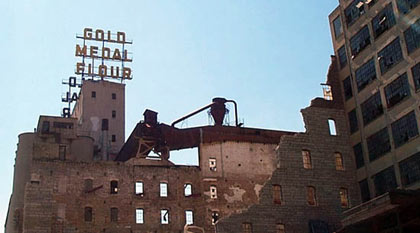
It seemed the perfect symbol of a time and industry long past, broken down but not entirely wiped away. I returned to visit Minneapolis occasionally and would drive past the Falls, wondering what would happen to my building, hoping against hope that they wouldn’t eventually tear it down. With the structure in such bad shape, demolition seemed to be the only option.
Last week, Meg and I spent a day in Minneapolis on our way to visit my parents in Wisconsin, my first stay in Mpls since mid-2002. Meg wanted to investigate running trails and I wanted to sneak a peek at the Gold Medal Flour Building (as I had taken to calling it), so we walked the three blocks to the river from our hotel, housed in the former Milwaukee Depot. The Gold Medal Flour sign was visible from several blocks away, so I knew they hadn’t torn down the grain elevators, but it wasn’t until I saw the shell of the Washburn A building peeking out around one of the other mill buildings that I knew it had been spared as well. As more of the building came into view, I saw a glass elevator rising from the ruins, backed by a glass facade.
What the??!?
Now practically running along the river in excitement and bewilderment, dragging poor Meg along with me in a preview of her jog the next morning, I saw a wooden boardwalk in front of the building and headed for what looked like the entrance. The burned out windows and broken glass remained; except for the elevator and the 8-story glass building sticking out the top, it looked much the same as it had after burning in 1991. I scrambled through the entrance and, lo, the Mill City Museum.
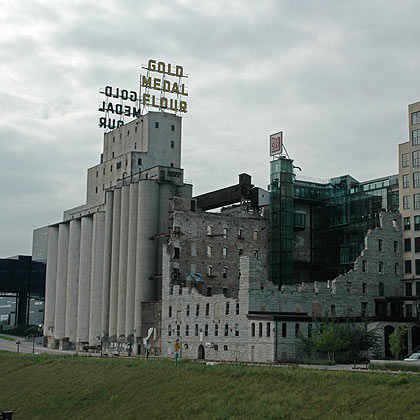
And what a museum. It was just closing when we got there, but we returned the next morning for a full tour of the museum and the Mill Ruins Park. The highlight of the museum is an elevator tour of the mill as it was back in the early 20th century. They load 30 people at a time into a giant freight elevator, which takes the group up to the 8th floor of the museum, stopping at floors along the way to view and hear scenes from the mills workings, narrated by former mill workers. After the elevator tour, you’re directed to an outdoor deck on the 9th floor, where you can view the shell of the mill building, St. Anthony Falls, the Stone Arch Bridge, the Gold Medal Flour sign, and the rest of the historic area.
Meyer, Scherer & Rockcastle are the architects responsible for the project, and they deserve all the accolades they get from one of the most unique museums I’ve ever been to. The statement from the American Institute of Architects jury explains the design of the museum:
A creative adaptive reuse of an extant shell of a mill building, with contrasting insertion of contemporary materials, weaving the old and the new into a seamless whole…A complex and intriguing social and regional story that reveals itself as the visitor progresses through the spaces. It is museum as a verb…A gutsy, crystalline, glowing courtyard for a reemerging waterfront district that attracts young and old and has stimulated adjacent development.
I still can’t quite believe they turned my favorite Minneapolis building (of all buildings) into a museum….and that it was done so well. More than anything, I’m happy and relieved that the Gold Medal Flour Building will always be there when I go back to visit. If you’re ever in Minneapolis, do yourself a favor and check it out.
Photos on Flickr tagged “mill city”
Photos on Flickr tagged “mill city museum”
Mill City: A Visual History of the Minneapolis Mill District was helpful in writing this post
A Washington Post review of the museum from September 2005
The new Guthrie Theater is right next door and is a dazzling building in its own right (photo, more photos)
Lifehacker has a great thread going about how to find cheap airline travel, online and off. Going through a travel agency situated in a neighborhood populated by people from the location you’re travelling to is a great tip.
Thought-provoking essay on hating America. “I find that my cultural observations about Guatemala are usually really about me. ‘These people are mean’ means ‘I am lonely.’ ‘Those people are loud’ means ‘I feel excluded.’ ‘This country is great’ means ‘I love being unemployed and drunk.’ When I start talking about AMERICA on the return, I’m usually still just talking about myself.”
Farecast, which I wrote about here, is now out of private beta, meaning anyone can use the site.
FareCast
A few months ago, I took a look at FlySpy, a site that will help people buy the lowest priced airplane ticket for a given destination. It was a good step in the right direction, but I wanted more:
The killer airline reservation app that I’ve been wanting for several years would tell you when to buy your ticket for a particular flight. Airlines update their fares several times a day and hundreds of times over the course of a month. Depending on when you buy, it might cost you $250 or $620 for the same exact ticket.
A new site called FareCast does exactly that. It shows you the price history of a particular ticket and tells you what the price forecast is…if the price is trending up/down, how much confidence they have in that prediction, and whether you should buy your ticket now or not. FareCast also shows you price differences based on time of day, so if you’ve got a flexible schedule, you can fly in the cheap early afternoon rather than the expensive early morning.
The site’s currently in a closed beta, the data is restricted to outgoing flights from Boston and Seattle, and they’ve got a challenging data-mining problem ahead of them, but the early offerings are quite impressive, helpful, and promising.
If you’d like to try it out, I’m giving away 10 invites to the FareCast beta…but you’re going to have to work for it a little bit. Email me a link/article/site that you think I would find interesting/relevant enough to post on kottke.org *and* that I haven’t seen before. I’ll pick the 10 best and give out the invites accordingly. Be sure to send me the email address you’d like to be invited at if it’s different from the one you’re using to email me. Thx everyone…all the invites have been given out; if you got one, you’ll be receiving your invite soon.
What’s the fastest way to get to the JFK airport in NYC? Helicopter, bus, subway, car, or cab? (Didn’t the NY Times or the NYer do a piece like this several months ago?)
Update: New York magazine and the NY Times both did stories on getting to JFK. (thx, kyu)
Mexico photos
For our honeymoon, we stayed right on the ocean near Tulum in the Yucatan, about two hours south of Cancun by car. Most of these photos are taken near Tulum, at Chichen Itza, or in Valladolid.

Color palette of the Caribbean
Luke Wroblewski wrote an article for Boxes and Arrows about using colors found in nature as inspiration for color palettes used in designing web sites. Unfortunately, the photos showing Luke’s examples don’t appear to be working on the site (the images have been fixed…thx, Lars), but Dave Shea published an image that illustrates Luke’s technique.
When you’re on the beach in the Caribbean as I was recently, it’s difficult for the color palette to escape your notice. I whipped up this collection of colors from some of my photos (coming soon) from Mexico:

From left to right, you’ve got the pale blue of the ocean close to shore, the light brown of the sand, the green of the lush vegetation, and the deep clear blue of the sky.
Update: A couple people asked, so here are the hex values for the above colors: 3DB8AE, FFEDD8, 396600, and 0050A2, respectively.
Nevermind…the video is fake. This is one of the most insane things I’ve ever seen….graffiti artist/entrepreneur Marc Ecko tagged Air Force One. The US govt can’t even effectively guard the President’s plane…how does Homeland Security expect to do it with all commercial passenger airplanes? (via airbag)
The World Heritage List consists of natural and man-made wonders from around the globe. Thirty-four of the sites are currently on the “in danger” list, in some cases because of a site’s inclusion on the master list (and subsequent dramatic increase in tourism).
Honeymoon
According to Wikipedia (which in turn references the Oxford English Dictionary on the matter), the etymology of the word honeymoon is unclear. The American Heritage Dictionary (via answers.com) suggests it’s “perhaps from a comparison of the moon, which wanes as soon as it is full, to the affections of a newly married couple, which are most tender right after marriage”, which doesn’t sound all that positive. Returning to the Wikipedia entry, honeymoon may have been used in Babylonian times to describe the bride and groom consuming honey (in the form of mead, a beverage) before the next moon.
At any rate, I’ve just returned from mine, the most relaxing vacation I’ve ever had. For two weeks, we did without electricity, running fresh water, newpapers, showers (we substituted ocean swimming + saltwater baths), television, magazines, movies, computers, internet, email, mobile phones (except for two unavoidable calls out and periodic checking of voicemail to see if the cat was ok), and music (for the most part). It was so relaxing that we didn’t even know that Daylight Saving Time was in effect until 2 full days after the fact and may not have found out until we got to the airport if Meg hadn’t shown up a full hour late to her yoga class and everyone was, somewhat confusingly, just finishing up.
I read three books: one fascinating, one great, and one good. Ate lots of great Mexican food with zero instances of microbial confrontation. Found really good pizza in an odd place.
We made up names for the people we saw repeatedly on the beach at the small place we were staying. There were the Naked Hat People, Naked Yoga Guy — you may be noticing a trend…the beach was clothing optional — and Naked Paddleball Players, who we renamed Ketchup and Mustard because of their signature matching red and yellow ball caps (they exercised their option to wear nothing besides). Civilization kept threatening to creep into our media deprivation tank, as when we saw Ketchup and Mustard at dinner near the end of our stay, surfing the web on the wireless connection we had no idea that our hotel/resort had. They checked out the New Yorker site and then caught up on the Huffington Post. Meg turned to me and said, “if he brings up kottke.org, I’m going over there and introducing you.”
“The hell you are. Are you trying to kill Vacation Jason?”
So yeah, I’m back and am eager to get back to kottke.org, even though getting my &%#$^#*%& email this morning completely killed Vacation Jason much sooner than I would have liked.
And not least, thanks to Greg Knauss, David Jacobs, and Anil Dash for keeping up with the remaindered links while I was gone. Good stuff, guys.
ps. For the curious, wedding pics here (taken by Eliot). Some pics of Mexico coming (somewhat) soon.
Mountain anatomy
M: That sign says Killington is “The Heart of the Green Mountains”.
J: Yeah?
M: But there’s a sign in Rochester that says the same thing. Which one is the actual heart?
J: Maybe the Green Mountains are like Klingons and have two hearts?
Cheaper airline tickets
TechCrunch reports on FlySpy, a site that will help people buy the lowest priced airplane ticket for a given destination:
The way it works is that I give it a departure city and a destination city and optionally a departure date and length of stay. The search result, which returns very quickly, will present me with a graph of flight prices over the next 30 days so that I can quickly look at which days are the cheapest to fly. To book a flight I just click on the point in the graph. Simple.
That’s a pretty useful UI innovation (especially if you’re able to drill down into individual days to find the lowest fare on that day), but it doesn’t help you much if your travel dates are inflexible. The killer airline reservation app that I’ve been wanting for several years would tell you when to buy your ticket for a particular flight. Airlines update their fares several times a day and hundreds of times over the course of a month. Depending on when you buy, it might cost you $250 or $620 for the same exact ticket.
What this hypothetical app would do is track fare histories and then release forecasts based on those histories. If you want a RT to SFO from JFK on 4/12/06 returning 4/17/06, the site would tell you to buy your ticket three weeks out or when the price hits $298, whichever comes first, but to never wait until the week before, when similar flights begin to sell out.
A thornier problem than the one FlySpy addresses, but it could save people a lot of money. (This would work for hotels and rental cars as well probably, although I don’t think their prices fluctuate as much.)
Some elderly Americans are foregoing retirement homes in favor of living permanently on cruise ships, in part because they are cheaper and the service is better. (thx cathy)
If you’re running out of travel ideas, perhaps you need to read 1,000 Places to See Before You Die. (via nelson)
Why do hotels sometimes charge for internet access and sometimes don’t? My take is that most hotels figure that it’s mostly business travelers that use the internet and therefore it’s the guests’ companies who are footing the bill and since it’s a business necessity for them, the companies pay, no matter what the daily rate. Which sucks for those of us who like a little internet on vacation or want to keep our small business expenditures down.
Judith lost her camera (and most of her pictures) on her trip to Hawaii, so she’s using other people’s photos from Flickr to produce a trip journal.
The year in cities
Following Hanna’s example, here’s my 2005 in cities:
New York, NY*
London, UK
Austin, TX
Paris, France
Boston, MA*
Blarney, Ireland
Ballylickey, Ireland
Waterville, Ireland
Dingle, Ireland
Ennis, Ireland
Etna, NH*
Los Angeles, CA
Orange, MA
Nantucket, MA*
Woodstock, VT
Rochester, VT
Las Vegas, NV
Hong Kong*
Bangkok, Thailand
Saigon, Vietnam
Waitsfield, VT*
One or more nights spent in each place. Those cities marked with an * were visited multiple times on non-consecutive days. Somehow, I did a lot more and a lot less traveling last year than I had anticipated. And just for fun, let’s make this a meme! Blog your list of cities and get your friends to do the same. It’ll be fun.
Skiing at Mad River
Over the holidays, Meg and I went up to Vermont skiing. I skied quite a bit when I was in middle/high school (on the small hills of northwestern WI and east central MN), but I’d only strapped on the boards a couple times since graduating from college. Meg’s family has skied at Mad River Glen for years, so that’s where we went. After three straight days of hitting the slopes, my back got a little wonky, so on the 4th day I brought the camera along to document a run down the mountain:

There are a few photos of Waitsfield (the town closest to Mad River) and the surrouding area at the beginning of the set, but most are from the mountain, including some of the best winter views I’ve ever witnessed. The snow covering the trees, the fog at the top of the hill…it looked almost magical. At one point, I was alone on the mountain with my camera, engulfed in fog, no one within 200 yards. With no wind and all the snow & fog muffling the sound, when I stopped breathing, I couldn’t hear anything at all.
Socials & More