Night sky timelapse…with a twist!
This will be the hundredth night sky timelapse video you’ve seen but probably the first one that shows the Earth rotating instead of the stars.
Best viewed full screen. (via stellar)

This site is made possible by member support. 💞
Big thanks to Arcustech for hosting the site and offering amazing tech support.
When you buy through links on kottke.org, I may earn an affiliate commission. Thanks for supporting the site!
kottke.org. home of fine hypertext products since 1998.
Beloved by 86.47% of the web.
This will be the hundredth night sky timelapse video you’ve seen but probably the first one that shows the Earth rotating instead of the stars.
Best viewed full screen. (via stellar)
Due to a lack of funding, SETI Institute shut down the radio telescope array they were using to look for evidence of extraterrestrial life outside our solar system.
The timing couldn’t be worse, say SETI scientists. After millenniums of musings, this spring astronomers announced that 1,235 new possible planets had been observed by Kepler, a telescope on a space satellite. They predict that dozens of these planets will be Earth-sized — and some will be in the “habitable zone,” where the temperatures are just right for liquid water, a prerequisite of life as we know it.
(via ★genmon)
There is no 3-D CGI involved in this amazing Saturn fly-by video…it’s made from thousands of hi-res photographs taken by the Cassini orbiter.
Wait for the full-frame full-color video starting at around 1:00. (thx, sam)
Indian lunar orbiter Chandrayaan-1 has discovered a large cave on the Moon. Aside from the hey, cool, there’s a cave on the Moon factor, the other big feature of the cave is its constant and temperate temperature.
Temperatures on the moon swing wildly, from a maximum of 262 degrees Fahrenheit to a minimum of -292. The cave holds steady at a (relatively) comfortable -4, since the moon’s weather can’t penetrate its 40-foot-thick wall. It could also protect astronauts from “hazardous radiations, micro-meteoritic impacts,” and dust storms, according to paper published by the journal Current Science.
(via @juliandibbell)
From a paper published in the Journal of Cosmology entitled Sex On Mars: Pregnancy, Fetal Development, and Sex In Outer Space:
Humans are sexual beings and it can be predicted that male and female astronauts will engage in sexual relations during a mission to Mars, leading to conflicts and pregnancies and the first baby born on the Red Planet. Non-human primate and astronaut sexual behavior is reviewed including romantic conflicts involving astronauts who flew aboard the Space Shuttle and in simulated missions to Mars, and men and women team members in the Antarctic. The possibilities of pregnancy and the effects of gravity and radiation on the testes, ovaries, menstruation, and developing fetus, including a child born on Mars, are discussed. What may lead to and how to prevent sexual conflicts, sexual violence, sexual competition, and pregnancy are detailed. Recommendations include the possibility that male and female astronauts on a mission to Mars, should fly in separate space craft.
Redfield blogged a scathing attack on Saturday. Over the weekend, a few other scientists took to the Internet as well. Was this merely a case of a few isolated cranks? To find out, I reached out to a dozen experts on Monday. Almost unanimously, they think the NASA scientists have failed to make their case. “It would be really cool if such a bug existed,” said San Diego State University’s Forest Rohwer, a microbiologist who looks for new species of bacteria and viruses in coral reefs. But, he added, “none of the arguments are very convincing on their own.” That was about as positive as the critics could get. “This paper should not have been published,” said Shelley Copley of the University of Colorado.
(thx, anil)
Matt Webb of BERG shares some of his favorite sci-fi about each of the planets. And the Sun (sort of)…no solar system sci-fi list would be complete without a mention of Sunshine.
In 2057, the Sun is dying, and the Earth is freezing. So the ship Icarus 2 goes on a mission to reignite it with a massive bomb. This is the movie Sunshine, and if you get a chance to see it, watch it on a big screen. The crew themselves watch the Sun close-up, awestruck, from a view-port the exact dimensions of a movie screen, so the Sun fills your picture too and you spend half the film bathing in powerful yellow light. Like some kind of church.
Although I didn’t, Matt, appreciate the diss of Pluto. Never forget, my friend.
Spacelog is taking the original NASA transcripts from early space missions and snazzing them up with a more compelling presentation. Here’s the famous moment in the Apollo 13 mission:
Houston, we’ve had a problem. We’ve had a MAIN B BUS UNDERVOLT.
Wonderful stuff. The site is looking for help with getting more missions transcripts up…go here and scroll down to “Getting involved without technical knowledge”. Although I think they’d get more people involved if they didn’t just dump people into GitHub. (thx, the 50 people who sent this to me this morning)
Here’s a curious press release from NASA:
NASA will hold a news conference at 2 p.m. EST on Thursday, Dec. 2, to discuss an astrobiology finding that will impact the search for evidence of extraterrestrial life. Astrobiology is the study of the origin, evolution, distribution and future of life in the universe.
I did a little research on the news conference participants and found:
1. Pamela Conrad (a geobiologist) was the primary author of a 2009 paper on geology and life on Mars
2. Felisa Wolfe-Simon (an oceanographer) has written extensively on photosynthesis using arsenic recently (she worked on the team mentioned in this article)
3. Steven Benner (a biologist) is on the “Titan Team” at the Jet Propulsion Laboratory; they’re looking at Titan (Saturn’s largest moon) as an early-Earth-like chemical environment. This is likely related to the Cassini mission.
4. James Elser (an ecologist) is involved with a NASA-funded astrobiology program called Follow the Elements, which emphasizes looking at the chemistry of environments where life evolves (and not just looking at water or carbon or oxygen).
So, if I had to guess at what NASA is going to reveal on Thursday, I’d say that they’ve discovered arsenic on Titan and maybe even detected chemical evidence of bacteria utilizing it for photosynthesis (by following the elements). Or something like that. (thx, sippey)
Update: According to Alexis Madrigal, the answer to the hyperbolic question in the headline is “no”.
I’m sad to quell some of the @kottke-induced excitement about possible extraterrestrial life. I’ve seen the Science paper. It’s not that.
For one thing, sleeping is more troublesome than you’d think, considering the remote location:
The onslaught of apparent days and nights would play havoc with astronauts’ body clocks, so a shutters-down and bedtime schedule is imposed by mission controllers. Each of the crew has a closet-like cabin where they can hook a sleeping bag to the wall and settle down for the night. Some strap pillows to their heads to make it feel more like lying down. The lights don’t go out completely, though. People dozing in orbit see streaks and bursts of bright colour caused by high-energy cosmic rays painlessly slamming into their retinas. Fans and air filters add to the distractions, so some astronauts wear ear plugs to block out the constant hum.
Unsurprisingly, falling asleep can take some getting used to. Just as you are nodding off, you can feel as though you’ve fallen off a 10-storey building. People who look half asleep will suddenly throw their heads back with a start and fling out their arms. It gets easier with time. One Russian crew member is renowned for doing without a sleeping bag and falling asleep wherever he ends the day. Anyone still awake after bedtime would see his snoozing form drift by, slowly bouncing off the walls, his course set by the air currents that gently pushed and pulled him.
Whoa! The whole thing is worth a read.
That habitable exoplanet discovery? Maybe not.
Astronomer Francesco Pepe of the Geneva Observatory in Switzerland, who spoke Oct. 11 at an International Astronomical Union symposium on planetary systems, reported a new analysis using only HARPS data, but adding an extra 60 data points to the observations published in 2008. He and his colleagues could find no trace of the planet.
A team of scientists has discovered a potentially habitable planet located about 20 light years from Earth.
The paper reports the discovery of two new planets around the nearby red dwarf star Gliese 581. This brings the total number of known planets around this star to six, the most yet discovered in a planetary system other than our own solar system. Like our solar system, the planets around Gliese 581 have nearly circular orbits.
The most interesting of the two new planets is Gliese 581g, with a mass three to four times that of the Earth and an orbital period of just under 37 days. Its mass indicates that it is probably a rocky planet with a definite surface and that it has enough gravity to hold on to an atmosphere, according to Vogt.
Gliese 581, located 20 light years away from Earth in the constellation Libra, has a somewhat checkered history of habitable-planet claims. Two previously detected planets in the system lie at the edges of the habitable zone, one on the hot side (planet c) and one on the cold side (planet d). While some astronomers still think planet d may be habitable if it has a thick atmosphere with a strong greenhouse effect to warm it up, others are skeptical. The newly discovered planet g, however, lies right in the middle of the habitable zone.
Sam Arbesman’s prediction of May 2011 might have been too conservative. And 20 light years…that means we could send a signal there, and if someone of sufficient technological capability is there and listening, we could hear something back within our lifetime. Contact! (thx, jimray)
Due to the Moon’s relative position in the sky as Neil Armstrong started his moonwalk, Australia was able to capture the first few minutes of his descent down the ladder before NASA was able to find a signal. But it was lost until recently; the restored footage will be shown next week at an event in Sydney.
Using the properties of previously discovered exoplanets (that is, planets outside of our solar system) and their dates of discovery, Sam Arbesman and Greg Laughlin predict that the discovery of the first Earth-like exoplanet will likely occur in early May 2011.
Of course, it’s a bit more complicated than that, but here’s an overview of what we did. Using the properties of previously discovered exoplanets, we developed a simple metric of habitability for each planet that uses its mass and temperature to rate it on a scale of 0 to 1, where 1 is Earth-like, and 0 is so very not Earth-like. Plotting these values over time and taking the upper envelope yields a nice march towards habitability.
The authors don’t address this directly in their paper, but I wondered what the Moore’s Law for planetary discovery might be — e.g. every X years (or months?), the habitability of the most habitable planet discovered doubles. So I emailed Sam Arbesman and he said that his quick back of the envelope calculation would be “half a month or so”…which is an astounding pace.
From a typically excellent selection of photos taken from space curated by Alan Taylor over at The Big Picture, there’s this:
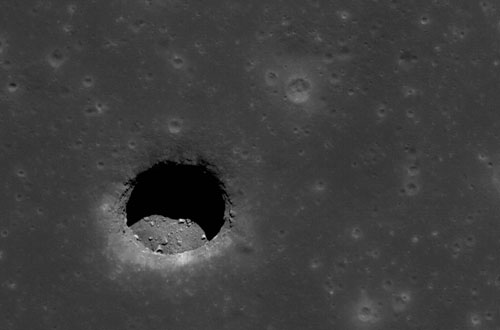
I don’t know why, but that freaks me right out. THERE’S A FREAKING HOLE IN THE MOON!!
Back in July, Ben Terrett wrote a post about how many instances of the word “helvetica” set in unkerned 100 pt Helvetica it would take to go from the Earth to the Moon:
The distance to the moon is 385,000,000,000 mm. The size of an unkerned piece of normal cut Helvetica at 100pt is 136.23 mm. Therefore it would take 2,826,206,643.42 helveticas to get to the moon.
But let’s say you wanted to stretch one “helvetica” over the same distance…at what point size would you need to set it? The answer is 282.6 billion points. At that size, the “h” would be 44,600 miles tall, roughly 5.6 times as tall as the Earth. Here’s what that would look like:

The Earth is on the left and that little speck on the right side is the Moon. Here’s a close-up of the Earth and the “h”:
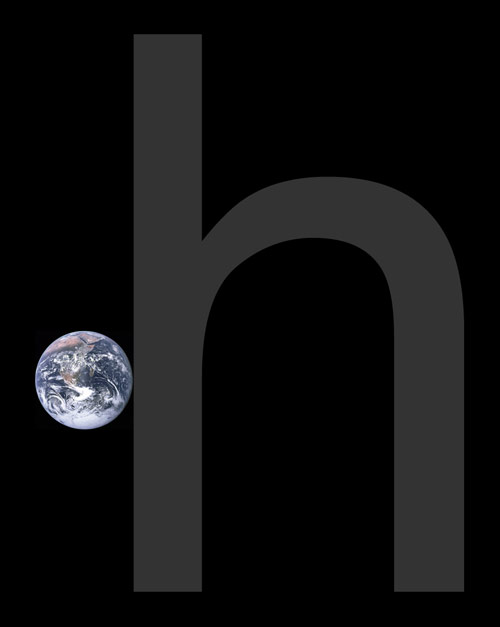
And if you wanted to put it yet another way, the Earth is set in 50.2 billion point type — Helvetically speaking — while the Moon is set in 13.7 billion point type. (thx, @brainpicker)
I had so much fun with this last year, I’m doing it again: watch the original CBS News coverage of the Apollo 11 Moon landing and first Moon walk, reported live by Walter Cronkite exactly 41 years after it happened.
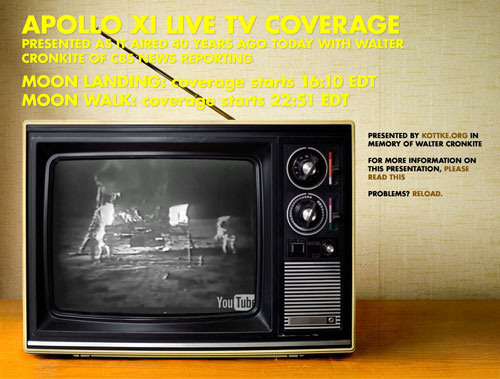
Just leave this page open in your browser and at the appointed times (schedule is below), the broadcast will begin (no manual page refresh necessary).
Schedule:
Moon landing broacast start: 4:10:30 pm EDT on July 20
Moon landing shown: 4:17:40 pm EDT
Moon landing broadcast end: 4:20:15 pm EDT
…
Moon walk broadcast start: 10:51:27 pm EDT
First step on Moon: 10:56:15 pm EDT
Nixon speaks to the Eagle crew: approx 11:51:30 pm EDT
Moon walk broadcast end: 12:00:30 am EDT on July 21
If you’ve never seen this coverage, I urge you to watch at least the landing segment (~10 min.) and the first 10-20 minutes of the Moon walk. I hope that with the old time TV display and poor YouTube quality, you get a small sense of how someone 40 years ago might have experienced it.
Please note that schedule times are approximate, based on your computer’s clock, and that the syncing of the videos might not be perfect. You need to have JS and Flash 8+ to view. This is just like real TV…if you miss the appointed time, there’s no rewind or anything…the video is playing “live”. I have not done extensive browser testing so it may not work perfectly in your browser. If you run into any problems, just reload the page. Thanks for tuning in.
Gorgeous CSS3 animation of the solar system. But here’s what it looks like in IE (tee hee).
Remember the boiling tongue water story from yesterday’s post about how long a human can last in the vacuum of space? Here’s the video of that depressurization event, with the participants taking about it:
(thx, brad)
From NASA, an extensive listing of the “wake-up” music heard by astronauts on their missions in space. For Apollo 17’s first wake-up call on the Moon, they played Wagner’s The Ride of the Valkyries while the second Space Shuttle mission crew got stuck with “Pigs in Space comedy routine #1 by The Muppets”. (via girlhacker)
The answer, straight from NASA.
At NASA’s Manned Spacecraft Center (now renamed Johnson Space Center) we had a test subject accidentally exposed to a near vacuum (less than 1 psi) in an incident involving a leaking space suit in a vacuum chamber back in ‘65. He remained conscious for about 14 seconds, which is about the time it takes for O2 deprived blood to go from the lungs to the brain. The suit probably did not reach a hard vacuum, and we began repressurizing the chamber within 15 seconds. The subject regained consciousness at around 15,000 feet equivalent altitude. The subject later reported that he could feel and hear the air leaking out, and his last conscious memory was of the water on his tongue beginning to boil.
Boiling tongue water! (via acts of volition)
The view is from one of the cameras close to the engines. The narration is great; you really get a sense of how many things had to be considered to make it to the Moon (like the launch pad paint that burned and charred in order to protect the underlying materials). (via df)
The playlist sent out into space with the Voyager 1 and Voyager 2 spacecraft include songs by Bach, Stravinsky, Chuck Berry, and Blind Willie Johnson.
All nine of the planets in our solar system are represented in these wonderful posters by Ross Berens.
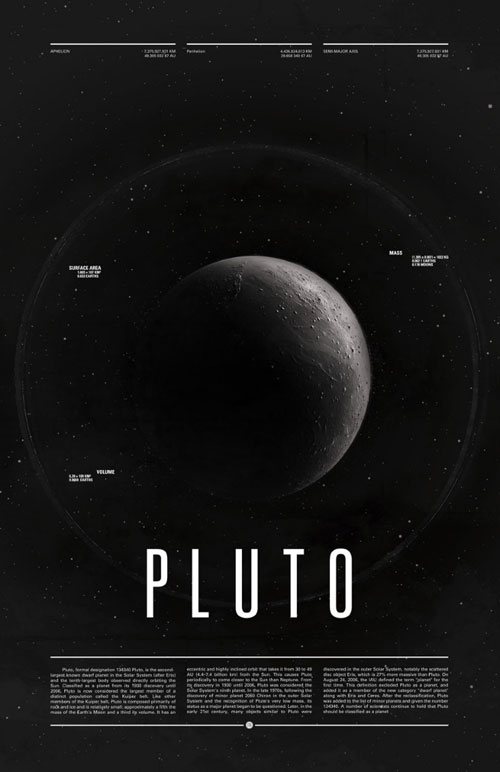
Pluto. Never forget.
Those wildly colorful Hubble telescope photos…how do they get them to look like that?
The colors in Hubble images, which are assigned for various reasons, aren’t always what we’d see if we were able to visit the imaged objects in a spacecraft. We often use color as a tool, whether it is to enhance an object’s detail or to visualize what ordinarily could never be seen by the human eye.
See also this informative Reddit thread.
Vincent Fournier has made a series of photos of astronauts training and of the interiors of the Chinese, Russian and US space agencies.
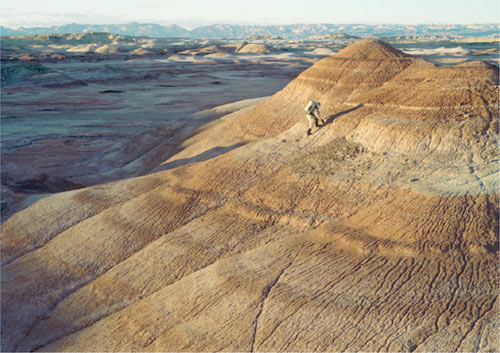
Looks alien, doesn’t it?
The logistics of fighting wars in space is a little different than the movies have lead us to believe.
For the same reason that we have Space Shuttle launch delays, we’ll be able to tell exactly what trajectories our enemies could take between planets: the launch window. At any given point in time, there are only so many routes from here to Mars that will leave our imperialist forces enough fuel and energy to put down the colonists’ revolt.
The Known Universe zooms out from Tibet to the limits of the observable universe. Dim the lights, full-screen it in HD, and you’re in for a treat.
Like Powers of Ten, except astronomically accurate. It’s not a dramatization, it’s a map; the positioning data was pulled from Hayden Planetarium’s Digital Universe Atlas, which is available for free download.
Since 1998, the American Museum of Natural History and the Hayden Planetarium have engaged in the three-dimensional mapping of the Universe. This cosmic cartography brings a new perspective to our place in the Universe and will redefine your sense of home. The Digital Universe Atlas is distributed to you via packages that contain our data products, like the Milky Way Atlas and the Extragalactic Atlas, and requires free software allowing you to explore the atlas by flying through it on your computer.
In 2004, the Hubble Space Telescope took an image called the Hubble Ultra Deep Field; basically astronomers pointed the Hubble toward an “empty” part of space and took a long-exposure shot in the visible spectrum. What they found were thousands of far away galaxies from early in the development of the universe. Now the Hubble has peered even deeper into the universe in near-infrared and captured this image:
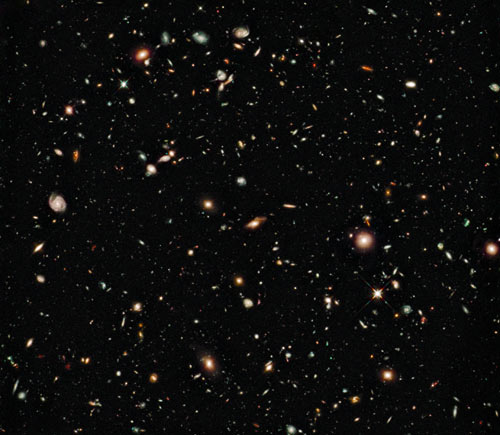
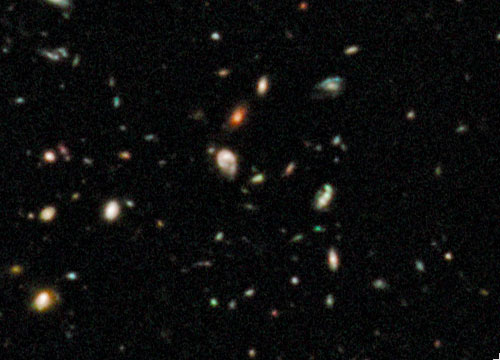
Each one of those little specks is an entire galaxy, some only 600 million years old. Here’s a zoomed-in section:
Socials & More