
Milky Way chromoscope
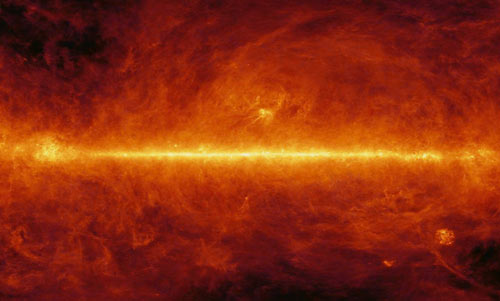
Chromoscope provides views of the Milky Way galaxy in x-ray, visible, microwave, and several other EM wavelengths. This is the view in far infrared:

This site is made possible by member support. 💞
Big thanks to Arcustech for hosting the site and offering amazing tech support.
When you buy through links on kottke.org, I may earn an affiliate commission. Thanks for supporting the site!
kottke.org. home of fine hypertext products since 1998.
Beloved by 86.47% of the web.
Chromoscope provides views of the Milky Way galaxy in x-ray, visible, microwave, and several other EM wavelengths. This is the view in far infrared:
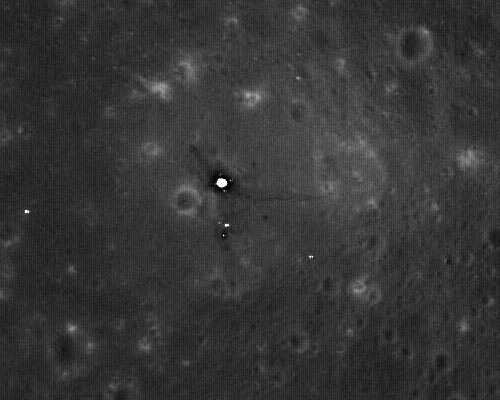
Speaking of the Moon, the LRO snapped a new picture of Apollo 11 landing site from its orbital perch 50km above the surface.
NASA announced that it has found pretty hard evidence of significant amounts of water on the Moon.
“We are ecstatic,” said Anthony Colaprete, LCROSS project scientist and principal investigator at NASA’s Ames Research Center in Moffett Field, Calif. “Multiple lines of evidence show water was present in both the high angle vapor plume and the ejecta curtain created by the LCROSS Centaur impact. The concentration and distribution of water and other substances requires further analysis, but it is safe to say Cabeus holds water.”
I don’t have to tell you about the implications here. Just think of how much you could sell authentic Moon bottled water for.
Beautiful map by National Geographic of human exploration of the solar system.
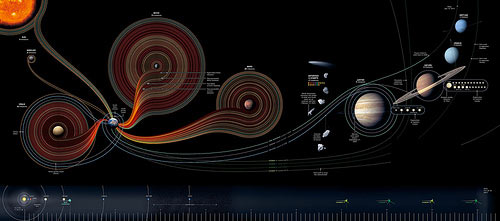
See also Race to the Moon at HistoryShots and Bryan Christie’s Mission(s) to Mars. (thx, byrne)
As black holes evaporate, they release Hawking radiation. Named after the legendary Stephen, who first argued for its existence in 1974, Hawking radiation emitted is measured by the mass, angular momentum, and charge of the black hole. Hawking radiation has been predicted to be part of the eventual catalyst for the heat death of the universe, and recent findings suggest that it’s possibly closer than astronomers originally calculated. Don’t max out your credit cards or adopt a Twinkie diet just yet. Scientists believe that it takes roughly 10^102 years for a supermassive black hole to evaporate, and chances are that global warming, war, or Twinkies will have done in humanity long before then.
From an article in The Boston Globe by Samuel Arbesman, about his quest to name an asteroid after author George Plimpton:
There is a whole group of asteroids named after rock stars. Each member of Rush has a minor planet. Fantasia, Hammurabi, and Jerrylewis are all out there. While Goldfinger is not named after the Bond film (it’s named after an astronomer), Vespa is named after the motor scooter. Here is where we find the asteroid named Qwerty, and even an asteroid named ASCII.
While the author was on his mission to get Mr. Plimpton’s name on a piece of space real estate, he discovered some of the intricacies of naming objects up there. For example, the moons of Uranus have all been named after characters from works by Shakespeare and Alexander Pope. Also, those “name a star” advertisements on the radio are bunk. Although you get a certificate claiming your star has been named, the monikers aren’t recognized by the International Astronomical Union, the one organization that has authority in the matter.
You can look up tributes to George Plimpton on the Plimpton Project. To locate 7932 Plimpton, look up.
Borsch, sticky rice with sweet bean paste, duck cassoulet, and tvorog (Russian cottage cheese and nuts) are just a smattering of the culinary variety served up in space. On board the Discovery Space Shuttle, the various offerings reflect the amalgamation of nations that make up the ships temporary inhabitants. Recent Discovery visitor Danny Olivas brought a little American fare to the deck, perfecting the zero-g breakfast burrito. If you’re looking to spice up your food between the stars, be warned: salt and pepper are only available in liquid form.
Update: Nuts aren’t an essential ingredient of tvorog, and it’s actually not cottage cheese at all. The thickened dairy treat is a relative of German quark, and is consumed throughout Central and Eastern Europe. Its add-ins vary depending on location, but vanilla and fruit are popular additives in both the Netherlands and Germany.
(thx tomek)
Nothing like a little science on the Moon, I always say.
Astronaut David Scott in 1971, from the Apollo 15 Lunar Surface Journal. Scott was part of the Apollo 15 crew, and applied Galileo’s findings about gravity and mass by testing a falcon feather and a hammer. The film, shown in countless high school physics classes, is the nerdy, oft-neglected cousin of Neil Armstrong’s space paces.
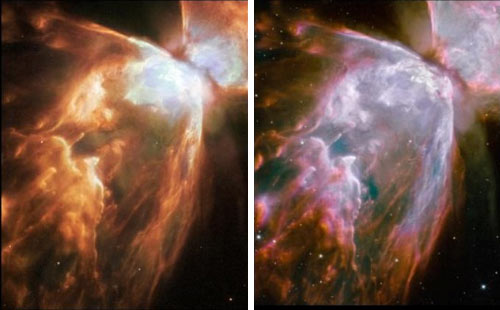
Before and after photos from the Hubble telescope, which recently underwent spaceLASIK to extend the life and capabilities of the prolific telescope.
A massive solar flare on September 1, 1859 “caused the most potent disruption of Earth’s ionosphere in recorded history”.
Within hours, telegraph wires in both the United States and Europe spontaneously shorted out, causing numerous fires, while the Northern Lights, solar-induced phenomena more closely associated with regions near Earth’s North Pole, were documented as far south as Rome, Havana and Hawaii, with similar effects at the South Pole.
(via the browser)
Nice animated timeline of the construction of the International Space Station. (thx, struan)
Using redshift data, a 3-D animated view of the Hubble Ultra Deep Field was created.
For those of you who missed the show last night or if you just want a replay, the CBS News footage of the Apollo 11 Moon landing and Moon walk, presented by Walter Cronkite, is available on YouTube. The Moon landing video is here and the first of 7 videos of the Moon walk is here.
On July 17, 1969, The New York Times issued a correction related to an editorial the paper published in 1920 that dismissed the idea of rocket travel in the vacuum of space. The editorial read, in part:
That Professor Goddard, with his ‘chair’ in Clark College and the countenancing of the Smithsonian Institution, does not know the relation of action to reaction, and of the need to have something better than a vacuum against which to react — to say that would be absurd. Of course he only seems to lack the knowledge ladled out daily in high school.
The correction stated:
Further investigation and experimentation have confirmed the findings of Issac Newton in the 17th Century and it is now definitely established that a rocket can function in a vacuum as well as in an atmosphere. The Times regrets the error.
The Times regrets the error! Wish I’d written that next to a few muffed physics exam questions. Here’s a pretty good explanation of why rockets work in vacuums. (via @davidfg)
Inspired by the ApolloPlus40 Twitter account and We Choose the Moon, both of which are tracking the Apollo 11 mission as it happened 40 years ago, I’ve built a page where you can watch the CBS News coverage of Walter Cronkite reporting on the Moon landing and the first moon walk, 40 years to the second after it originally happened.
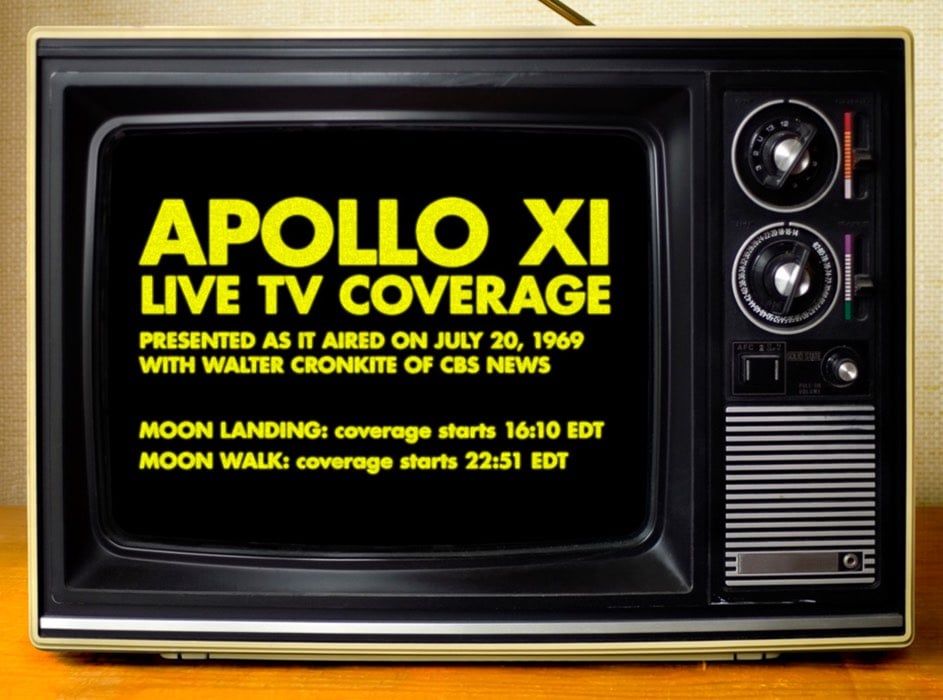
Just leave this page open in your browser and at the appointed times (schedule is below), the broadcast will begin (no manual page refresh necessary).
Schedule:
Moon landing broadcast start: 4:10:30 pm EDT on July 20
Moon landing shown: 4:17:40 pm EDT
Moon landing broadcast end: 4:20:15 pm EDT
Moon walk broadcast start: 10:51:27 pm EDT
First step on Moon: 10:56:15 pm EDT
Nixon speaks to the Eagle crew: approx 11:51:30 pm EDT
Moon walk broadcast end: 12:00:30 am EDT on July 21
If you’ve never seen this coverage, I urge you to watch at least the landing segment (~10 min.) and the first 10-20 minutes of the Moon walk. I hope that with the old time TV display and poor YouTube quality, you get a small sense of how someone 40 years ago might have experienced it. I’ve watched the whole thing a couple of times while putting this together and I’m struck by two things: 1) how it’s almost more amazing that hundreds of millions of people watched the first Moon walk *live* on TV than it is that they got to the Moon in the first place, and 2) that pretty much the sole purpose of the Apollo 11 Moon walk was to photograph it and broadcast it live back to Earth.
Thanks to Meg for her JS help…any errors or sloppy code are mine. Please note that schedule times are approximate, based on your computer’s clock, and that the syncing of the videos might not be perfect. You need to have JS and Flash 8+ to view. This is just like real TV…if you miss the appointed time, there’s no rewind or anything…the video is playing “live”. I have not done extensive browser testing so it may not work perfectly in your browser. Bug reports are welcome and I will try to fix things as they crop up. If you run into any problems, just reload the page. To ensure that you have the latest (hopefully bug-free) version before the broadcast begins, reload the page. Other than that, if you leave it open, the broadcast will happen automatically.
Update: If you missed the “live” show, you can watch all of the clips on YouTube.
Update: The Apollo broadcast no longer requires Flash. Big thanks to Geoff Stearns for helping me with the upgrade.
I said yesterday that NASA would be taking some new photos of the Apollo landing sites with the Lunar Reconnaissance Orbiter. Turns out that happened pretty quickly…they just released photos of the Apollo 11, 14, 15, 16, and 17 sites. Here’s the Apollo 11 site:
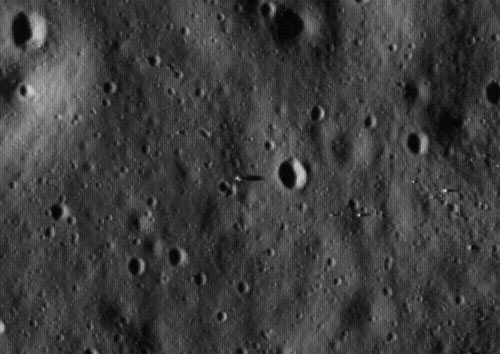
The lunar module is the small white bit in the middle casting the long shadow. The Apollo 14 site is the coolest…you can see the path the astronauts took out to some scientific instruments. The LRO hasn’t reached its final orbit yet so future images “will have two to three times greater resolution”. !!! See also my giant Apollo 11 post.
Yesterday was the 40th anniversary of the launch of Apollo 11 and Monday is the same for both the first Moon landing and the first walk on the surface. In this entry, I’ve collected some of the best resources on the web related to the anniversary…articles, historical documents, audio, video, transcripts, photos, and the like. Enjoy.
We Choose the Moon is tracking the activities of the Apollo 11 mission as it happened 40 years ago. Very nicely done.
Housed on NASA’s history site is a ton of resources about the Apollo 11 landing, including an annotated transript of the landing, which makes for really interesting reading. MP3 files are also available as are many, many video clips of the landing at the astronauts’ time on the surface. Highlights: this video was shot out of the window of the lunar module from a height of 50,000 feet until one minute after touchdown and I’ve never seen Armstrong’s first step on the Moon from this angle before.
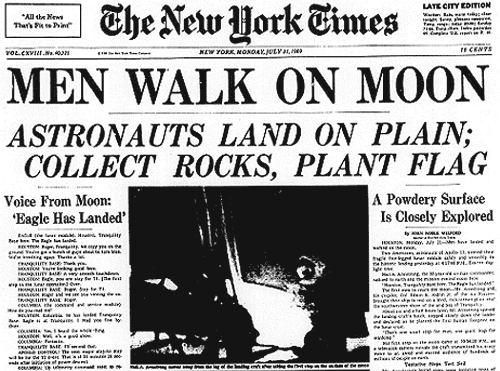
For its July 21, 1969 issue, The NY Times used 96 pt. type to declare that MEN WALK ON MOON.
The landing was made four miles west of the aiming point, but well within the designated area. An apparent error in some data fed into the craft’s guidance computer from the earth was said to have accounted for the discrepancy.
Suddenly the astronauts were startled to see that the computer was guiding them toward a possibly disastrous touchdown in a boulder-filled crater about the size of a football field.
Mr. Armstrong grabbed manual control of the vehicle and guided it safely over the crater to a smoother spot, the rocket engine stirring a cloud of moon dust during the final seconds of descent.
The Onion used larger type and took a more unadulterated and profane approach (love the video version).
John Noble Wilford, the Times journalist who wrote the front page story underneath the 96 pt. type — “the biggest single story of my career” — recounts his Apollo 11 experience and ponders the Apollo program’s legacy in a great piece for the Times.
It then occurs to me that if Columbus and Capt. James Cook were alive, they might be less astonished by two men landing on the Moon than by the millions of people, worldwide, watching every step of the walk as it happens. Exploring is old, but instantaneous telecommunications is new and marvelous.
In just 1.3 seconds, the time it takes for radio waves to travel the 238,000 miles from Moon to Earth, each step by Armstrong and Aldrin is seen, and their voices heard, throughout the world they have for the time being left behind. In contrast to exploration’s previous landfalls, the whole world shares in this moment.
The Apollo 11 mission in photographs: NASA Images is the comprehensive source for NASA photos of the Apollo 11 mission; the always excellent Big Picture has photos of the mission from a variety of sources; David Burnett shot photos of people watching the launch; Time looks at Apollo astronauts Now and Then; the NY Times collected photos from readers of their Apollo 11 moments; Life has several photo galleries: Buzz Aldrin Looks Back, Scenes From the Moon, Up Close With Apollo 11 (rare and never-published photos), and The World Watches; and Google’s archive of Life magazine’s Apollo 11 images.
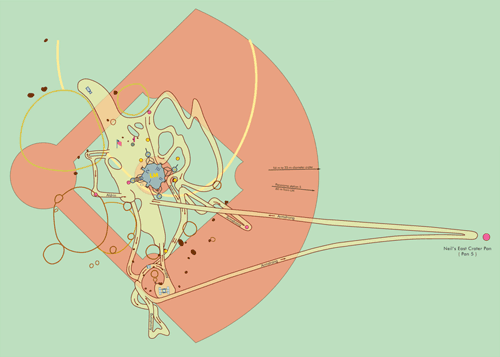
A map of where Armstrong and Aldrin walked during their 2+ hours on the surface. That same map superimposed on a soccer pitch and on a baseball field. They didn’t walk that far at all.
Explore the Apollo 11 landing site on Google Moon.
In piece published on the 40th anniversary of the Apollo 11 launch, Buzz Aldrin advocates not a return to the Moon but a mission to Mars with the objective of establishing a colony on the red planet.
Let the lunar surface be the ultimate global commons while we focus on more distant and sustainable goals to revitalize our space program. Our next generation must think boldly in terms of a goal for the space program: Mars for America’s future. I am not suggesting a few visits to plant flags and do photo ops but a journey to make the first homestead in space: an American colony on a new world.
Robotic exploration of Mars has yielded tantalizing clues about what was once a water-soaked planet. Deep beneath the soils of Mars may lie trapped frozen water, possibly with traces of still-extant primitive life forms. Climate change on a vast scale has reshaped Mars. With Earth in the throes of its own climate evolution, human outposts on Mars could be a virtual laboratory to study these vast planetary changes. And the best way to study Mars is with the two hands, eyes and ears of a geologist, first at a moon orbiting Mars and then on the Red Planet’s surface.
Video of John F. Kennedy’s “we choose to go to the Moon” speech given at Rice University on September 12, 1962. Fewer than 7 years later, Apollo 11 achieved the goal that Kennedy laid out in that speech.
In a piece for New Scientist, Linda Geddes writes about possible future lunar parks and how they might be preserved.
Around these [landing sites] are scattered smaller artefacts and personal items, such as Neil Armstrong’s boots and portable life-support system, scientific instruments and their power generators — and, of course, the iconic US flag which remains planted in the moon’s surface. Then there are the footprints and rover tread paths. Despite the passing of the years, these remain carved into the dust because the moon has no wind or rain to wash them away.
Anthropologist P. J. Capelotti of Penn State University in Abington has mapped out five “lunar parks”. These cover the areas where the majority of the artefacts are concentrated and could be used as a basis for future preservation efforts. “Nobody’s saying that the whole moon has to be off limits, but as people are starting to make plans for tourism and mineral extraction, or for putting a base there, they just need to be aware of them and work around them.”
Since returning from the Moon, Neil Armstrong has been less and less willing to speak in public about his Apollo 11 experience. For the 40th anniversary, Armstrong will not take part in the NASA event to commemorate the landing. His only appearance related to the anniversary will be a 15-minute lecture at a Smithsonian Institution event on Sunday night. I found this event on the National Air and Space Museum site…maybe that’s it? If so, then Armstrong’s lecture will be webcast live on the NASA TV site that evening.
Popular Science shares a list of ten things you didn’t know about the Apollo 11 Moon landing.
7. When Buzz Aldrin joined Armstrong on the surface, he had to make sure not to lock the Eagle’s door because there was no outer handle.
Moonwalk One is a documentary film about Apollo released in 1970 to little fanfare, even though it won an award at the Cannes Film Festival. The film was commissioned by NASA but with so much Apollo activity and information happening in the late 60s and early 70s, no one was interested in distributing or seeing the film and it was soon forgotten. Recently, the only remaining 35mm print of the film was located under the director’s desk, restored, and offered for sale on DVD in time for the 40th anniversary.
To get a feel of what it was like in the Soviet Union during the Apollo 11 mission, Scientific American interviewed Sergei Khrushchev, son of former Russian premier Nikita Khrushchev. The reaction was somewhat more subdued than in other parts of the world.
Of course, you cannot have people land on the moon and just say nothing. It was published in all the newspapers. But if you remember [back then] when Americans spoke of the first man in space, they were always talking of “the first American in space” [not Yuri Gagarin]. The same feeling was prevalent in Russia. There were small articles when Apollo 11 was launched. Actually, there was a small article on the first page of Pravda and then three columns on page five. I looked it up again.
Eat Me Daily explores the food consumed on the mission.
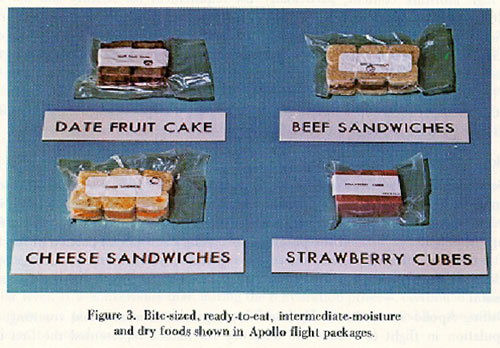
The Apollo crew even dined on thermo-stabilized cheddar cheese spread and hot dogs during the moon mission, bringing at least a bit of America in July to the sterile flight craft. And yes, there was bacon - foreshadowing the current bacon craze, the first meal eaten by man on the moon was none other than bacon cubes, coated with gelatin to combat crumbs.
The issue of the New Yorker published just after the Moon landing is worth a look: much of the Talk of the Town section is devoted to the landing and there’s also a Letter from the Space Center. (Subscribers only.)
The main NASA site has an interactive feature to explore the landing site and Eagle (Eagle was the name of the lunar module).
Finally, there’s still some good stuff to be had on the old telly on Monday. The History Channel has As It Happened: Man on the Moon at 8pm ET:
This special takes viewers back to July 1969 to experience the actual CBS News/Walter Cronkite coverage of man’s first lunar landing. Using minimal editing and leaving the original footage untouched viewers will feel as if they are watching the CBS coverage in July of 1969. While today we know the outcome of Apollo 11’s mission it was not a given then. This will become evident watching Walter Cronkite and his colleagues as they watch the historic lunar mission unfold before them.
and Moonshot, a two-hour documentary about Apollo 11, at 9pm ET. Turner Classic Movies is airing a bunch of Moon-related movies all day, including A Trip to the Moon (a 12-minute film from 1902) at 8pm ET and the excellent For All Mankind (newly out on Criterion Blu-ray) at 8:15pm ET. The Discovery Channel has When We Left the Earth, a one-hour documentary on the mission, at 10pm ET. If none of that tickles your fancy, try episode 6 of the excellent From the Earth to the Moon (available for the insanely low price of $12 on Amazon) or In the Shadow of the Moon on DVD.
[If you enjoyed this post, you should post it to Twitter.]
Update: Tom Wolfe, author of The Right Stuff, writes that landing on the Moon killed NASA.
Everybody, including Congress, was caught up in the adrenal rush of it all. But then, on the morning after, congressmen began to wonder about something that hadn’t dawned on them since Kennedy’s oration. What was this single combat stuff — they didn’t use the actual term — really all about? It had been a battle for morale at home and image abroad. Fine, O.K., we won, but it had no tactical military meaning whatsoever. And it had cost a fortune, $150 billion or so. And this business of sending a man to Mars and whatnot? Just more of the same, when you got right down to it. How laudable … how far-seeing … but why don’t we just do a Scarlett O’Hara and think about it tomorrow?
July Moon is a forthcoming documentary about some lost NASA tapes. Surely not these NASA tapes?
The computer source code that ran Apollo 11’s Command Module and Lunar Module has been released.
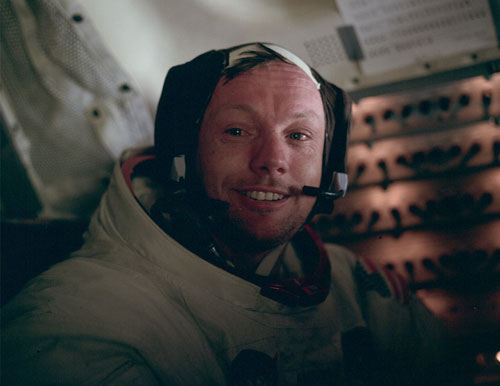
A recently discovered photo clearly shows Neil Armstrong’s face on the Moon through his visor.
He was the first man to walk on the moon, taking that one giant leap for mankind — yet most of the famous shots are of his fellow astronaut Buzz Aldrin, as it was Armstrong who manned the stills camera.
New Scientist overlaid the Apollo lunar excursion maps on top of cities in Google Earth. Neil and Buzz didn’t even leave Trafalgar Square on their trip to the Moon.
Hmm, I was just wondering about this the other day: NASA’s Lunar Reconnaissance Orbiter is going to take photos of some of the Apollo landing sites, including where Apollo 11 landed.
Lunar archaeologists, interested in making the Apollo 11 site a National Historic Landmark, hope the planned photos will answer some of these longstanding questions: What is the condition of Tranquility Base after 40 years? Was the American flag blown over on the Eagle’s ascent and is it now a bleached skeleton? What are the relatively long term effects of the lunar environment on human artifacts?
This should quiet the people who still think it was all a hoax…although NASA could be faking these photos as well.
NASA is restoring and improving the video footage of the Apollo 11 mission and this morning they released some of those videos, including Neil Armstrong’s first step on the Moon, Aldrin’s first step, and the raising of the American flag.
Update: The tapes containing the original footage were erased to record satellite data. The restorations are being sourced from broadcast TV footage.
Today is the 40th anniversary of the liftoff of Apollo 11. You can follow along on We Choose the Moon, on Twitter, and with a NASA audio program. (Is there a video launch being broadcast anywhere?)
NASA is also releasing “greatly improved video imagery” of the Apollo 11 moon walks. !!! So look for that later today.
Update: Someone should have synced up this video footage of the launch so that people could watch it in realtime.
We Choose the Moon is a site that tracks the activities of the Apollo 11 mission as it happened 40 years ago. Nice work. The transmissions from the spacecraft, CAPCOM, and the lunar lander are cleverly published to and pulled in from Twitter.
With all this 40th anniversary stuff, I’m having trouble getting my mind around that the first Moon landing is as far removed from the present as the low point of The Great Depression was from my birth (i.e. the Moon landing, culturally speaking, is Ollie’s Great Depression). See also timeline twins. (via jimray)
The scamps at Nature are updating the ApolloPlus40 Twitter account as the Apollo 11 mission happened 40 years ago. (thx, matt)
Oliver Morton fills us in on the current happenings in the search for planets outside of our solar system. A friend of his clued him in on a technique that could be used to not only discover planets but to determine if those planets show signs of supporting Earth-like life.
When they are passing in front of their stars, their atmospheres are backlit in a way that can make spectroscopic analysis of the different chemicals in their atmospheres comparatively easy: the wavelengths of light absorbed by the various chemicals will show up, in a tiny way, in the spectrum of the starlight. And this is what makes it possible to imagine looking at them for signs of life.
What scientists would look for are planets with unstable atmospheres, which James Lovelock said was an indication of life.
After the extragalactic planet post this morning, Sam Arbesman sent me a link to systemic, a blog dedicated to the search for extrasolar planets written by Greg Laughlin, one of the scientists involved in the effort. Here are two relevant posts. In Forward, Laughlin says we’re very close to finding a nearby Earth-like planet:
Detailed Monte-Carlo simulations indicate that there’s a 98% probability that TESS will locate a potentially habitable transiting terrestrial planet orbiting a red dwarf lying closer than 50 parsecs. When this planet is found, JWST (which will launch near the end of TESS’s two year mission) can take its spectrum and obtain resolved measurements of molecular absorption in the atmosphere.
In Too cheap to meter, Laughlin presents a formula for the land value of such a discovery that depends on how far away the planet is, the age of the star it orbits, and the star’s visual magnitude.
Applying the formula to an exact Earth-analog orbiting Alpha Cen B, the value is boosted to 6.4 billion dollars, which seems to be the right order of magnitude. And applying the formula to Earth (using the Sun’s apparent visual magnitude) one arrives at a figure close to 5 quadrillion dollars, which is roughly the economic value of Earth (~100x the Earth’s current yearly GDP)…
HD video of the Moon from 13 miles above the surface taken by Japan’s KAGUYA probe. The probe’s orbit has been decaying since it began circling the Moon and will crash on the surface at 18:30 GMT on June 10.
Using a Chilean telescope, astronomer Debra Fischer is leading a team searching for Earth-like planets around Alpha Centuri, our sun’s nearest stellar neighbor.
RV shifts are how the vast majority of extrasolar worlds have been discovered, but only because these planets, called “hot Jupiters,” are extremely massive and in hellishly close orbits around their stars. Their stellar wobbles are measurable in meters per second; seeing the much smaller centimeters-per-second wobble of an Earth twin is orders of magnitude more difficult. For the Alpha Centauri system, the feat is akin to detecting a bacterium orbiting a meter from a sand grain-from a distance of 10 kilometers. But by devoting hundreds of nights of telescope time to collecting hundreds of thousands of individual observations of just these two stars, Fischer believes she can eventually distill the faint RV signal of any Earth-like planets. It’s simply a matter of statistics and brute force. The planets wouldn’t reveal themselves as images in a telescope, but as steadily strengthening probabilistic peaks.
Live on NASA TV right now: the launch of the Space Shuttle Atlantis, tasked to repair the Hubble telescope. Looks like if the weather holds, lift-off is around 2:01pm. (via @noahkalina)
I am hoping that Moon will be awesome and not just a mashup of 2001 and Solaris. The score is by Clint Mansell, who has scored all of Darren Aronofsky’s movies, most notably Requiem for a Dream. Moon opens on June 12 in NYC and LA. (via sarahnomics)
If the naked eye could see like a telescope, this is what the night sky might look like. (via rw)
The Hubble Space Telescope captured four of Saturn’s moons crossing its face at the same time. (via cyn-c)
A zoomable National Geographic map of the Moon from 1969. Richard Furno worked on the map and tells the very long story of how it came about. One of the first images on the page is from a Soviet mission called Luna-3 that took the first photographs of the far side of the Moon. (thx, lynda)


Socials & More