kottke.org posts about science
In the five years since the sequencing of the human genome, “much of the data have little immediately useful meaning, and the research has produced only a trickle of medicine”. And where medical science has failed, hucksters have filled the gap.
Twenty percent of the human genome is patented. I expect that someday in the future, my morning will be interrupted by a lawyer telling me that the company he represents holds a patent on the biochemical conversion of foodstuffs to energy suitable for powering a biological organism and that I should cease and desist eating my Cheerios.
Frans de Waal on low frequency audio as a social instrument: “The host, Larry King, would adjust his timbre to that of high-ranking guests, like Mike Wallace or Elizabeth Taylor. Low-ranking guests, on the other hand, would adjust their timbre to that of King. The clearest adjustment to King’s voice, indicating lack of confidence, came from former Vice President Dan Quayle.” (via mr)
Time magazine asks Moby, Malcolm Gladwell, Tim O’Reilly, Clay Shirky, David Brooks, Mark Dery, and Esther Dyson about their views on the future: religion, culture, politics, etc. Gladwell: “If I had to name a single thing that has transformed our life, I would say the rise of JetBlue and Southwest Airlines. They have allowed us all to construct new geographical identities for ourselves.”
Two of the biggest pessimists in the business, Bill Joy and Ray Kurzweil, outline their case for not releasing the genome for the 1918 influenza virus. “The genome is essentially the design of a weapon of mass destruction. No responsible scientist would advocate publishing precise designs for an atomic bomb, and in two ways revealing the sequence for the flu virus is even more dangerous.”
In the real world, the process of design depends on evolution: “To consider the iPod, it did not spring fully formed from the mind of a powerful Designer, but rather it represents one distinct point on a long evolutionary timeline.” Intelligent design is bad science and bad design. That doesn’t leave much.
College football and network theory meet at last. In a recent paper, a pair of researchers have devised a ranking system based on network theory (with teams that didn’t directly play each other, the theory determines who’s the better team based on games played versus a mutual foe) that is more accurate than the current polling system used to choose a college football national champion. (via cd)
Further discovery of Homo floresiensis bones have strengthened researchers’ argument that the so-called Hobbit is a new and distinct human species. More on Flores man at Nature, which is doing a weekly podcast now.
Is it strange that every time I go into my bathroom and look at the box of tissues sitting on the shelf, I see Charles Darwin looking back at me?
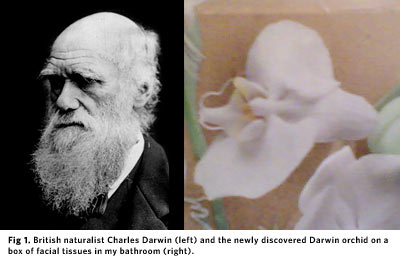
It does look like Darwin, yes? Or have I been reading far too much about science and evolution lately?
Note: My bathroom Darwin orchid has nothing to do with Angraecum sesquipedale, an orchid that Darwin discovered in 1850. At the time, he speculated that in order for the plant to be pollinated, a moth with a 12” proboscis would have to do it, even though no such moth had been shown to exist. This freakish moth was eventually discovered (not in my bathroom) in 1903, 20 years after Darwin’s death.
Scientists want to build an array of submillimeter telescopes across the whole earth to peer “inside” the massive black hole at the center of the galaxy.
Update: Many people wrote in to correct me in saying that “submillimeter” referred to the size of the telescopes…it of course referred to the EM wavelength. Me brain not working right.
Brian Greene on Einstein’s most famous equation, E =mc^2. When he finally gets around to it in the middle of the article, Greene’s got a pretty good layman’s explanation of what the formula actually means.
Regrading this: Summer Movies Other Than March of the Penguins That Conservatives Are Rallying Behind. “The Dukes of Hazzard: Not once is the word ‘evolution’ used in this movie. Many pundits proclaim this to be a tacit endorsement of intelligent design.”
Nick Paumgarten’s Talk of the Town piece opens with an anecdote about the doorman’s role in elevating the social status of their building’s tenants:
When Peter Bearman, a professor of sociology, moved from North Carolina to New York, seven years ago, to take a post at Columbia, he found his new colleagues unusually arrogant and difficult, even for the Ivy League. After considering other factors, he laid the blame on the doormen in their apartment buildings. He reasoned that the doormen had an interest in elevating the status of their tenants in order to enhance their own status, and so they treated the professors like big shots — for example, by addressing them as “professor” — until the professors came to believe that they really were big shots. Bearman felt that he had discovered a previously unobserved variant of the Matthew effect, Robert K. Merton’s theory concerning the compounding of iniquity among prominent and marginal individuals — the rich getting richer, and so forth.
I’d never heard of the Matthew effect before, so I looked it up in Wikipedia:
In sociology, Matthew effect was a term coined by Robert K. Merton to describe how, among other things, eminent scientists will often get more credit than a comparatively unknown researcher even if their work is similar; it also means that credit will usually be given to researchers that are already famous…
Here is Merton’s original paper.
Steven Johnson’s thoughts on Web 2.0. He compares it to a rain forest, with the information flow through the web being analogous to the efficient nutrient flow through a forest. “Essentially, the Web is shifting from an international library of interlinked pages to an information ecosystem, where data circulate like nutrients in a rain forest.” Compare with Tim O’Reilly’s recent thoughts on the subject.
A rare interview with Stephen Hawking about his remix of A Brief History of Time. The interview’s a bit weird…the interviewer doesn’t seem to know a whole lot about science.
Flowers don’t smell as good as they used to and part of the reason is breeding…they’re breeding flowers for looks and longevity, not for scent. I believe Michael Pollan discusses this in his excellent The Botany of Desire (tulip chapter).
Bats may be the source of SARS. “Researchers found a virus closely related to the Sars coronavirus in bats from three regions of China”.
First photos of the giant squid ever captured. In capturing the photos, they ripped one of the squid’s tentacles off, which has made the squid a bit angry.
Scientists have explained the Cheerio Effect, answering why things like Cheerios floating in milk tend to clump together.
The science behind shyness, an “affliction” shared by 30% of the population (the lurkers in real life). Reminds of the fantastic Caring for Your Introvert from The Atlantic Monthly a couple of years ago. Sadly, the article has disappeared behind the Atlantic’s pay wall, but I posted a short excerpt here.
Update: The complete Caring for Your Introvert article is available on the author’s web site. (thx chris and several others)
Profile of Robert Trivers who “came up with the first Darwinian explanations for human cooperation, jealousy and our sense of justice that made genetic sense, and he showed how these arose from the same forces as act on all animals, from the pigeons outside his window to the fish of coral reefs”.
Scientists are having a bit of fun wondering about the genetics of wizardry in Harry Potter. “This suggests that wizarding ability is inherited in a mendelian fashion, with the wizard allele (W) being recessive to the muggle allele (M). According to this hypothesis, all wizards and witches therefore have two copies of the wizard allele (WW).”
Here’s a sampling of the rest of the AIGA Design Conference, stuff that I haven’t covered yet and didn’t belong in a post of it’s own:
- Juan Enriquez gave what was probably my favorite talk about what’s going on in the world of genetics right now. I’ve heard him give a variation of this talk before (at PopTech, I think). He started off talking about coding systems and how when they get more efficient (in the way that the Romance languages are more efficient than Chinese languages), the more powerful they become in human hands. Binary is very powerful because you can encode text, images, video, etc. using just two symbols, 1 and 0. Segue to DNA, a four symbol language to make living organisms…obviously quite powerful in human hands.
- Enriquez: All life is imperfectly transmitted code. That’s what evolution is, and without the imperfections, there would be no life. The little differences over long periods of time are what’s important.
- Enriquez again: The mosquito is a flying hypodermic needle. That’s how it delivers malaria to humans. We could use that same capability for vaccinating cows against disease.
- Along with his list of 20 courses he didn’t take in design school, Michael Bierut offered some advice to young designers:
1. Design is the easy part.
2. Learn from your clients, bosses, collaborators, and colleagues.
3. Content is king.
4. Read. Read. Read.
5. Think first, then design.
6. Never forget how lucky you are. Enjoy yourself.
- Nicholas Negroponte: If programmers got paid to remove code from sofware instead of writing new code, software would be a whole lot better.
- Negroponte also shared a story about outfitting the kids in a school in Cambodia with laptops; the kids’ first English word was “Google”, and from what Negroponte said, that was followed closely by “Skype”. He also said the children’s parents loved the laptops because at night, it was the brightest light in the house.
- Christi recorded Milton Glaser’s mother’s spaghetti recipe. “Cook until basically all of the water is evaporated. Mix in bottle of ketchup; HEINZ ketchup.”
- Ben Karlin and Paula Scher on the challenges of making America, The Book: Books are more daunting than doing TV because print allows for a much greater density of jokes. In trying to shoot the cover image, they found that bald eagles cannot be used live for marketing or advertising purposes. The solution? A golden eagle and Photoshop. And for a spread depicting all the Supreme Court Justices in the buff, they struggled — even with the Web — to find nude photos of older people until they found a Vermont nudist colony willing to send them photos because they were big fans of The Daily Show.
- Bill Strickland blew the doors off the conference with his account of the work he’s doing in “curing cancer” — his term for revitalizing violent and crime-ridden neighborhoods — in Pittsburgh. I can’t do justice to his talk, so two short anecdotes. Strickland said he realized that “poor people never have a nice day” so when he built his buildings in these poor black neighbohoods, he put nice fountains out front so that people coming into the building know that they’re entering a space where it’s possible to have a good day. Another time, a bigwig of some sort was visiting the center and asked Strickland about the flowers he saw everywhere. Flowers in the hood? How’d these get here? Strickland told him “you don’t need a task force or study group to buy flowers” and that he’d just got in his car, bought some flowers, brought them back, and set them around the place. His point in all this was creating a place where people feel less dissimilar to each other…black, white, rich, poor, everybody has a right to flowers and an education and to be treated with respect and to have a nice day. You start treating people like that, and surprise!, they thrive. Strickland’s inner city programs have produced Fulbright Scholars, Pulitzer Prize winners, and tons of college graduates.
- I caught 30 minutes of David Peters’ presentation of Typecast: The Art of the Typographic Film Title and realized I should have gotten there in time to see the whole thing. I could sit and watch cool movie titles all day long. Among the titles he showed were Bullit, Panic Room, Dr. Strangelove, Barbarella, The Island of Dr. Moreau, and Superman. The title sequence for Napoleon Dynamite (which was discussed on Design Observer last year) was shown later in the main hall.
- At the closing party at the Museum of Science, we checked out the cool Mathematica exhibit that was designed by Charles and Ray Eames, two designers who were also pretty big science/math nerds.
- And some final thoughts from others at the conference. Peter Merholz says that “form-makers”, which make up the vast majority of the AIGA audience, “are being passed by those who are attempting to use design to serve more strategic ends”. (That’s an interesting thought…) A pair of reviews from Speak Up: Bryony was a bit disappointed with the opening Design Gala but left, like everyone else, in love with emcee John Hockenberry while Armin noted that the preservation of digital files is a big concern for museums in building a collection of graphic design pieces…in 35 years, how are you going load that Quark file or run that Flash movie?
For more of what people are saying about the conference, check out IceRocket. There’s a bunch of photos on Flickr as well.
A couple of guys calculated the average color of the universe to be turquiose. Then it turned out they had made an error and the actual color of the universe is beige.
Odd story of one astronomer possibly “stealing” another astronomer’s discovery of a large trans-Neptunian object. The original discoverer alleges that the usurper looked at a couple of Web sites that detailed the discovery and where the discover’s telescopes were pointed…the astronomy equivalent of stealing signs.
Animal Reviews is (duh) a site that reviews animals, including giving them a rating. The dolphin gets 0.8/10 while the duck-billed platypus gets a 6.3.
Newer posts
Older posts





Socials & More