If we want to travel into the future, we just need to go fast. Really fast. And I think the only way we’re ever likely to do that is by going into space. The fastest manned vehicle in history was Apollo 10. It reached 25,000mph. But to travel in time we’ll have to go more than 2,000 times faster. And to do that we’d need a much bigger ship, a truly enormous machine. The ship would have to be big enough to carry a huge amount of fuel, enough to accelerate it to nearly the speed of light. Getting to just beneath the cosmic speed limit would require six whole years at full power.
An animal must lie still for a great stretch of time, during which it is easy prey for predators. What can possibly be the payback for such risk? “If sleep doesn’t serve an absolutely vital function,” the renowned sleep researcher Allan Rechtschaffen once said, “it is the greatest mistake evolution ever made.” […]
At Stanford University I visited William Dement, the retired dean of sleep studies, a co-discoverer of REM sleep, and co-founder of the Stanford Sleep Medicine Center. I asked him to tell me what he knew, after 50 years of research, about the reason we sleep. “As far as I know,” he answered, “the only reason we need to sleep that is really, really solid is because we get sleepy.”
And this fatal familial insomnia sounds like a horrible disease:
The main symptom of FFI, as the disease is often called, is the inability to sleep. First the ability to nap disappears, then the ability to get a full night’s sleep, until the patient cannot sleep at all. The syndrome usually strikes when the sufferer is in his or her 50s, ordinarily lasts about a year, and, as the name indicates, always ends in death.
James Cameron spoke about the science of Avatar at Caltech last month; Discovery has a summary.
“We tried to make it not completely fanciful,” Cameron told the crowd, which filled the auditorium. “If it was too outlandish, there would be a believability gap.” So while Pandora features floating mountains, that might not be so far-fetched, Cameron said, considering Earth has developed high-speed “bullet” trains that levitate on magnetic fields. Of course, the “reality-based” scenario did have its limits. “We figured that to actually lift mountains, the magnetic field would have to be strong enough to rip the hemoglobin out of your blood,” says Cameron. “But we decided not to go there.”
“Early on in our research, it became apparent that the majority of salt on a snack doesn’t even have time to dissolve in your saliva because you swallow it so rapidly,” explained Mehmood Khan, senior vice president and chief scientific officer and a former Mayo Clinic endocrinologist. A Wall Street Journal story later reported only about 20 percent of the salt on a chip dissolves on the tongue, and the remaining 80 percent is swallowed without contributing to taste.
I’m confused as to why “an understanding of crystal chemistry” is necessary. Why couldn’t they just crush/grind the salt into a fine powder instead? Are the cubic crystals still too big even when crushed?
During an 11 month study in 2007, scientists sequenced the genes of more than 180,000 specimens from the Western English Channel. Although this level of sampling “far from exhausted the total diversity present,” they wrote, one in every 25 readings yielded a new genus of bacteria (7,000 genera in all).
This suggests there is a long tail of life in bacteria, with a few species super-abundant, but many many species with very thin populations. At the far end of the tail there may be a billion species with only a few individuals. […] And like other kinds of long tails, the sum of all these small bits total up to exceed the sum of individuals in the most popular species. As the microbiologists involved in the Census of Marine Life like to say, this survey reveals life’s “hidden majority.”
Today only, the usually $499 DNA test from 23andMe is only $99. Ship your spit off and in a few weeks, you’ll receive information about your ancestry, health risks, and so on.
DNA testing for $100! Stick that in your flying car’s tailpipe and smoke it!
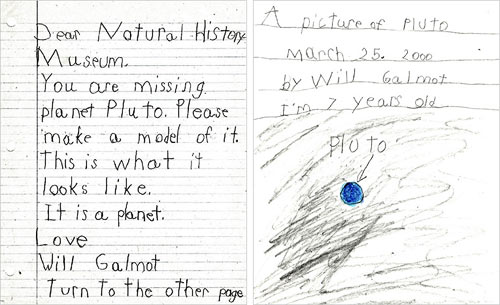
The Natural History Museum got a lot of hate mail from children when they demoted Pluto from planet to a resident of the Kuiper Belt, including this one from a fellow named Will:
In order to see if a lava lamp would still function on Jupiter, Neil Fraser built a large centrifuge to try it out. This is the best homemade centrifuge video you’ll see today:
He used the accelerometer on an Android phone to measure the G force.
The centrifuge is a genuinely terrifying device. The lights dim when it is switched on. A strong wind is produced as the centrifuge induces a cyclone in the room. The smell of boiling insulation emanates from the overloaded 25 amp cables. If not perfectly adjusted and lubricated, it will shred the teeth off solid brass gears in under a second. Runs were conducted from the relative safety of the next room while peeking through a crack in the door.
As I note in How We Decide, this data directly contradicts the rational models of microeconomics. Consumers aren’t always driven by careful considerations of price and expected utility. We don’t look at the electric grill or box of chocolates and perform an explicit cost-benefit analysis. Instead, we outsource much of this calculation to our emotional brain, and rely on relative amounts of pleasure versus pain to tell us what to purchase.
“If you want to discover new particles, you have to produce them; and these new particles are massive. To produce them, you need higher energies. For the first time [on Tuesday], we will be producing particles that have energy 3.5 times higher than the maximum energy achieved so far. […] At the end of the 7 TeV (3.5 TeV per beam) experimental period, the LHC will be shut down for maintenance for up to a year. When it re-opens, it will attempt to create 14 TeV events.
Verlinde suggested that gravity is merely a manifestation of entropy in the Universe. His idea is based on the second law of thermodynamics, that entropy always increases over time. It suggests that differences in entropy between parts of the Universe generates a force that redistributes matter in a way that maximises entropy. This is the force we call gravity.
I’m a sucker for would-be GUTs; this one seems especially interesting to consider.
He wants to inject the DNA with a string of nucleotides that form a comprehensible poem, and he also wants the protein that the cell produces in response to form a second comprehensible poem.
Researchers at Princeton have shown that if you keep the number of calories the same, rats eating high-fructose corn syrup “gained significantly more weight” than rats who ate table sugar.
Some people have claimed that high-fructose corn syrup is no different than other sweeteners when it comes to weight gain and obesity, but our results make it clear that this just isn’t true, at least under the conditions of our tests,” said psychology professor Bart Hoebel, who specializes in the neuroscience of appetite, weight and sugar addiction. “When rats are drinking high-fructose corn syrup at levels well below those in soda pop, they’re becoming obese — every single one, across the board. Even when rats are fed a high-fat diet, you don’t see this; they don’t all gain extra weight.
But not so fast sugar lovers:
The new research complements previous work led by Hoebel and Avena demonstrating that sucrose [i.e. “regular sugar”] can be addictive, having effects on the brain similar to some drugs of abuse.
From the 52 paintings, which date between 1000 and 2000 A.D., the sizes of loaves of bread, main dishes and plates were calculated with the aid of a computer program that could scan the items and rotate them in a way that allowed them to be measured. To account for different proportions in paintings, the sizes of the food were compared to the sizes of the human heads in the paintings.
A team of scientists has succeeded in putting an object large enough to be visible to the naked eye into a mixed quantum state of moving and not moving.
Wait, what? Like, WHAT? Ok, let’s start over:
Andrew Cleland at the University of California, Santa Barbara, and his team cooled a tiny metal paddle until it reached its quantum mechanical ‘ground state’ — the lowest-energy state permitted by quantum mechanics. They then used the weird rules of quantum mechanics to simultaneously set the paddle moving while leaving it standing still.
The fuck? In my day, we were taught, with the help of non-graphing calculators and paper notebooks, that quantum mechanics was a lot of wand-wavey nonsense about wave/particle duality that you never had to worry about because it belonged to some magical tiny land that no one visits with their actual eyes. This…this is straight-up magic. [Cue Final Countdown]
Free-throw success is also improved by adding a little backspin, which pushes the ball downward if it hits the back of the rim. The North Carolina State engineers calculated the ideal rate of free-throw backspin at three cycles per second. That is, a shot that takes one second to reach the basket will make three full revolutions counterclockwise as seen from the stands on the player’s right side.
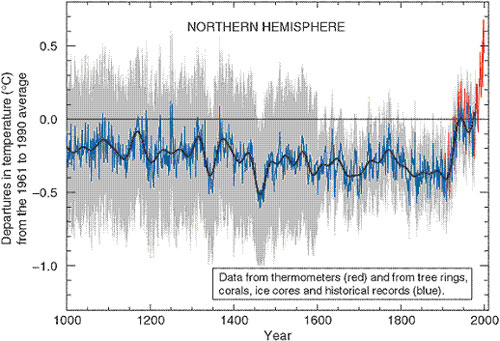
In a review in Prospect, Matt Ridley, who is no slouch as a science writer himself, calls Andrew Montford’s The Hockey Stick Illusion “one of the best science books in years”. Pretty high praise for what Ridley also calls “the biography of a graph”. Specifically, this graph:
You may have seen it in An Inconvenient Truth in this form. The graph shows the dramatic rise in temperature in the northern hemisphere over the past 100 years caused, presumably, by humans. But as Montford details in his book, the graph is incorrect.
[The author] had standardised the data by “short-centering” them — essentially subtracting them from a 20th century average rather than an average of the whole period. This meant that the principal component analysis “mined” the data for anything with a 20th century uptick, and gave it vastly more weight than data indicating, say, a medieval warm spell.
After analyzing dozens of Hollywood films, a team of researchers has found evidence that the visual rhythm of movies at the shot level matches a pattern called the 1/f fluctuation, the same pattern that is found in dozens of natually occurring phenomena, including the length of the human attention span.
These results suggest that Hollywood film has become increasingly clustered in packets of shots of similar length. For example, action sequences are typically a cluster of relatively short shots, whereas dialogue sequences (with alternating shots and reverse-shots focused sequentially on the speakers) are likely to be a cluster of longer shots. In this manner and others, film editors and directors have incrementally increased their control over the visual momentum of their narratives, making the relations among shot lengths more coherent over a 70-year span.
Modern action movies are particularly adept at matching the audience’s attention span in this manner. The full paper is available here.
“We found that the people who were sensitive to fat, who could taste very low concentrations, actually consumed less fat than the people who were insensitive,” Keast told AFP. “We also found that they had lower BMIs (Body Mass Indexes).”
This is a good example of how the very ubiquity of vitamin C made it hard to identify. Though scurvy was always associated with a lack of greens, fresh meat contains adequate amounts of vitamin C, with particularly high concentrations in the organ meats that explorers considered a delicacy. Eat a bear liver every few weeks and scurvy will be the least of your problems.
But unless you already understand and believe in the vitamin model of nutrition, the notion of a trace substance that exists both in fresh limes and bear kidneys, but is absent from a cask of lime juice because you happened to prepare it in a copper vessel, begins to sound pretty contrived.
To start with, only simple tissues, such as skin, muscle and short stretches of blood vessels, will be made, says Keith Murphy, Organovo’s chief executive, and these will be for research purposes. Mr Murphy says, however, that the company expects that within five years, once clinical trials are complete, the printers will produce blood vessels for use as grafts in bypass surgery. With more research it should be possible to produce bigger, more complex body parts. Because the machines have the ability to make branched tubes, the technology could, for example, be used to create the networks of blood vessels needed to sustain larger printed organs, like kidneys, livers and hearts.
Over at Worldchanging, Alex Steffen calls Bill Gates’ talk about climate change the most important speech ever given at TED. Gates said that the number one priority for him and the Gates Foundation (the world’s largest philanthropic organization) is to combat human-driven climate change.
He reckons that because population is going to continue to grow for at least four decades, because billions of poor people want more equitable prosperity, and because (as he sees it) improvements in energy efficiency are limited, we have to focus on the last element of the equation, the carbon intensity of energy. Simply, we need climate-neutral energy. We need to use nothing but climate-neutral energy.
Using the Relativistic Heavy Ion Collider at the Brookhaven National Laboratory on Long Island, particle physicists have succeeded in creating quark-gluon plasma, the temperature of which is 4 trillion degrees Celsius (about 250,000 times hotter than the center of the Sun). The plasma is believed to be the state the universe was in a microsecond after its creation.
The departure from normal physics manifested itself in the apparent ability of the briefly freed quarks to tell right from left. That breaks one of the fundamental laws of nature, known as parity, which requires that the laws of physics remain unchanged if we view nature in a mirror.
This happened in bubbles smaller than the nucleus of an atom, which lasted only a billionth of a billionth of a billionth of a second. But in these bubbles were “hints of profound physics,” in the words of Steven Vigdor, associate director for nuclear and particle physics at Brookhaven. Very similar symmetry-breaking bubbles, at an earlier period in the universe, are believed to have been responsible for breaking the balance between matter and its opposite antimatter and leaving the universe with a preponderance of matter.
A recent study indicates that the wing shapes of North American birds are changing in response to deforestation.
He found that over half of the species he examined demonstrated changes over time with boreal birds developing more pointed wings and temperate birds developing rounder wings. These results support the hypothesis that habitat isolation is spurring evolutionary changes in birds.
Boreal forests have suffered severe deforestation over the past century, and so Desrochers had predicted that increased distances between habitat patches would select for more pointed wings in birds. Pointed wings are associated with more energy-efficient sustained flight.
Archaeologists and experts on early nautical history said the discovery appeared to show that these surprisingly ancient mariners had craft sturdier and more reliable than rafts. They also must have had the cognitive ability to conceive and carry out repeated water crossing over great distances in order to establish sustainable populations producing an abundance of stone artifacts.
Some scientists have developed a promising method for targeting and destroying individual cancer cells without harming the tissue around them. Tiny (like nano tiny) gold-plated iron-nickel discs are attached to cancer-seeking antibodies. The antibodies attach themselves to the cancer cells and when an alternating magnetic field is applied, the metal nano-discs vibrate and literally shake the cancer cells to death.
Since the antibodies are attracted only to brain cancer cells, the process leaves surrounding healthy cells unharmed. This makes them unlike traditional cancer treatment methods, such as chemotherapy and radiation, which negatively affect both cancer and normal healthy cells.
Were you to be close to a black hole, this program shows you what you might observe.
The optical appearance of the stellar sky for an observer in the vicinity of a black hole is dominated by bending of light, frequency shift, and magnification caused by gravitational lensing and aberration. Due to the finite apperture of an observer’s eye or a telescope, Fraunhofer diffraction has to be taken into account. Using todays high performance graphics hardware, we have developed a Qt application which enables the user to interactively explore the stellar sky in the vicinity of a Schwarzschild black hole. For that, we determine what an observer, who can either move quasistatically around the black hole or follow a timelike radial geodesic, would actually see.
For Linux and Windows only, although there are sample videos for non-downloaders or those on other machines.
The evidence comes from a study of how energy travels across the light-harvesting molecules involved in photosynthesis. The work has culminated this week in the extraordinary announcement that these molecules in a marine alga may exploit quantum processes at room temperature to transfer energy without loss. Physicists had previously ruled out quantum processes, arguing that they could not persist for long enough at such temperatures to achieve anything useful.
In 1905, Einstein came up with the concept of special relativity, published his paper on the photoelectric effect, finished his doctoral dissertation, devised the E=mc^2 concept, published a paper on Brownian motion, was approved for his doctorate, and turned 26.
If this doesn’t blow your socks off, then Hogan, who has just been appointed director of Fermilab’s Center for Particle Astrophysics, has an even bigger shock in store: “If the GEO600 result is what I suspect it is, then we are all living in a giant cosmic hologram.” […] Our everyday experience might itself be a holographic projection of physical processes that take place on a distant, 2D surface.
Note: If you are a member and tried to log in, it didn't work, and now you're stuck in a neverending login loop of death, try disabling any ad blockers or extensions. Or try logging out and then back in. Still having trouble? Email me!




Socials & More