Recent evidence of horizontal gene transfer — in which genes are exchanged from other organisms, not from ancestors — has some scientists thinking that the dominant form of evolution for most of the Earth’s history was between non-related organisms and not among ancestors.
In the past few years, a host of genome studies have demonstrated that DNA flows readily between the chromosomes of microbes and the external world. Typically around 10 per cent of the genes in many bacterial genomes seem to have been acquired from other organisms in this way, though the proportion can be several times that. So an individual microbe may have access to the genes found in the entire microbial population around it, including those of other microbe species. “It’s natural to wonder if the very concept of an organism in isolation is still valid at this level,” says Goldenfeld.
Read on for their hypothesis about how horizontal evolution drove innovation — development of a universal genetic code and genetic innovation-sharing protocols — in life forms early on in the Earth’s history. Fascinating.
Several times when Subject 23 was asked to imagine playing tennis, Monti said, the region of the brain most closely associated with complex motor planning became highly active, and stayed active for 30 seconds after researchers prompted such imagery by saying “tennis.”
Similarly, when researchers asked the patient to imagine walking through the house where he grew up and then said the word “navigate,” Subject No. 23 responded with bursts of activity in the region of the brain involved in constructing and navigating a mental map.
The young, French-speaking man was the only subject who was then trained to answer simple yes or no questions — whether his father’s name was Paul (yes) or Alexander (no), whether he had siblings and how many — using the imagery technique he had already learned.
Checking the patient’s responses for accuracy and comparing them to the yes-no brain responses of a group of healthy volunteers, researchers discerned that Subject No. 23 was not only still “in there,” but capable of purposeful thought and communication.
I really can’t do a good job, any job, of explaining magnetic force in terms of something else you’re more familiar with, because I don’t understand it in terms of anything else you’re more familiar with.
This is why science is so maddening for some and so great for others.
Kids can remember hundreds of Pokemon characters but very few animals. The solution? The Phylomon Project is an open source initiative aiming to make Pokemon-type cards for actual animals.
We can imagine wild wolves scavenging on a rubbish tip on the edge of a village. Most of them, fearful of men throwing stones and spears, have a very long flight distance. They sprint for the safety of the forest as soon as a human appears in the distance. But a few individuals, by genetic chance, happen to have a slightly shorter flight distance than the average. Their readiness to take slight risks — they are brave, shall we say, but not foolhardy — gains them more food than their more risk-averse rivals. As the generations go by, natural selection favours a shorter and shorter flight distance, until just before it reaches the point where the wolves really are endangered by stonethrowing humans. The optimum flight distance has shifted because of the newly available food source.
Most of us have genes that make us as hardy as dandelions: able to take root and survive almost anywhere. A few of us, however, are more like the orchid: fragile and fickle, but capable of blooming spectacularly if given greenhouse care. So holds a provocative new theory of genetics, which asserts that the very genes that give us the most trouble as a species, causing behaviors that are self-destructive and antisocial, also underlie humankind’s phenomenal adaptability and evolutionary success. With a bad environment and poor parenting, orchid children can end up depressed, drug-addicted, or in jail — but with the right environment and good parenting, they can grow up to be society’s most creative, successful, and happy people.
From start to finish, this is one of the most interesting things I’ve read in weeks.
For the same reason that we have Space Shuttle launch delays, we’ll be able to tell exactly what trajectories our enemies could take between planets: the launch window. At any given point in time, there are only so many routes from here to Mars that will leave our imperialist forces enough fuel and energy to put down the colonists’ revolt.
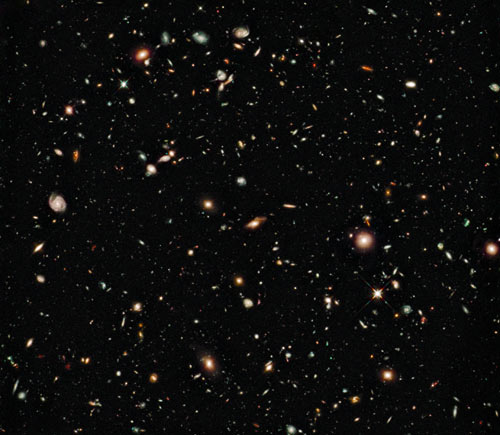
In 2004, the Hubble Space Telescope took an image called the Hubble Ultra Deep Field; basically astronomers pointed the Hubble toward an “empty” part of space and took a long-exposure shot in the visible spectrum. What they found were thousands of far away galaxies from early in the development of the universe. Now the Hubble has peered even deeper into the universe in near-infrared and captured this image:
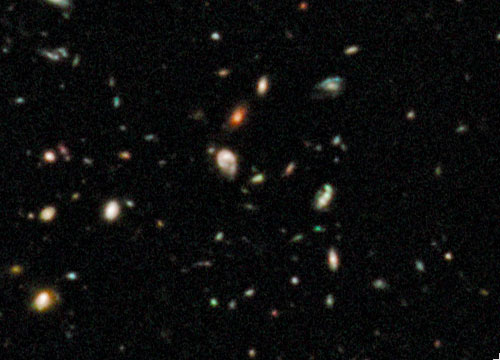
Each one of those little specks is an entire galaxy, some only 600 million years old. Here’s a zoomed-in section:
How did whales get so big eating such tiny creatures? And why aren’t they bigger? Carl Zimmer explains.
According to the scientists, this pattern occurs when the whales lunge into a cloud of krill and drop open their jaws. Pleats under the lower jaw open up, engulfing huge amounts of water. The whale slows down because of the drag. It behaves, in other words, a lot like a parachute. […] It’s a lot of water, the scientists have found: in one lunge, a fin whale can momentarily double its weight.
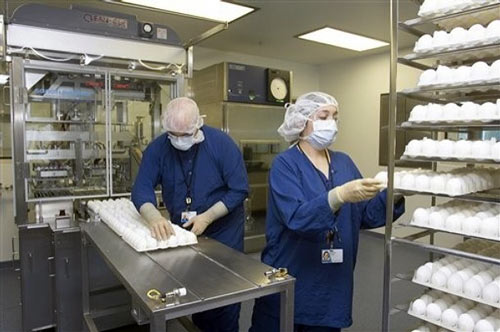
The most striking feature of the H1N1 flu vaccine manufacturing process is the 1,200,000,000 chicken eggs required to make the 3 billion doses of vaccine that may be required worldwide. There are entire chicken farms in the US and around the world dedicated to producing eggs for the purpose of incubating influenza viruses for use in vaccines. No wonder it takes six months from start to finish. But we’ll get to that in a minute.
The most commonly used process for manufacturing an influenza vaccine was developed in the 1940s — one of its co-inventors was Jonas Salk, who would go on to develop the polio vaccine — and has remained basically unchanged since then. The process is coordinated by the World Health Organization and begins with the detection of a new virus (or rather one that differs significantly from those already going around); in this instance, the Pandemic H1N1/09 virus. Once the pandemic strain has been identified and isolated, it is mixed with a standard laboratory virus through a technique called genetic reassortment, the purpose of which is to create a hybrid virus (also called the “reference virus strain”) with the pandemic strain’s surface antigens and the lab strain’s core components (which allows the virus to grow really well in chicken eggs). Then the hybrid is tested to make sure that it grows well, is safe, and produces the proper antigen response. This takes about six to nine weeks.
[Quick definitional pause. Antigen: “An antigen is any substance that causes your immune system to produce antibodies against it. An antigen may be a foreign substance from the environment such as chemicals, bacteria, viruses, or pollen. An antigen may also be formed within the body, as with bacterial toxins or tissue cells.” So, when the H1N1 vaccine gets inside your body, the pandemic strain’s surface antigens will produce antibodies against it.]
At roughly the same time, a parallel effort to produce what are referred to as reference reagents is undertaken. The deliverable here is a standardized kit provided to vaccine manufacturers so that they can test how much virus they are making and how effective it is. This process serves to standardize vaccine doses across manufacturers and takes four months to complete. WHO notes that this part of the process is “often a bottleneck to the overall timeline for manufacturers to generate the vaccine”.
Once the reference virus strain is produced, it is sent to pharmaceutical companies (Novartis, Sanofi Pasteur, etc.) for large-scale production of the vaccine. The companies fine-tune the virus to increase yields and produce seed virus banks that will be used in the bulk production.
And this is where the 1.2 billion chicken eggs come in. A portion of the seed virus is injected into each 9- to 12-day old fertilized egg. The virus incubates in the egg white for two to three days and is then separated from the egg.
For the shot vaccine, the virus is sterilized so that it won’t make anyone sick. This is the magic part of the vaccine: it’s got the pandemic virus antigens that make your body produce the antibodies to fight the virus but the virus is inactive so it won’t make you ill. For the nasal spray vaccine, the virus is left alive and attenuated to survive only in the nose and not the warmer lungs; it’ll infect you enough to produce antibodies but not enough to make you sick. Either way, the surface antigens are separated out and purified to produce the active ingredient in the vaccine. Each batch of antigen takes about two weeks to produce. With enough laboratory space and chicken eggs, the companies can crank out an infinite amount of purified antigens, but those resources are limited in practice.
[Side note. You may have noticed that the H1N1 vaccine has been difficult to find in some places around the US. The vaccine manufacturers have said that the Pandemic H1N1/09 virus when combined with the standard laboratory virus does not grow as fast in the eggs as they anticipated. The batches of antigens from each egg have been smaller than expected, up to five or even ten times smaller in some cases. Hence the slow rollout of the vaccine.]
The purified antigen is then tested against the aforementioned reference reagents once they are ready. The antigen is diluted to the required concentration and placed into properly labelled vials or syringes. Further testing is performed to make sure the vaccine won’t make anyone ill, to confirm the correct concentration, and for general safety. At this point clinical testing in humans is required in western Europe but not in the United States. Finally, each company’s vaccine has to be approved by the appropriate regulatory body in each country — that’s the FDA in the case of the US — and then the vaccine is distributed to medical facilities around the country.
However, if the theorists are right, before it ever finds the Higgs, the LHC will see the first outline of something far bigger: the grand, overarching theory known as supersymmetry. SUSY, as it is endearingly called, is a daring theory that doubles the number of particles needed to explain the world. And it could be just what particle physicists need to set them on the path to fresh enlightenment.
If you haven’t been keeping up with particle physics for the past few years (as I haven’t), this will bring you up to speed a bit.
Nathan Myhrvold, ex-Microsoftie and founder of an invention company called Intellectual Ventures, is also really interested in food, so much so that he’s writing a monster cookbook (currently ~1500 pages) about the science of cooking.
In another discovery of culinary heat transfer physics, Dr. Myhrvold said the bulbous shape and black color of Weber grills were wrong. To achieve an even cooking temperature across the cooking grate, the inside of the grill should be vertical and shiny to reflect the heat. That can be fixed by adding an aluminum insert to the grill. “So we have directions for that,” Dr. Myhrvold said.
NASA announced that it has found pretty hard evidence of significant amounts of water on the Moon.
“We are ecstatic,” said Anthony Colaprete, LCROSS project scientist and principal investigator at NASA’s Ames Research Center in Moffett Field, Calif. “Multiple lines of evidence show water was present in both the high angle vapor plume and the ejecta curtain created by the LCROSS Centaur impact. The concentration and distribution of water and other substances requires further analysis, but it is safe to say Cabeus holds water.”
I don’t have to tell you about the implications here. Just think of how much you could sell authentic Moon bottled water for.
Given their emphasis on cold, hard numbers, it’s noteworthy that Levitt and Dubner ignore what are, by now, whole libraries’ worth of data on global warming. Indeed, just about everything they have to say on the topic is, factually speaking, wrong. Among the many matters they misrepresent are: the significance of carbon emissions as a climate-forcing agent, the mechanics of climate modelling, the temperature record of the past decade, and the climate history of the past several hundred thousand years.
With Arnoldussen behind me carrying the laptop, I walked around the Wicab offices. I managed to avoid most walls and desks, scanning my head from side to side slowly to give myself a wider field of view, like radar. Thinking back on it, I don’t remember the feeling of the electrodes on my tongue at all during my walkabout. What I remember are pictures: high-contrast images of cubicle walls and office doors, as though I’d seen them with my eyes.
The natural nuclear reactor formed when a uranium-rich mineral deposit became inundated with groundwater that acted as a neutron moderator, and a nuclear chain reaction took place. The heat generated from the nuclear fission caused the groundwater to boil away, which slowed or stopped the reaction. After cooling of the mineral deposit, short-lived fission product poisons decayed, the water returned and the reaction started again. These fission reactions were sustained for hundreds of thousands of years, until a chain reaction could no longer be supported. Fission of uranium normally produces five known isotopes of the fission-product gas xenon; all five have been found trapped in the remnants of the natural reactor, in varying concentrations. The concentrations of xenon isotopes, found trapped in mineral formations 2 billion years later, make it possible to calculate the specific time intervals of reactor operation: approximately 2 hours and 30 minutes
Nice try Fermi, but Mother Nature got there first.
Due to a mistranslation, Soviet reports on Enrico Fermi claimed that his work was performed in a converted “pumpkin field” instead of a “squash court”, squash being an offshoot of hard racquets.
When the first self-sustained nuclear chain reaction was achieved, a coded phone call was made by one of the physicists, Arthur Compton, to James Conant, chairman of the National Defense Research Committee. The conversation was in impromptu code:
Compton: The Italian navigator has landed in the New World. Conant: How were the natives? Compton: Very friendly.
Pumpkin field, tube alloy, the Italian navigator, the Manhattan Project…the building of the atomic bomb had no shortage of fanciful language.
Update: BLDGBLOG did a post on fossil reactors recently, which is probably where I got the link above in the first place.
The process of inoculation against diseases like smallpox has been known for at least 1200 years. An 8th-century Indian book contains a how-to chapter on smallpox inoculations. Chinese use of the technique dates back to the first millennium as well. The technique was imported to Europe via the Ottoman Empire in 1721 and reached America at about the same time.
The practice is documented in America as early as 1721, when Zabdiel Boylston, at the urging of Cotton Mather, successfully inoculated two slaves and his own son. Mather, a prominent Boston minister, had heard a description of the African practice of inoculation from his Sudanese slave, Onesimus, in 1706, but had been previously unable to convince local physicians to attempt the procedure. Following this initial success, Boylston began performing inoculations throughout Boston, despite much controversy and at least one attempt upon his life. The effectiveness of the procedure was proven when, of the nearly three hundred people Boylston inoculated during the outbreak, only six died, whereas the mortality rate among those who contracted the disease naturally was one in six.
It is inadvertently affirmed in the Christian countries of Europe that the English are fools and madmen. Fools, because they give their children the small-pox to prevent their catching it; and madmen, because they wantonly communicate a certain and dreadful distemper to their children, merely to prevent an uncertain evil. The English, on the other side, call the rest of the Europeans cowardly and unnatural. Cowardly, because they are afraid of putting their children to a little pain; unnatural, because they expose them to die one time or other of the small-pox. But that the reader may be able to judge whether the English or those who differ from them in opinion are in the right, here follows the history of the famed innoculation, which is mentioned with so much dread in France.
Ah, risk. It is the idea that fuels the anti-vaccine movement — that parents should be allowed to opt out, because it is their right to evaluate risk for their own children. It is also the idea that underlies the CDC’s vaccination schedule — that the risk to public health is too great to allow individuals, one by one, to make decisions that will impact their communities. (The concept of herd immunity is key here: It holds that, in diseases passed from person to person, it is more difficult to maintain a chain of infection when large numbers of a population are immune.)
Anti-vaccine activists are degenerate idiots who deserve to get polio and live out their days in iron lungs while Child Protective Services takes away their children to be properly raised. Or tetanus. Get lockjaw and shut up and die. What’s the point of living in 21st-century America if not to avoid dying of stupid, easily preventable disease?
Ordinarily I wouldn’t question others’ parenting choices. But the problem is literally one of live or don’t live. While that parent chose not to vaccinate her child for what she likely considers well-founded reasons, she is putting other children at risk. In this instance, the child at risk was my son. He has leukemia.
There’s something very interesting about vaccine scares. These are cultural products. They’re not about evidence. If vaccine scares were about genuine scientific evidence showing that a vaccine caused a disease, then the vaccine scares would happen all around the world at exactly the same time, because information can disseminate itself around the world very rapidly these days. But what you find is that vaccine scares actually respect cultural and national boundaries.
They then put the participants, one by one, in a dark anechoic chamber which shields all incoming sounds and deadens any noise made by the participant. The room had a ‘panic button’ to stop the experiment but apparently no-one needed to use it.
Are the problems that have plagued the Large Hadron Collider and previous high-energy efforts (SSC, I’m looking at you here) a result of the Higgs boson travelling back from the future to meddle in its own discovery? A pair of scientists think it’s a possibility.
“It must be our prediction that all Higgs producing machines shall have bad luck,” Dr. Nielsen said in an e-mail message. In an unpublished essay, Dr. Nielson said of the theory, “Well, one could even almost say that we have a model for God.” It is their guess, he went on, “that He rather hates Higgs particles, and attempts to avoid them.”
This malign influence from the future, they argue, could explain why the United States Superconducting Supercollider, also designed to find the Higgs, was canceled in 1993 after billions of dollars had already been spent, an event so unlikely that Dr. Nielsen calls it an “anti-miracle.”
I remember, every season, multiple occasions where I’d hit someone so hard that my eyes went cross-eyed, and they wouldn’t come uncrossed for a full series of plays. You are just out there, trying to hit the guy in the middle, because there are three of them. You don’t remember much. There are the cases where you hit a guy and you’d get into a collision where everything goes off. You’re dazed. And there are the others where you are involved in a big, long drive. You start on your own five-yard line, and drive all the way down the field-fifteen, eighteen plays in a row sometimes. Every play: collision, collision, collision. By the time you get to the other end of the field, you’re seeing spots. You feel like you are going to black out. Literally, these white explosions-boom, boom, boom-lights getting dimmer and brighter, dimmer and brighter.
Perhaps this is what Gladwell will be talking about at the upcoming New Yorker Festival?
Update: From Stephen Fatsis, a list of improvements for the NFL players union to consider to protect the health of the players.
N.F.L. players often get excellent medical treatment, but the primary goal is to return them to the field as quickly as possible. Players are often complicit in playing down the extent of their injuries. Fearful of losing their jobs — there are no guaranteed contracts in the N.F.L. — they return to the huddle still hurt.
And from GQ comes a profile of Bennet Omalu, one of the few doctors investigating the fate of these NFL players.
Let’s say you run a multibillion-dollar football league. And let’s say the scientific community — starting with one young pathologist in Pittsburgh and growing into a chorus of neuroscientists across the country — comes to you and says concussions are making your players crazy, crazy enough to kill themselves, and here, in these slices of brain tissue, is the proof. Do you join these scientists and try to solve the problem, or do you use your power to discredit them?
Goodell faced his harshest criticism from Representative Maxine Waters, Democrat of California, who called for Congress to revoke the league’s antitrust exemption because of its failure to care adequately for injured former players. “I believe you are an $8 billion organization that has failed in your responsibility to the players,” Waters said. “We all know it’s a dangerous sport. Players are always going to get injured. The only question is, are you going to pay for it? I know that you dearly want to hold on to your profits. I think it’s the responsibility of Congress to look at your antitrust exemption and take it away.”
The worm is consumed by the snail, and begins its development in the snail digestive tract. Once it grows and matures, it moves into the snail’s optical tentacles, where it will pulsate and writhe as an example of aggressive mimicry, turning the tentacle into a dead-ringer for a caterpillar larvae, and making the snail a visible snack to a passing bird. The worm’s dance is also deadly because it renders the snail insensitive to light, making it incapable of shielding itself from predators. After the bird eats the infected snail, the worm matures fully inside the bird’s digestive tract, there it reproduces and lays eggs. Once the bird excretes the Leucochloridium larva, it is consumed by snails, thus continuing its life cycle.
Seven new species of phosphorescent mushrooms have been discovered, bringing the grand total of documented glowing fungi species to 71. The new discoveries join the ranks of the other luminous mushrooms that produce light as a result of a chemical reaction. Although easily noticeable at night, phosphorescent mushrooms glow all day long. Ten new fungi species were documented between 2002 and 2006, which is surprising considering how difficult it is to write in the dark.
Scientists discovered that it’s likely that some individuals with high testosterone actually perceive other people’s anger as a reward. Researchers tested the subjects’ testosterone levels and assigned them “learning tasks” where images of faces were subliminally flashed in response to their performance. Participants who had higher testosterone levels responded better to angry faces than to neutral ones, even though the faces were on screen too briefly to identify. Michelle Wirth, who led the study, explained how this can possibly be correlated to other testing methods:
“Better learning of a task associated with anger faces indicates that the anger faces were rewarding, as in a rat that learns to press a lever in order to receive a tasty treat. In that sense, anger faces seemed to be rewarding for high-testosterone people, but aversive for low-testosterone people.”
So the next time it seems like that person is trying to piss you off, reward them with a knuckle sandwich.
Note: If you are a member and tried to log in, it didn't work, and now you're stuck in a neverending login loop of death, try disabling any ad blockers or extensions. Or try logging out and then back in. Still having trouble? Email me!





Socials & More