kottke.org posts about science
Astronomers behind the Event Horizon Telescope are building a virtual telescope with a diameter of the Earth to photograph the supermassive black hole at the center of our galaxy. The idea is that different observatories from all over the surface of the Earth all look at the black hole at the same time and the resulting data is stitched together by a supercomputer into a coherent picture. Seth Fletcher wrote a great piece about the effort for the NY Times Magazine (it’s an excerpt from his new book, Einstein’s Shadow: A Black Hole, a Band of Astronomers, and the Quest to See the Unseeable):
Astronomical images have a way of putting terrestrial concerns in perspective. Headlines may portend the collapse of Western civilization, but the black hole doesn’t care. It has been there for most of cosmic history; it will witness the death of the universe. In a time of lies, a picture of our own private black hole would be something true. The effort to get that picture speaks well of our species: a bunch of people around the world defying international discord and general ascendant stupidity in unified pursuit of a gloriously esoteric goal. And in these dark days, it’s only fitting that the object of this pursuit is the darkest thing imaginable.
Avery Broderick, a theoretical astrophysicist who works with the Event Horizon Telescope, said in 2014 that the first picture of a black hole could be just as important as “Pale Blue Dot,” the 1990 photo of Earth that the space probe Voyager took from the rings of Saturn, in which our planet is an insignificant speck in a vast vacuum. A new picture, Avery thought, of one of nature’s purest embodiments of chaos and existential unease would have a different message: It would say, There are monsters out there.
A video by the EHT team says that imaging the black hole is like trying to count the dimples on a golf ball located in LA while standing in NYC.
EHT team member Katie Bouman also did a TEDx talk on the project.
P.S. There’s a cloud near the center of the galaxy that tastes like raspberries and smells like rum.
In a 700-page report detailing the latest research on climate change, a UN panel of scientists strongly warns that unless we make “massive and unprecedented changes to global energy infrastructure to limit global warming to moderate levels” to limit the world’s warming to 1.5 degrees Celsius, there will be widespread coastal flooding, food shortages, wildfires, and other issues related to climate change. If you are 60 or under, these changes will occur in your lifetime. From the NY Times:
A landmark report from the United Nations’ scientific panel on climate change paints a far more dire picture of the immediate consequences of climate change than previously thought and says that avoiding the damage requires transforming the world economy at a speed and scale that has “no documented historic precedent.”
The report, issued on Monday by the Intergovernmental Panel on Climate Change, a group of scientists convened by the United Nations to guide world leaders, describes a world of worsening food shortages and wildfires, and a mass die-off of coral reefs as soon as 2040 — a period well within the lifetime of much of the global population.
The report “is quite a shock, and quite concerning,” said Bill Hare, an author of previous I.P.C.C. reports and a physicist with Climate Analytics, a nonprofit organization. “We were not aware of this just a few years ago.” The report was the first to be commissioned by world leaders under the Paris agreement, the 2015 pact by nations to fight global warming.
And from the Washington Post:
The transformation described in the document is breathtaking, and the speed of change required raises inevitable questions about its feasibility.
Most strikingly, the document says the world’s annual carbon dioxide emissions, which amount to more than 40 billion tons per year, would have to be on an extremely steep downward path by 2030 to either hold the world entirely below 1.5 degrees Celsius, or allow only a brief “overshoot” in temperatures. As of 2018, emissions appeared to be still rising, not yet showing the clear peak that would need to occur before any decline.
Overall reductions in emissions in the next decade would probably need to be more than 1 billion tons per year, larger than the current emissions of all but a few of the very largest emitting countries. By 2050, the report calls for a total or near-total phaseout of the burning of coal.
If you’d like to dive into the report itself, two good places to start are the headline statements and the summary for policymakers.
This video explores how humans could begin to colonize the Moon today, using currently available technology.
We actually do have the technology and current estimates from NASA and the private sector say it could be done for $20-40 billion spread out over about a decade. The price is comparable to the International Space Station or the budget surplus of Germany in 2017.
That’s also only 12-25% of the net worth of Jeff Bezos. I don’t know whether that’s more an illustration of the relative affordability of building a Moon base or of Bezos’ wealth, but either way it’s a little bit crazy that the world’s richest man can easily afford to fund the building of a Moon base and somehow it’s not happening (or even close to happening).
For Motherboard’s The Most Unknown series, physicist Davide D’Angelo and geomicrobiologist Jennifer Macalady travel to Laboratori Nazionali del Gran Sasso to see one of the latest efforts to detect dark matter, the SABRE detector.
As with the search for neutrinos, looking for dark matter needs to happen under conditions of “cosmic silence” — in this case, beneath a mountain in Italy. D’Angelo, who is a collaborator on the project, likens the search to “hunting ghosts”.
One of the ways that climatologists know that the dramatically increasing amount of atmospheric carbon dioxide (and corresponding temperature increase) is caused by human activity is by measuring changing land use and how much fossil fuel has been burned over the last few hundred years. From a 2004 RealClimate article:
One way that we know that human activities are responsible for the increased CO2 is simply by looking at historical records of human activities. Since the industrial revolution, we have been burning fossil fuels and clearing and burning forested land at an unprecedented rate, and these processes convert organic carbon into CO2. Careful accounting of the amount of fossil fuel that has been extracted and combusted, and how much land clearing has occurred, shows that we have produced far more CO2 than now remains in the atmosphere. The roughly 500 billion metric tons of carbon we have produced is enough to have raised the atmospheric concentration of CO2 to nearly 500 ppm. The concentrations have not reached that level because the ocean and the terrestrial biosphere have the capacity to absorb some of the CO2 we produce. However, it is the fact that we produce CO2 faster than the ocean and biosphere can absorb it that explains the observed increase.
That was back when the CO2 concentration was ~380 parts per million…it’s now ~407 ppm. That is pretty convincing evidence all by itself…the inputs match the outputs.
But there is also extremely compelling corroborating evidence that has to do with what kind of carbon is being released into the atmosphere — the smoking gun of anthropogenic climate change, if you will. For several hundred years before the start of the 19th century, the CO2 in the atmosphere contained a more-or-less consistent ratio of two carbon isotopes: carbon-12 and carbon-13 (which contains one more neutron than carbon-12 and is therefore heavier). Plants prefer consuming the lighter carbon-12 over carbon-13 and since fossil fuels are ultimately made from decayed plants, when you burn them, they disproportionately produce carbon-12 (when compared to atmospheric CO2).
So if you’re burning a bunch of oil and coal, you’d expect to see carbon-12 levels in the atmosphere go up…and that’s exactly what scientists have found. If you graph the amount of carbon-12 present in the atmosphere over time, you can see very clearly that it begins rising in lockstep with CO2 concentration right around when people began burning a lot of fossil fuels circa 1800.
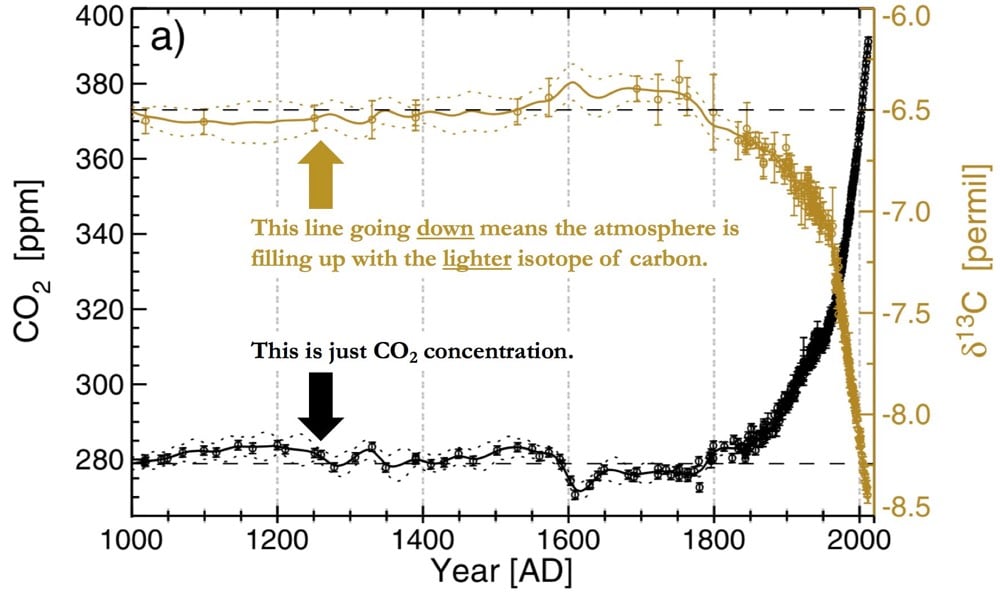
You can read more about how scientists took these measurements in the 2004 RealClimate article I mentioned above. Meteorologist Eric Holthaus says learning about these measurements “propelled me to a career in climate” and I can totally see why — this is really persuasive.
These nudibranchs (sea slugs) are lit up like the midway at a county fair because they’re warning predators that they use stinging cells called nematocysts to defend themselves when attacked. But the nematocysts are not native to nudibranch physiology — they hoover them up from hydroids, a jellyfish relative, and distribute them around their bodies.
The nudibranch’s gut has fingerlike branches that extend up into the long cerata on its back. The unfired stingers travel up into the cerata and concentrate in little sacs at the tips, where they continue to develop.
If a fish or crab tries to bite the nudibranch, it squeezes those sacs and shoots out the stingers, which immediately pop in the predator’s mouth. It doesn’t take long for predators to avoid the brightly colored nudibranchs.
What a wild adaptation! (via the kid should see this)
While Isaac Newton and the 17th century were more decisive for understanding the physics of color, you can’t beat the late 18th and early 19th century for a broader, subtler, more humanistic sense of the science of colors. The playwright and polymath J.W. von Goethe built up his Theory of Colours by collecting almost 18,000 meteorological and mineralogical specimens, with an emphasis on subtle distinctions between colors and their psychological perception in nature, rather than wavelengths of light.
Another phenomenal collection of naturalist examples is Abraham Gottlob Werner’s Nomenclature of Colours, first published in 1814. An 1821 edition recommends it for “zoology, botany, chemistry, mineralogy, and morbid anatomy.” At My Modern Met, Kelly Richman-Abdou writes:
Nomenclature of Colours served as a must-have reference for artists, scientists, naturalists, and anthropologists alike. The exquisitely rendered guide showcases the earth’s rich range of color by separating it into specific tones. Illustrated only by a small swatch, each handwritten entry is accompanied by a flowery name (like “Arterial Blood Red” and “Velvet Black”) as well as an identifying number. What the book is truly known for, however, is its poetic descriptions of where each tone can be found in nature.
Werner was a German mineralogist who created the system of color classification in the book to help distinguish between his own samples. His Scottish collaborators Patrick Syme and Robert Jameson were a painter and naturalist, respectively, who adapted the system into the book format in which it exists today. As you might guess, each color in the book includes a name, a swatch, and examples from the animal, vegetable, and mineral world showing where each color is found in nature.
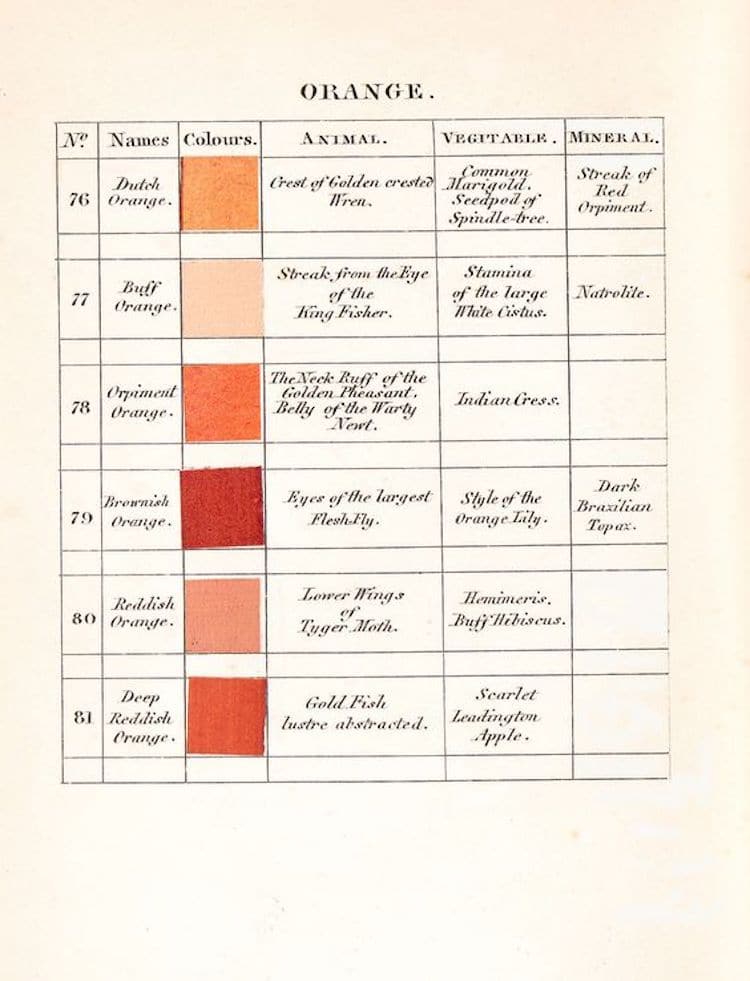
Probably the most famous user of Werner’s book was Charles Darwin, who used it to help describe animals and other bits of the natural world in his books and journals. But if you think about it, before photography, anything that let naturalists describe what they were seeing in something resembling a universal vocabulary had to be essential. Essential enough that they were willing to produce the book by hand, with no real way to print in color.
Amazon sells a pocket-sized facsimile edition of the book. It may not be as handy as a color wheel for painting a room, but might be handier if you’re identifying bird eggs or a rare bit of stone.
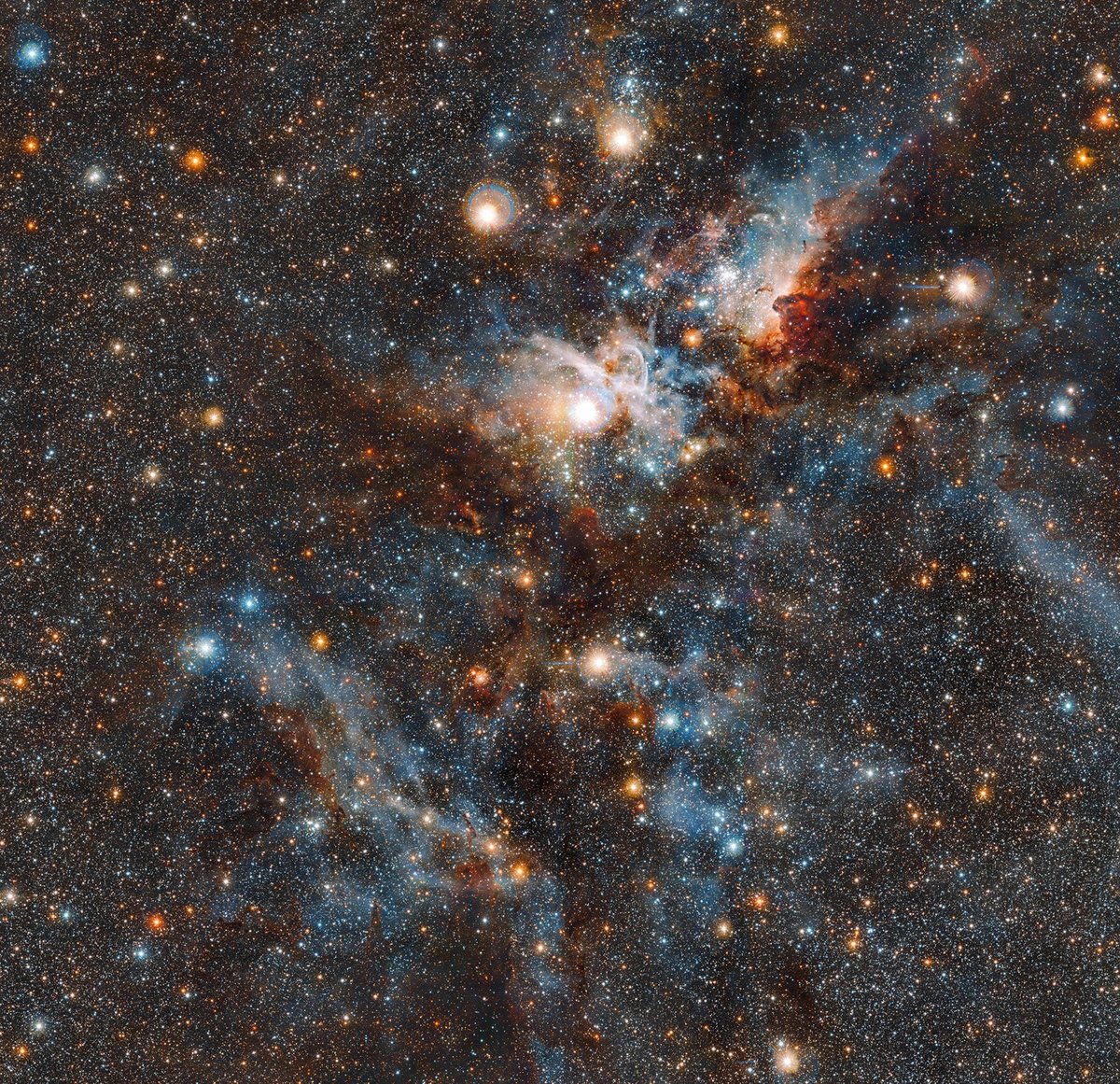
Astronomers using an infrared telescope at the European Southern Observatory in Chile recently released an infrared photo of the Carina Nebula that shows the inner workings of the star factory “as never before”.
This spectacular image of the Carina nebula reveals the dynamic cloud of interstellar matter and thinly spread gas and dust as never before. The massive stars in the interior of this cosmic bubble emit intense radiation that causes the surrounding gas to glow. By contrast, other regions of the nebula contain dark pillars of dust cloaking newborn stars.
This is a massive image…the original is 140 megapixels (<- that’s a 344MB download). Phil Plait notes that it may contain about 1 million stars and gives a bit of background on what we’re looking at here:
The colors you see here are not what you’d see with your eye, since it’s all infrared. What’s shown as blue is actually 0.88 microns, or a wavelength just outside what your eye can see. Green is really 1.25 microns and red is 2.15, so both are well into the near-infrared.
Even in the infrared, a lot of gas and dust still are visible. That’s because there’s a whole bunch of it here. And it’s not just randomly strewn around; patterns are there when you look for them.
For example, in this subimage you can see long, skinny triangles of dust. These are formed when very thick clots of dust are near very luminous stars. The wind and fierce blast of ultraviolet light from the stars erode away at the clump and also flow around it. They’re like sandbars in a stream! This is the same mechanism that made the Pillars of Creation in the Eagle nebula, and they’re common in star-forming nebulae.
Wow! Genetic analysis of a human bone fragment found in Siberia reveals that her parents belonged to two different groups of humans: her father was Denisovan and her mother Neanderthal.
A female who died around 90,000 years ago was half Neanderthal and half Denisovan, according to genome analysis of a bone discovered in a Siberian cave. This is the first time scientists have identified an ancient individual whose parents belonged to distinct human groups. The findings were published on 22 August in Nature1.
“To find a first-generation person of mixed ancestry from these groups is absolutely extraordinary,” says population geneticist Pontus Skoglund at the Francis Crick Institute in London. “It’s really great science coupled with a little bit of luck.”
Luck is right…what a needle in a haystack.
A Swiss company has designed a system for storing energy in concrete blocks. The blocks are lifted by a crane when surplus energy is available (say, when the Sun is shining or the wind blowing) and then, when energy is needed later, allowed to fall, turning turbines to generate electricity.
The innovation in Energy Vault’s plant is not the hardware. Cranes and motors have been around for decades, and companies like ABB and Siemens have optimized them for maximum efficiency. The round-trip efficiency of the system, which is the amount of energy recovered for every unit of energy used to lift the blocks, is about 85% — comparable to lithium-ion batteries which offer up to 90%.
Pedretti’s main work as the chief technology officer has been figuring out how to design software to automate contextually relevant operations, like hooking and unhooking concrete blocks, and to counteract pendulum-like movements during the lifting and lowering of those blocks.
The storage of energy in this way isn’t new…the ARES project uses hills and heavy trains to accomplish the same thing.
It’s a wonderfully simple idea, a 19th century solution for a 21st century problem, with some help from the abundant natural resource that is gravity. When the local utility’s got surplus electricity, it powers up the electric motors that drag 9,600 tons of rock- and concrete-filled railcars up a 2,000-foot hill. When it’s got a deficit, 9,600 tons of railcar rumble down, and those motors generate electricity via regenerative braking — the same way your Prius does. Effectively, all the energy used to move the train up the hill is stored, and recouped when it comes back down.
There’s something really interesting about big kinetic machines operating as though they were computers, autonomous black boxes where data flows in and out that can operate anywhere with a bit of flat ground.
Are wormholes science or just science fiction? As this video by Kurzgesagt shows, they’re actually a little bit of both. Einstein and string theory both posit that these “short cuts” through spacetime could exist, but finding or building a stable wormhole, a la Star Trek, is another matter altogether.
In the description of the video, they link to a pair of papers published by Michael Morris and Kip Thorne in the late 80s: Wormholes, Time Machines, and the Weak Energy Condition and Wormholes in spacetime and their use for interstellar travel: A tool for teaching general relativity. For a high school physics class, I gave a presentation on wormholes & time travel and I’m pretty sure I used at least one of those papers as a reference. The presentation also included a clip of Bill & Ted’s Excellent Adventure. The teacher gave me a B+ — he felt the presentation was excellent (*guitar riff*) but that I had, in spite of the movie clip, “lost most of the other students” and should have chosen a more suitable topic.
The European Southern Observatory’s Very Large Telescope in Chile has been watching the supermassive black hole in the center of our galaxy and the stars that orbit it. Using observations from the past 20 years, the ESO made this time lapse video of the stars orbiting the black hole, which has the mass of four million suns. I’ve watched this video like 20 times today, my mind blown at being able to observe the motion of these massive objects from such a distance.
The VLT was also able to track the motion of one of these stars and confirm for the first time a prediction made by Einstein’s theory of general relativity.
New infrared observations from the exquisitely sensitive GRAVITY, SINFONI and NACO instruments on ESO’s Very Large Telescope (VLT) have now allowed astronomers to follow one of these stars, called S2, as it passed very close to the black hole during May 2018. At the closest point this star was at a distance of less than 20 billion kilometres from the black hole and moving at a speed in excess of 25 million kilometres per hour — almost three percent of the speed of light.
S2 has the mass of about 15 suns. That’s 6.6 × 10^31 pounds moving at 3% of the speed of light. Wowowow.
I have been going a little Moon crazy lately. There was the whole Apollo 11 thing, I finished listening to the excellent audiobook of Andrew Chaikin’s A Man on the Moon (which made me feel sad for a lot of different reasons), and am thinking about a rewatch of From the Earth to the Moon, the 1998 HBO series based on Chaikin’s book. This video from National Geographic answers a lot of questions about the Moon in a short amount of time.
In response to a dumb viral video with almost 20 million views that suggests detonating a powerful nuclear device at the bottom of the ocean would unleash global chaos, Kurzgesagt provides a counterpoint using, you know, science. This was also an early What If? query:
The bubble grows to about a kilometer across in a couple of seconds. The water above bulges up, though only slightly, over a large area. Then the pressure from that six miles of water overhead causes it to collapse. Within a dozen or so seconds, the bubble shrinks to a minimum size, then ‘bounces’ back, expanding outward again.
It goes through three or four cycles of this collapse and expansion before disintegrating into, in the words of the 1996 report, “a mass of turbulent warm water and explosion debris.” According to the report, as a result of such a deep-water closed bubble creation and dissipation, “no wave of any consequence will be generated.”
Sarah Zhang writes about a support group on Facebook for people who have discovered surprising parentage through DNA testing.
Lisa, 44, admits she is still trying to go of that anger. She had always felt out of place in her family. Her hair — which she always straightened — was naturally fine and curly, her skin dark. “People would think I’m Hispanic, and would speak Spanish to me on the street,” she says. So when an DNA test in 2015 revealed her biological father was likely African American, it clicked into place. But her mom denied it. “She wouldn’t answer me. She would change the subject,” recalls Lisa. When she kept pressing, her mother broke down, saying it would destroy the family and that her dad — the man she grew up with — would kill her. She refused to say anything else about Lisa’s biological father.
I’ve written about this before (here and here) and reading these stories never gets any less heartbreaking. Back in 2010, I shared this:
I know someone who adopted a baby and they have never told her that she’s adopted and don’t plan to (she’s now in her 20s). When DNA testing becomes commonplace in another 5-15 years, I wonder how long that secret will last and what her reaction will be.
DNA testing confirms what we should have known all along: family is more than what biology says it is. Families already look quite differently than they did 40-50 years ago and they will continue to shift in the future, MAGA be damned.
Based on the available archaeological evidence, researchers had assumed that bread and agriculture developed around the same time. But a recent find in Jordan of a 14,500-year-old flatbread indicates that bread was first made some 4000 years before agriculture was invented.
No matter how you slice it, the discovery detailed on Monday shows that hunter-gatherers in the Eastern Mediterranean achieved the cultural milestone of bread-making far earlier than previously known, more than 4,000 years before plant cultivation took root.
The flatbread, likely unleavened and somewhat resembling pita bread, was fashioned from wild cereals such as barley, einkorn or oats, as well as tubers from an aquatic papyrus relative, that had been ground into flour.
And now researchers are wondering, did the invention of bread drive the invention agriculture?
“We now have to assess whether there was a relationship between bread production and the origins of agriculture,” Arranz-Otaegui said. “It is possible that bread may have provided an incentive for people to take up plant cultivation and farming, if it became a desirable or much-sought-after food.”
University of Copenhagen archeologist and study co-author Tobias Richter pointed to the nutritional implications of adding bread to the diet. “Bread provides us with an important source of carbohydrates and nutrients, including B vitamins, iron and magnesium, as well as fibre,” Richter said.
In a lesson for TED-Ed, David Dunning explains the Dunning-Kruger Effect, a cognitive bias in which people with lesser abilities tend to rate themselves as more proficient than they are.
Interestingly, this effect not only applies to those with lower abilities thinking they are better but also to experts who think they’re not exceptional. That is, the least & most skilled groups are both deficient in their ability to evaluate their skills.
Dunning also wrote a longer piece for Pacific Standard on the phenomenon.
In 1999, in the Journal of Personality and Social Psychology, my then graduate student Justin Kruger and I published a paper that documented how, in many areas of life, incompetent people do not recognize — scratch that, cannot recognize — just how incompetent they are, a phenomenon that has come to be known as the Dunning-Kruger effect. Logic itself almost demands this lack of self-insight: For poor performers to recognize their ineptitude would require them to possess the very expertise they lack. To know how skilled or unskilled you are at using the rules of grammar, for instance, you must have a good working knowledge of those rules, an impossibility among the incompetent. Poor performers — and we are all poor performers at some things — fail to see the flaws in their thinking or the answers they lack.
What’s curious is that, in many cases, incompetence does not leave people disoriented, perplexed, or cautious. Instead, the incompetent are often blessed with an inappropriate confidence, buoyed by something that feels to them like knowledge.
Confidence feels like knowledge. I feel like that simple statement explains so much about the world.
See also Errol Morris’ series for the NY Times about humanity’s unknown unknowns.
In closing, I’ll just note that thinking you’re impervious to the Dunning-Kruger Effect is itself an example of the Dunning-Kruger Effect in action. (via open culture)
In 1988, Dr. James Hansen testified in front of Congress about the future dangers of climate change caused by human activity. That same year, the results of a study released by Hansen and his team at the Goddard Institute for Space Studies detailed three possible scenarios for possible future warming. Their middle-of-the-road prediction has proved to be remarkably accurate over the past 30 years.
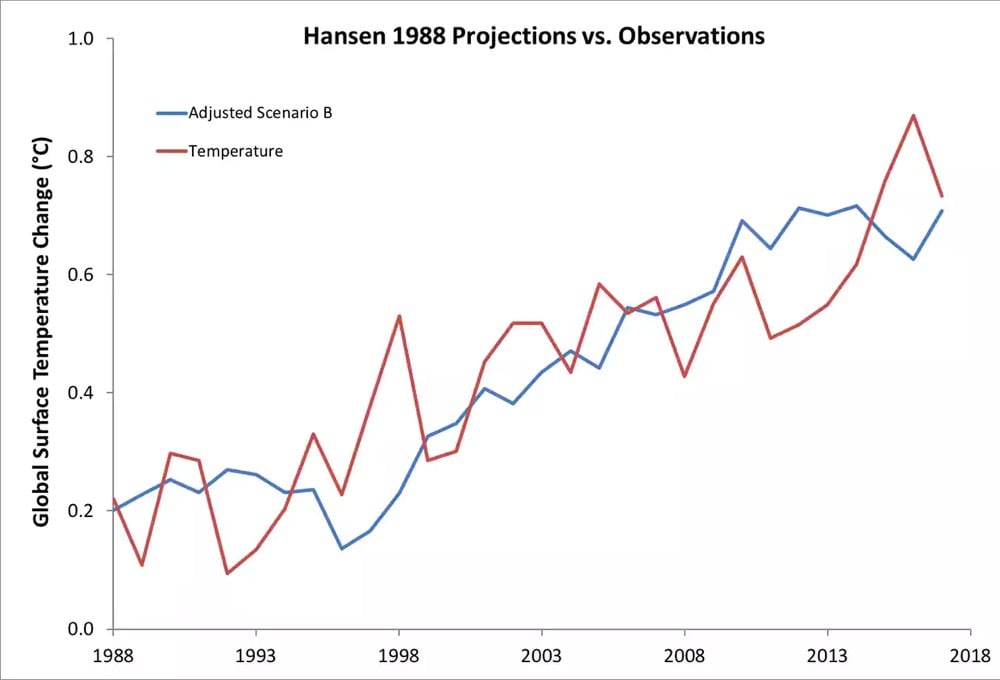
Changes in the human effects that influence Earth’s global energy imbalance (a.k.a. ‘anthropogenic radiative forcings’) have in reality been closest to Hansen’s Scenario B, but about 20-30% weaker thanks to the success of the Montreal Protocol in phasing out chlorofluorocarbons (CFCs). Hansen’s climate model projected that under Scenario B, global surface air temperatures would warm about 0.84°C between 1988 and 2017. But with a global energy imbalance 20-30% lower, it would have predicted a global surface warming closer to 0.6-0.7°C by this year.
The actual 1988-2017 temperature increase was about 0.6°C. Hansen’s 1988 global climate model was almost spot-on.
Scientists have known this was happening for decades and have been telling our government officials about it for more than 30 years. Our present inaction on a national level on this is shameful and “the global poor, the disenfranchised, the young, and the yet-to-be-born” will soon pay the price.
See also a brief history of America’s shameful inaction on climate change.
Elizabeth Kolbert writing for National Geographic: There’s No Scientific Basis for Race — It’s a Made-Up Label.
“What the genetics shows is that mixture and displacement have happened again and again and that our pictures of past ‘racial structures’ are almost always wrong,” says David Reich, a Harvard University paleogeneticist whose new book on the subject is called Who We Are and How We Got Here. There are no fixed traits associated with specific geographic locations, Reich says, because as often as isolation has created differences among populations, migration and mixing have blurred or erased them.
She also observes that there’s more diversity in Africa than all the other continents combined (which is what happens when the rest of the world’s population is based on a relatively small population that left Africa 60,000 years ago).
Speaking of Pangaea, this video shows how the present-day continents came to be formed from the Pangaea supercontinent about 240 million years ago, then shows what the Earth’s surface might look like 250 million years in the future, if the tectonic plates continue to move in predictable ways.
I hope this explanation is helpful. Of course all of this is scientific speculation, we will have to wait and see what happens, but this is my projection based on my understanding of the forces that drive plate motions and the history of past plate motions. Remember: “The past reveals patterns; Patterns inform process; Process permits prediction.”
Look at how quickly India slams into the Asian continent…no wonder the Himalayas are so high.1 And it’s interesting that we’re essentially bookended by two supercontinents, the ancient Pangaea and Pangaea Proxima in the future.
Alan Burdick recently wrote a piece for The New Yorker about the “burgeoning” flat Earth movement, a group of people who believe, against simple & overwhelming evidence, that the Earth is not spherical1 but flat.
If you are only just waking up to the twenty-first century, you should know that, according to a growing number of people, much of what you’ve been taught about our planet is a lie: Earth really is flat. We know this because dozens, if not hundreds, of YouTube videos describe the coverup. We’ve listened to podcasts — Flat Earth Conspiracy, The Flat Earth Podcast — that parse the minutiae of various flat-Earth models, and the very wonkiness of the discussion indicates that the over-all theory is as sound and valid as any other scientific theory. We know because on a clear, cool day it is sometimes possible, from southwestern Michigan, to see the Chicago skyline, more than fifty miles away — an impossibility were Earth actually curved. We know because, last February, Kyrie Irving, the Boston Celtics point guard, told us so. “The Earth is flat,” he said. “It’s right in front of our faces. I’m telling you, it’s right in front of our faces. They lie to us.”
John Gruber remarked on Burdick’s piece by saying:
In recent years I’ve begun to feel conflicted about the internet. On the one hand, it’s been wonderful in so many ways. I’ve personally built my entire career on the fact that the internet enables me to publish as a one-person operation. But on the other hand, before the internet, kooks were forced to exist on the fringe. There’ve always been flat-earther-types denying science and John Birch Society political fringers, but they had no means to amplify their message or bond into large movements.
Another way to put this is that all the people who bought those News of the World-style magazines from the grocery checkout — UFO sightings! Elvis lives! NASA faked the Moon landing! new treatment lets you live 200 years! etc.! — were able to find each other, organize, and mobilize because of the internet. And then they decided to elect one of themselves President.
I recently downloaded the audiobook of Kurt Andersen’s Fantasyland: How America Went Haywire: A 500-Year History and am looking forward to listening to it on my summer roadtrip. Here’s part of the synopsis:
In this sweeping, eloquent history of America, Kurt Andersen shows that what’s happening in our country today — this post-factual, “fake news” moment we’re all living through — is not something new, but rather the ultimate expression of our national character. America was founded by wishful dreamers, magical thinkers, and true believers, by hucksters and their suckers. Fantasy is deeply embedded in our DNA.
Over the course of five centuries — from the Salem witch trials to Scientology to the Satanic Panic of the 1980s, from P. T. Barnum to Hollywood and the anything-goes, wild-and-crazy sixties, from conspiracy theories to our fetish for guns and obsession with extraterrestrials — our love of the fantastic has made America exceptional in a way that we’ve never fully acknowledged. From the start, our ultra-individualism was attached to epic dreams and epic fantasies — every citizen was free to believe absolutely anything, or to pretend to be absolutely anybody.
Gruber’s point about the internet being a double-edged sword appears to be echoed here by Andersen about American individualism. Sure, this “if people disagree with you, you must be doing something right” spirit is responsible for the anti-vaxxer movement, conspiracy theories that 9/11 was an inside job & Newtown didn’t happen, climate change denialism, and anti-evolutionism, but it also gets you things like rock & roll, putting men on the Moon, and countless discoveries & inventions, including the internet.
Update: The Atlantic published an excerpt of Fantasyland last year:
I first noticed our national lurch toward fantasy in 2004, after President George W. Bush’s political mastermind, Karl Rove, came up with the remarkable phrase reality-based community. People in “the reality-based community,” he told a reporter, “believe that solutions emerge from your judicious study of discernible reality … That’s not the way the world really works anymore.” A year later, The Colbert Report went on the air. In the first few minutes of the first episode, Stephen Colbert, playing his right-wing-populist commentator character, performed a feature called “The Word.” His first selection: truthiness. “Now, I’m sure some of the ‘word police,’ the ‘wordinistas’ over at Webster’s, are gonna say, ‘Hey, that’s not a word!’ Well, anybody who knows me knows that I’m no fan of dictionaries or reference books. They’re elitist. Constantly telling us what is or isn’t true. Or what did or didn’t happen. Who’s Britannica to tell me the Panama Canal was finished in 1914? If I wanna say it happened in 1941, that’s my right. I don’t trust books — they’re all fact, no heart … Face it, folks, we are a divided nation … divided between those who think with their head and those who know with their heart … Because that’s where the truth comes from, ladies and gentlemen — the gut.”
Whoa, yes, I thought: exactly. America had changed since I was young, when truthiness and reality-based community wouldn’t have made any sense as jokes. For all the fun, and all the many salutary effects of the 1960s — the main decade of my childhood — I saw that those years had also been the big-bang moment for truthiness. And if the ’60s amounted to a national nervous breakdown, we are probably mistaken to consider ourselves over it.
(thx, david)
Cameras that can take usable photos in low light conditions are very useful but very expensive. A new paper presented at this year’s IEEE Conference on Computer Vision and Pattern Recognition shows that training an AI to do image processing on low-light photos taken with a normal camera can yield amazing results. Here’s an image taken with a Sony a7S II, a really good low-light camera, and then corrected in the traditional way:

The colors are off and there’s a ton of noise. Here’s the same image, corrected by the AI program:
Pretty good, right? The effective ISO on these images has to be 1,000,000 or more. A short video shows more of their results:
It would be great to see technology like this in smartphones in a year or two.
The marshmallow test is a famous psychological experiment designed by Walter Mischel in the 1960s. Kids were given a single marshmallow but told they could have another if they refrained from eating the first one for 15 minutes. The results seemed to indicate a much greater degree of self-control amongst those children who were able to delay gratification, which led to better outcomes in their lives. From a New Yorker article about Mischel:
Once Mischel began analyzing the results, he noticed that low delayers, the children who rang the bell quickly, seemed more likely to have behavioral problems, both in school and at home. They got lower S.A.T. scores. They struggled in stressful situations, often had trouble paying attention, and found it difficult to maintain friendships. The child who could wait fifteen minutes had an S.A.T. score that was, on average, two hundred and ten points higher than that of the kid who could wait only thirty seconds.
But Mischel only tested ~90 kids from a single preschool. Researchers from UC Irvine and NYU recently redid the test with more kids that were more representative of the general population and found that household income was a big factor in explaining both the ability to delay and outcomes.
Ultimately, the new study finds limited support for the idea that being able to delay gratification leads to better outcomes. Instead, it suggests that the capacity to hold out for a second marshmallow is shaped in large part by a child’s social and economic background — and, in turn, that that background, not the ability to delay gratification, is what’s behind kids’ long-term success.
If you’re poor, you might look at the promise of future food somewhat dubiously…and not because of a lack of self-control:
The failed replication of the marshmallow test does more than just debunk the earlier notion; it suggests other possible explanations for why poorer kids would be less motivated to wait for that second marshmallow. For them, daily life holds fewer guarantees: There might be food in the pantry today, but there might not be tomorrow, so there is a risk that comes with waiting. And even if their parents promise to buy more of a certain food, sometimes that promise gets broken out of financial necessity.
In 1923, Inkwell Studios1 released a 20-minute animated explanation of Albert Einstein’s theory of relativity, perhaps one of the very first scientific explainer videos ever made. Films were still silent in those days and the public’s scientific understanding limited (the discovery of Pluto was 7 years in the future, and penicillin 5 years) so the film is almost excruciatingly slow by today’s standards, but if you squint hard enough, you can see the great-grandparent to YouTube channels like Kurzgesagt, Nerdwriter, TED Ed, minutephysics, and the 119,000+ videos on YouTube returned for a “einstein relativity explained” search. (via open culture)
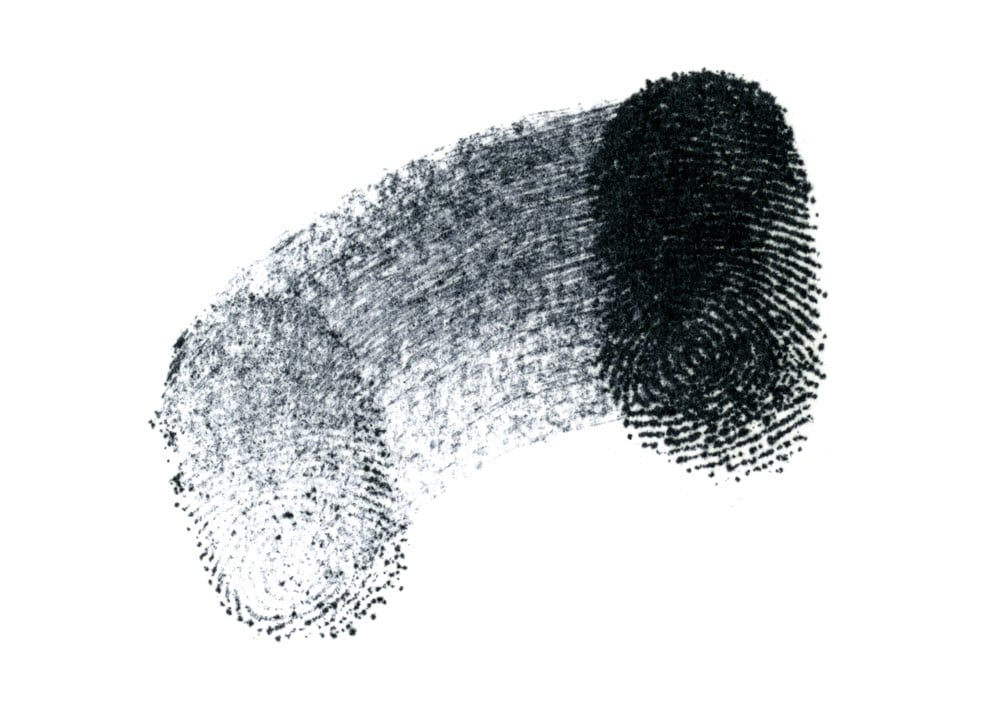
Chantel Tattoli’s piece for The Paris Review, The Surprising History (and Future) of Fingerprints, is interesting throughout, but these two things leapt from the screen (italics mine):
It is true that every print is unique to every finger, even for identical twins, who share the same genetic code. Fingerprints are formed by friction from touching the walls of our mother’s womb. Sometimes they are called “chanced impressions.” By Week 19, about four months before we are issued into the world, they are set.
WHAT?! Is this true? A cursory search shows this might indeed be the case, although it looks as though there’s not established scientific consensus around the process.
Also, Picasso was fingerprinted as a suspect in the theft of the Mona Lisa from the Louvre:
When French authorities interrogated Pablo Picasso, in 1911, at the Palais de Justice about the theft of the Mona Lisa from the Louvre that August, he was clad in his favorite red-and-white polka-dot shirt. Picasso cried. He begged forgiveness. He was in possession of two statuettes filched from the museum, but he hadn’t taken her.
“In possession of”? Turns out a pal of Picasso’s lifted the statuettes from the museum, which was notoriously easy to steal from, and sold them to the artist, who knew exactly what he was buying.
True to Pieret’s testimony, Picasso kept two stolen Iberian statues buried in a cupboard in his Paris apartment. Despite the artist’s later protestations of ignorance there could be no mistaking their origins. The bottom of each was stamped in bold: PROPERTY OF THE MUSÉE DU LOUVRE.
Fingerprint art by Evan Roth. (via @claytoncubitt)
Using simple graphic representations of annual temperatures (like this one posted by climate scientist Ed Hawkins), people are knitting and crocheting blankets that show just how warm the Earth has gotten over the past few decades. See Katie Stumpf’s blanket, for example.

According to climate scientist (and crocheter) Ellie Highwood, these blankets are a subset of “temperature blankets” made to represent, for example, daily temperatures over the course of a year in a particular location. The blanket she crocheted used NOAA data of global mean temperature anomalies for a 101-year period ending 2016.
I then devised a colour scale using 15 different colours each representing a 0.1 °C data bin. So everything between 0 and 0.099 was in one colour for example. Making a code for these colours, the time series can be rewritten as in the table below. It is up to the creator to then choose the colours to match this scale, and indeed which years to include. I was making a baby sized blanket so chose the last 100 years, 1916-2016.
If you read her post, she provides instructions for making your own global warming blanket.
P.S. You might think that with the Earth’s atmosphere getting warmer on average, these blankets would ironically be less necessary that they would have been 50 years ago. But climate change is also responsible for more extreme winter weather events — think global weirding in addition to global warming. So keep those blankets handy!
Degrees of Uncertainty is an upcoming documentary by Neil Halloran that “uses data-driven animation to explore the topic of global warming”. It’s based on this XKCD comic of A Timeline of Earth’s Average Temperature.
Halloran is a creator of the excellent The Fallen of World War II interactive documentary, so I’m looking forward to seeing what he does with the topic of climate change.
Last month when I posted a video comparing the sizes of various microorganisms, I noted the weirdness of bacteriophages, which are bacteria-killing viruses that look a bit like a 20-sided die stuck on the top of a sci-fi alien’s body.
Bacteriophages are really real and terrifying…if you happen to be a bacteria. Bacteriophages attack by attaching themselves to bacteria, piercing their outer membranes, and then pumping them full of bacteriophage DNA. The phage replicates inside of the bacteria until the bacteria bursts and little baby bacteriophages are exploded out all over the place, ready to attack their own bacteria.
I couldn’t find a good explainer (video or text) about these organisms, but over the weekend, Kurzgesagt rode to the rescue with this video. In the second part of the video, they discuss whether bacteriophages might form the basis of an effective treatment for antibiotic-resistant infections.
In a 2013 piece, Christie Aschwanden suggested a test in the spirit of the Bechdel test for avoiding gender bias in profiles written about scientists who are women.
To pass the Finkbeiner test, the story cannot mention:
- The fact that she’s a woman
- Her husband’s job
- Her child care arrangements
- How she nurtures her underlings
- How she was taken aback by the competitiveness in her field
- How she’s such a role model for other women
- How she’s the “first woman to…”
Aschwanden named the test after her colleague Ann Finkbeiner, who wrote that she was going to write a piece about an astronomer without mentioning that she, the astronomer, was a woman.
Meanwhile I’m sick of writing about [gender bias in science]; I’m bored silly with it. So I’m going to cut to the chase, close my eyes, and pretend the problem is solved; we’ve made a great cultural leap forward and the whole issue is over with.
And I’m going to write the profile of an impressive astronomer and not once mention that she’s a woman. I’m not going to mention her husband’s job or her child care arrangements or how she nurtures her students or how she was taken aback by the competitiveness in her field. I’m not going to interview her women students and elicit raves about her as a role model. I’m going to be blindly, aggressively, egregiously ignorant of her gender.
I’m going to pretend she’s just an astronomer.
(via @john_overholt)
This video, and the paper it’s based on, is called “Image Inpainting for Irregular Holes Using Partial Convolutions” but it’s actually straight-up witchcraft! Researchers at NVIDIA have developed a deep-learning program that can automagically paint in areas of photographs that are missing. Ok, you’re saying, Photoshop has been able to do something like that for years. And the first couple of examples were like, oh that’s neat. But then the eyes are deleted from a model’s portrait and the program drew new eyes for her. Under close scrutiny, the results are not completely photorealistic, but at a glance it’s remarkably convincing. (via imperica)
Newer posts
Older posts






Socials & More