kottke.org posts about racism
Adam Serwer writing about the yesterday’s Supreme Court decision that guts much of whatever remains of the Voting Rights Act:
In states with large Black populations that remain under Republican control — half of the Black American population resides in the South — lawmakers will now be able to draw districts that dilute Black residents’ voting power. In his opinion for the right-wing majority, Justice Samuel Alito wrote that “in considering the constitutionality of a districting scheme, courts must treat partisan advantage like any other race-neutral aim: a constitutionally permissible criterion that States may rely on as desired.” The Court’s decision is consonant with the philosophy, articulated by Kilpatrick in his earlier days, that the state is oppressive when it interferes with the right to discriminate, and respects liberty when it allows discrimination. And the decision fits just as well with Kilpatrick’s later spin on that philosophy: Attempts to ban racial discrimination are themselves discriminatory — against white people.
What Kilpatrick wanted, and what the Roberts Court is making possible, is a country where white people can maintain their political dominance at the expense of Americans who are not white. The anticaste provisions of the Reconstruction amendments, intended by their authors to reverse the “horrid blasphemy” that America was a white man’s country, are being inverted to defend that dominance. This is not the color-blindness of Martin Luther King Jr., but what the scholar Ian Haney López has called “reactionary colorblindness,” the purpose of which is to maintain racial hierarchy through superficially neutral means. It takes the view that the Constitution’s “color-blindness” renders any attempt to remedy anti-Black racism unconstitutional, because by definition that would involve making racial distinctions. Similarly, the ruling in this case does not explicitly overturn the VRA’s ban on racial discrimination in voting so much as rewrite it to allow such discrimination.
I can’t tell you how much I fucking hate this, and every other stupid fucking thing conservatives have done to this country. I try to keep my cynicism (or what I like to think of as being realistic) about the American political situation off the site for the most part, but seeing this decision come down yesterday morning let all the air out of my balloon. Not that it contained much air to begin with…the balloon is shot right through with holes from the past decade+ of authoritarian shenanigans and general acquiescence of institutions that are supposed to protect us.
On a personal note, in these moments I find it increasingly difficult to go on — being engaged here, keeping up with the news, highlighting positives in the world, showcasing the enthusiasms of others, informing ppl of harms & how they can help, hyping hope, not letting the bastards grind me down. It’s nothing new — I’ve talked about it here before — but as the situation becomes more unstable & uncertain (or rather: as I grow more certain about its instability & fuckedness), it grows more difficult to keep going. I know this is self-defeating & self-centered, but I’m angry and scared and grieving and tired. I’m gonna publish this before I just delete the whole stupid thing.
In 1966, Huey Newton & Bobby Seale formed the Black Panther Party and wrote a 10-point manifesto of what the group stood for and what they wanted. Here’s the full text of the plan.
4. We Want Decent Housing Fit For The Shelter of Human Beings.
We believe that if the White Landlords will not give decent housing to our Black community, then the housing and the land should be made into cooperatives so that our community, with government aid, can build and make decent housing for its people.
5. We Want Education for Our People That Exposes The True Nature Of This Decadent American Society. We Want Education That Teaches Us Our True History And Our Role in the Present-Day Society.
We believe in an educational system that will give to our people a knowledge of self. If a man does not have knowledge of himself and his position in society and the world then he has little chance to relate to anything else.
This is an excellent video explanation from Jamelle Bouie of what Jim Crow was, how it developed, and how it continues to reverberate in American society and politics today.
If you are an American watching this, and you had a standard social studies or history class in high school, you may think of Jim Crow as more or less simply being separate institutions, separate bathrooms, separate water fountains — various kinds of public disrespect. And those certainly were the symbols of Jim Crow, symbols of outward public disrespect. But that’s not what the system was.
Jim Crow the system was something we would recognize today, and describe as today, as authoritarian. And specifically, it was an authoritarian system of labor control and political control. The Jim Crow states sharply limited political participation by large parts of their population — most of them black, but not a small number of them white as well — and the Jim Crow states themselves were largely vehicles for the interest of powerful owners of capital and property: land owners, factory owners — people who had a vested interest in direct control of labor. The social separation, the extreme and atavistic violence, the theft, the plunder — all of these things were downstream of this effort to control political behavior and control labor. They were the mechanisms of that control, the way to keep people in line or keep them bought into the system if they were on the white side of the color line.
The video is long and it gets into some detail that’s not super exciting (but is nevertheless important), but stick with it — I learned a lot.
Harvard is refusing to comply with Trump’s demands related to his regime’s racist, xenophobic political agenda, including a threat to cut $9 billion in research funding. From the AP:
Harvard President Alan Garber, in a letter to the Harvard community Monday, said the demands violated the university’s First Amendment rights and “exceeds the statutory limits of the government’s authority under Title VI,” which prohibits discrimination against students based on their race, color or national origin.
“No government — regardless of which party is in power — should dictate what private universities can teach, whom they can admit and hire, and which areas of study and inquiry they can pursue,” Garber wrote, adding that the university had taken extensive reforms to address antisemitism.
“These ends will not be achieved by assertions of power, unmoored from the law, to control teaching and learning at Harvard and to dictate how we operate,” he wrote. “The work of addressing our shortcomings, fulfilling our commitments, and embodying our values is ours to define and undertake as a community.”
You can read Garber’s letter and the letter Harvard received from the Trump regime.
I recently attended a virtual talk and Q&A with Timothy Snyder and when he was asked about Columbia and other schools capitulating to Trump’s demands and what needs to happen in order to stop it, he replied something along the lines of: “Some big school is gonna have to stick their neck out and take the hit. Say ‘no’ unequivocally to Trump and get their funding pulled. Lead by example and others will follow. Solidarity is the only way out of this.” Good on Harvard1 for helping to lead the way on this…hopefully more schools will find their backbone after this.
In 1945, the US Department of War (the precursor to the Dept of Defense) produced this educational film on the “destructive effects of racial and religious prejudice” and the use of such prejudice to gain power.
Reel 1 shows a fake wrestling match and “crooked” gambling games. An agitator addresses a street crowd; he almost convinces one man in the audience until the man begins to talk to a Hungarian refugee from Germany. A Nazi speaker harangues a crowd in Germany denouncing Jews, Catholics, and Freemasons. Reel 2, a German unemployed worker joins Hitler’s Storm Troops. SS men attack Jewish and Catholic headquarters in Germany, and beat up a Jewish storekeeper. A German teacher explains Nazi racial theories; the teacher is dragged away by German soldiers.
It’s a good watch, but perhaps keep in mind this was produced at a time when American citizens were imprisoned for being of Japanese descent (among other things…Jim Crow, sexism, discrimination of LGBTQ+ people, etc.)
In the NY Times crossword for Sunday, March 2, the clue for 47-down reads, “‘At a time like this, scorching ___, not convincing argument, is needed’: Frederick Douglass”. The answer can be found in Douglass’ July 5, 1852 speech, What, to the American Slave, Is Your 4th of July?
Near the beginning of the speech, Douglass refuses to continue to debate that slavery is wrong — “there is nothing to be argued” he says. From a transcript of the speech:
Would you have me argue that man is entitled to liberty? that he is the rightful owner of his own body? You have already declared it. Must I argue the wrongfulness of slavery? Is that a question for Republicans? Is it to be settled by the rules of logic and argumentation, as a matter beset with great difficulty, involving a doubtful application of the principle of justice, hard to be understood? How should I look to-day, in the presence of Americans, dividing, and subdividing a discourse, to show that men have a natural right to freedom? speaking of it relatively and positively, negatively and affirmatively. To do so, would be to make myself ridiculous, and to offer an insult to your understanding. There is not a man beneath the canopy of heaven that does not know that slavery is wrong for him.
I am reminded, yet again, of Toni Morrison’s assertion about the function of racism:
It’s important, therefore, to know who the real enemy is, and to know the function, the very serious function of racism, which is distraction. It keeps you from doing your work. It keeps you explaining over and over again, your reason for being. Somebody says you have no language and so you spend 20 years proving that you do. Somebody says your head isn’t shaped properly so you have scientists working on the fact that it is. Somebody says that you have no art so you dredge that up. Somebody says that you have no kingdoms and so you dredge that up. None of that is necessary. There will always be one more thing.
Back to Douglass — a few minutes later in the speech, he outlines what is needed instead (crossword spoilers):
At a time like this, scorching irony, not convincing argument, is needed. O! had I the ability, and could reach the nation’s ear, I would, to-day, pour out a fiery stream of biting ridicule, blasting reproach, withering sarcasm, and stern rebuke. For it is not light that is needed, but fire; it is not the gentle shower, but thunder. We need the storm, the whirlwind, and the earthquake. The feeling of the nation must be quickened; the conscience of the nation must be roused; the propriety of the nation must be startled; the hypocrisy of the nation must be exposed; and its crimes against God and man must be proclaimed and denounced.
I don’t know about you, but I feel like this is relevant to current events. Must we continue to argue the wrongfulness of racism and fascism and corruption and autocracy?
Whoa, HBO has made a third installment of Eyes on the Prize, the landmark series on the American Civil Rights Movement. The trailer is above and you can watch the six-part series on HBO or Max right now.
The first two series, which are amongst the best television ever aired, covered events from 1954–1965 (part one) and 1965–1985 (part two). Eyes on the Prize III covers significant events from 1977-2015, including:
- Community activists in the South Bronx and Philadelphia fighting for fair housing and healthcare during the Carter administration
- Reaganomics and the AIDS crisis
- How the criminal justice system affected the Black community from 1989-1995 in Washington DC and South Central Los Angeles (the LA Uprising).
- The Million Man March in 1995.
- The environmental movement (1982-2011)
- “The complexities of affirmative action policies and how a changing demographic landscape affected school desegregation in new ways.”
- The soaring police brutality of the Obama years.
- The birth of the Black Lives Matter movement.
Featured participants include Angela Davis, Al Sharpton, congressman Kweisi Mfume, Kimberlé Crenshaw, Al Gore, Black Lives Matter co-founders Alicia Garza and Patrisse Cullors, and dozens of other activists, scholars, and politicians.
In a review for the Hollywood Reporter, Daniel Fienberg writes:
Eyes on the Prize III is, as the title suggests, a formal sequel to Eyes on the Prize II, a six-hour exploration of the “aftermath” of the Civil Rights Movement that makes it very clear that the movement has never ended, just as its real concerns were never fully resolved. It’s an emotional, inspiring and righteously angry series of vignettes that looks backward, while very clearly intending to reflect upon and instigate conversations about our fraught current moment.
The series isn’t perfect, but it’s utterly essential, sometimes feeling disheartening for the immediacy of that necessity.
In a post on Bluesky, Fienberg says “nothing you could watch this week is better”.
For the Atlantic, Adam Serwer writes about the Great Resegregation, the attempt by the Trump administration to reverse the civil rights movement.
If the Great Resegregation proves successful, it will restore an America past where racial and ethnic minorities were the occasional token presence in an otherwise white-dominated landscape. It would repeal the gains of the civil-rights era in their entirety. What its advocates want is not a restoration of explicit Jim Crow segregation—that would shatter the illusion that their own achievements are based in a color-blind meritocracy. They want an arrangement that perpetuates racial inequality indefinitely while retaining some plausible deniability, a rigged system that maintains a mirage of equal opportunity while maintaining an unofficial racial hierarchy. Like elections in authoritarian countries where the autocrat is always reelected in a landslide, they want a system in which they never risk losing but can still pretend they won fairly.
Like CRT before it, DEI has become conservatives’ go-to cover for their discriminatory actions:
The term DEI, frequently invoked by the Trump administration, functions as a smoke screen. It allows people to think that the Trump administration’s anti-DEI purge is about removing pointless corporate symbolism or sensitivity trainings. Although it is easy to find examples of DEI efforts that are ill-conceived or ill-applied, some conservatives have leveraged those criticisms to pursue a much broader agenda that is really about tearing anti-discrimination laws out at the roots, so that businesses and governments are free to extend or deny opportunities based on race, gender, and sexual orientation if they so choose.
Karen Attiah recently wrote about resegregation as well: The assault on DEI? It’s aimed at resegregation.
Across the United States, in government agencies and private corporations, leaders are scrambling to eliminate DEI programs. President Donald Trump is not only destroying any trace of diversity work within the government: He has ordered a review of federal contracts to identify any companies, nonprofits and foundations that do business with the government and keep their diversity, equity and inclusion programs, and he has warned that they could be the target of investigations.
Let’s call this what it really is: resegregation.
This fantastic two-minute video, from a guy named Rich, neatly explains why the anger and frustration of Trump’s supporters has been growing over time — why the pushback on things like diversity, equity, inclusion, trans rights, and LGBTQ+ issues seems to be increasing and the hate grows more overt. It has to do with an idea called an extinction burst.
Here’s a transcript of the video:
The Trump spike in racism, sexism, and hate — it’s the emotional foundation for the entire Make America Great Again movement, that nostalgia for when life in America was simpler and paler. But as soon as we began addressing it — boom! extinction burst.
This term is why I love science so much. You can take an idea from one field, like psychology for example, and apply it to another field, like political science, and the principles still apply.
Extinction burst is actually really simple. It’s when you have a behavior and a reward, and you withdraw the reward in order to change the behavior. When you do that, usually to change an undesirable behavior, the behavior itself increases in frequency and intensity for a short period of time until ultimately the subject changes the behavior and then that behavior goes extinct.
This is like you’re at the store and you’re swiping your credit card, and it doesn’t work, and so then you swipe your credit card like 15 more times until you’re so angry you’re freaking out, and you’re about to scream an F-bomb in the middle of Toys R Us. And then you say, “I’ll just pay with cash”. Swiping is the behavior and the payment is the reward. So when the swiping doesn’t work and you don’t get the reward you need, you get madder and madder and you try it more and more until you change the behavior, which then results in the extinction of the original behavior.
Now, extinction burst at the national level is much slower, but in this case we actually know very clearly what triggered it: it was Obama’s election in 2008. Sarah Palin, the Tea Party Movement, the birther movement, and ultimately MAGA. It is a 10-year tsunami of rage in the face of inevitable extinction.
This is why Republicans are still so angry. They know they know Trump winning can’t stop it, and they know Trump in office can’t stop it — they can feel the inevitable extinction of their own terrible beliefs.
At this point, the only thing that’ll stop it is if we let up. If you stop interfering with that undesirable behavior, it will go back to normal. So no, you’re not crazy; yes, you are doing the right thing; and yes, if you persevere, the extinction burst will end.
Note that this isn’t an explanation of where the Tea Party & MAGA movements came from; many people have written about how MAGA can be understood as a reaction to Obama’s election — subsequent events like Black Lives Matter, the Me Too movement, the election of a Black woman as vice-president, the legalization of gay marriage, etc. have kept the indignities coming.
Rather, the extinction burst concept explains why the reaction seems to be getting more extreme, from QAnon to an increased number of book bans to anti-trans laws to anti-abortion laws to Elon Musk doing Nazi salutes in public to openly expressed racism by many Republican politicians to January 6th to the 2025 Coup. We are seeing behavior that 15-20 years ago would have been almost unthinkable — now it’s daily. They are swiping the card and getting madder and madder.
You can read more about extinction bursts, including some examples of extinction bursts in children:
Tantrums: A child who has learned that tantrums result in attention from their parents may initially escalate their tantrum behavior when their tantrums are no longer reinforced. This escalation is an extinction burst, as the child is attempting to regain the attention they once received.
Protesting: When a person has been reinforced by being excused from a task or activity, they may initially increase their protest behaviors, such as whining or arguing, when the reinforcement is no longer provided. This increase in protest behavior is an extinction burst.
Persistence: In some cases, individuals may persistently engage in a behavior that previously led to reinforcement, even if the reinforcement is no longer present. For example, a child who used to receive a treat for asking repeatedly may continue to ask repeatedly, hoping for the treat, even when the treat is no longer given. This persistence is an extinction burst.
And in adults:
Cell Phone Addiction: If an individual is accustomed to receiving instant gratification through social media notifications on their cell phone, they may experience an extinction burst when they attempt to reduce their screen time. They may initially intensify their checking behavior, hoping to regain the previous level of reinforcement.
Gambling: In the context of gambling, an individual who has previously experienced wins and rewards may exhibit an extinction burst if they suddenly stop winning. They may increase their gambling behavior, hoping to recreate the past reinforcement.
Smoking Cessation: When someone tries to quit smoking, they may experience an extinction burst in the form of increased cravings and even heightened smoking behavior. This burst occurs because the expected reinforcement (nicotine) is no longer being received, leading to an initial escalation in smoking behavior.
(via @karenattiah.bsky.social)
Karen Attiah wrote a short opinion piece about how the nationwide assault on diversity, equity and inclusion led by conservatives is actually aimed at resegregation and how being precise in our language about what’s happening is crucial.
These facts, taken together, point to the removal of Black people from academic, corporate and government spaces: resegregation.
People are vowing to push back with their wallets — to shop at Costco and boycott Target, for example. But I believe the fight starts with language. Journalists have a role and an obligation to be precise in naming what we are facing.
Frankly, I wish the media would stop using “DEI” and “diversity hiring” altogether. Any official, including the president, who chooses to blame everything from plane crashes to wildfires on non-White, non-male people should be asked whether they believe that desegregation is to blame. Whether they believe resegregation is the answer. We need to bring back the language that describes what is actually happening.
When I write about difficult or contentious topics where I want to take great care to not be misunderstood and to be as accurate as I can be, I always think about this piece by history professor Michael Todd Landis on the language we use to talk about the Civil War & slavery.
Specifically, let us drop the word “Union” when describing the United States side of the conflagration, as in “Union troops” versus “Confederate troops.” Instead of “Union,” we should say “United States.” By employing “Union” instead of “United States,” we are indirectly supporting the Confederate view of secession wherein the nation of the United States collapsed, having been built on a “sandy foundation” (according to rebel Vice President Alexander Stephens). In reality, however, the United States never ceased to exist. The Constitution continued to operate normally; elections were held; Congress, the presidency, and the courts functioned; diplomacy was conducted; taxes were collected; crimes were punished; etc. Yes, there was a massive, murderous rebellion in at least a dozen states, but that did not mean that the United States disappeared.
Landis notes that scholar Edward Baptist also uses different language:
In his 2014 book The Half Has Never Been Told: Slavery and the Making of American Capitalism (Basic Books), he rejects “plantations” (a term pregnant with false memory and romantic myths) in favor of “labor camps”; instead of “slave-owners” (which seems to legitimate and rationalize the ownership of human beings), he uses “enslavers.” Small changes with big implications. These far more accurate and appropriate terms serve his argument well, as he re-examines the role of unfree labor in the rise of the United States as an economic powerhouse and its place in the global economy. In order to tear down old myths, he eschews the old language.
German museums and public remembrances of the Holocaust use similarly precise language:
Just as important, the language they used on the displays in these places was clear and direct, at least in the English translations. It was almost never mealy-mouthed language like “this person died at Treblinka”…like they’d succumbed to natural causes or something. Instead it was “this person was murdered at Treblinka”, which is much stronger and explicitly places blame on the Nazis for these deaths.
This is why I’ve been so insistent on describing the events of January 6, 2021 as an attack on Congress and as a coup attempt:
This was not an attack on the Capitol Building. This was an attack on Congress, the United States Government, and elected members of our government. It was a coup attempt. Can you imagine what the mob in those videos would have done had they found Nancy Pelosi? Kidnapping or a hostage situation at the very least, assassination in the worst case. Saying that this was an “attack on the Capitol” is such an anodyne way of describing what happened on January 6th that it’s misleading. Words matter and we should use the correct ones when describing this consequential event.
In writing about the 2025 Coup, I’ve been careful to call it a coup because it is. I’ve been repeating words like “illegal” and “unconstitutional” because these actions attacks by Trump and Musk are just that. Our government’s computing systems have been “seized” or “broken into to” or “hacked” (illegal!) rather than “accessed” (sounds routine). In his piece yesterday, Jamelle Bouie argued for more precision in how we describe the coup:
To describe the current situation in the executive branch as merely a constitutional crisis is to understate the significance of what we’re experiencing. “Constitutional crisis” does not even begin to capture the radicalism of what is unfolding in the federal bureaucracy and of what Congress’s decision not to act may liquidate in terms of constitutional meaning.
One of the reason people get so upset at media like the NY Times and Washington Post is because the language they often use is so watered down that it’s actually not truthful. Take the initial opening paragraph to this NYT piece about Trump’s statement about wanting to ethnically cleanse Gaza:
President Trump declared on Tuesday that he would seek to permanently displace the entire Palestinian population of Gaza and take over the devastated seaside enclave as a U.S. territory, one of the most audacious ideas that any American leader has advanced in years.
(They later changed “audacious” to “brazen”.) Audacious? Brazen? Advanced? Ideas? These words all have meanings! And when you put them together, it makes Trump sound like some genius superhero statesman. And “seaside enclave”? That is technically correct but it sounds like they’re talking about fucking Montauk. This is terrible writing that fails to communicate the truth of the situation.
Here’s why this matters: imprecise and euphemistic language is the language of fascists, authoritarians, and oppressors — power-craving leaders who either don’t want people to know what they are doing or don’t want them to think too hard about the illegality or immorality of their actions. The Nazis had all kinds of euphemisms — the “Final Solution to the Jewish Question”, “protective custody”, “work-shy”, “enhanced interrogation” — to mask their mass imprisonment activities and mass murder.
In 1946, Nineteen Eighty-Four author George Orwell published an essay called Politics and the English Language in which he decried the “lack of precision” of political writing:
Each of these passages has faults of its own, but, quite apart from avoidable ugliness, two qualities are common to all of them. The first is staleness of imagery; the other is lack of precision. The writer either has a meaning and cannot express it, or he inadvertently says something else, or he is almost indifferent as to whether his words mean anything or not. This mixture of vagueness and sheer incompetence is the most marked characteristic of modern English prose, and especially of any kind of political writing. As soon as certain topics are raised, the concrete melts into the abstract and no one seems able to think of turns of speech that are not hackneyed: prose consists less and less of words chosen for the sake of their meaning, and more and more of phrases tacked together like the sections of a prefabricated hen-house.
And from his concluding paragraph:
…one ought to recognize that the present political chaos is connected with the decay of language, and that one can probably bring about some improvement by starting at the verbal end. If you simplify your English, you are freed from the worst follies of orthodoxy. You cannot speak any of the necessary dialects, and when you make a stupid remark its stupidity will be obvious, even to yourself. Political language — and with variations this is true of all political parties, from Conservatives to Anarchists — is designed to make lies sound truthful and murder respectable, and to give an appearance of solidity to pure wind. One cannot change this all in a moment, but one can at least change one’s own habits…
You can read Orwell’s whole essay here.
I don’t always succeed, but I try really hard to use precise, concrete language in my writing. As Attiah urges, we should want and expect our media to do the same — anything less is an abdication of their duty to their readers to tell them the truth.
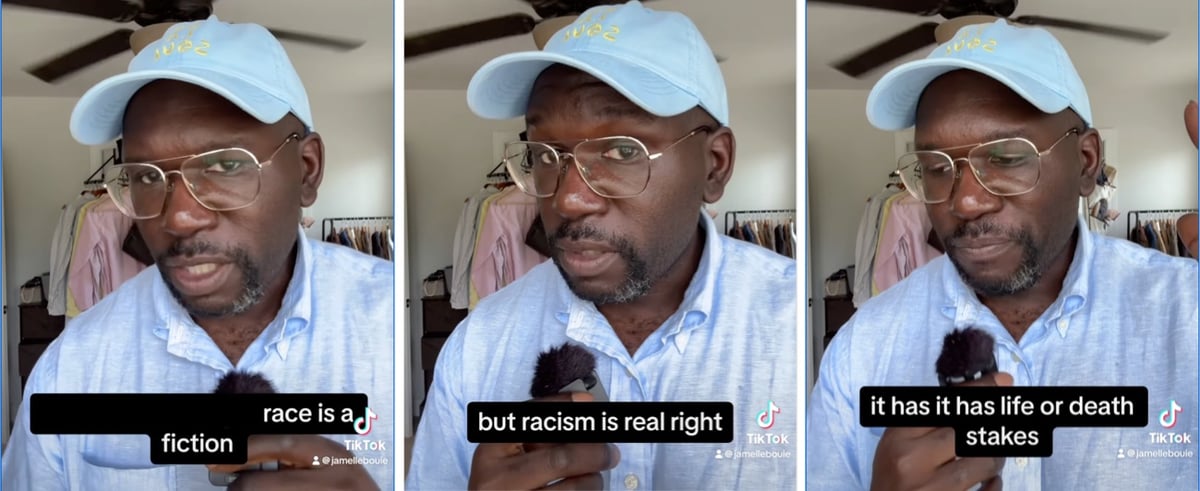
No surprise that Jamelle Bouie’s short videos are as interesting and informative as his NY Times columns. In a recent TikTok video (mirrored on Instagram), Bouie recommended a book called Racecraft: The Soul of Inequality in American Life by sociologist Karen Fields and historian Barbara Fields and nutshelled the premise:
The way the Fields sisters see it, and I think they’re right: race is a fiction, it doesn’t exist biologically, it’s a social construction, it’s designed to categorize, and it often obscures far more than it explains. But racism is real, right? Racism, the action, is real, it’s material, it affects people’s lives, it has life or death stakes, it structures the way that we engage in, and are received by, the society in which we live.
The example they give in the beginning of the book is: imagine a Black police officer is killed by one of his white colleagues. He’s undercover and he’s shot and killed. The news would say that this police officer was killed because he was Black. But the Fields sisters would say, wait a sec. Did the white officer shoot because he was white? That the Blackness caused the death, that the whiteness caused the shooting? No, of course not. What happened was that a white officer relied on racist assumptions about people of African descent to come to a set of conclusions, then acted on those conclusions.
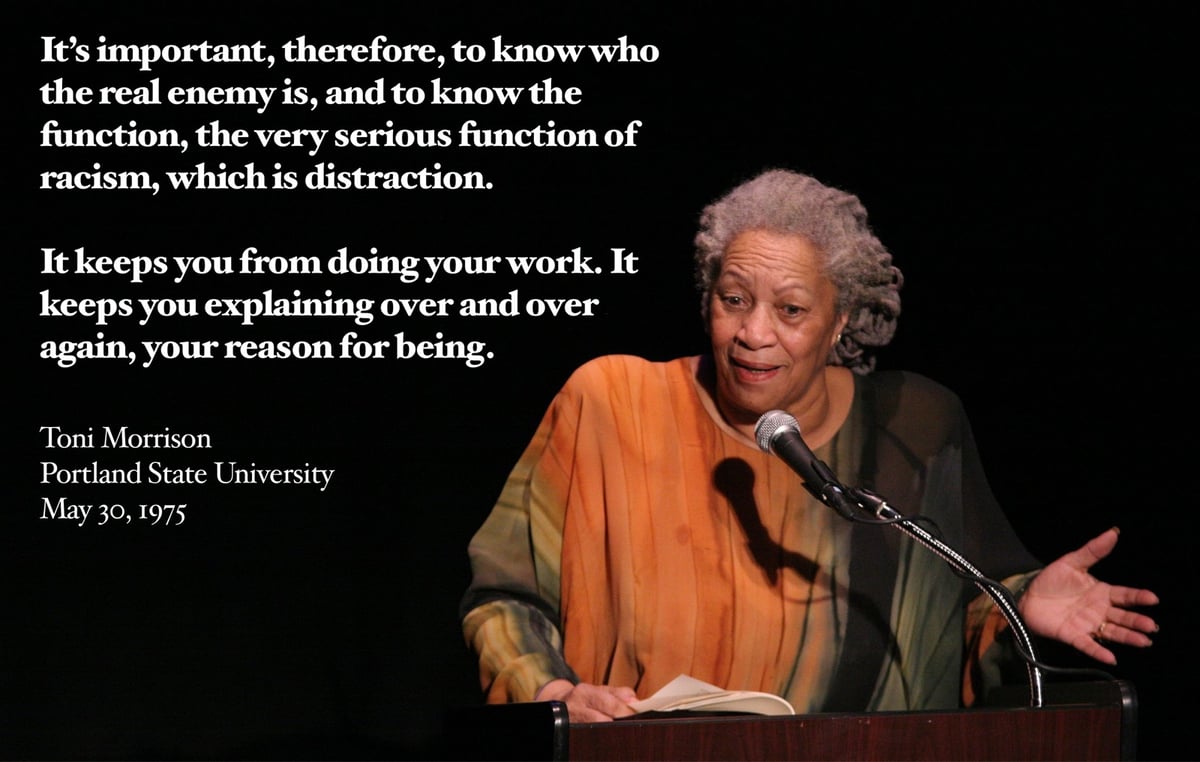
On social media this morning, I ran across this evergreen quote from Toni Morrison about the true function of racism:
It’s important, therefore, to know who the real enemy is, and to know the function, the very serious function of racism, which is distraction. It keeps you from doing your work. It keeps you explaining over and over again, your reason for being. Somebody says you have no language and so you spend 20 years proving that you do. Somebody says your head isn’t shaped properly so you have scientists working on the fact that it is. Somebody says that you have no art so you dredge that up. Somebody says that you have no kingdoms and so you dredge that up. None of that is necessary. There will always be one more thing.
Morrison said this during a speech titled The Humanist View at Portland State University on May 30, 1975. The text above, which is slightly different than you’ll see on social media or Goodreads, is taken directly from the transcript. You can also listen to Morrison’s full remarks on Soundcloud:
The snippet quoted above starts at about 35:45. (via @greg.org)
Andrea Pitzer, who wrote about about the history of concentration camps in her 2017 book One Long Night, has a piece in Scientific American about the historical parallels between Trump’s desire to expel as many as 20 million people from the country and previous concentration camps.
Trump’s plan to launch a massive deportation project nationwide — the first plank in the platform approved at his party’s convention — draws on the same flawed historical rationales and pseudoscience that built support for concentration camps worldwide in the 20th century. Early architects of these camps veiled their efforts in scientific terms while using terror and punishment to seize more power.
For example, Trump has claimed repeatedly that undocumented immigrants are “poisoning the blood” of the U.S. “Blood poisoning” is a medical condition; saying that foreigners are poisoning a nation’s blood is simply a slur. But perverting scientific or medical language to violate human rights and permit atrocities comes from a familiar playbook.
Again, this stuff is all right out in the open — no reading between the lines required.
As part of the effort to incorporate the Negro Leagues into MLB history, MLB held a pair of games at Birmingham, Alabama’s Rickwood Field, “the oldest professional ballpark in the United States and former home of the Birmingham Black Barons of the Negro Leagues”. During the pregame show Fox Sports invited Reggie Jackson, who played on a minor league team at the ballpark, to offer his perspective on the event. (Content note: Jackson says the n-word twice during his remarks.)
About halfway through this clip (the 4:35 mark), Alex Rodriguez asks him a softball question designed to elicit some fond memories about baseball and some gauzy reflections on the impact of the Negro Leagues:
How emotional is it for you to come back to a [place] that you played with one of the greatest teams around?
Jackson, as he did so many times during his career, knocked it out of the park with the brutal truth about what it was like to play baseball in the South as a Black man in the 60s (transcript):
Coming back here is not easy. The racism when I played here, the difficulty of going through different places where we traveled. Fortunately, I had a manager and I had players on the team that helped me get through it. But I wouldn’t wish it on anybody. People said to me today, I spoke and they said, ‘Do you think you’re a better person, do you think you won when you played here and conquered?’ I said ‘You know, I would never want to do it again.’
“I walked into restaurants and they would point at me and say, ‘The n***** can’t eat here.’ I would go to a hotel and they would say, ‘The n***** can’t stay here.’ We went to [Oakland Athletics owner] Charlie Finley’s country club for a welcome home dinner and they pointed me out with the n-word, ‘He can’t come in here.’ Finley marched the whole team out. Finally, they let me in there. He said ‘We’re going to go the diner and eat hamburgers. We’ll go where we’re wanted.’”
“Fortunately, I had a manager in Johnny McNamara that, if I couldn’t eat in the place, nobody would eat. We’d get food to travel. If I couldn’t stay in a hotel, they’d drive to the next hotel and find a place where I could stay. Joe and Sharon Rudi, I slept on their couch three, four nights a week for a month and a half. Finally, they were threatened that they would burn our apartment complex down unless I got out.
The year I came here, Bull Connor was the sheriff the year before, and they took minor league baseball out of here because in 1963, the Klan murdered four Black girls - children 11, 12, 14 years old - at a church here and never got indicted. The Klan, Life Magazine did a story on them like they were being honored.
“I wouldn’t wish it on anyone. At the same time, had it not been for my white friends, had it not been for a white manager, and Rudi, Fingers and Duncan, and Lee Meyers, I would never have made it. I was too physically violent. I was ready to physically fight some - I would have got killed here because I would have beat someone’s ass and you would have saw me in an oak tree somewhere.”
Ooh, I’d been waiting for this — Tressie McMillan Cottom’s take on the Grammy performance of Fast Car by Tracy Chapman and Luke Combs.
The cover is popular in a genre that has long been roiled by racial conflict. Over the past five years, artists and activists have tried to get mainstream Big Country to get with the multiracial program, but they have won little more than nominal, marginal inclusion rather than a reckoning with the industry’s soul. However lovely, Chapman’s and Combs’s performance ties too neat a bow on years of conflict within country music over who gets to play with the genre’s big boys.
Contrast that with articles like this one: A Rare Moment Americans Could All Share.
People across an angry and divided nation were given a magical, unifying moment on Sunday. We needed it.
“Ties too neat a bow” indeed. Maybe it’s the beginning of something but it sure doesn’t seem like the end of anything.
Update: If you’re on Bluesky, I recommend reading Cottom’s thread that answers a few questions that readers had.
Older posts





Socials & More