kottke.org posts about medicine
If you’re ever called on to perform CPR in an emergency but you don’t have training, the American Heart Association recommends performing “Hands-Only CPR”. There are two easy steps: you call 911 and then you press hard and fast in the center of the person’s chest 100-120 times per minute. As their fact sheet explains, familiar music can help maintain the proper tempo.
Song examples include “Stayin’ Alive” by the Bee Gees, “Crazy in Love” by Beyoncé featuring Jay-Z, “Hips Don’t Lie” by Shakira” or “Walk the Line” by Johnny Cash. People feel more confident performing Hands-Only CPR and are more likely to remember the correct rate when trained to the beat of a familiar song.
When performing CPR, you should push on the chest at a rate of 100 to 120 compressions per minute, which corresponds to the beat of the song examples above.
New York Presbyterian Hospital maintains a Spotify playlist of “Songs to do CPR to” that hit that 100-120 bpm sweet spot.
The playlist includes songs familiar to lifesavers of all generations, from Book of Love by the Monotones to Sweet Home Alabama by Lynyrd Skynyrd to Walk Like an Egyptian by The Bangles to Sorry by Justin Bieber. Stayin’ Alive or Justin Timberlake’s Rock Your Body are probably more appropriate to the situation, but should the need arise, my go-to CPR song is now Crazy in Love. Who knows, Beyoncé might help save someone’s life someday. (via @juliareinstein)
This was a new term for me:
keyword void, or search void, n.: a situation where searching for answers about a keyword returns an absence of authoritative, reliable results, in favor of “content produced by a niche group with a particular agenda.”
An article by Renee DiResta at Wired uses the example of Vitamin K shots, a common treatment given to newborn babies at hospitals, but whose top search results are dominated by anti-vaccination groups.
There’s an asymmetry of passion at work. Which is to say, there’s very little counter-content to surface because it simply doesn’t occur to regular people (or, in this case, actual medical experts) that there’s a need to produce counter-content. Instead, engaging blogs by real moms with adorable children living authentic natural lives rise to the top, stating that doctors are bought by pharma, or simply misinformed, and that the shot is risky and unnecessary. The persuasive writing sounds reasonable, worthy of a second look. And since so much of the information on the first few pages of search results repeats these claims, the message looks like it represents a widely-held point of view. But it doesn’t. It’s wrong, it’s dangerous, and it’s potentially deadly.
I wondered what other examples of keyword voids might be out there, so I searched for it. Unsurprisingly — in retrosepect — you don’t get a lot of relevant results. It’s mostly programming talk, when you literally want a function to return no results.
Science writer Carl Zimmer has a new book on genetics and heredity called She Has Her Mother’s Laugh. The New York Times published an excerpt this week focusing on mosaicism — an unexpected but surprisingly common condition where different cells in the same organism display different DNA (sometimes strikingly, fatally different).
Dr. Walsh and his colleagues have discovered intricate mosaics in the brains of healthy people. In one study, they plucked neurons from the brain of a 17-year-old boy who had died in a car accident. They sequenced the DNA in each neuron and compared it to the DNA in cells from the boy’s liver, heart and lungs.
Every neuron, the researchers found, had hundreds of mutations not found in the other organs. But many of the mutations were shared only by some of the other neurons.
It occurred to Dr. Walsh that he could use the mutations to reconstruct the cell lineages — to learn how they had originated. The researchers used the patterns to draw a sort of genealogy, linking each neuron first to its close cousins and then its more distant relatives.
When they had finished, the scientists found that the cells belonged to five main lineages. The cells in each lineage all inherited the same distinctive mosaic signature.
Even stranger, the scientists found cells in the boy’s heart with the same signature of mutations found in some brain neurons. Other lineages included cells from other organs.
Based on these results, the researchers pieced together a biography of the boy’s brain.
I’ve always been drawn to the idea that each of us are many people, an assembly of mismatched parts, manifesting themselves in different times and contexts. It’s striking to see that reflected, albeit in a refracted way, in our array of possible genomes.
Last month when I posted a video comparing the sizes of various microorganisms, I noted the weirdness of bacteriophages, which are bacteria-killing viruses that look a bit like a 20-sided die stuck on the top of a sci-fi alien’s body.
Bacteriophages are really real and terrifying…if you happen to be a bacteria. Bacteriophages attack by attaching themselves to bacteria, piercing their outer membranes, and then pumping them full of bacteriophage DNA. The phage replicates inside of the bacteria until the bacteria bursts and little baby bacteriophages are exploded out all over the place, ready to attack their own bacteria.
I couldn’t find a good explainer (video or text) about these organisms, but over the weekend, Kurzgesagt rode to the rescue with this video. In the second part of the video, they discuss whether bacteriophages might form the basis of an effective treatment for antibiotic-resistant infections.
A suspect in the Golden State Killer murders has been arrested, based largely on DNA evidence that was apparently obtained in part through creating a dummy profile on a heredity website. California’s laws are apparently fairly permissive when it comes to using familial DNA to match suspects to crimes.
Solving unsolved rape and murder cases is generally good, but turning private websites into repositories of criminal evidence police can obtain without a warrant is generally bad. Like, extra bad.
One of the first things this reminded me of was Cathy O’Neil’s recent call for a Hippocratic Oath for data scientists. The idea is for data scientists to have some ethical guidelines, and above all to avoid doing harm or violating the rights of the people implicated by the practice of data science. In order to do that, you need to bring in the various stakeholders, properly weigh each of their concerns, and continually work to address them.
It’s always an incomplete process, because as O’Neil notes right away, data science isn’t limited to the acts of professional data scientists; it’s also the province of companies, and algorithms, and automated or self-learning uses of data. So in addition to a Hippocratic Oath (or some version of it), you also need a version of HIPAA (the law that guarantees the secure storage and distribution of health information).
DNA/heredity sites seem like the perfect test case for figuring out the compatibility of these two modes of operating. It seems like largely, they’re being treated either as a simple data regime, a la social media networks, and/or under criminal statutes. But a person’s DNA is, or should be, treated like medical information, with strict limits on its use. There has to be some way to figure out how to weigh all of these things together without compromising people’s rights.
This morning I ran across news from two different studies about reducing deaths from opioid overdoses and they both had the same solution: medication-assisted treatment. First, from a study involving inmates in Rhode Island correctional facilities:
The program offers inmates methadone and buprenorphine (opioids that reduce cravings and ease withdrawal symptoms), as well as naltrexone, which blocks people from getting high.
The data set is small but the results are encouraging: there were fewer overdose deaths of former inmates after the program was implemented in 2016.
In the 90s, France used a similar program to cut heroin overdose deaths by 79%:
In 1995, France made it so any doctor could prescribe buprenorphine without any special licensing or training. Buprenorphine, a first-line treatment for opioid addiction, is a medication that reduces cravings for opioids without becoming addictive itself.
With the change in policy, the majority of buprenorphine prescribers in France became primary-care doctors, rather than addiction specialists or psychiatrists. Suddenly, about 10 times as many addicted patients began receiving medication-assisted treatment, and half the country’s heroin users were being treated. Within four years, overdose deaths had declined by 79 percent.
When she was 16, Charlotte Eades was diagnosed with glioblastoma, an extremely aggressive form of brain cancer. About a year after the diagnosis, she began documenting her illness and her life on her YouTube channel. After Eades died, her family made the video above, a short tribute to her life and video blog.
Annie Onishi is a general surgery resident at Columbia University and Wired asked her to break down scenes from movies and TV shows featuring emergency rooms, operating rooms, and other medical incidents. Spoiler alert: if you seek medical treatment from a TV doctor, you will probably die. Secondary spoiler alert: that adrenaline-shot-to-the-heart scene in Pulp Fiction is not as implausible as you might think, even if some of the details are wrong.
Data artist Josh Begley edited together a 5m30s video of every concussion suffered in an NFL game this year. I was barely able to get through this…I had to pause a couple of times. From an article about the video at The Intercept:
The NFL has done a masterful job at mainstreaming the violence of the game, so that fans and spectators don’t feel too bad about what’s actually happening out there. No single word has protected the NFL from the true costs of this violence more than “concussion.” That word puts a protective barrier between us and what’s really going on out on the field.
It’s not a headache. It’s not “getting your bell rung.” You don’t have a bell. It’s a traumatic brain injury. Every single concussion is a new traumatic brain injury. In addition to the torn ACLs and MCLs, in addition to all of the horrible broken bones, the NFL diagnosed at least 281 traumatic brain injuries this season. And no document has ever quite displayed the horror of it all like “Concussion Protocol,” a film by Josh Begley and Field of Vision.
The backwards slow-mo technique is a bit off-putting at first, but as Greg Dorsainville noted in the video’s thread:
If it was in forwards it would be like any big hits package you see in an espn highlight show where we celebrate the football and hit and not mourn the result of the moment: a human in pain, disorientation, and slowly killing themselves.
Having big second thoughts on watching the Super Bowl this weekend, karma offsets or no. (via @harmancipants)
In a study done by UPenn researchers, first-year medical students who were taught art observation classes at the Philadelphia Museum of Art were more proficient at reading clinical imagery than students who didn’t take the classes.
If you’re unfamiliar or uncomfortable with how art and science can mingle to produce something clinically beneficial, it’s a study premise that might seem far-fetched — but it didn’t seem that way to Gurwin, an ophthalmology resident at Penn, in part because she’d already seen the benefits of art education on a medical career firsthand.
“Having studied fine arts myself and having witnessed its impact on my medical training, I knew art observation training would be a beneficial practice in medical school,” she said. “Observing and describing are skills that are taught very well in fine arts training, and so it seemed promising to utilize their teachings and apply it to medicine.”
Gurwin and Binenbaum’s findings, published in the journal Ophthalmology in September: The medical students who’ve dabbled in art just do better.
It’s a glimpse at how non-clinical training can and does make for a better-prepared medical professional. Not only does art observation training improve med students’ abilities to recognize visual cues, it also improves their ability to describe those cues.
The results of this study reminded me of Walter Isaacson’s assertion in his book that Leonardo da Vinci’s greatest skill was his keen observational ability. Not coincidentally, Leonardo was both an artist and a medical researcher who dissected more than 30 human cadavers to study human anatomy. These dissections helped him to represent the human form more realistically in his paintings and drawings.
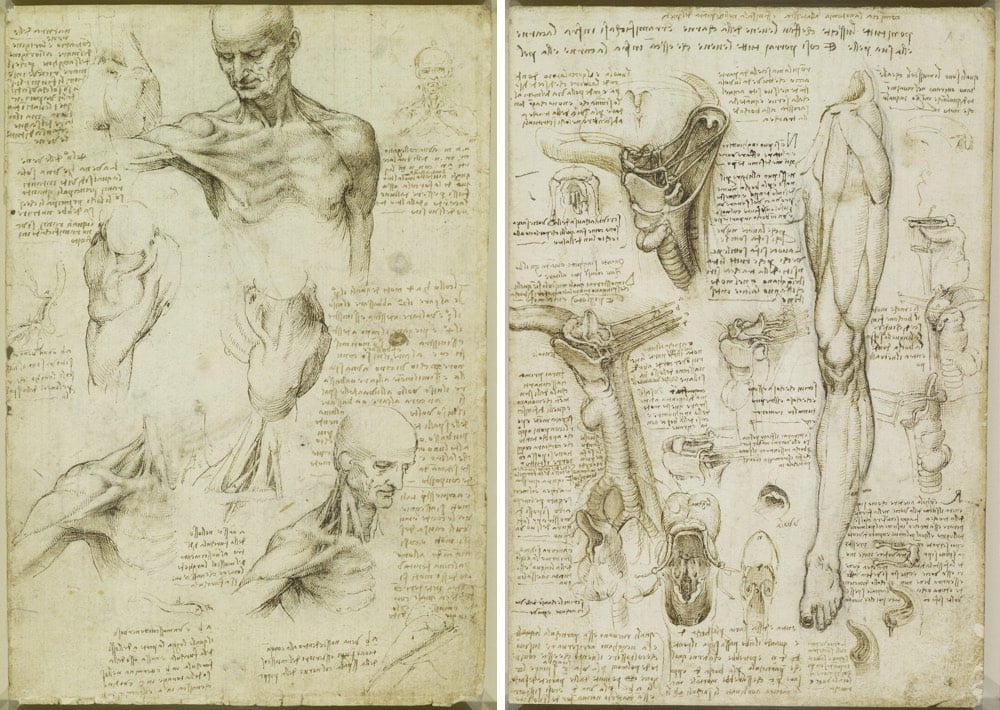
It’s easier to draw a hand, particularly a hand that appears to be moving (as Leonardo liked to do), if you know that’s going on underneath the skin. Looking carefully and purposefully at art, at anatomy, at the physical world, at people’s actions, at movies; it’s all the same skill that can be applied to anything.
I’ve been preoccupied with observation lately…the new kottke.org newsletter is named Noticing for good reason. Again, Leonardo factors in:
Isaacson argues that Leonardo’s observational powers were not innate and that with sufficient practice, we can all observe as he did. People talk in a precious way about genius, creativity, and curiosity as superpowers that people are born with but noticing is a more humble pursuit. Noticing is something we can all do.
In only 90 seconds with the use of a few props (and some profanity), entertainers Penn & Teller offer a succinct and compelling argument of the benefits of vaccinating our children.
So even if vaccination did cause autism, WHICH IT FUCKING DOESN’T, anti-vaccination would still be bullshit.
Along with “Vaccines. And now my kids don’t die.”, this might be my favorite anti-vaxxers broadside ever.
Kurzgesagt takes a look at three possible areas of research that may help people live longer and healthier: senescent cells, NAD+, and stem cells. The distinction articulated early on in the video between optimizing for human lifespan versus increasing human healthspan seems particularly important in this search for a cure for aging.
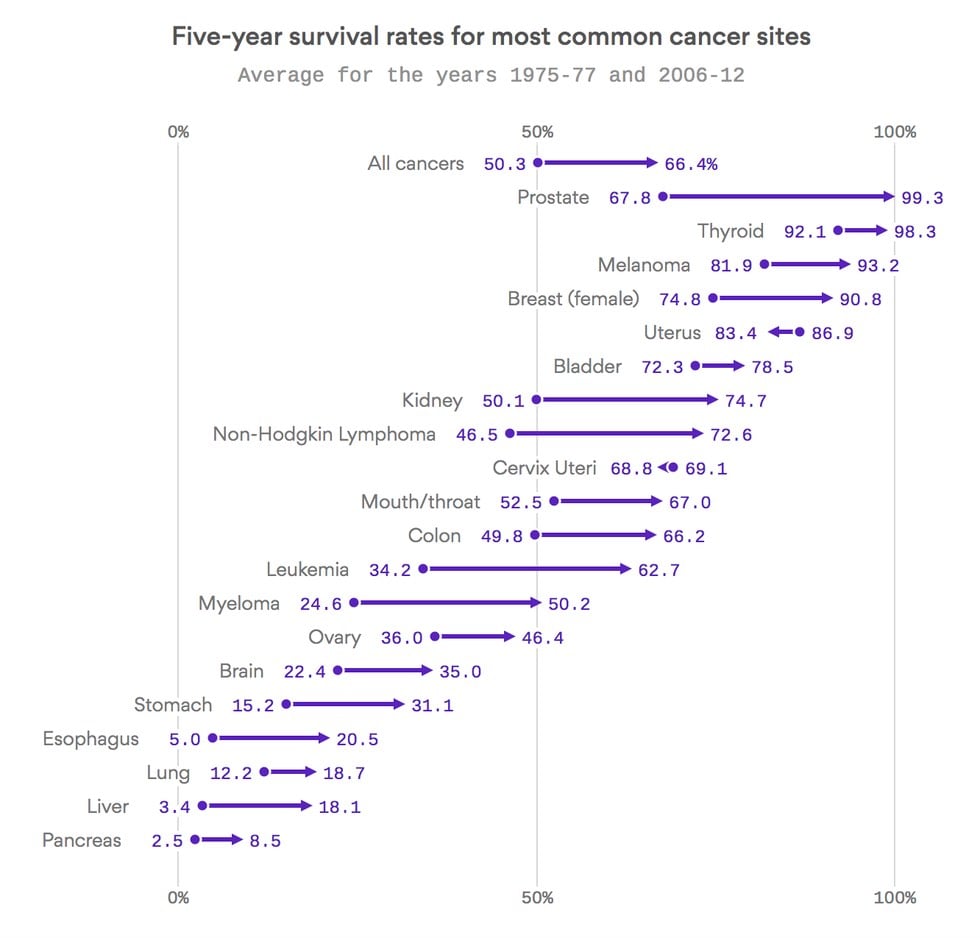
According to a study published in March 2017 in the Journal of the National Cancer Institute, cancer death rates continue to fall across most cancer types. From 2010 to 2014 (the most recent year that statistical data is available), overall death rates decreased by 1.8%.
Overall cancer death rates from 2010 to 2014 decreased by 1.8% (95% confidence interval [CI] = -1.8% to -1.8%) per year in men, by 1.4% (95% CI = -1.4% to -1.3%) per year in women, and by 1.6% (95% CI = -2.0% to -1.3%) per year in children. Death rates decreased for 11 of the 16 most common cancer types in men and for 13 of the 18 most common cancer types in women, including lung, colorectal, female breast, and prostate, whereas death rates increased for liver (men and women), pancreas (men), brain (men), and uterine cancers.
But the trends are much clearer when you look at progress over a longer time period. As this graph from Axios shows, the five-year survival rates for most common types of cancer have increased quite significantly in the past 30-40 years. Survival rates from all cancers increased by 16% and jumped 26% and almost 29% for non-Hodkin lymphoma and leukemia respectively. If you have prostate or thyroid cancer, you’re almost guaranteed to survive 5 years at this point and the female breast cancer survival rate is up to almost 91%. (via @Atul_Gawande)
Currently, the only way to diagnose chronic traumatic encephalopathy (CTE), a disease caused by repeated head trauma, is by posthumously examining brain tissue for signs of tau protein buildup. But a group from Boston University may have found a way to test for CTE in living patients.
McKee and her team discovered a specific biomarker in the brains of former football players. A biomarker is a measurable substance which is, in this case, found in the brain and identifies an abnormality.
This particular biomarker is called CCL11, and it’s a secreted protein the human body uses to help regulate the immune system and inflammation in the body.
As The Ringer’s Claire McNear writes, if a CTE test is easily available to players, what will that do to football? (Or indeed, what will it do to sports like soccer, boxing, skateboarding, or even skiing?)
“After learning all of this,” the retiring Ferguson wrote of the clarity he gained when he began researching CTE, “I feel a bit betrayed by the people or committees put in place by the league who did not have my best interests at heart.” He should feel betrayed, as should many of his fellow players. As will, certainly, so very many, once they have the ability to see what has happened to them. They may wonder, rightfully, about the people who trained them and paid them, sometimes even as they attempted to shut down research into CTE. They may look at the league’s structure, at the lopsided contracts that rob many players of their leverage, forcing them to choose between getting back on the field or losing a paycheck (and possibly getting cut), and at how the league cycles through players like they’re nothing more than easily broken pieces on a board.
Former New England Patriots player Aaron Hernandez, who was serving a life sentence for murdering a friend and who died in prison from suicide earlier this year, was found to have “a severe form” of CTE, a brain disease linked to repeated head trauma that has also been found in many other former NFL players.
Researchers who examined the brain determined it was “the most severe case they had ever seen in someone of Aaron’s age,” said a lawyer for Hernandez in announcing the result at a news conference on Thursday. Hernandez was 27.
Hernandez played three seasons in college and only three in the NFL, yet the damage to his brain was similar to “players with a median age of 67 years”. If you’re a young football player in college or the NFL right now, you have to be looking at this situation pretty hard right now.
See also: Don’t Let Kids Play Football, what the ball boy saw, I’m quitting football, NFL deliberately campaigned against science regarding head injuries, Junior Seau’s family sues NFL over concussions, how professional football might end (sooner than you think), and a message in an NFL player’s suicide.
Newer posts
Older posts





Socials & More