kottke.org posts about medicine
About two weeks ago, I had my right shoulder replaced. This was the second time I’ve had surgery on that shoulder, after multiple knee surgeries and arm surgeries, and abscesses and god knows what else. This surgery took place in the middle of what’s now, to me, a very familiar, and very tedious dance with my doctors around pain, pain management, and painkillers.
The way it works is this. Everyone knows that surgery, and the injuries that lead to surgery, are painful. Everyone also knows that the best way to treat pain of this kind is through the regular administration of opiates. However, because these drugs are addictive, everyone has to act as if they don’t know anything of the kind.
So instead of just prescribing the drugs, and preventing the pain, the doctors and nurses will wait until the patient asks for the pain medication. Or they’ll prescribe pain pills, but not enough to get the patient through to the next meeting with the doctor. They put the onus on the patient to beg for relief of his/her pain. Ideally with a buffer in between, like a nurse or a pain management specialist, so that the decision never comes directly from the person you’re interacting with, but an intercessor. This is why some patients end up medicated up to the gills, and others are left to grind their teeth and just get through it.
It’s really stupid. I suspect it heightens rather than lessening patients’ feelings of dependence on these drugs, which can do so much to reduce their acute pain and chronic discomfort. Instead, they’re doled out in a semi-arbitrary fashion, generally carefully rationed but sometimes overprescribed, based on your willingness to perform pain for someone else and that person’s level of compassion or complicity with your suffering.
This is all to say: no, I’m not on pain medication. Yes, I’m terribly uncomfortable. No, I’m not uncomfortable enough to jump through hoops and beg for more drugs. (Maybe if I were, things would be different.) And at the times I was most uncomfortable, those were the times when medicine was the least available to me, by design.
We’ve got to get over our weird Puritanical crap about pain and pain medication, and accept the fact that in certain contexts, we need the drugs. And by “we,” I mean myself, the medical system; everybody. We can’t be responsible for the entire opioid epidemic every second of every day. Sometimes we just need to be able to go to sleep.
Diane Munday, an 86-year-old women’s rights activist, recalls what illegal abortion had been like in the UK in the 1960s.
“Women would drink bleach to try to induce miscarriage. They would have very hot baths, or move heavy furniture, or try to do it themselves with a needle or a crochet hook,” says Munday.
As a result, an underground network of backstreet abortionists ran quietly across the country. Some of them, says Munday, became involved by force. It was not unknown for women who had carried out abortions for their close friends and family to be blackmailed by desperate pregnant women who threatened to report them to the police if they didn’t help them, too. Like women who had abortions, those who carried out the procedure illegally could be sent to prison.
“These people were unskilled. Some might have had a bit of nursing experience or had worked in a hospital, or carried out procedures for a friend or daughter,” says Munday.
Munday became active in the campaign to legalize abortion in the UK after she had one herself following giving birth to three children in less than four years.
See also Harrowing Illegal Abortion Stories from Before Roe v. Wade.
The development of vaccines against infectious diseases is among the greatest of human accomplishments and has saved ten of millions of people from dying. And yet some are still hung up on their side effects (and also the widely disproved and debunked fraudulent claim that vaccines cause autism). In this video, Kurzgesagt looks at how vaccines work and compares the impact of their side effects (minuscule) to the potential effect of the diseases they protect against (children dying).
The extensive list of sources they used for the video can be found here.
The title of this video is “The Side Effects of Vaccines - How High is the Risk?”, which seems like it’s maximized for clicks and to spread amongst anti-vaxxers on social media. I wish it had a more accurate title — something like “The Absurdly Low Risk of Vaccine Side Effects” or maybe “Vaccines. And Now My Kids Don’t Die.” — but perhaps positioning it this way is a good strategy to get folks who may not be quite so radicalized to watch it.
In her new book, Invisible Women: Data Bias in a World Designed for Men, Caroline Criado Perez argues that the data that scientists, economists, public policy makers, and healthcare providers rely on is skewed, unfairly and dangerously, towards men.
…because so much data fails to take into account gender, because it treats men as the default and women as atypical, bias and discrimination are baked into our systems. And women pay tremendous costs for this bias, in time, money, and often with their lives.
The Guardian has a lengthy excerpt of the book, including a discussion of crash test dummies:
Crash-test dummies were first introduced in the 1950s, and for decades they were based around the 50th-percentile male. The most commonly used dummy is 1.77m tall and weighs 76kg (significantly taller and heavier than an average woman); the dummy also has male muscle-mass proportions and a male spinal column. In the early 1980s, researchers based at Michigan University argued for the inclusion of a 50th-percentile female in regulatory tests, but this advice was ignored by manufacturers and regulators. It wasn’t until 2011 that the US started using a female crash-test dummy — although, as we’ll see, just how “female” these dummies are is questionable.
Designing cars around the typical male body type means women are more likely to be injured or killed:
Men are more likely than women to be involved in a car crash, which means they dominate the numbers of those seriously injured in them. But when a woman is involved in a car crash, she is 47% more likely to be seriously injured, and 71% more likely to be moderately injured, even when researchers control for factors such as height, weight, seatbelt usage, and crash intensity. She is also 17% more likely to die. And it’s all to do with how the car is designed — and for whom.
Another example Criado Perez cites involves women’s healthcare:
When Viagra — sildenafil citrate — was tested initially as heart medication, its well-known properties for men were discovered. “Hallelujah,” said Big Pharma, and research ceased. However, in subsequent tests the same drug was found to offer total relief for serious period pain over four hours. This didn’t impress the male review panel, who refused further funding, remarking that cramps were not a public health priority.
In this piece for The Guardian, Matthew Walker says that sleeping well is the best thing you can do for your health. Here are just a couple of examples:
Routinely sleeping less than six hours a night also compromises your immune system, significantly increasing your risk of cancer. So much so, that recently the World Health Organization classified any form of night-time shiftwork as a probable carcinogen.
Inadequate sleep — even moderate reductions of two to three hours for just one week — disrupts blood sugar levels so profoundly that you would be classified as pre-diabetic. Short sleeping increases the likelihood of your coronary arteries becoming blocked and brittle, setting you on a path towards cardiovascular disease, stroke and congestive heart failure.
A lack of sleep may also increase your chances of developing Alzheimer’s disease, decrease your athletic performance, make it more difficult to control your appetite, and have mental health consequences. Walker, who is the director of UC Berkeley’s Center for Human Sleep Science and author of Why We Sleep: Unlocking the Power of Sleep and Dreams, says we should change our cultural attitudes towards sleep.
I believe it is therefore time for us, as individuals and as nations, to reclaim our right to a full night of sleep, without embarrassment or the terrible stigma of laziness. I fully understand that this prescription of which I write requires a shift in our cultural, professional, and global appreciation of sleep.
In my media diet roundup post for 2018, I said that getting adequate sleep has “transformed my life” and that sleep is “even lower-hanging self-help fruit than yoga or meditation”. I have not been sleeping well for the past several weeks and it’s taking a toll: I’ve been sluggish, eating poorly & erratically, feeling down, and not anywhere near my peak mental performance. This morning I woke up at 4am, couldn’t really get back to sleep, and I feel like I’m running at 60% capacity, 65% tops.
Roald Dahl’s oldest daughter Olivia died from the measles when she was seven years old. She died because there wasn’t a reliable measles vaccine then, and in this heartfelt letter he wrote years later, Dahl wants everyone to know that there is such a vaccine now.
Olivia, my eldest daughter, caught measles when she was seven years old. As the illness took its usual course I can remember reading to her often in bed and not feeling particularly alarmed about it. Then one morning, when she was well on the road to recovery, I was sitting on her bed showing her how to fashion little animals out of coloured pipe-cleaners, and when it came to her turn to make one herself, I noticed that her fingers and her mind were not working together and she couldn’t do anything.
‘Are you feeling all right?’ I asked her.
‘I feel all sleepy,’ she said.
In an hour, she was unconscious. In twelve hours she was dead.
The measles had turned into a terrible thing called measles encephalitis and there was nothing the doctors could do to save her. That was twenty-four years ago in 1962, but even now, if a child with measles happens to develop the same deadly reaction from measles as Olivia did, there would still be nothing the doctors could do to help her.
On the other hand, there is today something that parents can do to make sure that this sort of tragedy does not happen to a child of theirs. They can insist that their child is immunised against measles. I was unable to do that for Olivia in 1962 because in those days a reliable measles vaccine had not been discovered. Today a good and safe vaccine is available to every family and all you have to do is to ask your doctor to administer it.
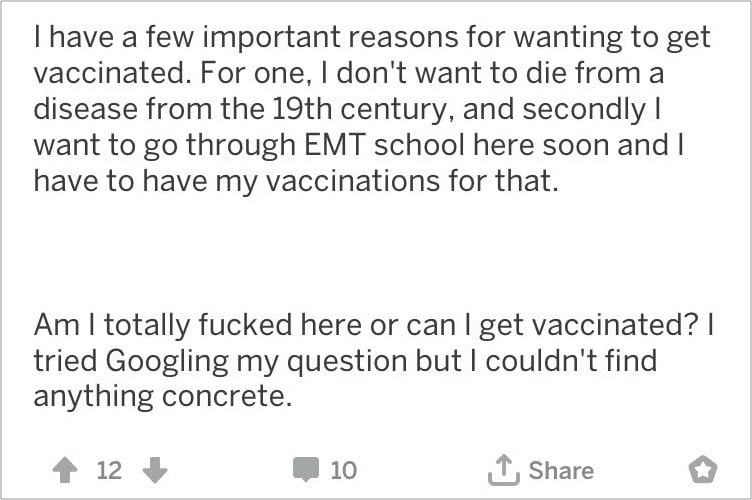
I feel so tired when I think about parents not vaccinating their children against easily preventable fatal diseases. It’s child abuse and the kids know better! Here’s a tweet from Erin Faulk sharing some screenshots of teens asking how they can get vaccinated over their parents’ objections.
“Vaccines. And now my kids don’t die.”
When Sonia Vallabh lost her mother to a rare disease called fatal familial insomnia, she soon found out that she had inherited the disease, that there was no cure, and that she’d be dead in “a decade or two”. Despite almost no scientific training, Vallabh and her husband both quit their jobs to work on a cure. Talk about going all-in.
Within a few weeks of the diagnosis, Sonia had quit her job to study science full time, continuing classes at MIT during the day and enrolling in a night class in biology at Harvard’s extension school. The pair lived off savings and Eric’s salary. Sonia had expected to take a temporary sabbatical from her real life, but soon textbooks and academic articles weren’t enough. “The practice of science and the classroom version of science are such different animals,” Sonia says. She wanted to try her hand in the lab. She found a position as a technician with a research group focusing on Huntington’s disease. Eric, not wanting to be left behind, quit his job too and offered his data-crunching expertise to a genetics lab. The deeper they dove into science, the more they began to fixate on finding a cure.
They’re now on the brink of getting their Harvard PhDs and are pushing ahead with a promising medical therapy.
As soon as the couple began their presentation, Lander says, there was a sense of “pushing on an open door” — quite a surprise, given the agency’s stodgy reputation. “People still flat-out don’t believe the FDA was cool with it,” Minikel says. Afterward, one of the 25 scientists in the audience pulled Lander aside and said, “That was one of the best presentations I’ve ever seen.” Schreiber agreed. He alluded to a pharmaceutical company he’d helped set up early in his career. “Twenty-four years into that company, there was nothing to show for it. Not one thing,” he says. “For two graduate students who are not trained in science to come in and do what they did? Absolute forces of nature, savants. They keep seeing things that other people don’t see.”
Update: D.T. Max wrote a book on prions and prion-based diseases called The Family That Couldn’t Sleep. I looked in the kottke.org archives and found a 2010 post on a National Geographic article Max wrote about sleep that specifically referenced fatal familial insomnia:
The main symptom of FFI, as the disease is often called, is the inability to sleep. First the ability to nap disappears, then the ability to get a full night’s sleep, until the patient cannot sleep at all. The syndrome usually strikes when the sufferer is in his or her 50s, ordinarily lasts about a year, and, as the name indicates, always ends in death.
(via @mattbucher)
For Outside magazine, Rowan Jacobsen talks to scientists whose research suggests that the current guidelines for protecting human skin from exposure to the sun are backwards. Despite the skin cancer risk, we should be getting more sun, not less.
When I spoke with Weller, I made the mistake of characterizing this notion as counterintuitive. “It’s entirely intuitive,” he responded. “Homo sapiens have been around for 200,000 years. Until the industrial revolution, we lived outside. How did we get through the Neolithic Era without sunscreen? Actually, perfectly well. What’s counterintuitive is that dermatologists run around saying, ‘Don’t go outside, you might die.’”
When you spend much of your day treating patients with terrible melanomas, it’s natural to focus on preventing them, but you need to keep the big picture in mind. Orthopedic surgeons, after all, don’t advise their patients to avoid exercise in order to reduce the risk of knee injuries.
Meanwhile, that big picture just keeps getting more interesting. Vitamin D now looks like the tip of the solar iceberg. Sunlight triggers the release of a number of other important compounds in the body, not only nitric oxide but also serotonin and endorphins. It reduces the risk of prostate, breast, colorectal, and pancreatic cancers. It improves circadian rhythms. It reduces inflammation and dampens autoimmune responses. It improves virtually every mental condition you can think of. And it’s free.
These seem like benefits everyone should be able to take advantage of. But not all people process sunlight the same way. And the current U.S. sun-exposure guidelines were written for the whitest people on earth.
Exposure and sunscreen recommendations for people with dark skin may be particularly misleading.
People of color rarely get melanoma. The rate is 26 per 100,000 in Caucasians, 5 per 100,000 in Hispanics, and 1 per 100,000 in African Americans. On the rare occasion when African Americans do get melanoma, it’s particularly lethal — but it’s mostly a kind that occurs on the palms, soles, or under the nails and is not caused by sun exposure.
At the same time, African Americans suffer high rates of diabetes, heart disease, stroke, internal cancers, and other diseases that seem to improve in the presence of sunlight, of which they may well not be getting enough. Because of their genetically higher levels of melanin, they require more sun exposure to produce compounds like vitamin D, and they are less able to store that vitamin for darker days. They have much to gain from the sun and little to fear.
A machine learning algorithm programmed by Dr. Jae Ho Sohn can look at PET scans of human brains and spot indicators of Alzheimer’s disease with a high level of accuracy an average of 6 years before the patients would receive a final clinical diagnosis from a doctor.
To train the algorithm, Sohn fed it images from the Alzheimer’s Disease Neuroimaging Initiative (ADNI), a massive public dataset of PET scans from patients who were eventually diagnosed with either Alzheimer’s disease, mild cognitive impairment or no disorder. Eventually, the algorithm began to learn on its own which features are important for predicting the diagnosis of Alzheimer’s disease and which are not.
Once the algorithm was trained on 1,921 scans, the scientists tested it on two novel datasets to evaluate its performance. The first were 188 images that came from the same ADNI database but had not been presented to the algorithm yet. The second was an entirely novel set of scans from 40 patients who had presented to the UCSF Memory and Aging Center with possible cognitive impairment.
The algorithm performed with flying colors. It correctly identified 92 percent of patients who developed Alzheimer’s disease in the first test set and 98 percent in the second test set. What’s more, it made these correct predictions on average 75.8 months — a little more than six years — before the patient received their final diagnosis.
This is the stuff where AI is going to be totally useful…provided the programs aren’t cheating somehow.
MEL Magazine’s Ian Lecklitner talked to clinical nutritionist David Friedman (author of Food Sanity: How to Eat in a World of Fads and Fiction) about which vegetables Friedman thinks are the healthiest. Happy to see that asparagus is #1:
“This tasty green stalk comes in first place on my vegetable ranking,” Friedman says. “Asparagus is a great source of vitamin K, which helps with blood clotting and building strong bones.” Friedman also mentions that asparagus provides vitamin A (which prevents heart disease), vitamin C (which supports the immune system), vitamin E (which acts as an antioxidant) and vitamin B6 (which, like vitamin A, also prevents heart disease).
Asparagus is also loaded with minerals, including iron (which supports oxygen-carrying red blood cells), copper (which improves energy production) and calcium (which improves bone health). “Asparagus increases your energy levels, protects your skin from sun damage and helps with weight loss,” Friedman continues. “It’s also an excellent source of inulin, a type of carbohydrate that acts as a prebiotic, supporting the growth of health-promoting bacteria in the colon.”
Personal faves brussels sprouts, beets, and broccoli also rank pretty high.
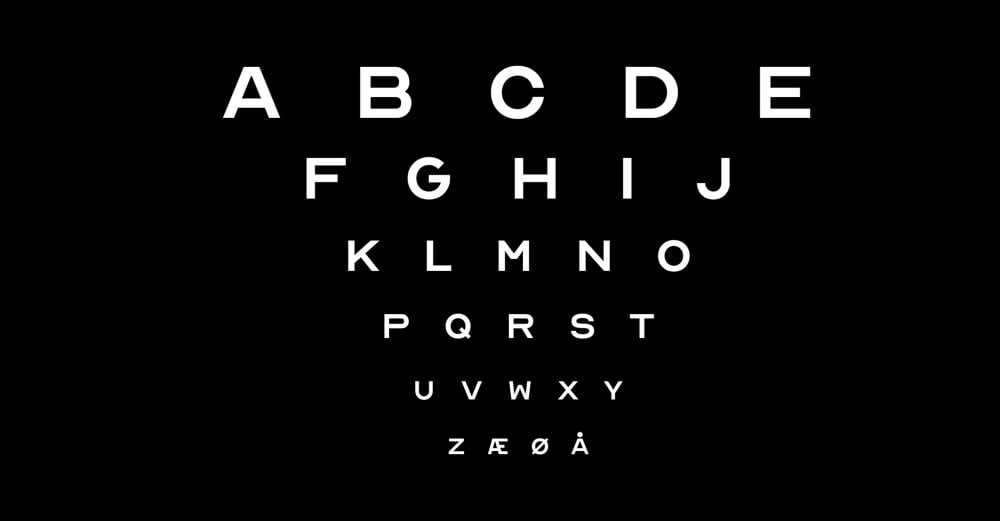
Eye charts at your optometrist’s office typically only have 10 letters on them: CDHKNORSVZ. Inspired by that lettering, creative agency ANTI Hamar and typographer Fábio Duarte Martins have expanded that abbreviated alphabet into a free font with a full alphabet called Optician Sans. Here’s a video look at how they did it:
(via khoi)
For this month’s issue of Topic, palliative care doctor Nathan Gray wrote & illustrated a comic about What Doctors Know About CPR. It does not match what you might have seen on TV.
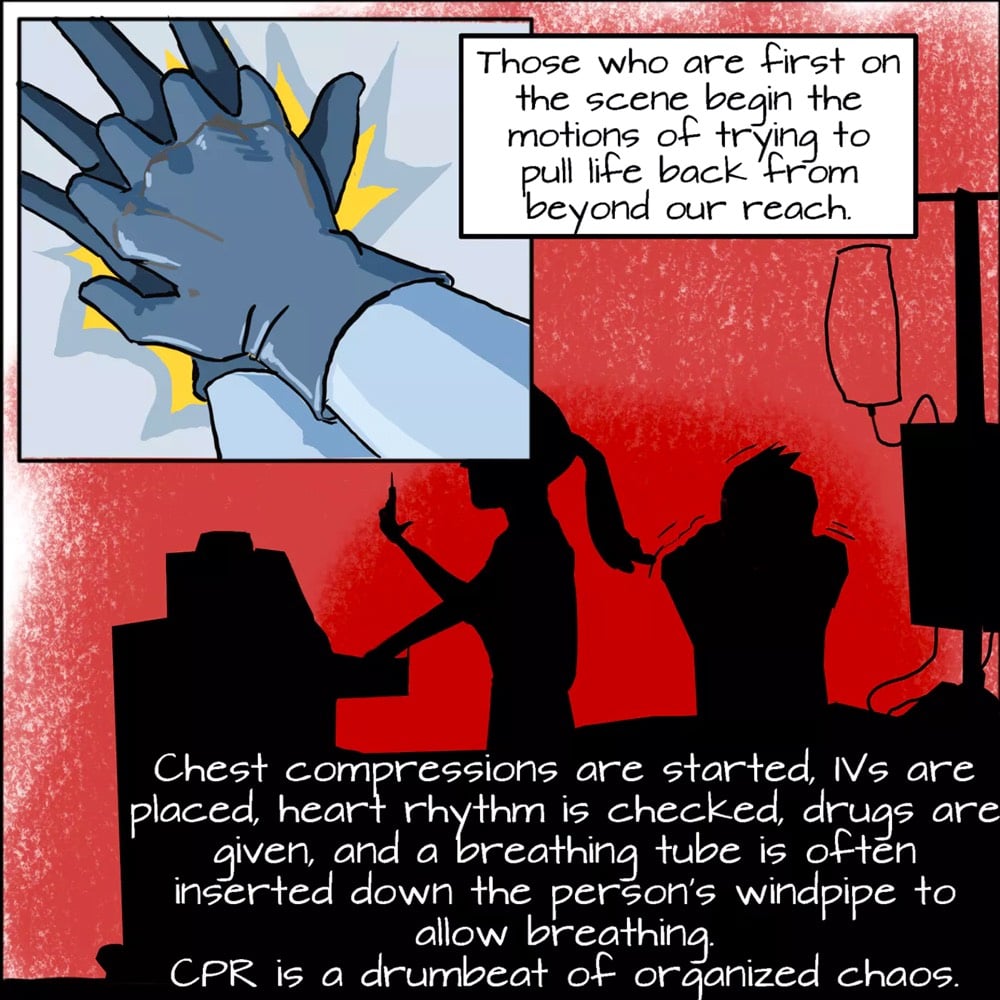
CPR holds an almost sacred space in medicine. Most doctors won’t refuse to perform it, even if they think it will be harmful or useless.
See also a hospital’s playlist of songs for doing perfect CPR chest compressions featuring Crazy in Love, Sweet Home Alabama, and Gloria Gaynor’s I Will Survive.
Nobody writes about health care practice from the inside out like Atul Gawande, here focusing on an increasingly important part of clinical work: information technology.
A 2016 study found that physicians spent about two hours doing computer work for every hour spent face to face with a patient—whatever the brand of medical software. In the examination room, physicians devoted half of their patient time facing the screen to do electronic tasks. And these tasks were spilling over after hours. The University of Wisconsin found that the average workday for its family physicians had grown to eleven and a half hours. The result has been epidemic levels of burnout among clinicians. Forty per cent screen positive for depression, and seven per cent report suicidal thinking—almost double the rate of the general working population.
Something’s gone terribly wrong. Doctors are among the most technology-avid people in society; computerization has simplified tasks in many industries. Yet somehow we’ve reached a point where people in the medical profession actively, viscerally, volubly hate their computers.
It’s not just the workload, but also what Gawande calls “the Revenge of the Ancillaries” — designing software for collaboration between different health care professionals, from surgeons to administrators, all of whom have competing stakes and preferences in how a product is used and designed, what information it offers and what it demands. And most medical software doesn’t handle these competing demands very well.
I don’t know how many people under the age of 35 know about the Chicago Tylenol murders, but for a few weeks in 1982, it was a national news sensation. Seven people in the Chicago area died after ingesting Tylenol capsules laced with potassium cyanide. Retro Report took a look back at this episode, with a focus on how Johnson & Johnson and other drug companies modified their packaging to prevent in-store tampering.
The company considered renaming Tylenol, a word that incorporates some of the letters from 4- (aceTYLamino) phENOL, a chemical name for acetaminophen, the drug’s active ingredient. But a name change was rejected.
Instead, a mere six weeks after the crisis flared, the company offered a different solution, a new bottle with the sorts of safety elements now familiar (if at times exasperating) to every shopper: cotton wad, foil seal, childproof cap, plastic strip. Capsules began to be replaced with caplets the following year.
Johnson & Johnson was viewed as an exemplar of corporate responsibility, and enjoyed what some people described as the greatest comeback since Lazarus. Nowadays, all sorts of products come in containers deemed tamper-proof, or at least tamper-evident, meaning that consumers can readily tell if a seal has been broken or something else is amiss.
Incredibly, the case is still unsolved…no one knows who did it or why. Thinking about the amount of in-store surveillance that we have, it seems unlikely that such a crime would go unsolved for long today.
From an independent newspaper here in Vermont, the heartbreaking and brutally honest obituary of Madelyn Linsenmeir, a 30-year-old mother who died from a drug addiction to opiates that lasted for more a decade.
When she was 16, she moved with her parents from Vermont to Florida to attend a performing arts high school. Soon after she tried OxyContin for the first time at a high school party, and so began a relationship with opiates that would dominate the rest of her life.
It is impossible to capture a person in an obituary, and especially someone whose adult life was largely defined by drug addiction. To some, Maddie was just a junkie — when they saw her addiction, they stopped seeing her. And what a loss for them. Because Maddie was hilarious, and warm, and fearless, and resilient. She could and would talk to anyone, and when you were in her company you wanted to stay. In a system that seems to have hardened itself against addicts and is failing them every day, she befriended and delighted cops, social workers, public defenders and doctors, who advocated for and believed in her ‘til the end. She was adored as a daughter, sister, niece, cousin, friend and mother, and being loved by Madelyn was a constantly astonishing gift.
This is powerfully straightforward writing by Linsenmeir’s family…my condolences are with them. They devoted a few paragraphs at the end of her obit to address addiction and its place in our society:
If you are reading this with judgment, educate yourself about this disease, because that is what it is. It is not a choice or a weakness. And chances are very good that someone you know is struggling with it, and that person needs and deserves your empathy and support.
If you work in one of the many institutions through which addicts often pass — rehabs, hospitals, jails, courts — and treat them with the compassion and respect they deserve, thank you. If instead you see a junkie or thief or liar in front of you rather than a human being in need of help, consider a new profession.
As in many other states, more and more people are dying of opiate overdoses in Vermont even as doctors cut the number of opioid prescriptions they write faster than other areas of the country.
Update: On Facebook, Burlington, VT’s chief of police Brandon del Pozo wrote a response to Linsenmeir’s obituary that is very much worth reading.
Why did it take a grieving relative with a good literary sense to get people to pay attention for a moment and shed a tear when nearly a quarter of a million people have already died in the same way as Maddie as this epidemic grew?
Did readers think this was the first time a beautiful, young, beloved mother from a pastoral state got addicted to Oxy and died from the descent it wrought? And what about the rest of the victims, who weren’t as beautiful and lived in downtrodden cities or the rust belt? They too had mothers who cried for them and blamed themselves.
She died just like my wife’s cousin Meredith died in Bethesda, herself a young mother, but if Maddie was a black guy from the Bronx found dead in his bathroom of an overdose, it wouldn’t matter if the guy’s obituary writer had won the Booker Prize, there wouldn’t be a weepy article in People about it.
Why not?
But if there had been, early enough on, and we acted swiftly, humanely, and accordingly, maybe Maddie would still be here. Make no mistake, no matter who you are or what you look like: Maddie’s bell tolls for someone close to you, and maybe someone you love. Ask the cops and they will tell you: Maddie’s death was nothing special at all. It happens all the time, to people no less loved and needed and human.
(thx, caroline)
Newer posts
Older posts





Socials & More