kottke.org posts about language
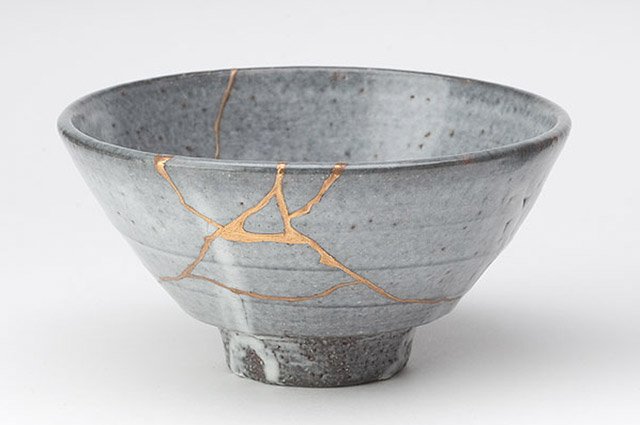
Kintsukuroi is the Japanese art of repairing broken pottery using resin mixed with precious metals like gold. The result is often something more beautiful than the original:

There are dozens of examples of kintsukuroi on Pinterest. And as with many Japanese concepts for which there are no corresponding English words, kintsukuroi has many philosophical and metaphorical implications. (via ★interesting)
Update: Here’s a short video that shows the technique and other related techniques:
(via the kid should see this)
Update: When I originally posted this, I forgot to transfer the photo of a bowl repaired through kintsukuroi to my server, resulting in the browser displaying a broken image icon. Rather than just fix it by uploading the photo, I used digital kintsukuroi to fill in the crack in the icon. Not sure the technique works as well as it does with pottery, but it seemed fitting. Here’s the photo I meant to post:
“Doodie” is a portmanteau of “dude” and “foodie” and a good word to describe the phenomenon of (mostly) male foodies I’ve observed with increasing regularity in the past few years. Jessica Pressler coined the term in Help! There’s a Doodie in My Kitchen.
You see; these are the things you deal with when you live with a food dude. Or, as I have come to call them, doodies. I know, it’s an unfortunate term, but like its antecedent, the dreaded foodie, it is also extremely useful for summing up the characteristics of a certain breed of food enthusiast, the kind whose culinary preferences are intrinsically, classically male.
You know the type. Has Heat or Fergus Henderson’s Complete Nose to Tail on his bookshelf. Can sustain a remarkably long conversation about knives. Is super into his grill. Likes pour-over coffee. Is, at this moment, really excited about ramps. I could go on, but I won’t, because I am sure you know one. New York City in 2014 is rife with doodies: You can find them stalking around Smorgasburg, attending knife-skills classes at the Meat Hook, writing lengthy, tumescent odes to the Bo Ssam Miracle in the paper of record.
(via @fanelli)
Update: Michael Hoffman of Food52 has another name for doodies: assholes.
The food dude is nothing new. He’s just a jerk who learned to cook. He’s taken what could be a force for good — feeding loved ones well — and made it into yet another thing that he can claim to be better at than his wife or girlfriend. (Apparently, food dudes are all heterosexual, too.)
Here’s what the food dude doesn’t do: He doesn’t spend his Sunday afternoon planning practical dinners for the week; he doesn’t make sure there’s milk in the fridge; he doesn’t make something the baby is going to eat. He might as well be building train sets in the basement. Even for people like us who love doing it, getting dinner on the table is, among many other things, a chore. And guess who’s doing the chores at Food Dude’s place? Women.
GLAAD has a good resource on transgender identity: Transgender 101.
Gender identity is someone’s internal, personal sense of being a man or a woman (or as someone outside of that gender binary.) For transgender people, the sex they were assigned at birth and their own internal gender identity do not match.
Trying to change a person’s gender identity is no more successful than trying to change a person’s sexual orientation — it doesn’t work. So most transgender people seek to bring their bodies more into alignment with their gender identity.
People under the transgender umbrella may describe themselves using one (or more) of a wide variety of terms, including transgender, transsexual, and genderqueer. Always use the descriptive term preferred by the individual.
In writing here, I sometimes get tripped up on the differences between sex, gender, and sexual orientation. No more. See also Tips for Allies of Transgender People and An Ally’s Guide to Terminology: Talking About LGBT People & Equality.
Farnam Street is featuring a handout given by the late David Foster Wallace to his fiction writing class in 2002. It’s titled YOUR LIBERAL-ARTS $ AT WORK and covers five common usages gotchas.
2. And is a conjunction; so is so. Except in dialogue between particular kinds of characters, you never need both conjunctions. “He needed to eat, and so he bought food” is incorrect. In 95% of cases like this, what you want to do is cut the and.
From Wikipedia, a list of former trademarks and brands that have become generic terms. Some surprises: Heroin, Videotape, Zipper, Laundromat, Kerosene, Dry Ice, and Escalator.
Using Google Earth, dialect coach Andrew Jack gives a tour of the accents of Great Britain and Ireland.
The audio is originally from this BBC program. See also Peter Sellers doing various English accents. (via devour)
You’ve probably seen instances of knolling without knowing there was a word for it. Knolling at the Apple Store:

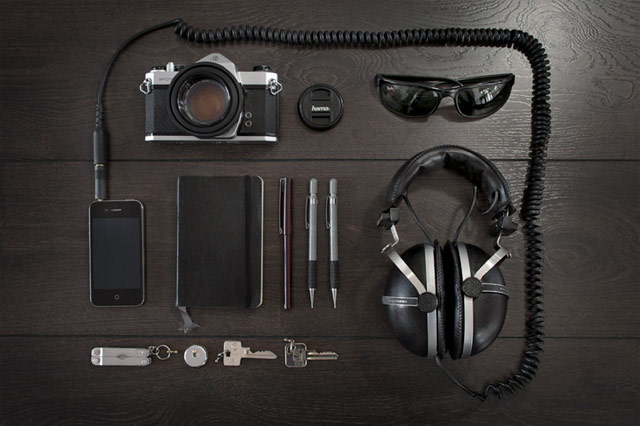
Knolling the contents of your bag:
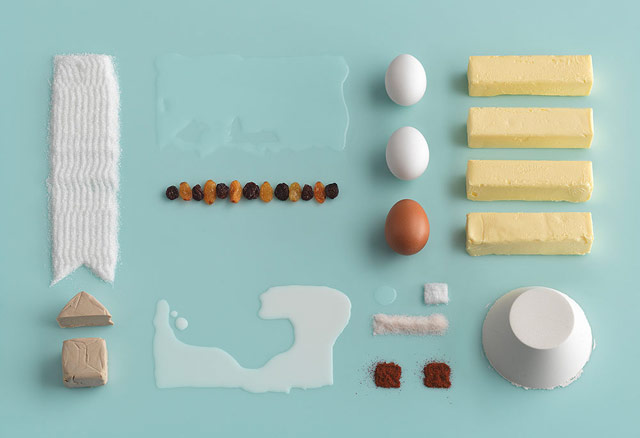
Knolling a recipe for a book:
Knolling the parts of a machine:

Knolling is the practice of organizing objects in parallel or at 90° angles. The term has been popularized by artist Tom Sachs; he picked it up from Andrew Kromelow when both were working at Frank Gehry’s furniture fabrication shop. Gehry was designing chairs for furniture company Knoll, and Kromelow would arrange unused tools in a manner similar to Knoll furniture. Hence, knolling.
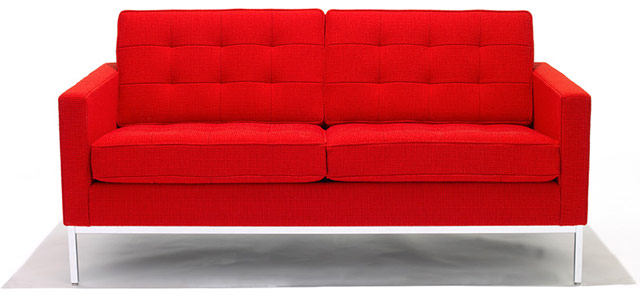
Update: Things Organized Neatly is really something. Lots of knolling.
Fit To Print is a Tumblr blog tracking the sometimes absurd instances of profanity avoidance in the NY Times. Like so:
Mr. Lee blasted a dictionary’s worth of unprintable words at developers who fluff gritty neighborhoods with glossy names (“East Williamsburg” for Bushwick, for instance), and at the “Christopher Columbus syndrome” of gentrifiers who were sweeping into the largely black neighborhood of his youth with little regard for “a culture that’s been laid down for generations.”
I have already been on record about the Times’ dumbass profanity policy, especially when it gets in the way of actually performing journalism.
Update: Language expert Jesse Sheidlower in a NY Times opinion piece:
When language can play such a hot-button role in our society, what we need is more reporting, not less. Some publications have loosened the restraints. The New Yorker has noticeably done so, British and Australian newspapers often print offensive words in full, and The Economist’s style guide reads: “if you do use swear words, spell them out in full, without asterisks or other coynesses.”
Jesse Hill made a music video for Beyonce’s Drunk in Love entirely out of emoji. Fantastic work.
Fist Eggplant! Poo! Surfbort! Oh man, that was fun.
Pop Chart Lab has produced a print of grammatical diagrams of the opening lines of notable novels. Here’s Hemingway’s The Old Man and the Sea:
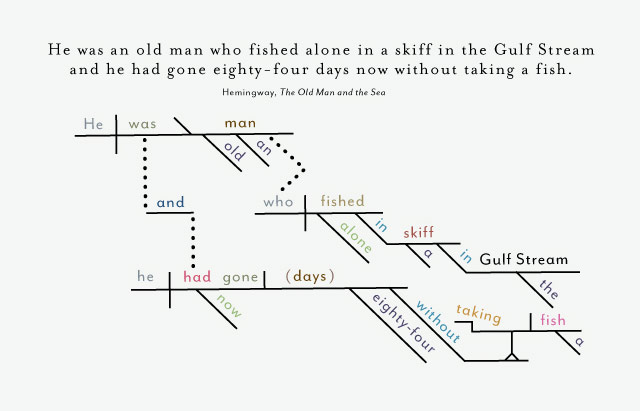
There are also sentences from DFW, Plath, and Austen. Prints start at $29.
While they still represent a small overall number, the popularity in the US of naming children after guns (Colt, Remington, Ruger, Gunner, Beretta) is up in recent years.
In 2002, only 194 babies were named Colt, while in 2012 there were 955. Just 185 babies were given the name Remington in 2002, but by 2012 the number had jumped to 666. Perhaps the most surprising of all, however, is a jump in the name Ruger’s (America’s leading firearm manufacturer) from just 23 in 2002 to 118 in 2012. “This name [Ruger] is more evidence of parents’ increasing interest in naming children after firearms,” Wattenberg writes. “Colt, Remington, and Gauge have all soared, and Gunner is much more common than the traditional name Gunnar.”
I don’t care if all of this vocabulary of NYC’s best bars is made up (it sure sounds made up), I still loved reading it. You can totally tell which places are about the drinks, which are about hospitality, which are bitchy, and which are all about the benjamins.
Sipper: A small pour (typically Mother’s Milk) gifted to a colleague, loved one, regular, etc.
Amuse-booze (experimental term): A tiny sipper to acknowledge a guest an reassure them they will be served soon.
The Cousins: Affectionate term for other cocktail bars (after the British secret service’s name for the CIA in Le Carre’s Smiley novels).
Even if it’s fake, it’s real.
Think you can distinguish between 80 of the world’s most spoken languages? Play the Great Language Game and find out. (Oof, I am bad at this.)
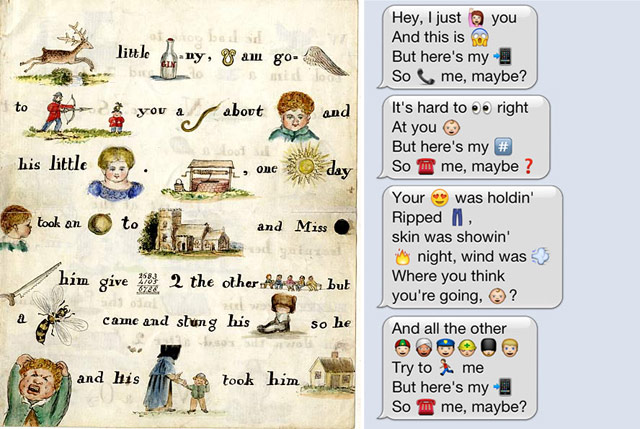
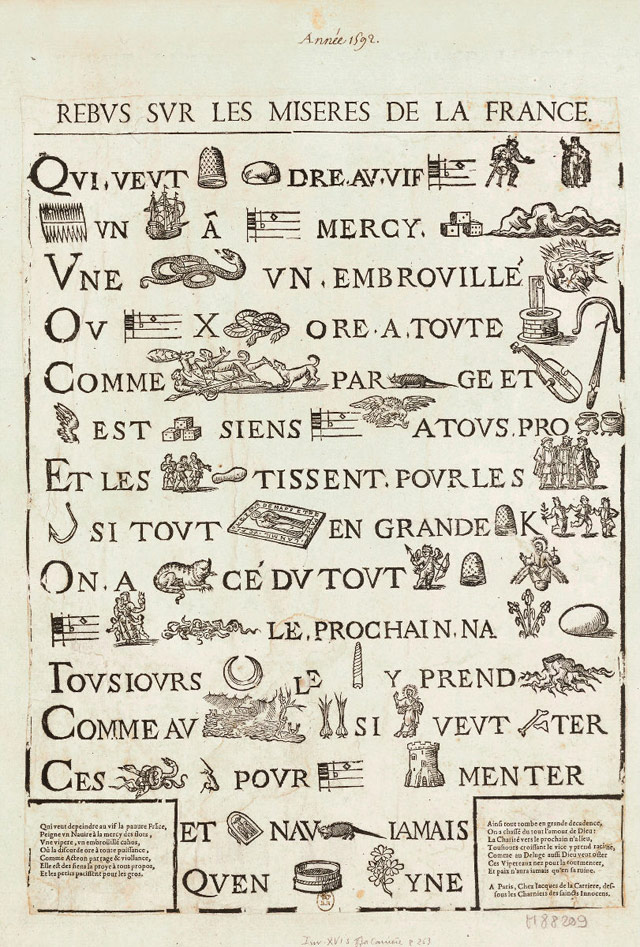
Using pictures to represent words dates back to Egyptian hieroglyphics and Chinese pictographs. But in the 1500s in France, a particular format of picture writing called the rebus was invented. A rebus is a word puzzle which uses pictures to represent words (or parts of words). The rebus became very popular in Europe and elsewhere. Here’s a French rebus from 1592:
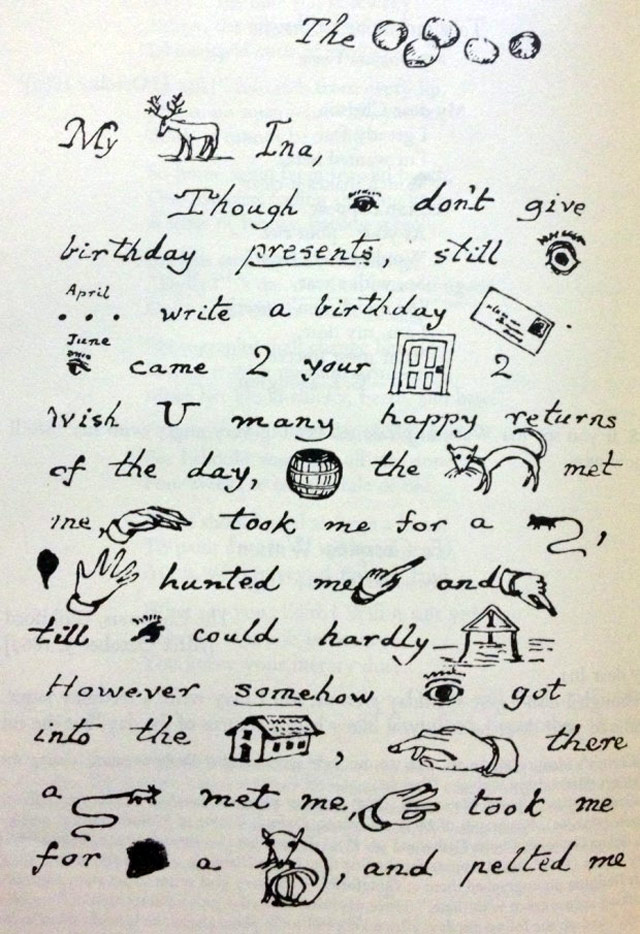
Alice in Wonderland’s author, Lewis Carroll, was fond of rebuses…here’s the first page of a letter he wrote in 1869:
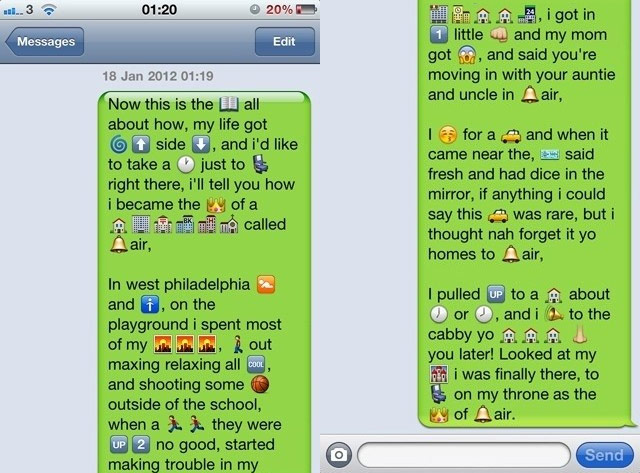
Compare the rebus with the use of emoji on mobile devices and social media, like this emoji version of the Fresh Prince of Bel Air theme song:
George Mason University’s speech accent archive collects English speech samples from all over the world. Each speaker is asked to say the same snippet of text:
Please call Stella. Ask her to bring these things with her from the store: Six spoons of fresh snow peas, five thick slabs of blue cheese, and maybe a snack for her brother Bob. We also need a small plastic snake and a big toy frog for the kids. She can scoop these things into three red bags, and we will go meet her Wednesday at the train station.
Newer posts
Older posts





Socials & More