kottke.org posts about language
You’ve likely seen the various dialect maps of the US…the Coke/soda/pop maps. The Atlantic Video team did a wonderful thing with them…they called native speakers around the country and asked them to pronounce some of the words featured on these maps.
It’s one thing to read the difference between the pronounciations of “route”, it’s another thing entirely to hear them. I haven’t lived in the Midwest since 2000 and I have since transitioned from “pop” to “soda”, “waiting in line” to “waiting on line”, and am working on switching to “sneakers” from “tennis shoes” (or even “tennies”). But I was surprised to learn that I still pronounce “bag” differently than everyone else!
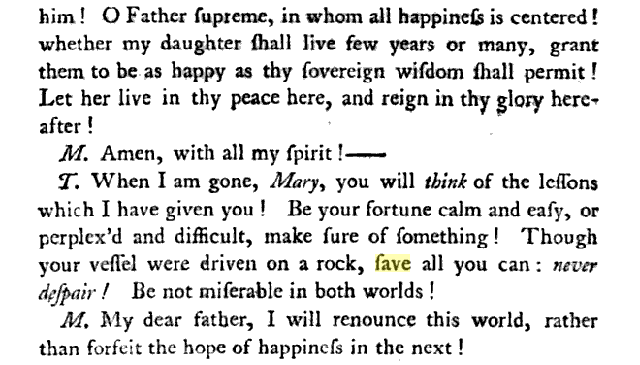
While researching the etymology of the word “fave”, a noun that’s in the process of being verbed,1 I noticed that, according to Google’s ngram viewer, the word was much more popular in the 1600-1700s than it is now.
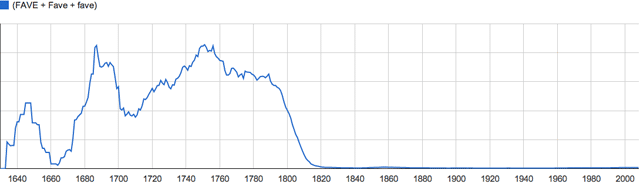
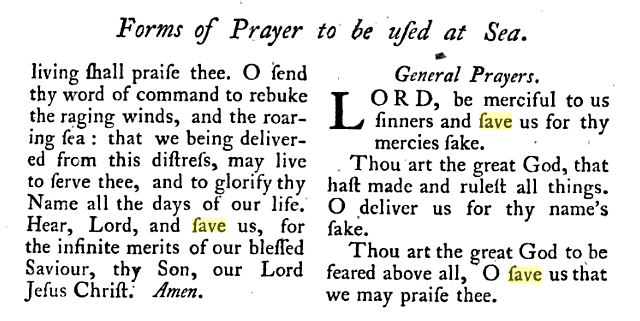
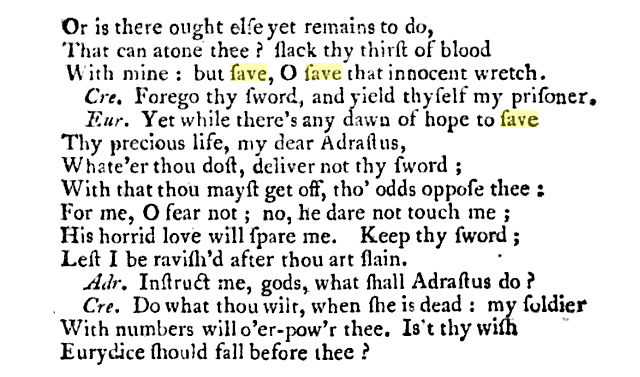
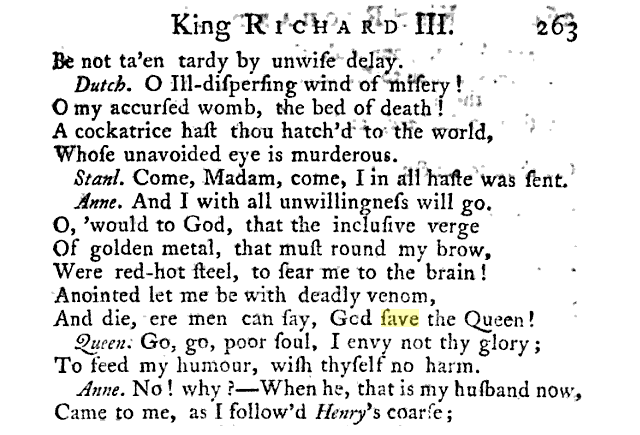
A bit of investigation reveals that Google’s book-scanning software is at fault; it can’t recognize the long s commonly used in books prior to the 1800s. So each time it encounters “save” with a long s, it sees “fave”:
Black Perl is a poem written in valid Perl 3 code:
BEFOREHAND: close door, each window & exit; wait until time.

    open spellbook, study, read (scan, select, tell us);

write it, print the hex while each watches,

    reverse its length, write again;

    kill spiders, pop them, chop, split, kill them.

        unlink arms, shift, wait & listen (listening, wait),

sort the flock (then, warn the "goats" & kill the "sheep");

    kill them, dump qualms, shift moralities,

    values aside, each one;

        die sheep! die to reverse the system

        you accept (reject, respect);

next step,

    kill the next sacrifice, each sacrifice,

    wait, redo ritual until "all the spirits are pleased";

    do it ("as they say").

do it(*everyone***must***participate***in***forbidden**s*e*x*).

return last victim; package body;

    exit crypt (time, times & "half a time") & close it,

    select (quickly) & warn your next victim;

AFTERWORDS: tell nobody.

    wait, wait until time;

    wait until next year, next decade;

        sleep, sleep, die yourself,

        die at last

# Larry Wall
It’s not Shakespeare, but it’s not bad for executable code.
When Shaquille O’Neal entered the NBA in 1992 after starring at LSU, people had already begun naming their children after him. 20-something years later, some of those kids are starting to play college basketball themselves. Ken Pomeroy is tracking the Shaq babies as they show up in their schools’ line-ups and offers a look at the future of children named after NBA stars.
We can never know those reasons for sure, but we can say that since 1997, Kobe has been the name of choice for parents opting to name their children after basketball players. (Lebron has yet to crack the top 1000.) From this we can be confident we’ll see the first-ever college basketball player named Kobe sometime in the 2016 to 2018 seasons. And while the supply of Shaqs will peter out right quick, Kobe’s name will be appearing on college basketball rosters well into the 2030’s. Kobe Bryant may have skipped college, but Kobe will be playing college basketball for many, many, many years to come.
(via http://marginalrevolution.com/)
Speaking of inexpensive time travel, listen as David and Ben Crystal perform selections from Shakespeare in the original accent, as it would have been heard at the Globe in the early 1600s. (via @KBAndersen)
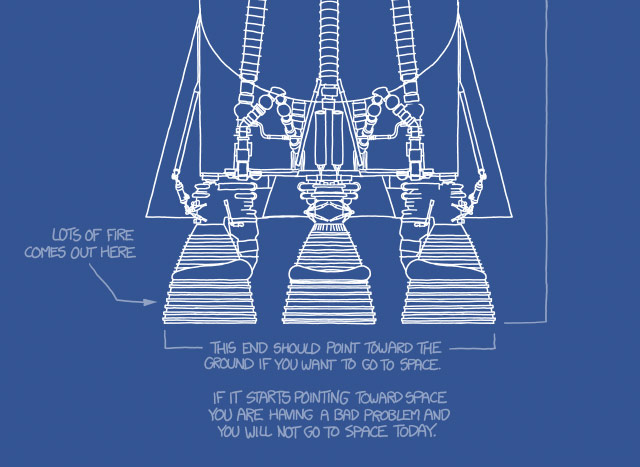
Randall Munroe of XKCD drew the Saturn V rocket (aka Up Goer Five) annotated using only the 1000 most common English words.
See also Albert Einstein’s Theory of Relativity In Words of Four Letters or Less.
This is a surprisingly helpful activity for learning about regular expressions. (via @bdeskin)
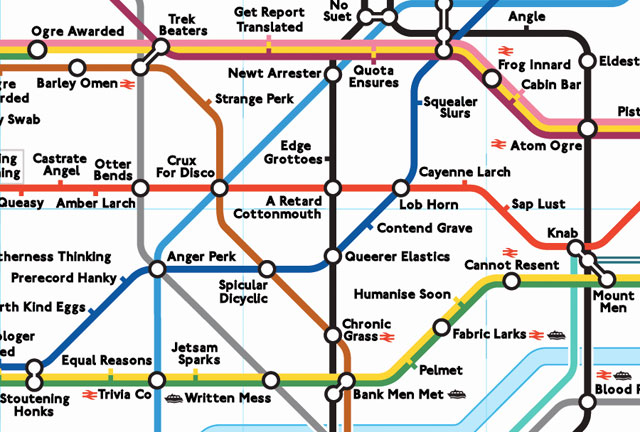
Otter Bends, Queer Spank, Frog Innard, and Lob Horn are some of the stations on the anagram map of the London Underground.
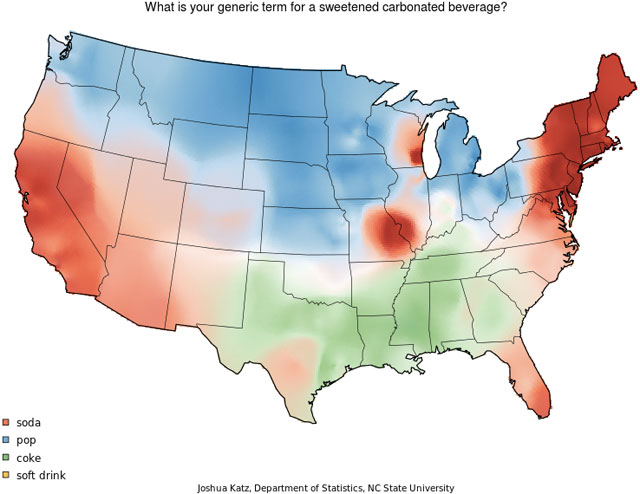
Joshua Katz has been studying American dialects and has made more than 120 maps of some of the differences in American speech. Here are a few examples:
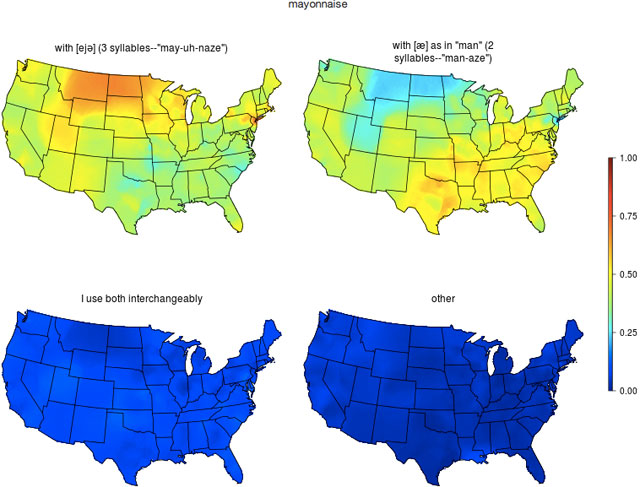
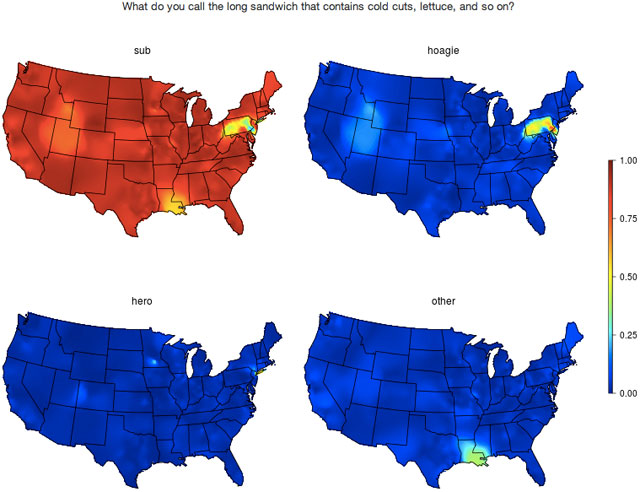
(thx, everyone)
Update: As he notes on the site, Katz’s maps are based on the research and work of Bert Vaux…Vaux’s maps of the same data can be found here. (thx, molly, margaret, & nicholas)
I’m reading back through my archive of stuff written by and about Roger Ebert and I realized I’ve never written about my favorite piece of his: Dwarfs, Little People and the M-Word. It’s nothing particularly earthshattering or insightful, but the piece demonstrates what I really liked about Ebert: humanist, happy to be corrected when in the wrong, not afraid to poke fun at himself, and a lover of both language and knowledge.
I had no idea the word “midget” was considered offensive, and you are the only person who has ever written to me about it. In my mind it is a descriptive term, like “dwarf.” “Little People” has seemed to me to have a vaguely condescending cuteness to it. If I am now informed that “midget” is offensive, I will no longer use it. What is your feeling about “dwarf?” Is “Little Person” always the preferred term? Our newspaper’s style book, based on Associated Press, does not consider “midget” or “dwarf” to be offensive terms, but perhaps we have not caught up.
Your endurance challenge for today: see how much of this video of the final round of the 2012 O. Henry Pun-Off World Championship you can watch before flinging your computing device across the room.
For bonus points, see if you can get through some of the comments…they are PUNishing. (Gah, I’ve been infected.)
For the NY Times, Ben Schott compiles an extensive list of wine-related jargon.
WHALE . PLAYER . BALLER . DEEP OCEAN
A serious drinker who will regularly DROP more than $1,000 on a single bottle. When on a furious spending spree, a WHALE is said to be DROPPING THE HAMMER. BIG WALES — or EXTRA BIG BALLERS (E.B.B.) — can spend more than $100,000 on wine during a meal.
Schott expanded on this list in a companion blog post:
But, vocabulary aside, the central thing I learned from these talented people is that if you are dining in a restaurant which employs a Sommelier, you should never, ever order your own wine.
If you know little or nothing about wine, they will guide you to a bottle far more interesting and suited to your food than you could possibly pluck from the list.
And if you are a wine aficionado, you will not know more than the Somm about their list - or what they are hiding off-list in the cellar.
See also What Restaurants Know (About You)
A study of 14,000 Twitter users was published recently (pdf) by a trio of linguists and computer scientists (Bamman, Eisenstein, Schnoebelen) that looks at the gendered expression of language online.
Female markers include a relatively large number of emotion-related terms like sad, love, glad, sick, proud, happy, scared, annoyed, excited, and jealous. All of the emoticons that appear as gender markers are associated with female authors, including some that the prior literature found to be neutral or male: :) :D and ;). […] Computer mediated communication (CMC) terms like lol and omg appear as female markers, as do ellipses, expressive lengthening (e.g., coooooool), exclamation marks, question marks, and backchannel sounds like ah, hmmm, ugh, and grr.
Swears and other taboo words are more often associated with male authors: bullshit, damn, dick, fuck, fucked, fucking, hell, pussy, shit, shitty are male markers; the anti-swear darn appears in the list as a female marker. This gendered distinction between strong swear words and mild swear words follows that seen by McEnry 2006 in the BNC. Thelwall 2008, a study of the social networking site MySpace produced more mixed results: among American young adults, men used more swears than women, but in Britain there was no gender difference
I don’t want to draw too many conclusions from a single study especially one that, in my opinion, makes some questionable methodology choices (people who follow or are followed by more than 100 people are excluded from the study?) but the results point to an interesting evolution in conversational, public speech.
Update 2: Tyler Schnoebelen, one of the study’s authors reached out to clarify. The study says “we selected only those users with between four and 100 friends”, with friends being defined not as people you follow, people who follow you, or even mutual follow backs. They poll accounts and if you and someone else mention each other with a separation of at least two weeks (to eliminate one-off convos with strangers), then for the purposes of the study you and the other person are defined as friends. And they’re looking to isolate people who have between 4 and 100 of those friend connections.
Now that that’s clarified, that seems a really reasonable way to try to determine friendships on Twitter.
Update 1: David Friedman reminded me of a post he did on telegraph operators in 1890 and how female operators have a different and identifiable transmission style.
It is a peculiar fact also that an experienced operator can almost invariably distinguish a woman’s sending from a man’s. There is nearly always some peculiarity about a woman’s style of transmission. it is not necessarily a fault. Many women send very clearly and make their dots and dashes precisely as they were intended to be made. It is impossible to describe the peculiarity, but there is no doubt of its existence. Nearly all women have a habit of rattling off a lot of meaningless dots before they say anything. But some men do that too. A woman’s touch is lighter than a man’s, and her dots and dashes will not carry so well on a very long circuit. That is presumably the reason why in all large offices the women are usually assigned to work the wires running to various parts of the cities.
This is perfect…Riker Ipsum is lorem ipsum dummy text from Commander Riker’s dialogue on Star Trek: The Next Generation.
Our neural pathways have become accustomed to your sensory input patterns. Computer, belay that order. The game’s not big enough unless it scares you a little. When has justice ever been as simple as a rule book? What’s a knock-out like you doing in a computer-generated gin joint like this? Did you come here for something in particular or just general Riker-bashing?
(via ★interesting)
James Fallows suggests talking about “gun safety” and not “gun control”.
I will henceforth and only talk about “gun safety” as a goal for America, as opposed to “gun control.” I have no abstract interest in “controlling” someone else’s ability to own a gun. I have a very powerful, direct, and legitimate interest in the consequences of others’ gun ownership — namely that we change America’s outlier status as site of most of the world’s mass shootings. No reasonable gun-owner can disagree with steps to make gun use safer and more responsible. This also shifts the discussion to the realm of the incremental, the feasible, and the effective.
Newer posts
Older posts





Socials & More