If you can handle just one more, GQ has a long article on David Chang, the chef/co-owner of NYC’s Momofuku restaurants.
Three years ago, David Chang was an obscure cook with a failing Manhattan noodle bar. Now he is being hailed as the most innovative and exciting chef America has seen in decades.
Decades? Please. I’m not backing down from my effusive review of Ssam Bar (Ssam Bar is one of my favorite restaurants of all time), but this decades business is bollocks. Just let the man (and his collaborators) cook and open more yummy restaurants.
The just-released Michelin restaurant guide for Tokyo awards more stars to that city’s restaurants than New York and Paris put together. And 8 get a 3-star rating, only 2 fewer than in Paris.
Tokyo has more restaurants - at least 160,000 that could be classified as proper “restaurants” - than almost any other urban centre. Paris, by comparison, has little more than 20,000 and New York about 23,000.
There’s a lot of handwringing about Tokyo restaurants getting so many stars, but to look at it another way, Paris has 8 times fewer restaurants and has more 3 stars than Tokyo. Not bad.
(via marginal revolution)
The annual report for Podravka, a Croatian food company, has to be heated in the oven before you can read it.
Called Well Done, the report features blank pages printed with thermo-reactive ink that, after being wrapped in foil and cooked for 25 minutes, reveal text and images.
Well done, indeed. (thx, judson)
Anthony Bourdain on the best method for finding good food in any city: provoke the nerds.
Take the city you want to go to and just google up some restaurant names that serve the dish you’re after. Then got to chowhound or another foodie site, and rather than asking about restaurants, you put up an enthusiastic post talking about how you just had the best whatever you’re looking for at one of these restaurants.
At that point, […] the nerdfury will begin. Posters will show up from nowhere to shower you with disdain, tell you how that place used to be good but has now totally sold out and — most important to your quest — will tell you where you would have gone if you were not some sort of mouth breathing water buffalo.
I wouldn’t have guessed that there’s actually an upside to Internet Jackass Syndrome. (via clusterflock)
This post about the carbon footprint of wine contains an interesting map at the bottom. It’s a map of the US with a line splitting the country in two. West of the line, it is more carbon efficient to drink Napa wine while to the east of the line it is more carbon efficient to drink French Bordeaux. You can almost see the coastline of the eastern and Gulf states struggling westward against the trucking route from California. The Vinicultural Divide?
Why does a salad cost more than a Big Mac? Perhaps because federal subsidies and federal nutrition guidelines don’t match up.
The bill provides billions of dollars in subsidies, much of which goes to huge agribusinesses producing feed crops, such as corn and soy, which are then fed to animals. By funding these crops, the government supports the production of meat and dairy products — the same products that contribute to our growing rates of obesity and chronic disease. Fruit and vegetable farmers, on the other hand, receive less than 1 percent of government subsidies.
As David Foster Wallace argued in Consider the Lobster, a recent study indicates that lobsters feel pain, an unpleasant finding for an animal that’s often boiled alive. But as Wallace says:
Is it possible that future generations will regard our present agribusiness and eating practices in much the same way as we now view Nero’s entertainments or Mengele’s experiments? My own initial reaction is that such a comparison is hysterical, extreme — and yet the reason it seems extreme to me appears to be that I believe animals are less morally important than human beings; and when it comes to defending such a belief, even to myself, I have to acknowledge that (a) I have an obvious selfish interest in this belief, since I like to eat certain kinds of animals and want to be able to keep doing it, and (b) I haven’t succeeded in working out any sort of personal ethical system in which the belief is truly defensible instead of just selfishly convenient.
Michael Ruhlman is partially responsible (along with my wife, Jeffrey Steingarten, Thomas Keller, Bryan Boyer, and Lance Arthur) for my interest in food. His The Making of a Chef and The Soul of a Chef are two of my favorite books on the subject. His latest is The Elements of Cooking, a Strunk and White’s for the kitchen. Ruhlman explains who this book is for:
Every home cook who cares about getting better and every soul who is in or about to attend culinary school. I want all the young cooks who never went to culinary school and have always been nagged by the not-knowing-what-they-missed (probably not as much as they imagine) to buy it. I want every chef to buy it for his or her line cooks. And maybe most of all, beginners — I can’t imagine a better starting reference for cooking terms to go along with other food books. I want every professional cook to buy it for the people who cook for them when they’re not at work. In short I want everyone who cares about cooking to buy this book.
A list of fast food menu items that are really high in trans fats. The list is a bit misleading as no attempt is made to normalize portions (the top two items are multi-portion side orders) but still handy, especially for the list of places that had no items on the list (Subway, Pizza Hut, Wendy’s, In-N-Out, etc.). (via serious eats)
Update: Many Eyes user Michael created two charts to accompany the list above: a bar chart and a treemap. (thx, michael)
New York has a decreasing number of Jewish delis, but the reopened Second Avenue Deli will be among them.
Federman said that his clientele has gone from “95 percent Jewish to 50-50” and that changing with the times is part of business. (He now sells three varieties of tofu “cream cheese.”) “I think Second Avenue Deli, Katz’s, us, we’re all making our little sphere of the world a better place,” he said. “Doctors and lawyers basically live off other people’s misery. Part of the perk of working here is people coming in and being so happy.”
The deli’s general manager recalled his favorite customers at the old location:
But my favorite was when we had five nuns eating matzoh balls served by a Lebanese waiter — in a kosher deli. That’s New York.
See also a writeup of a panel on Jewish Cuisine and the Evolution of the Jewish Deli on Serious Eats.
File this under odd jobs: Dr. Jana Klauer is an off-the-menu nutritionist for the wealthy.
“For my patients with heavy entertaining schedules, I go over the menus of restaurants they’re expected to attend, say, in the upcoming week and tell them what to order,” says Klauer, also known as the Park Avenue Nutritionist. “That way, there’s no guesswork. Before they even step foot inside a restaurant, they know what they’re going to eat.”
That’s a bit misleading however…it’s only a small part of what Klauer does.
Vanilla-tini (vanilla vodka)
Espresso-tini (coffee liqueur + espresso)
Key Lime-tini (key lime)
Valen-tini (tequila rose)
Pome-tini (pomegranate)
Raspberry-tini (raspberry)
Nutty-tini (amaretto + hazelnut liqueur)
Crescendo-tini (at the orchestra)
Moe-tini (at Moe’s Restaurant)
Franklin-tini (for Ben Franklin’s 300th birthday)
Tut-tini (King Tut exhibition)
Mex-tini (orange vodka + tequila)
Ginger-tini (grapefruit + ginger + pomegranate)
Spa-tini (at the spa)
Blue Glow-tini (with glowing ice cubes)
Free-tini (no charge)
Champagne-tini (champagne)
Pineapple-tini (pineapple)
Sex-tini (Asian sex tonic + x-rated vodka)
Flu-tini (vodka + cold medicine)
Apple-tini (apple)
Red Lobster Butter-Tini (butterscotch schnapps + half and half + Bailey’s)
Bikini-tini (low calorie)
Fire-tini (jalapenos)
K-tini (sauerkraut)
Caramel Apple Pie-tini (applesauce + caramel syrup)
Red Hot Santa-tini (chili peppers + whipped cream)
Fall-tini (apple cider)
Insomnia-tini (energy drink)
Jello-tini (lime Jello)
Peep-tini (Peeps candy)
Diamond-tini (1.06 carat diamond)
Teaser trailer for Alinea’s cookbook, which is due out in Autumn 2008 and will contain 600 recipes. Pre-orders through the site will get signed copies and early access to a companion web site which will contain more recipes, demo videos, and behind the scenes videos. I’m really appreciating the effort these top chefs and restaurants make to open source their recipes and process…it sounds like between the book and web site, one could open a restaurant serving Alinea’s menu. (Whether that restaurant would be successful or not would depend mostly on the 90% of the stuff involved with running a restaurant that doesn’t rely on the ability to read a cookbook.)
Update: Jason Fried says businesses could learn a lot from chefs giving their secrets away.
While poking around in the newly opened archives of the New York Times yesterday, I stumbled upon an article called How We Dine (full text in PDF) from January 1, 1859. I’m not well versed in the history of food criticism, but I believe this is perhaps the first restaurant review to appear in the Times and that the unnamed gentleman who wrote it (the byline is “by the Strong-Minded Reporter of the Times”) is the progenitor of the paper’s later reviewers like Ruth Reichl, Mimi Sheraton, and Frank Bruni.
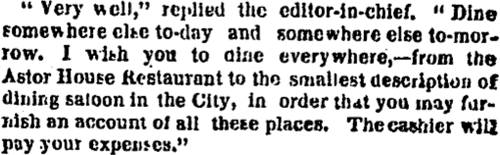
The article starts off with a directive from the editor-in-chief to “go and dine”:
“Very well,” replied the editor-in-chief. “Dine somewhere else to-day and somewhere else to-morrow. I wish you to dine everywhere, — from the Astor House Restaurant to the smallest description of dining saloon in the City, in order that you may furnish an account of all these places. The cashier will pay your expenses.”
Before starting on his quest, the reporter differentiates eating from dining — noting that many believe “whereas all people know how to eat, it is only the French who know how to dine” — and defines what he means by an American dinner (as opposed to a French one). Here’s his list of the types of American dinner to be found in New York, from most comfortable to least:
1. The Family dinner at home.
2. The Stetsonian dinner.
3. The Delmonican, or French dinner.
4. The Minor dinner of the Stetsonian principle.
5. The Eating-house dinner, so called.
6. The Second-class Eating-house dinner.
7. The Third-class Eating-house feed.
The remainder of the article is devoted to descriptions of what a diner might find at each of these types of establishments. Among the places he dined was Delmonico’s, where dining in America is said to have originated:
Once let Delmonico have your order, and you are safe. You may repose in peace up to the very moment when you sit down with your guests. No nobleman of England — no Marquis of the ancienne nobless — was ever better served or waited on in greater style that you will be in a private room at Delmonico’s. The lights will be brilliant, the waiters will be curled and perfumed and gloved, the dishes will be strictly en règle and the wines will come with precision of clock-work that has been duly wound up. If you “pay your money like a gentleman,” you will be fed like a gentleman, and no mistake… The cookery, however, will be superb, and the attendance will be good. If you make the ordinary mistakes of a untraveled man, and call for dishes in unusual progression, the waiter will perhaps sneer almost imperceptibly, but he will go no further, if you don’t try his feelings too harshly, or put your knife into your mouth.
According to a series of articles by Joe O’Connell, Delmonico’s was the first restaurant in the US when it opened in 1830 and invented Eggs Benedict, Oysters Rockefeller, Baked Alaska, Lobster Newberg, and the term “86’d”, used when the popular Delmonico Steak (#86 on menu) was sold out, or so the story goes. O’Connell’s history of Delmonico’s provides us with some context for the How We Dine piece:
The restaurant was a novelty in New York. There were new foods, a courteous staff, and cooking that was unknown at the homes of even the wealthiest New Yorkers. The restaurant was open for lunch and dinner.
The restaurant featured a bill of fare, which was itself new. Those who dined at inns were fed on a set meal for a set price. As a result, everyone was fed the same meal and were charged the same price, whether they ate little or much. In Paris, however, restaurants offered their patrons a “bill of fare”, a carte, which listed separate dishes with individual prices. Each patron could choose a combination of dishes which was different from the other patrons. Each dish was priced separately. Thus, the restaurant was able to accommodate the tastes and hunger of each individual. The various dishes and their prices were listed on a carte or (the English translation) “bill of fare”. Today, we call it a menu.
And from Delmonico’s developed many different types of dining establishments, which the Strong-Minded Reporter set out to document thirty years later. Contrast his visit to Delmonico’s with the experience in the “sandwich-room” at Browne’s Auction Hotel, an eating-house:
The habitués of the place are rarely questioned at all. The man who has eaten a sandwich every day for the past ten years at the Auction Hotel no sooner takes his seat than a sandwich is set before him. The man who has for the same period indulged daily in pie or hard boiled eggs (there are some men with amazing digestion) is similarly treated. The occasional visitor, however, is briefly questioned by the attendant before whom he takes his place. “Sandwich?” or “Pie?” If he say “Sandwich,” in reply, the little man laconically inquires, “Mustard?” The customer nods, and is served. If his mission be pie, instead, a little square morsel of cheese is invariably presented to him. Why such a custom should prevail at these places, no amount of research has yet enabled me to ascertain. Nothing can be more incongruous to pie than cheese, which, according to rule and common sense, is only admissible after pie, as a digester. But the guests at the Auction Hotel invariably take them together, and with strict fairness — a bite at the pie, and a bite at the cheese, again the pie, and again the cheese, and so on until both are finished.
The experience of being a regular has barely changed in 150 years. And finally, our intrepid reporter visits an unnamed third class eating-house:
The noise in the dining hall is terrific. A guest has no sooner seated himself than a plate is literally flung at him by an irritated and perspiring waiter, loosely habited in an unbuttoned shirt whereof the varying color is, I am given to understand, white on Sunday, and daily darkening until Saturday, when it is mixed white and black — black predominating. The jerking of the plate is closely followed up by a similar performance with a knife and a steel fork, and immediately succeeding these harmless missiles come a fearful shout from the waiter demanding in hasty tones, “What do you want now?” Having mildly stated what you desire to be served with, the waiter echoes your words in a voice of thunder, goes through the same ceremony with the next man and the next, through an infinite series, and rushes frantically from your presence. Presently returning, he appears with a column of dishes whereof the base is in one hand and the extreme edge of the capital is artfully secured under his chin. He passes down the aisle of guests, and, as he goes, deals out the dishes as he would cards, until the last is served, when he commences again Da Capo. The disgusting manner in which the individuals who dine at this place, thrust their food into their mouths with the blades of their knives, makes you tremble with apprehensions of suicide…
The entire article is well worth the read…one of the most interesting things I’ve found online in awhile.
Update: According to their web site, a restaurant in New Orleans named Antoine’s claims that they invented Oysters Rockefeller. Another tidbit: from what I can gather, the Delmonico’s that now exists in lower Manhattan has little to do with the original Delmonico’s (even though they claim otherwise), sort of like the various Ray’s Pizza places sprinkled about Manhattan. (thx, everyone who sent this in)





Socials & More