kottke.org posts about cars
Adam Driver as Enzo Ferrari — a little too on the nose? Michael Mann hasn’t made a film since 2015’s Blackhat and hasn’t made an award-winning film since 2004’s Collateral, so it’s nice to see him back in the director’s chair. The film is based on Brock Yates’ 1991 book Enzo Ferrari: The Man and the Machine.
Next to the Pope, Ferrari was the most revered man in Italy. But was he the benign padrone portrayed by an adoring world press at the time, or was he a ruthless despot, who drove his staff to the edge of madness, and his racing drivers even further?
Brock Yates’s definitive biography penetrated Ferrari’s elaborately constructed veneer and uncovered the truth behind Ferrari’s bizarre relationships, his work with Mussolini’s fascists, and his fanatical obsession with speed.
Ferrari just premiered at the Venice Film Festival and early reviews are mostly positive but not overwhelmingly so. The film opens on Dec 25 in the US.
On July 4, 2023, a couple thousand people gathered in Alaska to watch old junker cars get launched off of a 300-foot cliff and just get obliterated on impact. (The launching starts at the 8-minute mark.) It’s entertaining to watch in a Jackass sort of way, but the whole thing is a metaphor for a particular facet of America: loud, dumb, fun, and wasteful.
Tom Scott visits the small Swiss ski town of Zermatt, where petrol cars have never been allowed. In the 1980s, the town skipped right from horse-drawn carriages to locally-built electric vehicles, which are made pretty much by hand and are expensive — but they are also easy to maintain and repair and can last for 30-50 years. Because space is at a premium, the town tightly controls who can own a vehicle and most of allowed vehicles are delivery vans, public transportation, or other vehicles with a communal use.

David Zipper, who researches and writes about mobility and transportation, recently did a big thread on Mastodon (and Bluesky) about car bloat: the way in which cars and trucks have gotten much bigger and heavier in the US over the past few decades and how it’s bad for society. The whole thread is worth a read…here are a couple of Zipper’s points:
Tall vehicles have bigger blind spots and are more likely to strike a person’s torso or head. Heavier vehicles exert more force crashing into a person, bicycle, or smaller car. They also have longer braking distances.
Heavier cars exert more pressure on tires, eroding them faster. Tire particles are absorbed into water, where they damage ecosystems. They also float through the air, harming human health when ingested.
For further reading, Zipper links to a number of pieces he’s written in recent months: The Blatant Greenwashing of SUVs, EVs Are Sending Toxic Tire Particles Into the Water, Soil, and Air, Carry That Weight, and The Car Safety Feature That Kills the Other Guy. Zipper’s solution to these problems is government action: for example, taxing vehicles by weight, testing vehicles for pedestrian and cyclist safety, or requiring drivers have commercial driver’s licenses for larger vehicles.
The image above is from Carsized and compares a 2018 Dodge Ram to a 2005 VW Jetta.
Right now in the US, the majority of children are driven to school, even though many of them live within walking or cycling distance.
In 1969, about 48% of students walked or cycled to school in the United States. Today that figure is about 11%. And this decline wasn’t just in the US — you can find the same trend in Australia, England, and Canada: today the majority of students are driven to school in a car. One of the larger studies we have on this issue in [British Columbia] found that 58% of 4th graders and 50% of 7th graders were driven to school by their parents.
There are various reasons for this shift, including that roads are unsafe for cyclists and pedestrians because of cars, a cultural shift towards greatly increased parental supervision of children, and inflexible parental work schedules.
Cargobox is a design concept by Meelis Lillemets for a small electric utility vehicle that embraces the boxy aesthetic in a rib-crunching bear hug. I mean, just look at this absolute rectilinear unit:
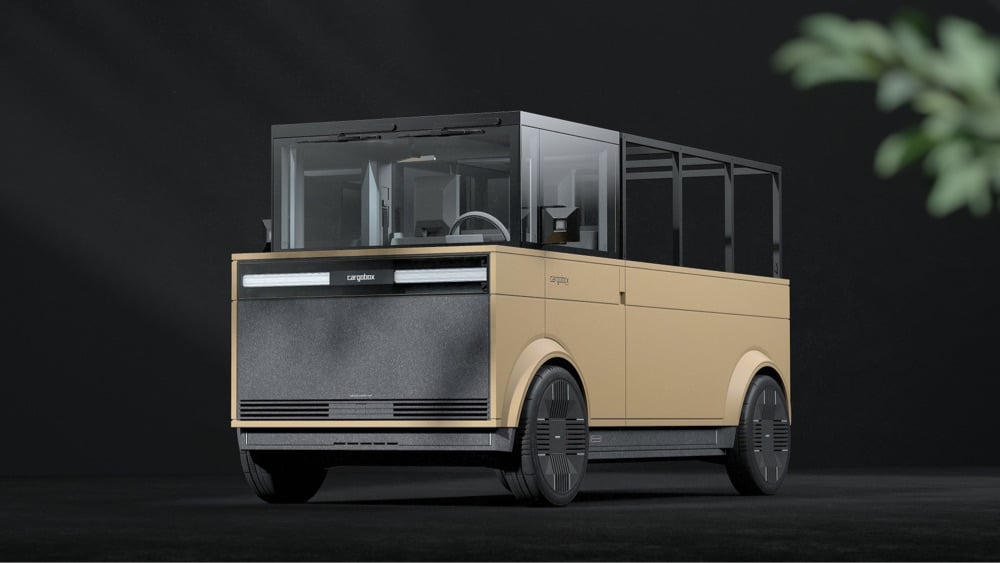
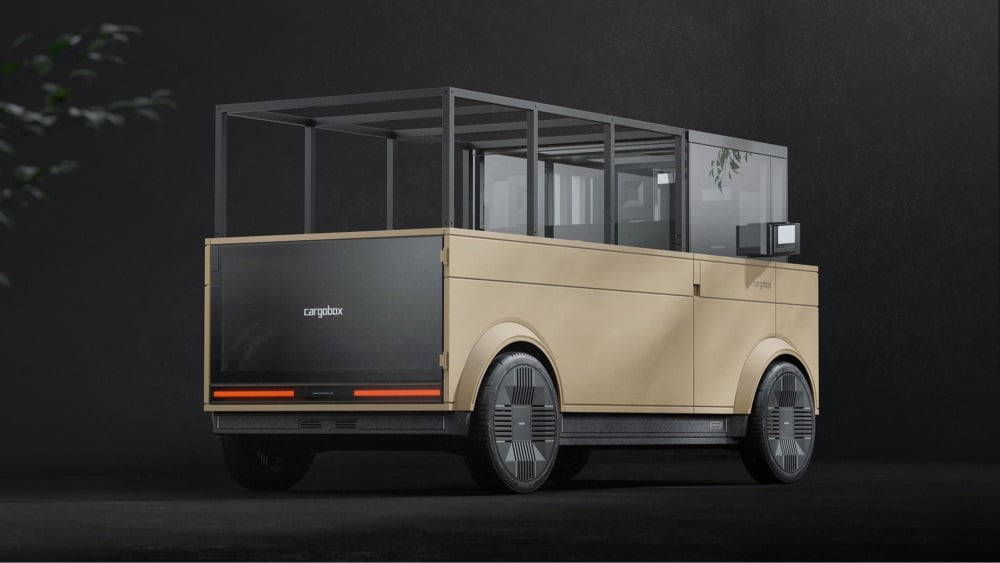
It’s like a Knoll shelving unit on wheels! Because the Cargobox is designed for use in cities, you can trade aerodynamic factors for other advantages:
Due to Cargobox only operating up to urban speeds, this study explores the extreme possibilities of design with little considerations for aerodynamics and lots of considerations for simplicity, cost, practicality, modularity.
The Cargobox will be available this fall at your local Design Within Reach store — jkjk. But seriously, the US post office should order a few thousand of these — they’d look really sharp with the red, white, and blue USPS colorway. (via yanko design)
In 2020, before the current crop of large language models (LLM) like ChatGPT and Bing, Emily Bender and Alexander Koller wrote a paper on their limitations called Climbing towards NLU: On Meaning, Form, and Understanding in the Age of Data. In the paper, Bender and Koller describe an “octopus test” as a way of thinking about what LLMs are capable of and what they aren’t. A recent profile of Bender by Elizabeth Weil for New York magazine (which is worth reading in its entirety) summarizes the octopus test thusly:
Say that A and B, both fluent speakers of English, are independently stranded on two uninhabited islands. They soon discover that previous visitors to these islands have left behind telegraphs and that they can communicate with each other via an underwater cable. A and B start happily typing messages to each other.
Meanwhile, O, a hyperintelligent deep-sea octopus who is unable to visit or observe the two islands, discovers a way to tap into the underwater cable and listen in on A and B’s conversations. O knows nothing about English initially but is very good at detecting statistical patterns. Over time, O learns to predict with great accuracy how B will respond to each of A’s utterances.
Soon, the octopus enters the conversation and starts impersonating B and replying to A. This ruse works for a while, and A believes that O communicates as both she and B do — with meaning and intent. Then one day A calls out: “I’m being attacked by an angry bear. Help me figure out how to defend myself. I’ve got some sticks.” The octopus, impersonating B, fails to help. How could it succeed? The octopus has no referents, no idea what bears or sticks are. No way to give relevant instructions, like to go grab some coconuts and rope and build a catapult. A is in trouble and feels duped. The octopus is exposed as a fraud.
The paper’s official title is “Climbing Towards NLU: On Meaning, Form, and Understanding in the Age of Data.” NLU stands for “natural-language understanding.” How should we interpret the natural-sounding (i.e., humanlike) words that come out of LLMs? The models are built on statistics. They work by looking for patterns in huge troves of text and then using those patterns to guess what the next word in a string of words should be. They’re great at mimicry and bad at facts. Why? LLMs, like the octopus, have no access to real-world, embodied referents. This makes LLMs beguiling, amoral, and the Platonic ideal of the bullshitter, as philosopher Harry Frankfurt, author of On Bullshit, defined the term. Bullshitters, Frankfurt argued, are worse than liars. They don’t care whether something is true or false. They care only about rhetorical power — if a listener or reader is persuaded.
The point here is to caution against treating these AIs as if they are people. Bing isn’t in love with anyone; it’s just free-associating from an (admittedly huge) part of the internet.
This isn’t an exact analogue, but I have a car that can drive itself under certain circumstances (not Tesla’s FSD) and when I turn self-drive on, it feels like I’m giving control of my car to a very precocious 4-year-old. Most of the time, this incredible child pilots the car really well, better than I can really — it keeps speed, lane positioning, and distance to forward traffic very precisely — so much so that you want to trust it as you would a licensed adult driver. But when it actually has to do something that requires making a tough decision or thinking, it will either give up control or do something stupid or dangerous. You can’t ever forget the self-driver is like a 4-year-old kid mimicking the act of driving and isn’t capable of thinking like a human when it needs to. You forget that and you can die. (This has the odd and (IMO) under-appreciated effect, when self-drive is engaged, of shifting your role from operator of the car to babysitting the operator of the car. Doing a thing and watching something else do a thing so you can take over when they screw up are two very different things and I think that until more people realize that, it’s going to keep causing unnecessary accidents.)

The American car has gotten bigger in the past few decades but parking spot size has not kept pace.
Regardless of the cause, the end result is roughly 50 percent of the American car market switched from sedans and wagons to SUVs, especially midsize and large SUVs, chunkifying the average American car. Consider someone who switched from a Honda Civic to a Honda CR-V. This added about three inches in width. A CR-V to a Pilot, a large SUV, would add five more inches in width. This may not sound like much, but repeat for half the cars in a parking lot and it adds up. For example, in a 700-space garage, if each car is four inches wider than its predecessor, that is 233 additional feet in car width-from the goal line to the opponent’s 23 yard line on a football field-that needs to be accommodated.
The local community mailing list in the small town I live in has been discussing this issue recently. Over the past 20 years (and in my opinion, it’s really escalated in the past few years), it’s become more and more difficult to park in the lot that serves the more popular of the town’s two grocery stores, 3-4 restaurants, and a few shops. Length is more the issue here than width: we’ve got many more massive pickup trucks, SUVs, and sport utility wagons around here than we used to have, and it’s become much harder to navigate the increasingly narrow aisles between rows of parked cars. I hate parking there now — getting into or backing out of a spot often requires multiple tries and just clogs things up for everyone.
BTW, before I get any feedback like “ban cars!”, you should know that I’m a very reluctant car owner — the amount of resources America devotes to cars over better alternatives is one of the many reasons why — but biking and public transportation in rural areas with cold winters are not viable options. I try to drive as little as possible and consolidate trips, but it still ends up being thousands of miles a year. (via curious about everything)
Note: The image above from Carsized compares the size of a 1955 Fiat 600 with a 2020 GMC Yukon.
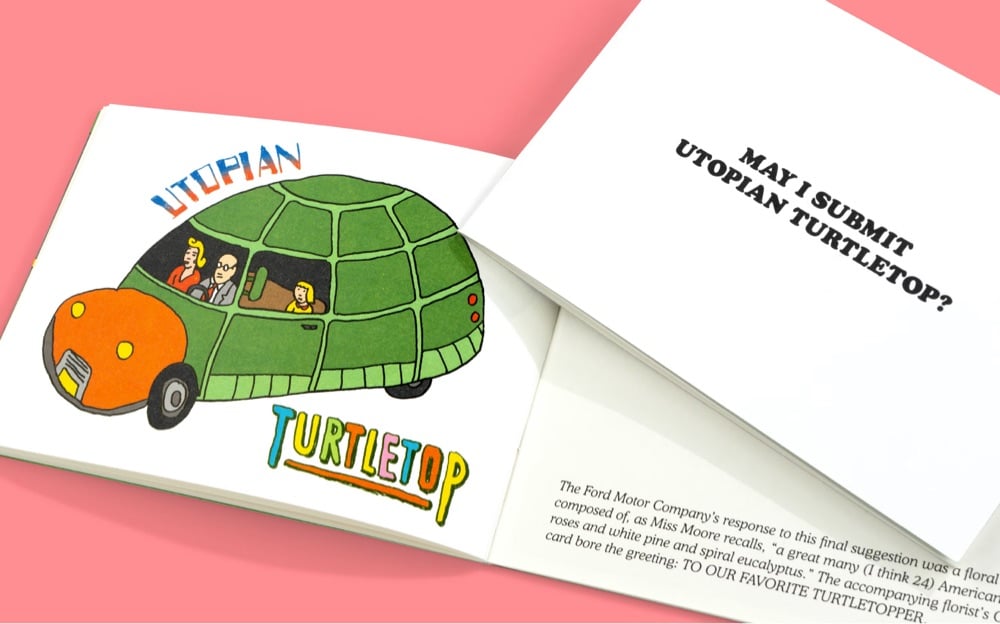
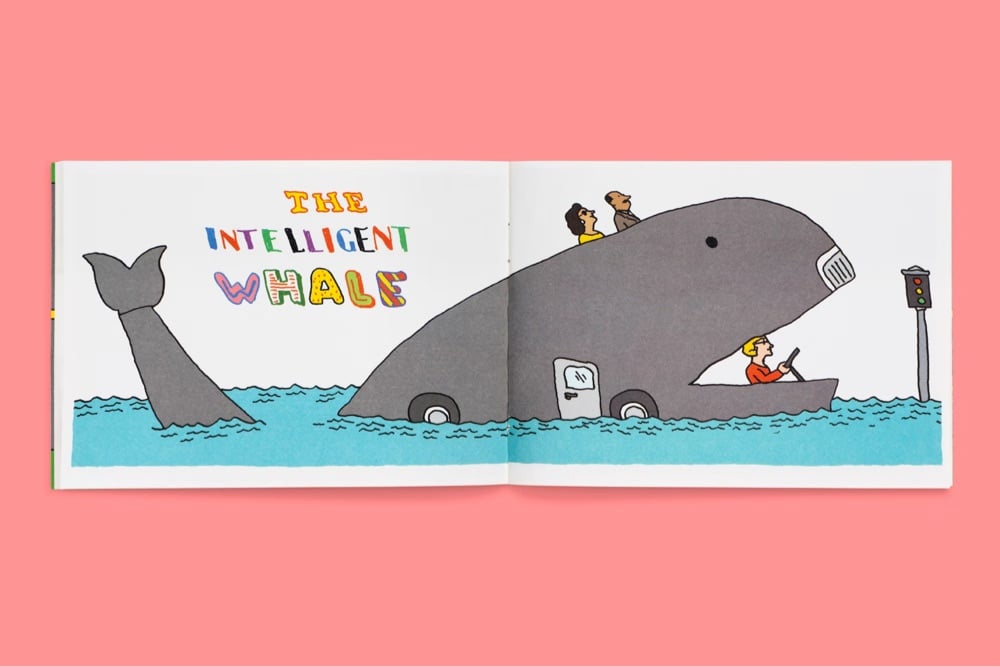
In 1955, the Ford Motor Company hired poet Marianne Moore to come up with some names for their revolutionary new car. Moore ended up submitting some amazing names, including “Silver Sword”, “Intelligent Whale”, “Angel Astro”, and “Utopian Turtletop”.
What Moore lacked in corporate nomenclature experience, she made up for in enthusiasm and imagination: she submitted over two dozen names for consideration, each one more delightful — and unlikely — than the last. In the end, the poet’s suggestions were rejected and the company’s chairman himself named the vehicle. Thus was born the notorious car known as the Edsel.
Ford realized perhaps too late that they shouldn’t have, in fact, sent a poet — but we’re sure glad they did.
Back here in the present day, Pentagram commissioned the legendary Seymour Chwast to turn Moore’s amazing collection of names into a booklet of illustrations that imagine what these cars might look like.
I was skeptical but if you listen carefully, there are some really solid ideas in this video on why designing cities around lots of cars makes sense.
Brb, currently buying some cars and moving to cities.
It is Friday and this is the perfect Friday sort of post. BeamNG is a video game of sorts that’s “a dynamic soft-body physics vehicle simulator capable of doing just about anything”. In the simulator, you can quickly devise all sorts of situations with a variety of cars and then press play to see what happens, with (mostly) realistic physics and collisions. For instance, here’s Cars vs Big Bulge:
Chained Cars vs Bollards:
Cars vs 100 Fallen Trees:
Trains vs Giant Pit:
And many many more. My god if this simulator had been around when I was 12 years old, I might not have done anything else. Hell, if I downloaded and installed this right now, I might not ever get anything done ever again. (via @tvaziri)
From the Brick Technology YouTube channel, a demonstration on how to build a 5-speed manual transmission with Lego. It even has a gear stick and goes in reverse. Unloaded, 1st gear spins an axel at 384 rpm and 5th gear spins at 3000 rpm. Really impressive.
See also Designing a Lego Car to Cross Gaps and Engineering a Capable Climbing Lego Car.
This drone fly-through of Tesla’s new factory in Berlin is amazing. I’ve never seen anything quite like this — the drone flies through the robotic machinery in between cycles of stamping out parts and also through the cars as they are being assembled. A uniquely effective how-things-are-made video.
YouTuber diorama111 took a 1/87 scale model car — about the size of a Jolly Rancher — and converted it into an incredibly small RC car that’s controlled via Bluetooth and even has working headlights, tail lights, and turn signals. It’s rechargeable too — the charging light turns green when the battery is full. (via @willhains)
Car builder Jay Ohrberg has constructed many familiar vehicles for TV and movies, including the DeLorean from Back to the Future, KITT for the Knight Rider movie,1 several Batmobiles, and the Duke boys’ General Lee. But the Ohrberg ride I really like is his robin’s egg blue double-wide Cadillac.
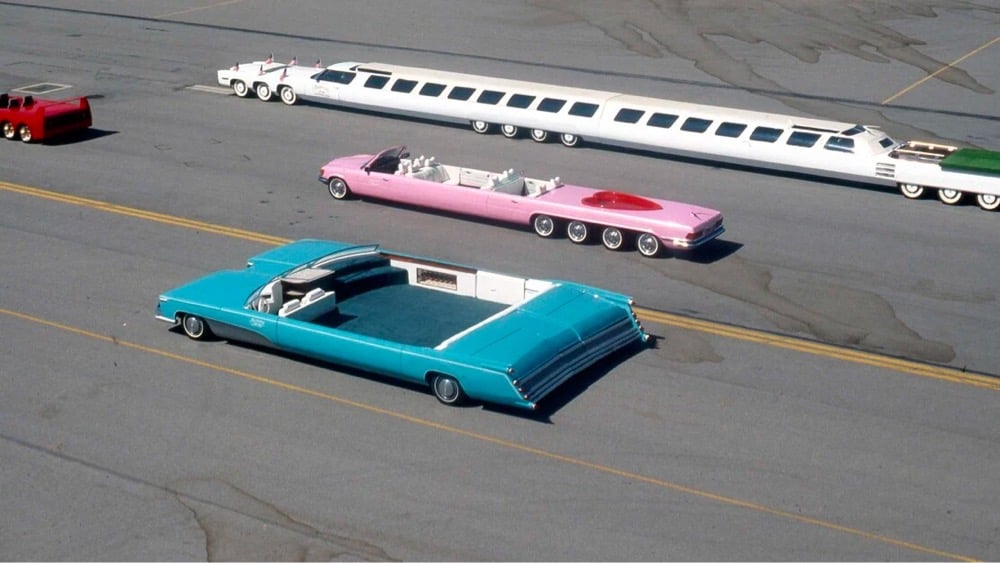
My god, the ingenious outlandishness of that car. The other cars in the photo are equally preposterous, but there is something about the squarish proportions of that Caddy that is really satisfying. And it somehow looks massive and miniature at the same time?
Newer posts
Older posts





Socials & More