
BEAUTY = BUY + EAT
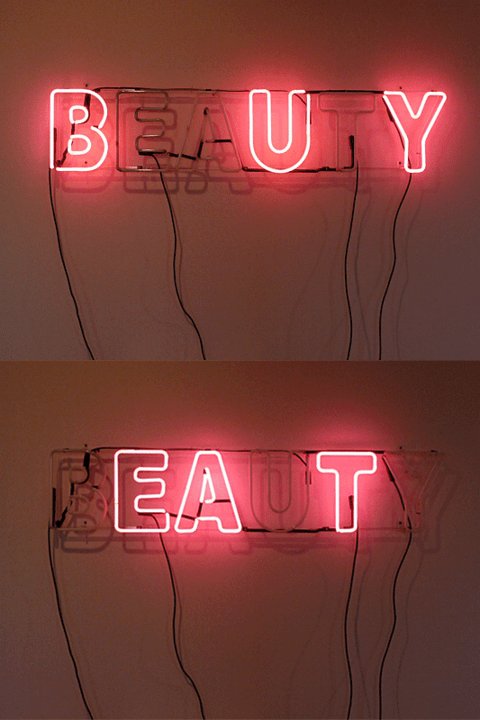
This is a piece called Operators Are Standing By by Jean Bevier. No idea who did this, but I love it. (via prosthetic knowledge and thx for the correction, dan)

This site is made possible by member support. 💞
Big thanks to Arcustech for hosting the site and offering amazing tech support.
When you buy through links on kottke.org, I may earn an affiliate commission. Thanks for supporting the site!
kottke.org. home of fine hypertext products since 1998.
Beloved by 86.47% of the web.
This is a piece called Operators Are Standing By by Jean Bevier. No idea who did this, but I love it. (via prosthetic knowledge and thx for the correction, dan)
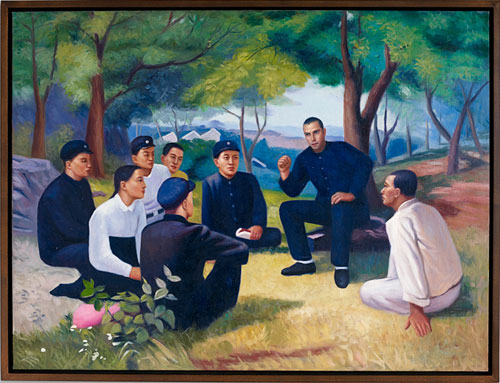
After noticing the similarities between artists and dictators, photographer Philip Toledano commissioned a series of paintings and sculpture with himself as Stalin, Kim Il Sung, etc.
Xavier Antin’s Just in Time project utilizes four printing techniques to produce full-color books.
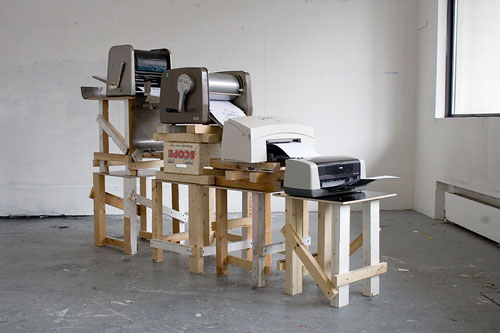
A book printed through a printing chain made of four desktop printers using four different colors and technologies dated from 1880 to 1976. A production process that brings together small scale and large scale production, two sides of the same history.
* MAGENTA (Stencil duplicator, 1880)
* CYAN (Spirit duplicator, 1923)
* BLACK (Laser printer, 1969)
* YELLOW (Inkjet printer, 1976)
For the second straight year, the best Super Bowl bet is between art museums in the cities playing in the big game.
The Milwaukee Art Museum and the Carnegie Museum of Art have agreed to a Super Bowl bet! Even better: The museums have put major works by major artists on the line. The bet continues an annual tradition begun last year when MAN instigated a wager between the Indianapolis Museum of Art and the New Orleans Museum of Art.
Both museums are offering up significant impressionist paintings: The Carnegie Museum of Art has wagered Pierre Renoir’s playful, fleshy Bathers with a Crab (cicra 1890-99, above) on a Pittsburgh Steelers victory. The Milwaukee Art Museum has put on the line Gustave Caillebotte’s serene Boating on the Yerres (1877, below).
As you might have heard, MoMA recently acquired 23 typefaces for its Architecture and Design collection. I was curious about how such an acquisition works, so I sent a quick email to Jonathan Hoefler, one of the principals at Hoefler & Frere-Jones, a New York City type foundry that contributed four typefaces to the MoMA.
Kottke: Three of the four H&FJ typefaces acquired by MoMA are available for purchase on your web site. Did they just put in their credit card info and voila? Or was there a little more to it?
Hoefler: MoMA’s adopting the fonts for their collection was much more complex than buying a copy online (and not only because Retina, one of our four, isn’t available online.) I should start by stating that you can never actually “buy fonts” online: what one can buy are licenses, and the End-User License that surrounds a typeface does not extend the kinds of rights that are necessary to enshrine a typeface in a museum’s permanent collection. The good news is that H&FJ has become as good at crafting licenses as we have at creating typefaces, an unavoidable reality in a world where fonts can be deployed in unimaginable ways. This was a fun project for our legal department.
It was actually a fascinating conversation with MoMA, as we each worked to imagine how this bequest could be useful to the museum for eternity. What might it mean when the last computer capable of recognizing OpenType is gone? What will it mean when computers as we know them are gone? How does one establish the insurance value of a typeface: not its price, but the cost of maintaining it in working order? Digital artworks are prone to different kinds of damage than physical ones, but obsolescence is no less damaging to a typeface than earthquakes and floods to a painting. On the business side there are presumably insurance underwriters who can bring complex actuarial tables to bear on the issue, but I think it’s an even more provocative issue for conservators. 472 years after its completion, the frescoes of the Sistine Chapel underwent a restoration that scholars still find controversial. What might it mean for someone to freshen up our typefaces in AD 2483?
—
Thanks, Jonathan.
In addition to sculpture, Richard Serra makes films. This is Serra’s first film from 1968, featuring a hand’s repeated attempts to catch pieces of lead.
Watching just 20 seconds made me surprisingly anxious. (via sippey, i think)
The photographs taken of everyone who sat with Marina Abramovic at her The Artist is Present show at MoMA are being compiled into a book called Portraits in the Presence of Marina Abramovic.
Just as Abramovic’s piece concerned duration, the photographs give the viewer a chance to experience the performance from Abramovic’s perspective. They reveal both dramatic and mundane moments, and speak to the humanity of such interactions, just as the performance itself did. The resultant photographs are mesmerizing and intense, putting a face to the world of art lovers while capturing what they shared during their contact with the artist.
Shinchi Maruyama throws water from his hands or from glasses and catches the temporary sculptures they make with his camera.
The Morning News has an interview with Maruyama and a photo gallery of his work; this one is really cool.
This is a wonderfully whimsical introduction to doodling by way of graph theory, snakes, Oroborous and mobius strips. Oh, and the Mobiaboros.
(via vulture)
For a piece called Metropolis II, artist Chris Burden is building a huge track and put 1200 Hot Wheels cars on it…the noise is deafening when they’re all circulating.
It includes 1,200 custom-designed cars and 18 lanes; 13 toy trains and tracks; and, dotting the landscape, buildings made of wood block, tiles, Legos and Lincoln Logs. The crew is still at work on the installation. In “Metropolis II,” by his calculation, “every hour 100,000 cars circulate through the city,” Mr. Burden said. “It has an audio quality to it. When you have 1,200 cars circulating it mimics a real freeway. It’s quite intense.”
(thx, aaron)
The Pierre Bergé – Yves Saint Laurent Foundation in Paris is currently displaying an exhibition of David Hockney’s iPhone and iPad drawings. The exhibition is on display through Jan 30, 2011.
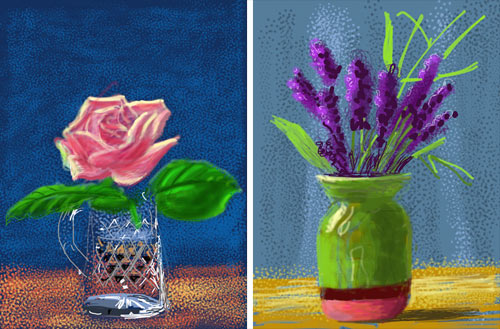
Hockney uses the Brushes app to create his digital paintings and even has his suits made with a pocket just for the iPad:
He picks up his iPad and slips it into his jacket pocket. All his suits have been made with a deep inside pocket so that he can put a sketchbook in it: now the iPad fits there just as snugly. Even his tux has the pocket, he tells me.
Mosaic collages like this one — where each “pixel” is a tiny self-contained image — are fairly common but I haven’t seen too many like these before:
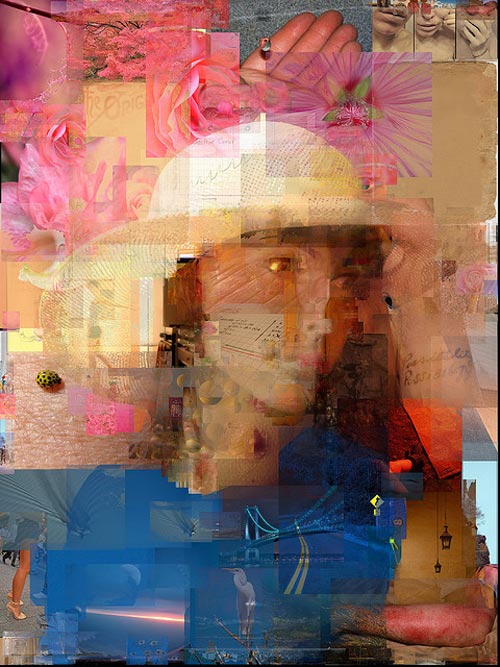
Lovely effect; they’re fun to look at zoomed in or out. (via matt)
Man, what if Spike Jonze had made Being Bill Murray instead? Casey Weldon did a series of paintings of Bill Murray as characters from Wes Anderson’s movies…but non-Murray characters like Max Fischer, Margot Tenenbaum, and the Baumer.
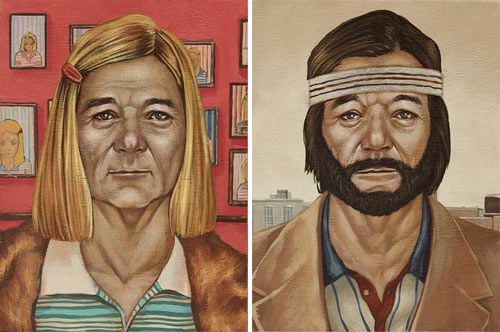
Prints are available. And these were a part of a show called Bad Dads, consisting of art inspired by various Anderson films. Again, prints are available.
Andy Denzler does these great paintings that look as though they’re highly compressed JPEGs with encoding issues.
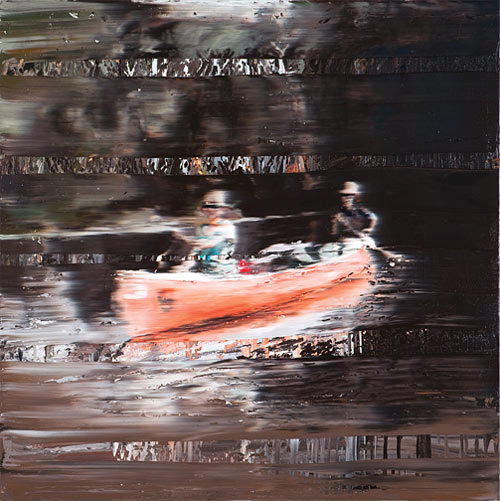
The newest exhibition in The Tate Modern’s cavernous Turbine Room is Ai Weiwei’s Sunflower Seeds:
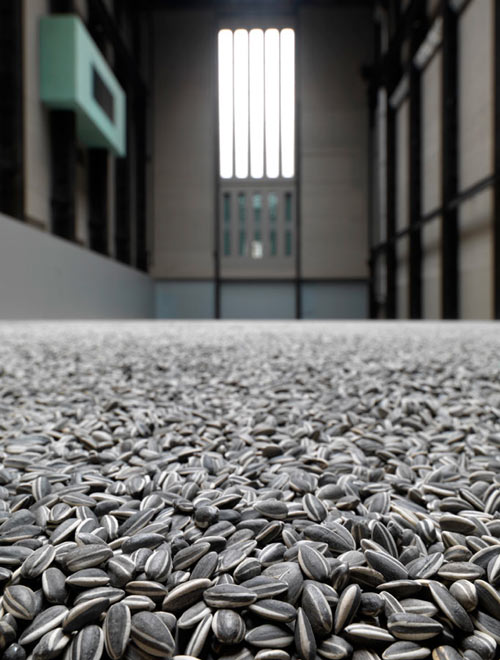
The room is filled with millions of handcrafted ceramic sunflower seeds:
Each seed has been individually sculpted and painted by specialists working in small-scale workshops in the Chinese city of Jingdezhen. Far from being industrially produced, they are the effort of hundreds of skilled hands. Poured into the interior of the Turbine Hall’s vast industrial space, the 100 million seeds form a seemingly infinite landscape.
Porcelain is almost synonymous with China and, to make this work, Ai Weiwei has manipulated traditional methods of crafting what has historically been one of China’s most prized exports. Sunflower Seeds invites us to look more closely at the ‘Made in China’ phenomenon and the geo-politics of cultural and economic exchange today.
For the first couple of days, people could walk around on the tiny sculptures (as you can see on Flickr), but health concerns prompted the museum to put a stop to that. Still pretty cool, but this remains my favorite Turbine Hall exhibition. (via hilobrow)
If you liked the video mapping on the IAC building, this one might be even better. For the 600th anniversary of the construction of the tower clock in Prague, The Macula projected a really great video on the tower…watch at least through the brick stacking animation.
Love this. In 1936, a 16-year-old Dutch girl played a shooting gallery game at the fair: hit the target and a camera takes a photo, which the girl receives as a prize. Almost every year between then and now, Ria van Dijk shot the target and got her prize.
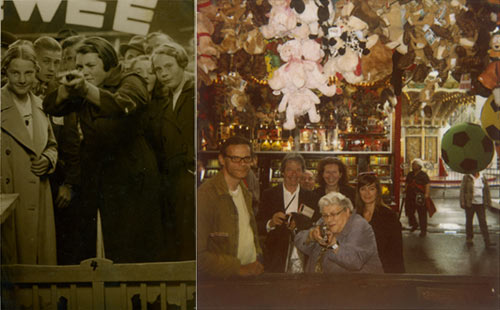
Van Dijk is now 88 and still shooting.
Last Saturday, the IAC building in Chelsea became the screen for a giant video art project.
Cassandra Jones takes photographs she finds online and stiches them together to form animations like this Eadweard Muybridge homage:
Really nice. Jones’ other work is worth a look as well. (via heading east)
Huh. The word “denim” comes from “serge de Nîmes”, a fabric made in Nîmes, France, and “blue jeans” comes from “Bleu de Genes”, blue pants made in Genoa (aka Genes). Both cities claim to have been manufacturing denim for centuries, but there has never been much proof in the way of artifacts and such. So the recent discovery of several paintings from the mid-1600s depicting people wearing jeans is surprising. Look at this jean jacket:
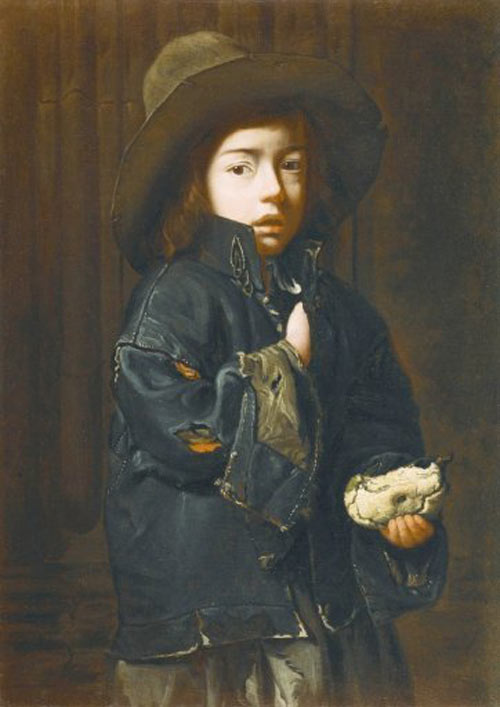
He’s even got his collar popped.
Rosmarie Fiore did this series of long exposure photographs of Atari games a few years ago.
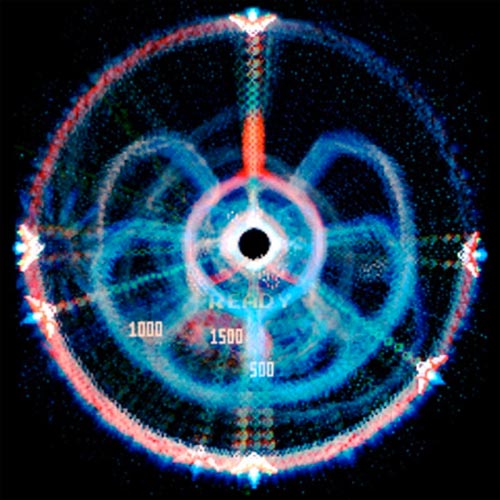
Fiore did a similar project with pinball machines…instead of photos, the ball was covered in paint and left trails on vellum. Reminds me of some of the other time merge media I collected awhile back. (via @brainpicker)
Photographer Adam Magyar uses scanner cameras to take these huge panoramic photos which are a little difficult to explain.
Adam uses the same technologies as the finish line cameras at the Olympic Games, which take thousands of images a second and records through a 1 pixel wide slit. The time and space slices are then placed next to one another to generate an image without perspective. This method is capable of recording movement only, with static objects and buildings appearing as stripes and lines.
Here’s just a small slice of one of his photos…you’ll notice that it does look an awful lot like the photo-finish photos of sprinters.
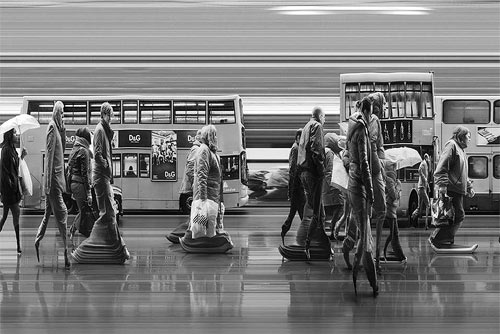
(via lens culture)
I remember reading that Greek and Roman statues were originally painted, but I didn’t know that through the use of modern scientific equipment, we actually know how they looked.
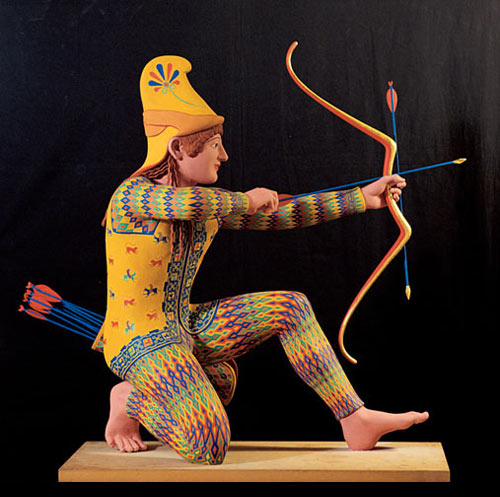
(via @brainpicker)
I don’t know what is being represented in either of these posts from but does it float, but they’re both capital G Gorgeous.
The images from ‘The most interesting trend in the development of the Internet is not how it is changing people’s ways of thinking but how it is adapting to the way that people think’ are from 3D compositions (concepts for Iron Man 2) by Prologue.
Here’s an example from ‘The most intense moments the universe has ever known are the next 15 seconds’, which is a gallery of the University of Florida Sparse Matrix Collection.

(Thanks, Adam)
Here’s a great story of Jami getting her bike stolen last night in Brooklyn. Wait, why is that great? Because, thanks to some internet sleuthing, a lot of luck (!!!), and solid police work from Brooklyn’s finest, she had it back by 11:30 this morning!
While we’re on the subject of bikes, according to a recently filed patent, Apple is looking at making a smart bike. I look to the future and I see 1) Consternation that Apple has signed an exclusive agreement to release the bike on Trek frames only for a period of 3, 4, or 5 years depending on which rumor you believe. 2) Several media stories crediting Apple for popularizing the riding of bikes. 3) Several media stories criticizing Apple for claiming they popularized the riding of bikes, even if they didn’t.make that claim, 4) Much rejoicing 3 weeks after release of the bike when someone has figure d out how to jail break the phone into a fixed gear. 5) 250 posts from John Gruber refudiating predictions of iBike failure. I look forward to all of it.
Lastly, on the topic of bikes. My friend Chris Piascik is drawing all the bikes he’s ever owned. This wouldn’t be a big deal for most people, Chris, however, has owned a gazillion bikes. The drawings are accompanied by vignettes on the bikes and I think the project will end up being more of a memoir than Chris originally anticipated. (Disclosure: If I had to name a favorite artist, it’d probably be Chris, and I post his art often on UW.)

Lauren Was and Adam Eckstrom, as Ghost of a Dream, create artstructuresculptures out of scratch tickets to show “unfulfilled dreams as well as money that could have been saved and possibly spent on the item itself”. “Dream Car” uses $39K worth of discarded tickets, and “Dream Home” uses $70K. That one’s really nice.
For what it’s worth, Was and Eckstrom aren’t the first to see art in scratch tickets. Rebecca Simering has explored the medium, as has the “I Love My Life The Way It Is” project. ILMLTWII is a project I want to believe in, but before sending scratch tickets to strangers in England, you should be aware of the risks.
(Via Cool Hunting / Derek)
Wikipedia has a page dedicated to controversial album art, which I found recently while looking up background on the 23rd birthday of Appetite for Destruction (yipe).
Eric Bana - Out of Bounds (1994)
The cover art features Bana naked from behind while streaking at a crowded AFL game. He is reaching for the ball and his buttocks are covered with the message “contents may offend”. The scene was created digitally, with the overlap of two photos. An alternative cover for the album was later released.
I was really hoping Eric Bana had a musical release in his background because musical releases by actors are usually hilarious, but this one appears to be comedy. Sigh.
This computer display covered by glass beads must be how bees see the web.
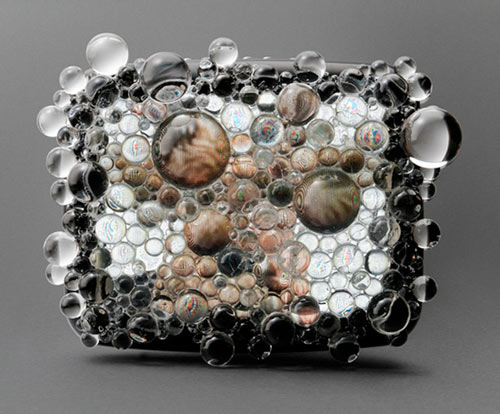
(via today and tomorrow, which is celebrating five years of excellence this week)
Scott Snibbe’s interactive art projects are available for sale on the iPhone/iPad and he’s pretty happy about it.
Over the past few days my first three apps became available on the iTunes store: Gravilux, Bubble Harp, and Antograph. I’ve been dreaming of this day for twenty years: a day when, for the first time, we can enjoy interactive art as a media commodity no different from books, music, and movies.
I remember the Gravilux Java applet from back in the day and happily bought it for the iPad.
Socials & More