kottke.org posts about USA
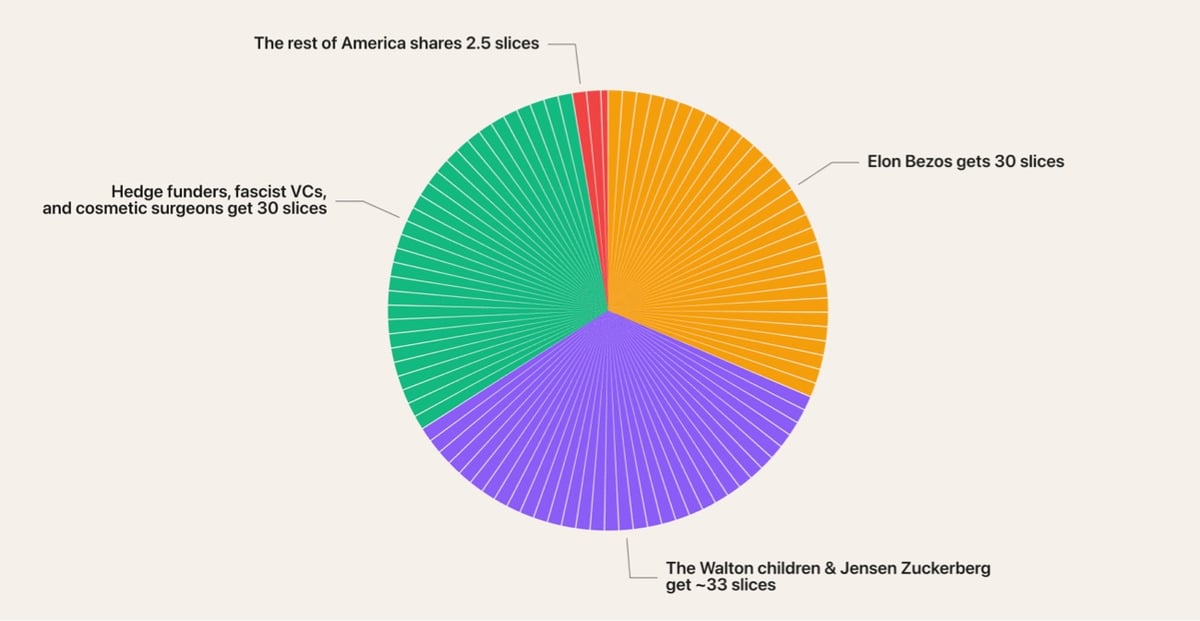
I think I’d heard the term “k-shaped economy” somewhere before but didn’t really know what it meant until I watched this video:
American Airlines is changing the layout of some of their aircraft to add 31 first class and premium seats while cutting out 73 economy seats. This is the hot new trend in air travel: pulling out all the stops to cater to the wealthy.
Airlines are adding suites with more bed space, privacy doors, an extra ottoman for guests. They’re offering caviar, free PJs, luxury skin care products, and multi-course meals with wine pairings made by gourmet chefs. They’re also building more airport lounges. Meanwhile, economy is getting more cramped and low-cost carriers are going bankrupt. It’s because wealthy passengers are where the money’s at.
For years, airlines have made more money from their credit cards than from actually flying passengers around. And these days, premium seating is bringing in more revenue than the economy cabin. It’s a perfect example of the K-shaped economy.
Here’s an AP article about the K-shaped economy from late last year.
Corporate executives are paying attention and in some cases explicitly adjusting their businesses to account for it. They are seeking ways to sell more high-priced items to the wealthy while also reducing package sizes and taking other steps to target struggling consumers.
The main point of Adam Bonica’s post The Wall Looks Permanent Until It Falls is about the optimism of this moment: that the US could be ripe for a Berlin Wall-falling moment that opens the door for a better future. I’m not in the mood for that message these days (IMO, our Wall-falling is a ways off in the future), but Bonica’s analysis of how the US compares to 30 other wealthy democracies, our economic peers, is important.
Start with work and economic life. Americans work longer hours, pay more out-of-pocket for college and childcare, lack parental leave, and enjoy less economic mobility. The share of income going to the top 1 percent is nearly double the OECD average. American CEOs earn, on average, 354 times as much as their workers. More workers are trapped in poverty-wage jobs. Collective bargaining covers fewer workers. And social protections are less generous for those who fall on hard times, with the government raising less in taxes and spending more on the military.
The economy is just the beginning.
We spend nearly twice as much on healthcare as other wealthy countries do. Yet life expectancy is well below average, infant and maternal mortality rates are alarmingly high, and more Americans remain uninsured.
We suffer from overlapping public health crises — the highest rates of teenage births, drug overdoses, obesity, and gun deaths among peer nations.
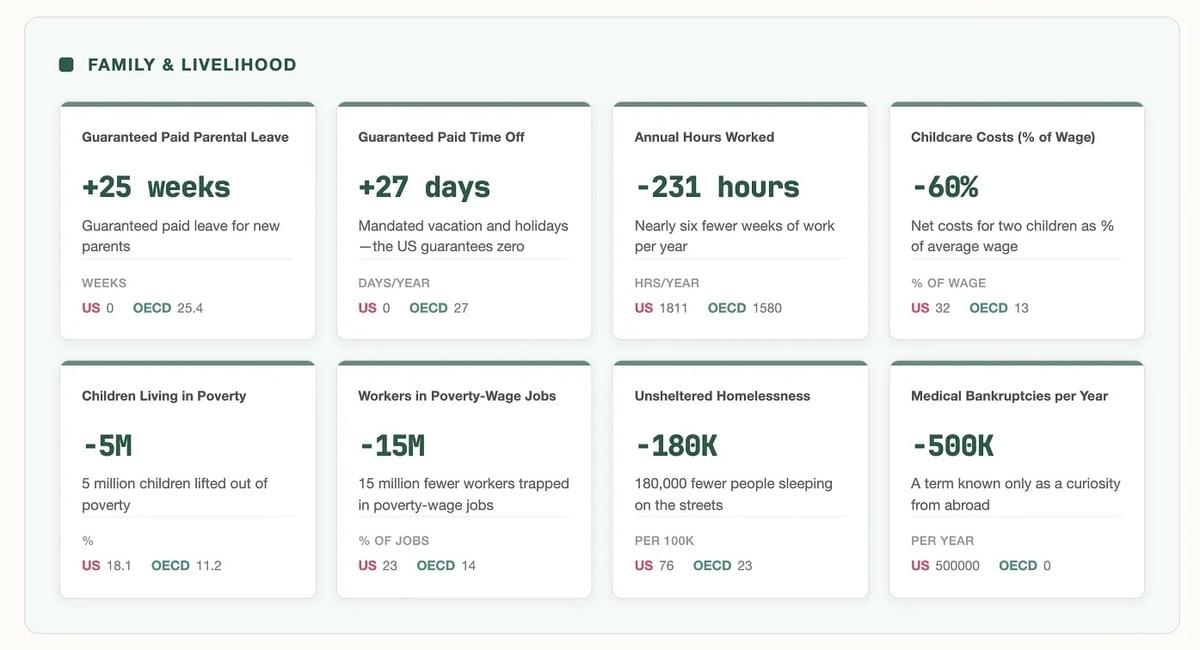
His description of our unique exceptionalism goes on for several more paragraphs. But then he does something quite simple and revealing: he does the math and imagines, in concrete terms, what the US would be like if it were just an average country in its cohort. Bonica calls it “Latent America: the nation that would exist if our democracy functioned to serve the public rather than protect the already powerful”. Here’s part of his analysis:

I don’t think I’ve seen this analysis done in quite this way before. You should click through to see the whole graphic, but some of the other stats are:
- $19,000 added income per household per year (and $96K more wealth)
- $2.1 trillion less spending on healthcare
- 4.1 more years of life expectancy at birth
- 51 million more Americans voting
- 1.4 million fewer Americans behind bars
- 60 more women serving in Congress
And this is just if the US were an average nation. Imagine if the US took its exceptionalism seriously and tried to maximally improve the lives of its citizens & residents instead of generating, as Bonica puts it, “enormous prosperity while deliberately withholding it from those who need it most”.

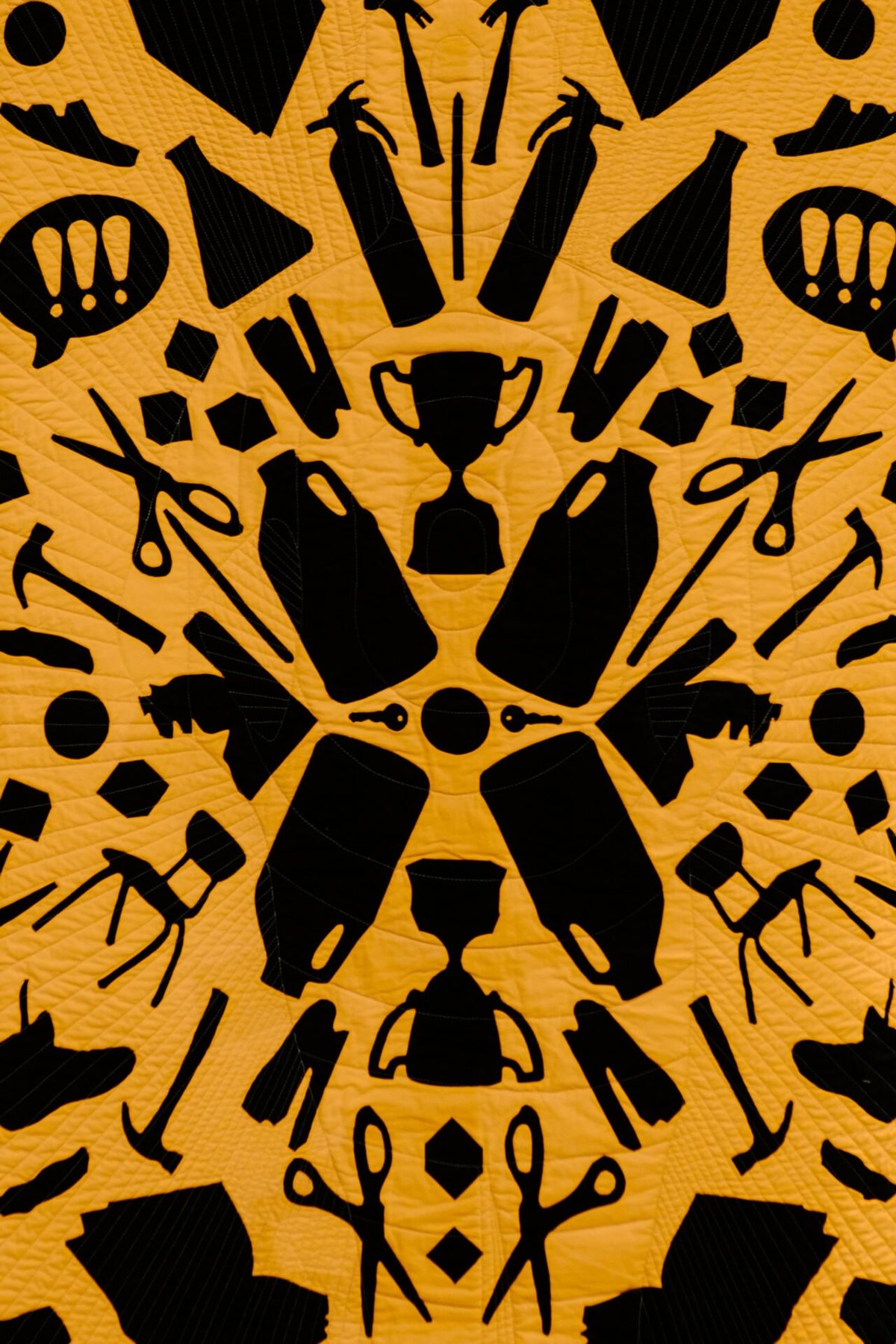
In 2024, schoolteacher Ginny Robinson won the Best in Show award at a quilting convention for her quilt called What We Will Use as Weapons: A List of School Supplies.
This is a protest quilt. It was made by an artist whose day job puts her on the front lines of one of the most grotesque realities in America today. She is a teacher.
What We Will Use as Weapons: A List of School Supplies is the title for this provocative work of art that features school supplies hurling toward the center on the front and an assault rifle on the back. This long, narrow quilt is the actual size and shape of a door. An outline of a human is stitched through the layers. On the front, the person is meant to represent a shooter, and on the reverse side, a teacher.
Robinson’s quilt is now part of the collection at the International Quilt Museum.
Born Poor (PBS/Frontline) is a documentary filmed across 14 years about three kids in the US as they grow into young adults while “dealing with an economy where they face more obstacles than opportunities”. Free to watch online (probably US-only, so fire up your VPN if you live elsewhere). From an accompanying article:
More than a decade ago, the Emmy-nominated documentary Poor Kids portrayed poverty in America as it’s rarely seen: through the eyes of children.
Now, those kids — Brittany, Johnny and Kaylie — are all grown up, fighting to overcome the lingering impact of childhood poverty as they navigate young adulthood.
“Once you get in the hole, it’s extremely hard to find your way out,” Brittany says.
She, Johnny and Kaylie continue to share their experiences with the American public in Born Poor, FRONTLINE’s season premiere. Filmed across 14 years, the documentary follows these three kids from three families across three chapters of their lives — from childhood through the teen years to young adulthood — and offers a powerful, personal and longitudinal look at the realities of growing up in poverty in the U.S.
“Do I ever get tired of the struggle? Absolutely,” Johnny says. “But I feel like if you get another day to breathe and wake up and make something happen, you got to get off your butt and make it happen.”
The original documentary was filmed in 2012; I couldn’t find it on PBS’s YT channel, but I think this is it:
The filmmakers updated the film in 2017:
I haven’t watched all of these so I don’t know how much the three versions overlap, but the 2025 version at the top is ~30 minutes longer than the other two.
See also the Up film series.

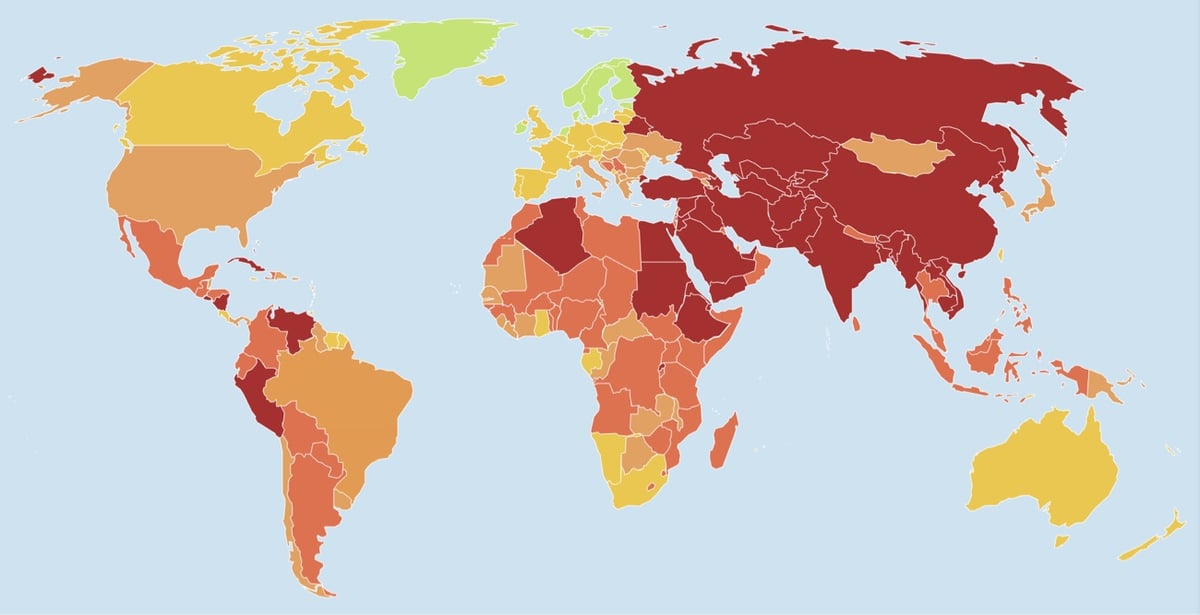
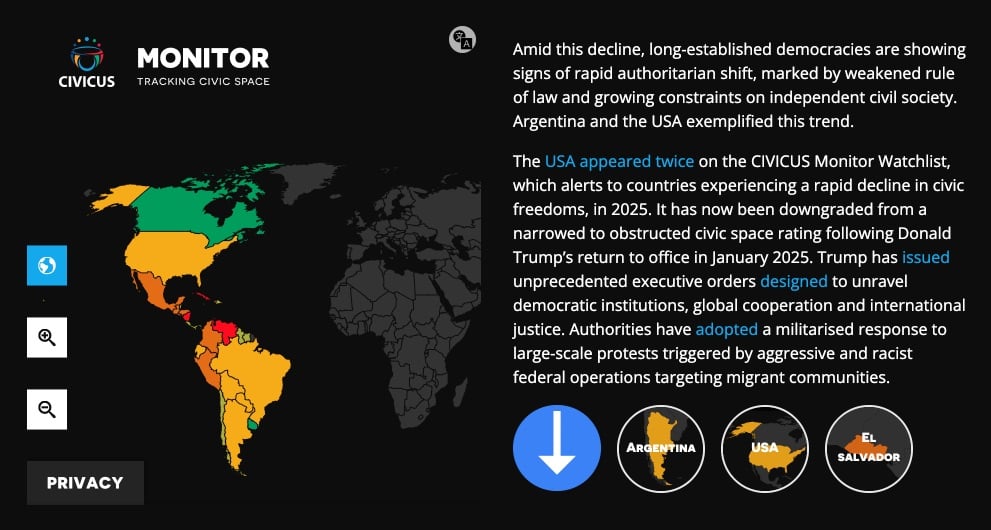
Civicus monitors the health of civic societies and their freedoms around the world. In their annual assessment on civic freedoms for 2025, they downgraded the United States from “narrowed” to “obstructed”.
The CIVICUS Monitor has downgraded the United States of America’s civic space rating, reflecting a sharp deterioration of fundamental freedoms in the country. The People Power Under Attack report now rates the USA as “Obstructed” following a year of sweeping executive actions, restrictive laws, and aggressive crackdowns on free speech and dissent.
The downgrade comes following Donald Trump’s return to office in January 2025, which triggered a wave of measures undermining democratic institutions and civic freedoms. The report flags a drastic surge in violations of the rights to freedom of expression, association, and peaceful assembly.
“The backsliding on rule of law and fundamental freedoms in the United States is truly alarming,” said Mandeep Tiwana, secretary general of CIVICUS. “We are witnessing a rapid and systematic attempt to stifle civic freedoms that Americans have come to take for granted, such as critiquing authorities and protesting peacefully.”
From an article in the Guardian on the report:
The report cited militarized crackdowns on protests in the US, pointing to Donald Trump’s deployment of the national guard to Los Angeles and other cities, as well as the widespread use of ICE agents across gatherings and immigrant communities.
It further highlighted escalating restrictions on free speech across college campuses, particularly around Palestinian solidarity activism.
“Universities have suspended student groups and opened investigations under broad and vague accusations of ‘material support for terrorism.’ Foreign-born students and faculty have been disproportionately targeted, facing disciplinary actions, visa threats, and professional retaliation for supporting Palestinian rights,” the report stated.
Civicus moreover warned that media freedoms were under mounting pressure nationwide, citing the Federal Communications Commission’s threats to revoke broadcast licenses and Trump’s lawsuits against various media companies.
It also pointed to Trump’s revocation of funding for public broadcasters including NPR and PBS, as well as the new White House Wire, an administration-run news website that promotes positive news about itself.
This is the trailer for an HBO documentary called Thoughts and Prayers about “the impact of the $3 billion active shooter preparedness industry on schools and communities across America”.
It’s tough to watch, as is this clip from the film in which a girl describes a bag of supplies that she carries in her backpack in case there’s a school shooting.
From David Ehrlich’s review in IndieWire:
Bulletproof desks that students can flip over at the first sign of trouble. A robot dog the size of a Pomeranian that jumps and yaps at the sight of an intruder. Inflatable body armor light enough for a first grader to blow up and hide behind. These are just a few of the more sensible products that are on display in the opening moments of Zackary Canepari and Jessica Dimmock’s utterly damning “Thoughts & Prayers” — the least farcical selection of props that contribute to America’s burgeoning active shooter defense industry, which now grosses more than three billion dollars per year.
Of course, that’s a small price to pay for the laughably transparent illusion that we’re taking any meaningful steps toward protecting our kids from being slaughtered in their classrooms. In a crumbling empire where common sense has been eroded by ideology, and the political will to solve a problem can’t hope to compete with the ghoulish impulse to profit from it, creating a new business sector might just be the only kind of healing that the richest country on Earth can afford.
It is totally and utterly and completely sickening that we choose to live this way in America.
From Vann R. Newkirk II, a editor & journalist who hosts the Floodlines podcast (about Hurricane Katrina), a long piece about the climate chaos that’s taking hold in the US: What Climate Change Will Do to America by Mid-Century.
Over the next 30 years or so, the changes to American life might be short of apocalyptic. But miles of heartbreak lie between here and the apocalypse, and the future toward which we are heading will mean heartbreak for millions. Many people will go in search of new homes in cooler, more predictable places. Those travelers will leave behind growing portions of America where services and comforts will be in short supply — let’s call them “dead zones.” Should the demolition of America’s rule of law continue, authoritarianism and climate change will reinforce each other, a vicious spiral from which it will be difficult to exit.
Newkirk details how the increasing effects of the climate crisis might play out in “a landscape of inequality” like the United States.
Even if climate change does not trigger a full-fledged economic panic, whole regions will be thinned out and impoverished. Residential areas are the centerpiece of local economies, yet without insurance, people cannot get mortgages, and so most cannot buy houses. The mere prospect of that makes business investment riskier. Jesse Keenan, a professor at Tulane University who studies climate change and real estate, told me that some places are already becoming economic “no-go” zones.
I remember reading about the coming climate-driven crisis in insurance back in the early 2000s — e.g. Michael Lewis’s post-Katrina piece in the NY Times Magazine — and hoping it wouldn’t come to that but knowing that it would as years went by without significant action on climate. And now here we are.
High Horse: The Black Cowboy is a three-part documentary about the culture of Black cowboys & cowgirls and their erasure from the history of the western United States.
From executive producer Jordan Peele and Monkeypaw Productions, the pop culture and historical documentary confronts and reclaims the Wild West while revealing the story of the Black cowboy — a history that has largely been untold. It rides into the forgotten corners of history, shattering myths and celebrating the Black cowboys, farmers, jockeys, musicians, and rodeo champions who built the West — and now takes back their place in the saddle, sitting high atop the horse.
High Horse: The Black Cowboy starts streaming Nov 20th on Peacock.


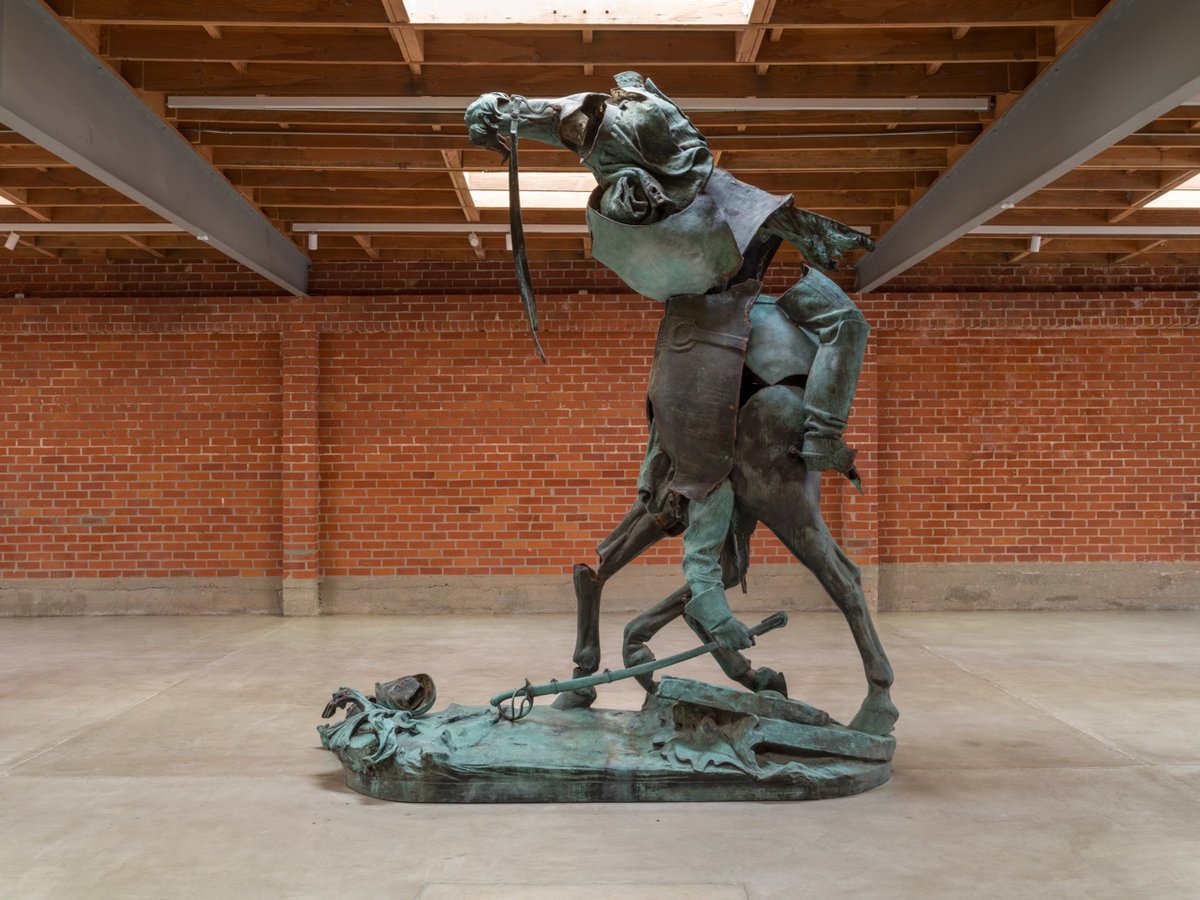
This is incredible: artist Kara Walker took a statue of Confederate general Stonewall Jackson that had stood in Charlottesville, Virginia until 2021, chopped it up, and reconstituted it into a disfigured beast. It’s part of an exhibition of several such works called Monuments, which opens at The Geffen Contemporary at MOCA in LA on October 23. From the press release:
In 2021, The Brick (then known as LAXART) acquired a decommissioned equestrian monument of “Stonewall” Jackson from the city of Charlottesville, Virginia. The monument was given to Kara Walker to create the new work Unmanned Drone (2023). The original bronze statue portrayed Jackson spurring his steed into the heat of battle. Walker dissected the statue and reshuffled the parts in a Hieronymous Bosch-like fashion. The result is still horse and rider, but instead of charging into battle, Walker’s horseman wanders in Civil War purgatory, dragging its sword over a ruined battlefield.
Here’s the statue as it looked in Charlottesville:

Walker described the intent of the work in this NY Times piece:
She likened the result to a haint — a Southern concept with roots in Gullah Geechee culture that designates a spirit that has slipped its human form and roams about making mischief and exacting vengeance. Here, what is deconstructed is not just a statue but the myth of suppressed Confederate glory that it represents. Her sculpture, she suggested, “exists as a sort of haint of itself — the imagination of the Lost Cause having to recognize itself for what it is.”
The Guardian also has a long article on the show and Walker’s piece.
Jamelle Bouie on Democratic politicians who maddeningly cannot recognize and acknowledge what is going on in the country.
From my perspective, the story of American politics right now is that the president, who fashions himself a kind of king of America, is attempting to barricade himself in the capital by unleashing a military occupation on its residents. And he’s promised to extend this military occupation to other cities and other states that he views as political opponents.
That to me is the big story of American politics right now: a mad king openly exerting tyrannical power over Americans and threatening further tyrannical power against other Americans, all under a pretext of crime reduction.
On April 9, 2016, several months before Donald Trump was elected President for the first time, the Boston Globe ran an editorial entitled “The GOP must stop Donald Trump”.
Donald J. Trump’s vision for the future of our nation is as deeply disturbing as it is profoundly un-American.
It is easy to find historical antecedents. The rise of demagogic strongmen is an all too common phenomenon on our small planet. And what marks each of those dark episodes is a failure to fathom where a leader’s vision leads, to carry rhetoric to its logical conclusion. The satirical front page of this section attempts to do just that, to envision what America looks like with Trump in the White House.
It is an exercise in taking a man at his word. And his vision of America promises to be as appalling in real life as it is in black and white on the page. It is a vision that demands an active and engaged opposition. It requires an opposition as focused on denying Trump the White House as the candidate is flippant and reckless about securing it.
As part of the editorial, they imagined a Globe front page one year into a future Trump presidency:

Some of the headlines read “Deportations to Begin: President Trump calls for tripling of ICE force; riots continue” and “Markets sink as trade war looms”. They may have gotten the timeline and some of the details wrong, but many of the Globe’s fake headlines now read as tame.
In his second term, Trump has removed any pretense of governing and is full steam ahead on indulging his bigotry, filling his coffers, playing Big Boy Diplomat, and replacing the American system of democracy with a conservative authoritarian government. And as the editorial notes, all you had to do to predict it was to take Trump at his word. (via @epicciuto.bsky.social)
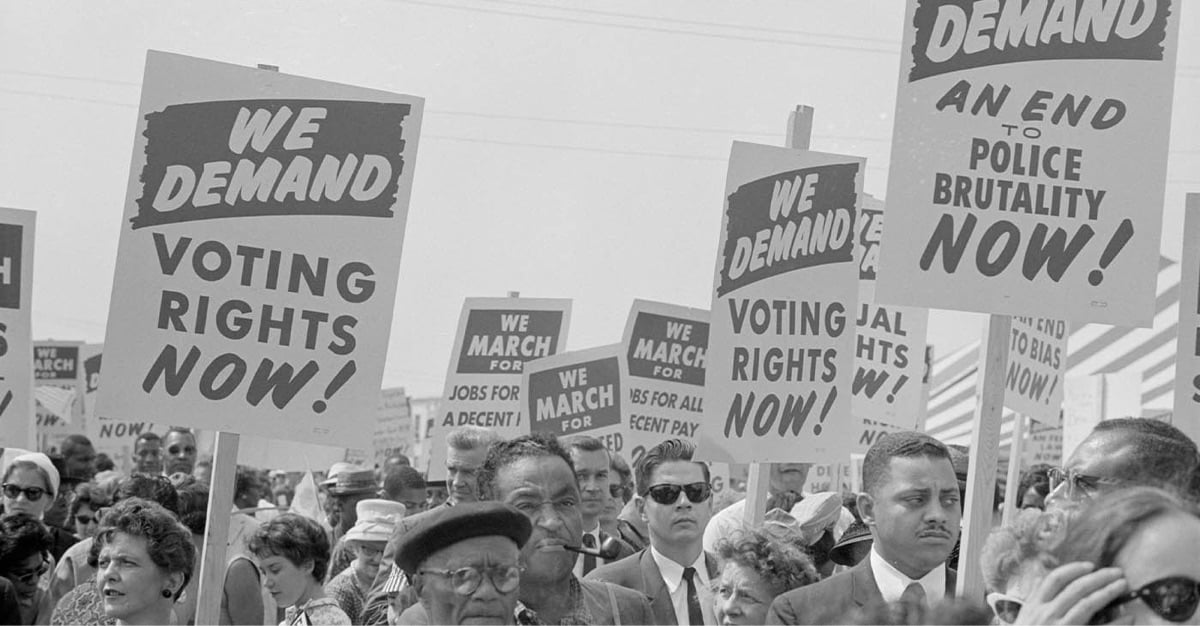
This is a great piece from Jamelle Bouie on the likely death of the Voting Rights Act and, zooming out, the end of an era in American society that began with the Act’s signing.
Americans pride ourselves, by contrast, on our undivided history under one Constitution — a single, ongoing experiment in self-government. But look closely at American history and you’ll see that this is an illusion of continuity that belies a reality of change, and sometimes radical transformation, over time. There are several American republics and at least two Constitutions, a first and a second founding. Our first republic began with ratification in 1788 and collapsed at Fort Sumter in 1861. Our second emerged from the wreckage of the Civil War and was dismantled, as the University of Connecticut historian Manisha Sinha argues, by Jim Crow at home and imperial ambition abroad. If the third American republic took shape under the unusual circumstances of the middle decades of the 20th century — what the Vanderbilt historian Jefferson Cowie calls “the great exception” of depression, war and a political system indelibly shaped by immigration restriction and the near-total exclusion of millions of American citizens from the political system — then the fourth began with the achievements of the civil rights movement, which included a newly open door to the world.
America’s fourth republic was one “built on multiracial pluralism” and it’s under siege by the Trump regime, which wants to return control of America to white men.
It’s this America that Donald Trump and his movement hope to condemn to the ash heap of history. It’s this America that they’re fighting to destroy with their attacks on immigration, civil rights laws, higher education and the very notion of a pluralistic society of equals.
Ross Anderson writes about how scientific empires, from the ancient Sumerians to the Nazis to the Soviet Union in the 1950s, have crumbled (or been willfully dismantled by ideologues) and the clear signs that the same thing is happening here in the United States under the conservative regime.
The very best scientists are like elite basketball players: They come to America from all over the world so that they can spend their prime years working alongside top talent. “It’s very hard to find a leading scientist who has not done at least some research in the U.S. as an undergraduate or graduate student or postdoc or faculty,” Michael Gordin, a historian of science and the dean of Princeton University’s undergraduate academics, told me. That may no longer be the case a generation from now.
Foreign researchers have recently been made to feel unwelcome in the U.S. They have been surveilled and harassed. The Trump administration has made it more difficult for research institutions to enroll them. Top universities have been placed under federal investigation. Their accreditation and tax-exempt status have been threatened. The Trump administration has proposed severe budget cuts at the agencies that fund American science — the NSF, the NIH, and NASA, among others — and laid off staffers in large numbers. Existing research grants have been canceled or suspended en masse. Committees of expert scientists that once advised the government have been disbanded. In May, the president ordered that all federally funded research meet higher standards for rigor and reproducibility — or else be subject to correction by political appointees.
And so:
Funding for American science has fluctuated in the decades since [World War II]. It spiked after Sputnik and dipped at the end of the Cold War. But until Trump took power for the second time and began his multipronged assault on America’s research institutions, broad support for science was a given under both Democratic and Republican administrations. Trump’s interference in the sciences is something new. It shares features with the science-damaging policies of Stalin and Hitler, says David Wootton, a historian of science at the University of York. But in the English-speaking world, it has no precedent, he told me: “This is an unparalleled destruction from within.”

XKCD mapped the most observed plant and animal for all 50 US states as reported by iNaturalist users. I had no idea bumble bees were such a popularly observed animal — the common eastern bumble bee (Bombus impatiens) is most-observed in Vermont, Wisconsin, Maine, Connecticut, Illinois, and Minnesota. Also popular: white-tailed deer, bison, milkweed, honeysuckle, and robins.
In 1966, Huey Newton & Bobby Seale formed the Black Panther Party and wrote a 10-point manifesto of what the group stood for and what they wanted. Here’s the full text of the plan.
4. We Want Decent Housing Fit For The Shelter of Human Beings.
We believe that if the White Landlords will not give decent housing to our Black community, then the housing and the land should be made into cooperatives so that our community, with government aid, can build and make decent housing for its people.
5. We Want Education for Our People That Exposes The True Nature Of This Decadent American Society. We Want Education That Teaches Us Our True History And Our Role in the Present-Day Society.
We believe in an educational system that will give to our people a knowledge of self. If a man does not have knowledge of himself and his position in society and the world then he has little chance to relate to anything else.
Tressie McMillan Cottom, one of America’s leading public intellectuals, posted this to Bluesky yesterday:
I’m going to be very honest and clear.
I am fully preparing myself to die under this new American regime. That’s not to say that it’s the end of the world. It isn’t. But I am almost 50 years old. It will take so long to do anything with this mess that this is the new normal for *me*.
I do hope a lot of you run. I hope you vote, sure. Maybe do a general strike or rent strike. All great!
But I spent the last week reading things and this is not, for ME, an electoral fix. So now I will spend time reflecting on how to integrate this normal into my understanding of the future.
Most of this will be personal. Some of it will be public — how we move in the world.
Right now, I know that I need to make a decision on my risk sensitivity. How much can I take? I also need to meditate HARD on accepting the randomness of that risk. No amount of strategy can protect me.
Those are things I am thinking about.
In response, Anil Dash posted:
Yeah, I keep telling people this is a rest-of-my-life fight, and… they do *not* want to hear it.
Author Meg Elison:
I’ve been thinking something like this for a few months now. We will fight, we will resist, etc. But we will also not live the lives we picked out and planned on. They’re not available anymore.
Therapist and political activist Leah McElrath:
Since Trump regained office, I’ve talked about this both gently and bluntly to try to help people understand that we lived in one era but we’re going to die in another.
I am, at least. I know my probable life expectancy and, at 61, have about 15 years left.
And @2naonwheat.bsky.social:
We’re all going to have to start planting shade trees we fully know we’ll never sit under.
Cottom nails how I’ve been feeling for the past few months (and honestly why it’s been a little uneven around KDO recently). America’s democratic collapse has been coming for years, always just over the horizon. But when everything that happened during Trump’s first three months in office happened and (here’s the important part) shockingly little was done by the few groups (Congress, the Supreme Court, the Democratic Party, American corporations & other large institutions, media companies) who had the power to counter it, I knew it was over. And over in a way that is irreversible, for a good long while at least.
Since then, I’ve been recalibrating and grieving. Feeling angry — furious, really. Fighting resignation. Trying not to fall prey to doomerism and subsequently spreading it to others. (This post is perhaps an exception, but I believe, as Cottom does, in being “honest and clear” when times call for it.) Getting out. Biking, so much biking. Paying less attention to the news. Trying to celebrate other facets of our collective humanity here on KDO — or just being silly & stupid. Feeling overwhelmed. Feeling numb. But also (occasionally, somehow) hope?
All of this is exhausting. Destabilizing. I don’t know what I’m doing or what I should be doing or how I can be of the most service to others. (Put on your oxygen mask before assisting others, they say. Is my mask on yet? I don’t know — how can I even tell?) I barely know what I’m trying to say and don’t know how to end this post so I’m just gonna say that the comments are open on this post (be gentle with each other, don’t make me regret this) and I’ll be back with you here after the, uh, holiday.
This is an excellent video explanation from Jamelle Bouie of what Jim Crow was, how it developed, and how it continues to reverberate in American society and politics today.
If you are an American watching this, and you had a standard social studies or history class in high school, you may think of Jim Crow as more or less simply being separate institutions, separate bathrooms, separate water fountains — various kinds of public disrespect. And those certainly were the symbols of Jim Crow, symbols of outward public disrespect. But that’s not what the system was.
Jim Crow the system was something we would recognize today, and describe as today, as authoritarian. And specifically, it was an authoritarian system of labor control and political control. The Jim Crow states sharply limited political participation by large parts of their population — most of them black, but not a small number of them white as well — and the Jim Crow states themselves were largely vehicles for the interest of powerful owners of capital and property: land owners, factory owners — people who had a vested interest in direct control of labor. The social separation, the extreme and atavistic violence, the theft, the plunder — all of these things were downstream of this effort to control political behavior and control labor. They were the mechanisms of that control, the way to keep people in line or keep them bought into the system if they were on the white side of the color line.
The video is long and it gets into some detail that’s not super exciting (but is nevertheless important), but stick with it — I learned a lot.
Historian Heather Cox Richardson is now doing visual versions of her daily newsletter on YouTube. Yesterday’s video explains the origins and significance of Juneteenth.
Black people in Galveston met the news Order No. 3 brought with celebrations in the streets, but emancipation was not a gift from white Americans. Black Americans had fought and died for the United States. They had worked as soldiers, as nurses, and as day laborers in the Union army. Those who could had demonstrated their hatred of enslavement and the Confederacy by leaving their homes for the northern lines, sometimes delivering valuable information or matériel to the Union, while those unable to leave had hidden wounded U.S. soldiers and helped them get back to Union lines.
But white former Confederates in Texas were demoralized and angered by the changes in their circumstances. “It looked like everything worth living for was gone,” Texas cattleman Charles Goodnight later recalled.

Among a number of things I’ve read online that I think about all the time is David Roberts’ 2020 piece for Vox about shifting baselines.
Humans often don’t remember what we’ve lost or demand that it be restored. Rather, we adjust to what we’ve got.
Concepts developed in sociology and psychology can help us understand why it happens — and why it is such a danger in an age of accelerating, interlocking crises. Tackling climate change, pandemics, or any of a range of modern global problems means keeping our attention on what’s being lost, not just over our lifetimes, but over generations.
Roberts cites the work of fisheries scientist Daniel Pauly in explaining the concept:
So what are shifting baselines? Consider a species of fish that is fished to extinction in a region over, say, 100 years. A given generation of fishers becomes conscious of the fish at a particular level of abundance. When those fishers retire, the level is lower. To the generation that enters after them, that diminished level is the new normal, the new baseline. They rarely know the baseline used by the previous generation; it holds little emotional salience relative to their personal experience.
And so it goes, each new generation shifting the baseline downward. By the end, the fishers are operating in a radically degraded ecosystem, but it does not seem that way to them, because their baselines were set at an already low level.
Over time, the fish goes extinct — an enormous, tragic loss — but no fisher experiences the full transition from abundance to desolation. No generation experiences the totality of the loss. It is doled out in portions, over time, no portion quite large enough to spur preventative action. By the time the fish go extinct, the fishers barely notice, because they no longer valued the fish anyway.
Shifting baselines can also occur in individuals and across shorter timelines, especially in intense situations. In a recent piece for the NY Times, M. Gessen warns that we’re entering a new phase of the Trump Era:
In this country, too, fewer and fewer things can surprise us. Once you’ve absorbed the shock of deportations to El Salvador, plans to deport people to South Sudan aren’t that remarkable. Once you’ve wrapped your mind around the Trump administration’s revoking the legal status of individual international students, a blanket ban on international enrollment at Harvard isn’t entirely unexpected.
Once you’ve realized that the administration is intent on driving thousands of trans people out of the U.S. military, a ban on Medicaid coverage for gender-affirming care, which could have devastating effects for hundreds of thousands, just becomes more of the same. As in a country at war, reports of human tragedy and extreme cruelty have become routine — not news.
This stasis, complacency, and boredom is what I was getting at in this post from March:
And but so anyway, the point is that there’s so much important stuff going on! Fundamental human rights are under fresh attack daily! This is not a drill! But at the same time, the fundamental situation has not materially changed in a few weeks. There was a coup. It was successful. It is ongoing and escalating. Elon Musk retains more or less total control over a huge amount of the federal government’s apparatus and its spending. Protests are building. Congress largely hasn’t reacted. The Democratic Party shows few signs of behaving like an opposition party. Some of the purges are being walked back, piecemeal. The judiciary is weighing in, slowly. There’s talk of cracks in the conservative coalition. We’re in a weird sort of stasis where each day’s events are both extremely significant and also just more of the same.
Humans can get used to almost anything. At times, our shifting baselines can be a source of resilience even in the face of great peril. They also can result in great injustice. I don’t have any advice about staying engaged during periods like these, but awareness is surely part of it.
At the end of March, I posted some news about three prominent scholars of fascism and authoritarianism who were leaving the United States to live and work in Canada. In this video for the NY Times, We Study Fascism, and We’re Leaving the U.S., Marci Shore, Timothy Snyder, and Jason Stanley explain their reasons for going. Here’s some of what they had to say:
I’m leaving to the University of Toronto because I want to do my work without the fear that I will be punished for my words.
The lesson of 1933 is you get out sooner rather than later.
My colleagues and friends, they were walking around and saying, “We have checks and balances. So let’s inhale, checks and balances, exhale, checks and balances.” And I thought my God, we’re like people on the Titanic saying our ship can’t sink. We’ve got the best ship. We’ve got the strongest ship. We’ve got the biggest ship. Our ship can’t sink. And what you know is a historian is that there is no such thing as a ship that can’t sink.
I want Americans to realize that this is a democratic emergency.
Toni Morrison warned us: “The descent into a final solution is not a jump. It’s one step. And then another. And then another.” We are seeing those steps accelerated right now.
On Friday, Heather Cox Richardson spoke at an event marking the 250th anniversary of the lighting of the lanterns at Boston’s Old North Church. The lantern lighting — “one if by land, two if by seas” — was part of years-long effort by some American colonists to resist what they thought of as unjust behavior by a tyrant king, and led to the start of the Revolutionary War. Richardson’s speech is well worth reading.
It was hard for people to fathom that the country had come to such division. Only a dozen years before, at the end of the French and Indian War, Bostonians looked forward to a happy future in the British empire. British authorities had spent time and money protecting the colonies, and colonists saw themselves as valued members of the empire. They expected to prosper as they moved to the rich lands on the other side of the Appalachian Mountains and their ships plied the oceans to expand the colonies’ trade with other countries.
That euphoria faded fast.
Almost as soon as the French and Indian War was over, to prevent colonists from stirring up another expensive struggle with Indigenous Americans, King George III prohibited the colonists from crossing the Appalachian Mountains. Then, to pay for the war just past, the king’s ministers pushed through Parliament a number of revenue laws.
In 1765, Parliament passed the Stamp Act, requiring the payment of a tax on all printed material—from newspapers and legal documents to playing cards. It would hit virtually everyone in the North American colonies. Knowing that local juries would acquit their fellow colonists who violated the revenue acts, Parliament took away the right to civil trials and declared that suspects would be tried before admiralty courts overseen by British military officers. Then Parliament required colonials to pay the expenses for the room and board of British troops who would be stationed in the colonies, a law known as the Quartering Act.
But what Parliament saw as a way to raise money to pay for an expensive war—one that had benefited the colonists, after all—colonial leaders saw as an abuse of power. The British government had regulated trade in the empire for more than a century. But now, for the first time, the British government had placed a direct tax on the colonists without their consent. Then it had taken away the right to a trial by jury, and now it was forcing colonists to pay for a military to police them.
You can also watch Richardson give her speech at the Old North Church (she begins at the ~1:18:30 mark):
You can also listen to her read it on Apple Podcasts, Spotify, or wherever you get your podcasts. (thx, meg)
Heather Cox Richardson on where we are right now in terms of what type of government we currently have:
Here’s the thing: Once you give up the idea that we are all equal before the law and have the right to due process, you have given up the whole game. You have admitted the principle that some people have more rights than others. Once you have replaced the principle of equality before the law with the idea that some people have no rights, you have granted your approval to the idea of an authoritarian government. At that point, all you can do is to hope that the dictator and his henchmen overlook you.
They are 100% going to try to do this with citizens:
Make no mistake: as Supreme Court Justices Sonia Sotomayor, Elena Kagan, and Ketanji Brown Jackson recently warned, if the administration can take noncitizens off the streets, render them to prison in another country, and then claim it is helpless to correct the error either because the person is out of reach of U.S. jurisdiction, it could do the same thing to citizens.
Meanwhile, Trump’s approval rating is still well above 40% (and is even higher if you don’t factor in the economy/tariffs). 🤷♂️
Ryan Broderick on how, with the trade war that Trump’s tariffs has unleashed, we are speedrunning Brexit and other hyper-inflationary financial crises (thread) and Americans may soon find out what happens when US dollars don’t buy anything.
So from my uniquely weird perspective after living in the UK through Brexit, being in India during Modi’s demonetization, and living in Brazil when the real tanked during the Bolsonaro administration, I can confidently say that Americans do not and can not understand how bad this is going to be.
To sort of broadly describe what is about to happen if the Trump admin doesn’t reverse course, we are quickly racing towards a world where not only does our money just not work correctly anymore day to day, but the background radiation of a crumbling economy will become impossible to ignore.
After the Brexit referendum, everything in London just got slightly worse. A year or two in, you could feel it. But that’s because it took five years for the country to actually leave the EU. We’re speedrunning that. In Brazil, prices would change overnight, stores just wouldn’t have stuff.
There’s more; read the whole thing. Broderick was reacting to this brief WSJ piece (archive):
The broad selloff in U.S. stocks and bonds, and the continuing decline in the dollar, represents a “simultaneous collapse in the price of all U.S. assets,” analysts at Deutsche Bank said Wednesday. They warned that “unchartered territory” lies ahead.
- Markets are dedollarizing, they said, citing the lack of evidence that investors are hoarding dollar liquidity— a dynamic that in previous market routs fueled Treasury and U.S. dollar rallies but this time is leading to declines in the prices of both.
- The administration is encouraging the Treasury selloff, they said, in a bid to bring down U.S. asset valuations—a decision they said now is exposing the fact that “reducing bilateral trade imbalances is functionally equivalent to lowering demand for U.S. assets as well.”
- A financial war with China could lie ahead, they conclude, contending that “there is little room now left for an escalation on the trade front” and that “there can be no winner to such a war.”
I’ve been saying since his election that Trump was going to drive the economy into the ditch. This is more like driving it off a cliff.
Anne Applebaum writes about how Trump, Bannon and other MAGA conservatives love what Hungarian Prime minister Viktor Orbán is going to his country.
Once widely perceived to be the wealthiest country in Central Europe (“the happiest barrack in the socialist camp,” as it was known during the Cold War), and later the Central European country that foreign investors liked most, Hungary is now one of the poorest countries, and possibly the poorest, in the European Union. Industrial production is falling year-over-year. Productivity is close to the lowest in the region. Unemployment is creeping upward. Despite the ruling party’s loud talk about traditional values, the population is shrinking. Perhaps that’s because young people don’t want to have children in a place where two-thirds of the citizens describe the national education system as “bad,” and where hospital departments are closing because so many doctors have moved abroad. Maybe talented people don’t want to stay in a country perceived as the most corrupt in the EU for three years in a row. Even the Index of Economic Freedom — which is published by the Heritage Foundation, the MAGA-affiliated think tank that produced Project 2025 — puts Hungary at the bottom of the EU in its rankings of government integrity.
Oh, and the corruption:
The Hungarian businessman and a Hungarian economist I spoke with — both of whom insisted on anonymity, for fear of retaliation — had separately calculated that NERistan amounts to about 20 percent of the Hungarian economy. That means, as the economist explained to me, that 20 percent of Hungary’s companies operate “not on market principles, not on merit-based principles, but basically on loyalty.” These companies don’t have normal hiring practices or use real business models, because they are designed not for efficiency and profit but for kleptocracy—passing money from the state to their owners.
An organization called Direkt36 has made an hour-long documentary about the corruption enabled by Orbán…it’s free on YouTube:


On Saturday, millions of Americans flooded the streets of cities, small towns, and every other sized municipality in the nation to protest the illegal and damaging actions of the Trump regime. These photos published by a number of media outlets show the scale, enthusiasm, and creativity of these peaceful protests, in the US and around the world.

On April 5th, a group of prominent national organizations (including 50501, Indivisible, Hands Off, MoveOn, and Women’s March) and many local organizations are all coming together for a day of nationwide action and protest.
This is a nationwide mobilization to stop the most brazen power grab in modern history. Trump, Musk, and their billionaire cronies are orchestrating an all-out assault on our government, our economy, and our basic rights — enabled by Congress every step of the way.
They want to strip America for parts — shuttering Social Security offices, firing essential workers, eliminating consumer protections, and gutting Medicaid — all to bankroll their billionaire tax scam. They’re handing over our tax dollars, our public services, and our democracy to the ultra-rich.
If we don’t fight now, there won’t be anything left to save.
This is gonna be huge. There are events all over the country on April 5, and if there isn’t one near you, you can plan your own. There are signs you can print out to bring (or design/bring your own).
For more information, you can check out the Hands Off! website, the See You In the Streets site, or this informative collection of info from several sites/orgs.
With the election of Donald Trump in 2016 and, especially, again in 2024, the adjacent possible of American society has shifted dramatically. For the Washington Post, Philip Bump asked a number of people who study systems of government and the erosion of democracy the following question: “Given the country’s trajectory and what’s unfolded in other countries, what can we expect the United States to look like in five or 10 years’ time?”
Steven Levitsky, co-author of How Democracies Die (Bookshop) and Tyranny of the Minority: Why American Democracy Reached the Breaking Point (Bookshop):
I think the most likely scenario is a kind of careening between pretty dysfunctional democracy and an unconsolidated authoritarianism. A kind of back and forth in which the relative good guys win once in a while, they don’t perform well, they don’t last long and the bad guys win power occasionally and also don’t perform well and don’t last long.
But also (emphasis mine):
I think it’s possible the flurry of abuses and attacks, first of all, and secondly, the incredibly weak response by civil society, suggests that the Trump administration can get away with much more than I think almost any of us anticipated. I would have thought it highly unlikely that the Trump administration could really seriously tilt the playing field in terms of media access and resource access, given the wealth and the diversity of the private sector in this country. A Hungary-like tilting of the playing field seemed really unlikely. Now, I think it’s possible.
Ruth Ben-Ghiat, author of Strongmen: Mussolini to the Present (Bookshop):
Domestically, you don’t need to abolish opposition parties today. You just engineer the electoral system to keep Democrats out of power.
Thomas Zimmer, author of Democracy Americana:
A little over two months after Trump returned to power, it seems undeniable that even critical observers underestimated the speed and scope of the Trumpist assault and overestimated democratic resilience in both the political system as well as civil society. In mere weeks, Trumpists have managed to push America into that space somewhere between (no longer) democracy and full-scale autocracy. That means we must recalibrate our expectations. “They are not going to go *that* far” has been proved wrong over and over again. The idea that “they won’t be able to do this” seems similarly unfounded. Let’s finally discard whatever notion of “it cannot happen here” that is still floating around.
God, the “it cannot happen here” argument was so stupid even back in 2016 when people were debating whether Trump was a fascist. If nothing else, it was clarifying to be able to stick anyone who was chastising others for worrying too much into the “I’m highly skeptical of anything you write now” box.
Anyway, the whole piece is worth a read.
I have one kid entering college this fall and one a few years away, so I’ve been thinking (with fury and sadness) about the effect that Trump’s authoritarian regime is having on American colleges and universities. They’re pulling funding from schools; schools are cancelling programs, freezing hiring, and cutting back on admissions; and NIH and NSF funding is being curtailed and withdrawn. College students are being snatched off the streets by ICE & DHS and schools either can’t or won’t do anything to stop it. If these actions persist, US colleges & universities could look quite different in a year or two.
In a piece called The End of College Life, Ian Bogost calls the potential effect of these changes a “calamity” and says “the damage to our educational system could be worse than the public comprehends”.
Any one of the Trump administration’s attacks on research universities, let alone all of them together, could upend the college experience for millions of Americans. What’s at stake is far from trivial: Forget the frisbees on the quad; think of what it means to go to college in this country. Think of the middle-class ideal that has persisted for most of a century: earning a degree and starting a career, yes, but also moving away from home, testing limits, joining new communities, becoming an adult.
This might all be changing for fancy private schools and giant public universities alike. If you, or your son, or your daughter, are in college now, or are planning to enroll in the years ahead, you should be worried.
I am curious to hear from parents of high school and college students, from college faculty & administrators, and from students themselves: how have the actions of the Trump regime changed your thinking about college? What plans are you making or changing? Let me know in the comments. (If you don’t have a membership but would like to leave a comment, just email me your thoughts and I’ll post it for you.)
This is a great post from Mike Masnick about why Techdirt is writing more or less full-time about the Trump regime’s attack on democracy: Why Techdirt Is Now A Democracy Blog (Whether We Like It Or Not).
I agree with every word of it. One of the points he makes is that media outlets like Techdirt (and Wired and 404 Media, etc) and reporters like Masnick that cover tech and the law are uniquely positioned to understand what has been going on, particularly w/r/t to Musk’s seizure of the government’s computer systems:
This is the kind of thing tech and law reporters spot immediately, because we’ve seen this all play out before. When someone talks about “free speech” while actively working to control speech, that’s not a contradiction or a mistake — it’s the point. It’s about consolidating power while wrapping it in the language of freedom as a shield to fool the gullible and the lazy.
This is why it’s been the tech and legal press that have been putting in the work, getting the scoops, and highlighting what’s actually going on, rather than just regurgitation of administration propaganda without context or analysis (which hasn’t stopped the administration from punishing them).
I’m not a legal expert or a reporter, but I have been covering & writing about technology for almost 30 years and when I saw what Musk was doing (in conjunction with Trump’s EOs and what Project 2025 promised), I recognized exactly what was going on and started to cover it almost exclusively:
I keep hearing people saying this is a five-alarm fire but I feel like it’s a 500-alarm fire…we need metaphorical fire trucks coming from thousands of miles away to fight this blaze.
Masnick’s other main point is even closer to my heart:
When the very institutions that made American innovation possible are being systematically dismantled, it’s not a “political” story anymore. It’s a story about whether the environment that enabled all the other stories we cover will continue to exist.
We’ve always covered the intersection of technology, innovation, and policy (27+ years and counting). Sometimes that meant writing about patents or copyright, sometimes about content moderation, sometimes about privacy. But what happens when the fundamental systems that make all of those conversations possible start breaking down? When the people dismantling those systems aren’t even pretending to replace them with something better?
This x 10000. Like Masnick, I’ve gotten lots of feedback about my pivot to covering the coup, the overwhelming majority of it supportive — even the people who have told me they need to tap out from reading (I totally get it!) are generally approving. But there have been a few disapprovals as well, in the vein of “shut up and dribble” or “keep politics out of it” — which I also understand. To an extent. They want the Other Stuff back, the art and beauty and laughter and distraction, and for me to cool it with the politics.
But echoing Masnick, I believe that covering the rapid disassembly of American democracy is not some separate thing from the Other Stuff and never has been. The reason I have been able to write freely about those things for the last 27 years is because the US has had a relatively stable democracy1 under which people feel free to innovate, create art, take risks, and be themselves. Those things become much more difficult under fascist and autocratic rule. In a recent piece, Masha Gessen describes how autocracy stifles creativity:
Life under autocracy can be terrifying, as it already is in the United States for immigrants and trans people. But those of us with experience can tell you that most of the time, for most people, it’s not frightening. It is stultifying. It’s boring. It feels like trying to see and breathe under water — because you are submerged in bad ideas, being discussed badly, being reflected in bad journalism and, eventually, in bad literature and bad movies.
I’m covering politics in this particular moment *because* the actions of the Trump administration are threatening all of that Other Stuff, because I want to be able to go back to covering design & photography & movies & science & food & travel & cities & all the cool things humans can do, and because I want my kids and everyone else’s kids to live in a stable, free society where they can make art, pursue scientific truth, be freely gay or trans, have health care, be able to have families, have a place to live, and, if they want to, write about frivolities on their websites. All of that becomes much more difficult if Trump/Musk get their way, and if I can help push back on their efforts in some small way with this platform that I have, I’m gonna do it. ✊✌️
Older posts
Socials & More