Fuck, it’s worth a watch even if you have seen it ten times. Eisenberg’s, Manganaro Foods, Keens, Le Veau d’Or, this show is like my NYC gastro-playbook. Watch it, love it, live it.
Nice fluffy towels
Believing in yourself
Finding a lost twenty in your coat pocket
Prince Edward Island
Coming home after being away for a while
Submarines
Supermodels
A kiss in the rain
He doesn’t like paying rent, but he does like living in Manhattan. So what does he do? He lives in a van down by the river, literally. I spent a few hours with Jimmy and let him speak his mind.
A truly maddening article about the NYC school system and its interactions with government and the teacher’s union.
These fifteen teachers, along with about six hundred others, in six larger Rubber Rooms in the city’s five boroughs, have been accused of misconduct, such as hitting or molesting a student, or, in some cases, of incompetence, in a system that rarely calls anyone incompetent.
The teachers have been in the Rubber Room for an average of about three years, doing the same thing every day — which is pretty much nothing at all. Watched over by two private security guards and two city Department of Education supervisors, they punch a time clock for the same hours that they would have kept at school — typically, eight-fifteen to three-fifteen. Like all teachers, they have the summer off. The city’s contract with their union, the United Federation of Teachers, requires that charges against them be heard by an arbitrator, and until the charges are resolved — the process is often endless — they will continue to draw their salaries and accrue pensions and other benefits.
It is actually pretty amazing how well the oven works. The first thing we made after pizza was a roasted chicken. I just can’t describe how amazing it was. Not to mention the pizzas. They cook in about 90 seconds, and when I pulled the first one out of the oven, and the backyard smelled like a pizzeria, we knew all the work was worth it.
Mark and I work in the same office and it’s nice to hear that his daily phone conversations about stucco, stucco suppliers, stucco styles, and stucco application techniques have resulted in success.
After a lengthy stare down, the maitre d’ shows you to your table. Once seated, you must adhere to two conditions: you will cook your own meal with your own ingredients, and no photography. If you refuse these terms, you will be warned that a crushing defeat will soon be brought down upon your soul. Don’t give in, though; stick to your guns (to coin a phrase), and ask calmly for a menu. But don’t press your luck by asking for water. This is very important.
Friday, August 14th at 1pm marked the opening event of the Midtown Games: Olympics, and was attended primarily by the city’s punch-drunk, heat-stroked interns. With the blare of a foghorn the crowd closed in like a shield, trumpets sang out “Eye of the Tiger” and five swimmers in Speedos and caps leapt into the burbly water of a decorative fountain to swim its 50 metres or so in elegant racing style.
In Lower Manhattan, my computer screen fizzled and the air conditioner cut off. While walking back to Brooklyn over the Manhattan Bridge I heard the following rumors: 1) The power’s out in the entire country; 2) The power’s out in the entire country and all of Canada; 3) There was an explosion and somebody’s definitely behind this but I don’t know who. (The last one was from a cop.)
I reach 18th Street. Some shops are open, most are not. The ice cream shop is doing good business. The owner of a bodega has barricaded the door with shelves of food and stands watch with his employees.
Serious Eats made a short documentary (~9 min.) about the Union Square Greenmarket and one of the farmers who brings his goods to the market every week.
At the beginning of the 20th century, the idea of moving walkways was in vogue. After successes in Paris and Chicago, plans were drawn up for a three-speed moving sidewalk across the Brooklyn Bridge to alleviate traffic on the crowded bridge.
With the Brooklyn Bridge walkway, Schmidt upped the ante. This time he envisaged a loop system at each end of the bridge, with a series of four ever-faster walkways. Passengers moved from one to another until finally taking a seat on the benches aboard the fastest, which whisked them across the bridge at 16 km/h [~10 mph]. Because the system ran constantly, there would be no waiting and little momentum lost on stops and starts.
At best, it would take 167 inbound lanes, or 84 copies of the Queens Midtown Tunnel, to carry what the NYC Subway carries over 22 inbound tracks through 12 tunnels and 2 (partial) bridges. At worst, 200 new copies of 5th Avenue. Somewhere in the middle would be 67 West Side Highways or 76 Brooklyn Bridges. And this neglects the Long Island Railroad, Metro North, NJ Transit, and PATH systems entirely.
Kinda puts the subway in perspective, doesn’t it? And don’t miss the map at the bottom that shows the size of the parking lots needed for all those cars.
Of Wrestling with Moses, the story of how Jane Jacobs took on Robert Moses and his plans for two Manhattan freeways, Tyler Cowen says:
The parts of this book about Jacobs are splendid. The parts about Moses are good, though they were more familiar to me. I believe there has otherwise never been much biographical material on Jacobs’s life.
Writing about the city remained her passion. She often went up to the rooftop of her apartment building and watched the garbage trucks as they made their way through the city streets, picking the sidewalks clean. She would think, “What a complicated great place this is, and all these pieces of it that make it work.” The more she investigated and explored neighborhoods, infrastructure, and business districts for her stories, the more she began to see the city as a living, breathing thing — complex, wondrous, and self-perpetuating.
The NY Times has named their replacement for outgoing restaurant critic Frank Bruni: current Times editor Sam Sifton. This is good news for me…I look a bit like Sifton; if I’m mistaken for him and incur favorable treatment at restaurants because of it, I won’t complain.
This is a documentary about vogueing, and the extremely refined and detailed aesthetic sensibilities it reflects, shot in New York City around Chelsea, the Meatpacking District, and Harlem in the mid- to late-80s. The city has changed in dramatic ways since then, to say the least. The characters of the film are complete outsiders with, at the same time, a deep understanding of the world they are outside of.
Manhattan is the national capital of disparate subcultures of the skinny: Aspiring models. Nightclubbing hipsters. Gay men with the time and money to chisel their physiques at the gym. Park Avenue society matrons who remain preternaturally slender into their 70s, the “social X-rays” satirized by Tom Wolfe.
When 2/3 of the American population is considered outside the normal range when it comes to their BMI, how long will it be before the standards are modified to reflect the new norms?
Gothamist’s Jake Dobkin attended a public discussion of “Rules for City Issued Press Credentials” in NYC today and took some good notes. The proposed new rules address some inconsistencies in the city’s issuing process…in particularly the denial of press passes to bloggers and other online publications.
Restrictions limiting press passes to certain mediums will be removed — in the future, online, offline, on-air, etc. will all be treated equally. To qualify for a press pass, the journalist or journalism organization will need to provide six clips from the last 24 months showing news-gathering activity that would merit a press card — that would include live reportage from police and fire scenes, public assemblies, government press conferences, or similar events.
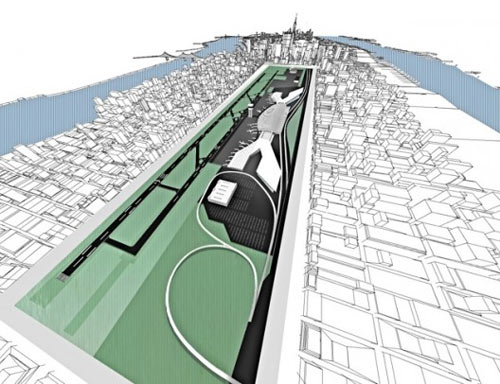
Public dollars helped create Central Park in the 1850s. And public responsibility dictates that we transform this underutilized asset into something we so desperately need today. Manhattan Airport will prove New York City no longer allows it’s vestigial prewar cityscape to languish in irrelevance but instead reinvents these spaces with a daring and inspired bravado truly befitting one of the world’s great cities. The moment is now.
And about those special Central Park landmarks?
Under the current plan the Imagine mosaic and Strawberry Fields will be preserved however they will be located indoors within the main terminal concourse. Tavern on the Green will be given the option of applying for a franchisee lease in the concourse food court.
GVSHP first proposed the street co-naming in 2006 shortly after Jacobs’ death; the proposal was approved by the local community board and the City Council, and then sat in limbo for 2 1/2 years.
Also, the townhouse that Jacobs lived in on the street is for sale. (thx, meg)
Exit Strategy NYC is an iPhone app that tells you where to get on the subway train so as to be in an optimal position when you get off.
Taking the 1 train uptown to 28th street? Get on right behind the middle conductor. Need to transfer to the L at Union Square from the N downtown? Ride in the 1st car. Detailed diagrams eliminate the guesswork and frustration from your ride, making your subway trip easier and faster.
There will also be one large meal, a free picnic in Central Park where eight chefs will each contribute a dish to what Luc Dubanchet, the founder of Omnivore, calls a “bento box performance.” Then there will be a series of demonstrations at the Alliance Francaise, master classes held by an impressive roster of French and American chefs (the final program is still being decided).
The MTA is trying to sell the naming rights to the Atlantic Ave subway stop in Brooklyn to Barclays, a London bank. If approved, other rights may be sold as well. Yes, let’s make the NYC subway even more confusing than it already is, although I’m sure the MTA will come up with some reason that cramming “Domino’s® Breadbowl Pasta™ Station” onto a map makes more sense than “23rd Street”.
On the other hand, a casual study of the NYC subway map reveals the following brand names already in use:
Rockefeller Center
Columbia University
JFK Airport
Museum of Natural History
Lincoln Center
Hunter College
Yankee Stadium
Aqueduct Racetrack
Times Square
Herald Square
NY Aquarium
World Trade Center
Brooklyn Museum
Mets
But, without exception, station names are derived from nearby landmarks: streets, airports, schools, stadiums, squares, parks, etc.
A pair of related articles from the New Yorker last week. The first is a Talk of the Town piece on a water-pistol ambush game played by the students at a New York City private school.
Willis Cohen was finally killed through no fault of his own. He woke up one day and, as usual, hopped a neighbor’s fence and exited through another house. He caught a livery cab on Amity Street and headed north to the Heights. He knew he was in trouble when his driver refused to raise the windows. A member of the Gaisford team shot him in the chest through the cab’s passenger-side window as he pulled up to the school.
The second is a piece by John Seabrook is about David Kennedy and his approach to reducing gang-related murder through a combination of community support and “one strike and everyone’s out” policy.
At the initial call-in, Victor Garcia was the first to speak. He told the young men that he loved them, that they had value to their community, and that he knew they were better than their violent actions implied. Afterward, Chief Steicher addressed them, thanking them for coming, and making it clear that “this is nothing personal.” He then delivered the message: “We know who you are, we know who your friends are, and we know what you’re doing. If your boys don’t stop shooting people right now, we’re coming after everyone in your group.”
Without too much trouble, you could imagine either of these excerpts appearing in either article. A curious editorial decision to run them in the same issue.
Geeking Out sounds interesting, but I can’t go. Perhaps you’d like to?
This month, we’ll be discussing the interaction between science and religion with speakers including: astrophysicist and Is God a Mathematician? author Mario Livio; psychologist Paul Bloom, the author of Descartes’ Baby; and The GOD Part of the Brain author Matthew Alper, one of the founders of the field of neurotheology. The work of local artists will be on display as well.
Geeking Out will be held Thursday, June 18th, at 7:30 pm (doors open at 7:00 pm) at the JLA Studios art gallery on 63 Pearl St in the DUMBO neighborhood of Brooklyn. Admission is FREE. Drinks will be available. Please spread the word and bring your friends.
While many organic dairy farmers who supply big producers have been suffering in the recession, Mr. Hesse says demand for their milk and cream has been growing and that they’d like to start selling in more markets. He’s also thinking about producing yogurt and ice cream.
The minimum investment is $1000 and the notes offer 5-7% interest.
Note: If you are a member and tried to log in, it didn't work, and now you're stuck in a neverending login loop of death, try disabling any ad blockers or extensions. Or try logging out and then back in. Still having trouble? Email me!





Socials & More