kottke.org posts about Covid-19
In an incredible effort, science has provided the world with what looks like an incredibly effective vaccine for Covid-19. For Stat, Helen Braswell writes about the challenges of turning that vaccine into vaccinations. In the US, despite heroic work from individuals and individual groups, our public health system has proved unequal to the challenge of addressing the pandemic, and we’re now turning, in part, to that system to distribute and administer the vaccines, as well as to educate the public and drum up support for vaccination. The people that we’re counting on are public officials and healthcare workers worn out from what is essentially one 9-month-long wave of illness, hospitalizations, and death across the country. Misinformation and skepticism of science and government has sowed “justified distrust” about vaccines in many people:
Concern about the vaccines, however, cuts across ethnic and socioeconomic groups. President Trump’s overt efforts to pressure the FDA to issue EUAs before the Nov. 3 election — before the vaccine trials were finished — has deepened the sense of unease. The CDC’s early pandemic testing fiasco, coupled with its sidelining by the Trump administration, has eroded its standing as a trusted source of information.
Alison Buttenheim, an associate professor of nursing and health policy at the University of Pennsylvania, refers to the current situation as a perfect storm of “justified distrust.”
“People who don’t think twice about vaccinating their kids totally on time, who get their flu shot every year, are in the sort of, ‘Hmmm. Might wait six months on this one,’” Buttenheim, who works on vaccine acceptance, told STAT. “I’ve heard people say, ‘I’ll get the European one,’” she said, adding other people have said they would get vaccinated after Anthony Fauci, director of the National Institute of Allergy and Infectious Diseases, gets vaccinated.
And it’s not just the general public. A recent survey of 2,000 doctors and nurses in New Jersey found that 60% of doctors planned to take a Covid vaccine, but only 40% of nurses intended to, Health Commissioner Judith Persichilli said in a recent “60 Minutes” segment about Operation Warp Speed.
Fauci, along with other respected public health officials and workers, should get vaccinated live on CNN. Stream it on YouTube and Twitch. It won’t convert the anti-vax, anti-mask, QAnon wingnuts (nothing will) but if you can at least get healthcare workers and at-risk folks on board, it would be time well spent.
But that’s only one small piece of the puzzle. Braswell’s piece is long and comprehensive look at the challenges regarding the Covid-19 vaccines and is worth reading all the way through.
Based on the four separate conversations I had with friends this weekend (and reading/watching assorted social media posts), it seems like everyone is really struggling with the pandemic right now, perhaps more so than back in March/April/May. Fatigue is really starting to set in, misinformation is wearing people down, there’s disease and death all around us, it’s tough to keep going towards an ill-defined finish line, and dealing with 9 straight months of grief is just not sustainable. I myself have been all right recently, thankful I’m able to do what I can to support others, but it really varies from week to week.
A year ago, before the pandemic set in, clinical psychologist Kathryn Gordon wrote a piece for Vox on how to help people that you know through a tough time. You may have seen similar advice before — e.g. How Do You Help a Grieving Friend? — but now seems like a good time for a refresher. Here’s one of Gordon’s four tips on how to help:
Ask them how they are feeling. Then, listen non-judgmentally to their response. The simple act of asking someone how they’re doing, with an open-ended question, shows that you care. Listen attentively rather than interrupting or offering your opinion. Ask simple follow-up questions like, “What does that feel like?” or “What has been on your mind as you’re going through this?” This communicates that you genuinely want to know how they’re doing and feel comfortable hearing the truth.
I hope you’re getting the support you need during all of this and are able to find small pockets of time & energy in which to be useful to those around you. ♥
My friend Jodi Ettenberg spent a decade traveling around the world, so she’s got friends and followers from all over the place. Over the weekend, she asked her Instagram followers to share their pandemic experiences and she’s been republishing them in Story collections: one, two, three. (You can also find them on her Instagram profile page.) Individually and as a collection, the stories she’s received are fascinating and heartbreaking to read. Almost 11 months into the pandemic — Wuhan’s lockdown began on Jan 23 — folks out there are really struggling and the response of governments around the world has varied widely (and wildly). Here are a few of the stories…check out the links above to read the rest.
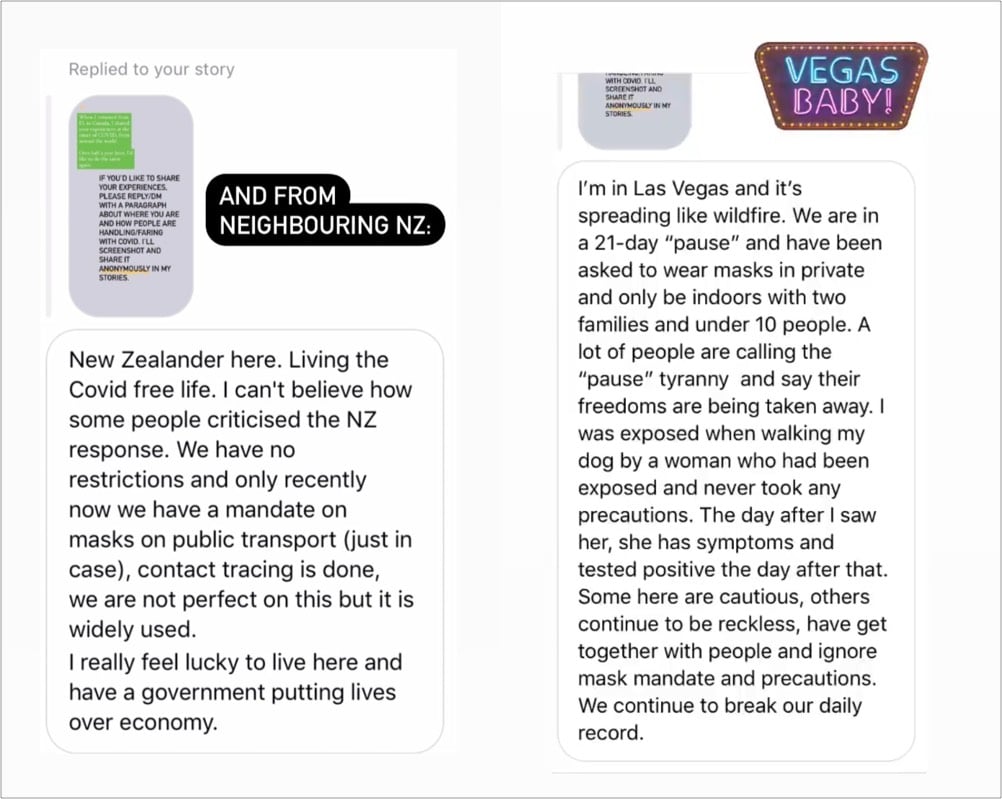
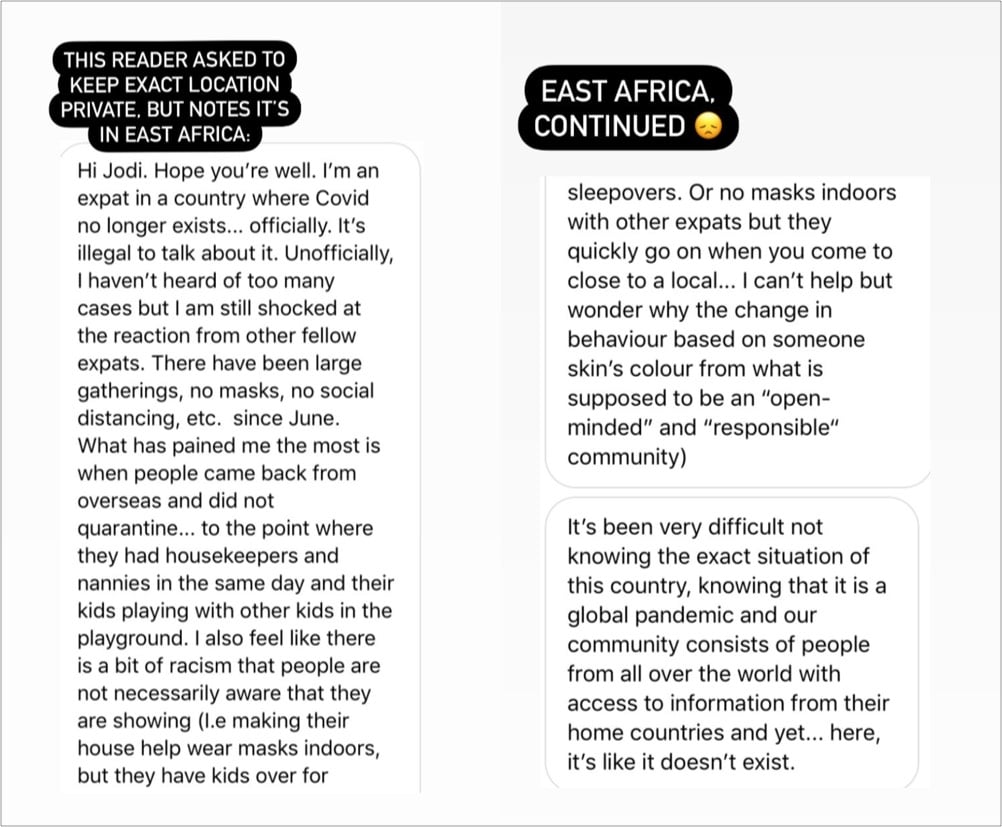
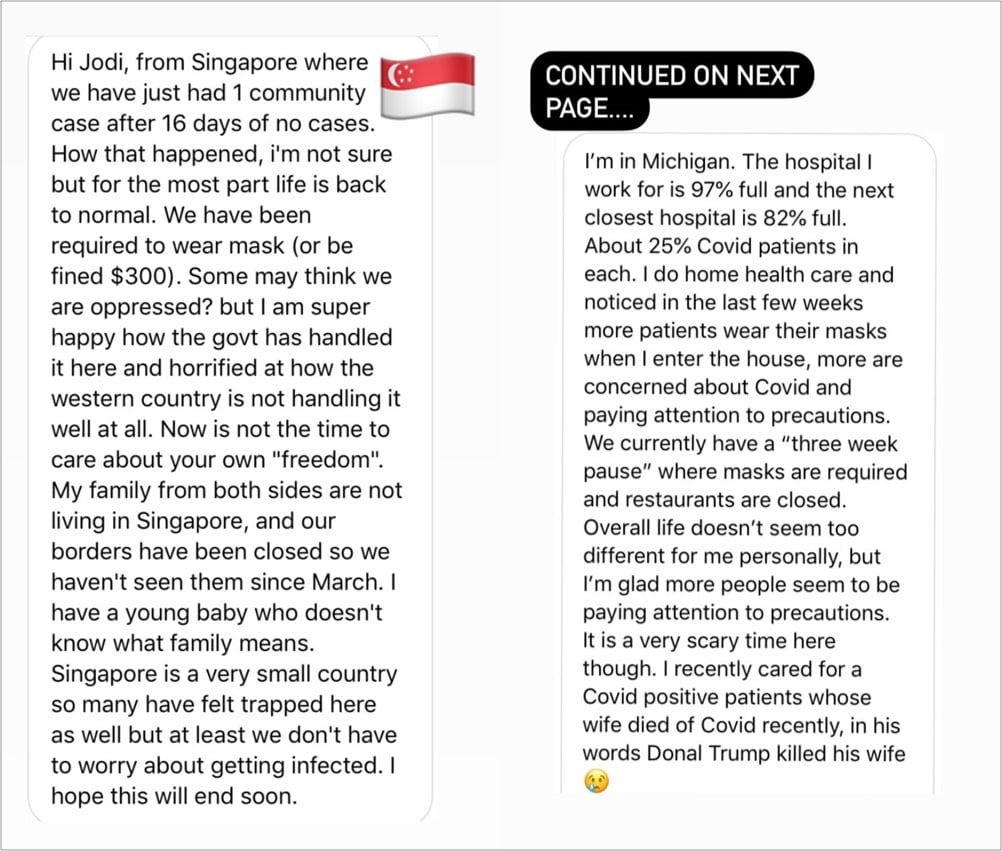
She’s still gathering & sharing stories from people, so send her a DM on Instagram about how things are going in your part of the world if you’d like to participate.
I solicited stories like this from folks back in early April. It’s surreal reading those responses now — so much completely avoidable death and suffering has occurred between then and now.
After Terri Nelson noticed people complaining online about a lack of scent from newly purchased scented candles, Kate Petrova analyzed Amazon reviews for candles from the past three years and found a drop in ratings for scented candles beginning in January 2020 (compared to a smaller ratings decline for unscented candles).
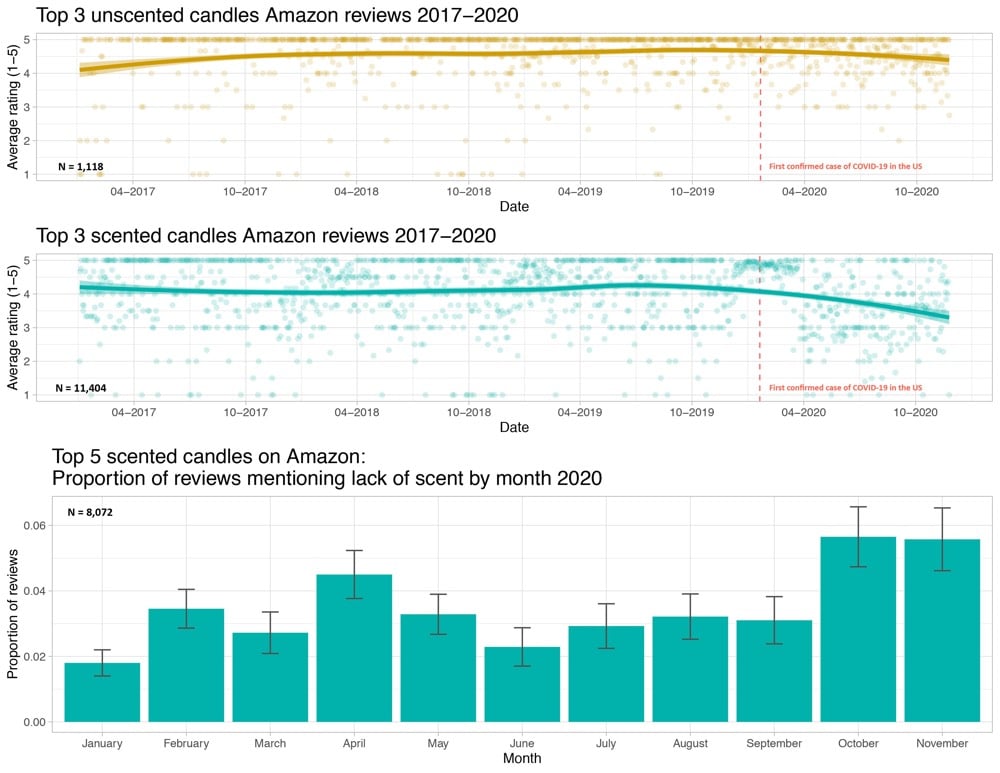
The hypothesis is that some of these buyers have lost their sense of smell due to Covid-19 infections and that’s showing up in the ratings.
With the positive news about the Covid-19 vaccine trials, I assume many of you have started to think about the potential end of the pandemic — what we’ll do, where we’ll go, who we’ll see, and reckon with what’s changed and what’s been lost. I know I have. Alex Hutchinson has written an intriguing piece on what sports science might be able to tell us about the psychology of a situation like the pandemic, where the finish line is poorly defined, ever-changing, or even non-existent.
As it happens, there’s a whole subfield of sports science, at the intersection of physiology and psychology, that explores this terrain. It’s called teleoanticipation, a term coined in 1996 by German physiologist Hans-Volkhart Ulmer to describe how our knowledge of an eventual endpoint (or telos) influences the entirety of an experience. Using endurance sports as their medium, researchers in this subfield have probed what happens when you hide the finish line, surreptitiously move it or take it away entirely. For those of us tempted by promising vaccine updates to start fantasizing about an end to the pandemic, these researchers have some advice: don’t.
Instead, the key seems to be remaining in the moment instead of focusing on the goal.
It turns out that, if you ask yourself “Can I keep going?” rather than “Can I make it to the finish?” you’re far more likely to answer in the affirmative.
This squares with mindfulness practices from Buddhism and Stoicism but also reminds me of a motivational trick I first heard a few years ago: that you can do anything for 10 seconds — and then you just begin a new 10 seconds. Turns out that was popularized by Unbreakable Kimmy Schmidt. Good advice can come from anywhere.

Even though we’re still in the midst of it, The Atlantic commissioned three designers/artists to design hypothetical Covid-19 memorials. Ian Bogost writes:
So this might seem like a strange time to imagine memorializing the pandemic in a formal way. A premature time. Maya Lin’s Vietnam Veterans Memorial was conceived in 1981, six years after the United States had withdrawn from the conflict. Michael Arad and Peter Walker’s 9/11 memorial broke ground at the site of the World Trade Center in 2006, almost five years after the attacks.
But there are downsides to waiting. A traumatic event is an author of its own memorial; as a famous anecdote attests, when a Nazi soldier asked Pablo Picasso if he had made Guernica, the famous painting the artist created during the month following the Luftwaffe’s bombing of its Basque namesake in 1937, Picasso replied, “No, you did.” The feelings, facts, and ideas available during a calamity dissipate as it ebbs. The temptation arises to contain tragedy in a tidy box, closing the book on its history.
Each of the three ideas is intriguing in its own way. I liked how Ronald Rael and Virginia San Fratello (who made those border wall teeter-totters last year) explained their thought process (which Rael elaborated on here).
Quarantine has limited our ability to use smell and touch for communion, so she and Rael became interested in finding a way to replicate the experience. That’s where pennies come in: Copper is an antiviral — a quality with obvious symbolism in the moment — and one that evolves over time, developing a patina as it interacts with water and air. So the pair latched on to it as a material.
Rael San Fratello’s first idea was a pragmatic one: a traditional memorial made of copper molded into a bulbous, organic wall. The copper material would invite the touch lost to quarantine. Outdoors, it could develop a green or purple patina. “If touched constantly,” San Fratello said, “the patina might never occur, and the memorial will remain shiny.”
See also the design for a pandemic memorial already in the planning stages in Uruguay.
Now that the preliminary results of various Covid-19 vaccine trials are coming out (and looking promising), attention is turning to the eventual distribution of the vaccines. The logistics of getting the doses out to hospitals, clinics, and doctor’s offices is one concern but so is the question of who should get vaccinated first. Supplies of the vaccines will be limited at first, so we’ll need to decide as a society what distribution method is most fair and is of the most benefit to the greatest number of people.
To this end, and in response to a request by the CDC and NIH, the National Academies of Sciences, Engineering, and Medicine formed a committee to produce a report called Framework for Equitable Allocation of COVID-19 Vaccine. The 252-page report is available to the public for free to read online or download.
In addition several recommendations — including that the vaccine be distributed to everyone free of charge — a central feature of the report is a four-phase system of vaccine distribution, summarized in this graphic:
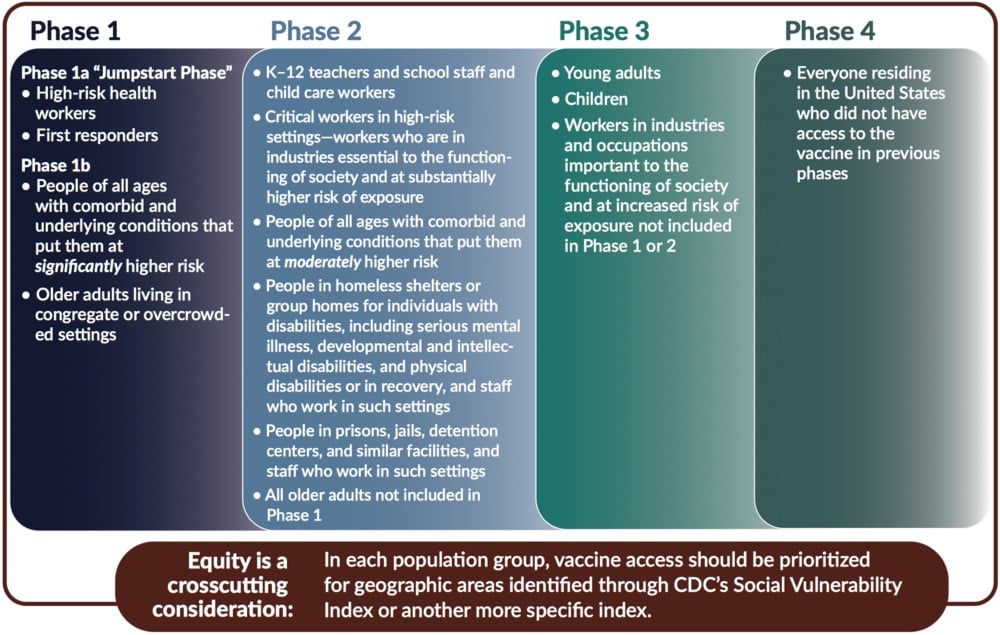
I’d like to stress that this graphic does not show all groups of people included in each phase — please consult the text of the report for that before you go sharing that graphic on social media without context. For example, here’s the full description for “high-risk health workers” in Phase 1a:
This group includes frontline health care workers (who are in hospitals, nursing homes, or providing home care) who either (1) work in situations where the risk of SARS-CoV-2 transmission is higher, or (2) are at an elevated risk of transmitting the infection to patients at higher risk of mortality and severe morbidity. These individuals — who are themselves unable to avoid exposure to the virus — play a critical role in ensuring that the health system can care for COVID-19 patients.
These groups include not only clinicians (e.g., nurses, physicians, respiratory technicians, dentists and hygienists) but also other workers in health care settings who meet the Phase 1a risk criteria (e.g., nursing assistants, environmental services staff, assisted living facility staff, long-term care facility staff, group home staff, and home caregivers). The health care settings employing these workers who are at increased risk of exposure to the virus may also include ambulatory and urgent care clinics; dialysis centers; blood, organ, and tissue donation facilities; and other non-hospital health care facilities. Finally, there are community and family settings where care for infected patients occurs. Not all the workers in these settings are paid for their labor, but, while they are caring for infected people, they all need to be protected from the virus.
Situations associated with higher risk of transmission include caring for COVID-19 patients, cleaning areas where COVID-19 patients are admitted, treated, and housed, and performing procedures with higher risk of aerosolization such as endotracheal intubation, bronchoscopy, suctioning, turning the patient to the prone position, disconnecting the patient from the ventilator, invasive dental procedures and exams, invasive specimen collection, and cardiopulmonary resuscitation. In addition, there are other frontline health care workers who, if they have uncontrolled exposure to the patients or the public in the course of their work, should be in this initial phase. This group includes those individuals distributing or administering the vaccine — especially in areas of higher community transmission — such as pharmacists, plasma and blood donation workers, public health nurses, and other public health and emergency preparedness workers. The committee also includes morticians, funeral home workers, and other death care professionals involved in handling bodies as part of this high-risk group.
The report declines to list specific industries which would be covered in Phase 2’s “critical workers in high-risk settings” but generally says:
The industries in which these critical workers are employed are essential to keeping society and the economy functioning. Since the beginning of the pandemic, millions of people have been going to work and risking exposure to the virus to ensure that markets have food; drug stores have pharmaceutical products; public safety and order are maintained; mail and packages are delivered; and buses, trains, and planes are operating.
Note also the text at the bottom of the graphic: they recommend that within each phase, priority be given to geographic areas where folks are more socially vulnerable in situations like these (e.g. as represented in the CDC’s Social Vulnerability Index).
In developing this phased approach, the committee focused on those who are at the most risk of exposure, severe illness or death, and passing along the virus to others as well as critical workers:
Risk of acquiring infection: Individuals have higher priority to the extent that they have a greater probability of being in settings where SARS-CoV-2 is circulating and of being exposed to a sufficient dose of the virus.
Risk of severe morbidity and mortality: Individuals have higher priority to the extent that they have a greater probability of severe disease or death if they acquire infection.
Risk of negative societal impact: Individuals have higher priority to the extent that societal function and other individuals’ lives and livelihood depend on them directly and would be imperiled if they fell ill.
Risk of transmitting infection to others: Individuals have higher priority to the extent that there is a higher probability of their transmitting the infection to others.
You should read (or at least skim) the full report for more information about the plan and the rationale behind it.
On a personal parting note, as someone who is squarely in the 5-15% of Americans covered in Phase 4 — more specifically: as a 40-something straight white man who non-essentially works from home, isn’t low-income, doesn’t socialize widely even under normal circumstances, and should probably be the very last person on this whole Earth scheduled to be vaccinated under an equitable framework — I am content to wait my turn should the US adopt this framework or something like it.1 Distributing vaccines to those who need them most is absolutely the right thing to do, both ethically and from the standpoint of getting society “back to normal” as quickly as possible and with as little additional death and suffering as possible.
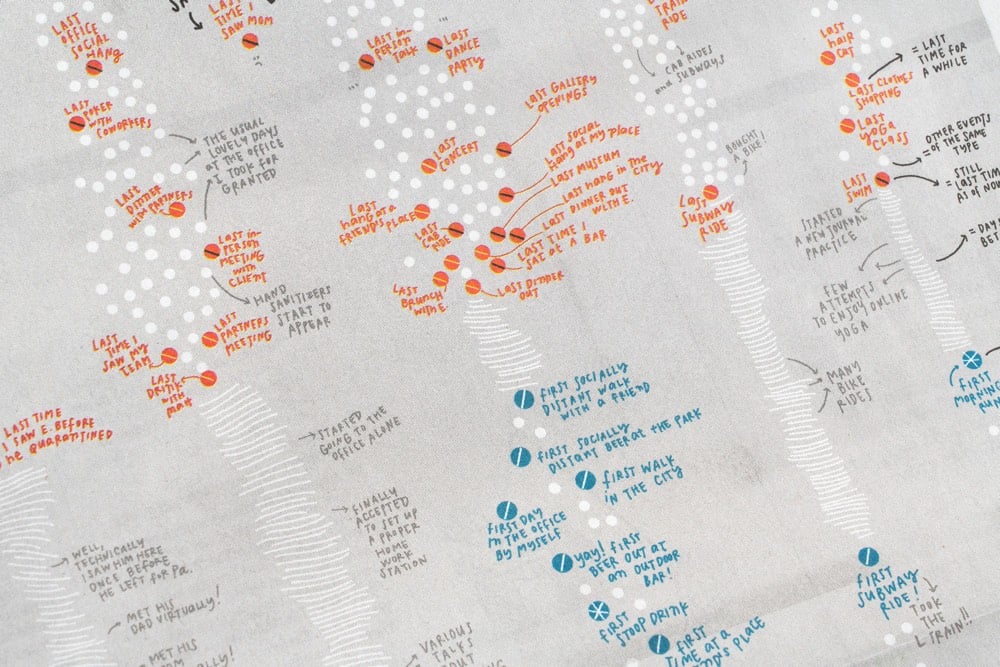
For the print version of the NY Times from this past Sunday, information designer Giorgia Lupi created a hand-drawn visualization that “tracks the last time [she] did something before the pandemic hit, and the first time she did something new with social distancing”.
Our lives have been transformed during the Covid-19 pandemic as the activities we used to do every day have been put on hold and new, socially distanced routines have taken their place. Pentagram partner Giorgia Lupi documents these changes in her own life in a data visualization commissioned by The New York Times for the cover of its “At Home” section, which runs as part of the newspaper’s Sunday edition. The hand-drawn visualization is a personal timeline that tracks the “last” time Giorgia did something before the pandemic hit, and the “first” time she did something new as she started to emerge from lockdown.
Not hand-drawn, but I remember pretty clearly what my lasts were:
- Last movie (w/ kids): Onward in mid-March
- Last movie (solo): Portrait of a Lady on Fire in mid-March
- Last visit to NYC: late October 2019
- Last trip: Vietnam/Singapore/Qatar in Jan/Feb 2020
- Last restaurant (solo): a forgettable ramen place in Burlington in mid-March
- Last restaurant (w/ a friend): better local ramen place in early March
- Last cocktail bar: Bar Stories in Singapore in early February
- Last museum: Museum of Islamic Art in Doha, Qatar in early February
I don’t remember my firsts as well, although one that sticks out is eating french fries (take-out) in July. On a normal day, french fries are delicious but when you haven’t had them in months, they are otherworldly.
Preliminary results from the trials of the Covid-19 vaccine jointly developed by the University of Oxford and AstraZeneca indicate that the vaccine’s overall efficacy is 70% but that a regimen that calls for a lower first dose is 90% effective.
The preliminary results on the AstraZeneca vaccine were based on a total of 131 Covid-19 cases in a study involving 11,363 participants. The findings were perplexing. Two full doses of the vaccine appeared to be only 62% effective at preventing disease, while a half dose, followed by a full dose, was about 90% effective. That latter analysis was conducted on a small subset of the study participants, only 2,741.
Hopefully more study will be done on that dosage question. From the AP:
“The report that an initial half-dose is better than a full dose seems counterintuitive for those of us thinking of vaccines as normal drugs: With drugs, we expect that higher doses have bigger effects, and more side-effects,” he said. “But the immune system does not work like that.”
The seemingly lower efficacy comes with some perhaps significant benefits: this vaccine is cheaper to produce and doesn’t require any special refrigeration.
The vaccine can be transported under “normal refrigerated conditions” of 2 to 8 degrees Celsius (36 to 46 degrees Fahrenheit), AstraZeneca said. By comparison, Pfizer plans to distribute its vaccine using specially designed “thermal shippers” that use dry ice to maintain temperatures of minus-70 degrees Celsius (minus-94 degrees Fahrenheit).
The Pfizer and Moderna vaccines were pretty similar in many respects and this one seems quite different. These results were just released a few hours ago, so it will be interesting to follow the debate and expert commentary on this. Stay tuned…
Update: This is amazing: the seemingly more effective 1/2 dose + full dose regimen was a mistake.
Around the time when Astra was initiating its partnership with Oxford at the end of April, university researchers were administering doses to trial participants in Britain.
They soon noticed expected side effects such as fatigue, headaches or arm aches were milder than expected, he said.
“So we went back and checked … and we found out that they had underpredicted the dose of the vaccine by half,” said Pangalos.
A far smaller number of participants was given the initial half-dose, so more research will need to be done to determine if this mistake will be added to the long list of scientific discoveries made because of errors. There’s a good piece in Nature that talks about what we know and don’t know about the vaccine results so far along with some informed speculation.
But, if the differences are bona fide, researchers are eager to understand why. “I don’t think it’s an anomaly,” says Katie Ewer, an immunologist at Oxford’s Jenner Institute who is working on the vaccine. “I’m keen to get into the lab and start thinking about how we address that question.” She has two leading theories for why a lower first dose might have led to better protection against COVID. It’s possible that lower doses of vaccine do a better job at stimulating the subset of immune cells called T cells that support the production of antibodies, she says.
Another potential explanation is the immune system’s response against the chimpanzee virus. The vaccine triggers an immune response not only to the SARS-CoV-2 spike protein, but also to components of the viral vector. It’s possible that the full first dose blunted this reaction, says Ewer. She plans to look at antibody responses against the chimpanzee virus to help address this question.
Update: A short thread by Dr. Natalie Dean, which leads with “AstraZeneca/Oxford get a poor grade for transparency and rigor when it comes to the vaccine trial results they have reported”.
COVID-19 has required all of us to scrutinize our actions and sacrifice our desires and even our obligations in order to keep ourselves and those around us safe. I want to examine two cases where reasonable, well-informed, and influential people make entirely different choices based on largely similar evidence.
You may have heard that MSNBC host Rachel Maddow has been quarantining at home following close contact with a person who had tested positive for COVID-19. You may have also heard that last night, Maddow returned to her show (still filming from home) to reveal that this person was her partner of 20+ years, artist/photographer Susan Mikula. Mikula is recovering, but at at least one point, the couple genuinely feared for her life. Maddow herself is still testing negative; with Mikula in much less danger and Maddow nearing the end of quarantine, they felt it was time to open the curtain on their experience.
If you haven’t seen it already, I’d like you to watch the video of Maddow describing her experience of living with a loved one who is suffering from COVID-19, whom you have to care for but cannot touch without grave risk to yourself, and then to others. (It is about Mikula’s own experience, but it’s really much more about Maddow’s experience, for good reason.)
Here’s a quick excerpt, if you want a textual preview (via Vulture):
“Just believe me: Whatever you have calculated into your life as acceptable risk, as inevitable risk, something that you’re willing to go through in terms of this virus because statistically, hey probably, it will be fine for you and your loved ones, I’m just here to tell you to recalibrate that,” [Maddow] warned. “Frankly, the country needs you to recalibrate that because broadly speaking, there’s no room for you in the hospital right now.”
She cites hospitals being overwhelmed with a “50 percent” increase in patients “in two weeks.” While it may be easy to risk your own life, the virus doesn’t let you make the choice. “What you need to know is whoever’s the most important person in your life, whoever you most love and most care for and most cherish in the world, that’s the person who you may lose and who you may spend weeks up all night freaking out about and calling doctors all over the place and over and over again all night long, trying to figure out how to keep that person breathing and out of the hospital,” she said. “Whatever you’re doing, however you’ve calibrated risk in your life, don’t get this thing.”
Another moment worth noting in the video is shortly after she begins. Maddow is interrupted by a recurring beeping noise in a room off-camera. She has to attend to it herself, in the middle of a live television show, because there’s no one else at home who can do it. She takes off her microphone and earpiece, then has to put it back on. After already revealing at the beginning of the show that she’s not wearing makeup—she doesn’t know how to apply it herself, and no one can help her—it’s a nice peek behind the scenes.
I don’t know if everyone always understands how much work it takes it is to perform for live television: how many accessories you need, how much support is required. People don’t see what you have to look like, sound like, or act like; they don’t see the almost cyborg contraption you have to become in order to make a successful television appearance. Being good at television is a specific skill. It’s as different from writing, reporting, or public speaking as football, baseball, and basketball are from playing polo. It doesn’t matter if you have your words on a teleprompter (although that does help): you still have to deliver them, in time, no backsies, and look and sound good while you’re doing it.
The disruption of the show also happens in the middle of a charming metaphor Maddow uses to describe her relationship:
The way that I think about it is not that she is the sun and I’m a planet that orbits her—that would give too much credit to the other planets. I think of it more as a pitiful thing: that she is the planet and I am a satellite, and I’m up there sort of beep-beep-beeping at her and blinking my lights and just trying to make her happy.
Compare this to Farhad Manjoo’s essay in The New York Times today, “I Traced My COVID-19 Bubble and It’s Enormous.” Manjoo starts with a classic dilemma: he knows it’s unsafe in general to travel for Thanksgiving, but he wonders if it might be safer for his family, given the size of their social circle and the precautions they’ve taken. He’d like to find out more, to replace his general intuitions, which pull him in both directions, with something more concrete. This is a time-honored journalistic premise (a rhetorical trope, really) for answering a question many people might have.
In researching his close contacts, and their own exposure to other people, Manjoo quickly has cold water thrown on the notion that his bubble is in any way contained to the degree he’d imagined it to be. (This part of the story is well-illustrated: I’ll give you the text excerpts, but it’s worth clicking through and scrolling through yourself.)
I thought my bubble was pretty small, but it turned out to be far larger than I’d guessed.
My only close contacts each week are my wife and kids.
My kids, on the other hand, are in a learning pod with seven other children and my daughter attends a weekly gymnastics class.
I emailed the parents of my kids’ friends and classmates, as well as their teachers, and asked how large each family’s bubble was.
Already, my network was up to almost 40 people.
Turns out a few of the families in our learning pod have children in day care or preschool.
And one’s classmate’s mother is a doctor who comes into contact with about 10 patients each week.
Once I had counted everyone, I realized that visiting my parents for Thanksgiving would be like asking them to sit down to dinner with more than 100 people.
He isn’t actually done counting yet: from himself, he’s only gone to three degrees of separation. But presumably, the point in the headline is made. The author’s bubble is enormous, and presumably the reader’s is, too.
Then a curious thing happens. Manjoo decides that what he’s learned doesn’t matter. He thinks his family and his contacts are special after all. “All of my indirect contacts are taking the virus seriously—none of them spun conspiracy theories about the pandemic, or suggested it was no big deal or told me to bug off and mind my own business.” (This is a very low threshold for “taking the virus seriously.”) And he would really like to take his wife and children to see his parents. An epidemiologist gives him some cover, saying his desire to see their parents is understandable, and it’s all a matter of assessing and evaluating risk.
So, he changes his mind again. He makes a few concessions (drive, not fly; an outdoor meal rather than an indoor one; staying off-site rather than sleeping over). And he’s going to travel five hours each way with his wife and children and their 100+ direct and indirect contacts to celebrate Thanksgiving with his parents.
This is contrarianism on a scale not usually seen in a newspaper article. (They’re usually too short to take this many turns.) It is one thing to counter received wisdom by posing a counterfactual. It is another to spend hours of reporting, gathering facts, calling in experts, putting everything on the record, and then deciding that none of that matters.
On Twitter, I called it “the full Gladwell”; only Malcolm Gladwell at The New Yorker can consistently pull this hairpin twist off and stick the landing, even if he frequently violates good sense and plain facts to do it.
It’s important, though, that this is not just a rhetorical trick. These are the real lives of real people, both in the story itself, and radiating out to its readers and their contacts in a global newspaper, the United States’ paper of record. And the reasoning and evidence that are considered but discarded gives the illusion that this is a choice motivated not by setting reason aside, but considering all options and maximizing one’s expected utility.
Not to “both sides” this, but I’m gonna “both sides” this: in some sense, both Maddow and Manjoo are putting their thumb on the scales, in opposite directions. For Maddow, the experience of almost losing the love of her life makes it so that she would take no willing risk that might endanger her or anyone else. (She acknowledges that a certain amount of unavoidable, unwilling risk remains.)
Manjoo is different. He acknowledges that he has no such experience. He is less concerned with the possible loss of his parents’ lives than the loss of their presence in his life and in their childrens’ lives. He sees the willing assumption of risk as an open moral question, and something that can be calculated and appropriately mitigated.
Maddow has constructed a universe where she is a tiny satellite orbiting a much larger planet, whose continued health and existence is the central focus of her concern. Manjoo has drawn a map with himself at its center, where anyone beyond the reach of his telephone falls off the edges.
Maddow is also explicitly pleading with her viewers to learn what they can from her experience, and adjust their behavior accordingly. Manjoo is performing his calculus only for himself; he implicitly presents himself as a representative example (while also claiming he and his circle are extraordinarily conscientious and effective), but each reader can draw their own conclusions and make their own decision.
At this point the balancing dominoes tip over. Maddow’s position, her argument, and her example are clearly more moral and more persuasive than Manjoo’s. Manjoo’s essay is worth reading, but the conclusion is untenable. It doesn’t do the work needed to arrive there or persuade anyone else to do the same. And at a time when many people are spinning conspiracies about the pandemic, or claiming that it’s no big deal, and in turn influencing others—when we haven’t even yet considered the virus’s impact on the uncounted number of people, from medical staff and many other essential workers to prisoners and the impoverished, who do not simply get to choose how to spend their holiday—it’s irresponsible.
The larger moral tragedy is that because our leaders have failed, and too often actually worked to damage the infrastructure, expertise, and goodwill accumulated over generations, we have no consistent, authoritative guidance on what we should and should not do. We do not know who to trust. We have no money, no help, and no plan but to wait. We have no sense of what rules our friends and neighbors, colleagues and workers, are following when they’re not in our sight; we don’t even know what practices they would even admit to embracing. We have no money; we have no help. We are left on our own, adrift in deep space, scribbling maps and adding sums on the back of a napkin. We are all in this together, yet we are completely alone.
For Vox, Julia Belluz takes a look at the approach that’s made Vermont more successful than most other US states in combatting Covid-19. The big thing? State officials recognized that those most at risk needed more support.
There’s a fatal flaw embedded in the basic Covid-19 test, trace, and isolate trifecta used around the world: It doesn’t account for the fact that the coronavirus is not an equal-opportunity pathogen. The people who are most likely to be tested, and to have the easiest time quarantining or isolating, are also the least likely to get sick and die from the virus.
From the United Kingdom to Sweden to Canada, we have evidence that the virus preys on people employed in “essential service” jobs (bus drivers, nurses, factory workers), which don’t allow for telecommuting or paid sick leave; people in low-income neighborhoods; and people in “congregate housing” like shelters, prisons, and retirement homes.
People of color tend to be overrepresented in these groups — but there’s no biological reason they’re more likely to get sick and die from the virus. Simply put: They tend to work jobs that bring them outside the home and into close contact with other people, live in crowded environments ideal for coronavirus contagion, or both.
The state then directed efforts, resources, and money to nursing homes, the unhoused, prisons, and essential workers to make it easier for those folks to stay safe.
I also thought this bit was really interesting:
There’s a simple adage in public health: “Never do a test without offering something in exchange,” said Johns Hopkins’s Stefan Baral. So when a patient gets tested for HIV, for example, they’re offered treatment, support, or contact tracing. “We’re not just doing the testing to get information but also providing a clear service,” Baral added, and potentially preventing that person from spreading the virus any further. “This is basic public health.”
With Covid-19, the US has failed at basic public health. Across the country, people have been asked to get tested without anything offered in exchange.
“If we are asking people to stay home and not work, we have to make sure society is supporting them,” Baral said. “An equitable program would support people to do the right thing.”
“Never do a test without offering something in exchange.” To the extent that federal and state governments have been asking to people to stay home, get tested, and wear a mask, many of those same governments have been unwilling or unable to provide people with much in return for doing so. And so, here we are months into this, paying for that inaction with 250,000 lives.
Update: How NYC does “never do a test without offering something in exchange”:
You can access a free hotel room to safely isolate from your family, which include meals, Rx delivery, free wi-fi, medical staff on site, and transportation to and from hotel and medical appointments.
(via @agoX)
As I write this, it’s snowing outside here in Vermont and Covid-19 has finally gained a foothold in our little state. At the governor’s press conference yesterday, he and his pandemic response team announced that contact tracing done by the state showed that the rise in cases started as an outbreak in some hockey leagues. That initial outbreak wasn’t contained and subsequent non-essential, indoor, mask-less, multi-household gatherings and Halloween parties resulted in the very sharp rise we started to see here in the first week of November.
Scott explained that 71% of outbreaks reported from Oct. 1 to Nov. 13 were linked to “social events, parties and people hanging out at home or bars and clubs.” He added Vermont has not seen the virus spread widely at schools, restaurants or other businesses.
Dr. Mark Levine, the state health commissioner, said those parties came in a variety of sizes of parties — Halloween gatherings large and small, dinner parties, baby showers, “people in the high single numbers at a deer camp.”
In states with many infections, particularly in the Midwest, contact tracing is all but impossible, so it’s instructive to pay attention to Vermont’s example here: we’re doing the tracing and the tracers say the infections are coming from people gathering indoors across multiple households. Which is exactly what public health and medical experts have been urging people not to do for months now.
And that brings us to Thanksgiving. For The Atlantic, Rachel Gutman asked her colleagues who have been writing extensively about the pandemic for some of their top safety rules and guidelines and their number one was, say it with me:
My colleagues’ guidance boils down to this winter’s golden rule for interacting with anyone outside your immediate household: Don’t spend time indoors with other people.
Here it is again in a fun font, just to make sure you got it: 𝓓𝓸𝓷’𝓽 𝓼𝓹𝓮𝓷𝓭 𝓽𝓲𝓶𝓮 𝓲𝓷𝓭𝓸𝓸𝓻𝓼 𝔀𝓲𝓽𝓱 𝓸𝓽𝓱𝓮𝓻 𝓹𝓮𝓸𝓹𝓵𝓮.
Look, for some people spending time indoors with others is essential — jobs, education, etc. — but those who don’t have to, shouldn’t. And this goes for everywhere in the US because no states (aside from maybe Hawaii) are doing well right now — cases are either high, rising sharply, or both. Please please don’t gather in indoor, multi-household groups for Thanksgiving if you haven’t quarantined beforehand. In the US right now, about 1-in-55 people who get Covid-19 die from it. With rates already high around the country, if many people do Thanksgiving as usual, an already horrific and deadly situation could become much much worse.
According to an unpublicized report by the Chinese government, the first documented case of Covid-19 was a 55-year-old person living in Hubei province on November 17, 2019. That makes today the first anniversary of the start of the Covid-19 pandemic. From that person (and possibly earlier or concurrent cases), the disease slowly and silently spread until it was determined to be due to a novel coronavirus.
They found that following the Nov. 17 case, about one to five new cases were reported every day and by Dec. 15, the total infections reached 27. Daily cases seem to have increased after that, with the case count reaching 60 by Dec. 20, the SCMP reported.
On Dec. 27, Dr. Zhang Jixian, head of the respiratory department at Hubei Provincial Hospital, reported to health officials in China that a novel coronavirus was causing the disease; by that day, it had infected more than 180 individuals. (Doctors may not have been aware of all of those cases at the time, but only identified those cases after going back over the records, the Morning Post reported.)
No one had any idea how much the world was going to change that day. What an awful, humbling, terrifying, ghoulish year.
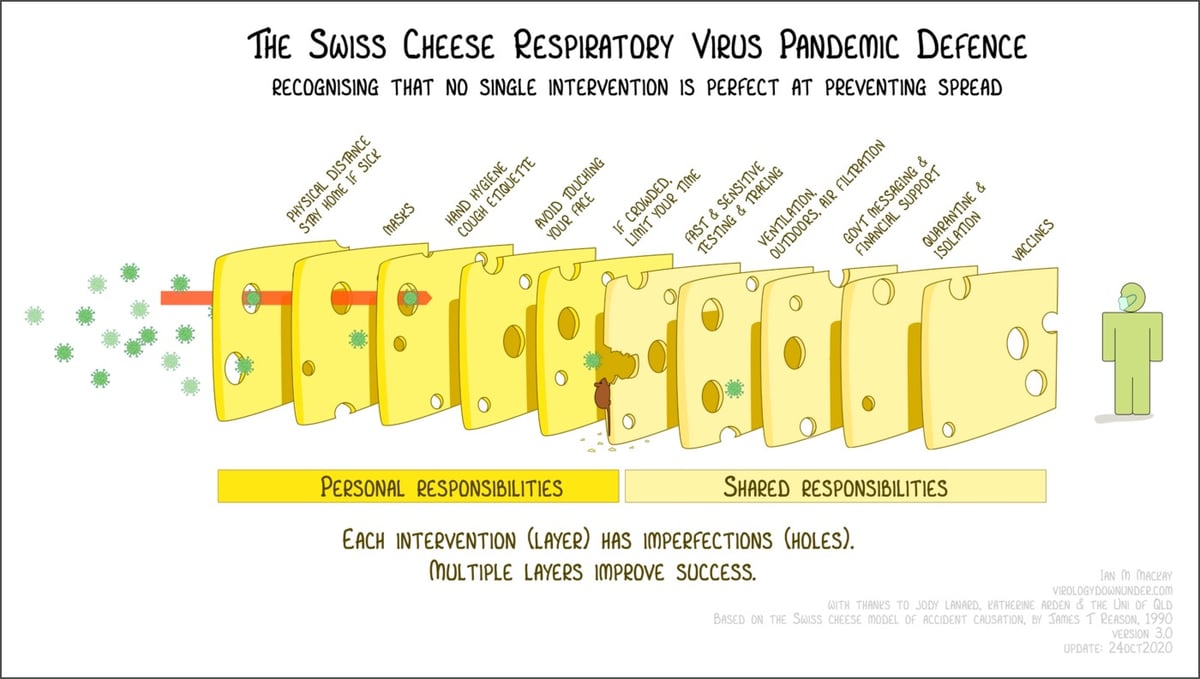
The Swiss cheese model of accident causation is a framework for thinking about how to layer security measures to minimize risk and prevent failure. The idea is that when several layers of interventions, despite their weaknesses, are properly stacked up between a hazard and a potentially bad outcome, they are able to cumulatively prevent that outcome because there’s no single point of failure. During the pandemic, health care workers and public health officials have been using the Swiss cheese model to visualize how various measures can work together to help keep people safe.
Virologist Dr. Ian Mackay has visualized the Swiss cheese Covid-19 defense in a wonderful way (pictured above). Each layer of cheese represents a personal or shared intervention — like mask wearing, limiting your time indoors w/ crowds, proper ventilation, quarantine, vaccines — and the holes are imperfections. Applied together, these imperfect measures work like a filter and can vastly improve chances of success.1 He even added a “misinformation mouse” chewing through one of the cheese slices to represent how deceptive information can weaken these defenses.
Mackay has released this graphic under a Creative Commons license (free to share and adapt w/ attribution) and is available in English, German, French, Spanish, Korean, and several other languages. (via @EricTopol)
Zeynep Tufekci says that a devastating third pandemic surge is upon us and that It’s Time to Hunker Down. She leads with the good news (vaccines, treatments, knowledge, testing capacity & quickness) but notes that with winter coming and a high baseline of cases from a summer not spent in preparation, now is the time to really knuckle down so that we can get to the finish line.
Whatever the causes, public-health experts knew a fall and winter wave was a high likelihood, and urged us to get ready.
But we did not.
The best way to prepare would have been to enter this phase with as few cases as possible. In exponential processes like epidemics, the baseline matters a great deal. Once the numbers are this large, it’s very easy for them to get much larger, very quickly — and they will. When we start with half a million confirmed cases a week, as we had in mid-October, it’s like a runaway train. Only a few weeks later, we are already at about 1 million cases a week, with no sign of slowing down.
Americans are reporting higher numbers of contacts compared with the spring, probably because of quarantine fatigue and confusing guidance. It’s hard to keep up a restricted life. But what we’re facing now isn’t forever.
It’s time to buckle up and lock ourselves down again, and to do so with fresh vigilance. Remember: We are barely nine or 10 months into this pandemic, and we have not experienced a full-blown fall or winter season. Everything that we may have done somewhat cautiously — and gotten away with — in summer may carry a higher risk now, because the conditions are different and the case baseline is much higher.
Newer posts
Older posts



Socials & More