kottke.org posts about Covid-19
On Friday, November 13, 170,792 new cases of Covid-19 were reported in the United States. About 3000 of those people will die from their disease on Dec 6 — one day of Covid deaths equal to the number of people who died on 9/11. It’s already baked in, it’s already happened. Here’s how we know.
The case fatality rate (or ratio) for a disease is the number of confirmed deaths divided by the number of confirmed cases. For Covid-19 in the United States, the overall case fatality rate (CFR) is 2.3%. That is, since the beginning of the pandemic, 2.3% of those who have tested positive for Covid-19 in the US have died. In India, it’s 1.5%, Germany is at 1.6%, Iran 5.5%, and in Mexico it’s a terrifying 9.8%.
A recent analysis by infectious disease researcher Trevor Bedford tells us two things related to the CFR.
1. Reported deaths from Covid-19 lag behind reported cases by 22 days. Some deaths are reported sooner and some later, but in general it’s a 22-day lag.1
2. The overall CFR in the US is 2.3% but if you use the 22-day lag to calculate what Bedford calls “a lag-adjusted case fatality rate”, it’s a pretty steady average of 1.8% since August. Here’s a graph:
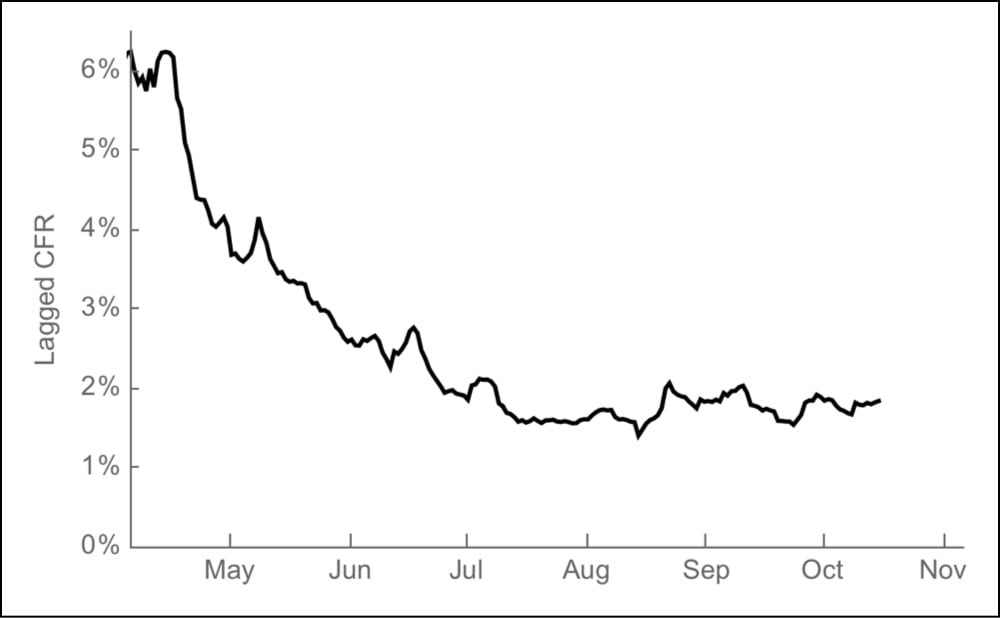
As you can see, in the early days of the pandemic, 4-6% of the cases ended in death and now that’s down to ~1.8%. That’s good news! The less good news is that the current case rate is high and rising quickly. Because of the lag in reported deaths, the rise in cases might not seem that alarming to some, even though those deaths will eventually happen. What Bedford’s analysis provides is a quick way to estimate the number of deaths that will occur in the future based on the number of cases today: just multiply the number of a day’s cases by 1.8% and you get an estimated number of people who will die 22 days later.2
For instance, as I said above, 170,792 cases were reported on Nov 13 — 1.8% is 3074 deaths to be reported on December 6. Cases have been over 100,000 per day for 11 days now: here are the estimated deaths from that time period:
| Date |
Cases |
Est. deaths (on date) |
| 2020-11-15 | 145,670 | 2622 (2020-12-08) |
| 2020-11-14 | 163,473 | 2943 (2020-12-07) |
| 2020-11-13 | 170,792 | 3074 (2020-12-06) |
| 2020-11-12 | 150,526 | 2709 (2020-12-05) |
| 2020-11-11 | 144,499 | 2601 (2020-12-04) |
| 2020-11-10 | 130,989 | 2358 (2020-12-03) |
| 2020-11-09 | 118,708 | 2137 (2020-12-02) |
| 2020-11-08 | 110,838 | 1995 (2020-12-01) |
| 2020-11-07 | 129,191 | 2325 (2020-11-30) |
| 2020-11-06 | 125,252 | 2255 (2020-11-29) |
| 2020-11-05 | 116,153 | 2091 (2020-11-28) |
| 2020-11-04 | 103,067 | 1855 (2020-11-27) |
| Totals | 1,609,158 | 28,965 |
Starting the day after Thanksgiving, a day traditionally called Black Friday, the 1.6 million positive cases reported in the past 12 days will result in 2-3000 deaths per day from then into the first week of December. Statistically speaking, these deaths have already occurred — as Bedford says, they are “baked in”. Assuming the lagged CFR stays at ~1.8% (it could increase due to an overtaxed medical system) and if the number of cases keeps rising, the daily death toll would get even worse. As daily case totals are reported, you can just do the math yourself:
number of cases × 0.018
200,000 cases in a day would be ~3600 deaths. 300,000 daily cases, a number that would have been inconceivable to imagine in May but is now within the realm of possibility, would result in 5400 deaths in a single day. Vaccines are coming, there is hope on the horizon. But make no mistake: this is an absolute unmitigated catastrophe for the United States.
Update: Over at The Atlantic, Alexis Madrigal and Whet Moser took a closer look at Bedford’s model, aided by Ryan Tibshirani’s analysis.
Tibshirani’s first finding was that the lag time between states was quite variable-and that the median lag time was 16 days, a lot shorter than the mean. Looking state by state, Tibshirani concluded, it seemed difficult to land on an exact number of days as the “right” lag “with any amount of confidence,” he told us. Because cases are rising quickly, a shorter lag time would mean a larger denominator of cases for recent days — and a lower current case-fatality rate, something like 1.4 percent. This could mean fewer overall people are dying.
But this approach does not change the most important prediction. The country will still cross the threshold of 2,000 deaths a day, and even more quickly than Bedford originally predicted. Cases were significantly higher 16 days ago than 22 days ago, so a shorter lag time means that those higher case numbers show up in the deaths data sooner. Even with a lower case-fatality rate, deaths climb quickly. Estimating this way, the country would hit an average of 2,000 deaths a day on November 30.
The other major finding in Tibshirani’s analysis is that the individual assumptions and parameters in a Bedford-style model don’t matter too much. You can swap in different CFRs and lag-time parameters, and the outputs are more consistent than you might expect. They are all bad news. And, looking retrospectively, Tibshirani found that a reasonable, Bedford-style lagged-CFR model would have generated more accurate national-death-count predictions than the CDC’s ensemble model since July.
Last Monday the world got some good news: an early review of the data showed that Pfizer’s Covid-19 vaccine was “more than 90% effective” in preventing the disease. The results pointed to other vaccines also being highly effective against the virus and this morning comes this news: Early Data Show Moderna’s Coronavirus Vaccine Is 94.5% Effective.
The drugmaker Moderna announced on Monday that its coronavirus vaccine was 94.5 percent effective, based on an early look at the results from its large, continuing study.
Researchers said the results were better than they had dared to imagine. But the vaccine will not be widely available for months, probably not until spring.
Despite the delivery timeline, this is such good news.
The companies’ products open the door to an entirely new way of creating vaccines — and creating them fast. Both use a synthetic version of coronavirus genetic material, called messenger RNA or mRNA, to program a person’s cells to churn out many copies of a fragment of the virus. That fragment sets off alarms in the immune system and stimulates it to attack, should the real virus try to invade. Although a number of vaccines using this technology are in development for other infections and cancers, none have yet been approved or marketed.
“The fact that two different vaccines made by two different companies with two different kinds of structures, in a new messenger RNA concept, both worked so effectively confirms the concept once and for all that this is a viable strategy not only for Covid but for future infectious disease threats,” said Dr. Barry R. Bloom, a professor of public health at Harvard.
Natalie E. Dean, a biostatistician at the University of Florida, said an important finding was that the vaccine appeared to prevent severe disease. Pfizer did not release information about disease severity when reporting its results.
Researchers say the positive results from Pfizer and Moderna bode well for other vaccines, because all of the candidates being tested aim at the same target - the so-called spike protein on the coronavirus that it uses to invade human cells.
It’s only a few more months — please please do what you can to stay safe and keep others safe (especially medical workers) until these vaccines can be rolled out.


Denver’s Vicki Myhren Gallery is hosting a virtual exhibition called MASK that showcases participating artists’ takes on the now-ubiquitous Covid-19 face masks.
Through this project, we hope to call attention to the significance and signification of masking as an issue of public health and a demonstration of civic responsibility. Equally, MASK calls attention to this newly important medium’s function as an outward mode of self-expression and opportunity for creativity.
(via colossal)
This morning, the transition team for President-elect Joe Biden announced the members of his Covid-19 task force.
The list includes Rick Bright, the former head of the vaccine-development agency BARDA ousted by the Trump administration in April; Atul Gawande, the surgeon, writer, and recently departed CEO of Haven, the joint JP Morgan Chase-Berkshire Hathaway-Amazon health care venture; and Luciana Borio, a former Food and Drug Administration official and biodefense specialist.
Biden has cast the escalating Covid-19 crisis as a priority for his incoming administration. The task force, he said, would quickly consult with state and local health officials on how to best prevent coronavirus spread, reopen schools and businesses, and address the racial disparities that have left communities of color harder hit than others by the pandemic.
From Biden’s transition website, here’s the Biden-Harris administration’s seven-point plan to beat COVID-19 (which is the first item in the site’s “Priorities” menu). The seven points are:
- Ensure all Americans have access to regular, reliable, and free testing.
- Fix personal protective equipment (PPE) problems for good.
- Provide clear, consistent, evidence-based guidance for how communities should navigate the pandemic — and the resources for schools, small businesses, and families to make it through.
- Plan for the effective, equitable distribution of treatments and vaccines - because development isn’t enough if they aren’t effectively distributed.
- Protect older Americans and others at high risk.
- Rebuild and expand defenses to predict, prevent, and mitigate pandemic threats, including those coming from China.
- Implement mask mandates nationwide by working with governors and mayors and by asking the American people to do what they do best: step up in a time of crisis.
This looks like what the plan should have been from the beginning. Of particular note, under the point about testing:
Stand up a Pandemic Testing Board like Roosevelt’s War Production Board. It’s how we produced tanks, planes, uniforms, and supplies in record time, and it’s how we will produce and distribute tens of millions of tests.
Establish a U.S. Public Health Jobs Corps to mobilize at least 100,000 Americans across the country with support from trusted local organizations in communities most at risk to perform culturally competent approaches to contact tracing and protecting at-risk populations.
Over the past week, as Americans voted and then held their breath for the results of the election, over 750,000 Americans tested positive for Covid-19. Based on the current case fatality rate of 2.4%, over 18,000 of those people will die in the days and weeks ahead. Many more will suffer long-term health effects because of the disease and struggle emotionally, financially, and spiritually in the months ahead. I really really hope there’s enough of a spirit of togetherness and cooperation left in America for a science-based plan like this to work in controlling a disease that’s killed almost 230,000 people. We — all Americans — need this so so much.
In a press release (and not a paper in a peer-reviewed journal) based on a preliminary outside review of data from its phase 3 trial, Pfizer says its Covid-19 vaccine was more than 90% effective in preventing the disease.
The company said that the analysis found that the vaccine was more than 90 percent effective in preventing the disease among trial volunteers who had no evidence of prior coronavirus infection. If the results hold up, that level of protection would put it on par with highly effective childhood vaccines for diseases such as measles. No serious safety concerns have been observed, the company said.
I really hope this analysis holds up when more data from the study is released:
The data released by Pfizer Monday was delivered in a news release, not a peer-reviewed medical journal. It is not conclusive evidence that the vaccine is safe and effective, and the initial finding of more than 90 percent efficacy could change as the trial goes on.
The world, and the United States, could really really use some good news like this about the pandemic.
Update: Here’s Pfizer’s press release. And a thread from Dr. Natalie Dean on how she is interpreting this news (“Celebrate, but let the process play out over time as intended.”)
Pfizer’s first analysis was planned for 32 events, which they pushed back after discussions with FDA. But by the time they analyzed the data, 94 had accrued. This shows how quickly trials can generate results when placed in hotspots (and how much transmission is ongoing!).
These vaccines are tested until a certain number of infections happen. So you have this interesting paradoxical situation where if a potential vaccine is more successful at curbing infection, the longer it takes for the study to conclude. You get a better vaccine but wait longer for it. Countering that are the rising transmission counts in the US — more community transmission will get you to the target number of infections more quickly.
Update: From virologist Dr. Florian Krammer, a thread about what Pfizer and other companies will be looking for in terms of the efficacy of vaccines in a number of different situations. Overall, he is optimistic about these preliminary results. And here’s a FAQ about the vaccine from the NY Times.
Another open question is whether children will get protection from the vaccine. The trial run by Pfizer and BioNTech initially was open to people 18 or older, but in September they began including teenagers as young as 16. Last month, they launched a new trial on children as young as 12 and plan to work their way to younger ages.
Update: A very simplified explanation of Pfizer’s RNA-based vaccine.
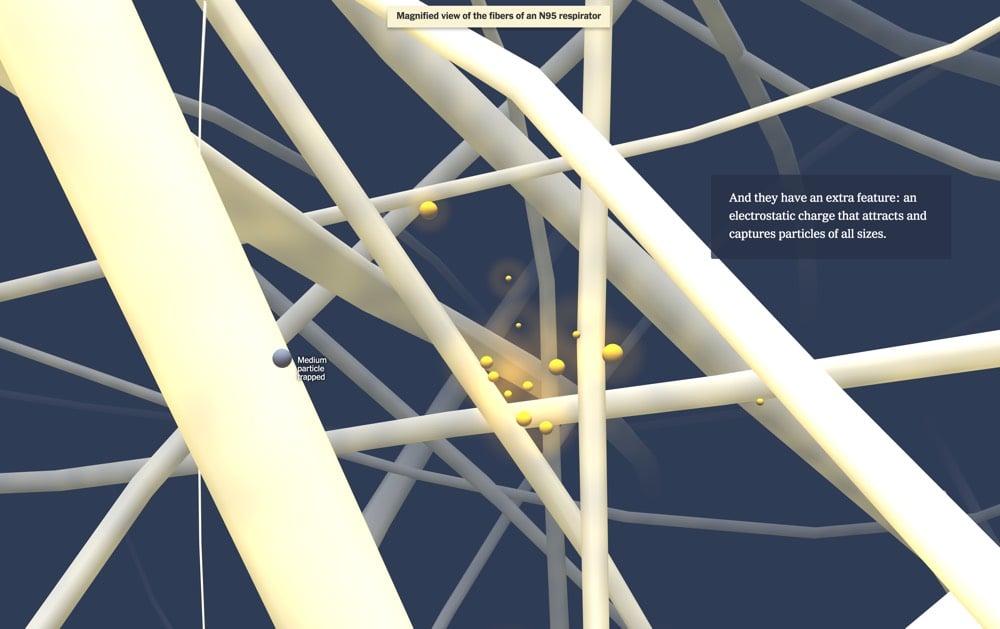
The NY Times has a fantastic visualization on how face masks help keep us safe from catching Covid-19 by taking readers on a journey through a mask to see how they block aerosols and droplets.
A lot of the pushback around the efficacy of masks from non-scientists focuses on the size of the droplets and aerosols (super tiny) compared to the gaps between the fibers in the masks (relatively large). Intuitively, it seems like masks don’t stand a chance of stopping anything. But as this visualization shows, multiple layers of fibers do the job quite well. Masks don’t work like sieves, which will let every particle smaller than the holes through the mesh. Instead, imagine shooting a BB gun into a thick stand of trees — no one tree stands a good chance of getting hit by the BB but the forest will stop it eventually.
N95, KN95, and masks made from polypropylene have an extra weapon against particles: the fibers carry an electrostatic charge that attracts particles to trap them. Picture our BB flying through a forest of magnetic trees — it’s got a much better chance of being captured that way.
The visualization also touches on the importance of making sure your mask fits properly. The best masks fit tightly around the edges and include a space around your nose and nostrils. Masks with unfiltered valves should not be used — you’re just breathing virus out into the air. It’s been 8-9 months now that we’ve been dealing with the pandemic and there will be many more months of wearing masks. If your mask is fits poorly around your nose, your straps aren’t tight enough, you need to fuss with it after putting it on, have a mask with a valve, or (god forbid) are still just wearing a bandana, please please do yourself and others a favor and upgrade your mask. High-quality, well-made masks are much easier to find now than 6-8 months ago.1 If you can’t afford a proper mask, email me and I’ll buy you one. Masks are one of the most successful low-tech interventions we can do to prevent the spread of Covid-19, and the better our masks, the more effective they will be.


The Urban Art Mapping Research Project has been collecting photos of street art created over the past several months related to the Covid-19 pandemic and the anti-racist protests.
Artists and writers producing work in the streets — including tags, graffiti, murals, stickers, and other installations on walls, pavement, and signs — are in a unique position to respond quickly and effectively in a moment of crisis. Street art’s ephemeral nature serves to reveal very immediate and sometimes fleeting responses, often in a manner that can be raw and direct. At the same time, in the context of a crisis, street art also has the potential to transform urban space and foster a sustained political dialogue, reaching a wide audience, particularly when museums and galleries are shuttered.
(via open culture)
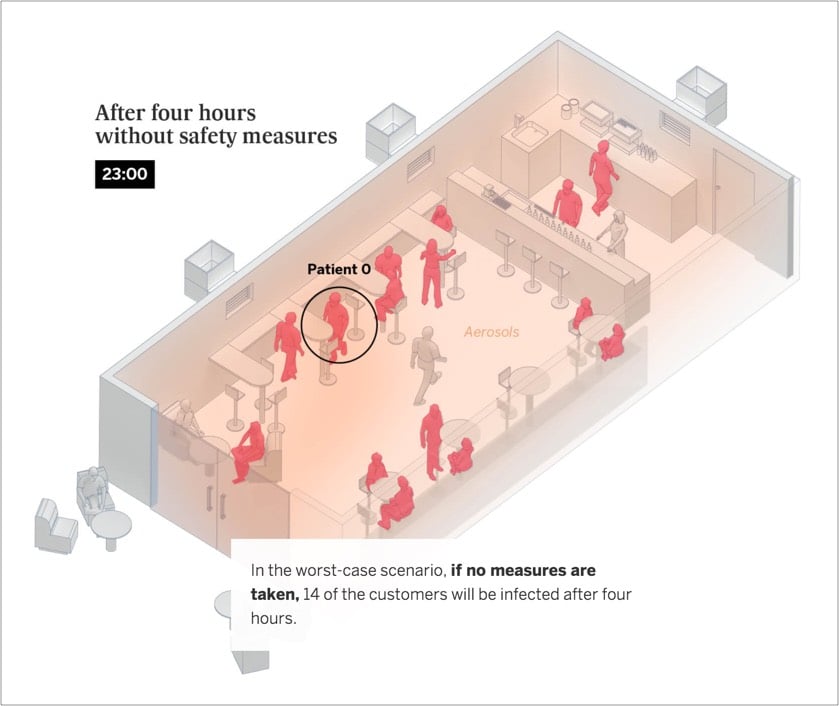
From El Pais, this is an excellent visualization of how Covid-19 spreads indoors via aerosols and what can be done to limit that spread. They go through simulations of three different indoor scenarios that are based on actual events — in a home with friends, in a bar at 50% capacity, and in a classroom — and see what happens when differing levels of precautions are applied: masks, ventilation, and limiting exposure time.
Six people get together in a private home, one of whom is infected. Some 31% of coronavirus outbreaks recorded in Spain are caused by this kind of gathering, mainly between family and friends.
Irrespective of whether safe distances are maintained, if the six people spend four hours together talking loudly, without wearing a face mask in a room with no ventilation, five will become infected, according to the scientific model explained in the methodology.
If face masks are worn, four people are at risk of infection. Masks alone will not prevent infection if the exposure is prolonged.
The risk of infection drops to below one when the group uses face masks, shortens the length of the gathering by half and ventilates the space used.
In all three scenarios, note that distancing is largely irrelevant when people gather indoors for longer periods in poorly ventilated areas. From the school example:
In real outbreaks, it has been noted that any of the students could become infected irrespective of their proximity to the teacher as the aerosols are distributed randomly around the unventilated room.
The only thing that’s disappointing about this piece is that it does not stress enough that finding alternatives to indoor activities with lots of people is the much safer course of action than just cracking a window or masking up. Safety step #1 is still being smart about non-essential activities — masks and ventilation are not magically going to protect you during risky activities. Educating our children is important and difficult (though not impossible) to do outside in many places, so yeah, let’s mask up and ventilate those classrooms. But your indoor birthday party with 10 friends or Thanksgiving dinner with the cousins and grandparents? Or dining out in a room full of strangers at a restaurant? Even with masks and ventilation, it’s not a great idea. Scale it down, move it to Zoom/FT, hold it outdoors (distanced, masked), or just skip it.
Paul Krugman writes about the harmful effects of “libertarianism gone bad, a misunderstanding of what freedom is all about” that have been made plain by the Covid-19 pandemic.
But you also see a lot of libertarian rhetoric — a lot of talk about “freedom” and “personal responsibility.” Even politicians willing to say that people should cover their faces and avoid indoor gatherings refuse to use their power to impose rules to that effect, insisting that it should be a matter of individual choice.
Which is nonsense.
Many things should be matters of individual choice. The government has no business dictating your cultural tastes, your faith or what you decide to do with other consenting adults.
But refusing to wear a face covering during a pandemic, or insisting on mingling indoors with large groups, isn’t like following the church of your choice. It’s more like dumping raw sewage into a reservoir that supplies other people’s drinking water.
Public health safety measures don’t have to be bureaucratic, dour, and oppressive. They can even be fun. This is a sign from my local hardware store here in Vermont reminding shoppers to social distance:
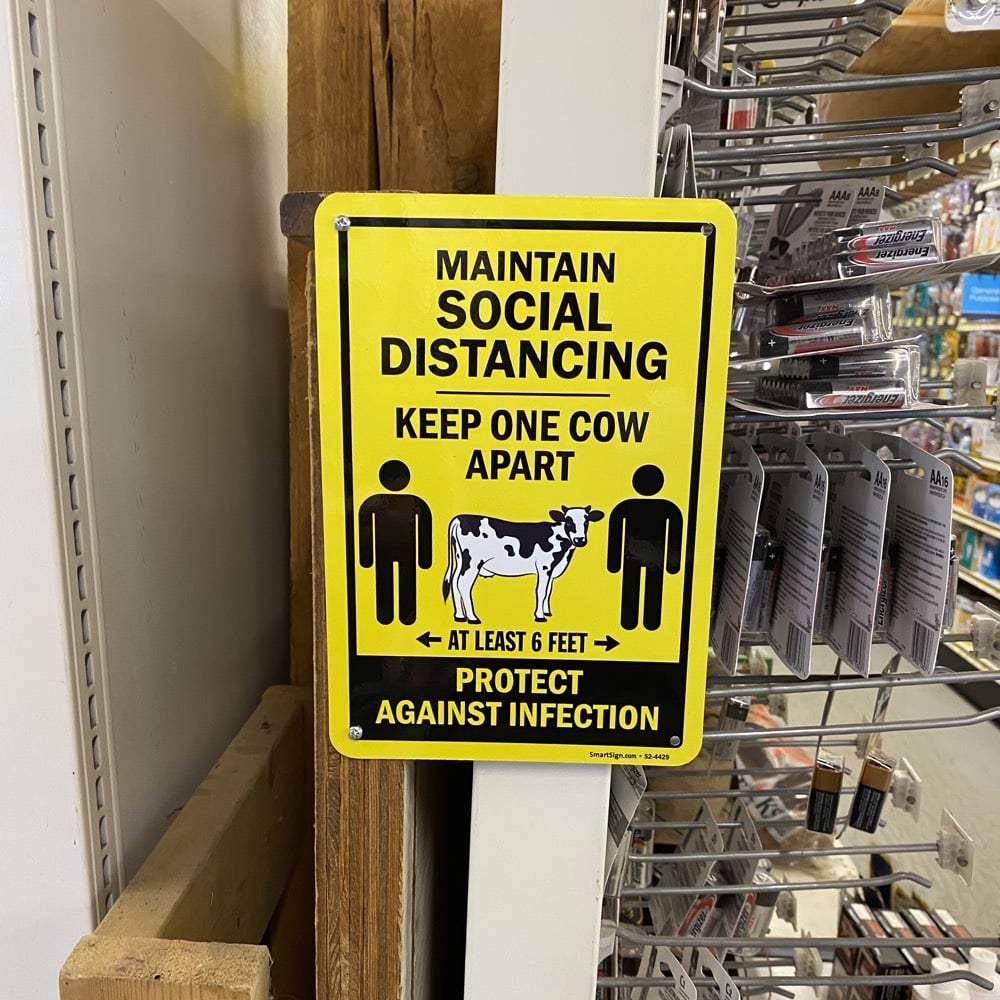
Journalist Rebecca Boyle recently asked her followers to share their local Covid-19 signage and they responded with some great examples.
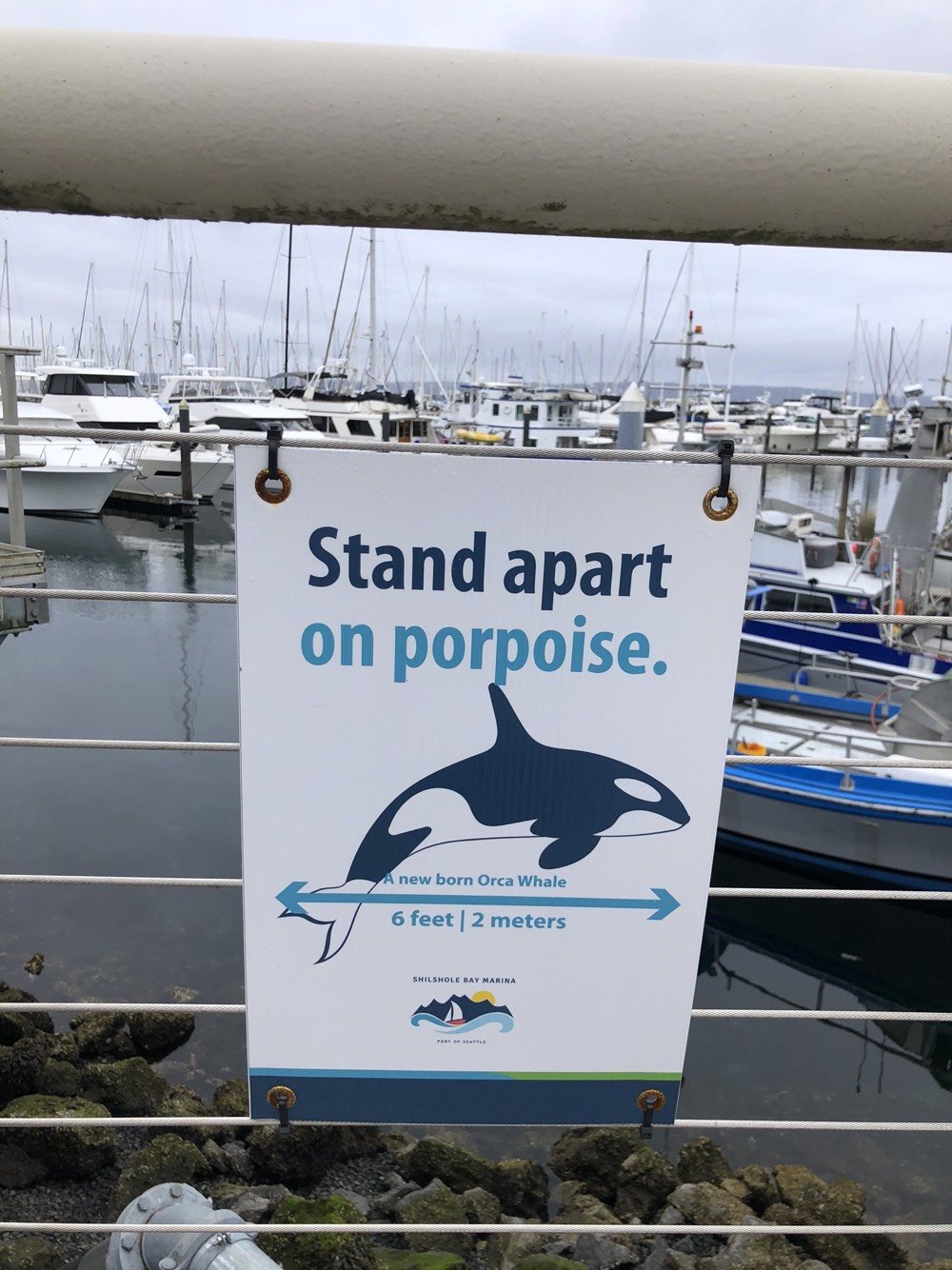
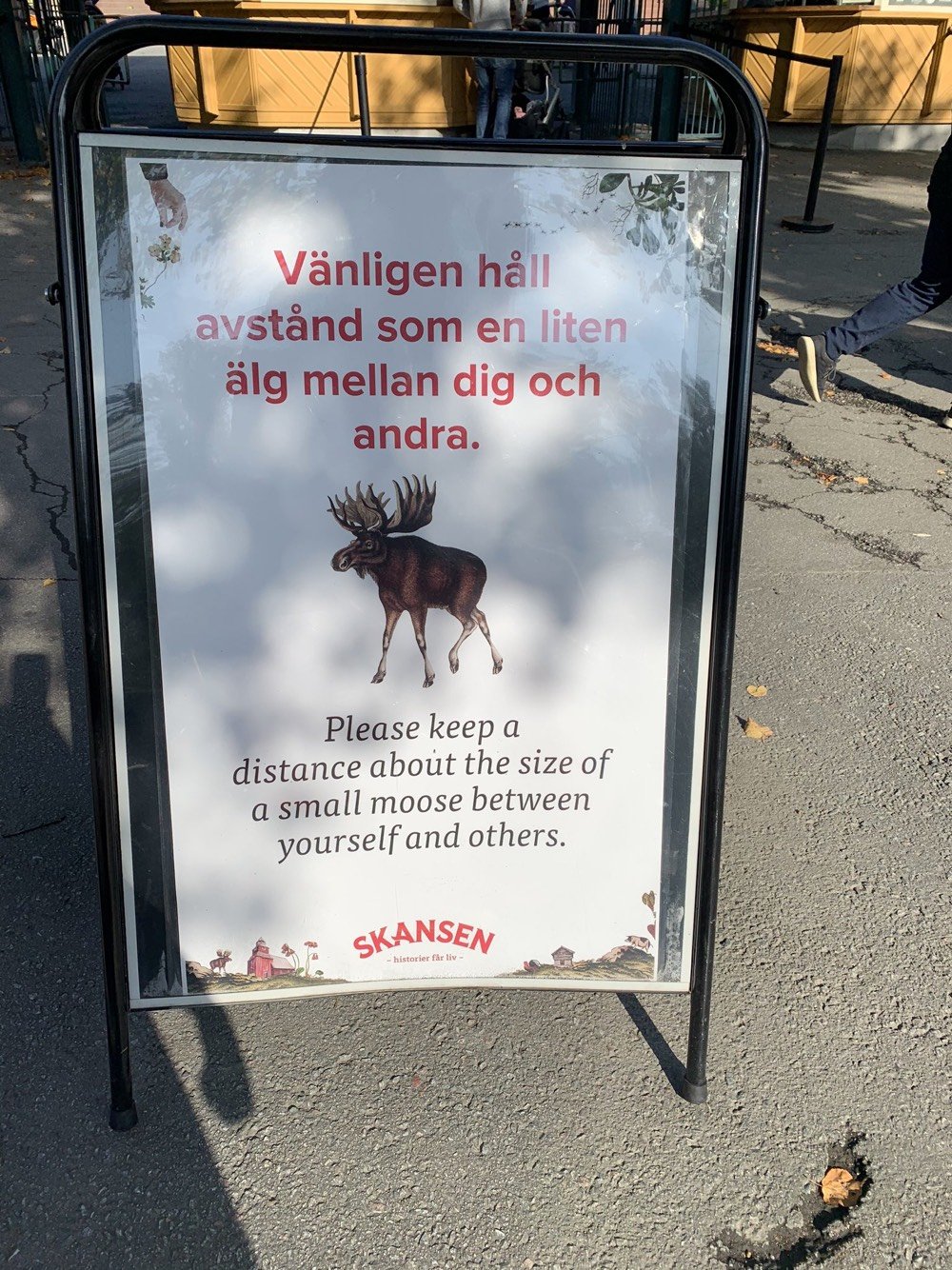
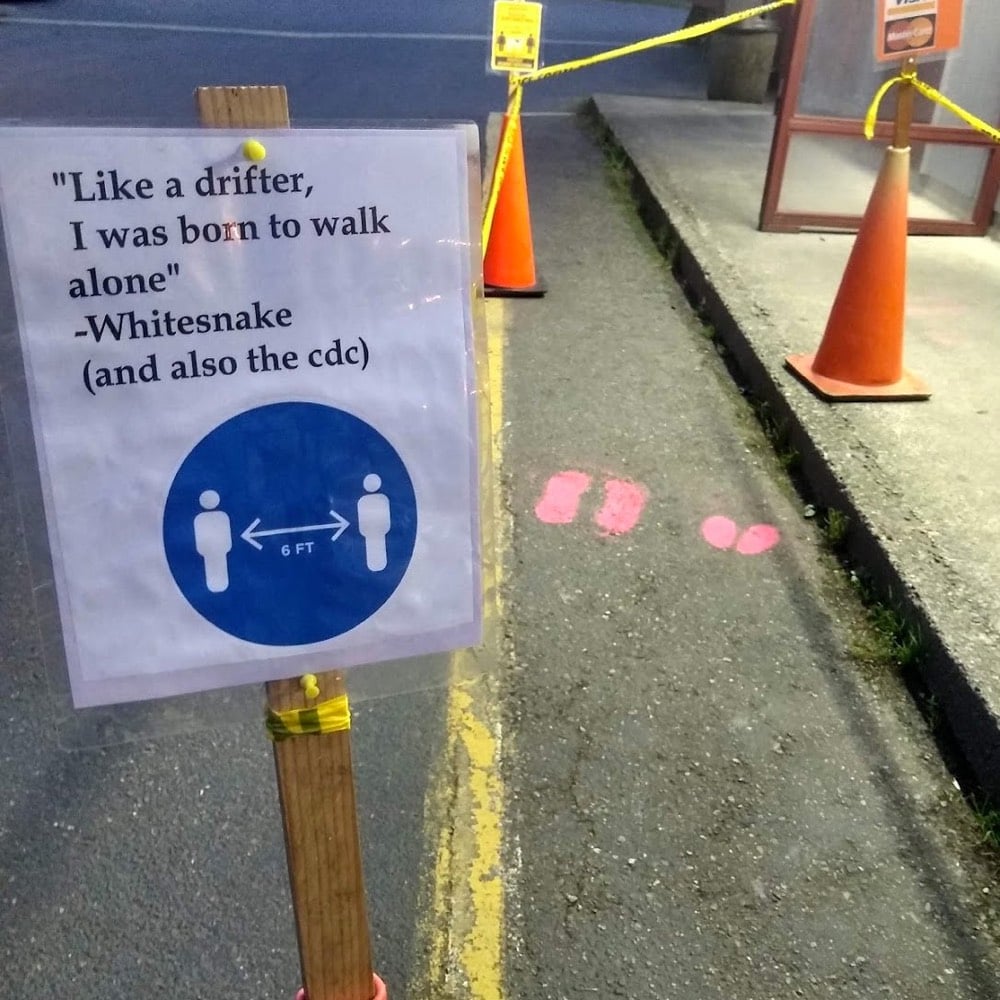
This homage to the Ministry of Silly Walks might be my favorite:
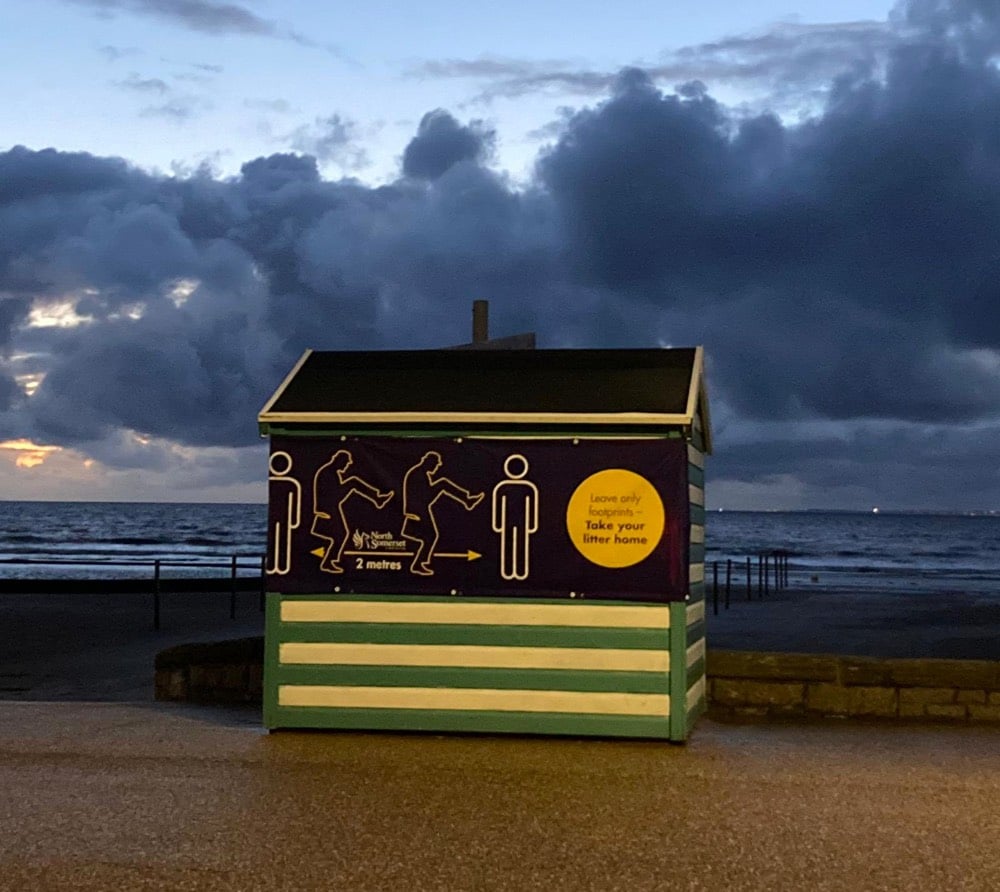
You can scroll through the whole thread for many more.
A spin studio (aka an indoor gym with stationary bikes) in Hamilton, Ontario is dealing with an outbreak of Covid-19 stemming from one asymptomatic patron that has resulted in 69 positive cases so far, even though the studio “followed the rules”. From the CNN report:
SPINCO, in Hamilton, Ontario, just reopened in July and had all of the right protocols in place, including screening of staff and attendees, tracking all those in attendance at each class, masking before and after classes, laundering towels and cleaning the rooms within 30 minutes of a complete class, said Dr. Elizabeth Richardson, Hamilton’s medical officer of health, in a statement.
As the Washington Post reports, patrons were allowed to take their masks off while exercising:
Although Hamilton requires masks to be worn in most public settings, the law includes an exemption for anyone “actively engaged in an athletic or fitness activity.” In keeping with that policy, the studio, SPINCO, allowed riders to remove their masks once clipped into their bikes, and told them to cover up again before dismounting.
The problem here is that while the studio may have followed the rules, they were not the right rules. This outbreak appears to be another clear-cut instance of Covid-19 spread by aerosols. A group of people indoors, without masks, breathing heavily, over long periods of time in what I’m guessing is not a properly ventilated room — this is exactly the sort of thing that has been shown over and over again to be problematic.1 The science is there, but governments and public health agencies have not caught up with this yet. If you take the transmission by aerosols into account, the rules for gyms (and bars and restaurants) being open is that they should probably not be open at all — or if they are, they should be well-ventilated and the wearing of masks should be mandatory at all times.2 (via @DrEricDing)
We’re all so goddamned tired of this fucking pandemic and so people are looking at the development and distribution of a vaccine as the thing that’s going to get us out of this (and quick). But realistically, that’s not what’s going to happen. Carl Zimmer wrote about some of the challenges with Covid-19 vaccines.
The first vaccines may provide only moderate protection, low enough to make it prudent to keep wearing a mask. By next spring or summer, there may be several of these so-so vaccines, without a clear sense of how to choose from among them. Because of this array of options, makers of a superior vaccine in early stages of development may struggle to finish clinical testing. And some vaccines may be abruptly withdrawn from the market because they turn out not to be safe.
“It has not yet dawned on hardly anybody the amount of complexity and chaos and confusion that will happen in a few short months,” said Dr. Gregory Poland, the director of the Vaccine Research Group at the Mayo Clinic.
See also Dr. Fauci’s belief that our best case scenario for returning to something close to normal life in the US is late 2021.
On Twitter, Zimmer also commented on something that I hadn’t really thought about: that all of these vaccines in development in the US are only for adults:
I wrote last month that no trials for kids had started. Update: still no US trials for kids. The goal of having shots ready for them by fall 2021 may be slipping further away.
From Zimmer’s article on the development of a kids’ vaccine:
Only if researchers discovered no serious side effects would they start testing them in children, often beginning with teenagers, then working their way down to younger ages. Vaccine developers are keenly aware that children are not simply miniature adults. Their biology is different in ways that may affect the way vaccines work. Because their airways are smaller, for example, they can be vulnerable to low levels of inflammation that might be harmless to an adult.
These trials allow vaccine developers to adjust the dose to achieve the best immune protection with the lowest risk of side effects. The doses that adults and children need are sometimes different — children get smaller doses of hepatitis B vaccines, for example, but bigger doses for pertussis.
You probably hate reading these kinds of articles; I know I do. But facing up to the reality of our situation, particularly here in the US where our political leadership has utterly failed in protecting us from this virus, is much better than burying our heads in the sand — that’s just not mentally healthy.
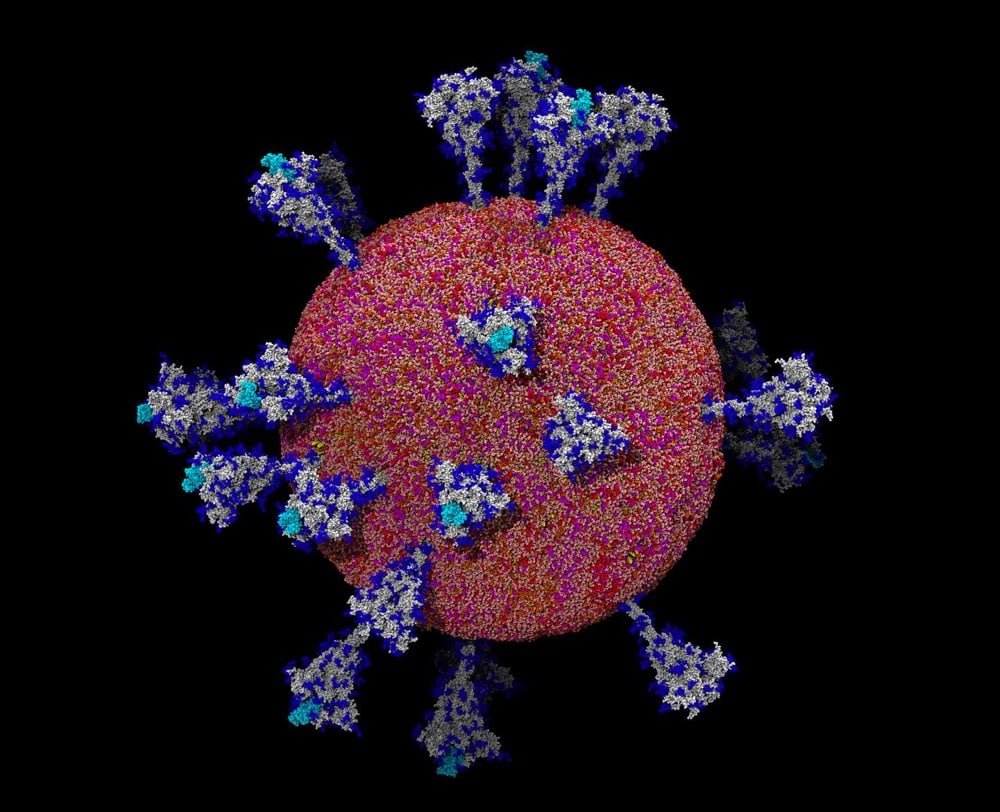
This is a great piece from Carl Zimmer about how much scientists have learned about SARS-CoV-2 through imaging, including how the virus works and prospects for treatment and a vaccine.
Thanks to the work of scientists like Dr. Li, the new coronavirus, known as SARS-CoV-2, is no longer a cipher. They have come to know it in intimate, atomic detail. They’ve discovered how it uses some of its proteins to slip into cells and how its intimately twisted genes commandeer our biochemistry. They’ve observed how some viral proteins throw wrenches into our cellular factories, while others build nurseries for making new viruses. And some researchers are using supercomputers to create complete, virtual viruses that they hope to use to understand how the real viruses have spread with such devastating ease.
I’ve been watching the lectures for MIT’s online Covid-19 class and the thing that has struck me most is just how much scientists have learned about the SARS-CoV-2 virus in such a short amount of time. To be clear, there are many things that they still do not understand about it (and viruses in general), but scientists know this thing upside down and backwards. The depth and breadth of their knowledge is so impressive and I wish more people were aware of it.
In an article that The Atlantic classifies as “politics” rather than “science” or “medicine”, Olga Khazan explores why, more than 8 months into the pandemic, Americans still have little idea about the safety of gathering with others indoors.
For months now, Americans have been told that if we want to socialize, the safest way to do it is outdoors, the better to disperse the droplets that spew from our mouths whenever we do anything but silently purchase grapefruit. But in many parts of the country, this is the last month that the weather will allow people to spend more than a few minutes outside comfortably. And next month, America will celebrate a holiday that is marked by being inside together and eating while talking loudly to old people.
In a nutshell, the lack of federal support/guidance/action is the main reason why people are still so confused about what safety measures to take to reduce their Covid risk:
Still, Ranney says, this [Covid risk] app is the kind of thing the federal government really should have developed by now. It’s odd that in a wealthy, industrialized country, a random researcher is the one designing a tool to keep citizens safe from public-health threats, using data she scraped from a newspaper.
One thing that Khazan doesn’t really get into is the whole aerosols thing, which in my mind is something that most people are still not familiar with, many local & state governments are not taking into account w/r/t recommended safety measures, and requires different risk guidance about the safety of the indoors than if we were just dealing with fomites & droplets. Again, from the excellent Time magazine piece by aerosol chemist Jose-Luis Jimenez:
When it comes to COVID-19, the evidence overwhelmingly supports aerosol transmission, and there are no strong arguments against it. For example, contact tracing has found that much COVID-19 transmission occurs in close proximity, but that many people who share the same home with an infected person do not get the disease. To understand why, it is useful to use cigarette or vaping smoke (which is also an aerosol) as an analog. Imagine sharing a home with a smoker: if you stood close to the smoker while talking, you would inhale a great deal of smoke. Replace the smoke with virus-containing aerosols, which behave very similarly, and the impact is similar: the closer you are to someone releasing virus-carrying aerosols, the more likely you are to breathe in larger amounts of virus. We know from detailed, rigorous studies that when individuals talk in close proximity, aerosols dominate transmission and droplets are nearly negligible.
If you are standing on the other side of the room, you would inhale significantly less smoke. But in a poorly ventilated room, the smoke will accumulate, and people in the room may end up inhaling a lot of smoke over time. Talking, and especially singing and shouting increase aerosol exhalation by factors of 10 and 50, respectively. Indeed, we are finding that outbreaks often occur when people gather in crowded, insufficiently ventilated indoor spaces, such as singing at karaoke parties, cheering at clubs, having conversations in bars, and exercising in gyms. Superspreading events, where one person infects many, occur almost exclusively in indoor locations and are driving the pandemic. These observations are easily explained by aerosols, and are very difficult or impossible to explain by droplets or fomites.
The science is there — it’s the lack of connection between scientists, public health experts & officials, and the government that continues to be a problem.
A few weeks ago during the Q&A session after his lecture for MIT’s online biology class about the pandemic, Dr. Anthony Fauci shared his expert opinion on when things might return to “normal” in the US. Here was my paraphrased tweet about it:
With a very effective vaccine ready in Nov/Dec, distributed widely, and if lots of people take it (i.e. the best case scenario), the earliest we could return to “normal life” in the world is the end of 2021.
At the New Yorker Festival earlier in the week, Michael Specter asked him about a return to normalcy and Fauci elaborated a bit more on this timeline (starts ~10:22 in the video).
When are we gonna get back to something that closely resembles, or is in fact, normal as we knew it?
We’re already making doses, tens and hundreds of millions of doses to be ready, first at least, in graded numbers at the end of the year in November/December. By the time we get to April, we likely will have doses to be able to vaccinate anybody who needs to be vaccinated. But logistically by the time you get everybody vaccinated, it likely will not be until the third or even the beginning of the fourth quarter of 2021.
So let’s say we get a 70% effective vaccine, which I hope we will get, but only 60% of the people get vaccinated. There are going to be a lot of vulnerable people out there, which means that the vaccine will greatly help us to pull back a bit on the restrictions that we have now to maintain good public health, but it’s not going to eliminate things like mask wearing and avoiding crowds and things like that.
So I think we can approach normality, but I don’t think we’re going to be back to normal until the end of 2021. We may do better than that; I hope so but I don’t think so.
Leaving aside what “normal” might mean and who it actually applies to,1 there’s some good news and bad news in there. The good news is, they’re already producing doses of the vaccine to be ready if and when the phase 3 trials are successful. Ramping up production before the trials conclude isn’t usually done because it’s a waste of money if the trials fail, but these vaccines are so critical to saving lives that they’re spending that money to save time. That’s great news.
The bad news is that we’re not even halfway through the pandemic in the best case scenario. We’re going to be wearing masks in public for at least another year (and probably longer than that). Large gatherings of people (especially indoors) will continue to be problematic — you know: movie theaters, concerts, clubs, bars, restaurants, schools, and churches — and folks staying within small pods of trusted folks will likely be the safest course of action.
A change in national leadership in both the executive branch and Senate could change the outlook for the better. We could get some normalcy back even without a vaccine through measures like a national mask mandate/distribution, a real national testing & tracing effort, taking aerosol transmission seriously, and easing the economic pressure to “open back up” prematurely. We’re never going to do as well as Vietnam or Taiwan, but I’d settle for Greece or Norway.
Update: In an interview posted yesterday, Johns Hopkins epidemiologist Dr. Caitlin Rivers gives her best guess at a return to normalcy:
Topol: When do you think we’ll see pre-COVID life restored?
Rivers: I wish I knew. I’m thinking toward the end of 2021. It’s really hard to say with any certainty. We should all be mentally prepared to have quite a bit ahead of us.
Newer posts
Older posts




Socials & More