kottke.org posts about Covid-19
Back in June, in a post called Jesus Christ, Just Wear a Face Mask!, I presented a bunch of evidence and arguments for wearing face masks to prevent the spread of Covid-19. Even then it was pretty clear that masks were working. In piece published by Nature yesterday, Lynne Peeples summarizes what the data and science currently says about the effectiveness of wearing face masks. Here is her one-sentence summary:
To be clear, the science supports using masks, with recent studies suggesting that they could save lives in different ways: research shows that they cut down the chances of both transmitting and catching the coronavirus, and some studies hint that masks might reduce the severity of infection if people do contract the disease.
And importantly, even ardently pro-mask scientists agree that masks should be worn in conjunction with taking other precautions: limiting large gatherings, maintaining distance, limiting the time you spend indoors with others, etc.
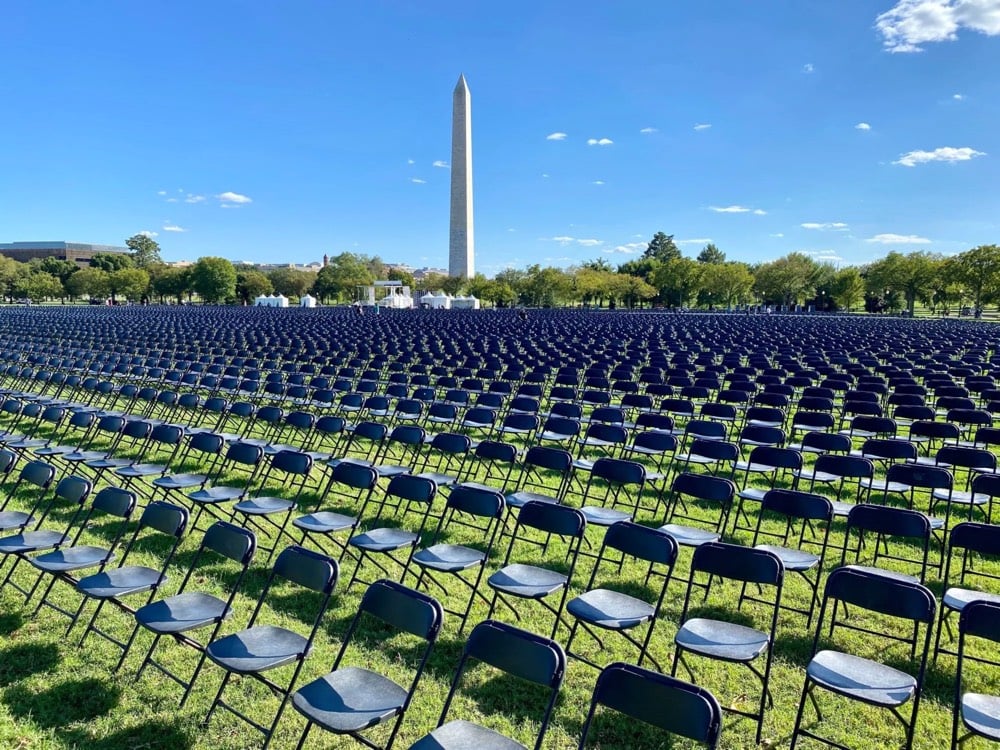
On Sunday in Washington DC, a group called Covid Survivors for Change set up 20,000 chairs in front of the White House to represent the 210,000 people who have died from Covid-19 in the United States.1 Each chair represents about 10 people who have died and their collective emptiness represents both the loss felt by the families & loved ones of those who have died and the feckless, hollow response of the federal government to the suffering.
In secrecy over the past several months, filmmaker Alex Gibney has been making a documentary film about the US government’s response to the Covid-19 pandemic called Totally Under Control. He and co-directors Ophelia Harutyunyan and Suzanne Hillinger interviewed “countless scientists, medical professionals, and government officials on the inside” to produce the film.
Academy Award-winning filmmaker Alex Gibney, directing with Ophelia Harutyunyan and Suzanne Hillinger, interrogates this question and its devastating implications in Totally Under Control. With damning testimony from public health officials and hard investigative reporting, Gibney exposes a system-wide collapse caused by a profound dereliction of Presidential leadership.
Gibney previously directed Enron: The Smartest Guys in the Room, Going Clear, and Zero Days (all excellent documentaries). The film comes out in theaters on October 13 and on Hulu on October 20.
A group of scientists who believe that WHO and the CDC are being too slow in acknowledging the role of aerosol transmission in spreading Covid-19 have written up a Google Doc of advice for the public: FAQs on Protecting Yourself from COVID-19 Aerosol Transmission.
The goal of these FAQs is to provide information to the general public in an efficient manner about how to prevent aerosol transmission of COVID-19, with the hope that this will allow more informed decision making by individuals or organizations. All of this information has been posted in Twitter and other forums, but can be difficult to find. Having multiple experts working together, and having the ability to update this information also improves its quality. These FAQs represent our best understanding at this time, and should always be similar or more stringent than information provided by CDC, WHO, and most regional & local health authorities. If your authority has a more stringent guideline than discussed here, follow that more stringent guideline.
The group was organized by chemist Jose-Luis Jimenez, who has been studying aerosols for 20 years. You may remember Jimenez from his excellent piece in Time magazine, where he used the analogy of smoke to explain aerosol transmission. Here’s a snippet from the FAQ, highlighting something I’ve been concerned about lately: people wearing face shields instead of masks and employees in stores not wearing masks behind plexiglass shields:
7.13. Are face shields and masks interchangeable?
No, face shields do not offer much protection against aerosols (also see this video), while masks do. Face shields are good for blocking ballistic droplets released by the wearer or that might fly into the wearer’s face when close to others. Face shields are considered a supplement to masks for partial eye protection (but less useful than closed glasses, as discussed above), but not a substitute for them.
7.14. Are plexiglass barriers helpful?
Plexiglass barriers are generally useful to avoid direct droplet infection and direct aerosol transmission whenever people are in close proximity and distance cannot be kept. Therefore, it is recommended to use them as a direct transmission suppression tool at such places, such as a supermarket checkout.
However, as aerosols follow the air movements indoors, the protective effects of the plexiglas barriers against aerosols will be limited. Plexiglas barriers alone are not a sufficient approach to protect against aerosol transmission. Their installation alone cannot protect against indoor aerosol transmission and should not be regarded as safe and sufficient protection.
MIT Technology Review’s Charlotte Jee interviewed Jimenez about the FAQ document.
We update the document all the time. We’re effectively having to be a little WHO or CDC. We’re saying the things that they should be saying. This is frustrating, but it’s the situation we find ourselves in. These organizations have been flat-out refusing to consider if aerosol transmission is important, which leaves people unprotected. So we feel it’s our duty to communicate directly with the public.
Right now, in my opinion as someone who has done a ton of reading about Covid-19, the most best accessible information on how individuals and societies can protect themselves and others during the pandemic (and why) is available in Jimenez’s Time article, Aaron Carroll’s NY Times piece about how to think about risk management, Zeynep Tufekci’s piece in the Atlantic about dispersion and superspreading, and now this Google Doc by Jimenez et al.
Zeynep Tufekci says that we are paying too much attention to the R value of SARS-CoV-2 (basically the measure of its contagiousness) and not nearly enough attention to the k value (“whether a virus spreads in a steady manner or in big bursts, whereby one person infects many, all at once”).
There are COVID-19 incidents in which a single person likely infected 80 percent or more of the people in the room in just a few hours. But, at other times, COVID-19 can be surprisingly much less contagious. Overdispersion and super-spreading of this virus is found in research across the globe. A growing number of studies estimate that a majority of infected people may not infect a single other person. A recent paper found that in Hong Kong, which had extensive testing and contact tracing, about 19 percent of cases were responsible for 80 percent of transmission, while 69 percent of cases did not infect another person. This finding is not rare: Multiple studies from the beginning have suggested that as few as 10 to 20 percent of infected people may be responsible for as much as 80 to 90 percent of transmission, and that many people barely transmit it.
We’ve known, or at least suspected, this about SARS-CoV-2 for awhile now — I linked to two articles about superspreading back in May and June — but Tufekci says we have not adjusted our thinking about what that means for prevention. We should be avoiding superspreading environments/events (“Avoid Crowding, Indoors, low Ventilation, Close proximity, long Duration, Unmasked, Talking/singing/Yelling”), doing backwards contact tracing, and rapid testing.
In an overdispersed regime, identifying transmission events (someone infected someone else) is more important than identifying infected individuals. Consider an infected person and their 20 forward contacts-people they met since they got infected. Let’s say we test 10 of them with a cheap, rapid test and get our results back in an hour or two. This isn’t a great way to determine exactly who is sick out of that 10, because our test will miss some positives, but that’s fine for our purposes. If everyone is negative, we can act as if nobody is infected, because the test is pretty good at finding negatives. However, the moment we find a few transmissions, we know we may have a super-spreader event, and we can tell all 20 people to assume they are positive and to self-isolate-if there is one or two transmissions, it’s likely there’s more exactly because of the clustering behavior. Depending on age and other factors, we can test those people individually using PCR tests, which can pinpoint who is infected, or ask them all to wait it out.
Part of the problem is that dispersion and its effects aren’t all that intuitive.
Overdispersion makes it harder for us to absorb lessons from the world because it interferes with how we ordinarily think about cause and effect. For example, it means that events that result in spreading and non-spreading of the virus are asymmetric in their ability to inform us. Take the highly publicized case in Springfield, Missouri, in which two infected hairstylists, both of whom wore masks, continued to work with clients while symptomatic. It turns out that no apparent infections were found among the 139 exposed clients (67 were directly tested; the rest did not report getting sick). While there is a lot of evidence that masks are crucial in dampening transmission, that event alone wouldn’t tell us if masks work. In contrast, studying transmission, the rarer event, can be quite informative. Had those two hairstylists transmitted the virus to large numbers of people despite everyone wearing masks, it would be important evidence that, perhaps, masks aren’t useful in preventing super-spreading.
The piece is an important read and interesting throughout: just read the whole thing.
Hannah Beech reports on how the United States1 is perceived by the outside world these days due to our poor response to the Covid-19 pandemic and the continuing failure of our political system.
Myanmar is a poor country struggling with open ethnic warfare and a coronavirus outbreak that could overload its broken hospitals. That hasn’t stopped its politicians from commiserating with a country they think has lost its way.
“I feel sorry for Americans,” said U Myint Oo, a member of parliament in Myanmar. “But we can’t help the U.S. because we are a very small country.”
The same sentiment prevails in Canada, one of the most developed countries. Two out of three Canadians live within about 60 miles of the American border.
“Personally, it’s like watching the decline of the Roman Empire,” said Mike Bradley, the mayor of Sarnia, an industrial city on the border with Michigan, where locals used to venture for lunch.
And I had to chuckle at this part:
“The U.S.A. is a first-world country but it is acting like a third-world country,” said U Aung Thu Nyein, a political analyst in Myanmar.
I made a similar observation after a trip to Asia in January: “America is a rich country that feels like a poor country.” I got a bunch of pushback on that statement but after the past eight months, the pandemic has laid America’s deficiencies bare for the whole world to see clearly.
As winter approaches in North America and Europe, cities should be thinking about how to encourage and enable people to spend as much time outdoors as possible to help keep everyone sane and safe from Covid-19. From a great piece in CityLab by Alexandra Lange:
Dress in layers, invest in silk and wool long underwear, get over your prejudice against parkas. Many people do this as a matter of course when gearing up for a day of skiing or a turn around the ice rink. But in cities, people dress for the destination, not the journey. “People dress saying, I’m going from my home to this business. What’s the least amount of clothing I can wear for the tolerance of walking x feet?” says Simon O’Byrne, senior vice president of community development for global design consultancy Stantec. “We have to switch that, and dress to loiter.”
O’Byrne, who is also co-chair of the WinterCity Advisory Council, adds, “Stickiness encourages people outside. Moscow does year-round farmers markets. The artists’ community has been pulverized by Covid. As much as we can, we should embrace things to help the local artists, community.” He suggests commissioning visual artists to illuminate dark spaces, via murals or light installations, and hiring musicians for distanced outdoor concerts.
Cities should also invest in places to loiter. All of those outdoor restaurants that are supporting local businesses and bringing liveliness back to the streets? In New York City, at least, they are scheduled to shut down at the end of October, while the mayor and governor bicker over indoor dining. But cities need to catch up to ski areas, which long ago figured out how to make après ski activities like outdoor bars and music venues as much of an attraction as the slopes. Wind breaks (with openings above and below for ventilation), patio heaters and sun orientation can all take outdoor dining further into 2020. WinterCity’s Four Season Patio Design Tips also include higher insulation value materials, like wood or straw bales rather than metal seating, as well as simple solutions like blankets, which offer customers the winter equivalent of being able to reposition your chair in the sun — though that works year-round.
And indeed, NYC just announced that the increased outdoor dining that the city has allowed during the pandemic will become “permanent and year-round”.
Tens of thousands of parking spaces will be permanently repurposed from free private vehicle storage for use by the city’s struggling restaurant owners as part of a revolution in public space unleashed on Friday by Mayor de Blasio.
On WNYC’s “Ask the Mayor” segment, Hizzoner revealed that restaurants would be allowed to occupy curbside spaces - which more than 10,000 are already doing — for outdoor dining, not just through the coronavirus pandemic, but all year and, apparently, forever.
It may turn out to be the single biggest conversion of public space since, well, since car drivers commandeered the curbside lane for free overnight vehicle storage in the 1950s.
But whatever measures are taken, they need to be inclusive for the diverse populations that live in cities. Here’s Lange again, who spends several paragraphs in her piece on this issue:
Snow clearance has become an ongoing political issue for winter cities, with disabled people, the elderly, and parents and caregivers arguing that sidewalks and crossings deserve the same priority as cars, lest people be essentially trapped in their homes. Many physically disabled people have already had their mobility limited during quarantine due to pre-existing health risks, the inability to avoid using elevators and the difficulty of maintaining social distancing. Temporary urban design changes also need to be inclusive.
In the next day or two, the official number of people who have died from Covid-19 in the United States will pass 200,000 (the actual death toll passed 200,000 back in July). To mark the grim occasion yesterday, the Washington National Cathedral tolled its mourning bell 200 times in remembrance, once for each 1000 people who have died.
We toll this 12-ton bell for every funeral held at the Cathedral. Funerals mourn the loss, but they also celebrate the lives of our loved ones, and point us to the hope of resurrection.
This gesture cannot replace the lives lost, but we hope it will help each American mourn the toll of this pandemic.
The tolling goes on for more than 19 minutes and you hear a number of deaths equal to 9/11 every 17 seconds. I recommend listening as long as you are able, to remember those who have been lost, and to inspire action so that 200,000 more Americans don’t have to die before this is all over.
See also A Time Lapse World Map of Every Covid-19 Death from back in July.
NY governor Andrew Cuomo enlisted actor Paul Rudd to do a public service announcement about the benefits of wearing a mask during the pandemic. Rudd, who often looks like he hasn’t aged a day in the past 20 years but is actually 51 years old, is in total “how do you do fellow kids” mode in this video, deploying some totally plausible youth lingo in an effort to get his fellow youths to mask up.
I’ve never read or seen any of the Dunes (Herbert’s book, David Lynch’s movie, or even Jodorowsky’s Dune) but I have very fond memories of the video game Dune II and will watch anything that Denis Villeneuve makes, so I’m definitely going to check this out when it’s released…let’s see….on December 18, 2020 in theaters? WTF?
Ok, so just watch the trailer if that’s what you’re here for, but I remain baffled that movie theaters are a) currently open (Tenet was showing in 2810 US theaters last weekend) and b) slated to still be open in December in a country trapped in a pandemic death spiral. Easy testing w/ quick results and contact tracing, the twin keys to controlling the virus, are still a mess. A safe & tested vaccine that’s distributed widely by the end of the year? I wouldn’t hold my breath. And you’re going to put a bunch of people who are laughing and gasping together in a room for two-plus hours with a virus that’s airborne1 and assume they’re going to stay properly masked up (except for when they are eating popcorn and nachos!) and properly distant from each other? (Have you met Americans?!) Even if you assume that movie theater screening rooms are huge & well-ventilated (some definitely are not) and capacity is restricted, I repeat: What The Fuck? And in terms of societal trade-offs, reopening places where people gather indoors for entertainment is more important than ensuring our kids can safely go to school? *extreme hair-tearing-out noise*
Update: Aaaaand the Dune release has been delayed until Oct 2021. Between the Trump debacle2 and the CDC acknowledging that the virus may spread through aerosols, I feel like people are coming around to the idea that indoor gatherings, entertainment, and dining are going to be problematic for several more months.
Coronation is a feature-length documentary film by Ai Weiwei about the lockdown in Wuhan, China, during the initial Covid-19 outbreak in early 2020. The trailer is not super compelling tbh, but it’s Ai Weiwei and the description sounds interesting:
The film showcases the incredible speed and power of China’s state machinery with its construction of massive coronavirus hospitals, deployment of roving sanitation-fogging robots, implementation of an exhaustive testing and contact-tracing protocol, and punctiliously engineered protective measures for health workers.
On the other side of the scale is the crushing bureaucracy of that same machine, its totalitarian decision-making, clear deception of ordinary citizens, the absence of civic communication, and perhaps, worst of all, a cold-eyed lack of empathy for those suffering loss and kept away from home.
Ai Weiwei paints a moving and revelatory portrait not just of China’s response to the pandemic but also of ordinary people in Wuhan, showing how they personally cope with the disaster.
Hyperallergic’s Dan Schindel has a review of the film. You can watch Coronation on demand at Vimeo or Alamo. (via colossal)
For Vanity Fair, novelist Jesmyn Ward writes about losing her husband just before the pandemic descended on America. She begins:
My Beloved died in January. He was a foot taller than me and had large, beautiful dark eyes and dexterous, kind hands. He fixed me breakfast and pots of loose-leaf tea every morning. He cried at both of our children’s births, silently, tears glazing his face. Before I drove our children to school in the pale dawn light, he would put both hands on the top of his head and dance in the driveway to make the kids laugh. He was funny, quick-witted, and could inspire the kind of laughter that cramped my whole torso.
It’s not long, but make some time for this one.
This short article by Dr. Aaron Carroll about Covid-19 and risk is excellent. I want to quote the entire thing here, punctuated only by increasingly emphatic YESes and THISes, but I will refrain. Somewhat.
Too many view protective measures as all or nothing: Either we do everything, or we might as well do none. That’s wrong. Instead, we need to see that all our behavior adds up.
Each decision we make to reduce risk helps. Each time we wear a mask, we’re throwing some safety on the pile. Each time we socialize outside instead of inside, we’re throwing some safety on the pile. Each time we stay six feet away instead of sitting closer together, we’re throwing some safety on the pile. Each time we wash our hands, eat apart and don’t spend time in large gatherings of people, we’re adding to the pile.
If the pile gets big enough, we as a society can keep this thing in check.
The article was published before today’s news that three PSG players — Neymar, Angel Di Maria, and Leandro Paredes — have tested positive for Covid-19 after returning from a vacation on Ibiza, but this could have easily been written in response:
To keep the pile big enough, though, we need to be willing to trade some activities for others. If people want to play on a sports team, for instance, they should consider giving something up to do so. Increasing their risk by participating in a group activity should prompt them to reduce their risk the rest of the time.
But we aren’t very good at discussing trade-offs. We want it all. We want to eat in restaurants, crowd into houses, go to work and celebrate occasions en masse.
We could choose to engage in just some of those things. We could decide to get a massage or get our nails done or have a haircut — instead of demanding that all of these and more be available to us simultaneously.
And this is just generally true:
If Americans were willing to invest in bigger-picture solutions, we could all have nicer things.
And this. This. THIS!! (sorry) THISSSSS!!!!:::
Instead of asking why we can’t do certain activities, we might consider what we’re willing to give up to do them more safely. Even better, we might even consider what we’re willing to give up so others can do them, too.
Go on, read the whole thing.
MIT’s biology department is offering a new online class this fall called COVID-19, SARS-CoV-2 and the Pandemic. The class will be led by Richard Young and Facundo Batista and will include guest lectures by several leading authorities on Covid-19, coronaviruses, epidemiology, and immune systems like Anthony Fauci, Michael Mina, and Akiko Iwasaki. Here’s the course description and syllabus.
Lectures by leading experts on the fundamentals of coronavirus and host cell biology, immunology, epidemiology, clinical disease, and vaccine and therapeutic development.
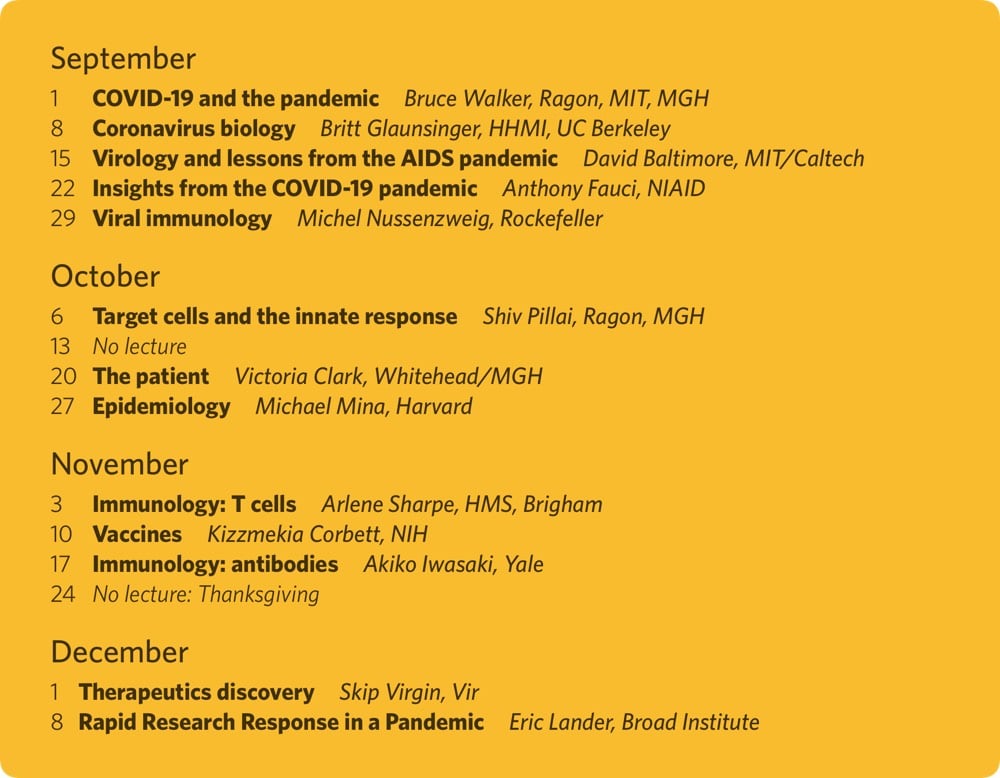
The first class is today, Sept 1st, at 11:30am ET and meets on Tuesday through December 8. Lectures are via live video but will be archived if you miss a class. There’s no homework or outside reading (it’s just the lectures), no pre-requisites needed, and it’s a 1-credit pass/fail exploratory course, so despite the source and subject matter, it should be fairly accessible. I’m taking the course and will let you know how it goes! (thx, meg)
Update: Here’s an archive of the first lecture by Bruce Walker of the Ragon Institute.


Uruguayan architecture firm Gómez Platero is building the world’s first large-scale memorial dedicated to victims of the Covid-19 pandemic. From Architecture Daily:
The memorial will be located on the edge of an urban waterfront, accessible only by a long pedestrian walkway. At the center of the platform, an open void to the ocean beneath allows people to observe nature. It is designed to allow a high percentage of the structure to be pre-assembled for on-site assembly, minimizing the impact on the natural environment. The large, circular structure will serve as a “sensory experience that bridges the gap between the urban and natural worlds, creating an ideal environment for introspection.”
(via print)
Newer posts
Older posts





Socials & More