kottke.org posts about Covid-19
Chemist Jose-Luis Jimenez writing for Time magazine: COVID-19 Is Transmitted Through Aerosols. We Have Enough Evidence, Now It Is Time to Act. In it, he argues that while much of the early attention has been on fomites (surface contamination) and droplets as pathways for spreading Covid-19, tranmission by aerosols may be more significant. His analogy of smoke makes it quite easy to understand:
When it comes to COVID-19, the evidence overwhelmingly supports aerosol transmission, and there are no strong arguments against it. For example, contact tracing has found that much COVID-19 transmission occurs in close proximity, but that many people who share the same home with an infected person do not get the disease. To understand why, it is useful to use cigarette or vaping smoke (which is also an aerosol) as an analog. Imagine sharing a home with a smoker: if you stood close to the smoker while talking, you would inhale a great deal of smoke. Replace the smoke with virus-containing aerosols, which behave very similarly, and the impact is similar: the closer you are to someone releasing virus-carrying aerosols, the more likely you are to breathe in larger amounts of virus. We know from detailed, rigorous studies that when individuals talk in close proximity, aerosols dominate transmission and droplets are nearly negligible.
Thinking of smoke can help guide our actions:
The visual analogy of smoke can help guide our risk assessment and risk reduction strategies. One just has to imagine that others they encounter are all smoking, and the goal is to breathe as little smoke as possible. But COVID-19 is not very contagious under most situations, unlike, for example, measles: the CDC says that 15 minutes of close proximity to a COVID-19 infected person often leads to contagion, which provides an estimate of how much “exhaled smoke” one may need to inhale for infection. Inhaling a little whiff of “smoke” here and there is OK, but a lot of “smoke” for a sustained period of time and without a mask is risky. (To be clear, actual smoke does not increase the probability of infection.)
In thinking about aerosolized Covid, Jimenez recommends avoiding crowds & indoor spaces and cutting down on proximity & duration, among other things.
We should continue doing what has already been recommended: wash hands, keep six feet apart, and so on. But that is not enough. A new, consistent and logical set of recommendations must emerge to reduce aerosol transmission. I propose the following: Avoid Crowding, Indoors, low Ventilation, Close proximity, long Duration, Unmasked, Talking/singing/Yelling (“A CIViC DUTY”). These are the important factors in mathematical models of aerosol transmission, and can also be simply understood as factors that impact how much “smoke” we would inhale.
But what about masks? N95s can block most aerosols but cloth masks have “huge” holes in them relative to aerosol particles, right? They still work in lowering risk (but not eliminating it!) because your “smoke” doesn’t travel as far when you’re wearing a mask and it filters incoming smoke (if your mask fits correctly and you’re keeping your distance).
Second, masks are essential, even when we are able to maintain social distance. We should also pay attention to fitting masks snugly, as they are not just a parapet against ballistic droplets, but also a means to prevent “smoke” from leaking in through gaps. We should not remove masks to talk, nor allow someone who is not wearing a mask to talk to us, because we exhale aerosols 10 times as much when talking compared to breathing. Everyone should be careful to not stand behind someone with a poorly fitting mask, as the curvature of an ill-fitting mask can cause aerosols to travel behind the person wearing it.
Great article, full of common sense advice backed up by science.
In the Atlantic, Ed Yong checks back in with the long-haulers, people who are still experiencing Covid-19 symptoms months after their initial infection. (Read his previous article from early June.)
Lauren Nichols has been sick with COVID-19 since March 10, shortly before Tom Hanks announced his diagnosis and the NBA temporarily canceled its season. She has lived through one month of hand tremors, three of fever, and four of night sweats. When we spoke on day 150, she was on her fifth month of gastrointestinal problems and severe morning nausea. She still has extreme fatigue, bulging veins, excessive bruising, an erratic heartbeat, short-term memory loss, gynecological problems, sensitivity to light and sounds, and brain fog. Even writing an email can be hard, she told me, “because the words I think I’m writing are not the words coming out.” She wakes up gasping for air twice a month. It still hurts to inhale.
As Yong says in a thread about the article: “The pandemic is going to create a large wave of chronically disabled people.” Once again for the people in the back: this is not just the flu. The flu does not incapacitate otherwise healthy people like this. I know at least two long-haulers personally and am astounded on a daily basis by how casually some Americans continue to regard Covid-19.
More than 90 percent of long-haulers whom Putrino has worked with also have “post-exertional malaise,” in which even mild bouts of physical or mental exertion can trigger a severe physiological crash. “We’re talking about walking up a flight of stairs and being out of commission for two days,” Putrino said. This is the defining symptom of myalgic encephalomyelitis, or chronic fatigue syndrome. For decades, people with ME/CFS have endured the same gendered gaslighting that long-haulers are now experiencing. They’re painfully familiar with both medical neglect and a perplexing portfolio of symptoms.
You can read Seabiscuit author Laura Hillenbrand’s excellent article on her chronic fatigue syndrome diagnosis and how difficult it is for people with chronic conditions like this to get the right diagnosis and to get family and friends to believe what’s going on.
Also, Yong should win all the awards this year for his pandemic coverage. It has been simply outstanding.
Isolation does funny things to people. Just ask designer Lydia Cambron, who recognized a certain kinship between the themes of her lockdown in Brooklyn this spring and Stanley Kubrick’s 2001: A Space Odyssey. Over the course of two months, Cambron meticulously recreated 2001’s ending scene in her apartment, not only shot-by-shot but nearly look-by-look, and produced a tiny masterpiece of her own.
The adapted version delineates the passing of time through wardrobe rather than age, identifying each phase of the character’s journey with a product of self care or PPE. Tools of private entertainment or self betterment are also used as props, questioning our confidence in products and productivity as anchors during times of uncertainty. Multitasking while #wfh, conjuring guilt or longing with unused exercise equipment, your entire being reduced to a measure of time — these scenes all illustrate the absurd comedy of trying to maintain control during this unprecedented and unpredictable time.
(via daring fireball)
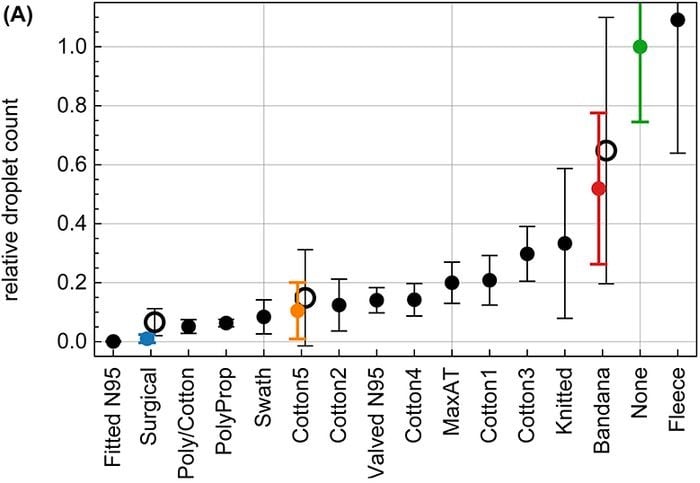
A new study on masks that measures the number of droplets emerging from the mouth during speech shows that properly fitted N95, surgical, and polypropylene masks are best, layered cotton masks are good, bandanas are not great, and neck gaiters may be worse than wearing no mask. Here’s a Washington Post article about the study.
I have some issues with this study — most masks were tested by only one speaker and mask materials were not identified precisely1 — but when combined with other studies about masks, it is clear that surgical masks or masks that are made with similar materials (polypropylene non-woven fabric) are what you want to shoot for, you want multiple layers for more protection (no single-layer microfiber gaiters), homemade cotton masks are pretty good (but would be better with a layer of polypropylene non-woven fabric), proper fit matters, and for god’s sake, stop wearing a bandana as a mask. Yes, bandanas are convenient, but you’re probably trading safety for that convenience, especially if you factor in the amount of time you’ll be wearing a mask over the next several months. A proper mask is going to protect you and your neighbors much more over the long haul — it’s just common sense at this point.
Re: the tested neck gaiter being worse than wearing no mask: the hypothesis is that the gaiter’s material splits large droplets into smaller ones, hence the higher count.
We noticed that speaking through some masks (particularly the neck fleece) seemed to disperse the largest droplets into a multitude of smaller droplets (see Supplementary Fig. S5), which explains the apparent increase in droplet count relative to no mask in that case. Considering that smaller particles are airborne longer than large droplets (larger droplets sink faster), the use of such a mask might be counterproductive.
Here’s what I’m taking away from this and other mask studies: wear the highest quality mask you can locate (multi-layered, incorporating surgical mask materials) that fits properly and, secondarily, is comfortable & convenient. For me, that’s a two-layer cotton mask (like these Vida masks) with an inserted layer of polypropylene non-woven fabric. An N95 would be much better in terms of efficacy, but it’s overkill in most situations (particularly here in VT, where rates continue to be low) and is difficult to fit properly and quickly. (via @EricTopol)
Update: Slate’s Susan Matthews goes into more detail about the problems with this study and the conclusions that others are drawing from it.
The purpose of the research was to establish that the testing method worked in principle-not to come up with meaningful or accurate verdicts about particular masks.
But she also concludes (correctly, in my mind):
Should you think twice about wearing just a gaiter inside, in close proximity to other people? Yeah, a fitted mask is probably better. But you didn’t need this study to tell you that.
(via @BrianDau)
Update: But interesting to note that in this test, scarves, bandanas, and microfiber neck gaiters came in last.
In the United States, amid high numbers of Covid-19 infections and thousands of weekly deaths, no national plan for testing & tracing, little support for working parents, and individual states and school districts left to their own devices to figure this all out for themselves, schools around the country are trying to “open” for the 2020-2021 school year. At McSweeney’s, Kara Baskin imagines Your School District’s Reopening Survey. Here’s what a hybrid learning model will look like:
This model will combine the key elements of in-person instruction (see above) with remote learning, which we hopefully perfected this spring. Your child will be divided into a cohort (A, B, AB, BC, CC, XVY, MCXLVII, and Depeche Mode) based on careful consideration of his or her learning style, social-emotional needs, friendships, and an algorithm our intern designed this summer. You will need a reliable Internet connection, a work schedule that follows no concrete pattern, a forgiving supervisor, independent wealth, or a Xanax prescription. Please contact our school nurse for the latter.
I sent this link to a friend who is currently evaluating several options for her child’s schooling that range from poor to dangerous, and she replied, “This may be too on the nose to be funny.”

Photographer Daniel Arnold and editor Dodai Stewart collaborated on a photoessay documenting the first five months of the pandemic in NYC. That image above is just…wow.
See also COVID-19 Empties Out Public Spaces.

The Instagram account thefamilyvocab features videos of words & phrases in sign language that are not part of standard ASL.
Our aim is to play with sign language and expand my child’s visual vocabulary with signs that are not part of standard ASL. It’s only 200 years old and still thriving and evolving.
I love this. So far, they’ve done words like pho, Black Lives Matter, TikTok (I really like this one), Brexit, coronavirus, emoji (I like this one too), gentrification, and dozens of others. They’re creating new signs, taking suggestions from followers, and sourcing signs from other sign languages from around the world. (via youngna)
Kristen McConnell writing for The Atlantic: I’m a Nurse in New York. Teachers Should Do Their Jobs, Just Like I Did.
So I can understand that teachers are nervous about returning to school. But they should take a cue from their fellow essential workers and do their job. Even people who think there’s a fundamental difference between a nurse and a teacher in a pandemic must realize that there isn’t one between a grocery-store worker and a teacher, in terms of obligation. People who work at grocery stores in no way signed up to expose themselves to disease, but we expected them to go to work, and they did. If they had not, society would have collapsed. What do teachers think will happen if working parents cannot send their children to school? Life as we know it simply will not go on.
Oh yes, that is a totally awesome thing our brave grocery store workers did for us out of a sense of obligation and not because their choice was between risking their health and losing their job in a country with a terrible social safety net. But let’s leave that to one side for a second.
I think many more people would support (and indeed rapturously welcome) kids going back to school if a) there were many fewer cases of Covid-19 in the US, b) if the federal and state governments were doing more testing, tracing, and isolation & support of those who test positive, c) if there was more support for parents, and especially low-income folks, with other options around education and childcare (more on that below), and d) if the mask issue wasn’t so contentious in some parts of the country. Oh and don’t forget that even before any of this happened, teachers regularly used their own money and held online fundraisers to buy necessary school supplies for their classrooms.
Blaming teachers for not wanting to go back to work because their country and communities can’t or won’t do the hard work of making it safe is ridiculous. It’s not fair to ask them to do their part when others with greater responsibility to act are not. Someone has been watching too many war movies where soldiers dying due to the negligence, incompetence, or bad intentions of their superiors is played off as patriotic service & bravery instead of murder.
And this…this is just flat out false:
(And parents who want their children to stay home have that option, whether through homeschooling or continued remote learning.)
Rich people with reliable internet access and extra computers lying around have that option, and it’s a terrible option if those parents work (especially if they’re single parents). A huge chunk of America does not.1 If, by some miracle, the federal government started paying people to stay home from work to help their kids with school, gave everyone a laptop stipend (as well as enough money so that kids have access to meals that they might usually get through school programs), and ensured internet access to those who don’t have it, that statement would be closer to the truth. As long as we’re waving magic wands, I would like a chocolate pony and a peanut butter unicorn.
I would have been far more sympathetic to McConnell’s case had she made a convincing argument that school is so essential to children that it’s worth the risk to them, their teachers, and their families, that schools and governments are doing the right things to ensure the safety of their students and staff, and that Covid-19 is coming under control in the United States. But she did not.
Update: Sarah Jones rebuts McConnell’s argument for New York magazine: Teachers Aren’t Sacrificial Lambs. No Essential Worker Is.
The idea that remote work and home education don’t qualify as doing one’s part for society is so pernicious that it nearly distracts from McConnell’s core argument, which is both simple and widespread: If work is essential, it must also be sacrificial. That argument is worth examining, not least because it’s likely to reappear as parents cope with another semester at home. McConnell has taken a view expressed most commonly in the pandemic policies of certain large corporations and extended it to teachers. The same thread is visible both in Amazon’s failure to get enough masks to workers and to ensure social-distancing in warehouses and in the insistence that teachers should head back into classrooms, whatever the risk.
I also had a bunch of mail in my inbox this morning, both from teachers and healthcare professionals, poking holes in this poorly argued piece. The Atlantic’s coverage of the pandemic has been outstanding, but this article was just not very good — a rare misfire. (via @zidaya)
The Auralnauts, who have rejiggered the dialogue and sounds from your favorite movies with hilarious results (most notably Star Wars), have reimagined Bane from The Dark Knight Rises as a coronavirus mask advocate for their latest video.
Do I look like I live in fear of anything?! I’m wearing this mask for you, the people of Gotham, who, I can’t help but notice, are not social distancing!
A compilation of TV news clips of people saying “mask debate” (which sounds very much like another unrelated word when spoken — try saying it out loud right now to see what I mean), stitched together by the folks at Last Week Tonight with John Oliver. It feels good to laugh at infuriating things sometimes.
BTW, the actual debate over masks will continue to wane — science and then culture will win most people over and it’ll just become a normal thing that most people do in public all the time, like wearing shoes or carrying a bag.
From We Can Eliminate Covid-19 if We Want To by Andy Slavitt:
We can virtually eliminate the virus any time we decide to. We can be back to a reasonably normal existence: schools, travel, job growth, safer nursing homes and other settings. And we could do it in a matter of weeks. If we want to.
Take New Zealand. With its fancy curve and life back to normal. Why can’t we? Not fair, you say. It’s an island nation. Okay. What about Germany? Not an island nation, large, growing diversity. Don’t like that comparison? What about countries that have been in big trouble? There’s Italy, France, and Spain. Those countries had it reasonably bad the same time we did. In fact, pick virtually any country you want.
But don’t tell me the United States can’t take action if we want to. And we can’t face the families of 150,000 people who didn’t have to die and tell them this had to happen. And I think it’s why our national political leaders won’t go near these families and the grieving process.
The good news — and it is good news — is we are always four to six weeks from being able to do what countries around the world have done.
I know this article is supposed to be hopeful and optimistic, but people have known what to do about Covid-19 since at least March. Instead the United States has not done it and indeed has done mostly the opposite. The “we” that are supposed to decide to lead this effort won’t because they don’t want to put in the work (it’s easier to blame the virus, Democrats, and China), they don’t want to just give money to people to stay home (a huge no-no for Republicans), and they don’t care that much about who is dying (urbanites, low-income, the elderly, Black & brown people).
As long as Republicans control the Senate and White House, the current scattershot approach of each state/county/city/person deciding what is best (or most in their self-interest) is what we’re stuck with. Treatments will improve, vaccines will be developed, many people will do the right thing and mostly stay home for many more months (sacrificing their mental health to do so), and Covid-19 will eventually come under control, but hundreds of thousands more people will die, many more will recover but carry chronic illnesses for years, vital years of the survivors’ lives will have been lost, and we will collectively grieve these losses for generations.
The Atlantic’s Sarah Zhang has A Vaccine Reality Check for us.
Biologically, a vaccine against the COVID-19 virus is unlikely to offer complete protection. Logistically, manufacturers will have to make hundreds of millions of doses while relying, perhaps, on technology never before used in vaccines and competing for basic supplies such as glass vials. Then the federal government will have to allocate doses, perhaps through a patchwork of state and local health departments with no existing infrastructure for vaccinating adults at scale. The Centers for Disease Control and Prevention, which has led vaccine distribution efforts in the past, has been strikingly absent in discussions so far — a worrying sign that the leadership failures that have characterized the American pandemic could also hamper this process. To complicate it all, 20 percent of Americans already say they will refuse to get a COVID-19 vaccine, and with another 31 percent unsure, reaching herd immunity could be that much more difficult.
I am the least anti-vaxxer person in the world, but I have to say that getting a vaccine for Covid-19 that was rushed through trials in time for the election (October surprise!) and signed off by a Trump administration that has completely politicized science does not sound like something I want to go near. Which, for me personally, is a really really depressing thing to even think.
Update: I got a lot of flack for suggesting that I’d be skeptical of a Trump-approved vaccine rushed to market in time for the election (a very specific set of circumstances). But his buddy Putin is attempting something similar in Russia (skipping phase 3 trials), so if you don’t think Trump can try to bully the FDA and CDC into signing off on a vaccine that hasn’t been fully tested — perhaps made by a company whose CEO has donated millions to a Trump SuperPAC? — in order to salvage his reelection chances, I suggest that you haven’t paying proper attention over the past 4 years.
Update: A poll suggests that many Americans across the political spectrum are worried about a politicized FDA being forced to approve a Covid-19 vaccine before it’s adequately tested.
Seventy-eight percent of Americans worry the Covid-19 vaccine approval process is being driven more by politics than science, according to a new survey from STAT and the Harris Poll, a reflection of concern that the Trump administration may give the green light to a vaccine prematurely.
The response was largely bipartisan, with 72% of Republicans and 82% of Democrats expressing such worries, according to the poll, which was conducted last week and surveyed 2,067 American adults.
The sentiment underscores rising speculation that President Trump may pressure the Food and Drug Administration to approve or authorize emergency use of at least one Covid-19 vaccine prior to the Nov. 3 election, but before testing has been fully completed.
Eater food critic Ryan Sutton, who had Covid-19 back in March, isn’t dining out at restaurants right now and explains why.
What’s more is that local health regulations for dining out aren’t strong enough. Before every shift, restaurants have to screen employees with health based questions, but temperature checks aren’t mandatory for either staffers or employees. And even though patrons are encouraged to wear masks at tables while they’re not actively eating or drinking, few really do. Even if no one dies or is sent to intensive care under these conditions, the notion of being in a place where underpaid staffers are financially compelled to interact with unscreened and unprotected patrons seeking leisure is unacceptable to me on a very basic human level.
I miss dining out so SO much. I miss my friends in the industry and am furious that federal and state governments have pushed them back into unsafe working conditions in the idiotic & dangerous race to “open up the economy” before any reasonable system of test/trace/isolate + a mask mandate is put into place nationwide. But I haven’t been in a restaurant since early March and will not return to one, outside dining or no, until the pandemic is over.1 I’ve been ordering takeout as much as I can (and heavily tipping) to support local businesses that are operating safely. But the whole concept of dining out seems very irresponsible to me and should not even be an option right now.
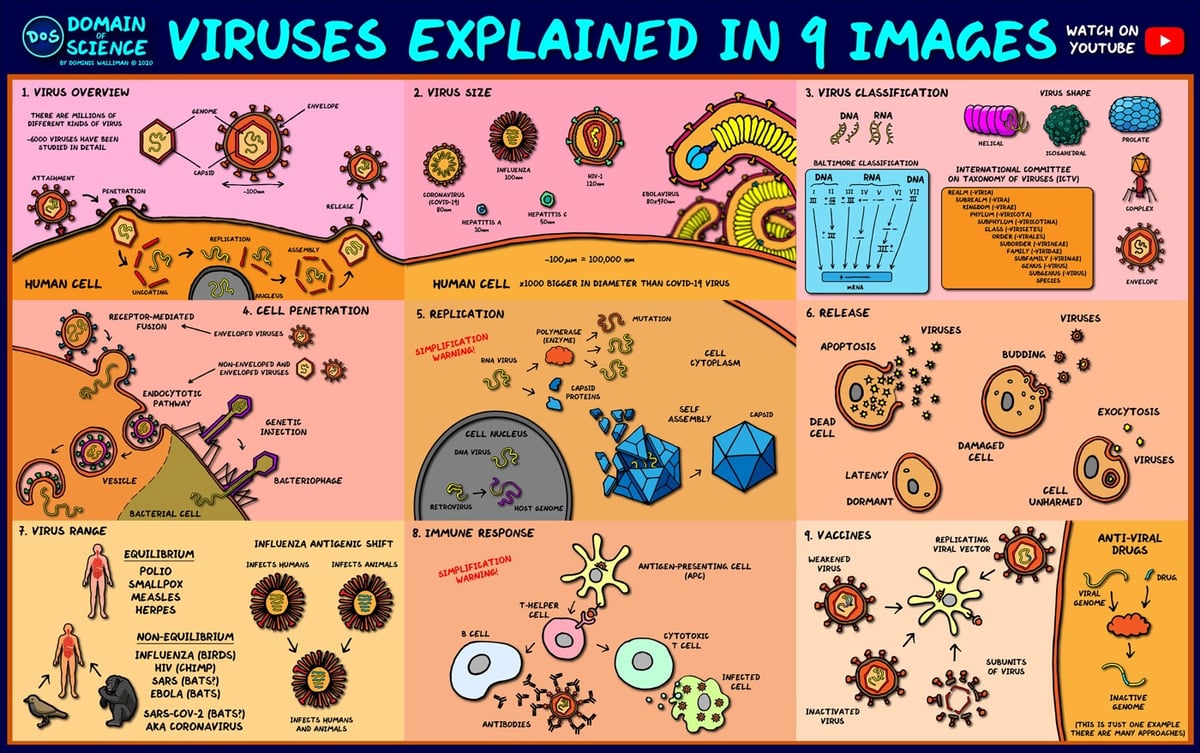
In this video and accompanying infographic, scientist Dominic Walliman of Domain of Science explains what viruses are, how they infect cells, how they replicate, and what can be done to mitigate their effects on the human body.
At the beginning of this pandemic like everyone I was hearing lots about viruses, but realised I didn’t know that much about what they are. So I did a load of research and have summarised what I learned in these nine images. This video explains the key aspects of viruses: how big they are, how they infect and enter and exit cells, how viruses are classified, how they replicate, and subjects involving viral infections like how they spread from person to person, how our immune system detects and destroys them and how vaccines and anti-viral drugs work.
After watching, it’s worth checking out Walliman’s sources in the video description for a deeper dive into viruses. (via open culture)
From Dr. Anna DeForest, a devastating article — a prose poem almost — in The New England Journal of Medicine: The New Stability.
This is the day you start to turn. What we suck up from your lungs turns frothy pink and then the frank red of blood. We don’t know if your heart is finally failing or if the virus has destroyed so much tissue that this is necrosis, hemorrhaged in your lungs. There are tests, but no one willing to run them — you are too sick, and you have never cleared the virus. No one would ever want to be what you are now: a hazard, a threat, a frightening object on the edge of death. We try not to touch you. We construct our plans for saving you around staying as far away from you as possible.
I tell your husband about the blood. It’s true that nothing else has changed: your struggling lungs, with help, still take in air, your heart, with help, still brags along. “But she is stable,” he asks, barely a question. Why do I lie? “Yes,” I say, “for now.”
DeForest wrote this in early May as Covid-19 cases peaked at her hospital in New Haven. The country and its leaders ignored this and now cases are spiking in many hospitals all around the country now. Just some sniffles, though, nothing to bother anyone about.
Newer posts
Older posts






Socials & More