



On Mastodon, Bluesky, and the Fediverse. “Should we stick with an easy system like the ones we know on Twitter and Facebook, where a few media kings rule us all? Or embrace the ambiguity of decentralization in the name of freedom?”

Advertise here with Carbon Ads
This site is made possible by member support. 💞
Big thanks to Arcustech for hosting the site and offering amazing tech support.
When you buy through links on kottke.org, I may earn an affiliate commission. Thanks for supporting the site!
kottke.org. home of fine hypertext products since 1998.
Beloved by 86.47% of the web.
Entries for May 2023
Trans Teen Hatches Nefarious Plot To Undergo Years Of Medical Treatments And Counseling To Win At Swimming. “I don’t even want to be a woman — I just want to win at swimming.”
Tejal Rao with a keen observation: On ‘Succession’, if You’re Eating, You’re Losing. “Their hunger, their appetite, their keenness, it’s a squishy surplus of vulnerability.”
How Precise Metal Machining Is Done
I’ve always wondered about the process for making pieces of metal that appear to fit together perfectly, so perfectly that you can’t see any sort of cut or seam. In this video, Steve Mould explains how wire EDM works, in part using cheese.
The Centre Pompidou in Paris will be closed for five years of renovations starting in 2025. Five years!? What, do they only have one person working on it?
A new study links exposure to a common chemical solvent called trichloroethylene to an increased risk of developing Parkinson’s disease. “TCE is highly persistent in soil and groundwater…”
Japan’s Evaporated People
In Japan, people who disappear from their lives are called “evaporated people”. People choose to drop out of their lives for different reasons, ranging from debt or abuse to mental health struggles or a lack of second chances in Japanese society. Some Japanese who want to go into hiding or relocate from domestic abuse or stalkers hire “night movers” to help them disappear.
For more info, here’s a long piece from Time magazine from 2017.
Sometimes a whole team works on a client’s disappearance, swiftly sweeping through an apartment in the dead of night. At TS, it costs between ¥50,000 ($450) and ¥300,000 ($2,600) depending on the amount of possessions somebody wants to flee with, how far they’re going, and whether the move needs to happen under the cover of darkness. Taking along children, or evading debt collectors, can push prices higher. Every day, TS receives between five and 10 inquiries like the one Saita described. Most people simply require counseling or legal advice but the company claims to help between 100 and 150 people to vanish annually.
Morris Tanenbaum, Inventor of the Silicon Microchip, Dies at 94. “In 1955 he and colleague Ernest Buehler demonstrated the first silicon transistor.”
Early Computer Art in the 50s and 60s

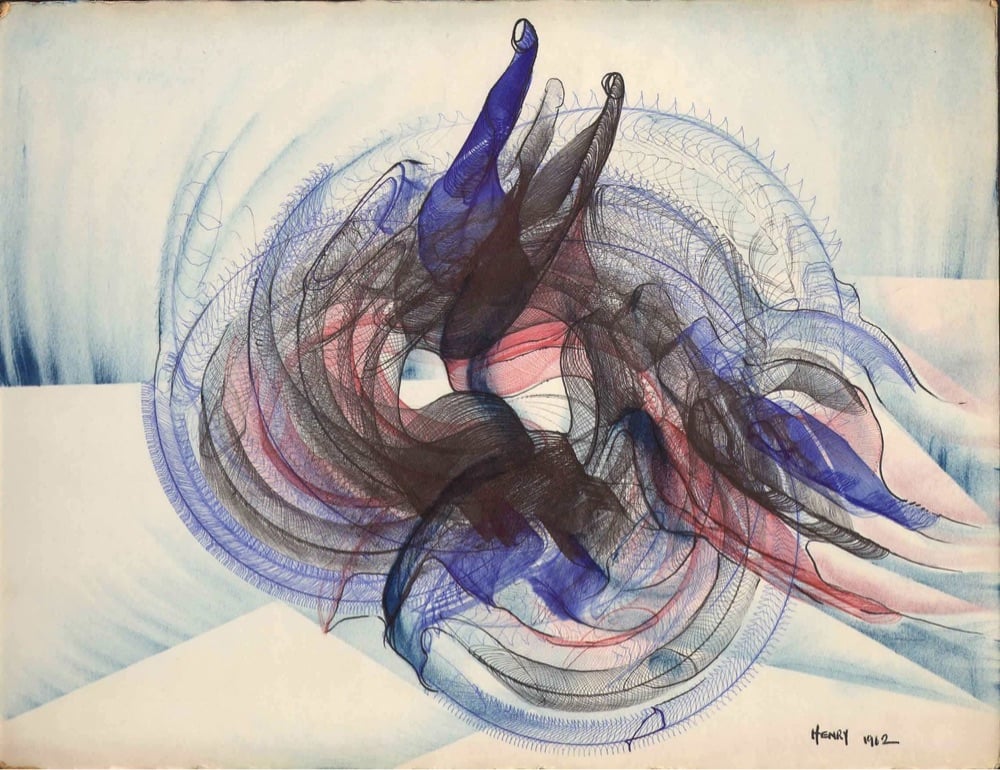
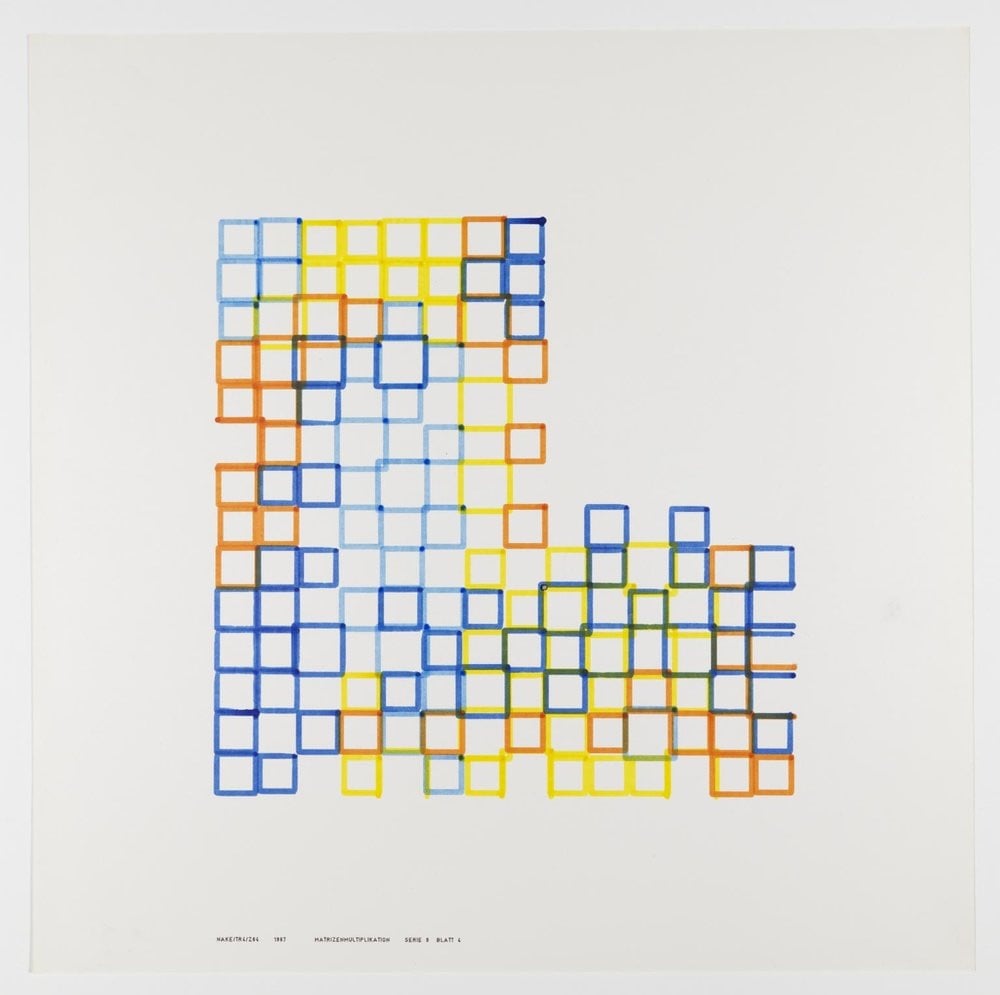
Artist Amy Goodchild recently published an engaging article about the earliest computer art from the 50s and 60s.
My original vision for this article was to cover the development of computer art from the 50’s to the 90’s, but it turns out there’s an abundance of things without even getting half way through that era. So in this article we’ll look at how Lovelace’s ideas for creativity with a computer first came to life in the 50’s and 60’s, and I’ll cover later decades in future articles.
I stray from computer art into electronic, kinetic and mechanical art because the lines are blurred, it contributes to the historical context, and also because there is some cool stuff to look at.
Cool stuff indeed — I’ve included some of my favorite pieces that Goodchild highlighted above. (via waxy)
Curve-Fitting Methods and the Messages They Send
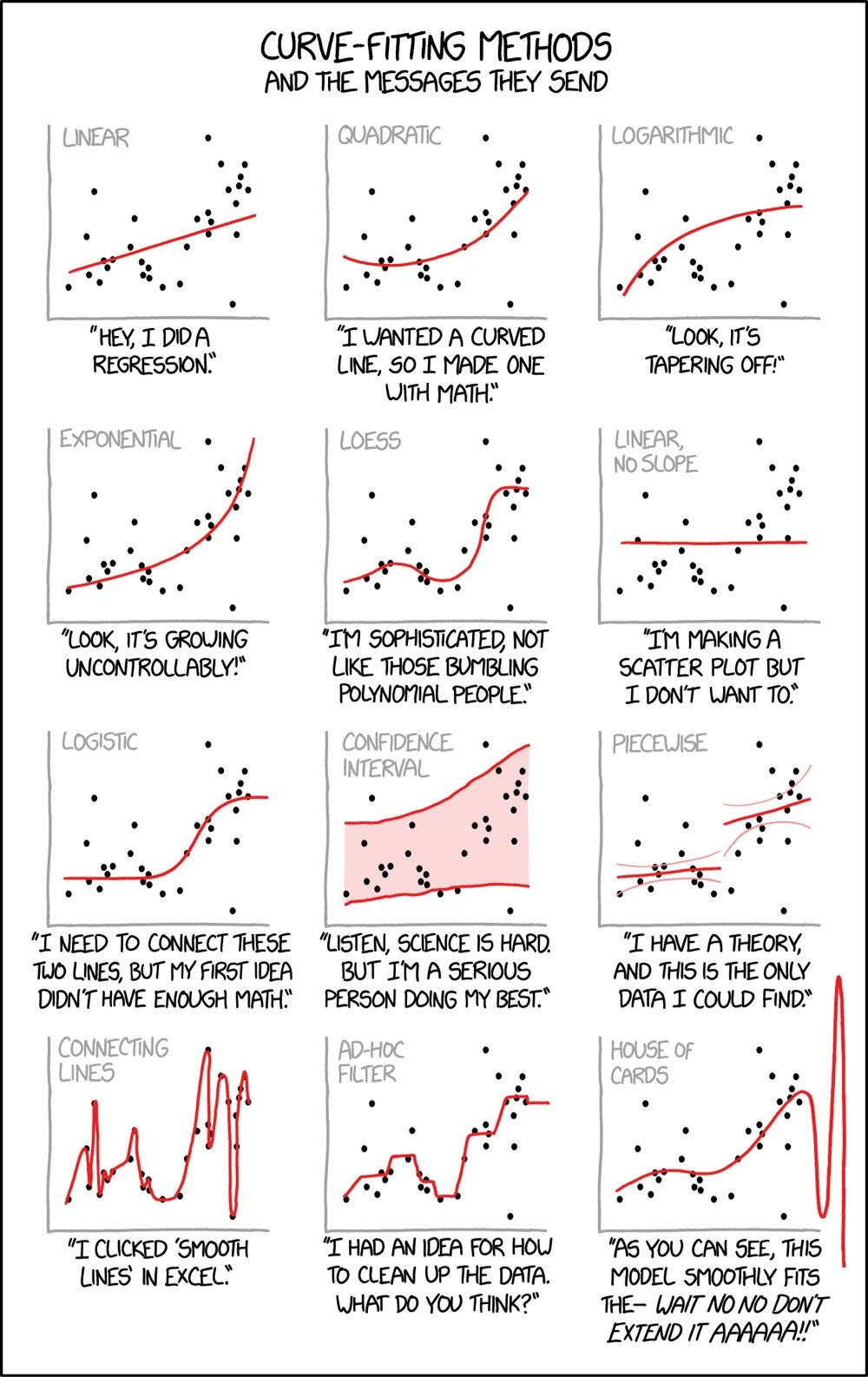
From XKCD, Curve-Fitting Methods and the Messages They Send. Ahhhh, this takes me back to my research days in college, tinkering with best fits and R-squared values…
Ian Frisch’s mother played competitive poker in her youth, but stopped to raise a family. She took it up again after her husband died in order to provide for her kids. “I love having a nemesis at the table. It gives me purpose.”
The winners of the 2023 Nebula Awards for the best speculative fiction released in 2022, including Babel by R.F. Kuang for best novel.
How A24 Took Over Hollywood
If you’re like me, sometime in the past 4-5 years you noticed that a lot of the films you liked (or, even if you didn’t, you appreciated that they were getting made) were coming from the same place, A24. Moonlight, Uncut Gems, Everything Everywhere All At Once, Aftersun, The Tragedy of Macbeth, Eighth Grade, Lady Bird, The Lobster, Amy, Ex Machina. More recently, TV shows like Euphoria, Beef, and Erma Vep.
This video from Vox charts the rise of A24 from a small distributor to an Oscar-winning powerhouse that pumps out more movies each year than much bigger studios. See also The Cult of A24 (a good companion piece to the video above) and Every A24 Movie, Ranked.
I Will Defend Free Speech to the Death. Or Until an Autocrat Asks Me to Stop. “Let every petty dictator take notice: If you want Twitter to censor its users, just send me an email.”
The Immortal Myths About Online Abuse. “We’ve learned how to fight abuse. It’s a solvable problem. We just have to stop repeating the same myths as excuses not to fix things.” Important read as we attempt to reorg social media.
A recent study suggests that Saturn’s rings are relatively young, no more than 400 million years old (Saturn is 4.5 billion years old). Horseshoe crabs & jellyfish are older.
A Trove of Video Profiles of Artists
On their YouTube channel, Art21 hosts a treasure trove of video profiles of artists like Amy Sherald, Olafur Eliasson, Chris Ware, Christian Marclay, Anish Kapoor, Kara Walker, Barbara Kruger, Julie Mehretu, and Sally Mann.
This is excellent — what a resource. (via colossal)
The media is not equipped to handle the return of Donald Trump. “Bigotry is not merely a different opinion that we should expose ourselves to. It isn’t an intellectual exercise or a useful contribution to a range of diverse viewpoints.”
The Future Pandemic Playbook: What the US Got Right
From The Atlantic, 23 Pandemic Decisions That Actually Went Right, the result of interviews with more than a dozen pandemic experts.
17. Basic research spending matters. The COVID vaccines wouldn’t have been ready for the public nearly as quickly without a number of existing advances in immunology, Anthony Fauci, the former head of the National Institute of Allergy and Infectious Diseases, told us. Scientists had known for years that mRNA had immense potential as a delivery platform for vaccines, but before SARS-CoV-2 appeared, they hadn’t had quite the means or urgency to move the shots to market. And research into vaccines against other viruses, such as RSV and MERS, had already offered hints about the sorts of genetic modifications that might be needed to stabilize the coronavirus’s spike protein into a form that would marshal a strong, lasting immune response.
The Search for My Kimchi. Food, data science, and the immigrant experience combine in Alvin Chang’s attempt to rediscover a childhood favorite that his grandmother made him.
Making Art by Day, Guarding It at the Met by Night. “Over 25 years walking the museum’s midnight shift, Greg Kwiatek learned how to look for the hidden subtleties of paintings, which helped inform his own.”
How Big Are the Biggest Black Holes?
This short animation from NASA shows the sizes of some of the supermassive black holes that feature at the center of galaxies. Some are relatively small:
First up is 1601+3113, a dwarf galaxy hosting a black hole packed with the mass of 100,000 Suns. The matter is so compressed that even the black hole’s shadow is smaller than our Sun.
While others are much larger than the solar system…and this isn’t even the biggest one:
At the animation’s larger scale lies M87’s black hole, now with a updated mass of 5.4 billion Suns. Its shadow is so big that even a beam of light — traveling at 670 million mph (1 billion kph) — would take about two and a half days to cross it.
The Brooklyn Museum and Hannah Gadsby are collaborating on an exhibition called It’s Pablo-matic: Picasso According to Hannah Gadsby that “reckons with complex questions around misogyny, creativity, the art-historical canon, and ‘genius.’”
Andy tracked down and interviewed Bobby Fingers, who came out of seemingly nowhere with these great & gloriously weird videos about “embarrassing moments in the lives of famous men”.
The Horror of Vintage Dutch Safety Posters
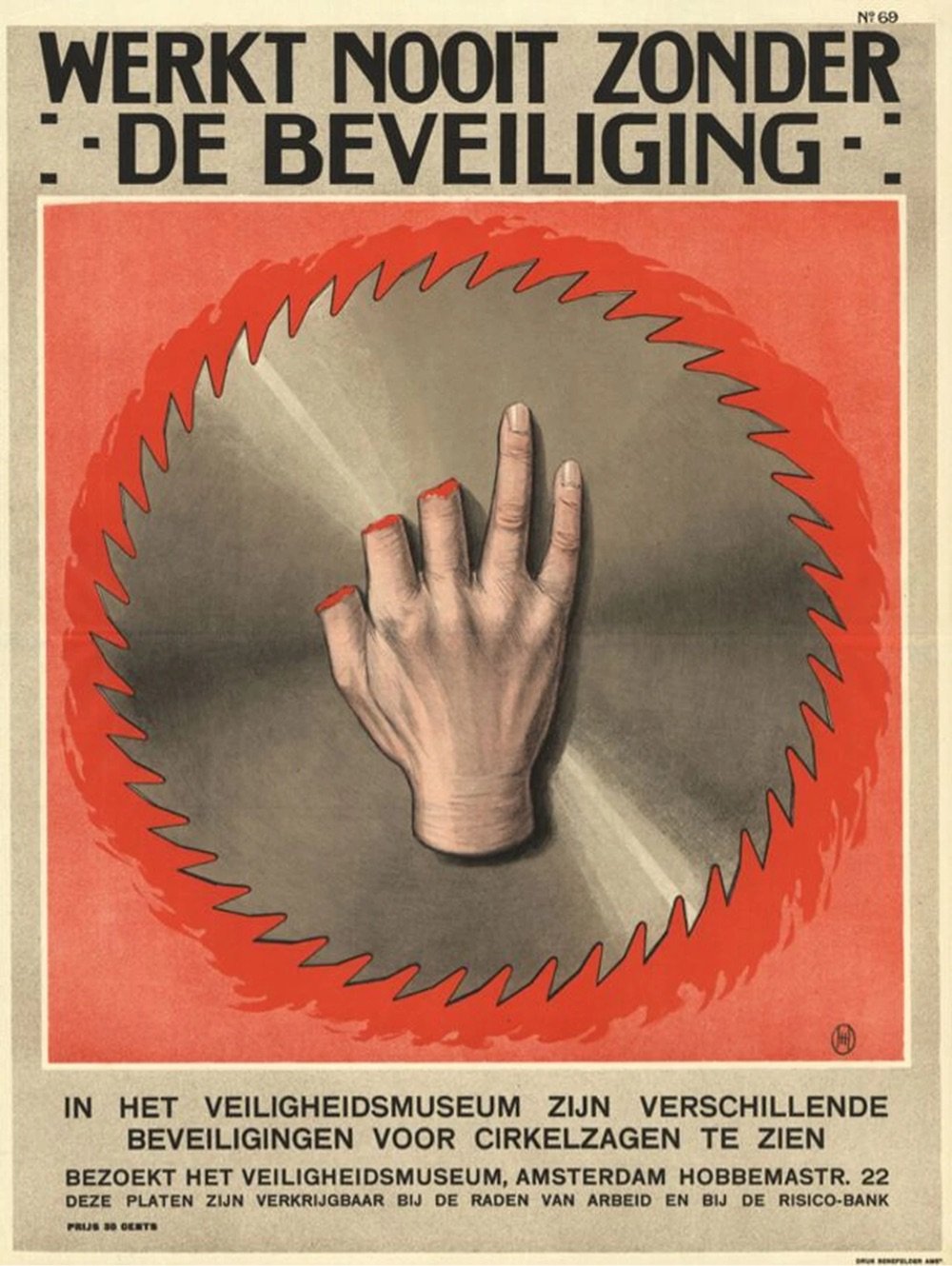
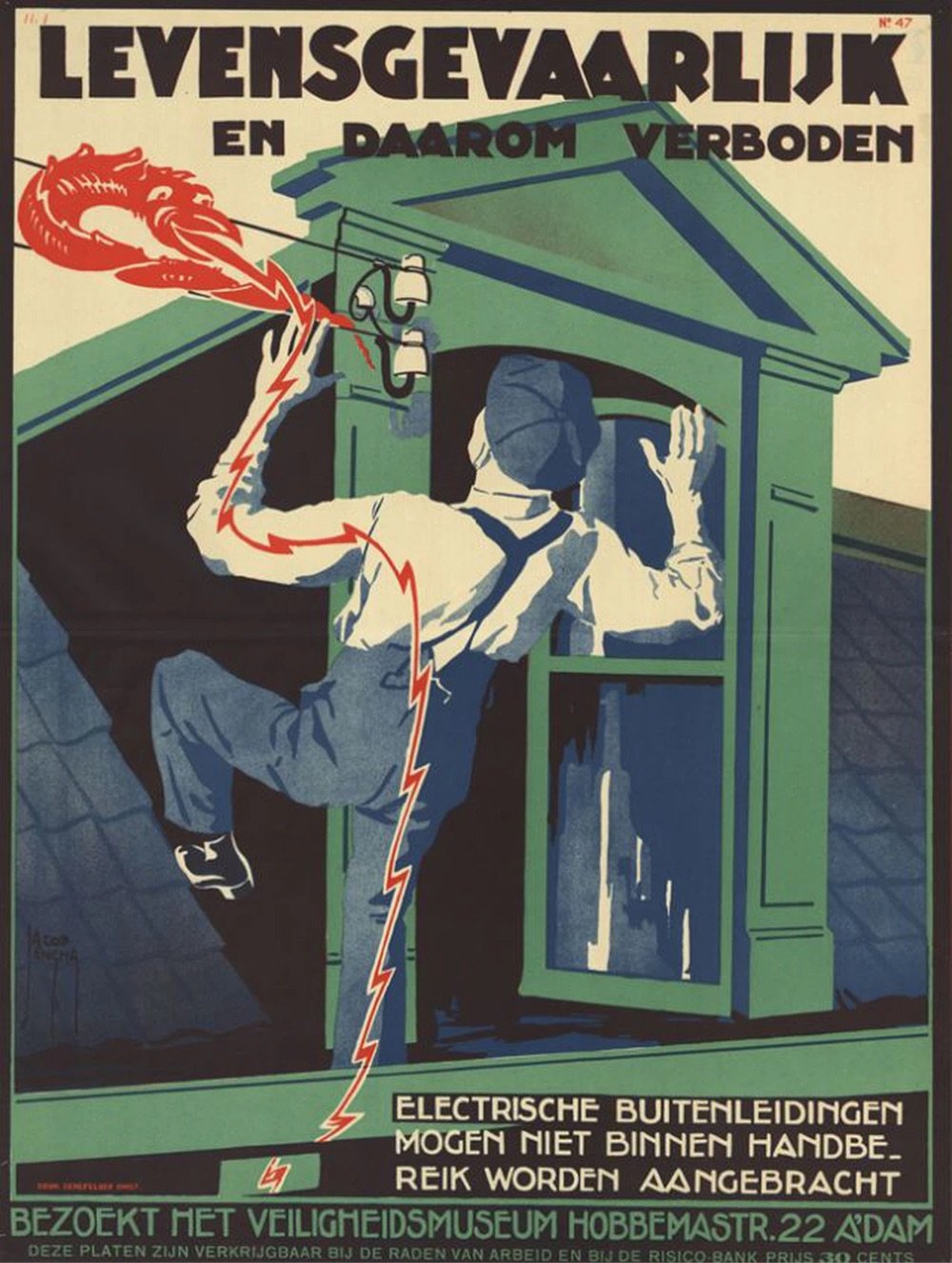
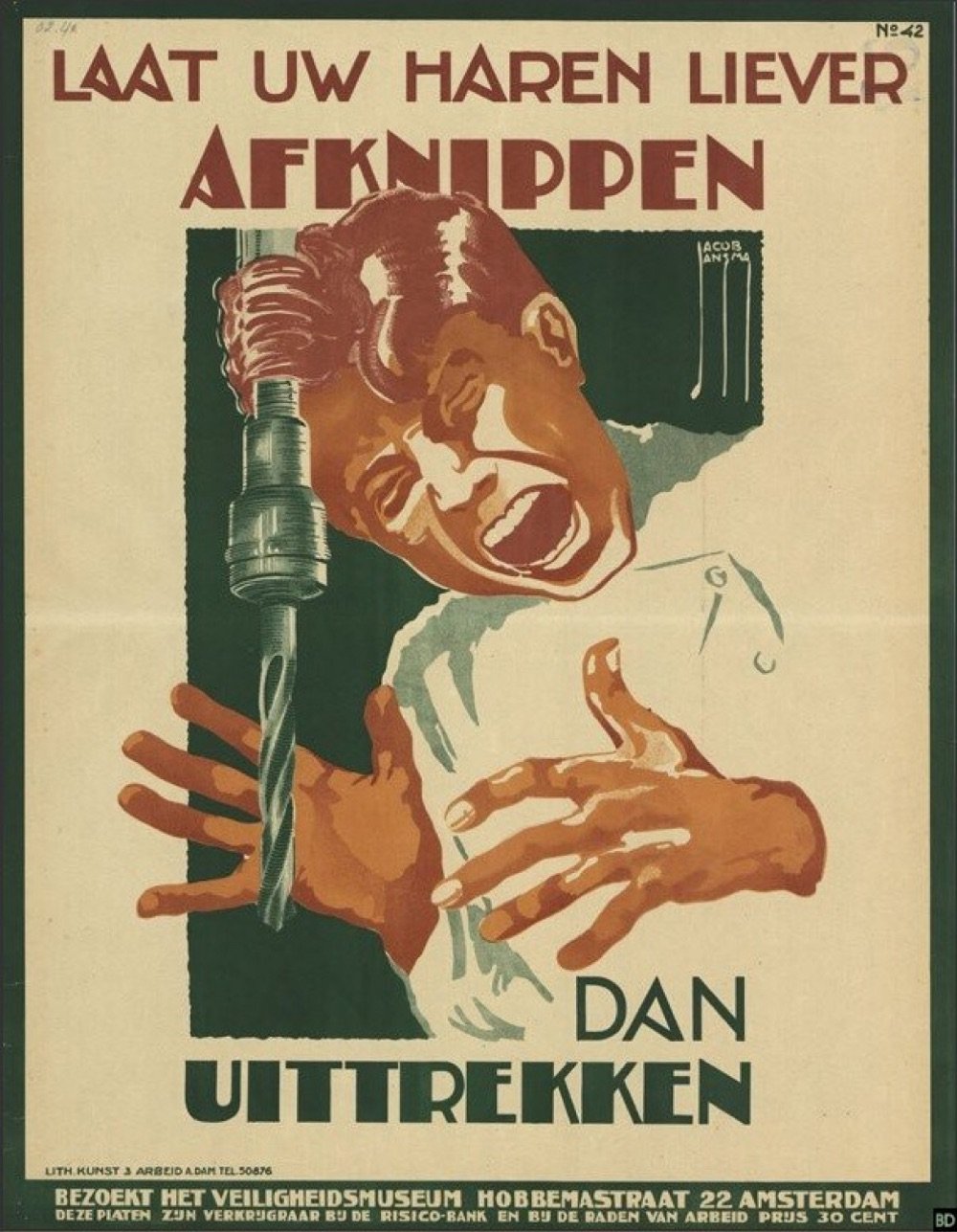
When it came to making safety posters, the Dutch were pretty hardcore — a lot of these vintage posters look more like horror film adverts than safety warnings. (via meanwhile)
Theoretical Puppets, a YouTube channel that features Muppet-style puppets of thinkers like Hannah Arendt, Walter Benjamin, and Michel Foucault discussing social science and philosophy. So weird.
Play Moderator Mayhem, in which you are tasked with moderating user-generated content. The game’s creators hope it will result in better conversations about trust & safety issues.
In The End: What It Felt Like to Almost Die
In this short film by Sarah Klein & Tom Mason, Christen O’Brien tells the story of how she almost died from a massive pulmonary embolism, what she experienced in those moments, and what she took from the experience. The film is based on an essay she wrote called What It Felt Like to Almost Die.1
Realizing that I was dying was like being pushed into a pool. You have no thought but to hold your breath and start swimming. It was the most out of control I’d ever been in my life, yet the only option was to succumb peacefully. I could hear the percussion of my heart beating wildly, recklessly. My breath only reached my trachea now, its pathway closing in rapidly. My palms spread open to the sky, just as my dog moved to stand over me. I am here with you, I am here to protect you.
O’Brien wrote a follow-up to her original post, How It Felt to Come Back to Life:
Coming back from death showed me that the journey of life is not what we often believe. On the surface, it appears as a journey outward — toward things, people, organizations, achievements. But in truth, it is a journey inward — toward the soul. Toward becoming who you actually are, no matter how far outward you may have to travel in order to discover that all the answers are within you, where you belong.
The filmmakers first read O’Brien’s story via a link from kottke.org. It doesn’t happen that often, but I love it when things I feature go on to inspire others to create things of their own. Just doing my bit to complete the loop.↩
In the 80s and 90s, many Asian American parents named their daughters after journalist Connie Chung; a group of Connies recently met their namesake. “People saw Connie Chung every night on TV; she was famous, and popular. She’d made it.”
The Whimsical Fellowship, Wes Anderson’s Lord of the Rings
I know, I know. Too much Wes Anderson. Too much AI. But there is something in my brain, a chemical imbalance perhaps, and I can’t help but find this reimagining of the Lord of the Rings in Anderson’s signature style funny and charming. Sorry but not sorry.
How to Survive a Car Crash in 10 Easy Steps. “Your brain can’t regenerate the neurons it’s lost. Use ‘em or lose ‘em. You had no idea your brain operated like annual dental benefits.”
A reminder that CNN is not bumbling into platforming fascists like Trump because of some unlearned lessons from 2016 — the network’s move to the right is on purpose. It’s entertainment, not news — like Fox.
Great Wave Off Kanagawa, In All Its 1-Bit Pixelized Glory
As part of a project to reproduce all 36 of Hokusai’s views of Mount Fuji as 1-bit black & white pixel art, James Weiner drew Great Wave Off Kanagawa:

And he used an old Mac running System 7 to do it:
I usually use either my Quadra 700 or PowerBook 100, mostly because those are my reliable and easy to access computers (that run System 7, my favourite and most familiar OS of that era).
Software-wise I use Aldus SuperPaint 3.0, which is what my family had when I was a kid. Yes, I’d say that all of this is 99% nostalgia-driven…
This is just a lovely rendering — spare and elegant with just the right amount of detail.
A book from 2019 called This Is How You Lose the Time War has rocketed to #3 on Amazon’s bestseller list because of a viral tweet by someone named Bigolas Dickolas.
Rest in Peace, Heather
Hey folks, I have some sad news to share. Heather Hamilton (aka Heather Armstrong), who wrote the popular and influential Dooce weblog, died yesterday. She was 47 years old. My thoughts are with her children, her family, and those closest to her.
I’ll see you back here tomorrow. In the meantime, hug your loved ones tight. ❤️
J. R. Moehringer on his experiences ghostwriting memoirs with Andre Agassi, Phil Knight, and Prince Harry. “For the thousandth time in my ghostwriting career, I reminded myself: It’s not your effing book.”
“From the copaganda marketing term ‘officer-involved shooting’ to the politician fave ‘mistakes were made,’ exonerative language deflects whose fault it is, absolving anyone of accountability and employing the passive voice to misleading ends.”
Finnish newspaper Helsingin Sanomat designed a map in Counter-Strike with a secret room that delivers factual information on the war in Ukraine to Russian players who only hear propaganda on the news.
The list of the 11 Most Endangered Historic Places in the US for 2023 includes two Chinatowns, a gas station in Arizona, and Miami’s Little Santo Domingo neighborhood.
Tour the Bridges of All of Star Trek’s Starships Enterprise
Drawing from the materials of The Roddenberry Archive, this video takes us on a virtual tour of the 3D rendered bridges of every iteration of the Starship Enterprise from Star Trek, from the original 1964 sketches to the final scenes of Star Trek: Picard. I’ve watched a bunch of Star Trek recently and it was neat to see the evolution of the design and presumed technology. Designing for the future is difficult and it’s even tougher when, for instance, you need to design something that for the future that looks contemporary to now but also, somehow, predates a design that looked contemporary 30 years ago. (If that makes any sense…)
You can also head over to The Roddenberry Archive to check out all of the Enterprise designs in more detail, inside and out. (via open culture)
“Looming behind antibiotic resistance is another bacterial threat – antibiotic tolerance.” Some bacteria can lie dormant while antibiotics are present, only to reactivate after they’ve left the system.
Right-wing gun nut Timothy McVeigh’s dreams are coming true. “Today, an often-inchoate movement of people who share many of McVeigh’s views is waging what increasingly looks like a low-level insurgency against the rest of us.”
Your Body Is Never Not Killing Cancer
From Kurzgesagt, this video is a good overview of the arms race going on in all human bodies between cancer cells and the defenses developed by our immune systems over the years.
Somewhere in your body, your immune system just quietly killed one of your own cells, stopping it from becoming cancer, and saving your life. It does that all the time. The vast majority of cancer cells you develop will be killed without you ever noticing. Which is an incredibly hard job because of what cancer cells are: parts of yourself that start to behave as individuals even if it hurts you.
What is cancer and how does your body kill it all the time?
Citing an increase in breast cancer among women in their 40s, the U.S. Preventive Services Task Force now recommends women should start getting regular mammograms at age 40.
Wendy’s plans on automating its drive-thru service using an AI chatbot developed by Google. “The application has also been programmed to upsell customers, offering larger sizes, Frosties or daily specials.”
The winners of the 2023 Pulitzer Prize for books include Beverly Gage’s biography of J. Edgar Hoover, Freedom’s Dominion: A Saga of White Resistance to Federal Power by Jefferson Cowie, and Hua Hsu’s memoir Stay True.
Overinflated: The Journey of a Humble Tire Reveals Why Prices Are Still So High. An “I, Pencil” look at inflation and why prices on some goods (like car tires) remain high.
Americans tend to react in six different ways to the climate crisis: alarmed, concerned, cautious, disengaged, doubtful, and dismissive. “Overall, Americans are becoming more worried about global warming, more engaged with the issue…”
There was an all-fonts category on Jeopardy the other day — the text of each clue was set in the typeface they were looking for as an answer.
SineRider: A Game About Love & Graphing
Remember Line Rider? It’s a simple video game / physics toy where you draw slopes and curves for a person on a sled to navigate, pulled along by gravity. SineRider, a project started by Chris Walker and finished by a group of teen hackers at Hack Club, is a version of Line Rider where you use math equations to draw curves to maneuver the sledder through a series of points, sometimes in a certain order. Here’s a trailer with some gameplay examples:
Let me tell you, I haven’t had this much fun mucking around with an online game/toy since I don’t know when. My math is super rusty, but SineRider eases you into the action with some simple slopes (no cosines or tangents necessary) and before you know it, it’s 20 minutes later and you’re googling equations for parabolas.
Right now, there are two ways to play. You can start on the front page and go through a progression of puzzles that get more challenging as more concepts are introduced (such as the curve changing over time). Or you can do the challenges, which are posted daily to Twitter or Reddit. My son and I spent 10-15 minutes solving these two challenges and we were laughing and cheering when we finally got them. (The educational opportunity here is obvious…)
SineRider is currently in beta so some of the UI stuff is a little rough around the edges, but I was really charmed by the music, the animations…everything really. The project is open source — the code is available on GitHub and the Hack Club folks are looking for contributors and collaborators:
There’s a reason it’s open-source and written in 100% vanilla JavaScript. We need volunteer artists, writers, programmers, and puzzle designers. And, if you’re a smart teenager who wants to change education for the better, you should come join Hack Club!
Socials & More