
Lifting restrictions, the FDA will allow patients to receive abortion medication by mail.

Advertise here with Carbon Ads
This site is made possible by member support. 💞
Big thanks to Arcustech for hosting the site and offering amazing tech support.
When you buy through links on kottke.org, I may earn an affiliate commission. Thanks for supporting the site!
kottke.org. home of fine hypertext products since 1998.
Beloved by 86.47% of the web.
Entries for December 2021
America Is Not Ready for Omicron
This piece, from Ed Yong, is not at all surprising: America Is Not Ready for Omicron.
America was not prepared for COVID-19 when it arrived. It was not prepared for last winter’s surge. It was not prepared for Delta’s arrival in the summer or its current winter assault. More than 1,000 Americans are still dying of COVID every day, and more have died this year than last. Hospitalizations are rising in 42 states. The University of Nebraska Medical Center in Omaha, which entered the pandemic as arguably the best-prepared hospital in the country, recently went from 70 COVID patients to 110 in four days, leaving its staff “grasping for resolve,” the virologist John Lowe told me. And now comes Omicron.
Will the new and rapidly spreading variant overwhelm the U.S. health-care system? The question is moot because the system is already overwhelmed, in a way that is affecting all patients, COVID or otherwise. “The level of care that we’ve come to expect in our hospitals no longer exists,” Lowe said.
The real unknown is what an Omicron cross will do when it follows a Delta hook. Given what scientists have learned in the three weeks since Omicron’s discovery, “some of the absolute worst-case scenarios that were possible when we saw its genome are off the table, but so are some of the most hopeful scenarios,” Dylan Morris, an evolutionary biologist at UCLA, told me. In any case, America is not prepared for Omicron. The variant’s threat is far greater at the societal level than at the personal one, and policy makers have already cut themselves off from the tools needed to protect the populations they serve. Like the variants that preceded it, Omicron requires individuals to think and act for the collective good — which is to say, it poses a heightened version of the same challenge that the U.S. has failed for two straight years, in bipartisan fashion.
The main point:
Here, then, is the problem: People who are unlikely to be hospitalized by Omicron might still feel reasonably protected, but they can spread the virus to those who are more vulnerable, quickly enough to seriously batter an already collapsing health-care system that will then struggle to care for anyone — vaccinated, boosted, or otherwise. The collective threat is substantially greater than the individual one. And the U.S. is ill-poised to meet it.
Also from Yong: he recently cancelled his 40th birthday party because of Omicron and wrote about how he thought through the decision.
If someone got sick, I know others could too. A week later, many of my friends will spend Christmas with their own families. At best, a cluster of infections at the birthday party would derail those plans, creating days of anxious quarantine or isolation, and forcing the people I love to spend time away from their loved ones. At worst, people might unknowingly carry the virus to their respective families, which might include elderly, immunocompromised, unvaccinated, partially vaccinated, or otherwise vulnerable people. Being born eight days before Christmas creates almost the perfect conditions for one potential super-spreader event to set off many more.
As has been the case the entire pandemic, our political and public health systems are not equipped to collectively combat this virus, so it falls to individuals to make good choices for our communities. It’s a nearly impossible thing to ask to pandemic-weary folks to focus in again on making good personal choices and even harder to achieve if few are willing to do it, but goddammit we have to try.
“Fully vaccinated” = 3 shots. Get that third shot if you haven’t and you’re eligible. It’s your best protection against Omicron.
This morning’s Omicron update. 1 million US cases/day by 1st week of Jan (exceeding testing capacity). “If we continue this rate of spread…there is no modern day virus that has spread this fast and this far ever before.”
Otherworldly Single Malt Scotch

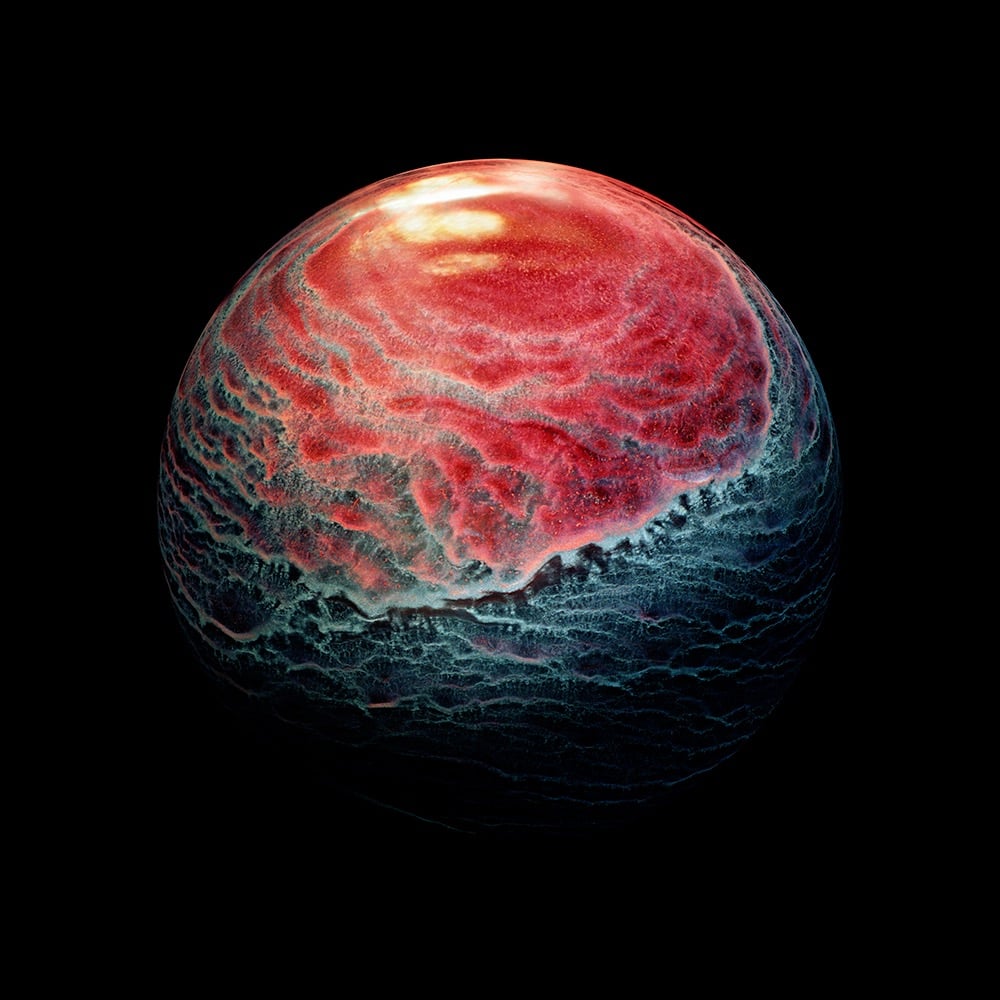
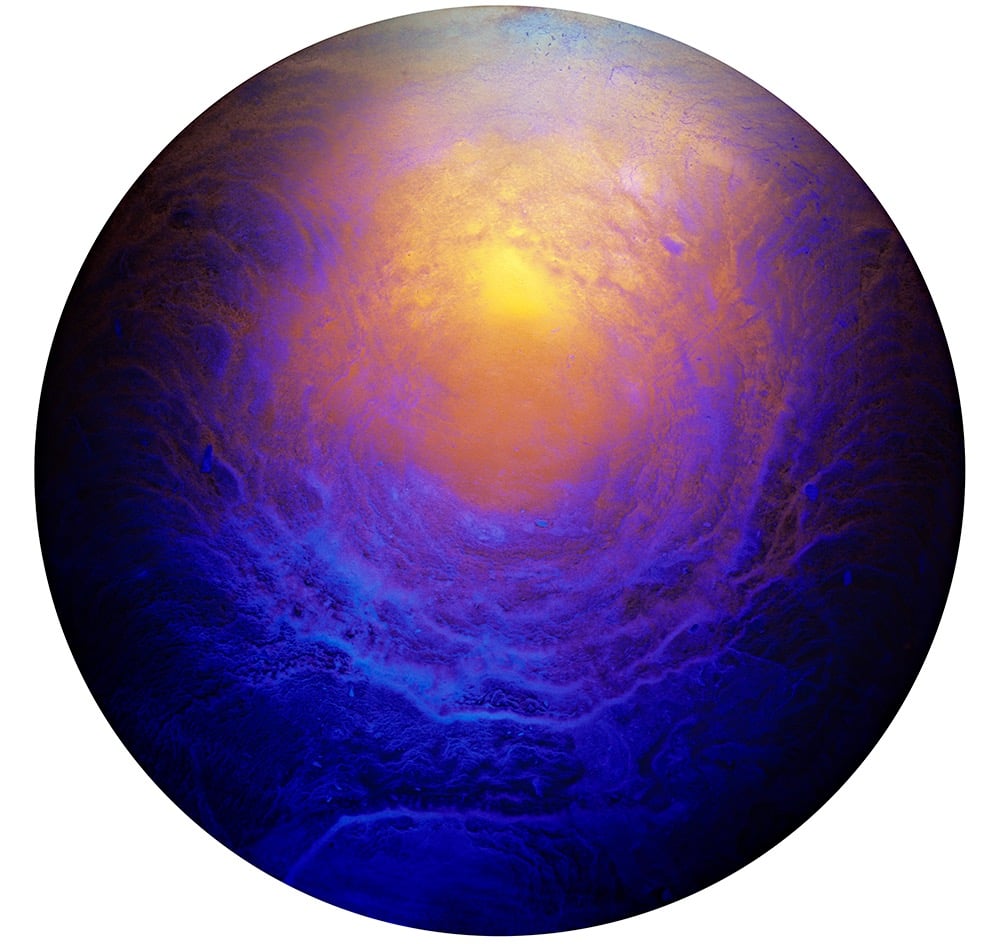
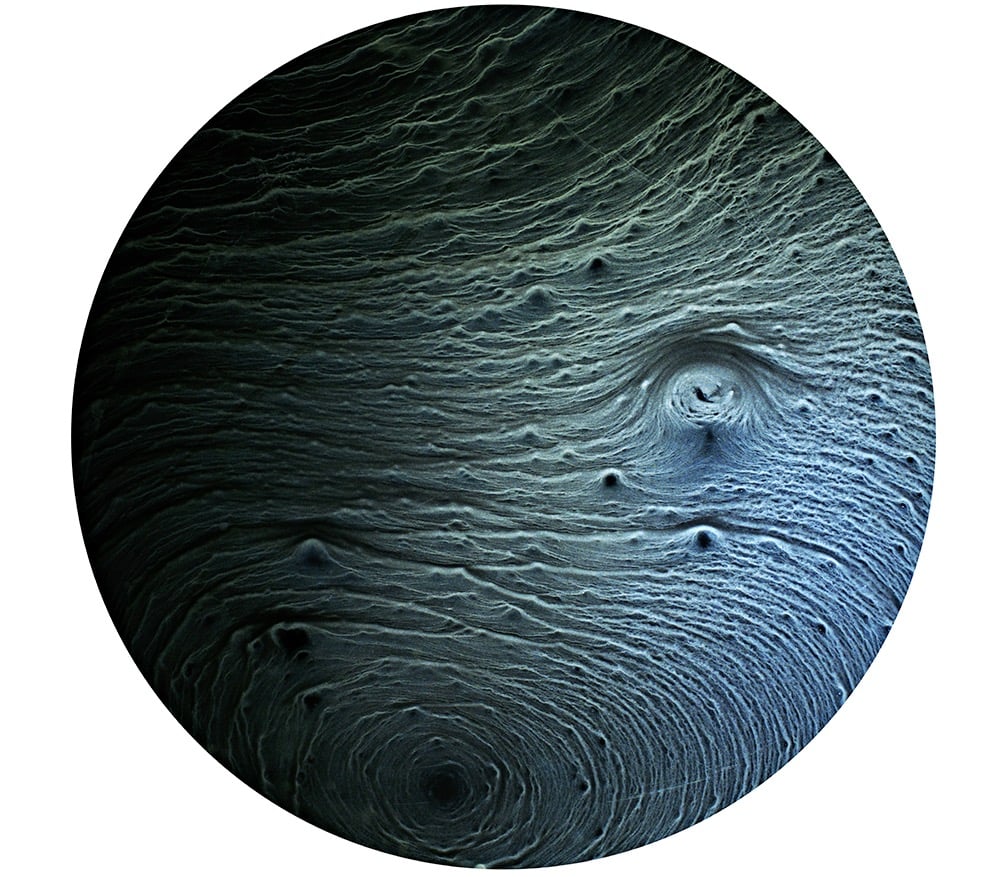
For his series Vanishing Spirits: The Dried Remains of Single Malt Scotch, photographer Ernie Buttons photographed the creatively lit bottoms of glasses emptied of their single malt Scotch whisky. The results look like alien worlds.
These remind me a lot of Christopher Jonassen’s frying pan worlds and Nadine Schlieper’s & Robert Pufleb’s photos of pancakes that look like moons. (via moss & fog)
88MPH: The Story of the DeLorean Time Machine, a feature-length documentary about the Back to the Future and the DeLorean used in the movie. The full documentary is available for free on YouTube.
An interesting list from Vogue of the 78 best documentaries of all time. Heavy focus on celebrity and culture but all solid picks.
Humans (and Vaccines!) Vs the Microbes
From Max Roser at Our World in Data: Our history is a battle against the microbes: we lost terribly before science, public health, and vaccines allowed us to protect ourselves.
Science is the foundation for our success. 150 years ago nobody knew where diseases came from. Or more precisely, people thought they knew, but they were wrong. The widely accepted idea at the time was the ‘Miasma’ theory of disease. Miasma, the theory held, was a form of “bad air” that causes disease. The word malaria is testament to the idea that ‘mal aria’ — ‘bad air’ in medieval Italian — is the cause of the disease.
Thanks to the work of a number of doctors and chemists in the second half of the 19th century humanity learned that not noxious air, but specific germs cause infectious diseases. The germ theory of disease was the breakthrough in the fight against the microbe. Scientists identified the pathogens that cause the different diseases and thereby laid the foundation for perhaps the most important technical innovation in our fight against them: vaccines.
Here’s what vaccines did for us, in three charts:
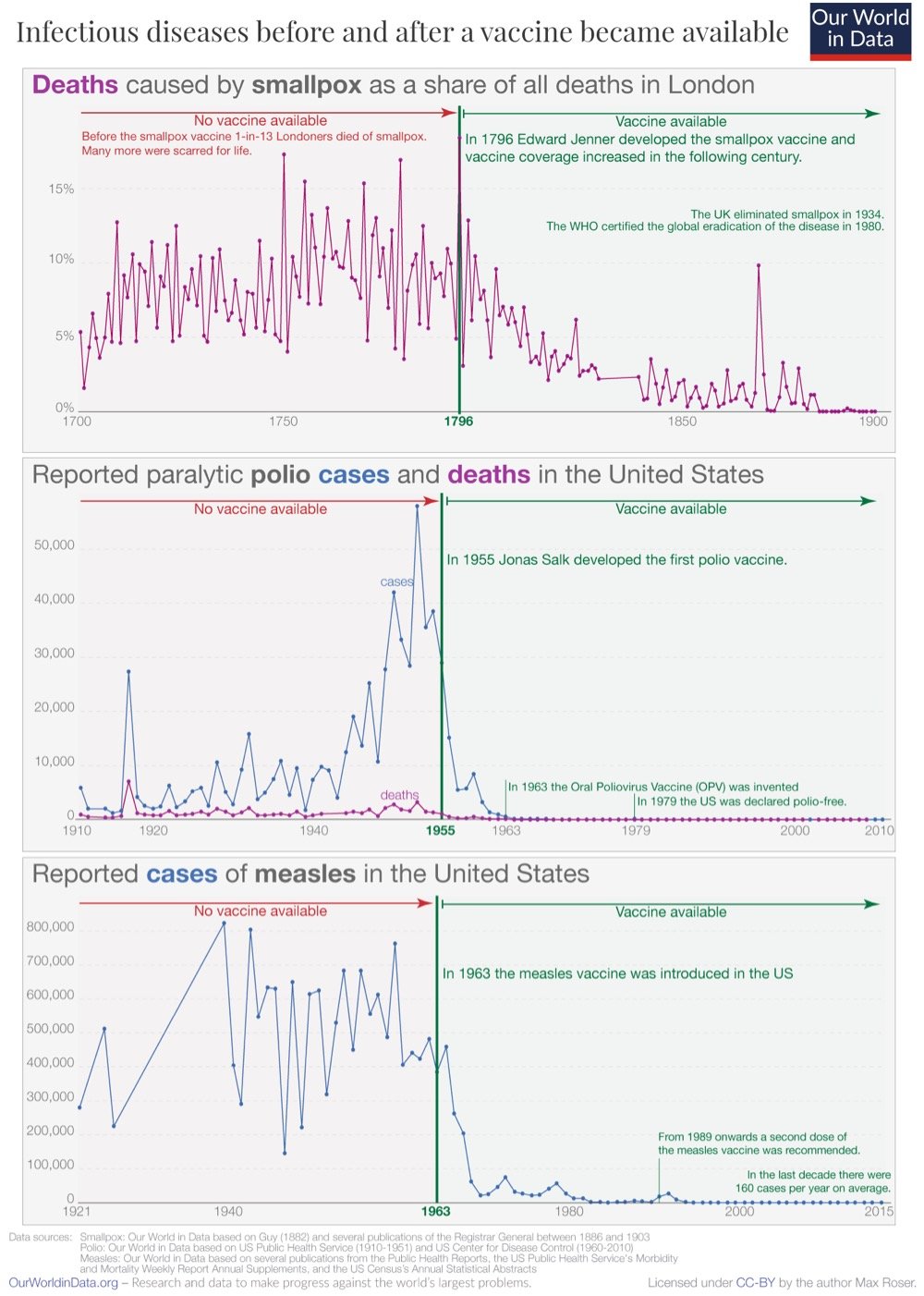
Even among those who accept and understand how good vaccines are at stopping disease, it’s difficult to truly appreciate just how incredible and transformative they have been. By one estimate, vaccines saved between 150 & 200 million lives from 1980 & 2018…and that’s just for smallpox. Covid-19 vaccines have saved hundreds of thousands of lives in Europe and the US in the first year of their availability. Truly a miraculous invention.
A report from the 2021 National Funeral Directors Association International Convention & Expo. “Funeral directors, we’re not the most popular kids at the party.”
bell hooks, Pathbreaking Black Feminist, Dies at 69. “I believe wholeheartedly that the only way out of domination is love.”
A Ted Lasso Animated Short: The Missing Christmas Mustache
Well this is a nice little holiday boost: a four-minute animated short with Ted Lasso and the gang called The Missing Christmas Mustache.
This is quite an obituary. “She also told us she came up with the name for Sunoco, and I choose to believe this, too. Yes, Renay lied a lot. But on the plus side, Renay didn’t cook, she didn’t clean, and she was lousy with money.”
Colorful Gradient Sculpture



Courtesy of her distinctive glazing technique — which she uses to “express feelings of transcendental experiences” — Angel Oloshove’s sculpture shares a colorful, gradient aesthetic with contemporary digital media (including this here website). More on her Instagram.
The Dark Forest (Or, Why We Should Keep Still and Not Look for Aliens)
Inspired by the second book in Liu Cixin’s excellent Three-Body Problem trilogy, Kurzgesagt made a video about the Dark Forest solution to the Fermi paradox.
Confronted with the seemingly empty universe, humanity faces a dilemma. We desperately want to know if we are alone in the Milky Way. We want to call out and reveal ourselves to anyone watching but that could be the last thing we ever do. Because maybe the universe is not empty. Maybe it’s full of civilizations but they are hiding from each other. Maybe the civilizations that attracted attention in the past were wiped away by invisible arrows. This is the Dark Forest solution to the Fermi paradox.
I have The Dark Forest on the Kindle, so I looked up how this is explained in the book (spoilers, obvs):
“The universe is a dark forest. Every civilization is an armed hunter stalking through the trees like a ghost, gently pushing aside branches that block the path and trying to tread without sound. Even breathing is done with care. The hunter has to be careful, because everywhere in the forest are stealthy hunters like him. If he finds other life-another hunter, an angel or a demon, a delicate infant or a tottering old man, a fairy or a demigod-there’s only one thing he can do: open fire and eliminate them. In this forest, hell is other people. An eternal threat that any life that exposes its own existence will be swiftly wiped out. This is the picture of cosmic civilization. It’s the explanation for the Fermi Paradox.”
Shi Qiang lit another cigarette, if only to have a bit of light.
“But in this dark forest, there’s a stupid child called humanity, who has built a bonfire and is standing beside it shouting, ‘Here I am! Here I am!’” Luo Ji said.
“Has anyone heard it?”
“That’s guaranteed. But those shouts alone can’t be used to determine the child’s location. Humanity has not yet transmitted information about the exact position of Earth and the Solar System into the universe. From the information that has been sent out, all that can be learned is the distance between Earth and Trisolaris, and their general heading in the Milky Way. The precise location of the two worlds is still a mystery. Since we’re located in the wilderness of the periphery of the galaxy, we’re a little safer.”
That’s the basic idea, but there’s more to it…you should watch the video or, even better, read the series — I’ve read the entire trilogy twice and this makes me want to read it again! (I loved the Drive Easter egg towards the end of the video. Well played.)
The Unbearable Weight of Massive Talent
In this movie, Nicolas Cage plays Nicolas Cage (or “Nick Cage”) playing Nicolas Cage roles from actual Nicolas Cage movies at the behest of his biggest fan for $1 million. Ok, I’m sold! It’s like Adaptation crossed with Being John Malkovich. (This is the second movie in as many days that’s reminded me of BJM. Something in the water?)
Burger Joint, a burger place with a dive bar vibe hidden behind a curtain in a fancy NYC hotel, has reopened. It had been closed due to the pandemic and the new owners of the hotel decided to keep it just the way it was.
This Is A Film About The James Webb Space Telescope
In this entertaining, informative, and charmingly goofy video, Dr. Kevin Hainline tells us all about the James Webb Space Telescope. The JWST is a bigger and better version of the Hubble Space Telescope and will allow scientists to peer deeper into the universe and farther back in time than ever before.
Listen, science is hard! Engineering is hard! It’s difficult to figure out how to build an incredibly sensitive infrared detector that you have to cram together on the back of a giant, foldable, gold covered mirror, sitting on a delicate, tennis-court-sized parasol, that can survive a rocket launch! It’s hard stuff!
And hundreds and hundreds of people around the world have been working on it together. JWST is the single most complicated science project human beings have ever attempted. But it’s been worth it. Because we want to discover the earliest galaxies in the universe, and clouds on other planets, and baby star-forming regions, and debris disks around stars, and weird dwarf galaxies, and supermassive black holes!
It’s been in development for almost thirty years and everyone is really ready for it! The James Webb Space Telescope is about to change astronomy. Get ready for discovery!
I am ready and excited! The JWST is currently set to launch no earlier than Dec 24, 2021. You can follow the progress of the launch here.
See also Looking back in time with the James Webb Space Telescope (60 Minutes) and 29 Days on the Edge. Oh and scientists have been working on this project for 20 years and are (understandably) really nervous about what happens with the launch.
A literary clock: each minute of the day is represented by a quote from a book. “…after that it was always ten minutes to five in the castle.” Like a text version of Christian Marclay’s The Clock.
A NASA Spacecraft Has Touched the Sun
For the first time in human history, a spacecraft has flown through the Sun’s corona to collect data and capture samples (and, crucially, exited safely).
During the flyby, Parker Solar Probe passed into and out of the corona several times. This is proved what some had predicted — that the Alfvén critical surface isn’t shaped like a smooth ball. Rather, it has spikes and valleys that wrinkle the surface. Discovering where these protrusions line up with solar activity coming from the surface can help scientists learn how events on the Sun affect the atmosphere and solar wind.
Six panels of images taken from inside a coronal streamer. They appear grayish with white streaks showing particles in the solar wind.
At one point, as Parker Solar Probe dipped to just beneath 15 solar radii (around 6.5 million miles) from the Sun’s surface, it transited a feature in the corona called a pseudostreamer. Pseudostreamers are massive structures that rise above the Sun’s surface and can be seen from Earth during solar eclipses.
Passing through the pseudostreamer was like flying into the eye of a storm. Inside the pseudostreamer, the conditions quieted, particles slowed, and number of switchbacks dropped — a dramatic change from the busy barrage of particles the spacecraft usually encounters in the solar wind.
For the first time, the spacecraft found itself in a region where the magnetic fields were strong enough to dominate the movement of particles there. These conditions were the definitive proof the spacecraft had passed the Alfvén critical surface and entered the solar atmosphere where magnetic fields shape the movement of everything in the region.
The first passage through the corona, which lasted only a few hours, is one of many planned for the mission. Parker will continue to spiral closer to the Sun, eventually reaching as close as 8.86 solar radii (3.83 million miles) from the surface. Upcoming flybys, the next of which is happening in January 2022, will likely bring Parker Solar Probe through the corona again.
The video above provides a great overview of the origins, objectives, and motivations for the mission.
Hockey sticks have curves. The visual signature of the Omicron variant is more like a bookend – straight up.
Won’t Someone Think of the Actual Children?
For her Culture Study newsletter, Anne Helen Petersen listed a few themes she’d identified over the past year. The first one is something I’ve noticed people talking a lot about too:
1) Our society values parenting, not parents; it honors “work ethic,” not workers; we cherish children in the abstract, but not actual children themselves.
To me, these ideas are borne out in the contrasts between the rhetoric of who and what we value (Moms! Kids’ futures! ESSENTIAL WORKERS!) and actual policy and behaviors. I mean that in terms of Covid, of course, but also in terms of labor protections for workers, the safety nets we provide for parents (and single parents in particular) and general actions and policy in regards to the future of the planet. We don’t value people, just generally. We value capital.
The Christian nationalists — who, despite ostensible Democratic control of the Senate, the House, and the presidency, nonetheless command the vision and future of the country — dress up obsession with controlling women’s bodies and freedom in the wardrobe of “the rights of the fetus,” but then allow that fetus, once it turns into an actual child, to go hungry, to live in fear of violence in their schools, to go unhoused or deal with housing insecurity, to endure the effects of environmental racism, and to grow into an adult indelibly marked by all of those experiences.
Bingo. This is also true to varying degrees for education (not teachers), art (not artists), and the troops (not individual soldiers that we send to incur PTSD, injury, and death).
BTW, Petersen has a new book out with her partner Charlie Warzel called Out of Office: The Big Problem and Bigger Promise of Working from Home, which relates to another of her yearly themes: “Work is miserable on so many levels — but it’s so hard to imagine a different way forward.”
Everything Everywhere All At Once
I don’t know anything about this movie and its directors (Daniels? Oh, Swiss Army Man!) but it has Michelle Yeoh kicking ass in it and I want to see it at the first possible opportunity. Getting some Jackie Chan meets Marvel multiverse meets Being John Malkovich vibes here.
Business Garden Inn & Suites & Hotel Room Inn
This pitch-perfect SNL commercial featuring Kate McKinnon & Billie Eilish advertises the bland budget business-ish hotel that can be found all across America.
Our rooms provide every comfort required by law: tiny soap in plastic, phone that blinks, Band-Aid-colored blanket, chair for suitcase, black & white photo of Ferris wheel, blow dryer that goes oooooooh, short glass wearing little hat, and small stain in place you have to touch.
And be sure to enjoy our hot tub; it’s always occupied by an eight-year-old boy in goggles staring at your breasts. He’s been in there for hours and he’s not getting out until you do.
I have stayed at this precise hotel many times in the past and I will again in the future. C+++++.
Continued great news about Pfizer’s Covid pill (Paxlovid): “[it] retained its 89% efficacy at preventing hospitalization and death in the full results of a study of 2,246 high-risk patients”. Pfizer is also confident about its effectiveness vs Omicron.
Omicron variant update from @erictopol, who has been an essential source of information for me throughout the pandemic. The third shot is looking essential & and the doubling rate seems quite high.
Fun holiday children’s book: Hookers and Blow Save Christmas. “It’s up to Hookers the tow truck and Blow the snowblower to make their way through the snow to save the day…”
Street Gang: How We Got to Sesame Street
Street Gang: How We Got to Sesame Street, a documentary about the beloved show’s first two decades, debuts today on HBO Max. The film is based on Michael Davis’s 2009 book Street Gang: The Complete History of Sesame Street.
The documentary focuses on the first two experimental and groundbreaking decades of Sesame Street, highlighting this visionary “gang” that audaciously interpreted radical changes in society and engaged children with innovative new ways to entertain and educate.
Featuring exclusive behind-the-scenes footage and interviews with over twenty original cast members and creators, the documentary explores how the team incorporated groundbreaking puppetry, clever animation, short films, music, humor, and cultural references into each episode to keep kids and parents coming back, while never shying away from difficult conversations with children.
In a review, NY Times TV critic James Poniewozik says the film reminds us that Sesame Street was political right from the beginning:
“Sesame Street,” which premiered in 1969, was the project of Joan Ganz Cooney, a TV executive who was originally more interested in the civil rights movement than in education but came to see the connection between the two. “The people who control the system read,” she once said, “and the people who make it in the system read.” And she believed that the best way to get the kids of the 1960s to read, paradoxically, was through TV.
Her Children’s Television Workshop brought together educators and entertainers, including a puppeteer named Jim Henson and the director Jon Stone, an idealist attracted to Cooney’s idea of closing the literacy gap for inner-city Black children. “I think what drew Dad in really had to do with her political vision,” his daughter Kate Stone Lucas says in the documentary.
“I’m Black But Look White. Here Are The Horrible Things White People Feel Safe Telling Me.”
Miriam Zinter for Huffington Post:
My neighbor, the one who asked me why “Black lives matter,” is not the only one who has felt comfortable asking me such a question or making a statement rife with racism.
White people think I am white too, and therefore feel safe saying all kinds of horrible things they might not say publicly. I’ve had people tell me it “disgusts” them to see interracial couples. They’ve told me they don’t understand why Black neighborhoods look so “ghetto,” and that Black people are “animals” or “thugs.” Many of these people are educated, and hold jobs or positions that give them some form of power or influence over Black people. They are doctors, judges, lawyers, social workers and politicians. That’s frightening.
Vaccine Avoidance, The Class Divide, and the Common Good
This is such an interesting article on vaccine avoidance in America by a primary care doctor & sociologist who have studied the phenomenon in America and other places. As more data has come in about the pandemic and vaccination program, the main differentiator in whether someone is willing to get a vaccine or not is class.
Over the past four decades, governments have slashed budgets and privatized basic services. This has two important consequences for public health. First, people are unlikely to trust institutions that do little for them. And second, public health is no longer viewed as a collective endeavor, based on the principle of social solidarity and mutual obligation. People are conditioned to believe they’re on their own and responsible only for themselves. That means an important source of vaccine hesitancy is the erosion of the idea of a common good.
Americans began thinking about health care decisions this way only recently; during the 1950s polio campaigns, for example, most people saw vaccination as a civic duty. But as the public purse shrunk in the 1980s, politicians insisted that it’s no longer the government’s job to ensure people’s well-being; instead, Americans were to be responsible only for themselves and their own bodies. Entire industries, such as self-help and health foods, have sprung up on the principle that the key to good health lies in individuals making the right choices.
Almost more than anything else, the pandemic has shown how damaged the US is from decades of neglect of the common good and how vulnerable we are to things like disease and political coups.
Over 800,000 people have died from Covid-19 in the US. More than 450,000 of those deaths have occurred in 2021.
Natural Forest Growth Simulator
The YouTube channel Two Minute Papers enthusiastically shares the findings from scientific papers about technology: computing, graphics, AI, robotics, etc. Recently they reviewed this paper on simulating the growth of large-scale plant ecosystems based on real-world forestry and botany research. From the paper’s abstract:
In this paper we describe a multi-scale method to design large-scale ecosystems with individual plants that are realistically modeled and faithfully capture biological features, such as growth, plant interactions, different types of tropism, and the competition for resources. Our approach is based on leveraging inter- and intra-plant self-similarities for efficiently modeling plant geometry. We focus on the interactive design of plant ecosystems of up to 500K plants, while adhering to biological priors known in forestry and botany research.
What that means, as they show in the video, is that you can watch these incredibly detailed time lapse videos of forests developing over time in a realistic way. So cool. This kind of thing always reminds me of favorite childhood thing, Al Jarnow’s Cosmic Clock. (via waxy)
I am reading epidemiologist Katelyn Jetelina’s Omicron roundup every morning. She’s sharing & contextualizing the latest scientific findings related to this significant variant.
Mayfield, Kentucky is reeling from the aftermath of an incredibly destructive tornado. Jim Finch drove 1.5 hours w/ his grill & a bunch of food to feed hungry folks. “Just figured I’d do what I could do.”
Vanity Fair Interviews Billie Eilish for a Fifth Consecutive Year
Since Billie Eilish was 15 years old in 2017, Vanity Fair has been interviewing her every year to see what she is up to, how she is feeling, and what has changed from previous years. A key message from this year’s video, in response to “technological thing that blows your mind”:
The vaccine, dude. Hell fucking yeah. I really, really urge you — if you are not already vaccinated, please get vaccinated. It’s not just for you, you selfish bitch. It’s for everyone around you. Take care of the people around you, man. Protect your friends, protect your children, protect your grandparents, protect anyone you walk by.
If you haven’t seen this before, it’s interesting to go back to watch the interviews from 2017 & 2018, 2019, and 2020 — it’s a fascinating chronicle of a young woman getting really famous really fast and growing up in public. Like I said last year:
I still marvel that Vanity Fair embarked on this project with this particular person. They could have chosen any number of up-and-coming 2017 pop singer/songwriters and they got lucky with the one who went supernova and won multiple Grammys.
See also R.J. Cutler’s 2021 documentary about Eilish, The World’s a Little Blurry and Mel Brooks at 95 (about a long life lived in public).
We’re Sorry, You Can’t Join Our Street Gang Because You Don’t Know Ballet. “If you can’t do a toe touch, you’re putting us all at risk.”
Socials & More