Entries for July 2020
This piece by Elitsa Dermendzhiyska about how and why psychotherapy works, the effectiveness of the bond between therapists and their patients, and attachment theory is interesting throughout but a bit tough to summarize. Let’s start here, with the idea that therapy provides the opportunity of a do-over in the building your emotional self that mirrors what happens, ideally, in early life between a loving, supportive caregiver and a child.
All of this suggests a tantalising alternative to both the medical professional’s and the layperson’s view of therapy: that what happens between client and therapist goes beyond mere talking, and goes deeper than clinical treatment. The relationship is both greater and more primal, and it compares with the developmental strides that play out between mother and baby, and that help to turn a diapered mess into a normal, healthy person. I am referring to attachment.
To push the analogy further, what if, attachment theory asks, therapy gives you the chance to reach back and repair your earliest emotional bonds, correcting, as you do, the noxious mechanics of your mental afflictions?
As someone who has been in therapy but doesn’t actually know a whole lot about how it works, I found the whole piece fascinating.
Oh god, I needed this video in my life this morning. Watch as Uncle Roger (a character created by comedian Nigel Ng) hilariously critiques a BBC Food video about how to cook fried rice. Spoiler alert: the cook drains the rice in a colander and then rinses it with water. Oh, and no MSG.
If you sad in life, use MSG. If you happy in life, use MSG. Put MSG in everything, it’ll turn it better. You just get a baby? Put MSG on baby, it’ll be better baby, smarter.
On Instagram, Uncle Roger shared how to cook rice properly.
Uncle Roger have many white friend tell me they use saucepan. Saucepan? Haiyaaa. World War II is over, use technology. Proper Asian use rice cooker.
(via @jennyyangtv <— this thread is an entertaining read as well)
Update: Uncle Roger meets up with the woman who cooked the egg fried rice in the BBC video:
In this video, Lin-Manuel Miranda shares how he came up with some of his most iconic songs from In the Heights, Hamilton, Moana, and even Star Wars (he wrote a cantina song for The Force Awakens). I can sit and listen to creators talking about how they came up with their best work pretty much forever. But honestly the reason I’m sharing this is this incredible detail about the “whoa whoa whoa” bit in “My Shot” (at ~7:35):
And then the “whoa” is based on the AOL startup dial sound, because I wanted it to feel like his words are connecting with the world and they’re reverberating out into the world. And I associate that with the first time I signed on to the internet and you hear [simulated modem noises]. It’s the AOL dialup octave.
Well, I’ll never listen to that song in the same way again. For spry minds, inspiration comes from everywhere. (via the spry minds at open culture)
Seven books to read in which very little happens. Includes Nicholson Baker’s The Mezzanine, which is fantastic.
The Billionaire Behind Efforts to Kill the U.S. Postal Service. Spoiler warning: it’s libertarian dipshit Charles Koch, who has done untold damage to our country and the Earth.
Billie Eilish’s bad guy, but played in the major key. “instead of playing it normal i’m the good guy so i play it in the major key, to the screams of music majors everywhere.”
Artist Seamus Wray is painting a series of self-portraits of himself painting previous self-portraits, Inception-style. Here’s the first painting:
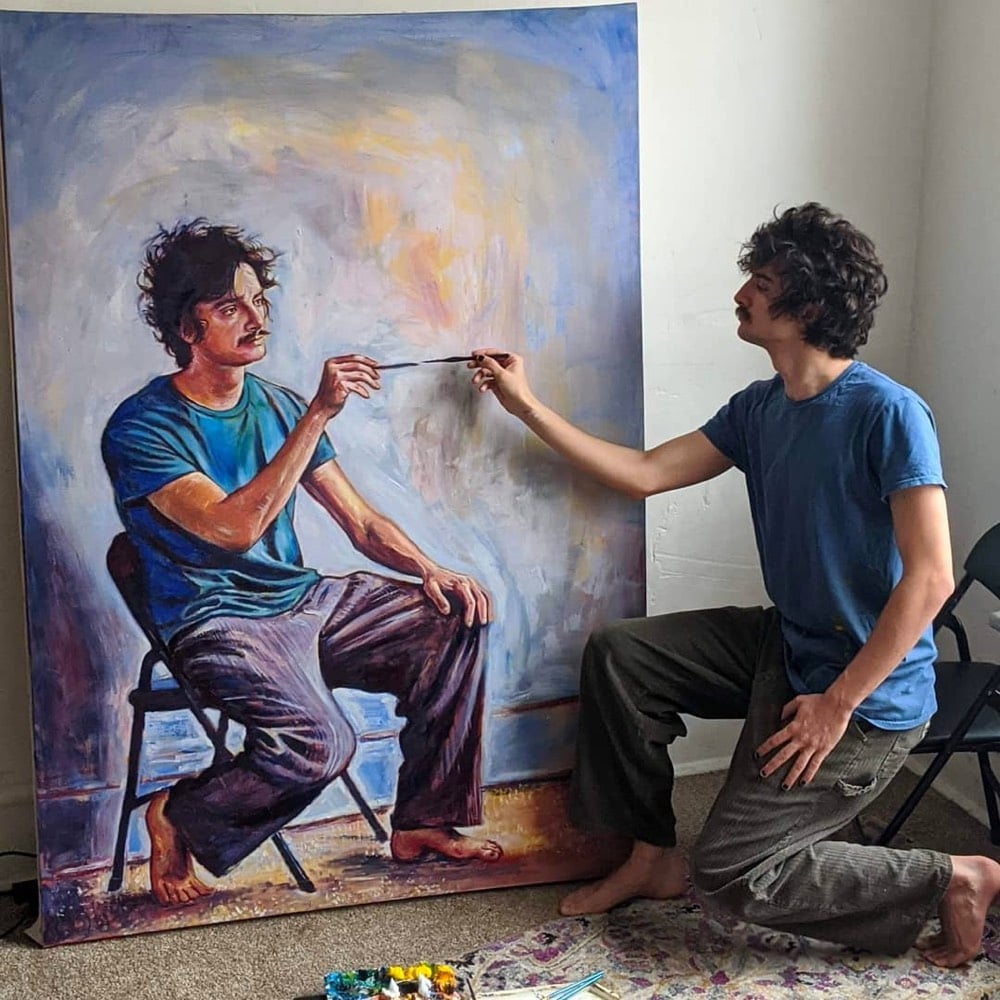
And then the most recent one (cats are increasingly involved):
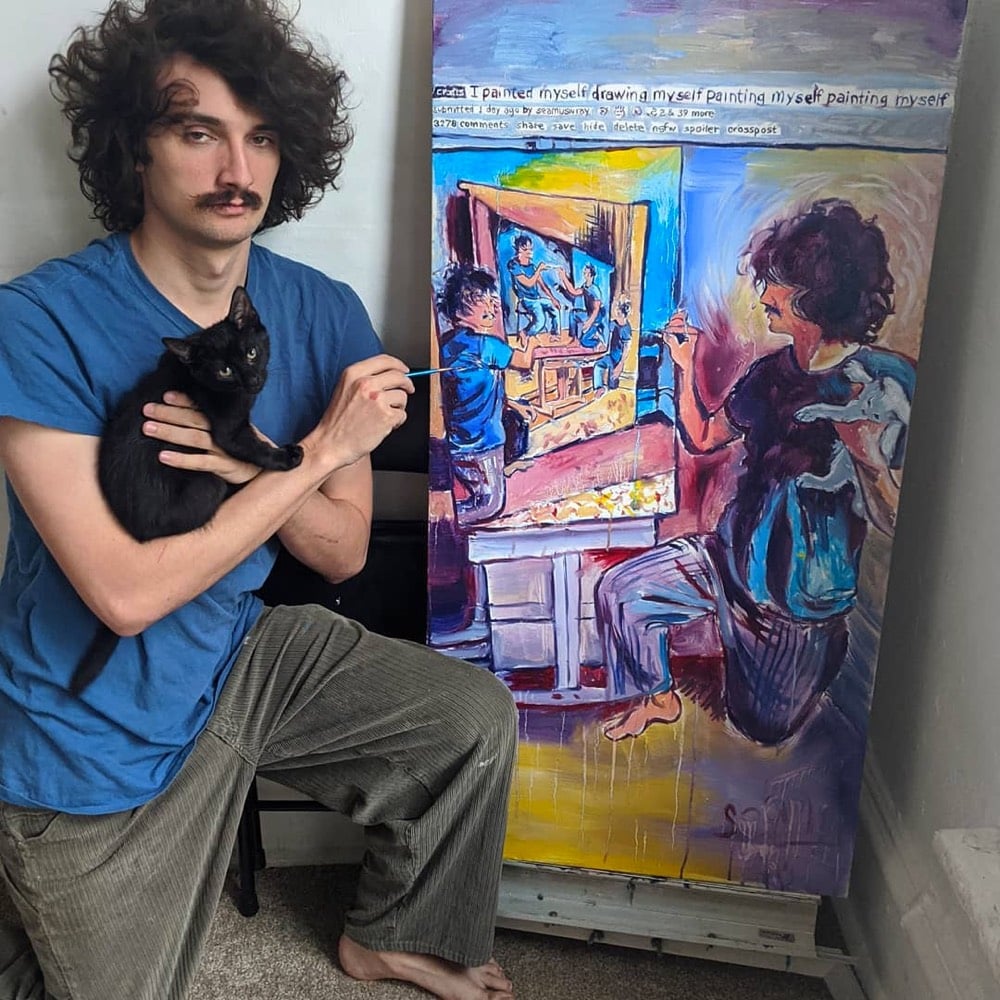
You can see the full progression so far on his Instagram. The influence of MC Escher is obvious here, but the two things that sprung to mind more immediately for me were Annie Wong’s “time-tunnel artwork” (she takes periodic photographs of her and her son with the previous photograph in the background) and Macaulay Culkin wearing a t-shirt of Ryan Gosling wearing a t-shirt of Macaulay Culkin. Oh, and the Droste effect.
Eater food critic Ryan Sutton, who had Covid-19 back in March, isn’t dining out at restaurants right now and explains why.
What’s more is that local health regulations for dining out aren’t strong enough. Before every shift, restaurants have to screen employees with health based questions, but temperature checks aren’t mandatory for either staffers or employees. And even though patrons are encouraged to wear masks at tables while they’re not actively eating or drinking, few really do. Even if no one dies or is sent to intensive care under these conditions, the notion of being in a place where underpaid staffers are financially compelled to interact with unscreened and unprotected patrons seeking leisure is unacceptable to me on a very basic human level.
I miss dining out so SO much. I miss my friends in the industry and am furious that federal and state governments have pushed them back into unsafe working conditions in the idiotic & dangerous race to “open up the economy” before any reasonable system of test/trace/isolate + a mask mandate is put into place nationwide. But I haven’t been in a restaurant since early March and will not return to one, outside dining or no, until the pandemic is over.1 I’ve been ordering takeout as much as I can (and heavily tipping) to support local businesses that are operating safely. But the whole concept of dining out seems very irresponsible to me and should not even be an option right now.
The Racist History of Tipping. “The practice spread throughout the country after the Civil War as U.S. employers, largely in the hospitality sector, looked for ways to avoid paying formerly enslaved workers.”
To create this ultra HD footage of the surface of Mars, high-definition panoramas created from hundreds of still photos taken by the Mars rovers are panned over using the Ken Burns effect. The end product is pretty compelling — it’s not video, but it’s not not video either.
A question often asked is: ‘Why don’t we actually have live video from Mars?’
Although the cameras are high quality, the rate at which the rovers can send data back to earth is the biggest challenge. Curiosity can only send data directly back to earth at 32 kilo-bits per second.
Instead, when the rover can connect to the Mars Reconnaissance Orbiter, we get more favourable speeds of 2 Megabytes per second.
However, this link is only available for about 8 minutes each Sol, or Martian day.
As you would expect, sending HD video at these speeds would take a long long time. As nothing really moves on Mars, it makes more sense to take and send back images.
(thx, paul)
Alex Trebek’s memoir, The Answer Is…, is out today. “I want people to know a little more about the person they have been cheering on for the past year.”

In this video and accompanying infographic, scientist Dominic Walliman of Domain of Science explains what viruses are, how they infect cells, how they replicate, and what can be done to mitigate their effects on the human body.
At the beginning of this pandemic like everyone I was hearing lots about viruses, but realised I didn’t know that much about what they are. So I did a load of research and have summarised what I learned in these nine images. This video explains the key aspects of viruses: how big they are, how they infect and enter and exit cells, how viruses are classified, how they replicate, and subjects involving viral infections like how they spread from person to person, how our immune system detects and destroys them and how vaccines and anti-viral drugs work.
After watching, it’s worth checking out Walliman’s sources in the video description for a deeper dive into viruses. (via open culture)
Why Do Some Vermonters Display The Confederate Flag? “The reason I started flying my Confederate flag is because it does irritate me that you’ve got these Black Lives Matter flags flying everywhere.”
In this special video edition of the Code Switch podcast, host Gene Demby explores the dangers of running while Black and why the safety of Black runners has not been given the same sort of attention as the safety of white women. The most striking bit of the video for me was right in the beginning when Demby debunks the myth of “all you need to run is a pair of shoes”.
When we runners talk about running — or let’s be real — when we evangelize about it, we talk a lot about how democratic it is. But it’s not really that simple. You’re gonna want gear, which costs money. Then there’s the issue of actual physical space. You want sidewalks that aren’t jagged, trails that aren’t overgrown, air that’s clean enough to breathe. (So ideally you don’t live near landfills or power plants or factories.) So yeah… all you need are shoes. And space. And money. And time. Oh and you also need something from the people around you — the sense that you belong in that space. Women don’t always get that luxury. And neither do runners of color.
Even a seemingly simple thing like running and who can do it is affected by decades of policy decisions that disproportionately favor residents of predominantly white neighborhoods.
Design a better face mask, win $1 million. “The $1M Next-Gen Mask Challenge aims to reimagine protective face masks used to prevent the spread of COVID-19 by making them more comfortable, functional, accessible, and even stylish.”
My mask protects you, your mask protects me, right? Yes, but masks are also protective to the wearer. “The less virus that you get in, the less sick you’re likely to be.”
My two favorite performances in the Disney+ version of Hamilton are Renée Goldsberry’s Angelica Schuyler and Daveed Diggs’ twin roles as Marquis de Lafayette and Thomas Jefferson. But perhaps a close third is Jonathan Groff’s turn as King George III. Ever since we watched the show a few weeks ago, my kids and I have been walking around the house breaking into song and talking a lot about what was so mesmerizing about Groff’s performance.
So, I was excited to run across this video of musical theatre coach Marc Daniel Patrick breaking down his performance of “You’ll Be Back”. Yes, he covered the spitting but I found the discussion of how he held specific members of the audience with his gaze for extended periods much more relevant in understanding what made that performance work. I particularly loved how still Groff held his body and the rest of his head as his lower jaw pistoned up and down like a ventriloquist dummy’s singing the “da da da dat” parts. The audio is funny enough, but his possessed mandible makes me laugh every time I see it.
Patrick made a similar video analyzing Phillipa Soo’s performance of “Burn”.

Fifty-one years ago today, on July 20, 1969, Neil Armstrong & Buzz Aldrin landed on the Moon and went for a little walk. For the 12th year in a row, you can watch the original CBS News coverage of Walter Cronkite reporting on the Moon landing and the first Moon walk on a small B&W television, synced to the present-day time. Just open this page in your browser today, July 20th, and the coverage will start playing at the proper time. Here’s the schedule (all times EDT):
4:10:30 pm: Moon landing broadcast starts
4:17:40 pm: Lunar module lands on the Moon
4:20:15 pm - 10:51:26 pm: Break in coverage
10:51:27 pm: Moon walk broadcast starts
10:56:15 pm: First step on Moon
11:51:30 pm: Nixon speaks to the Eagle crew
12:00:30 am: Broadcast end (on July 21)
Set an alarm on your phone or calendar!
This is one of my favorite things I’ve ever done online…here’s what I wrote when I launched the project in 2009:
If you’ve never seen this coverage, I urge you to watch at least the landing segment (~10 min.) and the first 10-20 minutes of the Moon walk. I hope that with the old time TV display and poor YouTube quality, you get a small sense of how someone 40 years ago might have experienced it. I’ve watched the whole thing a couple of times while putting this together and I’m struck by two things: 1) how it’s almost more amazing that hundreds of millions of people watched the first Moon walk *live* on TV than it is that they got to the Moon in the first place, and 2) that pretty much the sole purpose of the Apollo 11 Moon walk was to photograph it and broadcast it live back to Earth.
In 2018, I wrote about what to watch for during the landing sequence.
The radio voices you hear are mostly Mission Control in Houston (specifically Apollo astronaut Charlie Duke, who acted as the spacecraft communicator for this mission) and Buzz Aldrin, whose job during the landing was to keep an eye on the LM’s altitude and speed - you can hear him calling it out, “3 1/2 down, 220 feet, 13 forward.” Armstrong doesn’t say a whole lot…he’s busy flying and furiously searching for a suitable landing site. But it’s Armstrong that says after they land, “Houston, Tranquility Base here. The Eagle has landed.”. Note the change in call sign from “Eagle” to “Tranquility Base”. :)
The release of Christopher Nolan’s Tenet has been delayed with no forthcoming release date. Theater movies are done in the US for at least 6-12 months – either theaters will be closed or audiences too sparse to justify Hollywood budgets.
With time to burn during ye olde pandemic, practitioners of a musical genre called bardcore have been taking pop songs and medieval-izing their lyrics and tunes. The three examples embedded above are Radiohead’s Creep, Jolene by Dolly Parton, and Paint It Black by the Rolling Stones. Here’s how Creep starts off:
When thou wert here before
I could not look thee in the eye
Thou art like an angel
Thy skin makes me cry
Thou float’st like a feather
In a beautiful world
I wish I was special
Thou’rt so very special
But I am a creep
I am a weirdo
What in hell am I doing here?
I do not belong here
Here’s a playlist full of bardcore favorites.
Wikipedia and most of the news articles about bardcore date the genre to April 2020, but I found a cover of System of a Down’s Toxicity from 2017 and a medieval cover of Metallica’s One from 2014 by Belarusian band Stary Olsa, which released a whole album of medieval covers of classic rock hits in 2016.
The NY Times goes inside the White House’s disastrous response to the Covid-19 pandemic. Americans, all of us, should be FURIOUS about this. They straight-up murdered tens of thousands of people – where is the outrage?
The Claudia Kishi Club is a short documentary by Sue Ding about the impact of the Claudia Kishi character from The Baby-Sitters Club book series on a group of Asian-American creatives. They read the books when they were kids and in the film, they reflect on the importance of Claudia in shaping their perceptions of themselves in an era where Asian-American characters were rare in books, movies, and TV.
The six people interviewed in the film are novelist Sarah Kuhn, YA author CB Lee, Naia Cucukov (executive producer of the Netflix series The Babysitter’s Club), comic book artist & author Yumi Sakugawa, blogger Phil Yu, and Gale Galligan (author of The Baby-Sitter’s Club graphic novels, which my daughter loves).
The Claudia Kishi Club is now streaming on Netflix, the trailer is embedded above, and here’s a clip.
John Lewis, Towering Figure of Civil Rights Era, Dies at 80. “Never, ever be afraid to make some noise and get in good trouble, necessary trouble.”
From Dr. Anna DeForest, a devastating article — a prose poem almost — in The New England Journal of Medicine: The New Stability.
This is the day you start to turn. What we suck up from your lungs turns frothy pink and then the frank red of blood. We don’t know if your heart is finally failing or if the virus has destroyed so much tissue that this is necrosis, hemorrhaged in your lungs. There are tests, but no one willing to run them — you are too sick, and you have never cleared the virus. No one would ever want to be what you are now: a hazard, a threat, a frightening object on the edge of death. We try not to touch you. We construct our plans for saving you around staying as far away from you as possible.
I tell your husband about the blood. It’s true that nothing else has changed: your struggling lungs, with help, still take in air, your heart, with help, still brags along. “But she is stable,” he asks, barely a question. Why do I lie? “Yes,” I say, “for now.”
DeForest wrote this in early May as Covid-19 cases peaked at her hospital in New Haven. The country and its leaders ignored this and now cases are spiking in many hospitals all around the country now. Just some sniffles, though, nothing to bother anyone about.
Unidentified federal officers in unmarked cars are indiscriminately snatching people off the streets in Portland. I’ll just point out that this is literally (like literally literally, the literal use of the word “literally”) what the literal Nazis did.
For io9, Eleanor Tremeer digs into the complex and sexist legacy in Star Trek’s progressive universe. From Uhura on, Star Trek has always pushed the boundaries of how women were portrayed on TV, particularly in science fiction, but in some aspects, the shows have also been undeniably sexist.
With Yar gone, the women of The Next Generation fit more snugly into classic feminine molds, as Marina Sirtis reminisces. “They got it right, they cast a woman as the security chief. But Denise left, and the two remaining women were in caring professions. So it was ok to be on a spaceship as a woman, but you had to be a nurturer.” Speaking to io9, Gates McFadden (Crusher) is scathing about the few times the women would be thrown together, not to work together, but to gossip. “If the ladies did have a scene together we were dressed up in leotards talking about men. We weren’t sharing opinions on a medical issue!”
Over the ensuing years, Troi and Crusher would slowly get more screen time, as their characters became more nuanced, but they would rarely get the chance to break out of their nurturer molds. And with Crosby gone, security chief wasn’t the only position that needed filling. “I was never supposed to be the chick on the show, the va-va-voom. That was supposed to be Denise,” Sirtis told us. For as progressive as Star Trek tried to be with its women, every show has something in common: There has to be a hot chick.
To understand why this was the case, you have to look behind the scenes and at who was making the casting and plotting decisions.
If the entertainment industry is dominated by men now, this was even more the case decades ago. Star Trek has had a few female writers and producers over the years-DC Fontana wrote for The Original Series, The Next Generation, and Deep Space Nine; Jeri Taylor got her start producing The Next Generation before co-creating Voyager, to name just two immensely influential staffers. But, as Sirtis points out, Star Trek was a franchise created by men: “Even though we were writing a show about the 24th century, apart from Jeri Taylor and Melinda Snodgrass [another writer], the writers and producers were all men. Twentieth-century men. So it’s not gonna be that far-reaching.”
We could argue, of course, that Star Trek was a product of its era, but the actors were aware, at the time, that the show could be better. This aggravated Gates McFadden, as early as season one of The Next Generation, as she revealed to io9. “I wondered, did the women exist for the men to react to? Even Wesley just reacted to his mother, not seeking out her counsel-for counsel he sought out the men on the ship.” Coming from academia, McFadden was used to a collaborative creative environment, but she didn’t encounter that behind the scenes of The Next Generation. “Jonathan Frakes could bound into the producer’s office and put his feet up, but I couldn’t. That wasn’t acceptable.”
I’m rewatching The Next Generation right now and have been paying a lot of attention to how the women on the show (both the recurring cast and various single-episode characters) are portrayed. There’s definitely improvement after the first season or two, but there’s just so much on the show that’s off and obviously written primarily by and for men.
Anyway, if you’re a Star Trek fan at all, you should read Tremeer’s whole piece.
Sometimes I forget what a big space dork I am and then a comet comes along and I’m texting everyone I know to get their asses outside to see the amazing sky thing. Anyway, what I’m trying to say is that this is a Comet Neowise fan blog now. After seeing it last night in my backyard,1 I went looking for some of the best photos of it.
My favorite so far is from Thierry Legault (website) of the comet over Mont-Saint-Michel in France.

In Focus’s Alan Taylor shared a selection of photographs from around the world, including this one from Mika Laureque.

Colossal featured this shot by Lester Tsai of Neowise directly over Mt. Hood. Dang.

More Comet Neowise photography can be see at USA Today, NASA, Sky & Telescope, and Astronomy Picture of the Day (1, 2, 3, 4, 5).
Well this is lovely: Window Swap lets you experience other people’s views from around the world in the form of videos taken from their windows.
Window Swap is here to fill that deep void in our wanderlust hearts by allowing us to look through someone else’s window, somewhere in the world, for a while.
Very relaxing. See also Virtual Travel Photography in the Age of Pandemic and Let’s Go for a Stroll Outside. (thx, rion)
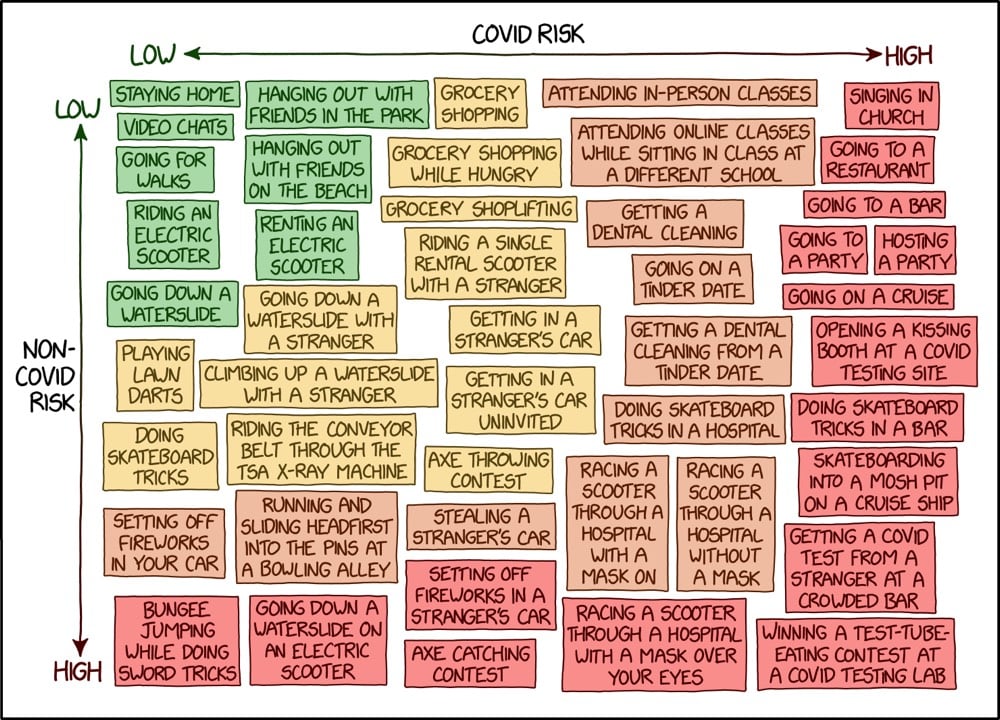
If you’ve been wondering about the risk of contracting Covid-19 while performing common activities vs. the risk of doing stupid shit, XKCD has you covered. I feel like “getting a dental cleaning from a Tinder date” should have been much more high risk than its position on the chart.
A taxonomy of Reply Guy behaviors. “LIFE STORY REPLY GUY: He saw you post personal anecdotes and assumes that replying to you with HIS life story will be very interesting.”

As a child of the 80s, this Lego set of the Nintendo Entertainment System activates a very ancient and primal region of my brain. As you can see in this short video, the set includes a controller, a cartridge that you can put into the machine, and a vintage TV with a hand-crank that you can use to “play” Super Mario Bros.
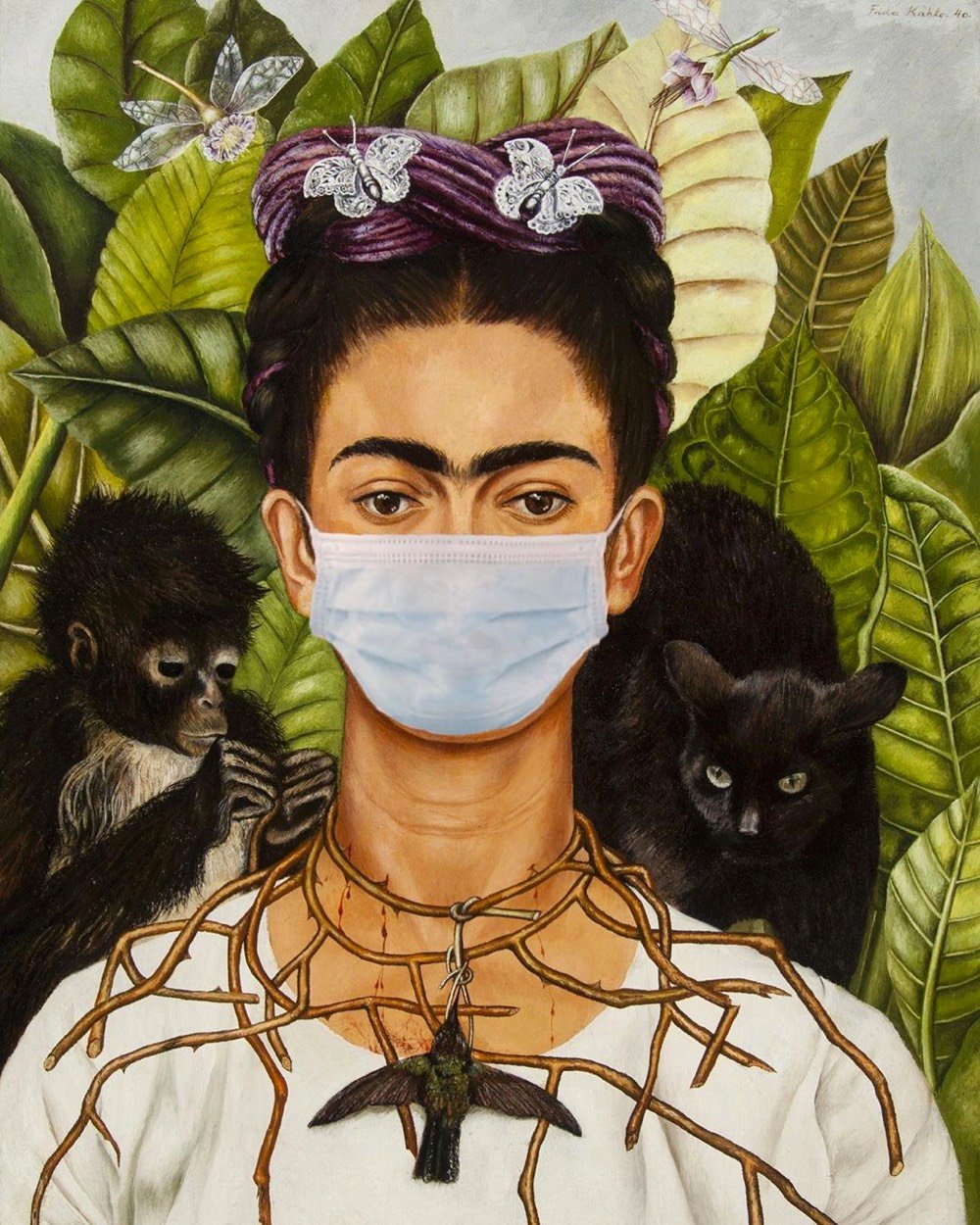
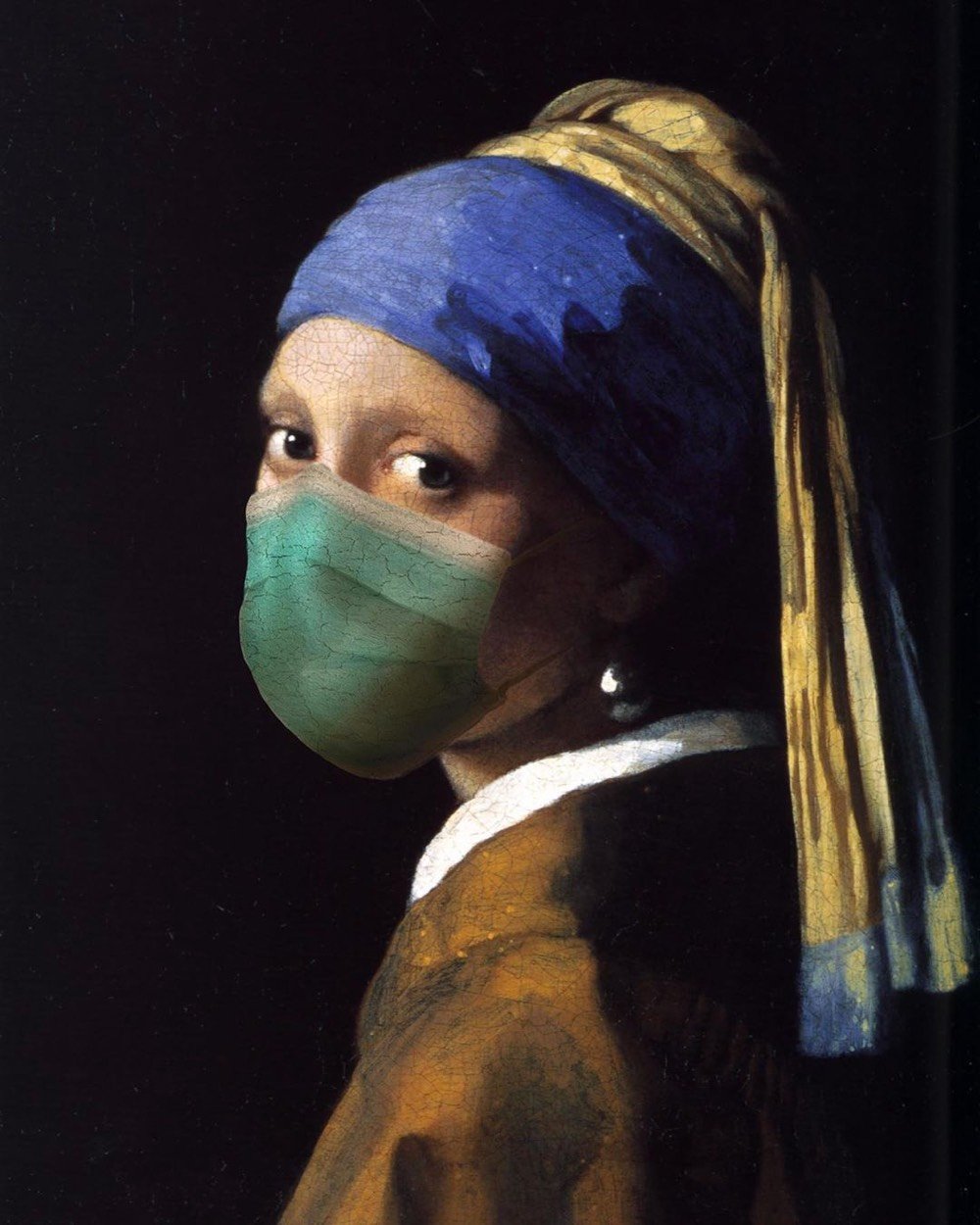


On an Instagram account called Plague History, artist Genevieve Blais has been modifying the subjects of artworks to give them face masks. You know I couldn’t resist including her rendition of Vermeer’s Girl with a Pearl Earring.
See also Iconic Art & Design Reimagined for the Social Distancing Era, Famous Art Recreated at Home During the Pandemic, and Jesus Christ, Just Wear a Face Mask! (via moss & fog)
Over the past 3 years, the past-year usage of LSD by Americans has increased by 56%. Scientists theorize it’s because the world has gone to hell and people are looking to self-medicate.
Taking a page from The Up Series, director John Sutter is making a series of films that revisit four geographic locations every 5 years until 2050 in order to document the effects in those areas due to climate change. The name of the series is Baseline and it’s a reference to the concept of shifting baselines, which the trailer above defines as “a phenomenon of lowered expectations in which each generation regards a progressively poorer natural world as normal”. The four areas the films will focus on are Alaska, Utah, Puerto Rico, and the Marshall Islands.
Sutter did a TEDx Talk about shifting baselines and climate change — the clip he shows right at the beginning featuring the shifting sizes of fish caught in Key West, Florida is astonishing.
He also wrote a piece about the series and the Alaskan village featured in it.
A dozen protestors were partially blinded after the police hit them with “less lethal” munitions. The Washington Post investigated three of the incidents and found that video footage undermines the official police accounts of the shootings.
From BBC Ideas, the story of three people who pioneered the science of climate change — Eunice Foote, Guy Stewart Callendar, and Charles Keeling — each of whom was under-recognized for their achievements at the time.
In particular, Eunice Foote demonstrated the greenhouse effect all the way back in 1856, but her contribution was lost to time and science until very recently.
Looking back on Earth’s history, Foote explains that “an atmosphere of that gas would give to our earth a high temperature … at one period of its history the air had mixed with it a larger proportion than at present, an increased temperature from its own action as well as from increased weight must have necessarily resulted.” Of the gases tested, she concluded that carbonic acid trapped the most heat, having a final temperature of 125 °F. Foote was years ahead of her time. What she described and theorized was the gradual warming of the Earth’s atmosphere — what today we call the greenhouse effect.
(via the morning news)
In an opinion piece for the NY Times, Kara Swisher argues that Facebook’s Mark Zuckerberg “cannot hold on to such enormous power and avoid responsibility when things get tough”. She uses an analogy about a butcher shop to explain the problem at the heart of Facebook:
This week, I finally settled on a simpler comparison: Think about Facebook as a seller of meat products.
Most of the meat is produced by others, and some of the cuts are delicious and uncontaminated. But tainted meat — say, Trump steaks — also gets out the door in ever increasing amounts and without regulatory oversight.
The argument from the head butcher is this: People should be free to eat rotten hamburger, even if it wreaks havoc on their gastrointestinal tract, and the seller of the meat should not be the one to tell them which meat is good and which is bad (even though the butcher can tell in most cases).
Basically, the message is that you should find the truth through vomiting and — so sorry — maybe even death.
She goes on to say:
In this, Mr. Zuckerberg is serving up a rancid meal that he says he’s not comfortable cooking himself, even as his hands control every aspect of the operation.
What’s particularly interesting about this analogy (and Swisher is possibly referencing this between the lines here) is that in 2011, Zuckerberg’s “annual challenge” was only eating meat from animals that he had personally killed.
This year, my personal challenge is around being thankful for the food I have to eat. I think many people forget that a living being has to die for you to eat meat, so my goal revolves around not letting myself forget that and being thankful for what I have. This year I’ve basically become a vegetarian since the only meat I’m eating is from animals I’ve killed myself.
This project later led to a meme-worthy video of him smoking meat in his backyard and Zuckerberg inviting fellow tech CEO Jack Dorsey over to feast on a goat he’d raised and killed.
Dorsey said he and Zuckerberg waited around 30 minutes for the goat to cook in the oven. Afterward, Zuckerberg believed the meal was ready and the two sat together to eat.
“We go in the dining room. He puts the goat down. It was cold,” said Dorsey in Rolling Stone. “That was memorable. I don’t know if it went back in the oven. I just ate my salad.”
Surreal. If all this were from the screenplay of a proposed The Social Network sequel, there’s no way this movie gets greenlit. (via daring fireball)
Newer posts
Older posts





Socials & More