Entries for August 2018
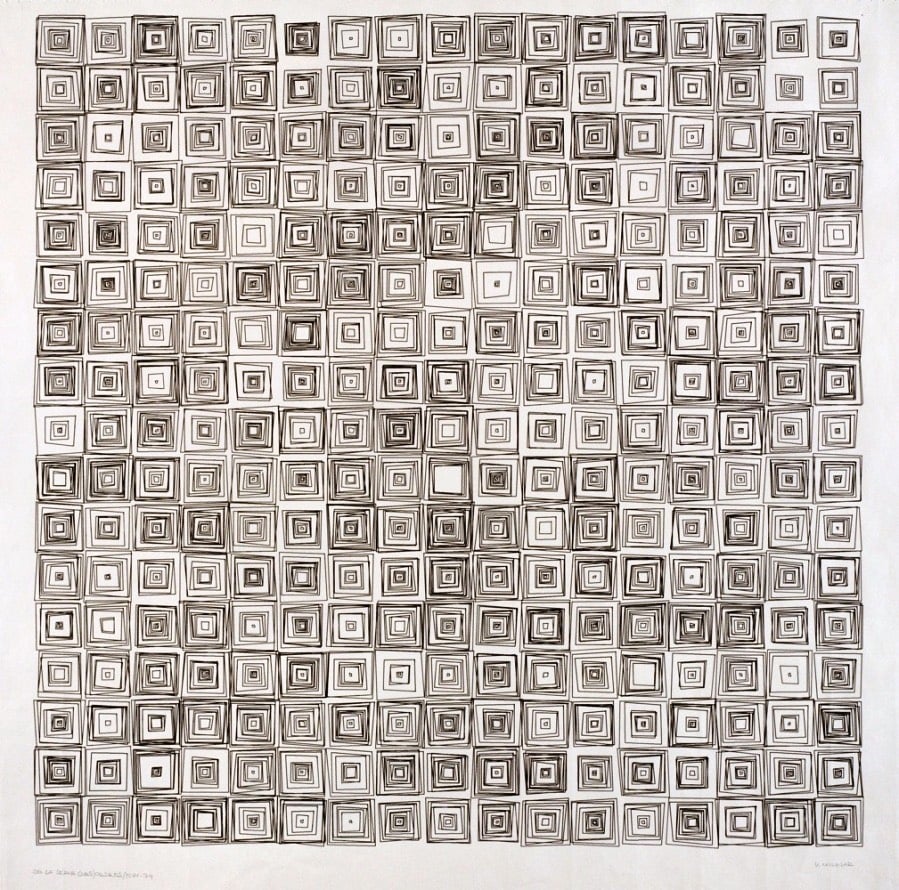
In his piece Why Love Generative Art?, Jason Bailey takes us on a short journey through the history of using computers to generate artwork, from the influence of Cézanne to the algorithmic art of Sol Lewitt to the women generative artists in the 60s and 70s, to John Maeda to the AI-generated artworks of the present day.
Imagine for a second that you drew the image above yourself using a pen and a piece of paper and it took you one hour to produce. It would then take you ten hours if you wanted to add ten times the number of squares, right? A very cool and important characteristic of generative art is that Georg Nees could have added thousands more boxes, and it would only require a few small changes to the code.
Unlike analog art, where complexity and scale require exponentially more effort and time, computers excel at repeating processes near endlessly without exhaustion. As we will see, the ease with which computers can generate complex images contributes greatly to the aesthetic of generative art.
The image at the top of the post is a piece done by Vera Molnar in 1974. I’m an instant fan…her stuff is fantastic.
The post also praises the work of Jared Tarbell, which I was obsessed with back in the 2000s. Tarbell’s work is still one of my favorite online things ever.


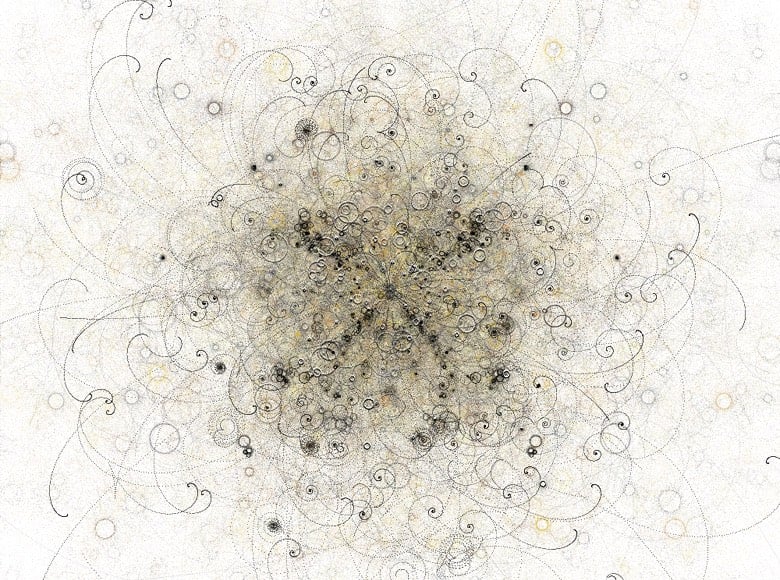
Tarbell still works with generative art but makes real-life objects using digital fabrication techniques.
A demo version of Imagine, unheard for decades, was recently uncovered in an archive of Lennon audio tapes. You can listen to the beautifully spare rendition here:
While sifting through boxes upon boxes of the original tapes for Yoko Ono, engineer Rob Stevens discovered something truly remarkable that had gone unnoticed all these years. “Early 2016, during the gestation period of this project, I’m in the Lennon archives with my people going through tape boxes that have labeling that’s unclear, misleading, or missing entirely”, says Stevens. “There’s a one-inch eight-track that says nothing more on the ‘Ascot Sound’ label than John Lennon, the date, and the engineer (Phil McDonald), with DEMO on the spine. No indication of what material was on the tape. One delicate transfer to digital later, the “Imagine” demo, subsequently enhanced superbly by Paul Hicks, appears within this comprehensive set. It was true serendipity.”
Compare it to the remastered studio version and a live version.
Imagine there’s no heaven
It’s easy if you try
No hell below us
Above us, only sky
Imagine all the people living for today
Imagine there’s no countries
It isn’t hard to do
Nothing to kill or die for
And no religion, too
Imagine all the people living life in peace
I could definitely get into that. For those unwilling to imagine no possessions, the demo, along with several others, appears on a collection coming out in the fall: preorder on Amazon or iTunes. (via @tedgioia)
The Museum in a Box project looks really cool. Headed up by George Oates, who initiated the amazing Flickr Commons project.
Robert Caro superfan Conan O’Brien has been trying to get the author on his show for 25 years. “I know that someday I’m going to turn on Fallon and see Caro playing Pictionary. And I’m just going to be enraged.”
vintage post from Aug 2018
· gift link
TIL that the hieroglyphic hobo code probably wasn’t used as extensively as the internet suggests. However, hobos and tramps did tag bridges, water towers, and train cars with tramp writing, which usually consisted of their moniker (i.e. their hobo name), the date, and the direction they were heading in.
Hobos, or tramps, were itinerant workers and wanderers who illegally hopped freight cars on the newly expanding railroad in the United States in the late 19th century. They used graffiti, also known as tramp writing, as a messaging system to tell their fellow travelers where they were and where they were going. Hobos would carve or draw their road persona, or moniker, on stationary objects near railroad tracks, like water towers and bridges.
More on hobo graffiti from CityLab.
Traces of hobo graffiti from the early 20th century have become almost totally obliterated, destroyed by natural forces, torn down along with old buildings, or painted over with new graffiti. So when anthropologist Susan Phillips came across a rare one scribbled underneath a bridge near the Los Angeles River, she knew it was a remarkable discovery.
(via open culture)
Beto O’Rourke is running against Ted Cruz for one of Texas’ two Senate seats. At a recent event, he was asked if he thought that NFL players kneeling during the national anthem to protest police violence against black people was disrespectful.
I kind of wanted to know how you personally felt about how disrespectful it is — like, you have the NFL players kneeling during the national anthems. I wanted to know if you found that disrespectful to our country, to our veterans, and anybody related to that.
O’Rourke’s answer, which connects this protest to past non-violent protests undertaken by black Americans, is pitch-perfect — honest, respectful of the questioner & the audience, and inclusive.
I can think of nothing more American than to peacefully stand up, or take a knee, for your rights anytime, anywhere, any place.
That’s how you politic.
P.S. In his campaign against Cruz, O’Rourke is relying solely on individual donors, no PAC money. If you’d like to help him out, you can donate to his campaign here.
In 2008, corporate lawyer & city slicker Jodi Ettenberg quit her job to travel the world for a year…and then just never went back to her old job (or self). For 10 years, she traveled and ate her way through the world, documenting her adventures at Legal Nomads. For the 10-year anniversary of the site, Ettenberg has posted a retrospective highlighting some of her most memorable times.1
Writing in a true voice was important. Presenting a glimmering version of yourself that doesn’t feel real is an easy path to discontent. You can follow your passion all you want, but if you’re not expressing it authentically, in a way that is indisputably you, the gap will catch up with you. The space between who you are and who you express yourself to be exists in varying degrees. But if it’s too large, especially if your work involves sharing your thoughts creatively, the disparity can easily engulf you.
As I’ve been lucky enough to travel a bit over the last couple of years, this post about The Overview Effect, Mindfulness, and Travel particularly caught my eye.
You cannot ignore the happenings in other places, or stick your head in the sand, because it’s too late — you’ve stepped away and looked at the planet in a different light. (Or, as I said to someone recently “once you’re a pickle you can’t go back to being a cucumber.”) While far less vivid or spectacular than a space trip, travel does tend to push people to think about the forest through the trees and to constantly pin current observations against past experiences. We all do this, naturally. But I think that the more you see, the more you have to compare ‘against’, which then permanently alters your views of the planet and of its people. The ultimate example of this, of course, is seeing it all from above, an orb glowing in the darkness of space.
This reflection on her travels in Mongolia also had my head nodding.
I included this post because nothing since has compared to the magic of simply watching the identity I had dissolve, replaced by pure wonder. Who I was shortly prior didn’t matter, because everything in front of me felt so intensely new that it blotted out anything familiar.
These wonder-filled moments, large and small, have happened to me while traveling, looking at art, lost in the company of others, watching heavenly bodies eclipse each other and even while working on this here website…and that’s a perfect succinct description of how it feels when it happens.
They’re making a Monument Valley movie? Is this the first iOS game to make the leap to the big screen?



Using traditional materials and techniques to achieve a digital effect, Japanese artist Toshiya Masuda makes this cool ceramic pixel art. (thx, karen)
Wow! Genetic analysis of a human bone fragment found in Siberia reveals that her parents belonged to two different groups of humans: her father was Denisovan and her mother Neanderthal.
A female who died around 90,000 years ago was half Neanderthal and half Denisovan, according to genome analysis of a bone discovered in a Siberian cave. This is the first time scientists have identified an ancient individual whose parents belonged to distinct human groups. The findings were published on 22 August in Nature1.
“To find a first-generation person of mixed ancestry from these groups is absolutely extraordinary,” says population geneticist Pontus Skoglund at the Francis Crick Institute in London. “It’s really great science coupled with a little bit of luck.”
Luck is right…what a needle in a haystack.
For more than 35 years, Dennis Hope has been selling land on the Moon. Hope registered a claim for the Moon in 1980 and, since the US government & the UN didn’t object, he figures he owns it (along with the other planets and moons in the solar system).
“I sent the United Nations a declaration of ownership detailing my intent to subdivide and sell the moon and have never heard back,” he says. “There is a loophole in the treaty — it does not apply to individuals.”
The US government had several years to contest such a claim. which they never did. Neither did the United Nations nor the Russian Government. This allowed Mr. Hope to take the next step and copyright his work with the US Copyright registry office. So, with his claim and Copyright Registration Certificate from the US Government in hand, Mr. Hope became what is probably the largest landowner on the planet today.
An acre-sized plot of the Moon is currently available for $24.99 and Hope says he has sold over a billion acres of his celestial properties to more than 6 million people, including to such moonsteaders as George H.W. Bush, Ronald Reagan, and Star Trek cast members.
After the 2016 election, artist and writer Paul Chan wrote the following poem that he called “New No’s”.
No to racists
No to fascists
No to taxes funding racists and fascists
No mercy for rapists
No pity for bigots
No forgiveness for nativists
No to all those
No hope without rage
No rage without teeth
No separate peace
No easy feat
No to bounds by genders
No to clickbait as culture
No to news as truths
No to art as untruths
No anti-Semitic anything
No Islamophobic anything
No progress without others
No meaning without meaning
No means no
No means no
No means no
No means no
I ran across this several times at The Whitney; it’s part of their great exhibition An Incomplete History of Protest. The exhibition is closing next week and the poem is difficult to find online (Chan’s own publishing company, which was selling posters of the poem, seems to be defunct at the moment), so I wanted to preserve a copy here.
Update: The notable prior art for this piece includes Yvonne Rainer’s No Manifesto, Ad Reinhardt’s No War, and The No Manifesto for Poetry Readings and LISTSERVs and Magazine and ‘Open Versatile Spaces Where Cultural Production Flourishes’. (via @joeld)
Hip hop pioneer Grandmaster Flash grew up in the Bronx and attended a public vocational high school. There he learned how to fix electronics. He was also into music — his father had a huge record collection. In this video, Flash talks about how he combined those two interests and built his first mixer using parts he bought at Radio Shack.
Grandmaster Flash was tinkerer and a hacker. There were commercially available mixers at the time; he built his own. He absorbed the nascent music culture developing around him and twisted it to his own ends, developing new mixing techniques like beat juggling. He perfected scratching and brought it to a wider audience.
Any scientist, engineer, or artist would recognize the process at work here, how tightly coupled the development of new technology and fresh ideas is. Club DJs wanted a way to transition from one record to another without missing a beat, so the mixer was invented. Once that technology existed, people started using mixers to do things other than their initial purpose. New tech begat new ideas begat new tech, the adjacent possible expanding all the while, until a curious kid who dabbled in electronics and was obsessed with music came along and helped invent hip hop, the most culturally significant movement of the past 40 years. (via kelli anderson)
In this video for Vox, Estelle Caswell explores Aretha Franklin’s unique blend of pop, soul, and gospel, particularly in her cover songs and live performances.
Aretha Franklin will always be the Queen of Soul. In the 1960s songs like “Respect” became the symbol for political and social change. It’s likely the reason her music moved so many people wasn’t necessarily the lyrics, but the way she delivered them.
Aretha was raised in the church, and her life and music was rooted in gospel music. You can hear this so clearly in her live performances and covers, where every musical decision she made was in the moment.
Listen to any one of Aretha’s songs and you’ll understand the power of gospel music, but her live performance of “Dr. Feelgood” and her cover of “Son of a preacher man” are a great place to start.
Holy moly, what a voice.
A Swiss company has designed a system for storing energy in concrete blocks. The blocks are lifted by a crane when surplus energy is available (say, when the Sun is shining or the wind blowing) and then, when energy is needed later, allowed to fall, turning turbines to generate electricity.
The innovation in Energy Vault’s plant is not the hardware. Cranes and motors have been around for decades, and companies like ABB and Siemens have optimized them for maximum efficiency. The round-trip efficiency of the system, which is the amount of energy recovered for every unit of energy used to lift the blocks, is about 85% — comparable to lithium-ion batteries which offer up to 90%.
Pedretti’s main work as the chief technology officer has been figuring out how to design software to automate contextually relevant operations, like hooking and unhooking concrete blocks, and to counteract pendulum-like movements during the lifting and lowering of those blocks.
The storage of energy in this way isn’t new…the ARES project uses hills and heavy trains to accomplish the same thing.
It’s a wonderfully simple idea, a 19th century solution for a 21st century problem, with some help from the abundant natural resource that is gravity. When the local utility’s got surplus electricity, it powers up the electric motors that drag 9,600 tons of rock- and concrete-filled railcars up a 2,000-foot hill. When it’s got a deficit, 9,600 tons of railcar rumble down, and those motors generate electricity via regenerative braking — the same way your Prius does. Effectively, all the energy used to move the train up the hill is stored, and recouped when it comes back down.
There’s something really interesting about big kinetic machines operating as though they were computers, autonomous black boxes where data flows in and out that can operate anywhere with a bit of flat ground.
Earlier this year, before a trip to Africa, President Obama shared a recommended reading list for this summer heavy on African authors.
Americanah by Chimamanda Ngozi Adichie
From one of the world’s great contemporary writers comes the story of two Nigerians making their way in the U.S. and the UK, raising universal questions of race and belonging, the overseas experience for the African diaspora, and the search for identity and a home.
With the end of summer approaching (**heavy sobbing**), Obama posted a list of books he’s personally been reading over the past few months.
Tara Westover’s Educated is a remarkable memoir of a young woman raised in a survivalist family in Idaho who strives for education while still showing great understanding and love for the world she leaves behind.
Set after WWII, Warlight by Michael Ondaatje is a meditation on the lingering effects of war on family.
With the recent passing of V.S. Naipaul, I reread A House for Mr Biswas, the Nobel Prize winner’s first great novel about growing up in Trinidad and the challenge of post-colonial identity.
An American Marriage by Tayari Jones is a moving portrayal of the effects of a wrongful conviction on a young African-American couple.
Factfulness by Hans Rosling, an outstanding international public health expert, is a hopeful book about the potential for human progress when we work off facts rather than our inherent biases.
Volumes is a 4K Full CG art film by Maxim Zhestkov exploring the juxtaposition of emotions with the laws of nature. Billions of colourful particles dance, play and communicate with each other in an eternal hypnotic ballet governed by the invisible wind of fate.
This looks fantastic at fullscreen resolution on my iMac. A nice little break in a hectic day. (via colossal)
The Washington Post’s Ann Hornaday proposes a list of movies made in the 2000s that should be added to the canon of the best films ever made. Many of my favorites are on there — The Royal Tenenbaums, The Fog of War, Spirited Away, There Will Be Blood, Children of Men.
Alfonso Cuarón’s adaptation of the P.D. James novel evinced the perfect balance of technical prowess, propulsive storytelling, complex character development and timeliness when it was released in 2006. But its depiction of a dystopian near-future — what we ruefully now call the present — has proved to be not just visionary but prophetic. Its predictive value aside, it stands as a flawless movie — a masterwork of cinematic values at their purest, with each frame delivering emotion and information in equally compelling measure.
Dunkirk, from just last year, is a bold inclusion…I love that movie but it’ll be interesting to see how it holds up. You can compare this list with two older lists: Dissolve’s and BBC Culture’s.
Update: The NY Times did a similar list last year, with There Will Be Blood and Spirited Away taking the #1 and #2 spots. (thx, paul)

Welp, I want to unsee that. 3D rendering courtesy of Miguel Vasquez, who did the same thing for SpongeBob awhile back.

(via @roeeb)
vintage post from Aug 2018
· gift link
There’s something so relaxing about watching art conservator Julian Baumgartner restore this damaged painting, a self-portrait by Italian painter Emma Gaggiotti Richards. I love how he paints tiny cracks in the damaged areas to match those in the rest of the painting.
There are many more videos and photos of Baumgartner’s restoration process on Instagram and YouTube. (via the kid should see this)

I finally picked up Tamara Shopsin’s Arbitrary Stupid Goal the other day. This is how it begins (emphasis mine):
The imaginary horizontal lines that circle the earth make sense. Our equator is 0°, the North and South Poles are 90°. Latitude’s order is airtight with clear and elegant motives. The earth has a top and a bottom. Longitude is another story. There isn’t a left and right to earth. Any line could have been called 0°. But Greenwich got first dibs on the prime meridian and as a result the world set clocks and ships by a British resort town that lies outside London.
It was an arbitrary choice that became the basis for precision. My father knew a family named Wolfawitz who wanted to go on vacation but didn’t know where.
It hit them. Take a two-week road trip driving to as many towns, parks, and counties as they could that contained their last name: Wolfpoint, Wolfville, Wolf Lake, etc.
They read up and found things to do on the way to these other Wolf spots: a hotel in a railroad car, an Alpine slide, a pretzel factory, etc.
The Wolfawitzes ended up seeing more than they planned. Lots of unexpected things popped up along the route.
When they came back from vacation, they felt really good. It was easily the best vacation of their lives, and they wondered why.
My father says it was because the Wolfawitzes stopped trying to accomplish anything. They just put a carrot in front of them and decided the carrot wasn’t that important but chasing it was.
The story of the Wolfawitzes’ vacation was told hundreds of times to hundreds of customers in the small restaurant that my mom and dad ran in Greenwich Village. Each time it was told, my dad would conclude that the vacation changed the Wolfawitzes’ whole life, and this was how they were going to live from now on — chasing a very, very small carrot.
The restaurant was Shopsin’s, no longer in Greenwich Village, and after a start like that, I read the next 80 pages without stopping. Really wish I’d heeded much advice to pick this up sooner.
See also “I’ve never had a goal”.
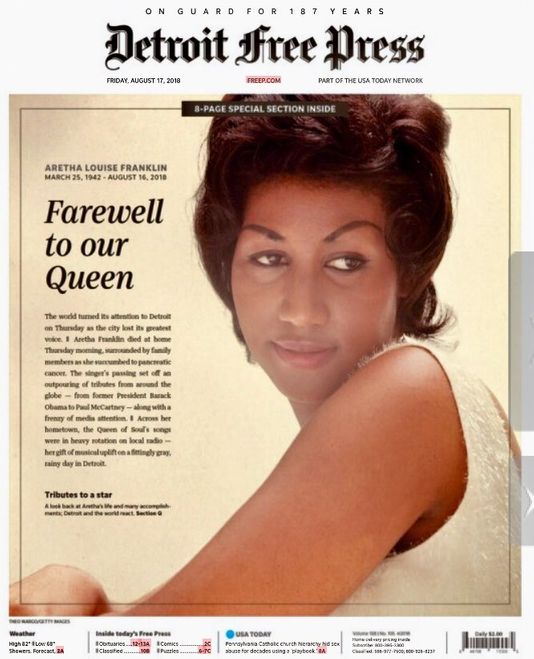
There are many very fine obituaries and appreciations of Aretha Franklin, who passed away this week at 76. I have two favorites.
The first is a whip-crack of an essay by the New York Times’s Wesley Morris that, better than most, taps into Franklin’s own musical energies.
Ms. Franklin’s respect lasts for two minutes and 28 seconds. That’s all — basically a round of boxing. Nothing that’s over so soon should give you that much strength. But that was Aretha Franklin: a quick trip to the emotional gym. Obviously, she was far more than that. We’re never going to have an artist with a career as long, absurdly bountiful, nourishing and constantly surprising as hers. We’re unlikely to see another superstar as abundantly steeped in real self-confidence — at so many different stages of life, in as many musical genres….
The song owned the summer of 1967. It arrived amid what must have seemed like never-ending turmoil — race riots, political assassinations, the Vietnam draft. Muhammad Ali had been stripped of his championship title for refusing to serve in the war. So amid all this upheaval comes a singer from Detroit who’d been around most of the decade doing solid gospel R&B work. But there was something about this black woman’s asserting herself that seemed like a call to national arms. It wasn’t a polite song. It was hard. It was deliberate. It was sure.
The second essay, for NPR by dream hampton, “Black People Will Be Free’: How Aretha Lived The Promise Of Detroit,” is more slowly wound, and less about the music than the time and place that produced Franklin and in which she flourished. It bleeds like a wound, a wound the size of a city, where the Industrial Revolution met the Great Migration and became the Civil Rights Movement.
It’s impossible to talk about Aretha without talking about her father, Reverend C.L. Franklin of Detroit’s New Bethel Baptist Church. Born to Mississippi sharecroppers, Franklin began preaching and soul singing as a teenager. Just after World War II, he, like so many black Southerners who were fleeing racial terror and looking for work, found himself in Detroit. Mayor Coleman Young, Detroit’s first black mayor, called him a “preacher’s preacher.” And when Franklin died from gunshot wounds after being robbed in his home in 1979, Mayor Young said his “leadership of the historic freedom march down Woodward Avenue in Detroit with Dr. Martin Luther King Jr. by his side in June of 1963 — and involving some 125,000 people — provided the prototype for Dr. King’s successful march in Washington later that summer.”
It is important to understand the tradition of black liberation theology, a term coined by James H. Cone, that sought to use scripture to center black self-determination. In Detroit, pastors like C.L. Franklin and Albert Cleage of the Shrine of the Black Madonna used black liberation theology to help a growing black city to imagine itself powerful. They used their churches to launch the campaign of Detroit’s black political class, including Coleman Young. At the same time, Rev. Franklin’s church remained a touch point for even more radical organizing. He opened New Bethel to black auto workers who were waging a class struggle within a racist United Automobile Workers union. He gave shelter to Black Panthers who were targeted by J. Edgar Hoover’s crusade against them. Later leaders of the fractured Black Power movement like the late Jackson, Miss. mayor (and Detroit native) Chokwe Lumumba gathered at New Bethel to form the Republic of New Afrika.
A new sound rooted in older sounds; a new politics rooted in older politics; a new, triumphant individualism rooted in the liberation of entire communities. In all these things, Aretha stood at the crossroads of history. Maybe no one else could have done it.

I’ve been enjoying The Verge’s series of posts about batteries, not least because it’s not just about so-called “hard” tech, but also how changing technologies change our culture, our social interactions, our range of possibilities. A good example is Tasha Robinson’s essay on how the dead or dying mobile phone battery has become a staple of contemporary horror films — not so much a cliché (although it sometimes veers into that) but a new condition of the genre.
[In the past,] it was possible for a horror movie to isolate its victims by taking them slightly outside the warm glow of civilization. Classics like 1960’s Psycho, 1974’s The Texas Chain Saw Massacre, or 1980’s The Shining dropped the protagonists at remote houses. With no access to landlines, the characters in those movies were so removed from help or contact with the outside world, they might as well have been stranded on the Moon. Even as of 1999’s The Blair Witch Project, it was plausible that a group of tech-savvy young people would venture into the woods without cellphones or a GPS tracker, and have no way to alert anyone else when their situation took a bad turn. But with upward of 75 percent of Americans owning smartphones, and upward of 95 percent owning cellphones of some kind, modern horror films have to work harder to keep their characters from summoning the police the second a maniac starts waving a chainsaw in their direction.
These days, a dead phone doesn’t just cut users off from emergency services; it also cuts them off from the conversation, the daily flow of online life that so many of us use as our primary form of contact with the outside world. In that sense, the need to kill a victim’s battery before killing the actual victim is becoming less of a predictable cliché, and more of a way of building the stakes and establishing sympathies. Horror movie audiences may find it hard to believe in Cloverfield’s group of friends fleeing a Godzilla-sized monster through the streets of New York, but they can certainly believe in a guy coming away from a party with a drained phone battery and obsessing over the need to make one last phone call before the night’s over.
Robinson talks about how this trope taps into real-world anxieties about being unable to communicate or connect with other people, whiling away necessary power with frivolous uses, and technology letting us down in key moments, but she also gestures towards something else; a peculiar sort of wish-fulfillment. She imagines a high-tech horror film in which unplugging becomes a form of escape. But we’re already longing for a retreat from our devices, notifications, internet drama, and everything that comes with it. Isn’t part of the uncanny quality of the battery death trope that it’s giving us what we want, just in a distorted form?
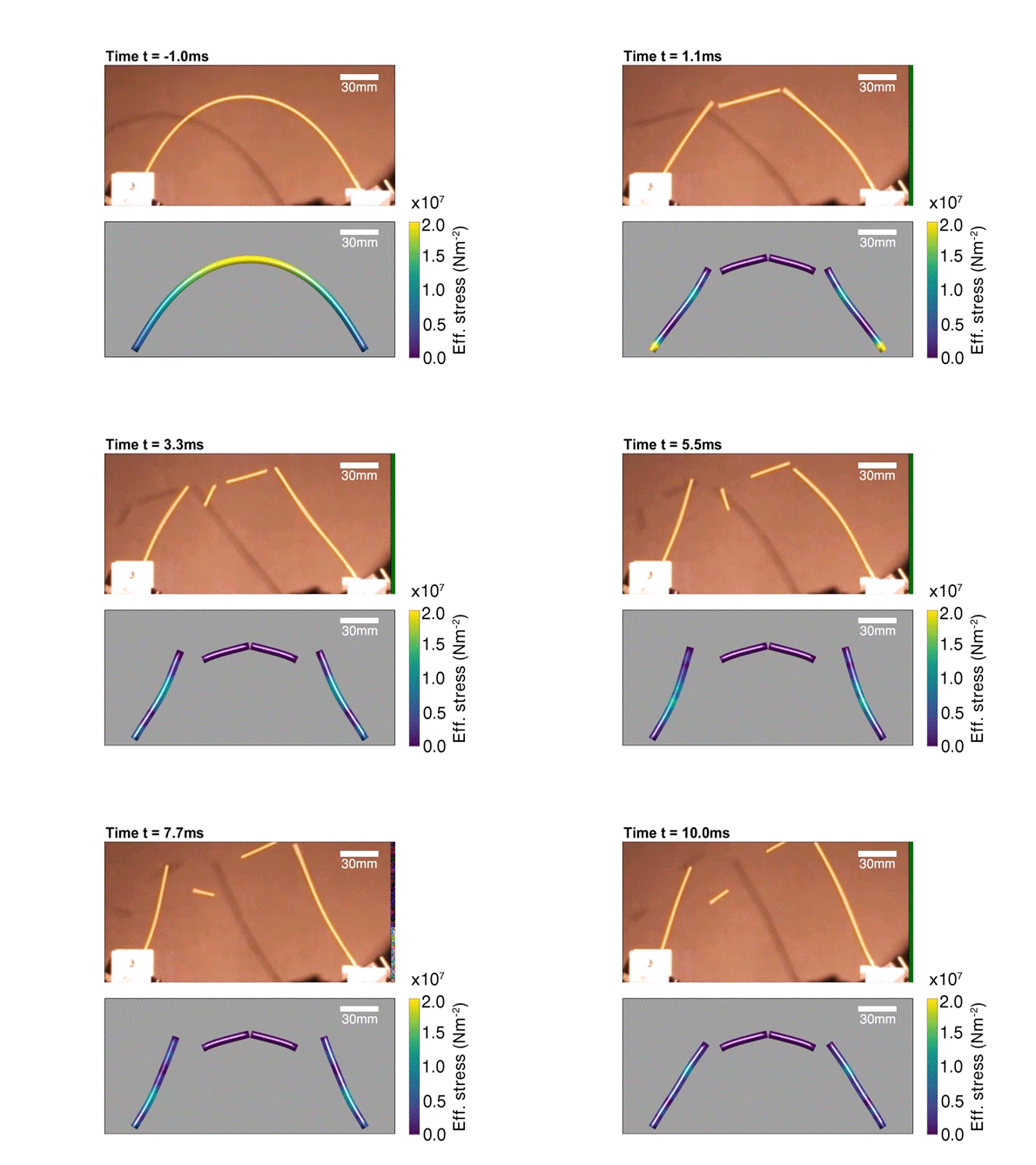
If you’ve ever tried to snap dried pasta in half, you know that it’s hard to get just two even pieces; what you usually get instead is macaroni shrapnel everywhere. It turns out this is due to fundamental physical forces of the universe when applied to a straight rod. The initial break creates a snap-back effect that creates additional fractures.
Apparently, this used to drive Richard Feynman nuts. Here’s an excerpt from No Ordinary Genius: The Illustrated Richard Feynman, where computer scientist Danny Hills describes Feynman’s obsession:
Once we were making spaghetti, which was our favorite thing to eat together. Nobody else seemed to like it. Anyway, if you get a spaghetti stick and you break it, it turns out that instead of breaking it in half, it will almost always break into three pieces. Why is this true — why does it break into three pieces? We spent the next two hours coming up with crazy theories. We thought up experiments, like breaking it underwater because we thought that might dampen the sound, the vibrations. Well, we ended up at the end of a couple of hours with broken spaghetti all over the kitchen and no real good theory about why spaghetti breaks in three. A lot of fun, but I could have blackmailed him with some of his spaghetti theories, which turned out to be dead wrong!
It turns out that controlling the vibrations does have something to do with controlling the breakage, although putting the rod underwater won’t help. Two young physicists, Ronald Heisser and Vishal Patil, found that the key to breaking spaghetti rods into two pieces is to give them a good twist:
If a 10-inch-long spaghetti stick is first twisted by about 270 degrees and then bent, it will snap in two, mainly due to two effects. The snap-back, in which the stick will spring back in the opposite direction from which it was bent, is weakened in the presence of twist. And, the twist-back, where the stick will essentially unwind to its original straightened configuration, releases energy from the rod, preventing additional fractures.
“Once it breaks, you still have a snap-back because the rod wants to be straight,” Dunkel explains. “But it also doesn’t want to be twisted.”
Just as the snap-back will create a bending wave, in which the stick will wobble back and forth, the unwinding generates a “twist wave,” where the stick essentially corkscrews back and forth until it comes to rest. The twist wave travels faster than the bending wave, dissipating energy so that additional critical stress accumulations, which might cause subsequent fractures, do not occur.
“That’s why you never get this second break when you twist hard enough,” Dunkel says.
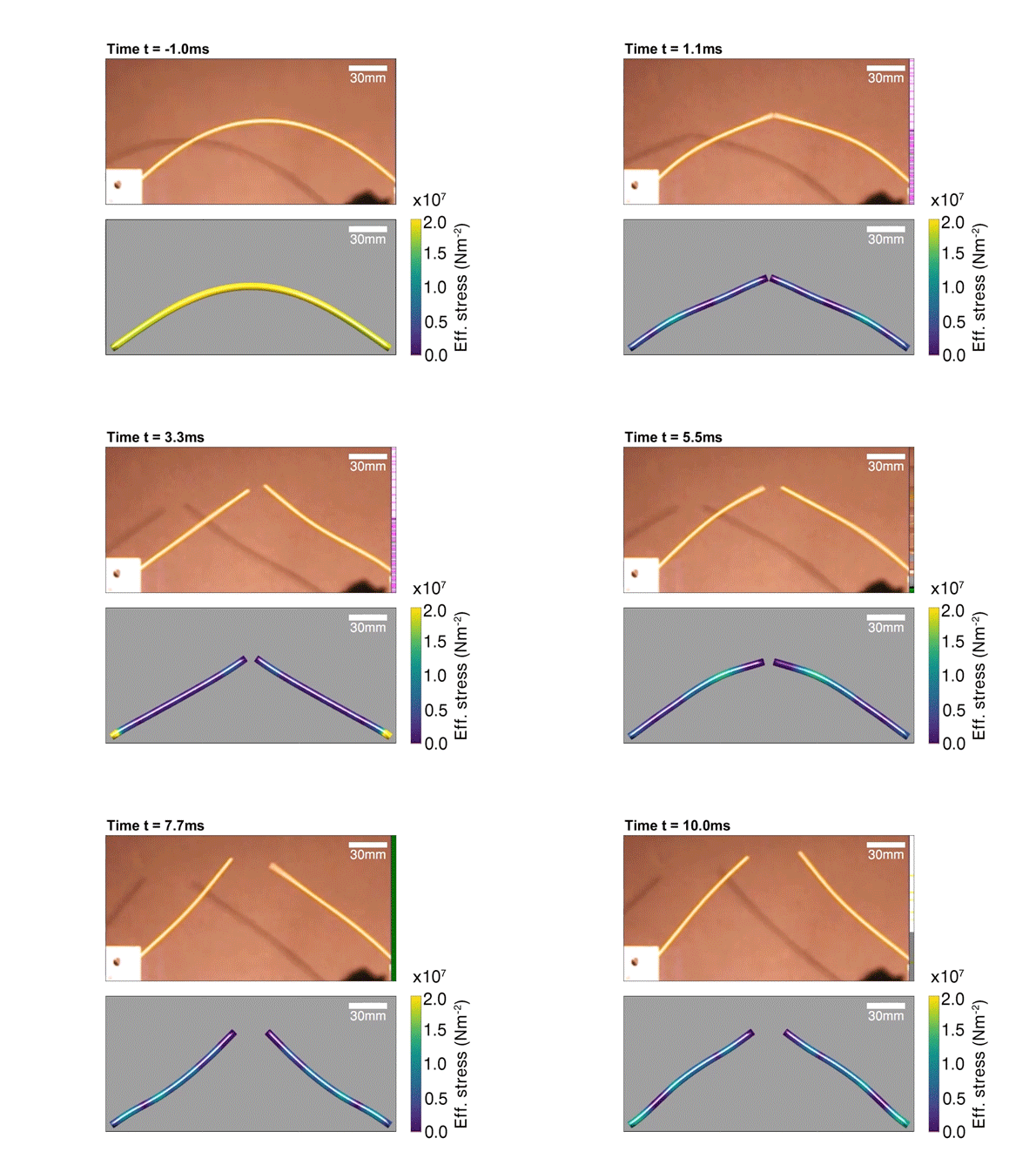
It’s not exactly practical to twist spaghetti 270 degrees before you break it in half, just to end up with a shorter noodle. And linguini, fettucine, etc., have a different physics altogether, because they deviate more strongly from the cylindrical rod shape of spaghetti. But it’s cool to have one of these everyday physics problems apparently solved through a relatively simple trick.
Newer posts
Older posts







Socials & More