




This site is made possible by member support. 💞
Big thanks to Arcustech for hosting the site and offering amazing tech support.
When you buy through links on kottke.org, I may earn an affiliate commission. Thanks for supporting the site!
kottke.org. home of fine hypertext products since 1998.
Beloved by 86.47% of the web.
Entries for February 2016
Fish slap remix
Happy Friday, everyone. I am so glad this week is done. I have no idea what this is. But it made me happy briefly and that’s enough. (via @jasonzada)
I rolled my eyes so hard reading this, they rolled right out of my head. Now they’re blocks away. Bye, eyes!
What’s it like in space?
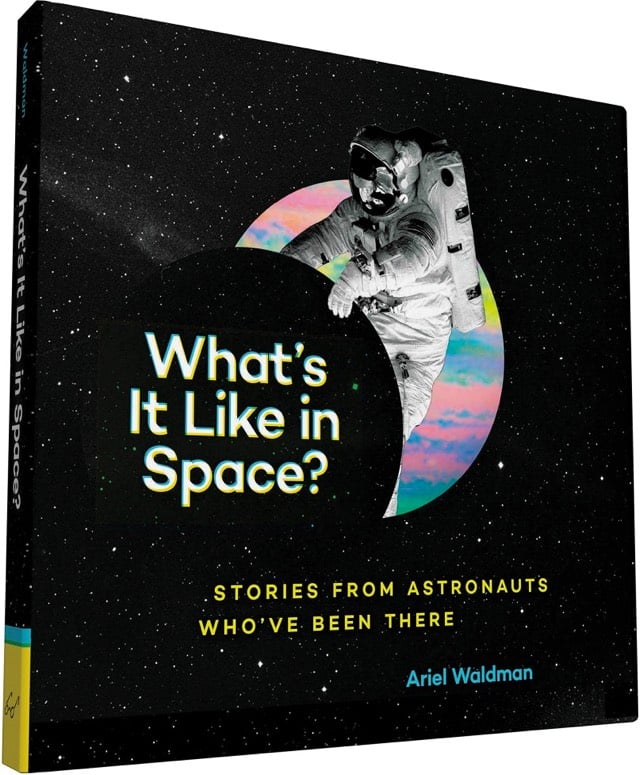
For her new book, Ariel Waldman asked dozens of astronauts about their experiences in space.
With playful artwork accompanying each, here are the real stories behind backwards dreams, “moon face,” the tricks of sleeping in zero gravity and aiming your sneeze during a spacewalk, the importance of packing hot sauce, and dozens of other cosmic quirks and amazements that come with travel in and beyond low Earth orbit.
Waldman is the co-creator of the very cool spaceprob.es.
Update: This book is now out, shipping, released…launched, if you will.
Woman escapes hired killers, shows up at own funeral
Noela Rukundo, whose husband had only recently paid to have killed, showed up at her own funeral.
Finally, she spotted the man she’d been waiting for. She stepped out of her car, and her husband put his hands on his head in horror.
“Is it my eyes?” she recalled him saying. “Is it a ghost?”
“Surprise! I’m still alive!” she replied.
Far from being elated, the man looked terrified. Five days earlier, he had ordered a team of hit men to kill Rukundo, his partner of 10 years. And they did - well, they told him they did. They even got him to pay an extra few thousand dollars for carrying out the crime.
Now here was his wife, standing before him. In an interview with the BBC on Thursday, Rukundo recalled how he touched her shoulder to find it unnervingly solid. He jumped. Then he started screaming.
What a story. As @tcarmody says, “I like to imagine Bezos grinning and salivating over this story like Charles Foster Kane”.
A History of Japan
Bill Wurtz’s History of Japan is the most entertaining history of anything I have ever seen.
Americanisms
The Economist style guide’s section on Americanisms is just a tad catty.
Try not to verb nouns or to adjective them. So do not access files, haemorrhage red ink (haemorrhage is a noun), let one event impact another, author books (still less co-author them), critique style guides, pressure colleagues (press will do), progress reports, source inputs, trial programmes or loan money. Avoid parenting and, even more assiduously, parenting skills. Gunned down means shot. And though it is sometimes necessary to use nouns as adjectives, there is no need to call an attempted coup a coup attempt, a suspected terrorist a terrorist suspect or the Californian legislature the California legislature. Vilest of all is the habit of throwing together several nouns into one ghastly adjectival reticule: Texas millionaire real-estate developer and failed thrift entrepreneur Hiram Turnipseed…
(via @mccanner)
Awesome, they’re putting in a protected bike lane on 6th Ave in NYC. Now do 5th Ave (which is where I got hit).
Clearing retired cells may extend life
“I’m looking at a picture of two mice. The one on the right looks healthy. The one on the left has graying fur, a hunched back, and an eye that’s been whitened by cataracts.”
What’s the difference? Well, scientists at the Mayo clinic used a process to remove senescent (or retired) cells from one of them. And that process leads to mice who age better and live longer. As one researcher not connected to the study explains:
The usual caveats apply — it’s got to be reproduced by other people — but if it’s correct, without wanting to be too hyperbolic, it’s one of the more important aging discoveries ever.
If movies ended when someone said the title
What a great idea. I just wish it were better executed. The weird music they use for the end credits of each movie is too much…it would have been better to just play it straight and let the gag stand by itself. (via cynical-c)
The Simpsons screencap search engine
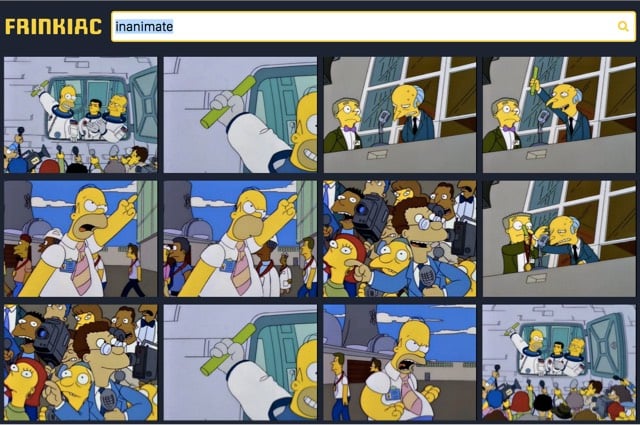
Frinkiac searches through the subtitles from every episode of The Simpsons (in the first 15 seasons) and returns screencaps of all the times when the search term was used. For example, inanimate:
(via @emunn)
Update: Hi diddley ho! The Frinkiac now does animated GIFs. Like this one. (via @buzz)
Pretty Much Everything by Aaron James Draplin
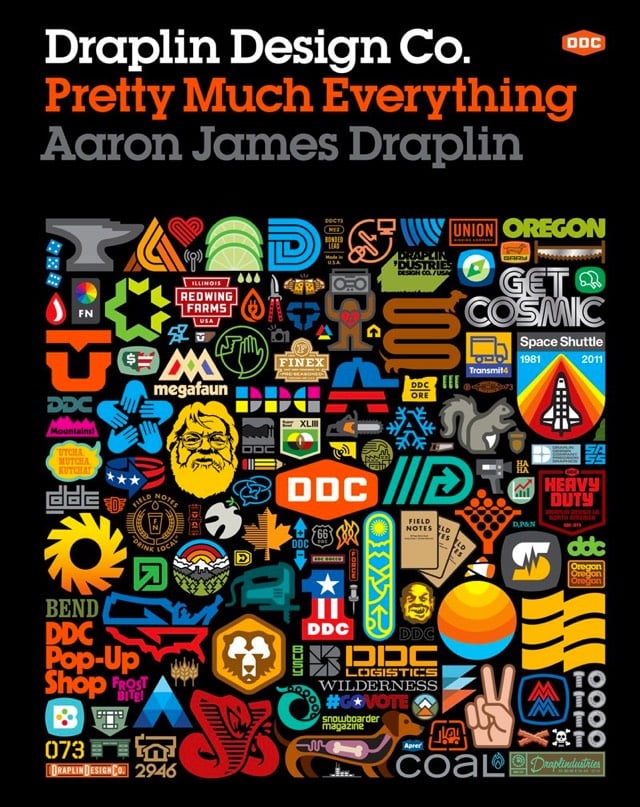
You’re probably familiar with Aaron James Draplin through his work on Field Notes. Well, as his upcoming book shows, Draplin is an uncommonly prolific designer who has done a ton of amazing work.
Pretty Much Everything is a mid-career survey of work, case studies, inspiration, road stories, lists, maps, how-tos, and advice. It includes examples of his work — posters, record covers, logos — and presents the process behind his design with projects like Field Notes and the “Things We Love” State Posters. Draplin also offers valuable advice and hilarious commentary that illustrates how much more goes into design than just what appears on the page. With Draplin’s humor and pointed observations on the contemporary design scene, Draplin Design Co. is the complete package for the new generation of designers.
I’ve been a fan of his for a long time…this is an easy purchase.
Climate change art
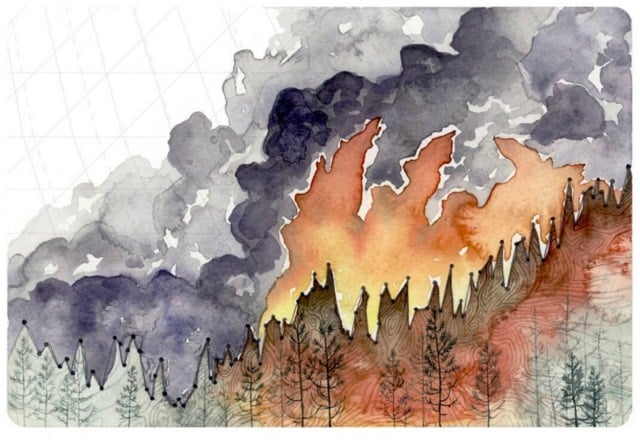
Artist Jill Pelto turns climate change graphs into art. So, for instance, a chart of rising global temperatures turns into a forest fire, which are becoming more common as temps rise:
And a graph of the retreat of glaciers over the years becomes a retreating glacier:

(via @EricHolthaus & climate central)
Drone footage of a Syrian city destroyed by war
Until recently, the Syrian city of Homs was the country’s third largest, with an estimated population of more than 800,000. As you can see from this drone footage, The Siege of Homs left much of the city destroyed and its population displaced.
If you scroll down in this Guardian piece, there’s a photo showing what a Homs street looked like before and after the siege. (via @alexismadrigal)
Update: A pair of newlyweds recently posed for some wedding portraits in war-ravaged Homs. Bad idea or the worst idea?
Absolutely mind- and leg-bending acrobatic gymnastics routine
The thing these three Russian women do starting at about 0:45 and continuing until about 1:20, is just flat-out amazing. Just watch. (via @dunstan)
A History of the Slave-Breeding Industry in the United States
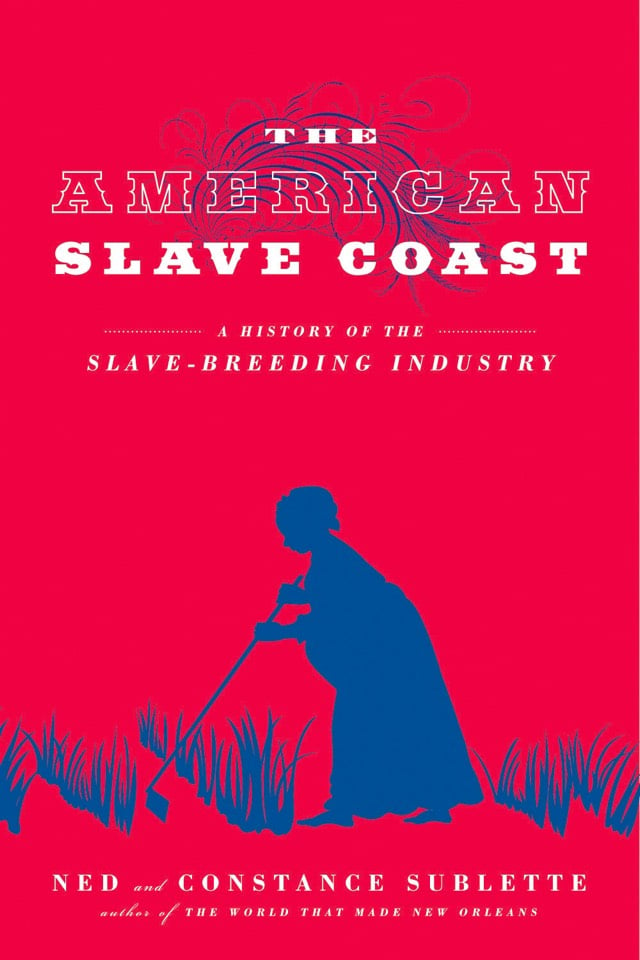
The American Slave Coast: A History of the Slave-Breeding Industry (Amazon) by Ned & Constance Sublette is a book which offers an alternate view of slavery in the United States. Instead of treating slavery as a source of unpaid labor, as it is typically understood, they focus on the ownership aspect: people as property, merchandise, collateral, and capital. From a review of the book at Pacific Standard:
In fact, most American slaves were not kidnapped on another continent. Though over 12.7 million Africans were forced onto ships to the Western hemisphere, estimates only have 400,000-500,000 landing in present-day America. How then to account for the four million black slaves who were tilling fields in 1860? “The South,” the Sublettes write, “did not only produce tobacco, rice, sugar, and cotton as commodities for sale; it produced people.” Slavers called slave-breeding “natural increase,” but there was nothing natural about producing slaves; it took scientific management. Thomas Jefferson bragged to George Washington that the birth of black children was increasing Virginia’s capital stock by four percent annually.
Here is how the American slave-breeding industry worked, according to the Sublettes: Some states (most importantly Virginia) produced slaves as their main domestic crop. The price of slaves was anchored by industry in other states that consumed slaves in the production of rice and sugar, and constant territorial expansion. As long as the slave power continued to grow, breeders could literally bank on future demand and increasing prices. That made slaves not just a commodity, but the closest thing to money that white breeders had. It’s hard to quantify just how valuable people were as commodities, but the Sublettes try to convey it: By a conservative estimate, in 1860 the total value of American slaves was $4 billion, far more than the gold and silver then circulating nationally ($228.3 million, “most of it in the North,” the authors add), total currency ($435.4 million), and even the value of the South’s total farmland ($1.92 billion). Slaves were, to slavers, worth more than everything else they could imagine combined.
Just reading that turns my stomach. The Sublettes also recast the 1808 abolition of the transatlantic slave trade as trade protectionism.
Virginia slaveowners won a major victory when Thomas Jefferson’s 1808 prohibition of the African slave trade protected the domestic slave markets for slave-breeding.
I haven’t read the book, but I imagine they touched on the fact that by growing slave populations, southern states were literally manufacturing more political representation due to the Three-Fifths clause in the US Constitution. They bred more slaves to help politically safeguard the practice of slavery.
Update: Because slaves were property, Southern slave owners could mortgage them to banks and then the banks could package the mortgages into bonds and sell the bonds to anyone anywhere in the world, even where slavery was illegal.
In the 1830s, powerful Southern slaveowners wanted to import capital into their states so they could buy more slaves. They came up with a new, two-part idea: mortgaging slaves; and then turning the mortgages into bonds that could be marketed all over the world.
First, American planters organized new banks, usually in new states like Mississippi and Louisiana. Drawing up lists of slaves for collateral, the planters then mortgaged them to the banks they had created, enabling themselves to buy additional slaves to expand cotton production. To provide capital for those loans, the banks sold bonds to investors from around the globe — London, New York, Amsterdam, Paris. The bond buyers, many of whom lived in countries where slavery was illegal, didn’t own individual slaves — just bonds backed by their value. Planters’ mortgage payments paid the interest and the principle on these bond payments. Enslaved human beings had been, in modern financial lingo, “securitized.”
Slave-backed securities. My stomach is turning again. (via @daveg)
Update: Tyler Cowen read The American Slave Coast and listed a few things he learned from it.
2. President James Polk speculated in slaves, based on inside information he obtained from being President and shaping policy toward slaves and slave importation.
3. In the South there were slave “breeding farms,” where the number of women and children far outnumbered the number of men.
Update: In his book The Half Has Never Been Told: Slavery and the Making of American Capitalism (Amazon), Edward Baptist details how slavery played a central role in the making of the US economy.
As historian Edward Baptist reveals in The Half Has Never Been Told, slavery and its expansion were central to the evolution and modernization of our nation in the 18th and 19th centuries, catapulting the US into a modern, industrial and capitalist economy. In the span of a single lifetime, the South grew from a narrow coastal strip of worn-out tobacco plantations to a sub-continental cotton empire. By 1861 it had five times as many slaves as it had during the Revolution, and was producing two billion pounds of cotton a year. It was through slavery and slavery alone that the United States achieved a virtual monopoly on the production of cotton, the key raw material of the Industrial Revolution, and was transformed into a global power rivaled only by England.
(via @alexismadrigal)
The top 10 closing movie shots of all time
Um, spoilers. Their picks include 2001, Gangs of New York, The 400 Blows, and Inception. I really thought Cache would be on the list.
Trailer for the upcoming Lego + The Force Awakens video game
Lego and Disney are teaming up for a Star Wars: The Force Awakens video game, out this summer. The trailer for it is possibly more fun than the movie was and is well worth watching if you enjoyed The Lego Movie.
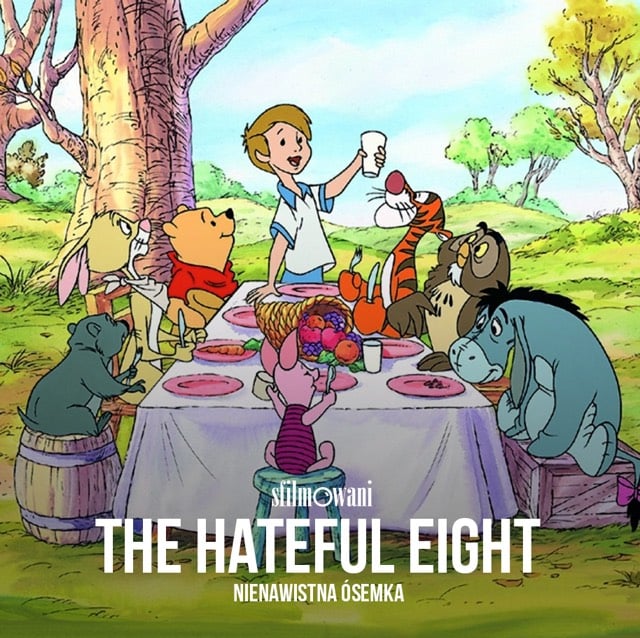
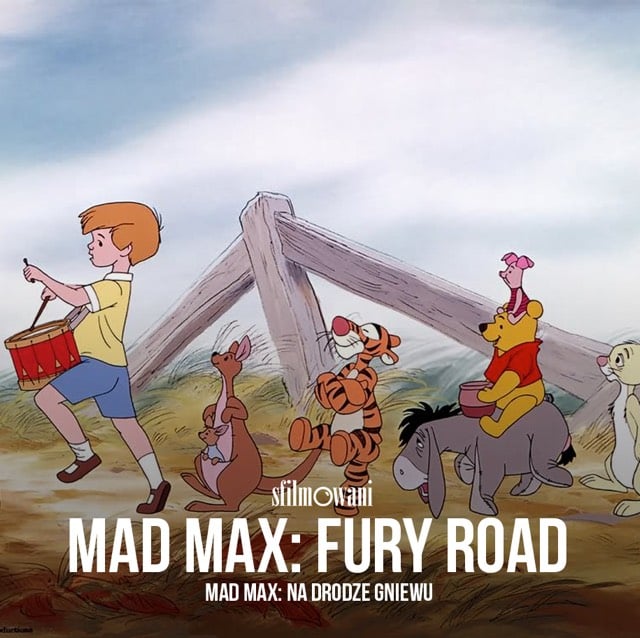
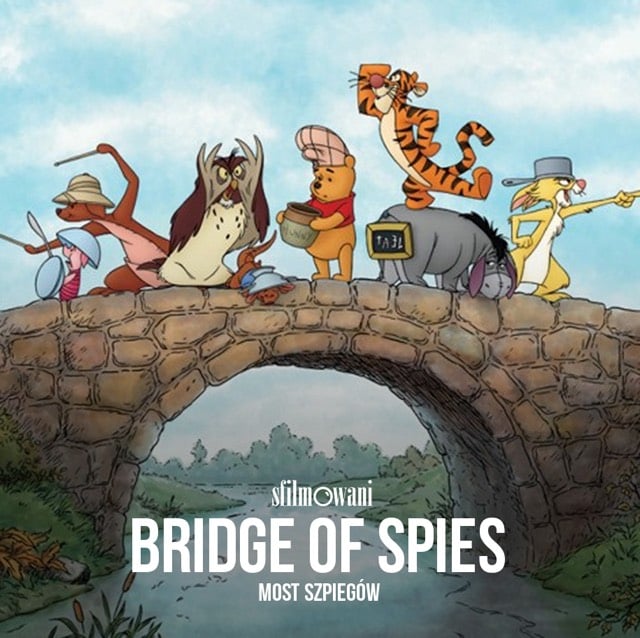
Oscar nominated films reimagined as Winnie the Pooh adventures
Twitter user @dilsexia posted the first one with the caption “The Revenant”:

Polish blogger Dawid Adamek ran with the idea and created several more Pooh/Oscar mashups:
Trippy spinning optical illusion

Somehow, this woman seems to be spinning both clockwise and counter-clockwise simultaneously. This is worse than the spinning ballerina. Anyone know who did this? Randomly found it on Facebook and couldn’t trace the source back…
Sesame Workshop (producer of Sesame Street) is launching a VC arm to fund kid-focused tech companies
Surprise! A new show by Louis CK (he stars w/ Steve Buscemi) called Horace and Pete, available only on his website
Infinite Jest turns 20
David Foster Wallace’s Infinite Jest turns 20 years old this month. To mark the occasion, the Harry Ransom Center, home of DFW’s archive of papers, is posting some of the more interesting findings by visiting scholars. Here, for instance, is a letter written by Wallace to his editor a few months before IJ’s publication.
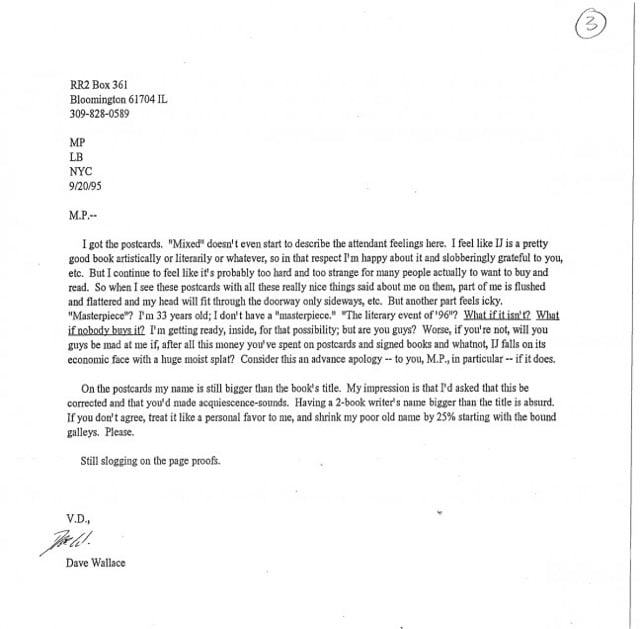
(via @john_overholt)
Update: In a NY Times essay adapted from his forward to an upcoming 20th anniversary edition of IJ, Tom Bissell reflects on why Infinite Jest still resonates 20 years later.
In interviews, Wallace was explicit that art must have a higher purpose than mere entertainment: “Fiction’s about what it is to be a … human being.” And here, really, is the enigma of David Foster Wallace’s work generally and “Infinite Jest” specifically: an endlessly, compulsively entertaining book that stingily withholds from readers the core pleasures of mainstream novelistic entertainment, among them a graspable central narrative line, identifiable movement through time and any resolution of its quadrumvirate plotlines. “Infinite Jest,” in other words, can be exceedingly frustrating. To fully understand what Wallace was up to, the book bears being read, and reread, with Talmudic focus and devotion. For many Wallace readers this is asking too much. For many Wallace fans this is asking too much.
I Hate the Lord of the Rings
Remy Porter hates The Lord of the Rings because it feels too much like work, too much like “every crappy enterprise IT project”. The tale begins with Gandalf, a legacy systems developer who pushes off important work onto Bilbo, who reluctantly became a developer after becoming proficient at spreadsheet macros. I wasn’t expecting too much from this video b/c of the title, but it’s a surprisingly entertaining analogy.
Socials & More