Entries for June 2013
For the Food Lab, Kenji Lopez-Alt debunks some old wives’ tales related to cooking steak.
Myth #2: “Sear your meat over high heat to lock in juices.”
The Theory: Searing the surface of a cut piece of meat will precipitate the formation of an impenetrable barrier, allowing your meat to retain more juices as it cooks.
The Reality: Searing produces no such barrier-liquid can still pass freely in and out of the surface of a seared steak. To prove this, I cooked two steaks to the exact same internal temperature (130^0F). One steak I seared first over hot coals and finished over the cooler side of the grill. The second steak I started on the cooler side, let it come to about ten degrees below its final target temperature, then finished it by giving it a sear over the hot side of a grill. If there is any truth to the searing story, then the steak that was seared first should retain more moisture.
What I found is actually the exact opposite: the steak that is cooked gently first and finished with a sear will not only develop a deeper, darker crust (due to slightly drier outer layers-see Myth #1), but it also cooks more evenly from center to edge, thus limiting the amount of overcooked meat and producing a finished product that is juicier and more flavorful.
If you’re serious about home-cooked steak, the “Further Reading” section at the bottom of this piece is your new best friend.
Andrew Blum writes about James Bridle and the New Aesthetic movement for Vanity Fair.
Suddenly everyone who thinks it’s a movement either wants to be part of it or wants to destroy it,” Bridle reflected one recent afternoon, sitting behind a makeshift desk in his new, windowless studio in a converted factory in the Cambridge Heath neighborhood of London. “Bruce describing it as a movement locks it into an existing idea of historical processes, but there’s no such thing as avant-gardes anymore. That’s such a ridiculous idea. That’s an art-historical construct that just doesn’t apply anymore. But it leads to that idea of there being avant-garde figures that are ahead of everything else. But there’s not. It’s just me, looking at this stuff, and going, ‘Have you seen this? Have you actually seen it? Have you really paid attention and thought this stuff through? Because I’m trying to, and it’s amazing!’”
More on the New Aesthetic here.
Are those your drums? The Late Show host likes drums so much that when musical guests finish up their sets on the show, Letterman often asks the drummer about them.
(via @hodgman)
This is great…Daft Punk’s Get Lucky as it would have sounded in every decade from the 1920s to the 2020s.
This is what singles should be from now on…you get the original song, a 30s jazz version of the song, a 1800s classical version, an 80s new wave version, and so on.
Jon Caramanica talks with Kanye West about his work, his past, his impending child, and all sorts of other things in the NY Times. I started pulling interesting quotes but stopped when I realized that I was copy/pasting like 96% of the article. So, you only get two:
I sat down with a clothing guy that I won’t mention, but hopefully if he reads this article, he knows it’s him and knows that out of respect, I didn’t mention his name: this guy, he questioned me before I left his office:, “If you’ve done this, this, and this, why haven’t you gone further in fashion?” And I say, “I’m learning.” But ultimately, this guy that was talking to me doesn’t make Christmas presents, meaning that nobody was asking for his [stuff] as a Christmas present. If you don’t make Christmas presents, meaning making something that’s so emotionally connected to people, don’t talk to me.
And I don’t want to ruin the amazing last few paragraphs, but I just had to include this:
I think what Kanye West is going to mean is something similar to what Steve Jobs means. I am undoubtedly, you know, Steve of Internet, downtown, fashion, culture. Period. By a long jump. I honestly feel that because Steve has passed, you know, it’s like when Biggie passed and Jay-Z was allowed to become Jay-Z.
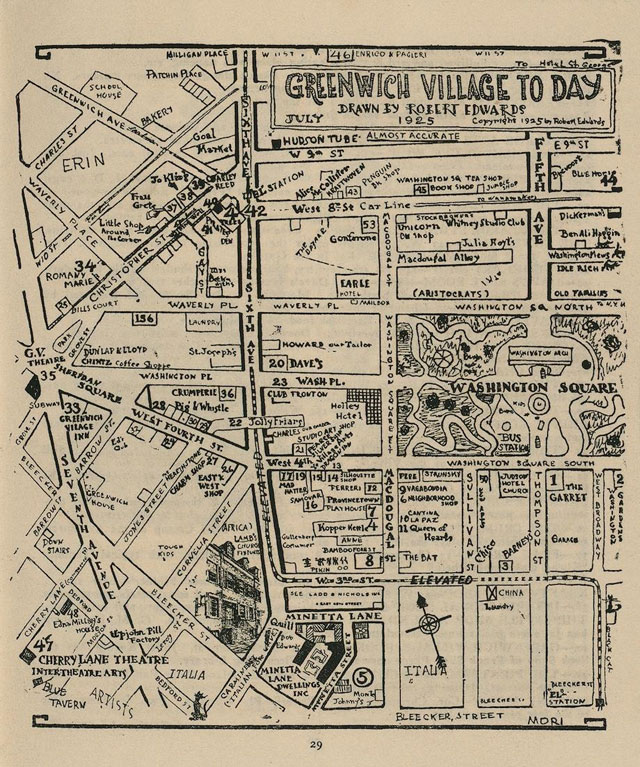
From a 1925 issue of Quill magazine, a map of NYC’s Greenwich Village hand-drawn by Robert Edwards.
What if journalists from foreign countries wrote about the US the way US newspapers and magazines cover events in foreign countries?
On a recent visit to the United States by GlobalPost, signs of the increased security apparatus could be found everywhere.
At all national airports, passengers are now forced to undergo full-body scans before boarding any flights. Small cameras are perched on many street corners, recording the movements and actions of the public. And incessant warnings on public transportation systems encourage citizens to report any “suspicious activity” to authorities.
Several American villagers interviewed for this story said the ubiquitous government marketing campaign called, “If you see something, say something,” does little to make them feel safer and, in fact, only contributes to a growing mistrust among the general population.
“I’ve deleted my Facebook account, stopped using email, or visiting websites that might be considered anti-regime,” a resident of the northern city of Boston, a tough-as-nails town synonymous with rebellion, told GlobalPost. It was in Boston that an American militia first rose up against the British empire. “But my phone? How can I stop using my phone? This has gone too far.”
An excerpt from Daniel Dennett’s new book, Intuition Pumps and Other Tools for Thinking, outlines seven of Dennett’s tools for thinking. His second tool is “respect your opponent”:
The best antidote I know for this tendency to caricature one’s opponent is a list of rules promulgated many years ago by social psychologist and game theorist Anatol Rapoport.
How to compose a successful critical commentary:
1. Attempt to re-express your target’s position so clearly, vividly and fairly that your target says: “Thanks, I wish I’d thought of putting it that way.”
2. List any points of agreement (especially if they are not matters of general or widespread agreement).
3. Mention anything you have learned from your target.
4. Only then are you permitted to say so much as a word of rebuttal or criticism.
Tired of all the lies, Allison Robicelli finally discovers the awful truth about jogging.
I despise everything about running. I hate the New York City Marathon, which bisects my neighborhood every year, making my commute to work or any theoretical trips to the emergency room completely impossible. I hate people who are constantly posting about running over on Facebook, casually humblebragging about how they fit in a “quickie 5K” between picking up the dry cleaning and the children. I hate 5Ks, even though, where I live, they usually conclude with free beer and six-foot-long heroes (Bay Ridge, Brooklyn: Turning Everything into an Excuse for Day-Drinking Since 1853). I hate “fun runs” because, seriously, fuck you.
James Somers, writer and web developer, ponders the value of the work that he does.
I have a friend who’s a mechanical engineer. He used to build airplane engines for General Electric, and now he’s trying to develop a smarter pill bottle to improve compliance for AIDS and cancer patients. He works out of a start-up ‘incubator’, in an office space shared with dozens of web companies. He doesn’t have a lot of patience for them. ‘I’m fucking sick of it,’ he told me, ‘all they talk about is colours.’
Web start-up companies are like play-companies. They stand in relation to real companies the way those cute little make-believe baking stations stand in relation to kitchens.
Take Doormates, a failed start-up founded in 2011 by two recent graduates from Columbia University whose mission was to allow users ‘to join or create private networks for buildings with access restricted to only building residents’. For that they, too, raised $350,000. You wonder whether anyone asked: ‘Do strangers living in the same building actually want to commune? Might this problem not be better solved by a plate of sandwiches?’ (The founders have since moved on to ‘Mommy Nearest’, an iPhone app that points out mom-friendly locations around New York.)
A lot of the stuff going on just isn’t very ambitious. ‘The thing about the advertising model is that it gets people thinking small, lean,’ wrote Alexis Madrigal in an essay about start-ups in The Atlantic last year. ‘Get four college kids in a room, fuel them with pizza, and see what thing they can crank out that their friends might like. Yay! Great! But you know what? They keep tossing out products that look pretty much like what you’d get if you took a homogenous group of young guys in any other endeavour: Cheap, fun, and about as worldchanging as creating a new variation on beer pong.’
You commit three felonies a day orig. from Jun 10, 2013
* Q: Wha? A: These previously published entries have been updated with new information in the last 24 hours. You can find past updates here.
People love Jerry Seinfeld so much that we will watch him driving cars and drinking coffee with other comedians. Wait, that actually sounds fantastic!
All the season one episodes are available on YouTube, featuring Ricky Gervais, Alec Baldwin, Michael Richards, and Larry David. (via devour)
Here are a few clips from Christian Marclay’s The Clock that have been surreptitiously filmed and uploaded to YouTube and Vimeo.
The clips are crappy bootlegs that cut off part of the screen, but I still totally get sucked in after 30 seconds of each clip.
In an essay that covers similar ground to Steven Johnson’s Where Good Ideas Come From, David Galbraith offers an interesting perspective on maximizing your creative potential.
I remember the very instant that I learned to be creative, to ‘invent’ things, to do things in an interesting and unusual way, and it happened by accident, literally.
I created mess around myself, the kind of chaos that would be very dangerous in an operating theater but which is synonymous with artists’ studios, and in that mess I edited the accidents. By increasing the amount of mess I had freed things up and increased the possibilities, I had maximised the adjacent possible and was able to create the appearance of inventing new things by editing the mistakes which appeared novel and interesting.
The adjacent possible is one of those ideas that, once you hear it, you want to apply to everything around you.
In a book called Three Felonies A Day, Boston civil rights lawyer Harvey Silverglate says that everyone in the US commits felonies everyday and if the government takes a dislike to you for any reason, they’ll dig in and find a felony you’re guilty of.
The average professional in this country wakes up in the morning, goes to work, comes home, eats dinner, and then goes to sleep, unaware that he or she has likely committed several federal crimes that day. Why? The answer lies in the very nature of modern federal criminal laws, which have exploded in number but also become impossibly broad and vague. In Three Felonies a Day, Harvey A. Silverglate reveals how federal criminal laws have become dangerously disconnected from the English common law tradition and how prosecutors can pin arguable federal crimes on any one of us, for even the most seemingly innocuous behavior. The volume of federal crimes in recent decades has increased well beyond the statute books and into the morass of the Code of Federal Regulations, handing federal prosecutors an additional trove of vague and exceedingly complex and technical prohibitions to stick on their hapless targets. The dangers spelled out in Three Felonies a Day do not apply solely to “white collar criminals,” state and local politicians, and professionals. No social class or profession is safe from this troubling form of social control by the executive branch, and nothing less than the integrity of our constitutional democracy hangs in the balance.
In response to a question about what happens to big company CEOs who refuse to go along with government surveillance requests, John Gilmore offers a case study in what Silverglate is talking about.
We know what happened in the case of QWest before 9/11. They contacted the CEO/Chairman asking to wiretap all the customers. After he consulted with Legal, he refused. As a result, NSA canceled a bunch of unrelated billion dollar contracts that QWest was the top bidder for. And then the DoJ targeted him and prosecuted him and put him in prison for insider trading — on the theory that he knew of anticipated income from secret programs that QWest was planning for the government, while the public didn’t because it was classified and he couldn’t legally tell them, and then he bought or sold QWest stock knowing those things.
This CEO’s name is Joseph P. Nacchio and TODAY he’s still serving a trumped-up 6-year federal prison sentence today for quietly refusing an NSA demand to massively wiretap his customers.
You combine this with the uber-surveillance allegedly being undertaken by the NSA and other governmental agencies and you’ve got a system for more or less automatically accusing any US citizen of a felony. Free society, LOL ROFLcopter.
Update: For the past two years, the Wall Street Journal has been “examining the vastly expanding federal criminal law book and its consequences”. (thx, jesse)
By now, you’ve likely heard of Edward Snowden, the former NSA contractor who leaked secret documents to the press regarding that agency’s electronic surveillance activities. From Glenn Greenwald’s excellent coverage for The Guardian, here are a few of the most interesting passages from interviews with Snowden.
From the moment he decided to disclose numerous top-secret documents to the public, he was determined not to opt for the protection of anonymity. “I have no intention of hiding who I am because I know I have done nothing wrong,” he said.
—
Despite these fears, he remained hopeful his outing will not divert attention from the substance of his disclosures. “I really want the focus to be on these documents and the debate which I hope this will trigger among citizens around the globe about what kind of world we want to live in.” He added: “My sole motive is to inform the public as to that which is done in their name and that which is done against them.”
He has had “a very comfortable life” that included a salary of roughly $200,000, a girlfriend with whom he shared a home in Hawaii, a stable career, and a family he loves. “I’m willing to sacrifice all of that because I can’t in good conscience allow the US government to destroy privacy, internet freedom and basic liberties for people around the world with this massive surveillance machine they’re secretly building.”
—
“All my options are bad,” he said. The US could begin extradition proceedings against him, a potentially problematic, lengthy and unpredictable course for Washington. Or the Chinese government might whisk him away for questioning, viewing him as a useful source of information. Or he might end up being grabbed and bundled into a plane bound for US territory.
“Yes, I could be rendered by the CIA. I could have people come after me. Or any of the third-party partners. They work closely with a number of other nations. Or they could pay off the Triads. Any of their agents or assets,” he said.
“We have got a CIA station just up the road — the consulate here in Hong Kong — and I am sure they are going to be busy for the next week. And that is a concern I will live with for the rest of my life, however long that happens to be.”
—
He left the CIA in 2009 in order to take his first job working for a private contractor that assigned him to a functioning NSA facility, stationed on a military base in Japan. It was then, he said, that he “watched as Obama advanced the very policies that I thought would be reined in”, and as a result, “I got hardened.”
The primary lesson from this experience was that “you can’t wait around for someone else to act. I had been looking for leaders, but I realised that leadership is about being the first to act.”
—
“I carefully evaluated every single document I disclosed to ensure that each was legitimately in the public interest,” he said. “There are all sorts of documents that would have made a big impact that I didn’t turn over, because harming people isn’t my goal. Transparency is.”
And from a second piece with a straight-up interview:
Q: Why did you decide to become a whistleblower?
A: “The NSA has built an infrastructure that allows it to intercept almost everything. With this capability, the vast majority of human communications are automatically ingested without targeting. If I wanted to see your emails or your wife’s phone, all I have to do is use intercepts. I can get your emails, passwords, phone records, credit cards.
“I don’t want to live in a society that does these sort of things … I do not want to live in a world where everything I do and say is recorded. That is not something I am willing to support or live under.”
—
Q: What do the leaked documents reveal?
A: “That the NSA routinely lies in response to congressional inquiries about the scope of surveillance in America. I believe that when [senator Ron] Wyden and [senator Mark] Udall asked about the scale of this, they [the NSA] said it did not have the tools to provide an answer. We do have the tools and I have maps showing where people have been scrutinised most. We collect more digital communications from America than we do from the Russians.”
—
Q: What is your reaction to Obama denouncing the leaks on Friday while welcoming a debate on the balance between security and openness?
A: “My immediate reaction was he was having difficulty in defending it himself. He was trying to defend the unjustifiable and he knew it.”
—
Q: Washington-based foreign affairs analyst Steve Clemons said he overheard at the capital’s Dulles airport four men discussing an intelligence conference they had just attended. Speaking about the leaks, one of them said, according to Clemons, that both the reporter and leaker should be “disappeared”. How do you feel about that?
A: “Someone responding to the story said ‘real spies do not speak like that’. Well, I am a spy and that is how they talk. Whenever we had a debate in the office on how to handle crimes, they do not defend due process - they defend decisive action. They say it is better to kick someone out of a plane than let these people have a day in court. It is an authoritarian mindset in general.”
Both of these pieces are very much worth reading in entirety. Also worth a read is Timothy Lee’s piece for The Washington Post, Has the US become the type of nation from which you have to seek asylum?
Four decades ago, Daniel Ellsberg surrendered to federal authorities to face charges of violating the Espionage Act. During his trial, he was allowed to go free on bail, giving him a chance to explain his actions to the media. His case was eventually thrown out after it was revealed that the government had wiretapped him illegally.
Bradley Manning, a soldier who released classified documents to WikiLeaks in 2010, has had a very different experience. Manning was held for three years without trial, including 11 months when he was held in de facto solitary confinement. During some of this period, he was forced to sleep naked at night, allegedly as a way to prevent him from committing suicide. The United Nations’ special rapporteur on torture has condemned this as “cruel, inhuman and degrading treatment in violation of Article 16 of the convention against torture.”
Maps of US linguistic patterns orig. from Jun 06, 2013
* Q: Wha? A: These previously published entries have been updated with new information in the last 24 hours. You can find past updates here.
I have not had a chance to check it out yet1, but any iOS app built by a team of John Gruber, Brent Simmons, and Dave Wiskus has to be worth a look. They released Vesper yesterday:
Vesper is a simple and elegant tool for collecting notes, ideas, things to do — anything you want to remember. Use tags to group related items into playlist-like collections. Vesper imposes no system; organize and curate your notes whatever way comes naturally to you. Eschewing complications, Vesper’s focus is on how it feels to use it.
Available at the App Store for $4.99.
[1] Busy, busy week…sorry for the slightly slow pace around here the past few days. I haven’t even had the chance to download and play the new Kingdom Rush yet. ↩
When Grant Hill and Jason Kidd retired from the NBA this week, they were the last players who appeared in the NBA Jam video game from 1994. There are still three active NHL players who appeared in the classic NHL ‘94: Teemu Selanne, Roman Hamrlik, and Jaromir Jagr. Kotaku’s Owen Good takes a look at which athletes were the last men standing from 8-bit and 16-bit sports video games.
Landeta, whose last game was in 2005, is the last man on the Tecmo Bowl roster to appear in an NFL game, beating out the Raiders’ Tim Brown, the 49ers’ Jerry Rice and Minnesota’s Rich Gannon, all of whom retired in 2004.
Actor/writer/director Ethan Hawke did a well-received AMA (ask me anything) on Reddit yesterday. A few highlights follow. On privacy and family:
My kids and I always have a debate about if the positives outweigh the negatives. Great seats to the Nicks game vs. being hounded for autographs at halftime. Every give has a take. For me, the blessings far outweigh the curses. I consider it a kind of luxury tax. For my family, I think it’s more difficult; they don’t get to work with Denzel Washington and Sidney Lumet, but they still have the paparazzi.
On Nicolas Cage:
I’m kind of obsessed with Nic Cage. I just found out about /r/onetruegod too. He’s the only actor since Marlon Brando that’s actually done anything new with the art of acting; he’s successfully taken us away from an obsession with naturalism into a kind of presentation style of acting that I imagine was popular with the old troubadours. If I could erase his bottom half bad movies, and only keep his top half movies, he would blow everyone else out of the water. He’s put a little too much water in his beer, but he is still one of the great actors of our time. And working with him was an absolute pleasure. In fact, one of my favorite scenes I’ve ever done is the last scene in LORD OF WAR.
On hobbies and work:
No… I’m so lucky, so much of what I would do as a hobby I do for my professional life. I love what I do. And I get to shake it up by directing in a movie, acting in a movie, directing a play, writing a book, acting in a play - i’ve found a way over the years to continue to shake up my job so it remains interesting to me. I’m one of the handful of people who doesn’t want a hobby because I’d rather be doing my job.
And on the one thing he would change in his life:
I don’t want to say. You know, the things that we want to change about our lives are things we don’t want everybody to know, and one of the most difficult things for me was having to learn in front of the public that having a reputation is a double-edged sword. It prevents me from making a first impression. I feel like I haven’t made a first impression on anyone in 20 years. There are many things about my life and my behavior that I wish I could change, situations I wish I could have handled better, relationships I could have healed, but unfortunately the earth seems to turn one way and all we can do is try to learn.
Hawke lives in my neighborhood and I see him every once in awhile on the street and at the playground. That “I haven’t made a first impression on anyone in 20 years” makes me want to give him a hug the next time I see him.
The first season of Sesame Street aired in 1969-1970 and this photo of the cast dates from then:
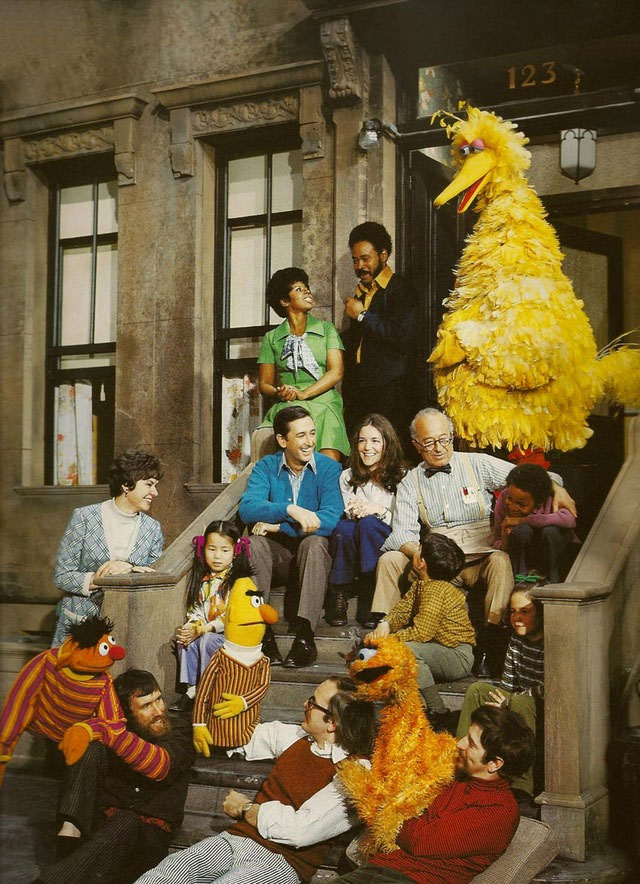
The giveaway is Oscar the Grouch’s orange fur…it would switch to green for the second season. Here’s the first 15 minutes of the first episode:
And here’s part 2, part 3, and part 4.
Sesame Street is insane, BTW. They aired 130 60-minute episodes over six months for that first season and over its 43 seasons, the show has averaged 100 episodes per season. A truly amazing combination of quantity and quality.
Joshua Katz has been studying American dialects and has made more than 120 maps of some of the differences in American speech. Here are a few examples:



(thx, everyone)
Update: As he notes on the site, Katz’s maps are based on the research and work of Bert Vaux…Vaux’s maps of the same data can be found here. (thx, molly, margaret, & nicholas)
The recipe for the cronut orig. from Jun 04, 2013
* Q: Wha? A: These previously published entries have been updated with new information in the last 24 hours. You can find past updates here.
The makers of Kingdom Rush, probably my all-time favorite iOS game, are out with a brand-new game: Kingdom Rush Frontiers.

I will see you all in a few days. Tell my wife and kids I love them. (“thx”, @mykeatkinson)
For her Sewn News project, artist Lauren DiCioccio embroiders photographs from the New York Times.

(via beautiful decay)
Shortly before his retirement at 60, Tatsuo Horiuchi picked up a copy of Microsoft Excel and started making art with it. His art does not look anything like you’d expect Excel art to look:

Update: Here’s a short video on Horiuchi and his art:
Turn your Twitter stream into your friends’ linkblog orig. from Jul 23, 2012
* Q: Wha? A: These previously published entries have been updated with new information in the last 24 hours. You can find past updates here.

Cronuts are donuts made from croissant dough and they are all the rage here in NYC. They were invented by chef Dominique Ansel and they are only available in limited quantities at his bakery in Soho. Apparently people start lining up for them at 6am and all 200 of the world’s daily supply of cronuts are gone within minutes of opening. Naturally, a black market has sprung up, with cronuts selling on Craigslist for upwards of $25/item:

Kevin Roose has some ideas for Ansel about expanding the reach of the cronut, but in the meantime, Edd Kimber replicated the treat at home with a quickie croissant dough.
Since I wont be in New York any time soon I thought I would see if I could replicate them at home, and you know what? They are pretty damn good! Now the dough I’m using isnt a proper croissant dough, its my quick dough made with just 20 minutes active work which, compared to traditional croissant dough is a snap to make.
Update: Pillsbury has gotten into the act as well with a cronut recipe that uses their crescent dough.
Update: In his forthcoming cookbook, Ansel reveals the recipe for the cronut and it’s not for the faint of heart…the recipe takes three days to make.
Baltazar Ushca is the last ice miner of Ecuador’s Mt. Chimborazo. Dozens of men, including Ushca’s brothers, used to mine Chimborazo’s glacial ice but commercial ice production has rendered the arduous process obsolete.
Also, it appears that the rocks and grass aren’t separated from the ice before it goes into the blender?
Kenji Fujimoto spent more than a decade as Kim Jong-il’s personal chef and his children’s nanny. This is his amazing story.
At a lavish Wonsan guesthouse, Fujimoto prepared sushi for a group of executives who would be arriving on a yacht. Executive is Fujimoto’s euphemism for generals, party officials, or high-level bureaucrats. In other words, Kim Jong-il’s personal entourage. Andguesthouse is code for a series of palaces decorated with cold marble, silver-braided bedspreads, ice purple paintings of kimilsungia blossoms, and ceilings airbrushed with the cran-apple mist of sunset, as if Liberace’s jet had crashed into Lenin’s tomb.
At two in the morning, the boat finally docked. Fujimoto began serving sushi for men who obviously had been through a long party already. He would come to realize these parties tended to be stacked one atop another, sometimes four in a row, spreading out over days.
All the men wore military uniforms except for one imperious fellow in a casual sports tracksuit. This man was curious about the fish. He asked Fujimoto about the marbled, fleshy cuts he was preparing.
“That’s toro,” Fujimoto told him.
For the rest of the night, this man kept calling out, “Toro, one more!”
The next day, Fujimoto was talking to the mamasan of his hotel. She was holding a newspaper, the official Rodong Sinmun, and on the front page was a photo of the man in the tracksuit. Fujimoto told her this was the man he’d just served dinner.
“She started trembling,” Fujimoto said of the moment he realized the man’s true identity. “Then I started trembling.”
The man in the tracksuit invited Fujimoto back to make more sushi. Fujimoto didn’t speak Korean, so he had a government-appointed interpreter with him at all times. At the end of the evening, a valet handed the interpreter an envelope.
“From Jang-gun-nim,” the valet said.
Perhaps the reason Fujimoto hadn’t known he’d been serving Kim Jong-il was because “no one ever called him by his real name,” Fujimoto said. “Never.”
The Writers Guild of America recently selected their list of the 101 best written TV series of all time. Here are the top 20:
1 The Sopranos
2 Seinfeld
3 The Twilight Zone
4 All in the Family
5 M*A*S*H
6 The Mary Tyler Moore Show
7 Mad Men
8 Cheers
9 The Wire
10 The West Wing
11 The Simpsons
12 I Love Lucy
13 Breaking Bad
14 The Dick Van Dyke Show
15 Hill Street Blues
16 Arrested Development
17 The Daily Show with Jon Stewart
18 Six Feet Under
19 Taxi
20 The Larry Sanders Show
The full list is here in PDF form. Lost above Deadwood? And Homicide? And several other more? Maybe they ignored everything after the first couple seasons?
Solar power is expensive, right? Actually, the high cost of alternative energy is a good example of a mesofact. As this graph shows, the cost of producing photovoltaic cells has dropped two orders of magnitude over the past 35 years, bringing costs within range of fossil fuel energy production.

The underlying cause of this disruption is a phenomenon that solar’s supporters call Swanson’s law, in imitation of Moore’s law of transistor cost. Moore’s law suggests that the size of transistors (and also their cost) halves every 18 months or so. Swanson’s law, named after Richard Swanson, the founder of SunPower, a big American solar-cell manufacturer, suggests that the cost of the photovoltaic cells needed to generate solar power falls by 20% with each doubling of global manufacturing capacity. The upshot (see chart) is that the modules used to make solar-power plants now cost less than a dollar per watt of capacity. Power-station construction costs can add $4 to that, but these, too, are falling as builders work out how to do the job better. And running a solar power station is cheap because the fuel is free.
Coal-fired plants, for comparison, cost about $3 a watt to build in the United States, and natural-gas plants cost $1. But that is before the fuel to run them is bought. In sunny regions such as California, then, photovoltaic power could already compete without subsidy with the more expensive parts of the traditional power market, such as the natural-gas-fired “peaker” plants kept on stand-by to meet surges in demand. Moreover, technological developments that have been proved in the laboratory but have not yet moved into the factory mean Swanson’s law still has many years to run.
We are all mostly related to each other. But weirder still, you’re just about as related to the stranger next to you as to your great×12 grandparents.
Now, there’s another important implication of genomic ancestry studies: Most of the people you are descended from are no more genetically related to you than strangers are. Or to put it another way, your genealogical family tree, which includes all the history of your family going back thousands of years, is much larger than your genetic family tree-the people whom genome sequencing would pinpoint as related to you. 99.9 percent of your genome is the same as that of every other human being (apart from the x and y chromosomes), and that .1 percent of variation in each person gets thinned out pretty quickly across the generations, as each child gets half of each of her parents’ genomes, passes on half to each of her children, and so on. Geneticist Luke Jostins did a nice mathematical analysis and estimated that you have only about a 12 percent chance of being genetically related to an ancestor 10 generations ago; by the time you get to a 14-generation ancestor, the probability is nearly zero.
Small protests in Istanbul over the past few days have erupted into what’s becoming a typical scene across the world: authoritarian governments attempting to crack down on a citizenry agitating for increased freedom.
No newspaper, no television channel was there to report the protest. It was a complete media black out.
But the police arrived with water cannon vehicles and pepper spray. They chased the crowds out of the park.
In the evening the number of protesters multiplied. So did the number of police forces around the park. Meanwhile local government of Istanbul shut down all the ways leading up to Taksim square where the Gezi Park is located. The metro was shut down, ferries were cancelled, roads were blocked.
Yet more and more people made their way up to the center of the city by walking.
They came from all around Istanbul. They came from all different backgrounds, different ideologies, different religions. They all gathered to prevent the demolition of something bigger than the park:
The right to live as honorable citizens of this country.
They gathered and marched. Police chased them with pepper spray and tear gas and drove their tanks over people who offered the police food in return. Two young people were run over by the panzers and were killed.
To keep up with events in Turkey, try Occupy Gezi’s Tumblr and Facebook page.
Lovely piece by Joe Posnanski about Tim Duncan, who at the age of 37 and in his 16th NBA season, finds himself in the Finals again seeking his fifth NBA championship.
Duncan almost certainly would have been the first pick in the draft after his sophomore year, but he came back to Wake Forest. He would have been the first pick in the draft after his junior year, for sure — and just about everyone thought he would go out — but once more he went back to Wake Forest to complete his senior year. Odom says that they were in the car after Duncan’s junior year and heading to the airport for the Wooden Award ceremony (Duncan did not win it until his senior year). He told Duncan, “You will get a lot of questions there about why you’re coming back to Wake Forest.”
Duncan, typically, looked out the window and did not say anything.
“No, Tim, this is important,” Odom said. “Let’s pretend I’m one of those reporters? Was it a hard decision to come back to Wake Forest?”
Duncan kept looking out the window, but he said: “No. It wasn’t hard.”
Odom: “It wasn’t? You didn’t agonize over leaving millions of dollars on the table?”
Duncan said: “I didn’t agonize. I just thought, why should I try to do today what I will be better prepared to do a year from now.”
Odom looked over at the best player he would ever coach, and he wondered: “What kind of college junior thinks like that? Who has that sort of confidence, that sort of patience, that sort of inner peace? And then Duncan said the words that Odom thinks about almost every day.”
He said: “You know something coach? The NBA can do a lot for me. It really can. But there’s one thing it can’t do. The NBA can never make me 20 years old again.”
In 2003, Duncan was 27 years old and the MVP of the NBA and the Spurs won their second championship. Ten years later, at 37, his statistics (per 36 minutes) are remarkably similar:
2002-2003: 21.3 points, 11.8 rebounds, 3.6 assists, 2.7 blocks, 0.6 steals.
2012-2013: 21.3 points, 11.9 rebounds, 3.2 assists, 3.2 blocks, 0.9 steals.
Newer posts





Socials & More