Entries for October 2012
From a site called Celebrity Net Worth (I know, blech), a list of the 25 richest people of all time, adjusted for inflation. Gates, Buffett, and Rockefeller all make the list but the big cheese is Malian emperor Mansa Musa I, with a net worth of $400 billion in today’s dollars.
Mansa Musa I of Mali is the richest human being in history with a personal net worth of $400 billion! Mansa Musa lived from 1280 - 1337 and ruled the Malian Empire which covered modern day Ghana, Timbuktu and Mali in West Africa. Mansa Musa’s shocking wealth came from his country’s vast production of more than half the world’s supply of salt and gold.
(via @DavidGrann)
A European team of exoplanet hunters has discovered a planet about the size of Earth orbiting Alpha Centauri B, which is in a group of stars closest to the solar system, a mere 4.3 light years away. Lee Billings explains the significance.
At a distance of just over 4.3 light years, the stars of Alpha Centauri are only a cosmic stone’s throw away. To reach Alpha Centauri B b, as this new world is called, would require a journey of some 25 trillion miles. For comparison, the next-nearest known exoplanet is a gas giant orbiting the orange star Epsilon Eridani, more than twice as far away. But don’t pack your bags quite yet. With a probable surface temperature well above a thousand degrees Fahrenheit, Alpha Centauri B b is no Goldilocks world. Still, its presence is promising: Planets tend to come in packs, and some theorists had believed no planets at all could form in multi-star systems like Alpha Centauri, which are more common than singleton suns throughout our galaxy. It seems increasingly likely that small planets exist around most if not all stars, near and far alike, and that Alpha Centauri B may possess additional worlds further out in clement, habitable orbits, tantalizingly within reach.
A team at the University of Maryland are building a human-powered helicopter in an attempt to win the Igor I. Sikorsky Human Powered Helicopter Competition. To win the $250,000 prize, the helicopter must fly for 60 seconds, reach a momentary altitude of 3 meters, and stay within a 10 meter square. This is surprisingly difficult.
The NPR story that the video accompanies is here. (via ★interesting)
Today marks the 50th anniversary of the beginning of the Cuban Missile Crisis. In commemoration of the event, the JFK Presidential Library & Museum presents Clouds Over Cuba, a tense and engaging presentation on the Crisis and, even more strikingly, a dramatization on what might have happened had things gone differently. This is really well done and worth taking 10-15 minutes to watch/listen. (via @alexismadrigal)
I love these posters featuring six women who changed science and the world. Hard to pick a favorite but I’ll go with the Sally Ride one:

The Rosalind Franklin poster is a close second. The same artist also did this wonderfully minimalist poster for Louis Braille.
ps. Today is Ada Lovelace Day!
N Is a Number is an hour-long documentary about Hungarian mathematician Paul Erdős.
Erdős was famously a prolific mathematician who collaborated widely….he coauthored over 1500 papers with 500 different collaborators. He was also a homeless methamphetamine user.
This is a really interesting and eclectic list of 25 TV shows that have had an impact on society beyond the water cooler. There are a few obvious choices, but most of these I hadn’t heard of.
In 2003, 24-year-old machinist Juan Catalan faced the death penalty for allegedly shooting a key witness in a murder case. Catalan told police that he couldn’t have committed the crime — he was at a Los Angeles Dodgers game at the time. He had the ticket stubs and everything!
When police didn’t buy his alibi, Catalan contacted the Dodgers, who pointed him to an unlikely hero: misanthropic comedian Larry David. On the day in question, David had been filming an episode of Curb Your Enthusiasm in Dodger Stadium. It was a long shot, but maybe Catalan could be seen in the background. When his attorney watched the outtakes, it took just 20 minutes to find shots of Catalan and his daughter chowing down on ballpark dogs while watching from the stands.
Thanks to the footage, Catalan walked free after five months behind bars. And Larry David found one more thing to be self-deprecating about. “I tell people that I’ve done one decent thing in my life, albeit inadvertently,” joked David.
(via @fimoculous)
I’ve never seen a better audition tape than this improvised scene by Henry Thomas for the part of Elliott in E.T.
The tears were inspired by thoughts of his dead dog. And the final line from Spielberg is gold. (via @Colossal)
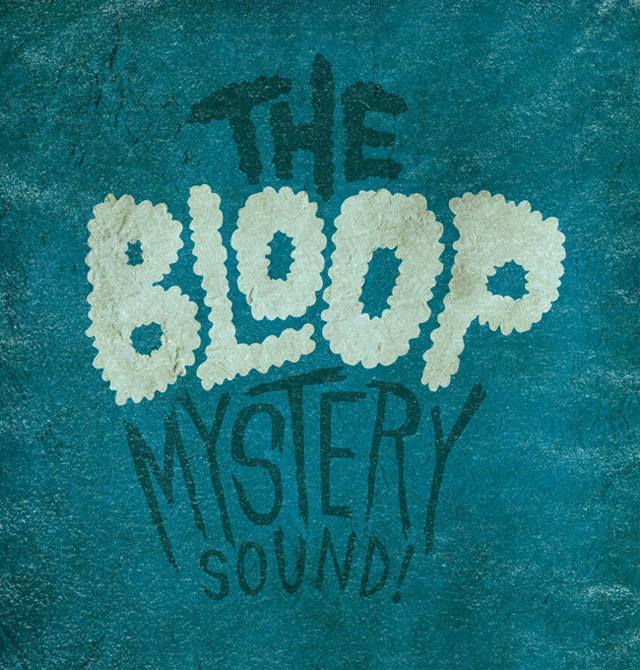
Every once in awhile, something somewhere will make a sound and no one really knows where it came from. Among the unexplained sounds listed on Wikipedia are mistpouffers, The Bloop, The Hum, and Julia.
The NOAA’s Dr. Christopher Fox does not believe its origin is man-made, such as a submarine or bomb, or familiar geological events such as volcanoes or earthquakes. While the audio profile of the Bloop does resemble that of a living creature, the source is a mystery both because it is different from known sounds and because it was several times louder than the loudest recorded animal, the blue whale.
Note: Illustration by Chris Piascik…prints & more are available.
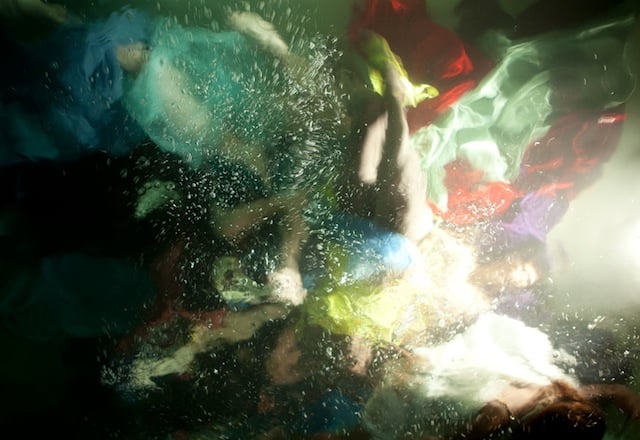
In Reckless Unbound, photographer Christy Rogers takes photographs of brightly-clothed people underwater resulting in photos that resemble Baroque paintings. GUP Magazine says:
Without the use of post-production manipulation, Rogers’ works are made in-camera, on the spot, in water and at night. She applies her technique to bodies submerged in water during tropical nights in Hawaii. Through a fragile process of experimentation, she builds elaborate scenes of coalesced colours and entangled bodies that exalt the human character as one of vigour and warmth, while also capturing the beauty and vulnerability of the tragic experience that is the human condition.
(via @robinsloan)
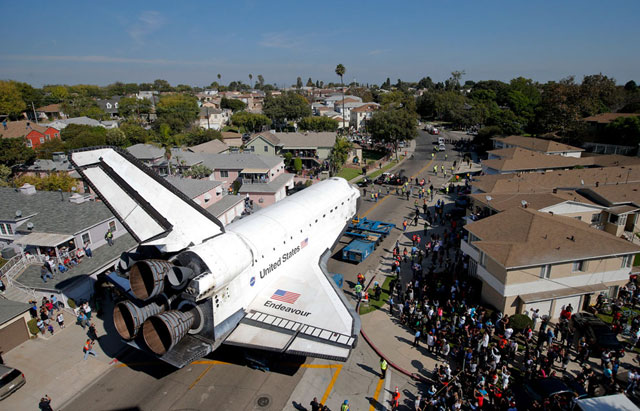
On Saturday, the Space Shuttle Endeavour was driven 12 miles through the streets of Los Angeles on its way to the California Science Center. It was a tight fit at times.
Watch live: record freefall jump from edge of space orig. from Oct 14, 2012
* Q: Wha? A: These previously published entries have been updated with new information in the last 24 hours. You can find past updates here.
Here’s some footage from the camera affixed to Felix Baumgartner’s chest during his record-breaking jump:
It’s frightening how fast he starts spinning. And then he really starts whipping around…watch the Sun’s reflection in his visor.
This has got to be some sort of record for quickest Lego parody of an event: watch as a Lego man jumps from a balloon hanging high in the air, just like Felix.
(via ★thoughtbrain)
Watch live as Felix Baumgartner jumps from a balloon more than 120,000 feet in the air.
Update: The jump was successful! The YT video above is now private but here are some highlights from the mission:
From New Zealand photographer John Crawford, a series called Aerial Nudes.
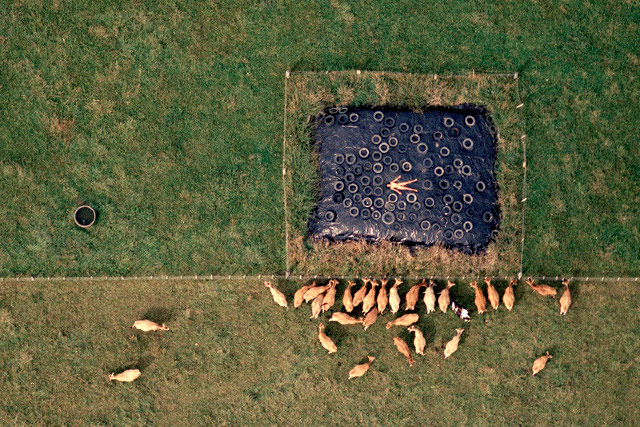
Technically not safe for work but your coworkers would need to be sitting at your desk with a magnifying glass to be offended so… (via @coudal)
Pixar is showing this short in front of Finding Nemo 3D in the theaters. It’s funny, a little disturbing, and perfect for the kids.
The embed is relatively low quality — way to make your awesome short film look like shit, Disney/Pixar! — so you should head over to their site to see it in crisp HD. (via ★pieratt)
Barbican’s Rain Room orig. from Oct 10, 2012
* Q: Wha? A: These previously published entries have been updated with new information in the last 24 hours. You can find past updates here.
There was a time when American Movie Classics used to show classic American movies, when The Learning Channel could teach you something, and when ABC Family broadcast family programming. Wired’s Ruth Suehle has a look at six TV networks that have significantly changed their programming since their founding. The story of ABC Family, which used to be known as The Family Channel, is especially interesting:
Plan A was to use it for ABC re-runs. Too bad [ABC] didn’t own the syndication rights to the stuff they wanted to show.
Plan B was an image makeover. They’d rename it XYZ (as in the opposite of ABC) and sell it to a younger, edgier audience. Too bad nobody read the contract that said the word “family” had to stay in the name forever.
Why? For that, we rewind to its beginning as Pat Robertson’s Christian Broadcasting Network Satellite Service in 1979. That religious beginning followed the network through multiple sales, each of which has been required to continue broadcasting Robertson’s The 700 Club, hence the reason that show is now bookended by the disclaimer, “The following/preceding CBN telecast does not reflect the views of ABC Family”as well as the network’s slogan of the last few years, “A New Kind of Family.”
(via @moth)
In response to some blogfight I don’t really understand or care too much about, Choire Sicha published a handy guide for determining whether you are on the internet or not.
Sometimes it’s hard to tell if you are on the Internet or not. For example you are almost always typing into a box on a series of screens on your computer. Because of this, there are whole sections of the Internet that are pretty sure they are not on the Internet, because, they are just boxes, right? You could be typing into anything, who knows if it’s public. This was true about LiveJournal for a long time. When you would link to a posting on LiveJournal, back in the day, you would get outraged emails about invasion of privacy. Because in their minds, they were just typing in their diary.
Korean pop music or K-pop has been steadily gaining popularity outside of Korea the last several years, and most of the artists share the trait of having been developed in a music factory. John Seabrook in the New Yorker looks at what the head of the first of these factories calls “cultural technology.” There’s a lot of fascinating stuff in this article.
In effect, Lee combined his ambitions as a music impresario with his training as an engineer to create the blueprint for what became the K-pop idol assembly line. His stars would be made, not born, according to a sophisticated system of artistic development that would make the star factory that Berry Gordy created at Motown look like a mom-and-pop operation. Lee called his system “cultural technology.” In a 2011 address at Stanford Business School, he explained, “I coined this term about fourteen years ago, when S.M. decided to launch its artists and cultural content throughout Asia. The age of information technology had dominated most of the nineties, and I predicted that the age of cultural technology would come next.” He went on, “S.M. Entertainment and I see culture as a type of technology. But cultural technology is much more exquisite and complex than information technology.”
[…]
Lee and his colleagues produced a manual of cultural technology—it’s known around S.M. as C.T.—that catalogued the steps necessary to popularize K-pop artists in different Asian countries. The manual, which all S.M. employees are instructed to learn, explains when to bring in foreign composers, producers, and choreographers; what chord progressions to use in what country; the precise color of eyeshadow a performer should wear in a particular country; the exact hand gestures he or she should make; and the camera angles to be used in the videos (a three-hundred-and-sixty-degree group shot to open the video, followed by a montage of individual closeups).
The AV Club has compiled a list of the 50 best films of the 1990s, which decade, when you look at this list, is starting to feel like a bit of a film golden age compared to now. Here’s part one, part two, and part three.
Few talk about the ’90s as a filmmaking renaissance on par with the late ’60s and early ’70s, but for many of the film critics at The A.V. Club, it was the decade when we were coming of age as cinephiles and writers, and we remember it with considerable affection. Those ’70s warhorses like Martin Scorsese and Robert Altman posted some of the strongest work of their careers, and an exciting new generation of filmmakers — Quentin Tarantino, Joel and Ethan Coen, Wong Kar-Wai, Olivier Assayas, David Fincher, and Wes Anderson among them — were staking out territory of their own.
I’ve seen 35 of the 50 films and some of my favorites are Election, Eyes Wide Shut, Fargo, Groundhog Day, Boogie Nights, Being John Malkovich, Rushmore, Reservoir Dogs, Dazed and Confused, and Pulp Fiction. Some films I’m surprised didn’t make the list: Iron Giant, Three Kings, Babe: Pig in the City, and The Insider.
Artists in the UK have created a ‘Rain Room’ inside the Barbican that gives the impression from the outside that it is pouring rain. 3D cameras make it so the rain stops when you walk through it. That is, the rain is everywhere you aren’t, and you don’t get wet at all.
(via ★adamkuban)
Update: Neglected to mention the Rain Room is an installation by rAndom International artists Stuart Wood and Hannes Koch.
Researchers in Copenhagan and Perth used DNA found in the leg bones of the extinct moa bird to determine the half-life of DNA: 521 years.
By comparing the specimens’ ages and degrees of DNA degradation, the researchers calculated that DNA has a half-life of 521 years. That means that after 521 years, half of the bonds between nucleotides in the backbone of a sample would have broken; after another 521 years half of the remaining bonds would have gone; and so on.
The team predicts that even in a bone at an ideal preservation temperature of -5 ºC, effectively every bond would be destroyed after a maximum of 6.8 million years. The DNA would cease to be readable much earlier — perhaps after roughly 1.5 million years, when the remaining strands would be too short to give meaningful information.
That means no real-life Jurassic Park, folks.
Sukiyabashi Jiro is a 3-star Michelin restaurant in Tokyo that many say serves the best sushi in the world. The chef/owner, 86-year-old Jiro Ono, was the subject of last year’s excellent Jiro Dreams of Sushi documentary film.
Adam Goldberg of A Life Worth Eating ate at Sukiyabashi Jiro yesterday. The meal was 21 courses, about US$380 per person (according the web site, excluding drinks), and lasted only 19 minutes. That’s more than a course a minute and, Goldberg estimates, around $20 per person per minute. And apparently totally worth it.

Goldberg has photos of each course up on Flickr and his site has a write-up of his 2009 meal.
Three slices of tuna came next, akami, chu-toro, and oo-toro increasing from lean, to medium fatty, to extremely fatty cuts. The akami (lean toro) was the most tender slice of tuna I’ve ever tasted that did not contain noticeable marbelization. The tuna was marinated in soy sauce for several minutes before service, perhaps contributing to this unique texture. The medium fatty tuna had an interesting mix of crunch and fat, while the fatty tuna just completely melted in my mouth. My friend with whom I shared this meal began to tear (I kid you not).
Lest you think Goldberg’s meal was an anomaly, this is a typical meal at Sukiyabashi Jiro. Dave Arnold wrote about his experience earlier this year:
The sushi courses came out at a rate of one per minute. 19 courses in 19 minutes. No ordering, no real talking — just making sushi and eating sushi. After the sushi is done you are motioned to leave the sushi bar and sit at a booth where you are served your melon. We took that melon at a leisurely 10 minute pace, leaving us with a bill of over $300 per person for just under 30 minutes time. Nastassia and Mark thought the pace was absurd and unpleasant. They felt obliged to keep up with Jiro’s pace. I didn’t feel obliged, but kept up anyway. I didn’t mind the speed. I could have easily eaten even faster, but I’m an inhuman eating machine — or so I’m told. At the end of the meal, Jiro went outside the restaurant and stood guard at the entrance, waiting to bid us formal adieu. This made Nastassia even more nervous about rushing to get out. Not me. At over 10 dollars a minute I have no problem letting an 86 year old man stand and wait for me to finish my melon if he wants to.
(via ★kathryn)
In the last few years, scientists have discovered that before Neanderthals went extinct around 30,000 years ago, they interbred with modern humans. As a result, many humans alive today contain Neanderthal DNA in their genomes, typically between 1-4%.
Yesterday, a few of the editors at The Atlantic had their genes analyzed for Neanderthal DNA: Alexis Madrigal had 3.6%, Steve Clemons had 4.3%, and James Fallows had 5%. Personal genetic information company 23andMe added the ability to determine your Neanderthal DNA percentage a few months ago and it turns out 2.7% of my DNA is from Neanderthals, compared to 2.5% for the average 23andMe user.
If you have a 23andMe acct, you can check your percentage by logging in and going to “Ancestry Labs” in the sidebar.
My son thinks corks grow on trees…not sure whether to pop his bubble on this or not.

It all starts in the forest. Cork oaks are harvested every nine years, once they reach maturity. It doesn’t harm the tree, and the cork bark regrows. Most cork forests are in Portugal and Spain.
Martyn Ashton takes a carbon fiber road bike (the same bike Bradley Wiggins won the Tour de France with) and does some trials riding with it. It’s a bit like recreating the Mini Cooper chase scene in the Bourne Identity with a Bugatti Veyron.
(thx, alex)
Gentlemen of Bacongo is a book of photography by Daniele Tamagni documenting a group of men from the Congo who dress in designer suits. Meet Le Sapeurs.
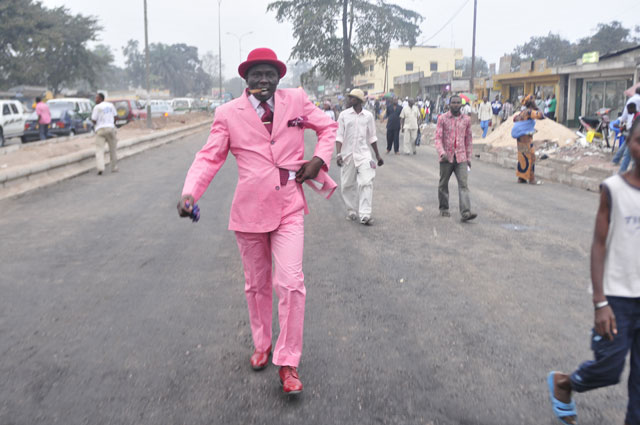
Photographer Daniele Tamagni’s new book Gentlemen of Bacongo captures the fascinating subculture of the Congo in which men (and a few women) dress in designer and handmade suits and other luxury items. The movement, called Le Sape, combines French styles from their colonial roots and the individual’s (often flamboyant) style. Le Sapeurs, as they’re called, wear pink suits and D&G belts while living in the slums of this coastal African region.
In interviews with some notable sapeurs, Tamagni unearths the complex and varied rules and standards of Le Sape, short for Société des Ambianceurs et des Personnes Élégantes, or the Society of Tastemakers and Elegant People. Sapeur Michel comments on the strange combination of poverty and fashion, “A Congolese sapeur is a happy man even if he does not eat, because wearing proper clothes feeds the soul and gives pleasure to the body.”
Solange Knowles recently shot Losing You in South Africa and it features many gentlemen of Le Sape. Tamagni went along as an advisor and photographed Solange along the way. (via @youngna)
This long ESPN piece about Lionel Messi and his hometown of Rosario, Argentina made me sad.
The next time people in Rosario heard his name, he was a star. “It is difficult to be a hero in your own city,” explained Marcelo Ramirez, a family friend and radio host who showed us text messages from Messi. “He didn’t grow up here. It’s like he lost contact with the people. He is more an international figure than a Rosarino.”
The Argentine national team coaches found out about him through a videotape, and the first time they sent him an invitation to join the squad, they addressed it to “Leonel Mecci.” In the 2006 and 2010 World Cups, playing outside the familiar Barcelona system, he struggled, at least in the expectant eyes of his countrymen. His coaches and teammates didn’t understand the aloof Messi, who once went to a team-building barbecue and never said a word, not even to ask for meat. The people from Argentina thought he was Spanish, and in the cafes and pool halls, they wondered why he always won championships for Barcelona but never for his own country. They raged when he didn’t sing the national anthem before games. In Barcelona, Messi inspired the same reaction. People noticed he didn’t speak Catalan and protected his Rosarino accent. He bought meat from an Argentine butcher and ate in Argentine restaurants. “Barcelona is not his place in the world,” influential Spanish soccer editor Aitor Lagunas wrote in an e-mail. “It’s a kind of a laboral emigrant with an undisguised homesick feeling.”
In many ways, he is a man without a country.
Peter Dean is a big Beatles fan. And so he set out to reproduce exactly — from photographic evidence only — an old circus poster owned by John Lennon. In true Sgt. Pepper’s fashion, he had a little help from his friends.
This is a reproduction of the poster that inspired John Lennon to write the song Being for the Benefit of Mr. Kite!, which appeared on The Beatles’ 1967 album Sgt. Pepper’s Lonely Hearts Club Band. It is printed in a limited edition of 1,967.
Lennon bought the poster in an antiques shop and hung it in his music room. While writing for Sgt. Pepper one day, he drew inspiration from the quirky, old-fashioned language and set the words to music.
A limited edition letterpress reproduction of the poster is available for sale.
A 1958 Mark Rothko painting worth millions of dollars, Black On Maroon, was defaced by graffiti at the Tate Modern on Sunday. The vandalism was some sort of ‘artistic statement’ by a guy with a neck tattoo.
Questions will be asked about security at the gallery, where the Rothkos are not protected by glass and are separated from visitors only be a low-level barrier that can easily be stepped over.
Typically, each room is monitored by a single gallery attendant.
It was Rothko himself who stipulated how his work should be displayed at the Tate.
The defaced painting was one of a series commissioned from Rothko in 1958 for the Four Seasons restaurant in New York’s Seagram Building, but never installed.
In 1969, the artist donated nine of the paintings to the Tate on the proviso that they be displayed “as an immersive environment”. He died the following year.
The halftime show of the OSU vs Nebraska football game featured the OSU Marching Band’s tribute to classic video games. This is a 9 minute video, and I surprised myself by watching the whole thing. Tetris at 1:25 is fantastic, and the running horse at 6:00 EXTRA fantastic.
(via @wilw)
Want to turn the page on your e-reader? Just glance at the lower right corner of the page. And don’t worry about scrolling on a long web page. You just read, the page will know what to do. Pando Daily’s most excellent Hamish McKenzie shares the story of three guys in a garage who are turning your eyes into powerful remote controls. (Sorry, for now, you’ll have to click on the link to make it open.)
A recently uncovered video shows the true inventors of 3D printer technology demoing their fantastic magic machine that can create ANYTHING. It appears the video has been kept hidden due to the unnerving power of this invention. Until now.
For a better afternoon, open a tab and let the music from this video play forever. (via ★acoleman)

Photographers Stephanie Bassos and Timothy Burkhart are working together on a project called People vs. Places.
This double exposure project allows us to step back from having full control of the image making process and trust in one another while allowing coincidences to happen naturally on film. Stephanie exposes a full roll of 35mm film of only “people,” and Timothy reloads the film again into the same camera, to imprint only “places” and locations to the same roll. These images are all the end result of our ongoing series and are unedited negatives straight from the camera.
Many of the images are unremarkable but every once in awhile, boom:

(via co.design)
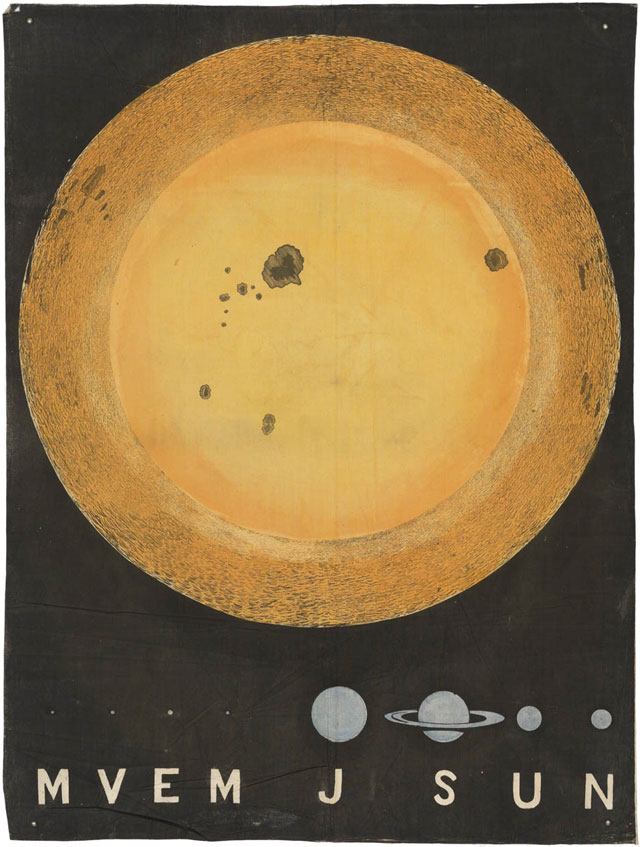
I love this poster:
(via @ptak)
This is Cedro di Versailles, a sculpture by Giuseppe Penone, carved out of a five-ton cedar log from Versailles.

To create the piece, Penone removed the outer rings of the tree to reveal the younger tree within. (via ★spavis)
Actor & Scotsman Brian Cox pronounces the names of different kinds of Scotch, including Bruichladdich, Laphroaig, An Cnoc, Auchentoshan, and Lagavulin.
Of course, this is how you really pronounce Laphroaig, courtesy of Pronunciation Manual.
(via @benhammersley)
Kermit Oliver is a postal employee who lives in Waco, Texas. He is also the designer of a very popular series of Hermès scarves:
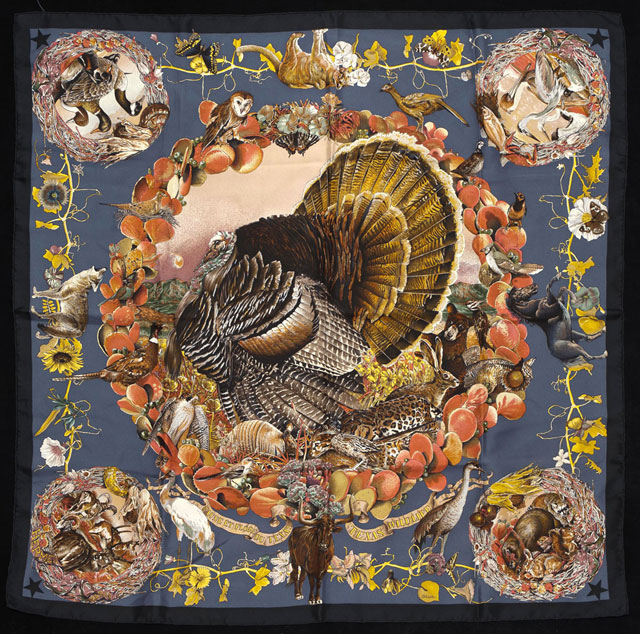
How that happened is an interesting story.
The sixteen scarves that Kermit has designed for Hermès represent three decades of work. Kermit takes six months to a year to design each one, depending on the intricacy of the image and the research required. When he finally arrives at a finished composition, he paints it onto a ninety-by-ninety-centimeter square of watercolor paper, the same size as the scarves, and sends it by FedEx to Hermès in Paris. After the design atelier there approves it, it moves on to the production facility in Lyon, where each color in the painting is traced onto ninety-centimeter-square slides and, in turn, each slide is etched onto a silk screen. That is to say, every color requires its own screen, and because Kermit’s work is both so colorful and so intricate, his scarves are some of the most laborious to print. They are also some of the most beloved. T. Boone Pickens’s wife, Madeleine, and Chase Bank executive Elaine Agather are said to be huge collectors. And while there are thousands of scarves designed by Kermit in the world, they are so treasured that few are ever available for purchase at any given time, and the handful that do make it to eBay sell for $800 or $900. An employee of the Hermès store in Houston told me that when a new design of Kermit’s is announced, it usually sells out before it even hits the floor.
(via @youngna)
Facebook recently went over a billion users served. In an interview with Businessweek, Mark Zuckerberg mentioned a conversation he had with Facebook board member Marc Andreessen, where Andreessen mentioned the likely only other companies with a billion users are Coca Cola and McDonald’s. What does it feel like to have a billion users?
It feels like an honor. We get the honor of building things that a billion people use. I mean, there’s no core need. It isn’t a core human need to use Facebook. It’s a core human need to stay connected with the people you care about. The need to open up and connect is such a deep part of what makes us human. Being in a position where we are the company—or one of the companies—that can play a role in delivering that service is just this … it’s an honor.
The interviewers also asked about how Facebook gets its next billion users and, while Zuckerberg demurred somewhat, Quartz had a look at the version of FB designed for countries without wide smartphone adoption. It runs on WAP and is called Facebook Zero (just like Coke Zero, OMG). Users of the text-only FB are not charged for the data used, and the article posits FB is making the gateway drug argument to the telecoms:
This is because, for the telecoms networks, free Facebook represents a solution to an ever-present existential threat. Their first subscribers were relatively rich; the ones they are gaining now are ever poorer. So the revenue per user is shrinking. At the same time, the amount of data being pushed through their networks is increasing, and customers are demanding faster connection speeds, pushing up the cost of infrastructure. The networks are looking for ways to get more users, and make more money from each one of them.
“The fact is that Facebook has made a compelling argument to operators, which is ‘You should give Facebook away [to consumers] for free,’” says Eagle. “I don’t know how Facebook is making that case, but if I were Facebook, the argument I’d make is that Facebook is one of the most addictive things on the internet. If you have someone try out Facebook for the first time, it might lead them to want to try the rest of the web, and a lot of these other services they can charge for.”
This doesn’t necessarily jive with something Zuckerberg said in the Businessweek interview, and has said numerous times in the past. Facebook doesn’t want to be the gateway drug to the internet, it wants to be the internet.
The whole vision around News Feed was it should be like a newspaper and shouldn’t just be a list of posts your friends are making. I mean we should be able to really show you interesting trends and things that are happening. There are already trillions of connections between friend requests and all the content that’s being pushed into the system. At some point, that will start to be a better map of how you navigate the Web than the traditional link structure of the Web. I think there’s an opportunity to really build something interesting there.
Primer is one of my favorite films. Director Shane Carruth famously made it for just $7,000 and the film found release in 2004, winning the Grand Jury Prize at Sundance that year. Carruth has been fairly quiet since then but he seems to be working on a new film called A Topiary. From a 2010 article on io9:
The website for now is just a place mark as financing has yet to be completed. I’m cautiously optimistic that this can happen soon and couldn’t be happier with the filmmakers that have committed to the project so far.
But it’s been more than two years since then so I am somewhat less than cautiously optimistic. :( In the meantine, Carruth worked on some effects for the time travel sequences in Looper.
A group of citizens is attempting to change Columbus Day to Exploration Day. Columbus Day has always been a weird holiday, what with CC’s slavery and genocide and all, so this seems like a good idea to me. Maggie Koerth-Baker makes the case over at Boing Boing.
The logic is quite neat. Columbus Day is about one guy and the (actually untrue) claim that he was the first person to discover America. Inherently, that’s pretty Euro-centric, which is a big part of why it sits awkwardly in a pluralistic country. But exploration is inclusive. The ancestors of Native Hawaiians were explorers who crossed the ocean. The ancestors of Native Americans explored their way across the Bering land bridge and then explored two whole continents. If you look at the history of America, you can see a history of exploration done by many different people, from many different backgrounds. Sometimes we’re talking about literal, physical exploration. Other times, the exploring is done in a lab. Or in space. But the point is clear: This country was built on explorers. And it needs explorers for the future.
If you want to help out, sign this petition to Congress or this one to the White House.
Videos of downhill skateboard racing make me nervous, here’s one reason why.
“Oh, deer.” “That skateboarder deerly missed an accident.” “Too bad the skateboarder couldn’t deer out of the way.” “Did you deer about the downhill skateboarder?” “Deer clear of animals on the track.” “Deer we go again!” “No ideer where that came from.” “Nothing to fear, but deer itself.” “Skateboarder should have been in a lower deer.” “Deered up and ready to go.” “Deer force of will.” “Happy new deer.” (via @carveslayer)
Manga Camera is an iPhone app that allows you to convert regular photos to Manga style comics. It’s fairly simple, and provides several different backgrounds, but I don’t think you can convert existing photos. Despite the cat picture rule, below are a few quick examples of Manga Camera in action. Some better examples here.

(via @heyitsgarrett)
While driving a couple weeks ago, I happened to catch a meteor shooting across the sky:
Saw one of the coolest things ever tonight: a meteor burning up in the lower atmosphere. Super bright, exploded at the end like a firework.
It turned out that “one of the coolest things ever” wasn’t hyperbole. You see, earlier that day over the UK, a meteor streaked across the sky for about 50 seconds:
And then the one I saw happened about two-and-a-half hours later. Spurred by this unlikely coincidence, mathematician Esko Lyytinen of the colorfully named Finnish Fireball Working Group of the Ursa Astronomical Association did some calculations and determined that the two events were actually the same meteor.
He believes a large body grazed the upper atmosphere, dipping to an altitude of 33 miles (53 km) over Ireland before escaping back to space. Because it arrived moving at only about 8 miles (13 km) per second, barely above Earth’s escape velocity, it lingered for more than a minute as it crossed the sky. (This explains why some witnesses mistook it for reentering spacecraft debris.)
Lyytinen says the brief atmospheric passage took its toll. As the meteoroid broke apart, its velocity dropped to just 5.7 miles (9.2 km) per second, too slow to make an escape back to space. Instead, it became a temporary satellite of Earth, looping completely around the globe before reentering the atmosphere — this time for good. “It looks now that the fireball witnessed 155 minutes later in U.S. and Canada, may have been one fragment of the British fireball, most probably the biggest one,” Lyytinen explains.

These earth-grazers are not common but they do happen from time to time. But a visible Earth grazing meteor that enters the atmosphere twice? Unprecedented. So cool! (thx, alex)
A 70 year-old Oregon farmer was eaten by his hogs after somehow being overcome by them during feeding time. An initial search of the pig pen resulted in only the farmer’s dentures being found, and coroners were still trying to determine the cause of death, though it seems obvious. (via ★pieratt)
Ebbets Field Flannels sells historic baseball jerseys made from “real 1950s-era wool blend baseball cloth”.

The Clowns were baseball’s answer to the Harlem Globetrotters. Players entertained the crowd with various comedic antics, including “shadowball”, where they would go through a warm-up routine with no baseball. When the team joined the Negro American League, they dropped the “Ethiopian” moniker and played straight baseball.
(via @tcarmody)
Speaking of Koyaanisqatsi, the Criterion Collection is releasing Godfrey Reggio’s Qatsi trilogy on Blu-ray in December. It’s the first time that the Qatsis will be available in HD in the US.
ps. Criterion is also releasing Blu-ray editions of Brazil and Following, which is Christopher Nolan’s first feature-length film.
Newer posts
Older posts





Socials & More