



N***as in Paris at Midnight
This is so perfectly in the kottke.org wheelhouse that I can’t even tell if it’s any good or not: a mashup of Jay-Z and Kanye’s N***as in Paris and Woody Allen’s Midnight in Paris.
(via ★davidfg)

This site is made possible by member support. 💞
Big thanks to Arcustech for hosting the site and offering amazing tech support.
When you buy through links on kottke.org, I may earn an affiliate commission. Thanks for supporting the site!
kottke.org. home of fine hypertext products since 1998.
Beloved by 86.47% of the web.
This is so perfectly in the kottke.org wheelhouse that I can’t even tell if it’s any good or not: a mashup of Jay-Z and Kanye’s N***as in Paris and Woody Allen’s Midnight in Paris.
(via ★davidfg)
Il Ratto di Proserpina (The Rape of Proserpina) is an amazing sculpture by Bernini. It depicts Pluto abducting Proserpina to take her to the underworld. The overall composition is great but the devil (ahem) is in the details. For example, check out how Pluto’s hands grip into the marble flesh:

Wonderful. Bernini completed this piece in 1622 when he was just 23 years old. (via stable transit)
That’s the subtitle of a book released in 2010 called The Last Leaf by Stuart Lutz. In the book are dozens of interviews with “last survivors or final eyewitness of historically important events”, including the last living pitcher to give up a home run to Babe Ruth in 1927, the last man alive to work with Thomas Edison, and the last American WWI soldier.
When we read about famous historical events, we may wonder about the firsthand experiences of the people directly involved. What insights could be gained if we could talk to someone who remembered the Civil War, or the battle to win the vote for women, or Thomas Edison’s struggles to create the first electric light bulb? Amazingly, many of these experiences are still preserved in living memory by the final survivors of important, world-changing events. In this unique oral history book, author and historic document specialist Stuart Lutz records the stories told to him personally by people who witnessed many of history’s most famous events.
See also human wormholes and the Great Span.
Wendy Woloson on pawn shops, which are currently getting the reality TV treatment.
According to the National Pawnbrokers Association, a trade group, there are now more than 30 million pawnshop customers per year. The value of the average loan in 2009 was $100, up 20 percent from the previous year. About 80 percent of pawners pay off their loans and redeem their collateral, though redemptions are on the decline.
(via ★whitneymcn)
Writing for Grantland, economists Tyler Cowen and Kevin Grier imagine how the NFL might end due to the increasing visibility of head injuries.
This slow death march could easily take 10 to 15 years. Imagine the timeline. A couple more college players — or worse, high schoolers — commit suicide with autopsies showing CTE. A jury makes a huge award of $20 million to a family. A class-action suit shapes up with real legs, the NFL keeps changing its rules, but it turns out that less than concussion levels of constant head contact still produce CTE. Technological solutions (new helmets, pads) are tried and they fail to solve the problem. Soon high schools decide it isn’t worth it. The Ivy League quits football, then California shuts down its participation, busting up the Pac-12. Then the Big Ten calls it quits, followed by the East Coast schools. Now it’s mainly a regional sport in the southeast and Texas/Oklahoma. The socioeconomic picture of a football player becomes more homogeneous: poor, weak home life, poorly educated. Ford and Chevy pull their advertising, as does IBM and eventually the beer companies.
Is this how soccer finally conquers America? Not that soccer doesn’t have its own concussion-related problems.
Update: Claire McNear for the Ringer: It’s Getting Harder and Harder to Deny That Football Is Doomed.
They keep telling us they’re going to find a safe way to do it — a way to play football that doesn’t result in Tre Mason’s mom telling the police that her 23-year-old son just isn’t acting right, that her boy, who couldn’t bring himself to turn up at Rams training camp this summer, now has the mind-set of a 10-year-old. They keep telling us they’re going to find a way that doesn’t end with Bruce Miller, all 248 pounds of him, wandering lost and angry and confused, looking very much like someone exhibiting the symptoms of long-term brain damage, and then attempting to enter a family’s hotel room and allegedly beating a 70-year-old man.
Peter Sellers did four different spoken word versions of The Beatles’ She Loves You: as Dr. Strangelove, with a Cockney accent, with an Irish accent, and with an upper crust English accent (my fave):
Yeah, Sellers is pretty good with accents. (via ★bump)
Charcoal remains found near six cave paintings in Spain have been carbon dated to between 43,500 and 42,300 years old. The paint has yet to be tested, but the drawings could be from the same period.
The next step is to date the paint pigments. If they are confirmed as being of similar age, this raises the real possibility that the paintings were the handiwork of Neanderthals — an “academic bombshell”, says Sanchidrian, because all other cave paintings are thought to have been produced by modern humans.
Neanderthals are in the frame for the paintings since they are thought to have remained in the south and west of the Iberian peninsula until approximately 37,000 years ago — 5000 years after they had been replaced or assimilated by modern humans elsewhere in their European heartland.
A list of all the winners of the 2012 World Press Photo Photo Contest. I’m not particularly fond of the overall winner but there’s lots of great photography here.
Turn up the sound for this one, a short video shot in Odessa, Ukraine of ice creaking and squeaking really really loudly.
It sounds like a pod of dolphins trying to mate with Skrillex. (via ★acoleman)
Trent Arsenault is a computer security engineer, a 35-year-old virgin, and also the father of fifteen children (and counting). Arsenault non-anonymously donates his sperm for free to couples who need it to have children.
After a woman from his hometown posted repeatedly to say she couldn’t find a donor, Trent knew she was the one. “I thought, I’m probably not going to hurt anyone. The worst that can happen is someone will waste their time with me.” He met the woman, a 37-year-old lesbian schoolteacher, and her partner, in December 2006 at a nearby Barnes & Noble, where the couple’s 3-year-old adopted daughter played while they questioned Trent for two hours. They liked that he’d been raised Christian and worked in technology. The recipient provided a donor contract, drafted by a lesbian-run law firm, negating both his paternal rights and responsibilities. The couple gave him a box of Ziploc food containers from Wal-Mart and scheduled a first appointment. On that day, they texted Trent when they were twenty minutes from his house, and he set to work on the “recovery,” as it’s known. When they rang his bell, he handed over a Ziploc. Two weeks later, they sent Trent another text, with good news. After a year of fruitless trips to a sperm bank, the recipient had gotten pregnant on Trent’s first try.
(thx, patrick)
You may remember Martin Klimas from his photos of shattering figurines (which I love).

His latest project involves arranging paint just above massive speakers, turning the sound up, and photographing the results. This is Steve Reich’s “Music for 18 Musicians”:

I wonder what dubstep looks like? (via @pomeranian99)
For the Anna to your Bates, the Matthew Crawley to your Lady Mary, or the cutting comeback to your Dowager Countess, a selection of Downton Abbey-themed Valentine’s Day cards.

The Composites blog takes descriptions of literary characters and runs them through police composite sketch software to produce composite sketches. This is Humbert Humbert from Nabokov’s Lolita:

Gloomy good looks…Clean-cut jaw, muscular hand, deep sonorous voice…broad shoulder…I was, and still am, despite mes malheurs, an exceptionally handsome male; slow-moving, tall, with soft dark hair and a gloomy but all the more seductive cast of demeanor.
And here’s Emma Bovary from Flaubert’s Madame Bovary:

Her eyelids seemed chiseled expressly for her long amorous looks in which the pupil disappeared, while a strong inspiration expanded her delicate nostrils and raised the fleshy corner of her lips, shaded in the light by a little black down.
This is one of those “why didn’t I think of this?” projects…well done. (via ★timcarmody)
The long recession in Japan has led to a curious result: the Japanese are no longer just importing American and European goods and services…they’re perfecting their own take on everything from cocktails and cusine to fashion and hotels.
Imagine going into an espresso bar, as I did in Tokyo, ordering a single shot, and being told that it’s not on offer. The counter at No. 8 Bear Pond may feature the shiniest, spiffiest, newest La Marzocco, as well as a Rube Goldberg-esque water-filtration system, but the menu, which lists lattes and Americanos, makes no mention of espresso or cappuccino.
“My boss won’t let me make espressos,” says the barista. “I need a year more, maybe two, before he’s ready to let customers drink my shots undiluted by milk. And I’ll need another whole year of practice after that if I want to be able to froth milk for cappuccinos.”
Only after 18 years as a barista in New York did his boss, the cafe’s owner, feel qualified to return home to show off his coffee-making skills. Now, at Bear Pond’s main branch, he stops making espressos at an early hour each day, claiming that the spike on the power grid after that time precludes drawing the voltage required for optimal pressure.
The Scale of the Universe 2 is an interactive Powers of Ten that takes you from the Planck length all the way up to the size of the observable Universe. That’s more than 60 orders of magnitude! Also interesting that the smallest things (Planck length, strings, branes) are millions of times smaller compared to human scale than the observable Universe is larger. Plenty of room at the bottom indeed.
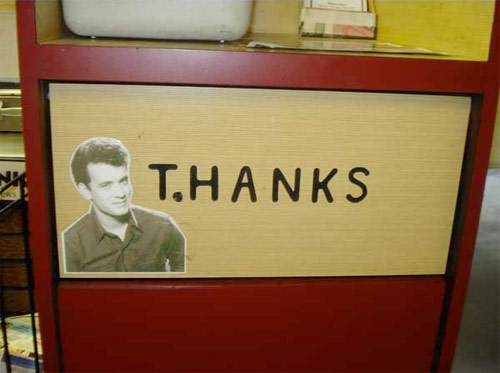
The Awl has an interview with a street artist named Hanksy, who takes images from Banksy and incorporates Tom Hanks into the mix. WIIIILLLSONNNN!!

I’ve come across comments or stories written about Hanksy saying I’m directly ripping off Banksy’s style. Like, “Where does this guy get off, stealing Banksy’s work?” They are completely missing the point. It’s a satire. My goal was never to make a profit. It came about and there was a genuine excitement around the people at the gallery and the community in general.
I’m pretty sure the interviewer, EA Hanks, is Tom’s daughter and she got her dad on the record about Hanksy:
Regarding your work, Tom Hanks sends the message, “I don’t know who Hanksy is, but I enjoy his (her?) comments via the semi-chaos of artistic expression.”
But the T.HANKS trash can remains my favorite Tom Hanks street art:
More on iPhone address book privacy orig. from Feb 08, 2012
One athlete plays for your soul orig. from Feb 07, 2012
* Q: Wha? A: These previously published entries have been updated with new information in the last 24 hours. You can find past updates here.
Yesterday, developer Arun Thampi noticed that the Path iPhone app uploads a user’s address book to their server without asking the user first. And by address book, I mean all the phone numbers and addresses and email addresses of everyone in your phone’s address book just gets sent off to Path. And not only that, Path stored that information on its server. To their credit, Path apologized and deleted the data from their server.
But this is a larger problem than just Path. In a post from earlier today, Dustin Curtis reveals the dirty little secret of iPhone developers everywhere.
It’s not really a secret, per se, but there’s a quiet understanding among many iOS app developers that it is acceptable to send a user’s entire address book, without their permission, to remote servers and then store it for future reference. It’s common practice, and many companies likely have your address book stored in their database. Obviously, there are lots of awesome things apps can do with this data to vastly improve user experience. But it is also a breach of trust and an invasion of privacy.
I did a quick survey of 15 developers of popular iOS apps, and 13 of them told me they have a contacts database with millons of records. One company’s database has Mark Zuckerberg’s cell phone number, Larry Ellison’s home phone number and Bill Gates’ cell phone number. This data is not meant to be public, and people have an expectation of privacy with respect to their contacts.
13 out of 15! Zuckerberg’s cell phone number! Maybe I’m being old-fashioned here, but this seems unequivocally wrong. Any app, from Angry Birds to Fart App 3000, can just grab the information in your address book without asking? Hell. No. And Curtis is right in calling Apple out about this…apps should not have access to address book information without explicitly asking. But now that the horse is out of the barn, this “quiet understanding” needs to be met with some noisy investigation. What happened to Path needs to happen to all the other apps that are storing our data. There’s an opportunity here for some enterprising data journalist to follow Thampi’s lead: investigate what other apps are grabbing address book data and then ask the responsible developers the same questions that were put to Path.
Update: I am aware of this very confusing display of data from the Wall Street Journal. It indicates that of the ~50 iPhone apps surveyed, only three (Angry Birds, Facebook, and TextPlus 4) transmit address book data to a server. That’s not exactly the widespread problem that Curtis describes (the data sets are likely different)…it would be nice to see the net cast a bit wider.
Update: Oh, and that WSJ survey is two years old. (thx, @marcprecipice)
Cat Valente remarks on the old-fashionedness on display in Star Trek DS9, particularly in regard to what the characters do and don’t do with their free time, infinite bandwidth, extreme connectedness, and lack of scarcity.
Nobody sits around and plays Farmville. Nobody gets embroiled in a flame war concerning the portrayal of Klingons in human vids or just sits and watches vids with their feet up. Nope. The brave men and women of the future read (super old) books, talk to each other face to face, and even in their VR fantasies practice for things they will have to do in real life or, admittedly quite realistically, have space holosex. There is no WoW. There are no video games at all unless they are evil ones from Risa that will suck out your brains.
Because of this, and because of the lack of a social network, it is possible to be alone in the Star Trek world in a way which I would have to deliberately take action to achieve in my world. Even when we are alone, most of us check a number of communication vectors and leave them live—Twitter, email, text messages, Facebook, our blogs, Reddit, news feeds. We are a baby hivemind spinning our training wheels. To be alone as profoundly (to me) as Sisko, Kira, and the rest often are, I would have to make a decision to shut down all of those streams.
The Literally Unbelievable blog is collecting examples from Facebook of people who think stories from The Onion are real.

(via ★swissmiss)
The bulk of the Jan 27th episode of This American Life was about Alabama’s tough new immigration laws.
Last Summer, Alabama passed HB56, the most sweeping immigration bill in the country. It’s an example of a strategy called “attrition through enforcement” or, more colloquially, “self-deportation” — making life so hard on undocumented immigrants that they choose to leave the country. But as reporter Jack Hitt found, the new law has had lots of other unintended consequences.
In 1930, Iowa artist Grant Wood painted American Gothic. The models he used for the painting were his sister Nan Wood Graham and his dentist, Byron McKeeby. Here they are next to the painting:
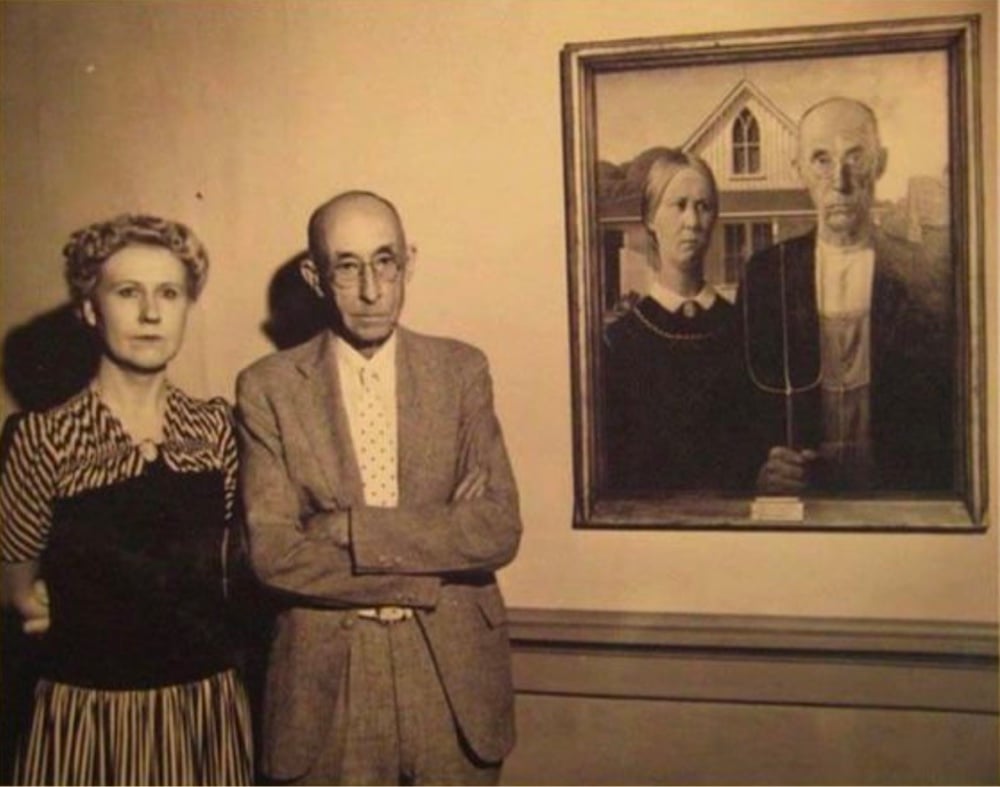
Wood made the painting after spotting a small house in Eldon, Iowa:

One athlete plays for your soul orig. from Feb 07, 2012
* Q: Wha? A: These previously published entries have been updated with new information in the last 24 hours. You can find past updates here.
Speaking of Apple, here’s a profile of Jerry Manock, who worked for Apple from 1977 to 1984 and designed the case for the Apple II and helped design the Macintosh. Manock was Jobs’ first Jony Ive.
The whole basis of the class I’ve taught at UVM for 21 years is … integrated product development, which means concurrently looking at all of these things: the aesthetics, the engineering, the marketing … which is what we were doing at Apple. Not necessarily purposefully, but everybody was just thrown together… I would walk through the software place and look around and see what people were doing … walk through the marketing area. I had my drawings all on the walls, so anybody could come up. There was a red pencil hanging there. I’d say, “If you see something you don’t like, or is a problem — I don’t care whether it’s a janitor or Steve — write the correction, circle it, put your phone there and I’ll call you and we’ll talk about it.”
(thx, mike)
I take this to mean that any iPhone app can download your address book to their servers? What. The. Hell! Apple?
Upon inspecting closer, I noticed that my entire address book (including full names, emails and phone numbers) was being sent as a plist to Path. Now I don’t remember having given permission to Path to access my address book and send its contents to its servers, so I created a completely new “Path” and repeated the experiment and I got the same result - my address book was in Path’s hands.
A fun question from Joe Posnanski: if you had to choose one athlete to play on your behalf for your soul, who would you choose?
So, here’s the game: The Jon Lovitz Devil has consigned you to an eternity of being stuck in traffic in a wheezing Ford Escort without air conditioning, and the only radio station plays Michael Bolton 24 hours a day. But you have one chance to escape your fate. You get to choose one athlete, at his or her peak, and one sport. Ever. And if that athlete wins, you get a whole different eternity, with chocolate-covered strawberries, DirecTV and a deck that overlooks the ocean.
Ah, but there is one catch. You get to pick the athlete and sport. But the Jon Lovitz Devil gets to pick the terms.
In other words, you might choose Tiger Woods circa 2000 and golf. That’s fine. But the JLD can then choose Ben Hogan and say that the match will be played at Merion with a U.S. Open setup.
You might choose Mike Tyson in his overpowering youth. But the JLD can then choose a young and almost unhittable Ali and a big ring.
You might choose John Elway and one final football drive. But the JLD can then say he has to drive 80 yards in three minutes against the 1985 Chicago Bears defense in the Soldier Field wind.
The question Posnanski is essentially asking is: who is the most dominant athlete of all time across any sport? But not quite that question…Babe Ruth was quite the slugger in his day, but he might not fare so well against modern pitching. Same with Wilt, Jim Thorpe, Babe Didrikson, or even Gretzky. The game played is a factor as well. Aside from variants such as speed chess and Chess960, chess is chess and the board is the board…home field, wind, and teammates aren’t really a factor. (Is chess a sport though? If so, I might take Kasparov against anyone.)
But the answer is probably someone not from one of the major sports and certainly not from a team sport. The comments of the article mention wrestler Aleksandr Karelin, wheelchair tennis player Esther Vergeer, and Secretariat. And I know that there are athletes in other sports who are equally as dominant. Even so, I might go with 2009 World Championships Usain Bolt in the 100 meter dash. He’s the fastest ever by a wide margin, he’s current, and it’s an individual sport. Of course, under the current one-and-done disqualification rules, he might be in trouble. Or if you could choose Jordan specifically playing 1-on-1…he would beat anyone — Wade, Kobe, LeBron — on any crappy hoop or shitty playing surface anywhere. (via ★djacobs)
Update: I knew I’d covered some of this same territory before but just couldn’t find it. From back in August:
Speaking of sports, Grantland, and Federer, Bill Simmons said of Lionel Messi earlier this year that “he’s better at soccer than anyone else is at anything”. That’s a pretty short list but got me wondering, if you expanded the criteria slightly, who else might join Messi on the “better at their sport than almost anyone else is at anything at some point in the past 5-6 years”. Off the top of my head, possible candidates include Roger Federer, Usain Bolt, Michael Phelps, Lindsey Vonn, Tiger Woods, Marta, Shaun White, Jimmie Johnson, and Annika Sörenstam. I don’t know much about hockey, but maybe Alex Ovechkin? No basketball, baseball, or football players on that list; Michael Jordan and Barry Bonds are the most recent candidates in basketball and baseball (please, don’t give me any of that LeBron crap) and I can’t think of any football player over the past 20 years who might fit the bill. Barry Sanders maybe? His team never won a lot of games and didn’t win championships, but man he was a genius runner.
I received several suggestions from readers about additions to that list, among them were surfer Kelly Slater, rally driver Sébastien Loeb, motorcycle racer Valentino Rossi, and cricketer Don Bradman.
At the end of this month Jeff Atwood is leaving Stack Exchange, a company he cofounded with Joel Spolsky. In a post on his blog, he explains why:
Startup life is hard on families. We just welcomed two new members into our family, and running as fast as you can isn’t sustainible for parents of multiple small children. The death of Steve Jobs, and his subsequent posthumous biography, highlighted the risks for a lot of folks. […] Stack Overflow and Stack Exchange have been wildly successful, but I finally realized that success at the cost of my children is not success. It is failure.
In his post, Jeff points to a similar post by another entrepreneur, Brad Wardell.
In the last several years, the company has been successful enough to generate a substantial amount of capital. And with it, I have been fortunate to bring in people with great talent. And so I started thinking of all the amazing things we would do. I would put in crazy hours to do it, of course, but we would go and do amazing things.
Then Steve Jobs died.
And suddenly I realized something. What is the objective here? My oldest child just turned 15. My other two are no longer little either. And I have been missing out on them.
And another from Eric Karjaluoto:
For a long time, work was my only thing. I worked evenings, weekends, and Christmas. At those rare times when I wasn’t at work in body, I was there in spirit, unable to speak or think of much else. I wanted so badly to climb the mountain that I stopped asking why I was doing it.
I admire [Jobs] for the mountains he climbed. At the same time, I wonder if he missed the whole point, becoming the John Henry of our time. He won the race, but at what cost?
Me? I may turn out to be a failure in business, but I refuse to fail my kids.
This mirrors my main reaction to Jobs’ death and Isaacson’s book as well. I wasn’t working 80 hours a week or leading a growing company or even spending very little time with my kids but I was pushing pretty hard on Stellar, pushing it towards a potential future of insane working hours, intense stress, and a whole lot less time with my family (and selfishly, less time for myself). Since Jobs died, I’ve been pushing a little less hard in that direction.
Four is hardly a trend but it is interesting that the death and biography of the greatest businessman of our generation — someone who was responsible for so many world-changing products and ideas, who shaped our world through sheer force of will & imagination, etc. etc. — is inspiring some people to turn away from the lifestyle & choices that made Jobs so successful & inspiring in the public sphere and to attempt the path that Jobs did not.
What jobs did people do in medieval Europe? Here’s a list, broken down by category. Criminals had jobs too:
silk-snatcher - one who steals bonnets
stewsman - probably a brothel keeper - “since the words stew and stewholder both mean a bawd, I’m guessing that a stewsman would be a brothel-keeper as well. Whether bawdry counts as a criminal activity varies at different times and places.”
thimblerigger - a professional sharper who runs a thimblerig (a game in which a pea is ostensibly hidden under a thimble and players guess which thimble it is under)
(via @zachklein)
From MUBI notebook, a selection of great movies posters from 2011, including Chris Ware’s lovely one for Uncle Boonmee.

(via dooce)
Adapted from her upcoming book Bringing Up Bébé: One American Mother Discovers the Wisdom of French Parenting, Pamela Druckerman shares why French parents are superior in this WSJ article.
The French, I found, seem to have a whole different framework for raising kids. When I asked French parents how they disciplined their children, it took them a few beats just to understand what I meant. “Ah, you mean how do we educate them?” they asked. “Discipline,” I soon realized, is a narrow, seldom-used notion that deals with punishment. Whereas “educating” (which has nothing to do with school) is something they imagined themselves to be doing all the time.
One of the keys to this education is the simple act of learning how to wait. It is why the French babies I meet mostly sleep through the night from two or three months old. Their parents don’t pick them up the second they start crying, allowing the babies to learn how to fall back asleep. It is also why French toddlers will sit happily at a restaurant. Rather than snacking all day like American children, they mostly have to wait until mealtime to eat. (French kids consistently have three meals a day and one snack around 4 p.m.)
We have a French pediatrician who advised us to do almost exactly what is in this article and we’ve had pretty good success with it. It’s not all roses (kids are kids after all) and a lot of work, especially for the first couple of years, because you have to be consistent and steady and firm (but also flexible) and I know I haven’t always done a great job, but the dividends have been totally worth it so far.
Wyatt Hodgson took Koyaanisqatsi and sped it up 1552% so you can watch the whole movie in about five minutes.
Reggio uses time lapse in the film to great effect — you notice different things at different playback speeds — and Hodgson’s clever use of the same technique reveals the overall structure of the film much more than watching it in realtime…but the emotion of the film is completely removed. (via the candler blog)
First of all, it’s not Puppybowl. It’s two words: Puppy Bowl. And it starts at 3pm ET. More information here.
p.s. The Super Bowl starts at 6:30pm ET, more or less.
I love the cover of the most recent Bloomberg Businessweek:

Here’s a peek at how the design process works at the magazine.
I love these cauliflower explosions done by Brock Davis…you can find them in his Food Stuff set on Flickr. Here’s the Challenger explosion in cauliflower:

(via @josephholmes)
Did you know that the Charlotte’s Web audiobook is read by E.B. White himself? He died in 1985 and must have recorded it before then. My wife and son listened to it on a long car trip this weekend and was declared “soooo good”.
The NY Times has a short documentary film by Errol Morris on El Wingador, a five-time winner of the Wing Bowl. My favorite line from the film, uttered by an off-camera Morris:
Wait a second. That’s cannibalism!
Though his several wins came early on in the competition’s history, El Wingador is still competing in the Wing Bowl. In the 2012 competition, held today, El Wingador came in third while Takeru Kobayashi completely demolished the competition in his first attempt, eating 337 wings in the process.
What happened to the former slave that wrote his old master? orig. from Feb 02, 2012
The view from an old time burger joint orig. from Feb 02, 2012
* Q: Wha? A: These previously published entries have been updated with new information in the last 24 hours. You can find past updates here.
From the This Must Be the Place series, a lovely short film about the Prime Burger Restaurant in midtown Manhattan. The restaurant opened in 1938 and one of the servers, Artie, has been there since 1952.
For many of the guys that work here, the restaurant is like a second home — some of them have been slinging burgers, making shakes, and waiting on customers at this location for decades. Opened in 1938, the place hasn’t been altered since the early ’60s, and it looks all the better for it. Here the waiters and workers of Prime Burger discuss their views on their chosen profession, and the unique nature of the place itself.
(via @daveg)
Update: Over at Serious Eats, Ed Levine gives some advice on how to order properly at Prime Burger.
So why the need to order right? Because to keep up with the fast food chains, the DiMicelis started par-broiling their burgers. Par-broiling produces a less juicy burger. So when you order at Prime Burger specify you want your burger ($5.25 for a hamburger, $5.95 for a cheeseburger) made from scratch, and that you’re willing to wait the extra few minutes.
You know that letter from former slave Jourdon Anderson to his old master that’s been going around? First of all, it’s good and you should read it.
As to my freedom, which you say I can have, there is nothing to be gained on that score, as I got my free papers in 1864 from the Provost-Marshal-General of the Department of Nashville. Mandy says she would be afraid to go back without some proof that you were disposed to treat us justly and kindly; and we have concluded to test your sincerity by asking you to send us our wages for the time we served you.
David Galbraith poked around a bit and found a record of Anderson still living in Ohio at the time of the 1900 census as “Jordan Anderson”. Here’s the relevant bit of the census form:

At the time, Anderson and his wife Mandy were in their 70s and had been married for 52 years. Mandy had borne 11 children, six of whom were still living (Anderson’s letter, written in 1865, references five children, two of whom were “brought to shame by the violence and wickedness of their young masters”…not sure if they had died or not). The three children living with them in 1900 were all in their 20s, born several years after the letter was written.
There’s also a record of Anderson from the 1880 census, this time as “Jordon Anderson”. The birth year listed is different (1830 vs 1825) but the family relations are the same. This census lists two older children, William and Andrew, the eldest of whom was born right around the time of Jordan and Mandy’s emancipation. Anderson’s occupation is listed as “coachman”.
I also found a record in the April 19, 1905 issue of the Dayton Daily Journal of Anderson’s death. He was 79 years old.
Update: Ok, a bit more digging, with the help of an ancestry.com trial membership.
The 1870 census shows Anderson living in Ohio with Mandy, four children (Jane, Felix, William, and Andrew).

Jane is mentioned in the letter…is Felix the “Grundy” mentioned? There was a Felix Grundy who served as a US Senator from Anderson’s home state of Tennessee in the 1830s who has a Tennessee county named after him…perhaps that’s where the nickname came from? Also listed in the household is Percella Mcgregor, Mandy’s mother.
And ho, what’s this? From the 1920 Census, here’s a record of who was living at 60 Burns Ave in Montgomery County, Ohio, the former address of Jordan Anderson:

Three families lived together at that address: Valentine and Abagail Anderson, who were both listed on the 1900 census form; Charles Johnson and his wife Eva, the same Eva listed as Jordan’s daughter on the 1900 census form; and Samuel Stewart and his wife Scharlet, who is the same age as the Lottie listed on the 1900 census form. Everyone in the household is listed as being able to read and write, just as Jordan wished for them in his letter:
The great desire of my life now is to give my children an education, and have them form virtuous habits.
Amazing. Ancestry.com provides a lot more information about the family…here’s a peek at the family tree:

Looks like Lottie lived until 1944, Eva died in 1937, and Jane in 1939. Oh and it looks like Felix is the Grundy mentioned in the letter. I’m sure there’s lots more. For now, I’m going to try to alert the “owner” of the Jordan Anderson family tree to the existence of the letter…we’ll see if they are related!
Update: The letter has already been added to the ancestry.com database by the tree’s owner.
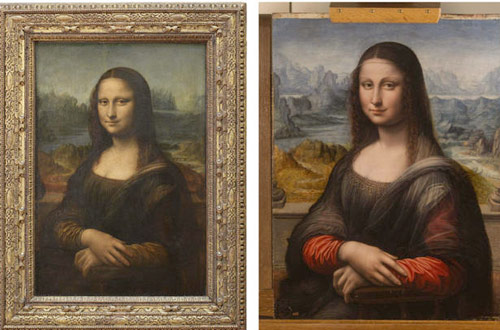
Restorers at the Prado Museum in Madrid, working on what they thought was a 16th or 17th century replica of the Mona Lisa, have discovered that the painting was actually done by a student of Leonardo’s at the same time as the original.
Museum experts are in the process of stripping away a cover of black over-paint which, when fully removed, will reveal the youthfulness of the subject they say. The final area of over-paint will come off in the next few days.
The original “Mona Lisa” hangs in the Louvre but the sitter looks older than her years as the varnish is cracked. The painting is so fragile that restoration or cleaning is deemed too risky. The Prado version, however, will show the sitter as she was: a young woman in her early 20s.
Just like they did last year, The Rumpus shares some of the stories of the players participating in the Super Bowl in a way that isn’t as syrupy as Bob Costas.
For instance, there’s Mark Herzlich, a former top NFL prospect who was diagnosed with bone cancer while in college, took a year off to beat the disease, returned to the game, and then went undrafted by every NFL team. As a last-ditch, he auditioned for training camp. By November, about two years after undergoing chemotherapy, Mark was a starting linebacker for the Giants.
There’s five-foot-seven Danny Woodhead of the Patriots, a player considered too small even for Division I college football, who went to the only place that wanted him, a little school in Nebraska called Chadron State, where he worked his ass off, and by the time he graduated, he was college football’s all-time leading rusher. He’s still so anonymous that he worked at a sporting goods store on a day off last year and pretty much no one recognized him. Now he’s a running back for a team in the goddamned Super Bowl.
Washing machine self-destructs orig. from Aug 31, 2011
* Q: Wha? A: These previously published entries have been updated with new information in the last 24 hours. You can find past updates here.
This is a 1930 short film from avant-garde filmmaker Ralph Steiner that shows dozens of gears and other machinery at work.
(thx, matthew)
You’ve seen one washing machine self-destruction video, you’ve seen them all, right? Maybe not. Back in August, I posted this short video of a washer destroying itself (with some help from a brick) but this longer video is mesmerizing and almost poignant at times.
At times, it seems as though the washer is attempting to turn into the Picasso version of itself, a Cubist sculpture manifesting itself over time. (via @aaroncoleman0)
Ice Cube’s “Good Day” located orig. from Jan 30, 2012
* Q: Wha? A: These previously published entries have been updated with new information in the last 24 hours. You can find past updates here.
Socials & More