



Arrested Development Documentary
Here’s the trailer for the Arrested Development Documentary.
The overall goal of the documentary is to provide awareness and education of this brilliant, witty and original comedy.

This site is made possible by member support. 💞
Big thanks to Arcustech for hosting the site and offering amazing tech support.
When you buy through links on kottke.org, I may earn an affiliate commission. Thanks for supporting the site!
kottke.org. home of fine hypertext products since 1998.
Beloved by 86.47% of the web.
Here’s the trailer for the Arrested Development Documentary.
The overall goal of the documentary is to provide awareness and education of this brilliant, witty and original comedy.
Michael O’Hare shares his experience of being wrongly accused of being The Zodiac Killer by conspiracy theory nut Gareth Penn.
The surreal quality of Penn’s dialogue with the facts is captured by the matter of the phone number. At one time in Cambridge I had a phone number with the last four digits 6266. From this Penn, using some sort of gematria, extracted enormous meaning. But what does a number assigned by the phone company say about the person it was given to? Many of the other details Penn has used to launch his voyages of conjecture are equally beyond my control, like my birthday and my mother’s name. There was also some fuss made about the fact that I was on the freshman rifle team in college. (At least two of the Zodiac murders were committed with a handgun at point-blank range, so rifle marksmanship doesn’t seem germane, but go figure.)
From the tail end of an article on a global guest-worker program, a quote by economist Lant Pritchett on how people perceive game-changing ideas over time.
Pritchett says he has a model of how game-changing ideas are received over time, and it works something like this: “Crazy. Crazy. Crazy. Obvious.”
And then the piece just leaves us hanging on that gem. It appears that Pritchett hasn’t written too much about that particular notion, but I did find a slide in a presentation he did that puts it a slightly different way:
silly, controversial, progressive, then obvious
Sounds about right. (via sam arbesman)
Update: Several people sent in Mahatma Gandhi’s related quote:
First they ignore you, then they ridicule you, then they fight you, then you win.
Update: The Gandhi quote is disputed. A similar quote appears in the transcript of a 1914 US trade union address:
And, my friends, in this story you have a history of this entire movement. First they ignore you. Then they ridicule you. And then they attack you and want to burn you. And then they build monuments to you. And that, is what is going to happen to the Amalgamated Clothing Workers of America.
(thx, robin)
Waiting Topless (NSFW) is a audio slideshow about a pair of waitresses who worked at the Grand View Topless Coffee Shop in the small town of Vassalboro, Maine.
“Yes, I am a topless waitress, but I’m just a regular normal person in society,” Cunningham says. “I honestly don’t think in this economy right that there is a job out there that would pay roughly the same.”
The coffee shop recently burnt to the ground in a suspected arson.
The Wall Street Journal’s Photo Journal blog, the launch of which was inspired by The Big Picture, has posted exactly *zero* photos of what’s going on in Iran right now in their “Pictures of the Day” feature. That strikes me as odd. In contrast, The Big Picture has posted three big entries dedicated to the elections.
Errol Morris follows up on his recent series about Dutch forger Han van Meegeren by addressing some of the comments he received. Here’s Morris on the interaction of historical research and modern content management techniques.
The first version of the Time article that I saw was the “electronic” version from the Web. It is particularly strange, if only because the text (from 1947) is surrounded by modern information, including contemporary advertisements for Liberty Mutual, teeth whitening preparations, wrinkle-cream, and most e-mailed articles. Emmy Göring and Henriette von Schirach complaints are directly adjacent to “Will Twitter Change the Way We Live.”
I also enjoyed the discussion of “Hitler-soup” at the end.
This video of a toy maglev train is a great illustration of how the technology works.
Watch the whole thing…there’s a nice bit at the end with tracks mounted vertically on buildings. (via cyn-c)
Popular Science published an article five years ago on the possibility of a trans-Atlantic maglev train that would travel in an airless underwater tunnel at 4,000 MPH and make the trip from New York to London in an hour.
A 4,000-mph magnetically levitated train could allow you to have lunch in Manhattan and still get to London in time for the theater, despite the 5-hour time difference. It’s not impossible: Norway has studied neutrally buoyant tunnels (concluding that they’re feasible, though expensive), and Shanghai is running maglev trains to its airport. But supersonic speeds require another critical step: eliminating the air — and therefore air friction — from the train’s path. A vacuum would also save the tunnel from the destructive effects of a sonic boom, which, unchecked, could potentially rip the tunnel apart.
I was kinda waiting for FiveThirtyEight to weigh in on this: using Benford’s Law to check for fraud in the Iranian election results (here as well).
Benford’s law is sometimes useful in these cases, because human beings intuitively tend to distribute the first digits about evenly when they’re making up “random” strings of numbers, when in fact many real-world distributions will be skewed toward the smaller digits.
Both 538 pieces are skeptical that Benford’s Law is applicable in this case. (thx, nick)
Update: Voting fraud expert Walter Mebane has produced a paper on the Iranian election that uses Benford’s Law to check the results. He’s updated the paper several times since it was first published and now writes that “the results give moderately strong support for a diagnosis that the 2009 election was affected by significant fraud”. (thx,scott)
Update: Done just after the election, this analysis shows that the returns released by Iran’s Interior Ministry during the course of the day of the election shows an unnaturally high steadiness of voting percentages. (thx, cliff)
Update: Regarding the previous link, Nate Silver doesn’t think much of that analysis. (thx, cliff)
A very interesting infographic of the ideological history of the Supreme Court from 1937 to the present. The color coding on the map is weirdly inaccurate but you can still be general trends pretty well…like how many of the justices changed greatly during their terms. William O. Douglas became slightly more moderate mid-term and then got really liberal while Rehnquist went from very conservative to more moderate as his term went on, especially after he became Chief Justice.
OT: I knew there was a Burger on the bench but was unaware of Justice Frankfurter (1938-1961).
Update: Alex Lundry designed the visualization and got in touch to explain the color coding.
The colors are chosen based upon the Min, Max, and Median of the area we are comparing. So, in the first view, the “overall” view, the darkest Red is anchored to the maximum ideology number across all justices and all terms, the darkest Blue is anchored to the minimum score, and the purest white is anchored to the actual median number (The Location of the Median Justice is NOT necessarily the actual median, as it is calculated via a Bayesian statistical estimate).
The second “compare” option, “within each seat, row” calculates separate color anchors for each row.
Similarly, the third compare option, “within each year, column” calculates separate color anchors for each column.
The Location of Median Justice and Court Average are not included in these calculations and their color values are set to what they would be in the overall comparison.
A 46-year-old Miami man duped Fidel Castro’s son Antonio into an online flirtation with “Claudia Valencia”, a Colombian hottie in her 20s.
“Claudia” and Castro exchanged e-mails, Internet chats, and at one point even used streaming live Web video to communicate. During “Claudia” and Castro’s Web romance, the dictator’s son never shared details about his father, Fidel, or any Cuban intelligence secrets, but Dominguez said he was able to get glimpses of the life of luxuries and freedoms the Cuban leaders enjoy while the people of the island nation struggle.
(via @juliandibbell)
Two recent projects that incorporate the experiences of map users into the subsequent versions of the maps:
1. For the Salone di Mobile event in Milan, The British Council commissioned a map of the event that would be augmented each day with information flowing in from Flickr, Twitter, blogs, and people’s physical scribbles on the maps.
One thing that’s very interesting to us that is using this rapidly-produced thing then becomes a ‘social object’: creating conversations, collecting scribbles, instigating adventures - which then get collected and redistributed.
More information about the project is available on The Incidental site.
2. Walking Maps, produced by Mike Migurski at Stamen, encourages people print out maps from OpenStreetMap, annotate them with missing information, and scan them back in.
In some places, participants are creating the first freely-available maps by GPS survey. In other places, such as the United States, basic roads exist, but lack local detail: locations of traffic signals, ATMs, caf’es, schools, parks, and shops. What such partially-mapped places need is not more GPS traces, but additional knowledge about what exists on and around the street. Walking Papers is made to help you easily create printed maps, mark them with things you know, and then share that knowledge with OpenStreetMap.
Taking a cue from auto insurance, Safeway has devised a healthcare insurance plan that emphasizes personal responsibility.
Safeway’s plan capitalizes on two key insights gained in 2005. The first is that 70% of all health-care costs are the direct result of behavior. The second insight, which is well understood by the providers of health care, is that 74% of all costs are confined to four chronic conditions (cardiovascular disease, cancer, diabetes and obesity). Furthermore, 80% of cardiovascular disease and diabetes is preventable, 60% of cancers are preventable, and more than 90% of obesity is preventable.
The result is that Safeway’s healthcare costs have held steady over the past four years while the costs at other American companies have increased almost 40%.
Infographics News collects some lovely infographics from a new Portuguese newspaper called i.
The style of infographics follow the general design created by Javier Errea: no fireworks, modern, compact, with cromatic impact but smart. And the Innovation spirit: “newspapers must be daily magazines”, as Juan Antonio Giner says.
(via max gadney)
Geeking Out sounds interesting, but I can’t go. Perhaps you’d like to?
This month, we’ll be discussing the interaction between science and religion with speakers including: astrophysicist and Is God a Mathematician? author Mario Livio; psychologist Paul Bloom, the author of Descartes’ Baby; and The GOD Part of the Brain author Matthew Alper, one of the founders of the field of neurotheology. The work of local artists will be on display as well.
Geeking Out will be held Thursday, June 18th, at 7:30 pm (doors open at 7:00 pm) at the JLA Studios art gallery on 63 Pearl St in the DUMBO neighborhood of Brooklyn. Admission is FREE. Drinks will be available. Please spread the word and bring your friends.
Chips made from bismuth telluride could signal a new era in electronics.
Recently-predicted and much-sought, the material allows electrons on its surface to travel with no loss of energy at room temperatures and can be fabricated using existing semiconductor technologies. Such material could provide a leap in microchip speeds, and even become the bedrock of an entirely new kind of computing industry based on spintronics, the next evolution of electronics.
No loss of energy…it’s like magic!
The Architects’ Journal selected their top 10 structures from the Star Wars films.
Not quite a building, but the monumental quality of its form and its polygonal facades lend this Jawa Sandcrawler a building-like presence. These large treaded vehicles have inspired buildings from a Tunisian hotel to Rem Koolhaas’ Casa de Musica in Porto.
(thx, janelle)
The scamps at Nature are updating the ApolloPlus40 Twitter account as the Apollo 11 mission happened 40 years ago. (thx, matt)
Arika Okrent wrote a book on invented languages so University of Chicago Magazine asked her to share her ten favorite made-up words.
lxmsgevjltshevjlpshev: “179 degrees 59 minutes and 59 seconds of west longitude within one second of reaching 180 degrees west” Now that’s a word!
Death to Smoochy
The Boondock Saints
The Karate Kid, Part III
Cool as Ice
Dice Rules
Basic Instinct 2
Gigli
SuperBabies: Baby Geniuses 2
From Justin to Kelly
The Hottie & the Nottie
Glitter
Car 54, Where Are You?
Son of the Mask
Leonard Part 6
Lady in the Water
Norbit
Swept Away
White Chicks
Anacondas: The Hunt for the Blood Orchid
Spice World
Jaws 3-D
Bratz: The Movie
Troll 2
Howard the Duck
Battlefield Earth
The Postman
I Know Who Killed Me
Kazaam
Rambo III
Freddy Got Fingered
Stop! Or My Mom Will Shoot
Striptease
Caddyshack II
The Adventures of Pluto Nash
Barb Wire
Ishtar
Bio-Dome
Jingle All the Way
Catwoman
Disaster Movie
Rocky V
BloodRayne
Deuce Bigalow: European Gigolo
The Love Guru
Crossroads
Book of Shadows: Blair Witch 2
The Flintstones in Viva Rock Vegas
It’s Pat!
Batman & Robin
Speed 2: Cruise Control
Global Street Food is an exhibition the various contraptions people use to make and sell food on the street.
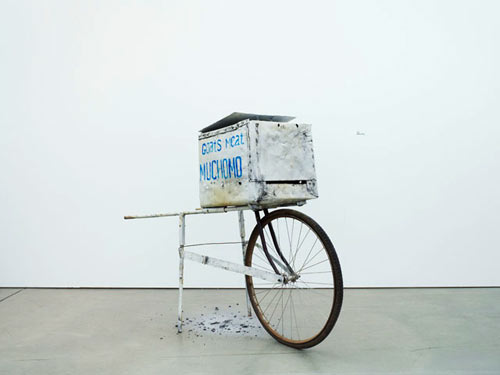
“Global Street Food” is dedicated to the fascination with improvised kitchens in public places. Urban fast food stations navigating the contrast between pragmatic dilettantism and complexity in the smallest of spaces. Mike Meiré will be presenting several objects and street kitchens from different parts of the world in the Buckmneister Fuller Dome. An exhibition depicting the sculptural quality of authentic objects and their cultural identity
(via today and tomorrow)
In an analysis of the global financial system, Duncan Watts says that we should limit the complexity of these sorts of systems because “once everything is connected, problems can spread as easily as solutions”.
Traditionally, banks and other financial institutions have succeeded by managing risk, not avoiding it. But as the world has become increasingly connected, their task has become exponentially more difficult. To see why, it’s helpful to think about power grids again: engineers can reliably assess the risk that any single power line or generator will fail under some given set of conditions; but once a cascade starts, it’s difficult to know what those conditions will be - because they can change suddenly and dramatically depending on what else happens in the system. Correspondingly, in financial systems, risk managers are able to assess their own institutions’ exposure, but only on the assumption that the rest of the world obeys certain conditions. In a crisis it is precisely these conditions that change in unpredictable ways.
No one, for example, anticipated that an investment bank as old and prestigious as Lehman Brothers could collapse as suddenly as it did, so nobody had that contingency built into their risk models. And once it did fail, then just as the failure of a single power line increases the stress on other parts of the system, leading to further “knock on” failures, so too did Lehman’s unlikely collapse render other previously unlikely failures suddenly much more likely.
This is essentially the same point that Nassim Taleb makes in The Black Swan re: Extremistan and Mediocristan.
A couple of weeks ago on Twitter, I asked about freely available financial data.
Anyone know where to get stock data in a standard API format (XML, JSON, etc)? Just looking for hi/lo/close data, not real-time.
I may or may not get around to doing the project I wanted the data for, but in the meantime, here’s a list of the suggested resources that people sent in:
- Google Finance’s CSV output (example)
- Google Finance API for gadgets.
- Yahoo Finance’s CSV output (example)
- There’s a stock quote example in this IBM article on using YQL, JSONP, and jQuery.
- The Stock Quote web service from WebserviceX.net.
- Data from Infochimps: AMEX, NASDAQ, NYSE.
Update: Getting stock information with YQL. (via @jonathantrevor)
The NY Times on the progress being made in explaining how life arose on Earth.
With these four recent advances — Dr. Szostak’s protocells, self-replicating RNA, the natural synthesis of nucleotides, and an explanation for handedness — those who study the origin of life have much to be pleased about, despite the distance yet to go. “At some point some of these threads will start joining together,” Dr. Sutherland said. “I think all of us are far more optimistic now than we were five or 10 years ago.”
When I first saw the headline, I thought “this is amazing…Darren Aronofsky’s directing a movie based on the book by Nassim Taleb and Natalie Portman’s gonna star in it!” The plot of the actual movie is only slightly less implausible:
“Swan” centers on a veteran ballerina (Portman) who finds herself locked in a competitive situation with a rival dancer, with the stakes and twists increasing as the dancers approach a big performance. But it’s unclear whether the rival is a supernatural apparition or if the protagonist is simply having delusions.
Hey, they’re making Blink and Moneyball into movies, why not The Black Swan?
Update: An additional important note about this film:
In this movie, Natalie Portman and Mila Kunis have sex. Yeah. You read that right. And not just nice sweet innocent sex either. We’re talking ecstasy-induced hungry aggressive angry sex.
The Fallen Princesses project imagines Disney characters if their stories didn’t end happily ever after.
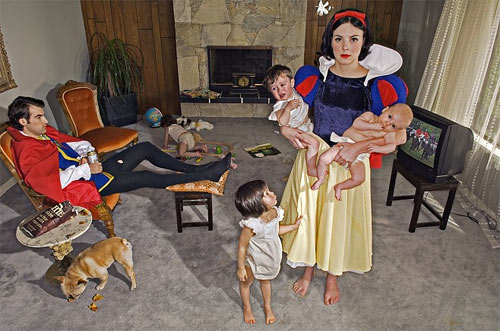
As a young girl, growing up abroad, I was not exposed to Fairy tales. These new discoveries lead to my fascination with the origins of Fairy tales. I explored the original brothers Grimm’s stories and found that they have very dark and sometimes gruesome aspects, many of which were changed by Disney. I began to imagine Disney’s perfect Princesses juxtaposed with real issues that were affecting women around me, such as illness, addiction and self-image issues.
Not so Charming. (via avenues)
On Friday, Atul Gawande gave the commencement address at the University of Chicago Pritzker School of Medicine. The address touched on some of the same themes as his recent piece on the differing costs of healthcare across the US. He began with an anecdote about how observation of well-nourished children in poor Vietnamese villages led to village-wide improvments in curbing malnutrition.
The villagers discovered that there were well-nourished children among them, despite the poverty, and that those children’s mothers were breaking with the locally accepted wisdom in all sorts of ways — feeding their children even when they had diarrhea; giving them several small feedings each day rather than one or two big ones; adding sweet-potato greens to the children’s rice despite its being considered a low-class food. The ideas spread and took hold. The program measured the results and posted them in the villages for all to see. In two years, malnutrition dropped sixty-five to eighty-five per cent in every village the Sternins had been to.
And I don’t know why, but I’ve always thought of surgery as primarily a cerebral pursuit; a great surgeon is so because he’s clever and smart. A short passage from Gawande’s address reveals that perhaps that’s not the case:
In surgery, for instance, I know that I have more I can learn in mastering the operations I do. So what does a surgeon like me do? We look to those who are unusually successful — the positive deviants. We watch them operate and learn their tricks, the moves they make that we can take home.
So surgeons learn surgery in the same way that kids learn Kobe Bryant’s post moves from SportsCenter highlights?
Inc. has a cover story on Paul Graham, whose essays you either love to hate or hate to love.
“Paul gives these kids money, but he also gives them a methodology and a value system,” he says. “I don’t mean this in a negative way, but Y Combinator is more like a cult than a venture capital fund. And Paul is the cult leader.”
The distribution of point differentials at the end of NBA basketball games shows that a tie is more than twice as likely as either team winning by one point. A possible simple explanation from the comments:
1. Teams down by 2 late are most likely to take a 2 point shot, while teams down by 3 will most often take a 3 point shot. The team’s choices make ties a likely outcome.
2. A Tie is a stable equilibrium, while other scores aren’t. If a team leads with the ball, they will be fouled, preventing the game from ending on that score. IF a team has the ball with a tie, they’ll usually be allowed to wait and take the last shot, either winning the game or leaving it as a tie.
Update: This study about golf putting seems to have something in common with the overtime finding.
Even the world’s best pros are so consumed with avoiding bogeys that they make putts for birdie discernibly less often than identical-length putts for par, according to a coming paper by two professors at the University of Pennsylvania’s Wharton School. After analyzing laser-precise data on more than 1.6 million Tour putts, they estimated that this preference for avoiding a negative (bogey) more than gaining an equal positive (birdie) — known in economics as loss aversion — costs the average pro about one stroke per 72-hole tournament, and the top 20 golfers about $1.2 million in prize money a year.
You may remember Robbie Cooper’s projects Alter Ego (photos of gamers and their in-game avatars) and Immersion (kids filmed with an Interrotron while playing video games). Cooper’s new project is like Immersion, except with people watching porn. The video stills can be found in the July issue of Wallpaper but an 18-minute video is available on their web site.
In a film of startling power and unsettling intimacy — produced exclusively for wallpaper.com — video artist and photographer Robbie Cooper shoots back at active porn aficionados lost in ecstatic release and hears how their passion developed. Be aware that this is not easy titillation and some of you may find the footage shocking. But the film does throw up any number of questions about voyeurism and exhibitionism and makes clear the incredible nakedness of the solo sex act.
NSFW because it turns out that watching people watching porn at the office is no easier to explain to your boss/co-workers than actually watching porn at the office.
Oobject interrupts the High Line hug fest with a list of nine reasons why the High Line sucks. He missed James Kunstler’s assertion that the whole thing should have remained a railroad.

Inspired by Carl Fredricksen’s house in Up, which was holding up construction of a massive building complex, deputydog uncovers some more such houses, which are actually called nail houses.
Another nail house is actually a nail church. Citicorp Center was built without corner columns to accommodate St. Peter’s Church, which occupied one corner of the block on which the skyscraper was built. The engineer who built Citicorp Center made a mistake related to the church’s accommodation and famously corrected it after the building was built.
Update: The original link is dead, but In Focus has collected 20+ photos of nail houses in China, where development is happening quickly.
On the Freakonomics blog, Dmitri Leybman tells us about the three main ways that the President’s political party can have an impact on the economy.
This tendency of Republican presidents to preside over growth that occurs so close to re-election has been cited by Bartels as the main reason why Republican presidents have been so successful in achieving two-term presidencies in the post-World War II era. Voters, Bartels believes, are economic myopists, paying attention only to the most recent economic outcomes and not the overall outcomes experienced under a president’s rule.
In 1899, Thomas Edison filmed some very contemporary looking bike tricks.
This seemed fake when I first watched it but here it is at The Library of Congress.
Five discoveries made while dreaming. A Hindu goddess delivered formulas to mathematician Srinivasa Ramanujan while Jack Nicklaus practiced some dreamful attraction.
Wednesday night I had a dream and it was about my golf swing. I was hitting them pretty good in the dream and all at once I realized I wasn’t holding the club the way I’ve actually been holding it lately. […] So when I came to the course yesterday morning I tried it the way I did in my dream and it worked. I shot a 68 yesterday and a 65 today.
In an interview with the New Yorker about basketball and his new book, The Book of Basketball, Bill Simmons offers up his take on how players skipping college impoverishes the NBA.
The lack of college experience also means that you probably have less of a chance to have a conversation with a Finals player about English lit or political science. For instance, if you’re a reporter, maybe you don’t ask for thoughts from modern players on the Gaza Strip or Abdul Nasser, or whether they read Chuck Pahlaniuk’s new book. These guys lead sheltered lives that really aren’t that interesting. Back in the seventies, you could go out to dinner with three of the Knicks — let’s say, Phil Jackson, Bill Bradley, and Walt Frazier — and actually have a fascinating night. Which three guys would you pick on the Magic or Lakers? I guess Fisher would be interesting, and I always heard Odom was surprisingly thoughtful. I can’t come up with a third. So I’d say that the effects are more in the “didn’t really have any experiences outside being a basketball player” sense.
Reason recalls the ten most ridiculous Time cover stories, including the infamous 1995 CYBERPORN story, which was the first time I remember the web collectively and vigorously fact-checking the ass of a mainstream media outlet.
The “principal researcher” for the study that inspired Time’s cover was actually an undergraduate, and experts began picking the study apart the moment the issue hit newsstands. Three weeks after the wee, wide-eyed web surfer cover, Time backpedalled — on page 57 — explaining that real experts say “a more telling statistic is that pornographic files represent less than one-half of 1 percent of all messages posted on the Internet” and that, “it is impossible to count the number of times those files are downloaded; the network measures only how many people are presented with the opportunity to download, not how many actually do.”
(via fimoculous)
Never Use White Type on a Black Background.
Design has many rules that claim to be big truths and full of wisdom. Designers all go by rules that work for them. However, their rules may not work for someone else, or for a particular piece of design work. When a rule is forced upon you, it stops working and becomes a joke, like “Never use a PC,” or “Leave it until the last minute,” or the most famous of them all, “Less is more.” The problem is that every rule related to, or governing, design is ultimately ridiculous. In this book we have collected the most talked-about rules and the viewpoints of designers and thought leaders who live by them or hate them.
(via swissmiss)
And he’s got several pairs of them. In this video, the noted writer shows off his suits and talks about “dressing up for the story” as a young reporter.
This afternoon at 3pm ET, I will offering the commentary in a first round match of the 2009 Layer Tennis playoffs. The match features Aaron Draplin vs. Sam Potts and promises to be awesome. Come by and heckle. BTW, the morning match between Chris Glass and Greg Hubacek with commentary by Rosecrans Baldwin has already begun.
I really really love this: on Wednesday, the Israeli newspaper Haaretz sent its regular staff home and had some of Israel’s notable poets and authors cover the news. From author Avri Herling, here is the most accurate financial report you’re ever likely to read in the paper:
“Everything’s okay. Everything’s like usual. Yesterday trading ended. Everything’s okay. The economists went to their homes, the laundry is drying on the lines, dinners are waiting in place… Dow Jones traded steadily and closed with 8,761 points, Nasdaq added 0.9% to a level of 1,860 points…. The guy from the shakshuka [an Israeli egg-and-tomato dish] shop raised his prices again….”
There’s a real “emperor has no clothes” vibe to this. (via snarkmarket)
Here’s a new wrinkle in the ongoing battle with people that inline other people’s images: I stole your images, put them back or I will call a lawyer.

Why is business so hard? (thx, jillian)
Update: That image is from 2005…here’s the rest of the story and a couple more images. (thx, andy)
Roger Ebert shares a few of his “two thumbs up” reviews from the past few months. Among them are Up, Away We Go, The Hangover, and somewhat surprisingly, Knowing starring Nicholas Cage. Ebert was the only major critic that really liked the film.
A short but revealing interview with Eliot Spitzer over a hot dog lunch in Central Park.
I asked him why so many politicians are caught in insane sex scandals. “What is it with you all?”
“I’m not going to make excuses,” he replied evenly. “Let me ask you a question: Is there a difference between politicians and anybody else? Or is it that the lives of politicians are so very public?”
“There is a difference, Mr. Spitzer. You were elected to a position of public trust.”
“That’s right,” he conceded. “It’s why I resigned without delay. Some said I could try to ride it out. But I didn’t see it that way. What I did was heinous and wrong.”
(via the browser)
This report from Vogue has inspired a new tag: Not The Onion.
The recession seemed like a far-removed concept for Hermes this morning, as the luxury retailer announced it is breeding its own crocodiles to keep up with the demand for its iconic handbags.
(via @bldgblog)
There are many different Asian pose cliches, including Nyan Nyan (aka the classic anime/manga cat girl pose), Pigtails, and, of course, the V Sign.

Puffy Cheeks is an expression that you can use with many different poses.
Oliver Morton fills us in on the current happenings in the search for planets outside of our solar system. A friend of his clued him in on a technique that could be used to not only discover planets but to determine if those planets show signs of supporting Earth-like life.
When they are passing in front of their stars, their atmospheres are backlit in a way that can make spectroscopic analysis of the different chemicals in their atmospheres comparatively easy: the wavelengths of light absorbed by the various chemicals will show up, in a tiny way, in the spectrum of the starlight. And this is what makes it possible to imagine looking at them for signs of life.
What scientists would look for are planets with unstable atmospheres, which James Lovelock said was an indication of life.
After the extragalactic planet post this morning, Sam Arbesman sent me a link to systemic, a blog dedicated to the search for extrasolar planets written by Greg Laughlin, one of the scientists involved in the effort. Here are two relevant posts. In Forward, Laughlin says we’re very close to finding a nearby Earth-like planet:
Detailed Monte-Carlo simulations indicate that there’s a 98% probability that TESS will locate a potentially habitable transiting terrestrial planet orbiting a red dwarf lying closer than 50 parsecs. When this planet is found, JWST (which will launch near the end of TESS’s two year mission) can take its spectrum and obtain resolved measurements of molecular absorption in the atmosphere.
In Too cheap to meter, Laughlin presents a formula for the land value of such a discovery that depends on how far away the planet is, the age of the star it orbits, and the star’s visual magnitude.
Applying the formula to an exact Earth-analog orbiting Alpha Cen B, the value is boosted to 6.4 billion dollars, which seems to be the right order of magnitude. And applying the formula to Earth (using the Sun’s apparent visual magnitude) one arrives at a figure close to 5 quadrillion dollars, which is roughly the economic value of Earth (~100x the Earth’s current yearly GDP)…
The recent acquisitions should give you some idea of the curatorial vision of the Museum of Bad Art. (thx, joe)
The internet cloud is actually “giant buildings full of computers and diesel generators”.
Yet as data centers increasingly become the nerve centers of business and society — even the storehouses of our fleeting cultural memory (that dancing cockatoo on YouTube!) — the demand for bigger and better ones increases: there is a growing need to produce the most computing power per square foot at the lowest possible cost in energy and resources. All of which is bringing a new level of attention, and challenges, to a once rather hidden phenomenon. Call it the architecture of search: the tens of thousands of square feet of machinery, humming away 24/7, 365 days a year — often built on, say, a former bean field — that lie behind your Internet queries.
Scientists may have found the first planet located in another galaxy. The evidence is a little sparse but the search technique they’re using is solid.
The idea is to use gravitational microlensing, in which a distant source star is briefly magnified by the gravity of an object passing in front of it. This technique has already found several planets in our galaxy, out to distances of thousands of light years. Extending the method from thousands to millions of light years won’t be easy, says Philippe Jetzer of the University of Zurich in Switzerland, but it should be possible.
Socials & More