Entries for March 2009
Bruce Haley shares his Tao of War Photography.
11. Do you believe in a personal, loving God who really cares about us mortals down here…? Go to a few war zones and famine areas and watch all those innocent children die, then answer this question………..
61. Yes, those really are gruesome hacked-up snake parts in that big glass of homebrew you’re expected to chug down, and YES, your hosts will be extremely dishonored and upset if you try to weasel out of it (or if they catch you dumping it under the table when they look away)… quit being such a pussy and just drink the damn thing…..
Due to the quirks of the NYC-area bridge toll system, truckers traveling between New Jersey and Long Island often take the Verrazano Bridge on the way into town (for free) but cut across downtown Brooklyn and lower Manhattan and out via the Holland or Lincoln Tunnels (for free) on the way out of town to avoid the steep toll on the Verrazano, creating a daily truck tsunami in areas of the city that aren’t equipped to handle it. (thx, david)
TrueHoop recently investigated a seemingly simple aspect of the NBA game: the traveling violation.
The question is basic: If you’re dribbling the ball in the NBA, and you pick up your dribble … how many steps can you take before you have broken the traveling rules? It’s a fundamental part of the game. But I asked several NBA players, and the answers were far from simple.
In addition to asking the players, TH’s Henry Abbott also talks with some NBA officials, gets the low-down on how the call is really made, and makes an argument that the rule should be rewritten. The intro to the series is here.
Liz Danzico turned a malapropism into a useful word. Mentornship, n.
Internship for the bright or advanced individual under guidance of a more senior practitioner. No making copies or coffee.
I love this idea, although I’ve never been a believer in interns fetching coffee or doing the shopping at Staples. The bright-but-junior person sees obvious educational benefits from the arrangement but so does the senior practitioner; they get high quality work and access to a sharp beginner’s mind. With the right people, the mentornship would likely morph into a collaboration before too long.
Update: Mentornship technically isn’t a malapropism, it’s a portmanteau word. (thx, dave)
Andreas Gefeller makes some really nice (and abstract and surreal) aerial photos.
Thru You is a site that showcases remixed YouTube videos…the singing from one video combined with the drums from another and the piano from a third and so on. I was skeptical but these are really well done. Do I even need to say that this reminds me of Christian Marclay’s Video Quartet? (via sfj)
Ok, wait, stop the internet for a second. Last month, reports popped up on the web that Pepsi Throwback would be released in the US with real cane sugar in place of the hated HFCS. Now comes a report of a Pepsi Natural product also hitting the shelves in select cities…with sugar and in a glass bottle. Glass bottle! Here’s a review:
While the regular version had a biting, acidic feel, the natural felt smoother and more mellow. The regular mouthfeel was inferior, being somewhat astringent. There was a grittiness on my tounge and teeth with the regular version that seemed absent with the other. Overall, the taste profile was very similar. I think that the natural version had hints of cognac, but even in the non-blind test the two drinks were difficult to distinguish. Later, a couple of my friends also used the adjective “smoother” when describing Pepsi Natural versus regular Pepsi.
It’s like Pepsi Island has time-shifted back to 1974 and I couldn’t be happier.
New MoMA web site is launching tomorrow…here’s the preview.
The Big Picture collects a number of photos of robots…particularly robots interacting with humans. (The third one is particularly freaky/awesome.) I’m wondering how these photos will look 50/60/70 years from now when (presumably) robots are smart & capable enough that they are thought of a new sentient life form (rather than as machines) and are entitled to the rights that humans have.
There’s a fascinating tidbit in this Google blog post about the non-discovery of Atlantis in Google Earth. It concerns how the depth of the ocean floor is measured.
Now you’re probably wondering where the rest of the depth data comes from if there are such big gaps from echosounding. We do our best to predict what the sea floor looks like based on what we can measure much more easily: the water surface. Above large underwater mountains (seamounts), the surface of the ocean is actually higher than in surrounding areas. These seamounts actually increase gravity in the area, which attracts more water and causes sea level to be slightly higher. The changes in water height are measurable using radar on satellites.
Wow! (via ben fry)
Several authors share what they like and dislike about writing for a living.
I wouldn’t be the first writer to point out that doing something so deeply personal does become less jolly when you have to keep on at it, day after cash-generating day. To use a not ridiculous analogy: Sex = nice thing. Sex For Cash = probably less fun, perhaps morally uncomfy and psychologically unwise. Sitting alone in a room for hours while essentially talking in your head about people you made up earlier and then writing it down for no one you know does have many aspects which are not inherently fulfilling.
Terrence Malick is supposedly working on a new film with Brad Pitt and Sean Penn called The Tree of Life. It’s a movie about time but the Wikipedia page doesn’t say anything about the dinosaurs.
Synchonized jumping from bridges is a thing in Russia now.
It’s new fun in some Russian cities, to jump from the bridge with the rope in a big group, when there is no water under the bridge but raw firm ice, also they use to jump at that same moment when the train is going thru the bridge — just imagine what the machinist could think when he sees a bunch of people standing on the rails just before the moving train, so he probably starts slowing down and then all those people jump out of the bridge…
As athletes get bigger, stronger, faster, and more well-trained and records repeatedly fall in other sports, the percentage of free throws made in college and NBA games has largely stayed the same.
The consistency of free-throw percentages stands out when contrasted with field-goal shooting over all. In men’s college basketball, field-goal percentage was below 40 percent until 1960, then climbed steadily to 48.1 in 1984, still the highest on record. The long-range 3-point shot was introduced in 1986, and the overall shooting percentage has settled in at about 44 percent.
I’ve said it before and I’ll say it again: it’s amazing that with so much at stake in the NBA game (wins, money, championships, glory), there are still players whose FT% is in the 50-60% range over the course of a season…for a shot that undefended and never changes! I wonder how the putting percentages have changed over the years in golf (if they even keep such statistics). The Times’ Room for Debate blog has a related discussion on unbreakable sports records.
Slate is organizing its readers in an effort to photographically document the current recession/depression/economic crisis. The 30s had photos of people in soup lines and the 70s had gas lines but what does the economic crisis look like when everyone is online?
You can’t take a picture of the unemployed if they never leave the house.
Interested photographers can upload their photos to Slate’s Shoot the Recession group on Flickr.
Your Lost prep for the evening: The Time Loop Theory. Spoilers.
All of the “werid” things that we see happen in seasons 1 & 2 of LOST are a result of the Losties now existing in the year 1996 on the island. This is why Locke can walk, and why Rose is Healed — their bodies are now existing in a time prior to them contracting their illnesses. This is also why some characters, such as Walt, have extraordinary perception — because they’re technically from the future.
This is Lost as Primer (note the Primer timeline map).
Now you can go to the iTunes Store to buy the Kindle app from Amazon that lets you read ebooks made for the Kindle device on the iPhone. Yes, it’s that confusing! Maybe they shouldn’t have called the app the same name as the device…I thought “Kindle” was the device? A noun and a verb form of the same proper name is ok (e.g. “I googled you on Google” or “Please digg my link on Digg”) but two nouns seems like a no-no.
In this trailer for Terminator Salvation — more like salivation, which is what I’m doing waiting for this movie to come out, amiright? — we’re led to believe that perhaps Christian Bale turns out to be a Replicant or a Mecha. (via fimoculous)
David Simon, formerly of The Wire and The Baltimore Sun, noticed an underreported Baltimore shooting involving a police officer and decided to investigate it himself. What he found is not good news for the citizenry.
Well, sorry, but I didn’t trip over any blogger trying to find out McKissick’s identity and performance history. Nor were any citizen journalists at the City Council hearing in January when police officials inflated the nature and severity of the threats against officers. And there wasn’t anyone working sources in the police department to counterbalance all of the spin or omission.
I didn’t trip over a herd of hungry Sun reporters either, but that’s the point. In an American city, a police officer with the authority to take human life can now do so in the shadows, while his higher-ups can claim that this is necessary not to avoid public accountability, but to mitigate against a nonexistent wave of threats. And the last remaining daily newspaper in town no longer has the manpower, the expertise or the institutional memory to challenge any of it.
In other Simon news, apparently he’s doing a pilot for HBO for a show called Treme, “post-Katrina-themed drama that chronicles the rebuilding of the city through the eyes of local musicians”. The cast will include Clarke Peters and Wendell Pierce, who played Lester and Bunk on The Wire.
And speaking of The Wire, the latest issue of Film Quarterly has several articles devoted to the show. Only one article is online so you best send Lamar out to the newsstand for a paper copy. (thx, david & walter)
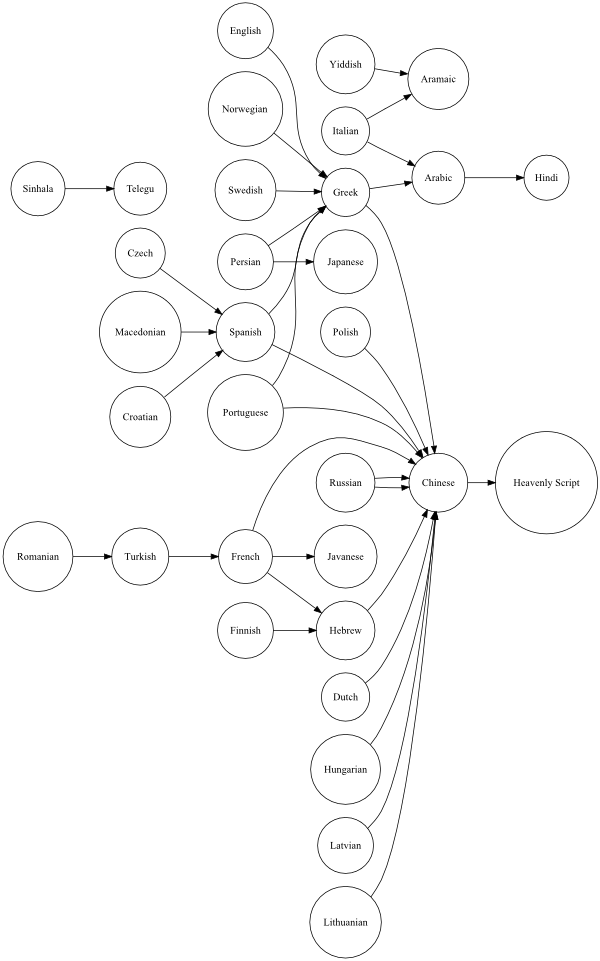
When confronted with an incomprehensible language, an English speaker might say “it’s all Greek to me” while a French or Finnish speaker might say that it sounds like Hebrew. Here’s a flowchart that illustrates the different incomprehensibility relationships (discussion here). The most stereotypical incomprehensible language appears to be Chinese. (via strange maps)
A photo of some fellows playing polo with horseless carriages.
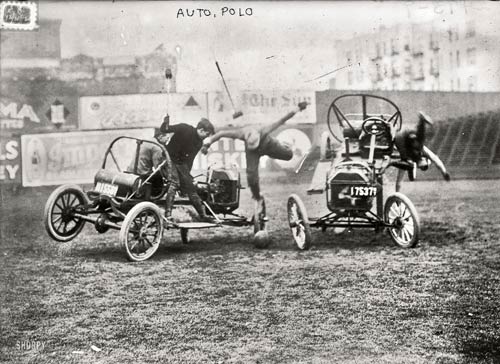
Looks like someone depressed their halting caliper a bit too quickly.
Update: From the NY Times, a report from 1912 on auto polo. The same page of the newspaper also contains a report of two gentleman who crossed the United States in a car without getting a single flat tire.
The two front tires contained Oregon air when they reached Massachusetts.
(via harrisj)
The Lone Gunman is one of my favorite new sites. Proprietor Lloyd Morgan doesn’t update super often but each post is solidly within the 40- and 50-point zones of my interests (this is likely the first and last skee ball metaphor you’ll read today). Morgan celebrated the site’s first anniversary with an entry reviewing the last year of posts…lots of good liberal arts 2.0 stuff in there.
A Continuous Lean found some great Life magazine photos of Sherman Billingsley, the owner of a famous NYC nightclub called The Stork Club, which club was frequented by celebrities, artists, and the well-to-do from 1929 to 1965. In the photos, Billingsley is pictured at his club giving secret hand signals to his assistant while sitting with guests.
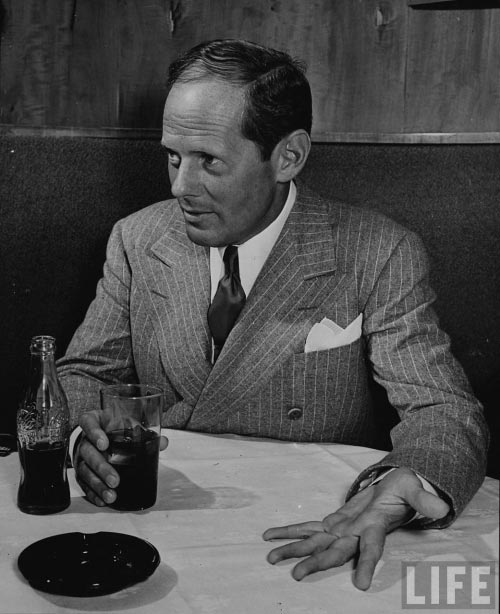
Closeup of Stork Club owner Sherman Billingsley [with his] palm up on table, one of his signals to nearby assistant which means “Bring a bottle of champagne,” while sitting w. patrons over his usual Coca Cola, in the Cub Room.
Billingsley’s signals cleverly allowed the club to provide seamless good service to his favored patrons while also letting him be the bad guy with less favorable customers without them knowing it. Billingsley went on to be the third base coach for the Yankees in the late 60s. (Untrue.)
Arc90 has released a nifty little bookmarklet called Readability, which strips away all the extra stuff (nav, ads, Digg buttons, etc.) from news article pages, leaving you with some nicely formatted text to read. It’s a “peace & quiet” button for your web reading. Get the bookmarklet here. I tried it on a bunch of open articles I’ve got up in tabs and it worked pretty well.
Update: It’s on! Michael Donohoe has whipped up some Javascript that blocks the Readability bookmarklet from doing its thing.
Wikipedia has a listing of unusual software bugs — “mostly named after scientists who discovered counterintuitive things” — that are difficult to identify or fix.
A mandelbug (named after fractal innovator Benoit Mandelbrot) is a computer bug whose causes are so complex that its behavior appears chaotic. This word also implies that the speaker thinks it is a bohrbug rather than a heisenbug. Some use mandelbug to describe a bug whose behavior does not appear chaotic, but whose causes are so complex that there is no practical solution. An example of this is a bug caused by a flaw in the fundamental design of the entire system.
My all-time favorite bug is still the 500-mile email. (thx, jake)
This clever bread cutting board has a crumb tube down to a bird feeder. (via monoscope)
Flickr has HD video now (for pro accounts only). Also, those with free accounts can now upload two videos a month.
After that great piece about how The Godfather got made was published, Vanity Fair got a call from the daughter of a reputed mobster who wanted to tell the magazine about the time the cast of The Godfather came over to her house for supper and some cultural exchange.
The doorbell rang at seven p.m. at the family house in Fort Lee, New Jersey, right across the Hudson River from Manhattan. “I opened the front door and there was Marlon Brando, James Caan, Morgana King [who played Don Corleone’s wife], Gianni Russo [who played Don Corleone’s son-in-law, Carlo], Al Ruddy [the film’s producer], and my uncle Al [Lettieri],” recalls Gio. “We all went downstairs into the family room, where the table was set and where we had the pool table and the bar.”
The 2009 Winterhouse Awards for Design Writing & Criticism are now open for entries until June 1.
The Winterhouse Awards for Design Writing & Criticism seek to increase the understanding and appreciation of design, both within the profession and throughout American life. A program of AIGA, these annual awards have been founded by Jessica Helfand and William Drenttel of the Winterhouse Institute to recognize excellence in writing about design and encourage the development of young voices in design writing, commentary and criticism.
The main award is $10,000 with a student award of $1000.
Warren Buffet has published his latest annual letter to the shareholders of Berkshire Hathaway, the giant holding company of which he is CEO and chairman. His letters are always a fun read.
The table on the preceding page, recording both the 44-year performance of Berkshire’s book value and the S&P 500 index, shows that 2008 was the worst year for each. The period was devastating as well for corporate and municipal bonds, real estate and commodities. By year end, investors of all stripes were bloodied and confused, much as if they were small birds that had strayed into a badminton game.
As the year progressed, a series of life-threatening problems within many of the world’s great financial institutions was unveiled. This led to a dysfunctional credit market that in important respects soon turned non-functional. The watchword throughout the country became the creed I saw on restaurant walls when I was young: “In God we trust; all others pay cash.”
Paging through, I was surprised at how much stock Berkshire owns in some major companies, including 13.1% of American Express, 8.6% of Coca-Cola, 8.9% of Kraft, and 18.4% of The Washington Post. Berkshire’s stock price is of interest as well; the stock has never split and the current price for one share is more than $73,000.
Electrolyzed water (salt water that has been run through an electrolytic process) is gaining acceptance in the US as a replacement for many cleaning agents.
At the Sheraton Delfina in Santa Monica, some hotel workers are calling it el liquido milagroso — the miracle liquid. That’s as good a name as any for a substance that scientists say is powerful enough to kill anthrax spores without harming people or the environment.
A food science professor says that electrolyzed water is “10 times more effective than bleach in killing bacteria” and it’s safe to drink. (Although maybe it would kill all the bacteria in your stomach?) But beware the phony health claims.
A full version of Sir Thomas Browne’s Pseudodoxia Epidemica is available online. First published in 1646, the book refutes errors and superstitions common to the 17th century. For instance:
That Crystall is nothing else but Ice strongly congealed.
That a Diamond is made soft, or broke by the blood of a Goate.
That a Bever to escape the Hunter bites off his testicles or stones.
Concerning the beginning of the world, that the time thereof is not precisely knowne, as commonly it is presumed.
(thx, julian)
Hannah Emily Upp suffers from dissociative fugue, “a rare form of amnesia that causes people to forget their identity, suddenly and without warning, and can last from a few hours to years”, which caused her to disappear from her usual life for three weeks until she was found floating, alive, in New York Harbor.
Its most famous sufferer is the fictional Jason Bourne, the secret agent made flesh on film by Matt Damon. The Bourne character takes his name from Ansel Bourne, a Rhode Island preacher who suffered the earliest recorded case of the condition when he was en route to Providence in 1887. The preacher continued to Norristown, Pa., where he opened a store and lived with another family, until one day he “woke up.”
Many of the readers of David Foster Wallace have been waiting for The New Yorker to cover the writer’s life since his death last September, something more than the quick Talk of the Town piece by the fiction editor published shortly after his death, some of that “sprawling New Yorker shit” that possessed a certain kinship with Wallace’s work. The March 9 issue follows through with two articles, one by Wallace and one on Wallace. The piece by Wallace is a chunk of the novel he left unfinished when he died. (More on that below.) The novel, entitled The Pale King, is about the transcendence that comes through boredom. I don’t think Lane Dean is quite there yet:
Then he looked up, despite all best prior intentions. In four minutes, it would be another hour; a half hour after that was the ten-minute break. Lane Dean imagined himself running around on the break, waving his arms and shouting gibberish and holding ten cigarettes at once in his mouth, like a panpipe. Year after year, a face the same color as your desk. Lord Jesus. Coffee wasn’t allowed because of spills on the files, but on the break he’d have a big cup of coffee in each hand while he pictured himself running around the outside grounds, shouting. He knew what he’d really do on the break was sit facing the wall clock in the lounge and, despite prayers and effort, count the seconds tick off until he had to come back and do this again. And again and again and again.
The Lane Dean character was featured once before in the New Yorker’s pages, a second chunk of the novel published in 2007 as Good People.
The second piece, a profile of Wallace by D.T. Max that focuses on his writing, especially his struggles in pulling the fragments of The Pale King into something finished, is long and difficult to read at times. It’s intimate; Max relies on interviews with Wallace’s wife, family & editors, private correspondence between Wallace and his friends, and passages from this unfinished novel that, for a long time, Wallace didn’t want anyone to read. It seems that anyone with $20 or a library card will get to read at least some of it after all.
From 1997 on, Wallace worked on a third novel, which he never finished — the “Long Thing,” as he referred to it with Michael Pietsch. His drafts, which his wife found in their garage after his death, amount to several hundred thousand words, and tell of a group of employees at an Internal Revenue Service center in Illinois, and how they deal with the tediousness of their work. The partial manuscript — which Little, Brown plans to publish next year — expands on the virtues of mindfulness and sustained concentration. Properly handled, boredom can be an antidote to our national dependence on entertainment, the book suggests.
The magazine also has an online feature that includes two scanned pages from The Pale King manuscript and some artwork from Karen Green, Wallace’s wife, which is obviously biographical in nature. Hard to Fill, indeed.
Newer posts




Socials & More