kottke.org posts about video
This video from StudioBinder looks at how Akira Kurosawa made his films.
In this video essay, we break down Kurosawa’s filmmaking techniques across Seven Samurai, High and Low, Rashomon, Ikiru, Yojimbo, and more. From dynamic blocking and layered composition to bold movement and weather-driven cinematography, Kurosawa didn’t just direct scenes — he engineered visual storytelling with precision.
See also Where to Start With Akira Kurosawa and Akira Kurosawa — Composing Movement. (via open culture)
Jay DeFao’s The Rose is one of my favorite pieces at The Whitney (or anywhere really). The story of how this art world behemoth somehow survived to become of the jewels of American art is wild.
First exhibited in 1969, The Rose was taken to the San Francisco Art Institute, where it was covered with plaster for support and protection, and finally stored behind the wall of a conference room. Legend grew about the painting, but it remained sealed until 1995, when Whitney curator Lisa Phillips had it excavated and restored by a team of conservators, who created a backing strong enough to support the heavy paint.
Another more entertaining look at the painting’s (sculpture’s?) journey.
Kurzgesagt explores what happens to your body when you die.
Death isn’t a single switch that shuts down your entire body at once. When your heart stops beating and your brain goes silent, trillions of cells inside you are still alive, desperately trying to keep themselves running. Death isn’t a single moment, but a slow and surprisingly complex process that can last for weeks.
What actually happens when you die? What makes death so mysterious, and which cells are the last survivors within your body?
During the Renaissance, spurred by the accelerating arrival of items from all over the world, wealthy Europeans began assembling handcrafted curios and unusual artifacts from the natural world in wonder cabinets, or wunderkammers. In this video, Evan Puschak takes a look at how this practice evolved and what it says about that period in history.
This was the period of the scientific revolution when thinkers were re-evaluating their reliance on ancient wisdom in the light of all the novel things arriving daily from around the world. “What grounds were there,” Steven Chapen writes, “for crediting ancient limits on the stock of factual knowledge? Every day, new phenomena presented themselves about which the ancient texts were silent.”
What was needed for the growth of real knowledge, according to philosophers like Francis Bacon, was not an interpretation of old texts, but an inventory of new facts.
I first heard about wunderkammers sometime in the late 90s when people started comparing them to weblogs and wikis. Here’s Julian Dibbell writing for Feed in May 2000:
A Web log really, then, is a Wunderkammer. That is to say, the genealogy of Web logs points not to the world of letters but to the early history of museums — to the “cabinet of wonders,” or Wunderkammer, that marked the scientific landscape of Renaissance modernity: a random collection of strange, compelling objects, typically compiled and owned by a learned, well-off gentleman. A set of ostrich feathers, a few rare shells, a South Pacific coral carving, a mummified mermaid — the Wunderkammer mingled fact and legend promiscuously, reflecting European civilization’s dazed and wondering attempts to assimilate the glut of physical data that science and exploration were then unleashing.
Just so, the Web log reflects our own attempts to assimilate the glut of immaterial data loosed upon us by the “discovery” of the networked world.
Some 26 years later, I still think about kottke.org that way. I mean, what is the Video Closet if not a cabinet of wonders?
Dwarkesh Patel recently interviewed Robert Caro for his podcast. They talked about loneliness, if JFK could have passed LBJ’s legislation, and how Caro gets people to talk. From the transcript:
Dwarkesh Patel: This raises another question that I wanted to ask you. You’re interviewing all these people, and in many cases, they must know that it’s not good for them to tell you what you want to know. In many cases, they tell you anyway. How do you get people to tell you things that they know they shouldn’t tell you?
Robert Caro: You ask terrific questions. Sometimes you’re sitting there and you know this person doesn’t want to talk to you about what you want to get out of them, like John Connally on how Johnson used money to get political power. I’m thinking, “But I’ve been through the notes. Connally collected the money and gave it out at Johnson’s instructions, so he’s the only guy who can tell me how Johnson did this, how he judged who to give money to.”
Sometimes Johnson would write on a request for money. If the guy asked for $1,500, Johnson would write, “Okay, 1,500.” Sometimes he’d write 500, sometimes he’d write no, but sometimes he’d write, “No, never.” I asked Connally what that meant, and he said, “This guy was never going to get money from Lyndon Johnson.” Then when you ask why he felt this way about this particular congressman, that’s when the really fascinating stories emerge.
Caro is 91 now, so every interview with him is a precious jewel, but one wonders if he’s got the time to finish that fifth LBJ book.
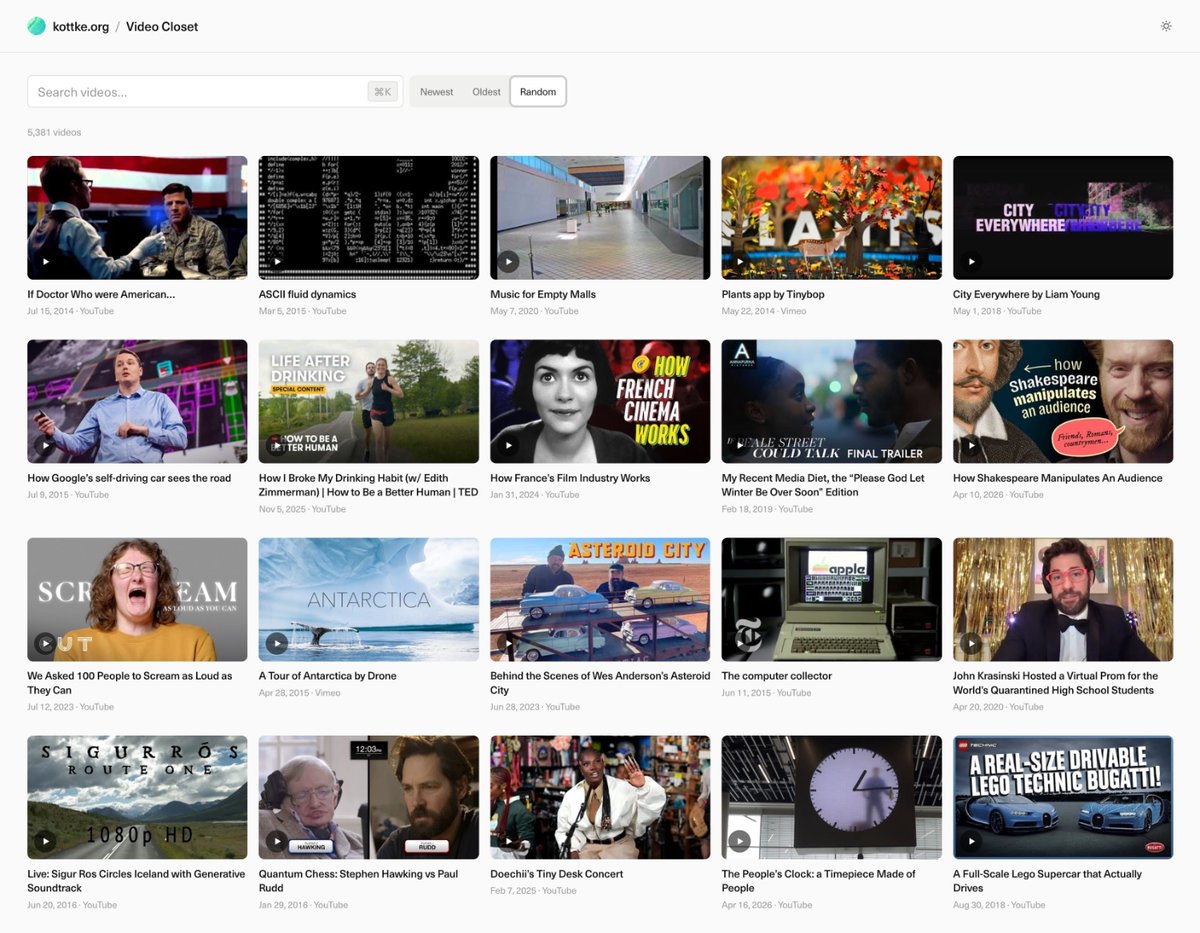
Ok folks, I’m gonna apologize in advance for totally ruining any plans you might have had for the rest of your day. This weekend I knocked together the Video Closet, a simple tool for exploring & watching every YouTube & Vimeo video1 I’ve posted to KDO since 2014 that’s still live: almost 5400 of them in total. It’s like a YouTube that’s just for people who read KDO. Click a video to play it or click the title to go to the original post containing the video.
The toughest thing about building the Video Closet was getting repeatedly distracted by videos while I was testing it. Seriously, don’t open this thing if you want to get any work done for the rest of the day!
I also tweaked how video embeds work on the main site: there’s now a play button (plays the video in place), an “open on [service]” button (opens it in a new tab on YT or Vimeo), and, on desktop browsers, a widescreen button that embiggens the video in the current window and plays it (my favorite). I like rolling my own video embeds because the default ones from YT & Vimeo are heavy and include a lot of tracking — and now you can choose three different ways of watching, according to the customs of your people.
See also a bunch of other stuff I’ve launched lately.
Afghan-American visual artist Daniel Malikyar recently shared some great photos of what he calls “a fashion subculture unlike anything I’ve encountered before” that he found in a remote village in the mountains of Afghanistan.


I met a group of boys in a remote village who had developed their own distinct sense of style. They wore colorful eyeliner called surma, painted their fingernails with henna, and dressed in embroidered clothing and handmade hats decorated with flowers and butterfly clips.
This wasn’t something they dressed up for. It was how they dressed every day, each with their own unique interpretation of style and self-expression.
With no access to the internet and limited resources, they had created something entirely their own.
These photos are part of Malikyar’s Afghanistan Book, which is available for sale from his website. He also produced a short video about these boys:
Be sure to check out the rest of his website and Instagram; amazing work.
NPR recently welcomed Swedish pop star Robyn to their office for a Tiny Desk Concert. She sings four songs, including one of her first hits, Show Me Love.
Every choice here is a tender one, down to the teardrop glued to her cheek. Every move is confident, yet comes from a place of vulnerability. Most of these arrangements play up the quiet desperation in her outsized songs, though on “Ever Again,” Robyn pulls off a magic trick by inviting us into the conversation, opening a broken heart to defiant resilience. “Light Up,” in particular, sounds revelatory, a glitchy synth banger reborn as a piano ballad. “I was looking at you like a mirror,” she sings with a catch in her throat, like an old memory surfacing for a split second, as she builds to a moment of emotional release.
Robyn was 16 years old when “Show Me Love” appeared on her debut album, Robyn Is Here. “For me, this is where it all started, in a way,” she tells the audience, understating the foundational impact the hit would have on late-’90s pop. Behind the Desk, its lite new jack swing slows to something more spacious and reflective, if no less flirtatious. She lets the music age with her.
When someone says “German techno group”, you probably have a pretty good picture in your mind. MEUTE, on the other hand, is an 11-piece techno marching band that plays electronic music with acoustic instruments: tubas, trombones, drums kits, etc. Reset (above) is a single from their new album, KOSMOS. I love this.
Animation director Maria Tomazou made a short animated film entirely in Microsoft Excel.
There’s no reason for this film to exist. Yet, I made it and it took ages to put together. To keep going and keep creating something that is pointless is actually very painful. I wish my love for making films was enough of a why to keep going, but sometimes it’s not. I’m glad I made this film. I don’t need to know the why for everything.
Three cheers for creating pointless things.
I love Taiwanese artist Kuang-Yu Tsui’s 1997 conceptual art piece The Welcome Rain Falling From the Sky but I couldn’t really tell you what it means. Something about the way people are bombarded with advertisements for consumer goods? I also couldn’t help but think of the iOS game co-created by Neven Mrgan, The Incident.
This is cool: Evan Puschak looks at the rush of cheapo knockoff space operas that came out in the wake of Star Wars, a once-in-a-generation film that refashioned the entire movie business. Even the names are kooky: Starcrash, War of the Planets, Battle of the Stars, The Humanoid, Message From Space, Battle Beyond the Stars, The Man Who Saved the World, Star Odyssey, and The Beast in Space — although tbh, Star Wars is a goofy name as well. Some of the movies even had lightsabers and anxious robots.
Puschak highlights Star Wars’ unique combination of realistic depictions of space with special effects (a la 2001) and an adventure story with colorful characters. He quotes Julie Turnock’s book, Plastic Reality: Special Effects, Technology, and the Emergence of 1970s Blockbuster Aesthetics, in making the case that Lucas and other filmmakers of his generation were using special effects to up the sensorial ante for moviegoers — I dug the full passage out of the book’s introduction:
Certainly what was so exhilarating to many about these films was not simply the experience of a new kind of realism. Perhaps even more important was the intensified density of effects in films of the era, which many at the time understood as a thrillingly new and vividly somatic technologized experience. This book aims to recover the excitement that not just ticket-buyers but also many academics, critics, and journalists felt upon experiencing the special effects-heavy films of the 1970s, in particular Star Wars and Close Encounters, and further grant historical dimension and context to that experience. It may be surprising for many to realize that in the 1970s George Lucas and Steven Spielberg were considered among the most interesting, ambitious, and exciting filmmakers of the era, alongside more canonized American filmmakers like Stanley Kubrick, Francis Ford Coppola, Peter Bogdanovich, and Martin Scorsese. What critics praised most often about Lucas and Spielberg as filmmakers was their grasp of specifically cinematic visual dynamics that lent their films both greater visceral and sensual engagement and an extra layer of expressive and intellectual potential. While many critics have (often rightly) condemned the aggressive, pummeling blockbuster style that has arisen in the wake of the two successes of 1977, it is incumbent upon scholars to recover the creative process that made them so stimulating and exhilarating to the likes of Pauline Kael, Stanley Kauffmann, Roger Ebert, and other prominent critics of the era, as well as so popular with audiences. A renewed interest in special effects technology by influential auteurist filmmakers certainly made this historical development possible. However, even more strongly, auteurist filmmakers went to the considerable and painstaking effort to promote and develop complex special effects technology, precisely in order to realize aesthetic filmmaking goals they designed to rouse and provoke the sensorium. They called this approach variously “visual storytelling,’ “visceral engagement,’ or “graphic dynamics.”
Moreover, so-called New Hollywood filmmakers in the 1970s reinterpreted the role of cinematic aesthetics to suggest a purposeful relation between sensual and intellectual impact. In other words, filmmakers sought to stimulate the senses. This was not to numb the viewer but to activate him or her — not unlike the notion of drug-induced mind expansion. Intensified color schemes, beams of light, fast-moving objects, and quick editing first penetrate the body and then engage the mind with the films’ ideas about technology, kineticism, power structures, liberty, etc.
I am firmly in the camp of those who enjoy filmmakers that engage the senses like this — among contemporary filmmakers, Christopher Nolan and Denis Villeneuve come to mind as continuing the legacy of Lucas et al. in this way.
For a 1992 conceptual art piece called The Hunt, Christian Jankowski survived for a week on goods he shot at the local supermarket with a bow and arrow.
To rebel against modern society, to return to nature: in pursuit of these primeval instincts, for one week, Jankowski lived off goods he hunted in the supermarket. Instead of stalking animals, he eyed and avoided the supermarket security cameras. Armed heroically with a bow and arrow, Jankowski shot down frozen chickens, butter, toilet paper, and various other essentials. His game, if edible, was not just dead, it was processed on a mass scale. Thus the reaction of the woman working the checkout counter: she remained wholly unimpressed by the trophies of his bargain hunt, which she scanned with the arrows still sticking out of them. He has to pay like everyone else.
In a recent video, Kurzgesagt explores what we know about the first human civilizations that formed some 12,000 years ago and how they led to the first cities and the invention of writing.
What we know about human history is only a fraction of the full story. Much of the rest is like dark matter, invisible to us. We can’t see it, and we can only see the effects of its presence. But thanks to new techniques for DNA sequencing, dating ancient detritus, mathematical models, and aerial and lidar archaeology, we are now able to get a faint idea of what this world might have looked and felt like.
One thing I really appreciate about Kurzgesagt is how each of their videos is accompanied by an extensive list of sources. For instance, I’m not sure I’d heard about the massive Lake Agassiz draining into the world’s oceans and disrupting the entire planet’s climate some 8200 years ago — and there are several primary sources listed for further reading. Here’s how Kurzgesagt tells it:
Around the year 3800 of the human era a sudden catastrophe happened in North America. The receding glaciers of the last ice age had created one of the largest lakes in Earth’s history, larger than the Caspian Sea today. It was held back by super massive ice sheets, which formed a gigantic dam.
Surprising no one, the dam melted and suddenly failed – the whole lake suddenly drained into the ocean. Global sea levels rose by 1-2 meters and the great conveyor belt that carried warm water northwards slowed down. Across the North Atlantic and Europe, and into the Near East, the climate turned colder and drier – in some regions by several degrees. Rain patterns shifted, summers grew longer and harsher, and a drought lasting well over a century parched the land.
And:
We know that during this time all over the world migration towards rivers and lakes sped up — bringing agriculture and technology with them. Some of the most consequential journeys led into the Nile Valley, where farming villages took root and slowly laid the ground for the rich civilization that would one day rise there.
From Wikipedia:
Lake Agassiz’s major drainage reorganization events were of such magnitudes that they significantly impacted climate, sea level, and possibly early human civilization. The lake’s enormous freshwater release into the Arctic Ocean has been postulated to have disrupted oceanic circulation and caused temporary cooling. The draining of 13,000 years ago may be the cause of the Younger Dryas stadial. Although disputed, the draining at 9,900–10,000 years ago may be the cause of the 8,200 yr climate event. A study by Turney and Brown links the 8,500-years-ago drainage to the expansion of agriculture from east to west across Europe; they suggest that this drainage may also account for various flood myths of ancient cultures, including the Biblical flood narrative.
Fascinating.

Sir Patrick Stewart, best known for his role as Captain Jean-Luc Picard on Star Trek: The Next Generation, has died at the age of 86. He passed at home in Los Angeles from Alzheimer’s disease and Lewy body dementia.
He was largely considered an unknown when the “Star Trek” offer came along. At the invitation of a friend, a university professor, Mr. Stewart had been in Los Angeles conducting master classes on Shakespeare when, one evening, he gave a lecture and performed some bits of the plays in a program that was open to the public.
A TV producer who was involved in developing a new “Star Trek” series happened to attend and soon persuaded Mr. Stewart to audition — even though, as Mr. Stewart later wrote, he knew “next to nothing” about the franchise.
Surprised to get the part — the “Star Trek” creator, Gene Roddenberry, who was overseeing the new series, had not been keen to hire him at first — Mr. Stewart expected the project to be a short-term commitment. How, he remembered thinking, could the show possibly succeed with a middle-aged pacifist captain with a French name and a British accent?
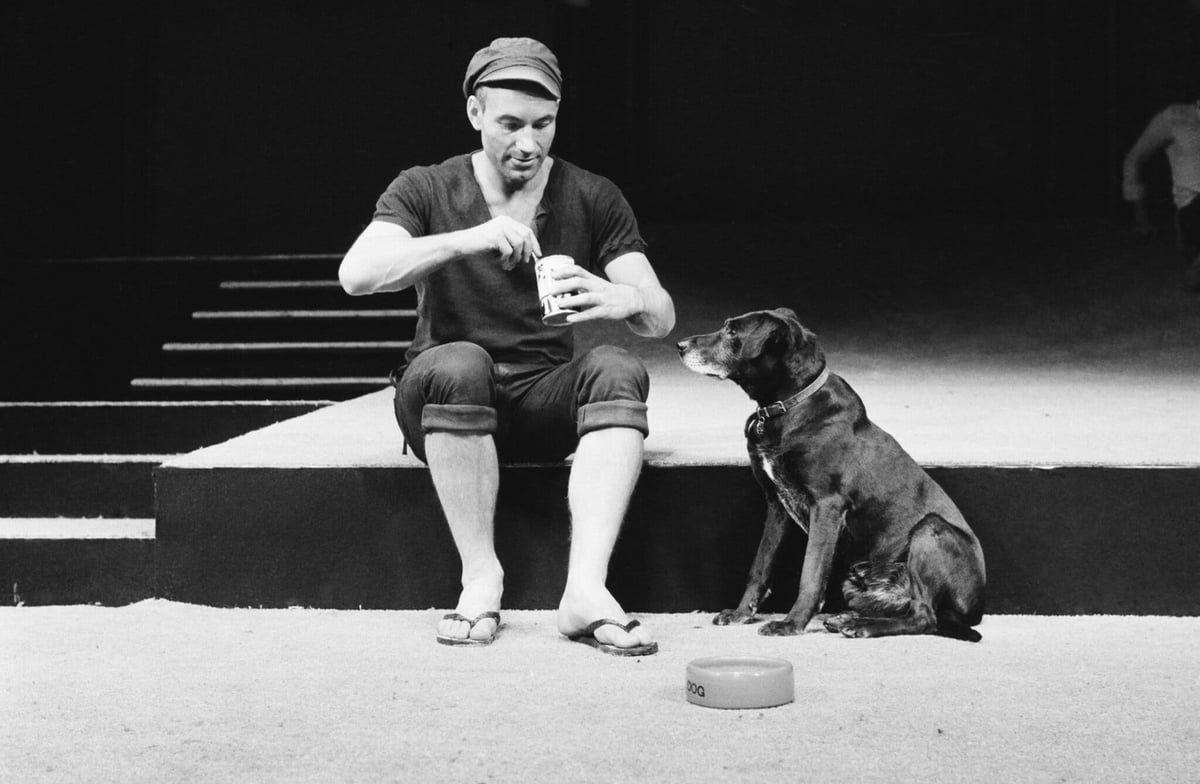
This is hard news to take, even though Stewart lived a full and fulfilling life. The Next Generation will always be my favorite Star Trek series and Picard my favorite captain. Stewart got off to a rough start on the series:
So when he was on set shooting the show’s debut season and co-stars like Jonathan Frakes, Denise Crosby and Brent Spiner would tease him or ad-lib a joke or laugh when they flubbed their lines, it would low-key infuriate him.
“I could be a severe bastard,” he writes. “My experiences at the Royal Shakespeare Company and the National Theatre had been intense and serious… On the TNG set, I grew angry with the conduct of my peers, and that’s when I called that meeting in which I lectured the cast for goofing off and responded to Denise Crosby’s, ‘We’ve got to have some fun sometimes, Patrick’ comment by saying, ‘We are not here, Denise, to have fun.’”
“In retrospect,” Stewart continues, “everyone, me included, finds this story hilarious. But in the moment, when the cast erupted in hysterics at my pompous declaration, I didn’t handle it well. I didn’t enjoy being laughed at. I stormed off the set and into my trailer, slamming the door.”
But he found his footing and eventually found meaning in the role of Picard (archive):
Q: There’s a passage where you say that, from your father, “I drew Picard’s stern, intimidating tendencies. But I like to think that my mother is in the captain too, in his moments of warmth and sensitivity.” Do you see Picard as your way of reconciling that conflict between your parents?
A: Very much so, yes. Both Star Trek and therapy have been responsible for that. Having to open the doors into my childhood in order to be an actor became utterly intriguing to me in a way that it never had been before. And I regret that when I look back on some of the roles I played, what I might have brought to them if I just released myself a little bit more.
Might watch an episode or two this evening in remembrance. If you’re not a Trek fan, you can watch Stewart play Macbeth in 2010:
Older posts



Socials & More