kottke.org posts about video
The Story Time from Space program aims to promote language and STEM literacy by having astronauts read educational bedtime books from low-Earth orbit on the International Space Station to kids on Earth. Here’s astronaut Kate Rubins reading Rosie Revere, Engineer:
And Ada Twist, Scientist read by Serena Auñón-Chancellor:
What a cool idea. Check out the rest of the available videos in their library.
(Wait for it, wait for it…) One guy, singing Bon Jovi’s Livin’ On A Prayer, gets an entire park to sing along with him. I know this was a tough week for many, but if this doesn’t brighten your day, I do not know what will.
See also Leadership Lessons from the Dancing Guy, which I swear is related. (via open culture)
I love echo - any kind of reverberation or atmosphere around a voice or a sound effect that tells you something about the space you are in.
That’s a quote from legendary film editor and sound designer Walter Murch. In the 70s, he pioneered a technique called worldizing, for which he used a mix of pristine studio-recorded and rougher set-recorded sounds to make a more immersive soundscape for theater audiences. He used it in The Godfather, Apocalypse Now, and American Graffiti:
George [Lucas] and I took the master track of the two-hour radio show with Wolfman Jack as DJ and played it back on a Nagra in a real space — a suburban backyard. I was fifty-or-so-feet away with a microphone recording that sound onto another Nagra, keeping it in sync and moving the microphone kind of at random, back and forth, as George moved the speaker through 180 degrees. There were times when microphone and speaker were pointed right at each other, and there were other times when they were pointed in completely opposite directions. So that was a separate track. Then, we did that whole thing again.
When I was mixing the film, I had three tracks to draw from. One of them was what you might call the “dry studio track” of the radio show, where the music was very clear and sharp and everything was in audio focus. Then there were the other two tracks which were staggered a couple of frames to each other, and on which the axis of the microphone and the speakers was never the same because we couldn’t remember what we had done intentionally.
The Prelude in G Major to Johann Sebastian Bach’s Cello Suite No. 1 is one of the world’s most recognizable pieces of music. You’ve likely heard Yo-Yo Ma play it — he’s been trying to master it for almost 60 years now. In a new episode of Earworm, Estelle Caswell and cellist Alisa Weilerstein break the song down to see what makes it such an effective and interesting piece of music.
In the early 1700s, Johann Sebastian Bach did something few, if any, composers had ever done. He composed six suites for the cello — a four stringed instrument that, at the time, was relegated to the role of accompaniment in larger ensembles.
Each suite consists of movements named for various dances, and they all begin with a prelude — an improvisatory movement meant to establish the key of the suite, as well as reoccurring themes and motifs. These suites are all masterpieces in music and considered a rite of passage for cellists to study and master.
But there’s one movement in particular, the Prelude in G Major, that has taken on a life of its own in the minds of musicians and music lovers alike.
If you hear the first few measures you’ll likely recognize it. A simple G major arpeggiated chord played expressively on the cello opens a short, but harmonically and melodically rich, 42 measures of music. Bach makes a single instrument sound like a full ensemble. How does he do it?
The machines that cut the pasta at Brooklyn pasta company Sfoglini are mesmerizing to watch.
I predict that a 10-minute super slow-motion film of this pasta cutter would easily win best short film at the Oscars.
Ariel Waldman and her microscopes spent five weeks in Antarctica investigating the microbes that live in the seas, lakes, and glaciers. One of the outcomes of the trip is Life Under the Ice, a website that showcases some of the tiny critters, plants, and miscellaneous things she found.
Typically when we think about Antarctica, we think of a place that’s barren and lifeless… except for a few penguins. But Antarctica should instead be known as a polar oasis of life, host to countless creatures that are utterly fascinating. They’ve just been invisible to us — until now. Life Under the Ice enables anyone to delve into the microscopic world of Antarctica as an explorer; as if you had been shrunk down and were wading through one large petri dish of curiosities.
Ahhh, look at this tardigrade at 20X magnification:
The tardigrade was found while extremophile hunting on a glacier.
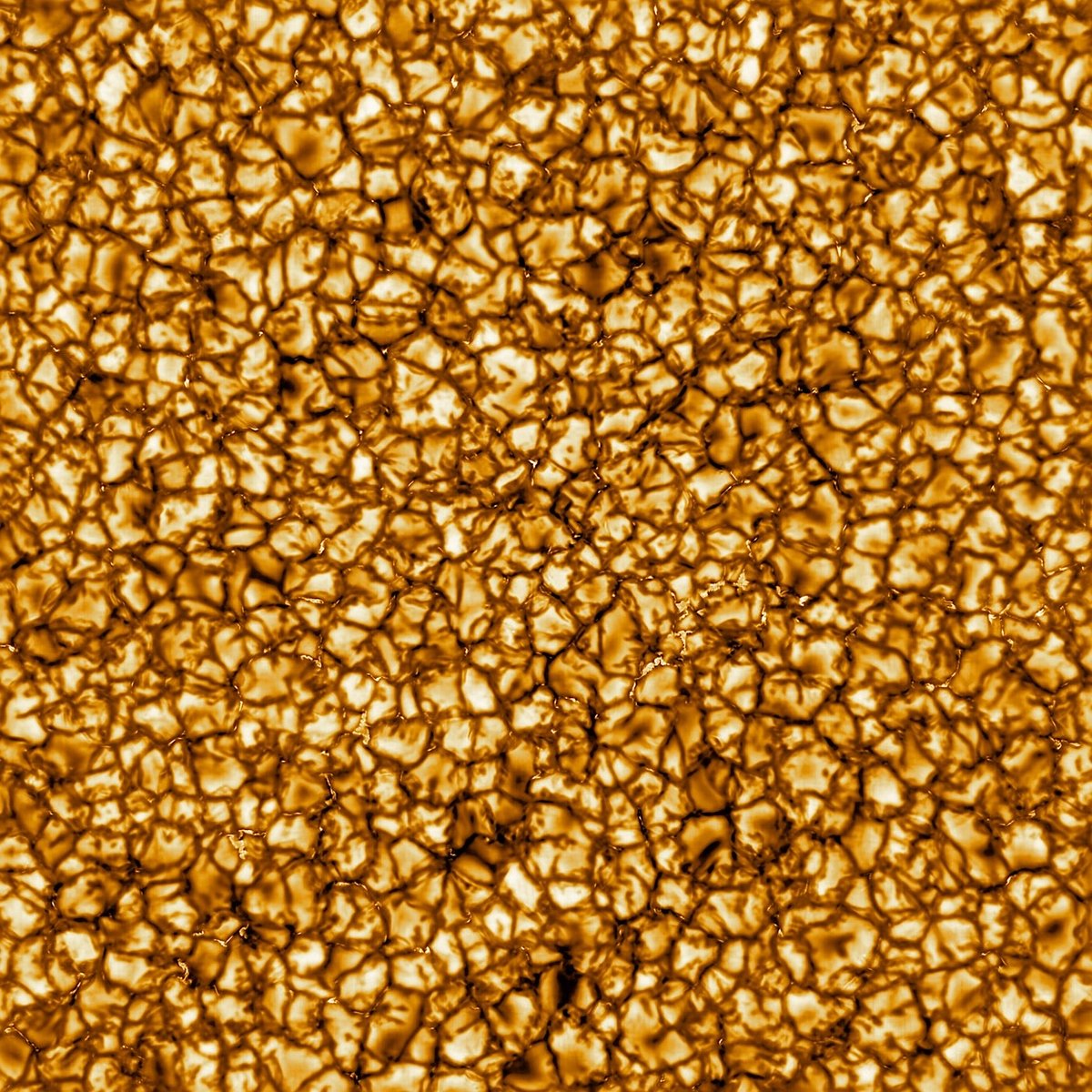
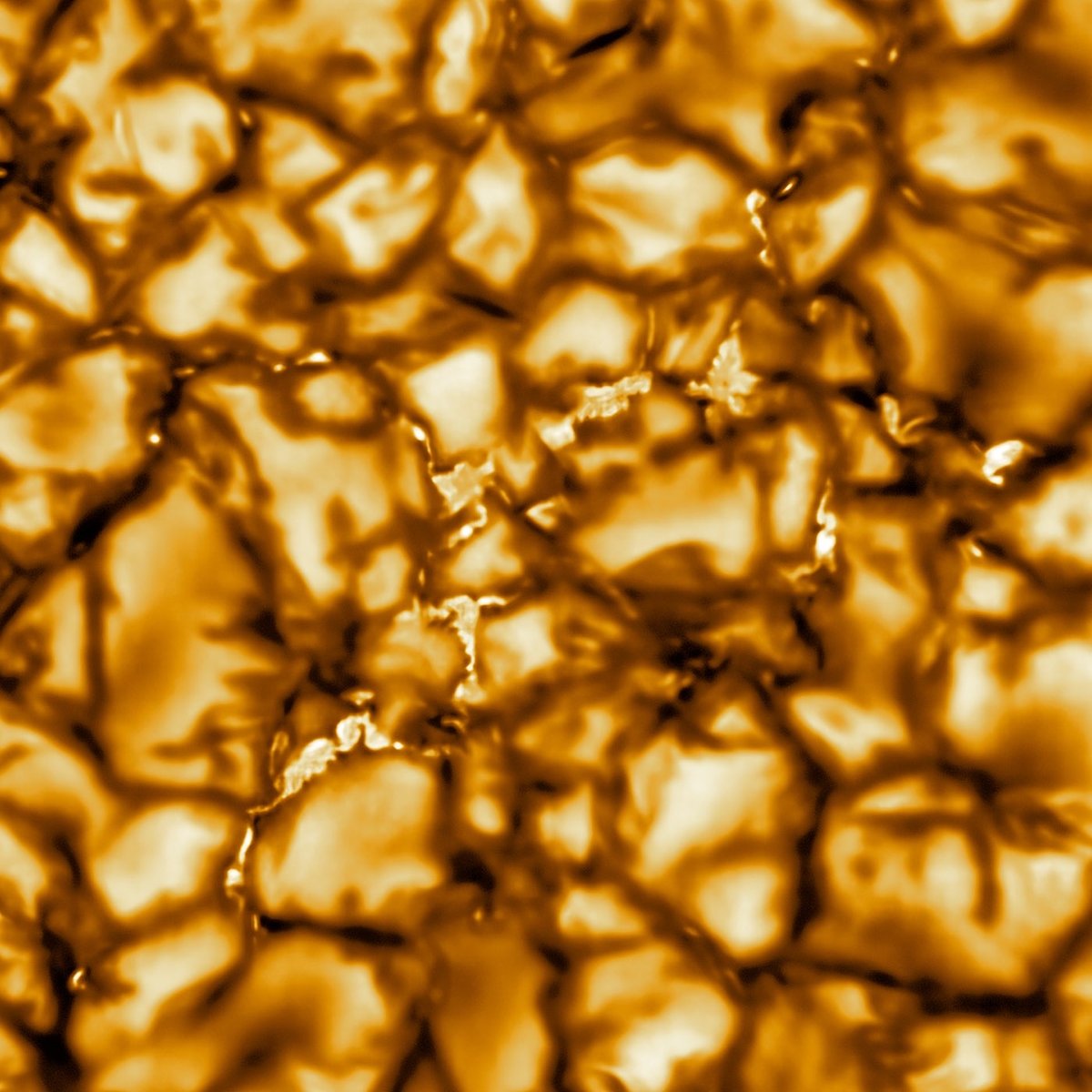
The National Science Foundation has just released the very first images of the Sun taken with the new Inouye Solar Telescope in Hawaii. They are the highest resolution images ever taken of the Sun’s surface, showing three times more detail than was possible using previous imaging techniques. Those cells you see in the image…they’re each about the size of Texas.
Building a telescope like this is not an easy task — there’s a lot of heat to deal with:
To achieve the proposed science, this telescope required important new approaches to its construction and engineering. Built by NSF’s National Solar Observatory and managed by AURA, the Inouye Solar Telescope combines a 13-foot (4-meter) mirror — the world’s largest for a solar telescope — with unparalleled viewing conditions at the 10,000-foot Haleakala summit.
Focusing 13 kilowatts of solar power generates enormous amounts of heat — heat that must be contained or removed. A specialized cooling system provides crucial heat protection for the telescope and its optics. More than seven miles of piping distribute coolant throughout the observatory, partially chilled by ice created on site during the night.
Scientists have released a pair of mesmerizing time lapse videos as well, showing ten minutes of the roiling surface of the Sun (wide angle followed by a close-up view) in just a few seconds:
The Daniel K. Inouye Solar Telescope has produced the highest resolution observations of the Sun’s surface ever taken. In this movie, taken at a wavelength of 705nm over a period of 10 minutes, we can see features as small as 30km (18 miles) in size for the first time ever. The movie shows the turbulent, “boiling” gas that covers the entire sun. The cell-like structures — each about the size of Texas — are the signature of violent motions that transport heat from the inside of the sun to its surface. Hot solar material (plasma) rises in the bright centers of “cells,” cools off and then sinks below the surface in dark lanes in a process known as convection. In these dark lanes we can also see the tiny, bright markers of magnetic fields. Never before seen to this clarity, these bright specks are thought to channel energy up into the outer layers of the solar atmosphere called the corona. These bright spots may be at the core of why the solar corona is more than a million degrees!
Man, I hope we get some longer versions of these time lapses — I would watch the hell out of one that ran for 10 minutes. (via moss & fog)
In his new music video, My Vote Dont Count, rapper YelloPain provides an excellent 4-minute summary in the sprit of Schoolhouse Rock of the importance of voting, particularly in midterm elections and with a focus on Congress and state legislatures.
So you know how back in ‘08, when we all voted for Obama? We was all supposed to go back in 2010 and vote for the Congress. Cause they the ones that make child support laws. They the ones choose if your kids at school get to eat steak or corn dogs. The state house makes the courthouse. So if the country fail you can’t say it’s them, it’s your fault, cause ya ain’t know to vote for Congress members that was for y’all. And they don’t gotta leave after four years; we just let ‘em sit. See, they don’t want to tell you this, they just want you to focus on the President.
The video was co-produced by Desiree Tims, a Democrat who is running for the House in Dayton, YelloPain’s home town. Tims appears in the closing seconds of the video to deliver this message:
Every time you stay home, someone is making a decision about you. Making decisions about the air you breath, the water you drink, the food your kids eat, and how much money you bring home every two weeks. So every time you sit out an election, every time you don’t show up because you think it doesn’t matter, someone else is happy that you didn’t show up, so they can make that decision for you. Vote!
Even though it’s not explicitly labeled as such, this might be one of the best political advertisements I’ve ever seen. It’s entertaining, informative, and authentic.
By digitally elongating them in a glitchy sort of way, motion graphics designer Theodore John transforms the buttes and mesas of the American southwest into a vaguely sci-fi scene in his new short, American Totem. (via colossal)
Here’s the trailer for Beastie Boys Story, a feature-length documentary about the band directed by Spike Jonze. The film will debut in early April in IMAX theaters and be out on Apple+ later that month. From Rolling Stone:
The documentary is a live extension of 2018’s Beastie Boys Book, a memoir that paid tribute to Yauch, who died of cancer in 2012. “Looking back, it’s like, oh shit, that was crazy — how did we live through that?” Horovitz told Rolling Stone of the memoir. “And look at us now. We’re grown-ups. We have to think about mortgages. I gotta get dog food.”
Live portions of the documentary were taken from Horovitz and Diamond’s recent show at Kings Theatre in Brooklyn; it was all part of a live tour directed by Jonze that consisted of Q&A segments, readings, and guest moderators.
There’s nothing more entertaining than watching Boston-area natives do over-the-top Bawston accents, but it’s always a precarious undertaking. If you don’t get the accent right…yeesh. When Hyundai named their new automated parking feature “Smart Park”, those two words demanded that they give the Boston angle a shot, and the team of Chris Evans, John Krasinski, and Rachel Dratch delivered. The bit that really set the hook for me was when Krasinski called Evans “kid”.
This clever stop motion animation by Charlotte Arene features a bedroom taking on the characteristics of an increasingly angry sea, before the morning calm sets in. Pillows, the comforter, a sleeping woman’s hair, candles on the windowsill, they all move like waves washing ashore to a seaside soundtrack.
The name of the short is “La mer à boire”, which Google translates as “unrealizable” but is literally something more like “drinking the sea”.1 “Ce n’est pas la mer à boire” is a French expression that means “it’s not that big a deal” (it’s not like drinking the sea), which is what the Google translation is hinting at, I think. Anyway, good title! (via colossal)
The BBC and Hulu are producing a 12-part TV series based on Sally Rooney’s book Normal People (which I excerpted here). The first trailer is above and I have to say, color me intrigued. (via the recently relaunched recs)
One of my favorite video series is Estelle Caswell’s Earworm for Vox — you can check out my posts about it here. It had been a few months since the last episode, so I went to see if she’d made any other videos in the meantime and, lo, Caswell produced a video about the Metropolitan Opera’s production of the opera Akhnaten by Philip Glass, one of my favorite composers.
The video above gives a behind-the-scenes look at the Metropolitan Opera’s production of Akhnaten. We follow Anthony Roth Costanzo, who plays Akhnaten, through the various phases of rehearsal, from working with his vocal coach in a Manhattan apartment to taking the stage for a dress rehearsal in a costume covered in doll heads.
I’ve only seen one opera at the Met (years ago) and was blown away by the production. I remember walking out of there thinking, “Do people know how good this is? Why isn’t opera a massive thing?” (Although I guess I answered my own question by not ever going back?)
When humans domesticated barnyard animals (goats, sheep, cows) starting around 10,000 years ago, they stumbled upon one of the most amazing schemes of all time. Instead of relying on the few human-edible plants scattered around for their energy needs, humans could raise animals that ate the plain old grass that was growing anywhere & everywhere and converted it into ultra-nutritious and energy-rich superfoods like meat and milk. Land back then was plentiful and the scheme allowed humans to produce many more calories with less effort using an energy source (the grass) that they didn’t otherwise have much use for.
But how does milk fit into the picture these days? It’s still a superfood that’s very beneficial to people in many parts of the world where adequate nutrition isn’t available from other sources. But as Kurzgesagt explains in this video, our land use has changed in the past 10,000 years, and cow’s milk production is a major source of carbon emissions (when compared to foods w/ similar nutritional value):
And don’t forget to check out the list of sources they used in producing the video.
Newer posts
Older posts



Socials & More