kottke.org posts about video games

Last year, Nintendo came out with a mini version of their original NES console with 30 pre-installed games. This year, they hoping to repeat that device’s wild popularity with the Super NES Classic. List price is $79.99. The SNES Classic comes with two controllers and 21 games built-in, including Super Mario Kart, F-ZERO, Super Mario World, and The Legend of Zelda: A Link to the Past. US pre-order information isn’t available yet (relevant Amazon page), but I’ll update this post when it is.

I love the aesthetic for Hidden Folks, an iOS game that’s like an interactive version of Where’s Waldo? in black & white. The creators just released a big update to the game and explained how they designed and built the new level.
Like everything in Hidden Folks, the Factory started on paper. Sylvain Tegroeg, the Illustrator with whom I made the game, uses a fineliner to draw every single element individually. Sylvain and I brainstorm on the theme and possible sub-themes that could work well with interactions, after which Sylvain enters The Zone™ and just draws whatever comes to mind. After drawing a bunch of things, Sylvain scans them and (manually) places them in a sprite sheet.
Sometimes, the technology you use ends up unexpectedly affecting your creative output:
When Sylvain and I started working on Hidden Folks about three years ago, he decided to buy a somewhat medium-quality / cost-efficient scanner for the project. When that scanner broke down recently, he used a better scanner for a while only to discover that his digital drawings suddenly looked very different, and so we bought that same low-budget scanner just to make sure all Hidden Folks drawings look consistent.
(via @njvack)
Everything, which was created (and funded) by David OReilly over a three-year period, is a difficult game to explain. Maybe just watch the trailer and let it wash over you, as I did.
Everything is an open ended interactive experience and reality simulation game.
There is no right or wrong way to play, and each person’s game will be different.
Playing Everything involves traveling through the Universe and seeing it from different points of view, it has elements of role playing games, sandbox & simulation. The systems connecting the game are designed to create moments of peace, beauty, sadness and joy — and allow the player to do whatever they want. Everything requires no player input — it will play automatically if left unattended.
That was perhaps the most cerebral video game trailer I’ve ever seen. (The voiceover is Alan Watts, btw.) The game itself contains elements of Powers of Ten as well as Dali and 2001, with a sprinkle of Katamari Damaci.
In his review of Everything for Polygon, Colin Campbell writes:
Mostly, Everything lets you loose to be and do as you please. I enjoy making small things very large or very small and placing them in strange places. A cockroach as big as a sun. A rhino as tiny as a mote. Once I’ve collected enough things, I can become any of them at any time. Look, I am a blue whale floating through space. Someone should write a book about me.
I wheel through existence, one life-form after another. It turns out that all things are infinitely variable and also, sorta the same as one another. Size, intelligence, beauty. None of these qualities signify much.
I think of the way my youngest child plays with Lego. He makes things one into the other, improbable concoctions. His imagination is boundless. This is precisely how I play Everything.
OReilly previously worked on the game animations in Spike Jonze’s Her and Mountain, a game in which you are a mountain.


Aditya Aryanto took a bunch of animal photos and, using Photoshop, turned them into cubic Minecraft animals. (via colossal)
Watch as digital artist Seb Lee-Delisle recreates the old school video game Asteroids with a laser. But why use a laser? There’s actually a good explanation for this. In the olden days of arcade video games, the screens on most games were like Pac-Man or Donkey Kong…a typical CRT refreshed the entire screen line-by-line many times a second to form a pixelized scene. But with vector games like Tempest, Star Wars, and Asteroids, the electron beam was manipulated magnetically to draw the ships and rocks and enemies directly…and you get all these cool effects like phosphor trails and brighter objects where the beam lingers. When you play Asteroids on a contemporary computer or gaming system, all those artifacts are lost. But with a laser, you can emulate the original feel of the game much more closely.
You’re not going to want to because it’s 17 minutes long, but you should watch the whole video…it’s super nerdy and the explanations of how the various technologies work is worth your while (unless you’re already a laser expert). I loved the bit near the end where they slowed down the rate of the laser so you could see it drawing the game and then slowly sped it back up again, passing through the transition from seeing the individual movements of the laser to observing an entire seamless scene that our mind has stitched together. In his recent book Wonderland, Steven Johnson talks about this remarkable trick of the mind:
On some basic level, this property of the human eye is a defect. When we watch movies, our eyes are empirically failing to give an accurate report of what is happening in front of them. They are seeing something that isn’t there. Many technological innovations exploit the strengths that evolution has granted us: tools and utensils harness our manual dexterity and opposable thumbs; graphic interfaces draw on our powerful visual memory to navigate information space. But moving pictures take the opposite approach: they succeed precisely because our eyes fail.
This flaw was not inevitable. Human eyesight might have just as easily evolved to perceive a succession of still images as exactly that: the world’s fastest slide show. Or the eye might have just perceived them as a confusing blur. There is no evolutionary reason why the eye should create the illusion of movement at twelve frames per second; the ancestral environment where our visual systems evolved had no film projectors or LCD screens or thaumatropes. Persistence of vision is what Stephen Jay Gould famously called a spandrel — an accidental property that emerged as a consequence of other more direct adaptations. It is interesting to contemplate how the past two centuries would have played out had the human eye not possessed this strange defect. We might be living in a world with jet airplanes, atomic bombs, radio, satellites, and cell phones — but without television and movies. (Computers and computer networks would likely exist, but without some of the animated subtleties of modern graphical interfaces.) Imagine the twentieth century without propaganda films, Hollywood, sitcoms, the televised Nixon-Kennedy debate, the footage of civil rights protesters being fire-hosed, Citizen Kane, the Macintosh, James Dean, Happy Days, and The Sopranos. All those defining experiences exist, in part, because natural selection didn’t find it necessary to perceive still images accurately at rates above twelve frames a second — and because hundreds of inventors, tinkering with the prototypes of cinema over the centuries, were smart enough to take that imperfection and turn it into art.
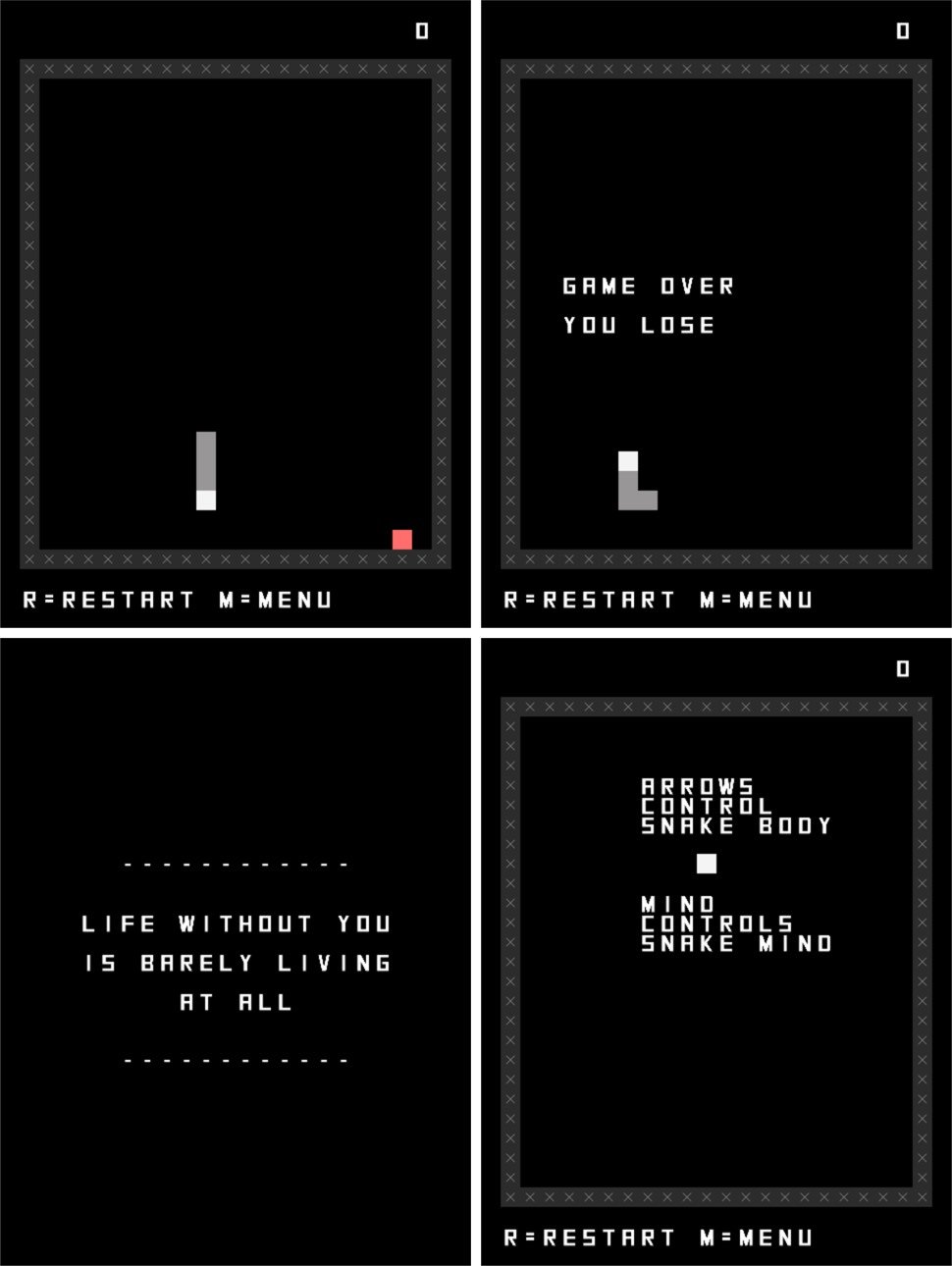
From Pippin Barr, Snakisms is a collection of 21 different variations on the old school cellphone game Snake. Each variation is based on a philosophical -ism like stoicism, capitalism, and determinism. For example, in the asceticism game, you lose as soon as you consume a dot. Clever and funny…I laughed pretty hard at narcissism.
Since its initial release in 2009, Minecraft has matured to the point of being a platform for people who want to make art and also for people who want to make money. Phil Edwards of Vox highlights some of the beautiful structures being created by Minecraft players (some of which are collected in this coffee table book called Beautiful Minecraft) and the challenges faced by creators trying to make money within a game owned by a large company.
The creativity “Creative Mode” enables is obvious in the work that talented designers produce. Sometimes Minecraft artists will create interactive worlds that replicate historic events; other times, Minecraft’s many cubes coalesce into a sculptural image, the same way pointillism’s dots disappear to form a picture. These images and worlds can be eerie, magical, and surprisingly beautiful.
But perhaps most surprising of all, Minecraft worlds can also be a business. Companies like Blockworks make maps for private Minecraft servers (computer networks that host Minecraft games), and they also occasionally design maps in collaboration with institutions and companies like Minecraft owner Microsoft.
BlockWorks — company tagline: “creative Minecraft solutions” — has done some really fantastic designs for themselves and their clients.


Shigeru Miyamoto has designed dozens of the most popular video games in the world: Donkey Kong, Super Mario Bros, and the Legend of Zelda among them. In this video by Vox, Miyamoto shares how he thinks about game design.
This is one of the first times that a video game’s plot and characters were designed before the programming. [Miyamoto:] “Well, early on, the people who made video games, they were technologists, they were programmers, they were hardware designers. But I wasn’t. I was a designer, I studied industrial design, I was an artist, I drew pictures. And so I think that it was in my generation that people who made video games really became designers rather than technologists.”
Also worth watching is this video by Game Maker’s Toolkit about how Nintendo builds everything in their games around a fun and unique play mechanic.
It seems to me that these two videos slightly contradict each other, although maybe you’ll disagree.


From Timeline, a collection of photos of video arcades in the 80s.
The years between 1978 and 1983 are generally considered the golden age of video games. Most recognize Space Invaders as the original, arcade game to reach mass audiences, quickly followed by Asteroids (1979), Centipede (1980), and Pac-Man (1980). Space Invaders was such a hit it was rumored that Japan suffered a shortage of ¥100 coins in its wake. But Pac-Man was the real game changer. Stateside, reception of the ground breaking character-driven game was ravenous, and by the end of the 20th century it was estimated that Pac-Man’s total gross consumer revenue had hit $2.5 billion (or 10 billion quarters).
I have an odd nostalgia for video arcades. They were very present in the media when I was a kid, but growing up in a small town, I never had the opportunity to actually visit a proper arcade in their heyday, aside from the one tucked into a corner of roller skating rink in a slightly larger nearby town. The best we had was a single Ms. Pac-Man machine in the entrance way of our local grocery store and the occasional Donkey Kong or Mr. Do machine we stumbled across in pizza places when we travelled later in the 80s. I was an arcade-era kid who had to wait for the Nintendo and Game Boy.

Lode Runner was probably the first video game I was ever obsessed with. I finished all 150 levels and designed countless custom levels to stump my younger sister with. That level editor was my first taste of design and I loved it. Simon Hung has built a version of the game in HTML5 that includes the 150 levels of the original game as well as almost 300 levels of subsequent versions and and! AND!! the custom level editor!!! (I actually squealed when I discovered this in the options.) I’ll see you in a few days, I guess. (via @pomeranian99)
This volley played during a game of ping pong sounds a lot like the first few bars of the music from Super Mario Bros. (thx, david)

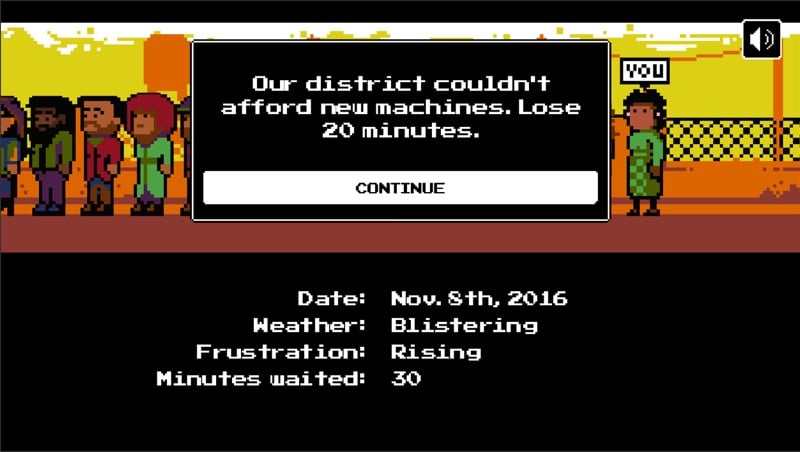
The NY Times has released their first video game editorial in the form of an Oregon Trail spin-off by GOP Arcade highlighting how the Republican Party engages in voter suppression tactics, especially in areas with many voters of color. In the game, you can play as a white programmer from California, a Latina nurse from Texas, or a black salesman from Wisconsin. As might expect, it takes somewhat longer to finish the game as some of these players versus others.
On Nov. 8, a new generation of Americans will make their own heroic journeys — to the polls. Some paths will be more intrepid than others, particularly for blacks, Latinos and pretty much anyone who brings the kind of diversity to our polling places that they have historically lacked. Thanks to laws passed by Republicans to fight the nonexistent threat of voter fraud, the perils will be great. Long lines and voter ID laws, not to mention pro-Trump election observers, will try to keep these voters from the polls.
More on voter suppression at Vox.
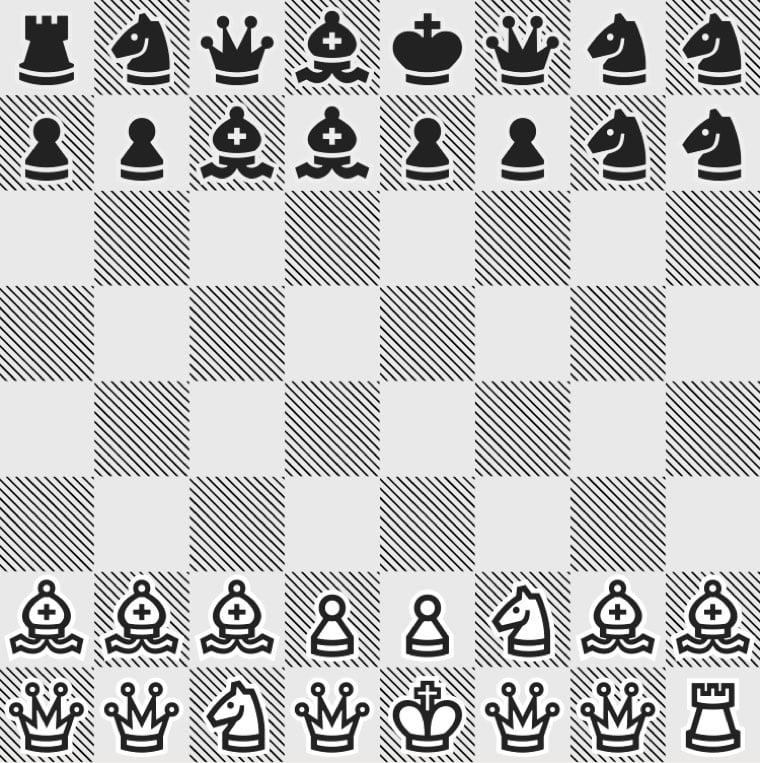
Really Bad Chess is an iOS game by Zach Gage that randomizes the distribution of pieces when the board is set up, so that you might start a game with 4 queens, 3 knights, and only 2 pawns in the back row. The result is that you get a completely new strategic game each time, but you still play with the familiar tactical rules of chess. What a great idea…I can’t tell if people who really love chess will love or hate this.
Update: See also Knightmare Chess:
Knightmare Chess is played with cards that change the default rules of chess. The cards might change how a piece moves, move opponent’s pieces, create special squares on the board or otherwise alter the game.
and Chess960 invented by Bobby Fischer:
It employs the same board and pieces as standard chess; however, the starting position of the pieces on the players’ home ranks is randomized. The random setup renders the prospect of obtaining an advantage through the memorization of opening lines impracticable, compelling players to rely on their talent and creativity.
(via @JonRelf & @akasian)
In the NY Times, Rory Smith writes about how video games like FIFA and Football Manager have changed professional soccer.
As Iwobi suggests, however, they increasingly do more than that: They are not merely representations of the game, but influencers of it. Iwobi is not the only player who believes that what he does on the field has been influenced by what he has seen rendered on a screen.
Ibrahimovic said that he would “often spot solutions in the games that I then parlayed into real life” as a young player. Mats Hummels, the Bayern Munich and Germany defender, has suggested that “maybe some people use what they learn in FIFA when they find themselves on a pitch.”
As a teen, Matt Neil went from a player of Football Manager to researcher for the game to working as a analyst for a League Two club.
I’m now an analyst at Plymouth. We’ve just signed the goalkeeper Marc McCallum, who some FM players will remember was an incredible prospect at Dundee United as a kid. I used to sign him all the time. When he came for a trial this summer, he walked in and it was one of the strangest moments in my life. I’ve never met him in person — I’d only ever seen his face on a computer game — but straight away I knew it was him.
I spoke to him at a pre-season game the next day. We got around to the subject of Football Manager and he’d been in charge of Argyle on the last game, getting them to the Premier League and signing himself. I asked him what he did when he first took over, and he said he got rid of all the staff. So I said: “Did you sack me?” And it turned out he’d actually sacked me as well. It was a strange opening conversation to have with someone.
American football and the Madden franchise have a similar relationship. The game is so realistic that prospective players can learn NFL-style offenses and established players like Drew Brees use the game to prep for the games ahead.
The New Orleans Saints quarterback told Yahoo! Sports in an interview this week that modern football simulation games such as Madden NFL have become so realistic that playing them during downtime can actually have a positive impact on the athlete’s on-field performance.
“Down the road it is going to be even more so,” Brees said. “The games are getting more lifelike every year, and everything in Madden is based on what really happens on the field.
“The plays are the same, it is updated all the time and you can go through a lot of stuff without having to get hit. I can definitely see a time when these things are used a lot more to help players.”
EA Sports’ FIFA is one of the most popular sports video games in the world. But it’s also a challenging game to master, which can make for some blooper-filled afternoons with your mates. In these two videos, real players get out onto the pitch to imitate the mannerisms and slip-ups of their video game counterparts.
Newer posts
Older posts





Socials & More