kottke.org posts about timeless posts
Writing for The Awl, Jeb Boniakowski shares his vision for a massive McDonald’s complex in Times Square that serves food from McDonald’s restaurants from around the world, offers discontinued food items (McLean Deluxe anyone?), and contains a food lab not unlike David Chang’s Momofuku test kitchen.
The central attraction of the ground floor level is a huge mega-menu that lists every item from every McDonald’s in the world, because this McDonald’s serves ALL of them. There would probably have to be touch screen gadgets to help you navigate the menu. There would have to be whole screens just dedicated to the soda possibilities. A concierge would offer suggestions. Celebrities on the iPad menus would have their own “meals” combining favorites from home (“Manu Ginobili says ‘Try the medialunas!’”) with different stuff for a unique combination ONLY available at McWorld. You could get the India-specific Chicken Mexican Wrap (“A traditional Mexican soft flat bread that envelops crispy golden brown chicken encrusted with a Mexican Cajun coating, and a salad mix of iceberg lettuce, carrot, red cabbage and celery, served with eggless mayonnaise, tangy Mexican Salsa sauce and cheddar cheese.” Wherever possible, the menu items’ descriptions should reflect local English style). Maybe a bowl of Malaysian McDonald’s Chicken Porridge or The McArabia Grilled Kofta, available in Pakistan and parts of the Middle East. You should watch this McArabia ad for the Middle Eastern-flavored remix of the “I’m Lovin’ It” song if for nothing else.
And I loved his take on fast food as molecular gastronomy:
How much difference really is there between McDonald’s super-processed food and molecular gastronomy? I used to know this guy who was a great chef, like his restaurant was in the Relais & Châteaux association and everything, and he’d always talk about how there were intense flavors in McDonald’s food that he didn’t know how to make. I’ve often thought that a lot of what makes crazy restaurant food taste crazy is the solemn appreciation you lend to it. If you put a Cheeto on a big white plate in a formal restaurant and serve it with chopsticks and say something like “It is a cornmeal quenelle, extruded at a high speed, and so the extrusion heats the cornmeal ‘polenta’ and flash-cooks it, trapping air and giving it a crispy texture with a striking lightness. It is then dusted with an ‘umami powder’ glutamate and evaporated-dairy-solids blend.” People would go just nuts for that. I mean even a Coca-Cola is a pretty crazy taste.
I love both mass-produced processed foods and the cooking of chefs like Grant Achatz & Ferran Adrià. Why is the former so maligned while the latter gets accolades when they’re the same thing? (And simultaneously not the same thing at all, but you get my gist.) Cheetos are amazing. Oscar Meyer bologna is amazing. Hot Potato Cold Potato is amazing. Quarter Pounders with Cheese are amazing. Adrià’s olives are amazing. Coca-Cola is amazing. (Warhol: ” A Coke is a Coke and no amount of money can get you a better Coke than the one the bum on the corner is drinking.”) WD50’s Everything Bagel is amazing. Cheerios are amazing. All have unique flavors that don’t exist in nature — you’ve got to take food apart and put it back together in a different way to find those new tastes.
Some of these fancy chefs even have an appreciation of mass produced processed foods. Eric Ripert of the 4-star Le Berdardin visited McDonald’s and Burger King to research a new burger for one of his restaurants. (Ripert also uses processed Swiss cheese as a baseline flavor at Le Bernardin.) David Chang loves instant ramen and named his restaurants after its inventor. Ferran Adrià had his own flavor of Lay’s potato chips in Spain. Thomas Keller loves In-N-Out burgers. Grant Achatz eats Little Caesars pizza.
In 1976, 20th Century Fox released a teaser trailer for a little film called Star Wars…aka “the story of a boy, a girl, and a universe”.
No James Earl Jones voiceover for Vader, no John Williams score (which wasn’t finished until just two months before the film premiered), but those visuals must have impressed.
Here’s the first teaser trailer for Empire Strikes Back, which features no film footage at all, just concept art drawn by Ralph McQuarrie:
And for the sake of completeness, the teaser trailer for Return of the Jedi, which appeared in theaters before Lucas changed the name from Revenge of the Jedi:
In 2011, Magnum photographer Martin Parr visited the Teddy Grays candy factory near Birmingham, England that makes old-fashioned candy with Wonka-esque names — Mint Humbugs, Nutty Brittles, Spearminties. The result is this ultra-charming 20 minute film profile of the company and its candy-making process.
Charmingness evidence, exhibit A: When asked if the company would ever modernize, company director Teddy Gray responds, “Imagine coming to work in the morning and looking at all them faxes, oh no.” Even his modernization references need modernizing.
Charmingness evidence, exhibit B: The lingerie calendar behind Gray as he talks on the phone, and the beefcake calendar behind his daughter in the very next scene.
Charmingness evidence, exhibit C through exhibit ZZZ: Every other scene in the film.
I know 20 minutes for a web video sounds daunting, but it’s worth the while. At the very least, skip to 14:00 and watch how they make “lettered rock”, hard candy sticks with words written on the inside of the candy. As shown in the video, the individual letters start out 3-4 inches high, are arranged into words when rolled up into a massive tube of candy a foot in diameter, and end up a fraction of an inch tall when pulled out into small sticks, like so:
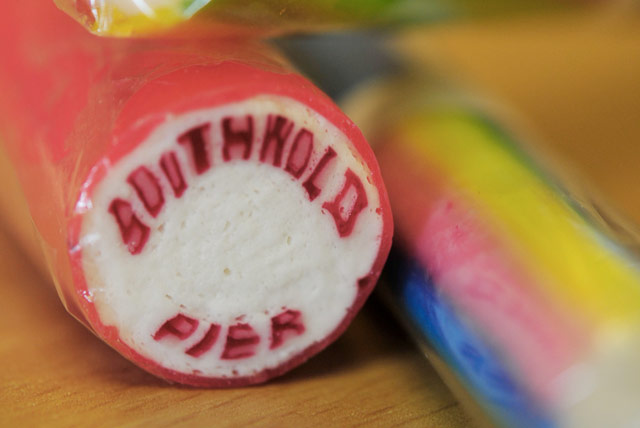
And you thought laying out type for the web was difficult. (thx, nick)
From Every Frame a Painting, an appreciation of Jackie Chan and his particular and excellent brand of action comedy.
I love old Jackie Chan movies. When I lived in Minneapolis, a theater there showed them on Saturday nights, late. Drunken Master II is a particular favorite…the final fight scene is AMAZING. The part about how the camera never moves and shoots wide-angle during his scenes is why action in contemporary Hollywood films leaves me yawning.
From 1957, this is a drawing of the synergistic strategy of Walt Disney Productions, or what Todd Zenger of Harvard Business Review calls “a corporate theory of sustained growth”.
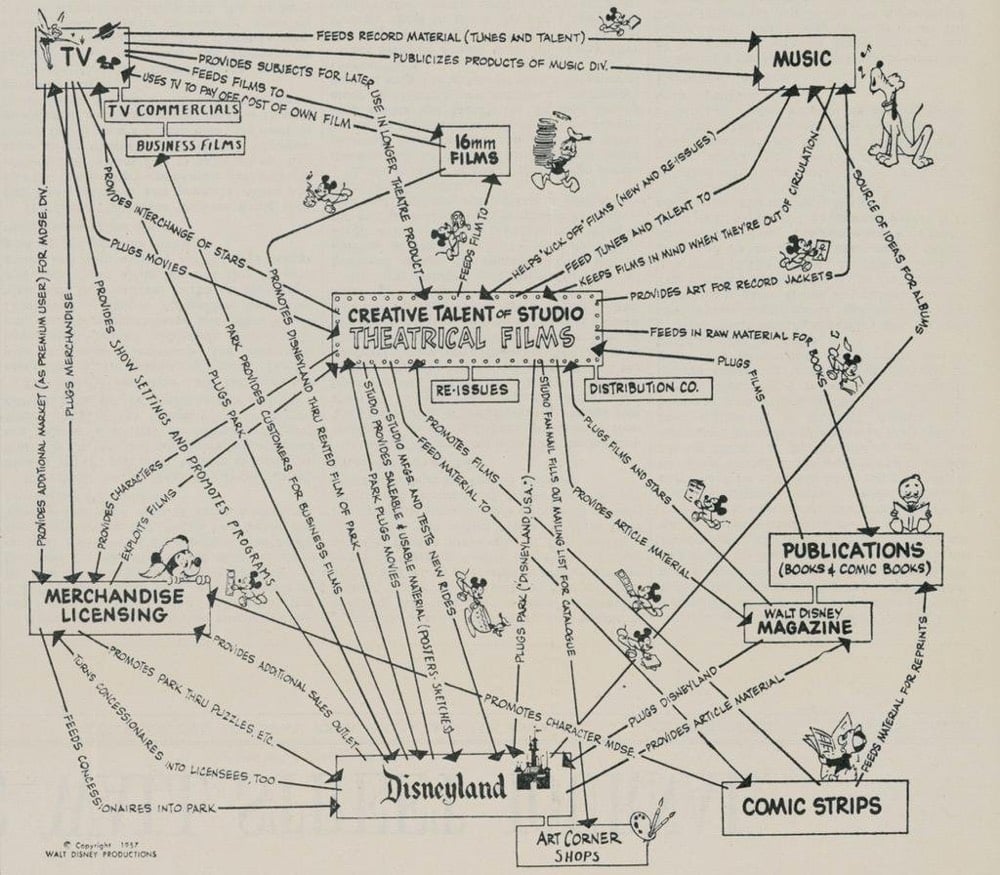
The boxes on the chart have changed, but since the appointment of Bob Iger as CEO, Disney has seemingly doubled down on Walt’s old strategy with their increased focus on franchises.
Disney’s dominance can be boiled down very simply to one word: franchises. Or rather, an “incessant focus on franchises” in the words of former Disney CFO Jay Rasulo.
“Everything we do is about brands and franchises,” Rasulo told a group of financial analysts last September. “Ten years ago we were more like other media companies, more broad-based, big movie slate, 20 something pictures, some franchise, some not franchise. If you look at our slate strategy now, our television strategy, almost every aspect of the company, we are oriented around brands and franchises.”
Franchises are well suited to extend across multiple parts of a big business like Disney, particularly because it’s a repeating virtuous cycle: movies drive merchandise sales and theme park visits, which in turn drives interest for sequels and spin-offs, rinse, repeat, reboot.
I wonder if more tech companies could be using this strategy more effectively. Apple does pretty well; their various hardware (iPhone, iPad, Mac), software (iOS, OS X), and services (iCloud, App Store, iTunes Store) work together effectively. Microsoft rode Office & Windows for quite awhile. Google seems a bit more all over the place — for instance, it’s unclear how their self-driving car helps their search business and Google+ largely failed to connect various offerings. Facebook seems to be headed in the right direction. Twitter? Not so much, but we’ll see how they do with new leadership. Or old leadership…I discovered Walt’s chart via interim Twitter CEO Jack Dorsey.
For the latest installment of Every Frame a Painting, Tony Zhou and Taylor Ramos examine the artistry and thought silent film master Buster Keaton put into the physical comedy in his movies. I used to watch all sorts of old movies with my dad (Chaplin, Keaton, Laurel & Hardy) and had forgotten how good Keaton was. If you’re anything like me in wanting to head down a Keaton rabbit hole, they recommend starting with the first short film he directed and released, One Week.
See also Studs Terkel’s 1960 interview with Keaton, a video showing Keaton’s use of symmetry and center framing (Wes Anderson, Kubrick), Every Frame a Painting episode on Jackie Chan, and The Ultimate Buster Keaton Collection, a 14-disc Blu-ray box set.
This video seems like it was made specifically for kottke.org. In the first half of it, you learn how cranberries are harvested. In the second half, there’s gorgeous HD slo-mo footage of wakeskating through a cranberry bog.
And with a Tycho soundtrack no less…it’s all too perfect. (via ★interesting)
I had no idea there was footage shot on the Moon from the perspective of a lunar rover passenger…basically a lunar rover dash cam. It’s the second half of this short video. Amazing. The first part shows the rover speeding off (at about 6 miles/hr), being put through its paces. From the transcript of the “Grand Prix”:
124:58:52 Duke: The suspension system on that thing is fantastic!
124:58:54 England: That sounds good. We sound like we probably got enough of the Grand Prix. We’re willing to let you go on from here. Call that a (complete) Grand Prix.
124:59:03 Duke: Okay. (Pause) Man, that was all four wheels off the ground, there. Okay. Max stop.
124:59:12 Young: Okay. I don’t want to do that.
124:59:13 Duke: Okay. Excuse me.
124:59:16 Young: They say that’s a no-no.
124:59:22 Duke: Okay, DAC off; Mark. Okay, John. DAC’s off.
124:59:27 Young: Okay. I have a lot of confidence in the stability of this contraption.
124:59:30 Duke: Me, too.
124:59:32 England: Sounds great.
Also, we took a fucking car to the Moon! Three times!
When he was asked to design a new outpost of iconic NYC hot dog joint Papaya King in the East Village, Andrew Bernheimer went around to several other establishments in the city built to serve food quickly — Chipotle, Russ & Daughters, Katz’s, Shake Shack, Gray’s Papaya — and looked at their floor plans and flow of customers through their spaces. Mark Lamster talked to Bernheimer about the survey.
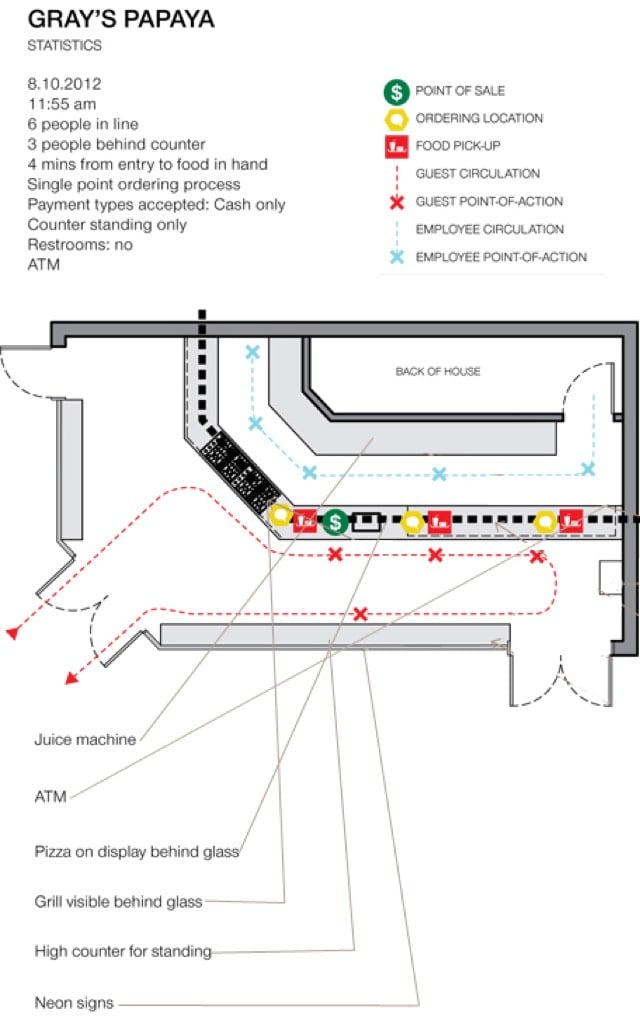
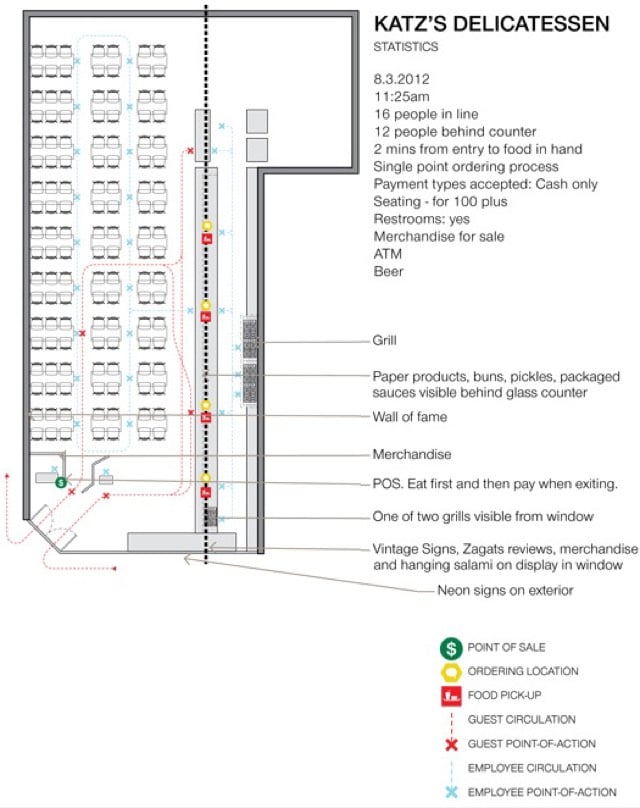
ML: I think at fast food joints we’re conscious that we’re in a very controlled environment, but perhaps don’t realize (because we are in a rush), just how manipulative that space can be. How did you see this playing out in the places you looked at?
AB: It ranged. Artisanal places (like Russ & Daughters) don’t feel manipulative in an insidious way at all (other than showing off some great food and triggering all sorts of synaptic response), while others do (Five Guys and their peanuts, a pretty nasty and obvious trigger to go order soda or spend money on WATER). We didn’t just look at fast food joints, but also icons of New York (R&D, Katz’s) that do try to serve people quickly but I don’t think qualify as “fast food joints.” In these cases the manipulation is either entirely subliminal and beyond recognition, or it has been rendered unnecessary because a place has become iconic, the domain of the “regular.”
Speaking as a customer, places like Katz’s and Russ & Daughters always felt like a total mess to me. Katz’s in particular is the worst: the whole thing with the tickets, paying on the way out, the complete lack of a single line, separate ordering locations for different types of food, etc.
That Gray’s Papaya that used to be on the corner of 8th St and 6th Ave, however, was fantastic. It had the huge benefit of being situated on the corner, but when you walked in, there was the food being cooked right in front of you. It was obvious where the line was and what direction it was moving. And after getting your food, you could exit immediately out the “back” door or circle back against the line to find a counter spot to quickly eat your meal.
I love everything about this…I scrolled through the entire list. This one was my favorite:


(via waxy)
Newsreel archivist British Pathé has uploaded their entire 85,000 film archive to YouTube. This is an amazing resource.
British Pathé was once a dominant feature of the British cinema experience, renowned for first-class reporting and an informative yet uniquely entertaining style. It is now considered to be the finest newsreel archive in existence. Spanning the years from 1896 to 1976, the collection includes footage — not only from Britain, but from around the globe — of major events, famous faces, fashion trends, travel, sport and culture. The archive is particularly strong in its coverage of the First and Second World Wars.
I’ve shared videos from British Pathé before: the Hindenberg disaster and this bizarre film of a little boy being taunted with chocolate. The archive is chock full of gems: a 19-year-old Arnold Schwarzenegger at a bodybuilding competition, footage of and interviews with survivors of the Titanic, video of the world’s tallest man (8’11”), and the collapse of the Tacoma Narrows Bridge. And this film from 1956 showing how cricket balls are made by hand:
A flock of starlings is called a murmuration, an apt word because the flocks move like a rumor pulsing through a crowded room. This is a particularly beautiful murmuration observed in Utrecht, The Netherlands.
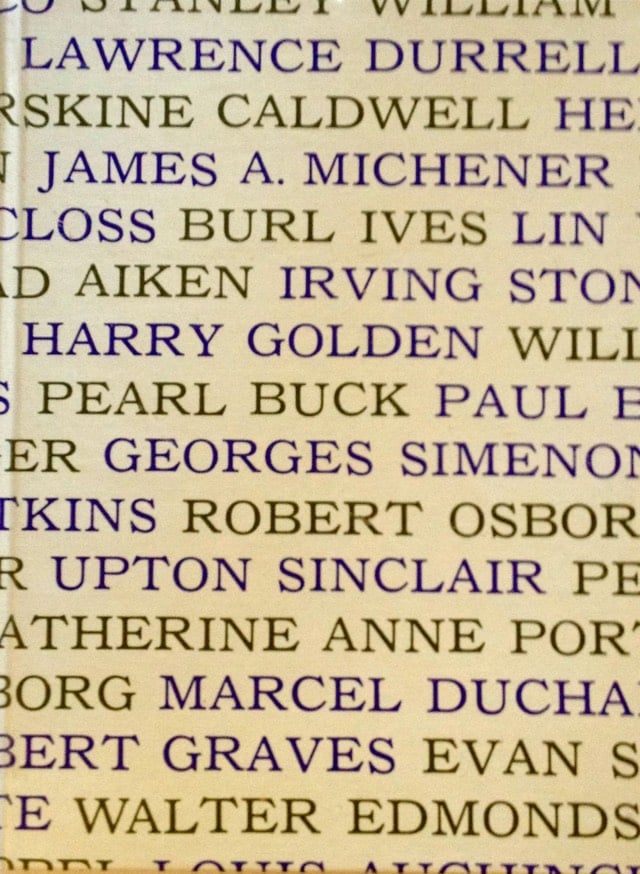
Published in 1961 with an introduction by Alice B Toklas, The Artists’ and Writers’ Cookbook features recipes and wisdom from dozens of writers and artists, including Harper Lee, Man Ray, Marcel Duchamp, Pearl Buck, Upton Sinclair, John Keats, and Burl Ives. Lee shared her recipe for crackling cornbread:
First, catch your pig. Then ship it to the abattoir nearest you. Bake what they send back. Remove the solid fat and throw the rest away. Fry fat, drain off liquid grease, and combine the residue (called “cracklings”) with:
1 ½ cups water-ground white meal
1 teaspoon salt
1 teaspoon baking powder
1 egg
1 cup milk
Bake in very hot oven until brown (about 15 minutes).
Result: one pan crackling bread serving 6. Total cost: about \$250, depending upon size of pig. Some historians say this recipe alone fell the Confederacy.
And Marcel Duchamp offers up a preparation of steak tartare:
Let me begin by saying, ma chere, that Steak Tartare, alias Bitteck Tartare, also known as Steck Tartare, is in no way related to tartar sauce. The steak to which I refer originated with the Cossacks in Siberia, and it can be prepared on horseback, at swift gallop, if conditions make this a necessity.
Indications: Chop one half pound (per person) of the very best beef obtainable, and shape carefully with artistry into a bird’s nest. Place on porcelain plate of a solid color — ivory is the best setting — so that no pattern will disturb the distribution of ingredients. In hollow center of nest, permit two egg yolks to recline. Like a wreath surrounding the nest of chopped meat, arrange on border of plate in small, separate bouquets:
Chopped raw white onion
Bright green capers
Curled silvers of anchovy
Fresh parsley, chopped fine
Black olives minutely chopped in company with yellow celery leaves
Salt and pepper to taste
Each guest, with his plate before him, lifts his fork and blends the ingredients with the egg yolks and meat. In center of table: Russian pumpernickel bread, sweet butter, and bottles of vin rosé.
Not to be outdone, MoMA published their own artists’ cookbook in 1977, featuring contributions from Louise Bourgeois, Christo, Salvador Dali, Willem De Kooning, Roy Lichtenstein, and Andy Warhol. Here’s Warhol’s recipe:
Andy Warhol doesn’t eat anything out of a can anymore. For years, when he cooked for himself, it was Heinz or Campbell’s tomato soup and a ham sandwich. He also lived on candy, chocolate, and “anything with red dye #2 in it.” Now, though he still loves junk food, McDonald’s hamburgers and French fries are something “you just dream for.”
The emphasis is on health, staying thin and eating “simple American food, nothing complicated, no salt or butter.” In fact, he says, “I like to go to bad restaurants, because then I don’t have to eat. Airplane food is the best food — it’s simple, they throw it away so quickly and it’s so bad you don’t have to eat it.”
Campbell’s Milk of Tomato Soup
A 10 3/4-ounce can Campbell’s condensed tomato soup
2 cans milk
In a saucepan bring soup and two cans milk to boil; stir. Serve.
Watch as a Latvian master blacksmith forges a Damascus steel1 knife with 320 layers of steel. Then he uses the finished knife to make a leather holder for it.
Pound it flat, fold it over. Pound it flat, fold it over. I love that twist he puts on the steel in the middle of the process. You can also see how their chisels are made, how their axes are made, or take a listen to what their knives sound like after being struck with a hammer (headphones on for this one).
The knives are available for sale from John Neeman (for $650), along with axes, chef’s knives, longbows, and other handmade items.
This 8-minute video of a drone’s eye tour of the coast of Antarctica is just flat-out gorgeous.
Newer posts
Older posts






Socials & More