



Advertise here with Carbon Ads
This site is made possible by member support. 💞
Big thanks to Arcustech for hosting the site and offering amazing tech support.
When you buy through links on kottke.org, I may earn an affiliate commission. Thanks for supporting the site!
kottke.org. home of fine hypertext products since 1998.
Beloved by 86.47% of the web.
kottke.org posts about science
Nicholas Kristof’s “Modest Proposal for a Truce
Nicholas Kristof’s “Modest Proposal for a Truce on Religion,” and responses by Sam Harris, Richard Dawkins, and Daniel Dennett. “Mr. Kristof has simply become acclimatized to the convention that you can criticize anything else but you mustn’t criticize religion.”
Richard Dawkins answers some questions from readers
Richard Dawkins answers some questions from readers of the Independent. “Terrible things have been done in the name of Christ, but all he ever taught was peace and love. What’s wrong with that?”
I thought that said “Netherlanders”…I was
I thought that said “Netherlanders”…I was ready to put that in the “odd things I didn’t know about the Dutch” column.
The weight of cyberspace
Russell Seitz says that cyberspace weighs roughly 2 ounces:
A statistically rough (one sigma) estimate might be 75-100 million servers @ ~350-550 watts each. Call it Forty Billion Watts or ~40 GW. Since silicon logic runs at three volts or so, and an Ampere is some ten to the eighteenth electrons a second, a straight forward calculation reveals that if the average chip runs at a Gigaherz, some 50 grams of electrons in motion make up the Internet. So as of today, cyberspace weighs less than two ounces.
A 2000 year-old Greek computer accurately tracked the
A 2000 year-old Greek computer accurately tracked the motion of the sun, the irregular orbit of the moon, and predicted lunar eclipses. “Remarkably, scans showed the device uses a differential gear, which was previously believed to have been invented in the 16th century. The level of miniaturisation and complexity of its parts is comparable to that of 18th century clocks.”
Frozen beer tricks
I learned something terrific yesterday: if you take a really cold but still liquid beer out of the freezer and open it, the beer will freeze within seconds. The freezing trick also works if instead of opening the beer, you give the unopened bottle a sharp rap. The reasons I’ve found online for why the trick works varies slightly for the two cases. According to Daryl Taylor’s site for science teachers, opening the bottle changes the pressure in the bottle and thus lowers the temperature:
The sealed bottle’s envoronment has a specific volume, pressure, and temperature. By changing one, you are necessarily affecting the others. The chilled liquid has a smaller temperature, esentially the same volume, thus a smaller smaler pressure. This is, of cousre, according to the basic gas-law, PVNERT. Better known as PV=nRT. Even though the internal pressure has decreased, it is still far greater than the pressure outside the container, namely one atmosphere. Upon opening, the pressure inside drastically plunges as it tries to equalize with the atmosphere. This rapid decrease in P corresponds to a rapid decrease in T, since the V is essentially the same. This rapid drop in temperature of a liquid that is NEAR freezing actually plunges the liquid into a frozen state.
Not sure I completely buy this…does the ideal gas law work for liquids? I can see that the small amount of gas in the neck of the bottle would decrease in pressure and thus decrease in temperature and that might be enough to spur the liquid into freezing. For a better answer for both cases, I consulted the internet’s all-seeing oracle, Ask Metafilter. This comment gives a succinct answer:
The beer is below the freezing temperature, but there is not enough contamination for the ice to form. The bubbles of carbon dioxide released when the bottle is hit act as nuclei for ice crystal growth in the supercooled beer. Same thing happens in reverse when water is microwaved in a smooth container but won’t boil until hit.
This more scientific discussion of unfreezable water provides more evidence of what may be going on: supercooling effects, the carbon dioxide in solution hindering freezing (osmotic depression of freezing point), and hydration factors. Anyway, wicked cool! Supercooled beer!
Update: If you require visual proof, check out these two videos of beer freezing after it’s been opened. Here’s a video with water…so fast! (via digg)
Physiologically, humans aren’t meant to drive fast
Physiologically, humans aren’t meant to drive fast in cars because our flicker fusion frequency isn’t high enough. Compared to birds (> 100 Hz versus 60 Hz for humans), at high speeds, everything kinda blurs together for us, leaving us ill-equipped to react quickly.
Discover magazine picks the 25 greatest science books
Discover magazine picks the 25 greatest science books of all time. Darwin, Newton, and Galileo top the list.
Physicists at the University of Washington are
Physicists at the University of Washington are hoping to use entangled photons to send information back in time. “Here’s where it gets weird.”
As part of their 50th anniversary celebration,
As part of their 50th anniversary celebration, New Scientist asked “70 of the world’s most brilliant scientists” what their forecasts are for the next 50 years. As Steven Pinker says, this is a sucker’s bet, but enjoyable reading nonetheless.
Interesting hypothesis: young Hollywood starlets are dieting
Interesting hypothesis: young Hollywood starlets are dieting to retain exaggerated child-like features that, evolutionarily speaking, are more attractive to adults. The technical term for this is neoteny.
Will Wright’s bibliography
The recent New Yorker piece on Will Wright is a thorough profile of the game designer, but also functions as a bibliography of sorts for the games he’s created over the past 20 years. Bibliographies are something normally reserved for books, but Wright draws much of the inspiration for his games from articles, books, papers, and other games that a list of further reading/playing in the instruction booklet for SimCity wouldn’t feel out of place. Because I like utilizing bibliographies — they allow you to get into the head of an author and see how they sampled & remixed the original ideas to create something new — I’ve created one for Will Wright. Sources are grouped by game; general influences are listed seperately.
SimCity
The Game of Life, John Conway.
Montessori school. “It’s all about learning on your terms, rather than a teacher explaining stuff to you. SimCity comes right out of Montessori — if you give people this model for building cities, they will abstract from it principles of urban design.”
Urban Dynamics - Jay Wright Forrester. “This study of urban dynamics was undertaken principally because of discoveries made in modeling the growth process of corporations. It has become clear that complex systems are counterintuitive. That is, they give indications that suggest corrective action which will often be ineffective or even adverse in its results. Very often one finds that the policies that have been adopted for correcting a difficulty are actually intensifying it rather than producing a solution.”
World Dynamics - Jay Wright Forrester.
The Sims
A Pattern Language - Christopher Alexander. “By understanding recurrent design problems in our environment, readers can identify extant patterns in their own design projects and use these patterns to create a language of their own. Extraordinarily thorough, coherent, and accessible, this book has become a bible for homebuilders, contractors, and developers who care about creating healthy, high-level design.”
A Theory of Human Motivation - Abraham Maslow. Paper on human behavior and motivation.
Maps of the Mind - Charles Hampden-Turner.
Other Sim Games
Gaia hypothesis - James Lovelock. “The Gaia hypothesis is an ecological theory that proposes that the living matter of planet Earth functions like a single organism.”
The Ants - E.O. Wilson. “This is the definitive scientific study of one of the most diverse animal groups on earth; pretty well everything that is known about ants is in this massive work.”
Spore
Powers of Ten - Charles and Ray Eames. “The film starts on a picnic blanket in Chicago and zooms out 10x every 10 seconds until the entire universe (more or less) is visible. And then they zoom all the way back down into the nucleus of an atom. A timeless classic.”
Drake Equation - Frank Drake. “Dr. Frank Drake conceived a means to mathematically estimate the number of worlds that might harbor beings with technology sufficient to communicate across the vast gulfs of interstellar space.”
SETI. “The mission of the SETI Institute is to explore, understand and explain the origin, nature and prevalence of life in the universe.”
2001: A Space Odyssey - Stanley Kubrick.
Panspermia - Freeman Dyson. “This approach was directly inspired by Freeman Dyson’s notion of Panspermia - the idea that life on earth may have been seeded via meteors carrying microscopic “spores” of life from other planets. (Dyson’s concept is also the origin of the game’s title.)”
The Life of the Cosmos - Lee Smolin. “[Smolin’s] theory of cosmic evolution by the natural selection of black-hole universes makes what we can experience into an infinitesimal, yet crucial, part of an ever-larger whole.”
The Anthropic Cosmological Principle - John Barrow, Frank Tipler, and John Wheeler. “Is there any connection between the vastness of the universes of stars and galaxies and the existence of life on a small planet out in the suburbs of the Milky Way?”
The demoscene. “The demoscene was originally limited by the hardware and storage capabilities of their target machines (16/32 bit micros such as the Atari and the Amiga ran on floppy disks), they developed intricate algorithms to produce large amounts of content from very little initial data.”
General influences
PanzerBlitz - Avalon Hill. “PanzerBlitz is a tactical-scale board wargame of tank, artillery, and infantry combat set in the Eastern Front of the Second World War.”
Super Mario Bros. - Shigeru Miyamoto. “[SMB] encouraged exploration for its own sake; in this regard, it was less like a competitive game than a ‘software toy’ — a concept that influenced Will Wright’s notion of possibility space. ‘The breadth and the scope of the game really blew me away,’ Wright told me. ‘It was made out of these simple elements, and it worked according to simple rules, but it added up to this very complex design.”
Go. “[Go] is a strategic, zero-sum, deterministic board game of perfect information.”
—
Sources: Game Master, The Long Zoom, Master of the Universe, Interview: Suzuki and Wright, Spore entry at Wikipedia, Will Wright entry at SporeWiki, Will Wright Interview.
Update: This interview with Wright at Game Studies contains a list of references from the conversation, many of which have influenced Wright’s body of work. (thx, phil)
Woo, NASA finally decides to fix the
Woo, NASA finally decides to fix the Hubble, repairs that will keep it working until at least 2013. “Scientists expect an upgraded Hubble to continue to make groundbreaking discoveries.”
By subjecting ordinary water to extremely high
By subjecting ordinary water to extremely high pressure and bombarding it with x-rays, scientists at Los Alamos have formed a new hydrogen-oxygen alloy. “Given high enough pressures, even hydrogen will behave as a metal. All the other heavier elements in hydrogen’s group of the periodic table are metals.”
The Royal Institution of London has named
The Royal Institution of London has named Primo Levi’s The Periodic Table the best science book ever written. Other authors in the running: Oliver Sacks, Steven Pinker, and Richard Dawkins.
Scott Adams hacks brain, restores speech
I know it’s only 8am, but this is the best link of the day. Scott Adams, creator of Dilbert, lost his voice 18 months ago due to a strange condition called spasmodic dysphonia. He wasn’t ever supposed to get it back, but he did what any good nerd would do: he figured out how to hack his brain to route around the problem and, voila, his voice returned. Awesome. (thx, eric)
Update: In November 2004, Adams also lost the ability to draw because of a condition called focal dystonia. As with his voice problems, he routed around the problem by learning to draw in a different way. (thx, martin)
Update: Wired has an update on Adams’ condition. Apparently a few days after he wrote the blog post above, Adams had a relapse and waited almost two more years for a surgical procedure that helped him.
Richard Dawkins: Why there almost certainly is
Richard Dawkins: Why there almost certainly is no God. “We cannot, of course, disprove God, just as we can’t disprove Thor, fairies, leprechauns and the Flying Spaghetti Monster. But, like those other fantasies that we can’t disprove, we can say that God is very very improbable.”
PopTech day 2 wrap-up
Some notes from day 2 at PopTech, with a little backtracking into day 1 as well. In no particular order:
The upshot of Thomas Barnett’s entertaining and provacative talk (or one of the the upshots, anyway): China is the new world power and needs a sidekick to help globalize the world. And like when the US was the rising power in the world and took the outgoing power, England, along for the ride so that, as Barnett put it, “England could fight above its weight”, China could take the outgoing power (the US) along for the globalization ride. The US would provide the military force to strike initial blows and the Chinese would provide peacekeeping; Barnett argued that both capabilities are essential in a post-Cold War world.
Juan Enriquez talked about boundries…specifically if there will be more or less of them in the United States in the future. 45 states? 65 states? One thing that the US has to deal with is how we treat immigrants. Echoing William Gibson, Enriquez said “the words you use today will resonate through history for a long time”. That is, if you don’t let the Mexican immigrants in the US speak their own language, don’t welcome their contributions to our society, and just generally make people feel unwelcome in the place where they live, it will come back to bite you in the ass (like, say, when southern California decides it would rather be a part of Mexico or its own nation).
Enriquez again, regarding our current income tax proclivities: “if we pay more and our children don’t owe less, that’s not taxes…it’s just a long-term, high-interest loan”.
Number of times ordained minister Martin Marty said “hell” during his presentation: 2. Number of times Marty said “goddamn”: 1. Number of times uber-heathen Richard Dawkins said “hell”, “goddamn”, or any other blasphemous swear: 0.
Dawkins told the story of Kurt Wise, who took a scissors to the Bible and cut out every passage which was in discord with the theory of evolution, eventually ending up with a fragmented mess. Confronted with this crisis of faith and science, Wise renounced evolution and became a geologist who believes that the earth is only 6000 years old.
The story of Micah Garen’s capture by Iraqi militants and Marie-Helene Carlton’s efforts to get her boyfriend back home safely illustrates the power of the connected world. Marie-Helene and Micah’s family used emails, mobile phones, and sat phones to reach out through their global social network, eventually reaching people in Iraq whom Micah’s captors might listen to. A woman in the audience stood during the Q&A and related her story of her boyfriend being on a hijacked plane out of Athens in 1985 and how powerless she was to do anything in the age before mobiles, email, and sat phones. Today, Stanley Milgram might say, an Ayatollah is never more than 4 or 5 people away.
Lexicographer Erin McKean told us several interesting things about dictionaries, including that “lexicographer” can be found in even the smallest of dictionaries because, duh, look who’s responsible for compiling the words in a dictionary. She called dictionaries the vodka of literature: a distillation of really meaty mixture of substances into something that odorless, tasteless, colorless, and yet very powerful. Here an interview with her and a video of a lecture she gave at Google.
An evolutionary theorist has predicted that humans
An evolutionary theorist has predicted that humans may split into two sub-species: “the genetic upper class would be tall, slim, healthy, attractive, intelligent, and creative and a far cry from the ‘underclass’ humans who would have evolved into dim-witted, ugly, squat goblin-like creatures.”
Headline of the week: “Horniest male beetles
Headline of the week: “Horniest male beetles have the tiniest testicles”. Bravo!
The future of science: celebrity photography. While
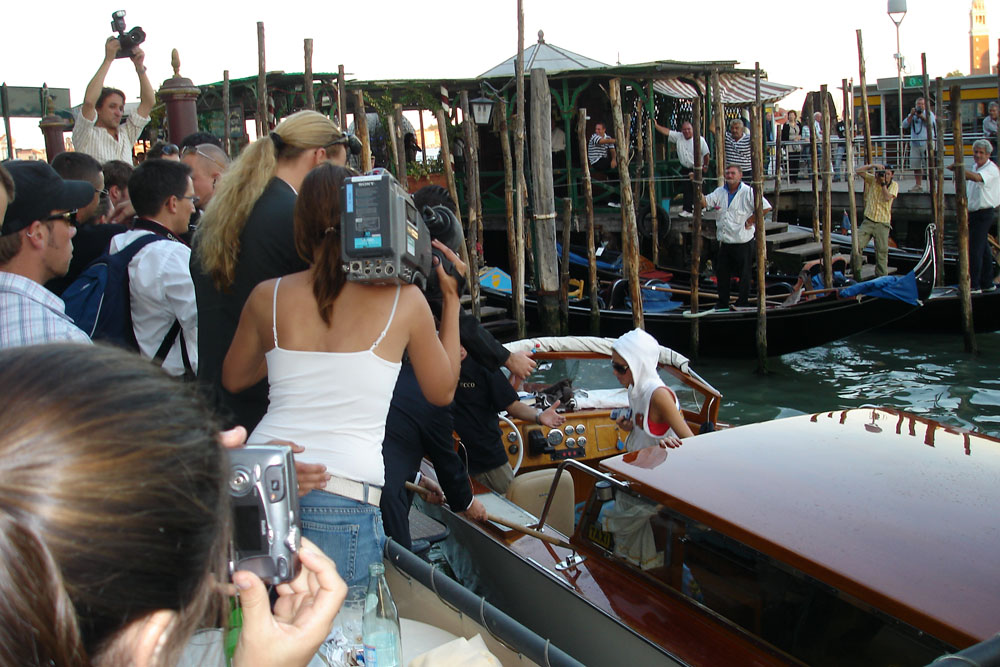
The future of science: celebrity photography. While in Venice for the World Conference on the Future of Science, prominent philosopher Daniel Dennett squeezed off a shot of Paris Hilton arriving at the hotel for, one would assume, activities unrelated to the scientific proceedings.
Stephen Hawking is making an Imax 3D
Stephen Hawking is making an Imax 3D film about “cosmology and the meaning of existence”. The film “will be like Groundhog Day meets Star Trek”.
Bob Holmes imagines an earth without people
Bob Holmes imagines an earth without people in New Scientist. “All things considered, it will only take a few tens of thousands of years at most before almost every trace of our present dominance has vanished completely. Alien visitors coming to Earth 100,000 years hence will find no obvious signs that an advanced civilisation ever lived here.”
Update: Derek Miller notes that even after human traces have vanished from earth, evidence of our civilization would remain on the moon and in space.
The Ghost Map
The Ghost Map is a book about:
- a bacterium
- the human body
- a geographical map
- a man
- a working friendship
- a household
- a city government
- a neighborhood
- a waste management system1
- an epidemic
- a city
- human civilization
You hooked yet? Well, you should be. As the narrative unfolds around the 1854 London cholera epidemic, author Steven Johnson weaves all of these social, geographical, and biological structures/webs/networks into a scientific parable for the contemporary world. The book is at its best when it zooms among these different scales in a Powers of Ten-like fashion (something Johnson calls The Long Zoom), demonstrating the interplay between them: the way the geography of a neighborhood affected the spread of a virus, how ideas spreading within a social context are like an epidemic, or the comparison between the organism of the city and the geography of a bacterial colony within the human colon. None of this is surprising if you’ve read anything about emergence, complexity, or social scale invariance, but Johnson effectively demonstrates how tightly coupled the development of (as well as our understanding of) viral epidemics and large cities were across all of these scales.
The other main theme I saw in the book is how inherently messy science is. Unlike many biographies, The Ghost Map doesn’t try to tie everything up into a nice little package to make a better story. The cholera epidemic and its resolution was sloppy; there was no aha! moment where everyone involved understood what was going on and knew what had to be done. But the scientific method applied by John Snow to the situation was solid and as more evidence became available over the years, his theory of and solution to cholera epidemics were revealed as actual fact. Johnson reminds us that that’s how science works most of the time; science is a process, not a set of facts and theories. During the recent debate in the US over evolution and intelligent design, I felt a reluctance on the part of scientists to admit to this messiness because it would give an opening to their detractors: “haha, so you admit you don’t know what’s going on at all!” Which is unfortunate, because science is powerful in its nuance and rough edges (in some ways, science is what happens at the margins) in helping us understand ourselves and the world we live in.
[1] Had Mark Kurlansky written this book, it would have been called “Shit: How Human Effluence Changed the World”. ↩
The population of earth fell into “ecological
The population of earth fell into “ecological debt” with the planet yesterday. “The date symbolised the day of the year when people’s demands exceeded the Earth’s ability to supply resources and absorb the demands placed upon it.” In 1987, ecological debt day fell on December 19.
Jim Holt reports on a pair of
Jim Holt reports on a pair of books that argue that string theory is hurting theoretical physics. The article contains a good overview of the history and current status of the theory. For those looking to discover which book is better, Holt recommends Smolin’s The Trouble with Physics.
Chad and Dave over at ScienceBlogs concocted
Chad and Dave over at ScienceBlogs concocted an experiment to compare the SAT results of high school students with those of bloggers. The result? Short answer: the bloggers lost. More results here.
Socials & More