kottke.org posts about science
That is the question that physicist Lawrence Krauss answers in his book, A Universe from Nothing. The book’s trailer provides a little more context.
Everything we see is just a 1% bit of cosmic pollution in a Universe dominated by dark matter and dark energy. You could get rid of all the things in the night sky — the stars, the galaxies, the planets, everything — and the Universe would be largely the same.
And my favorite line from the trailer:
Forget Jesus, the stars died so you could be born.
(via open culture)
From the landmark science series Cosmos, Carl Sagan narrates the evolution of humans from the first cells billions of years ago.
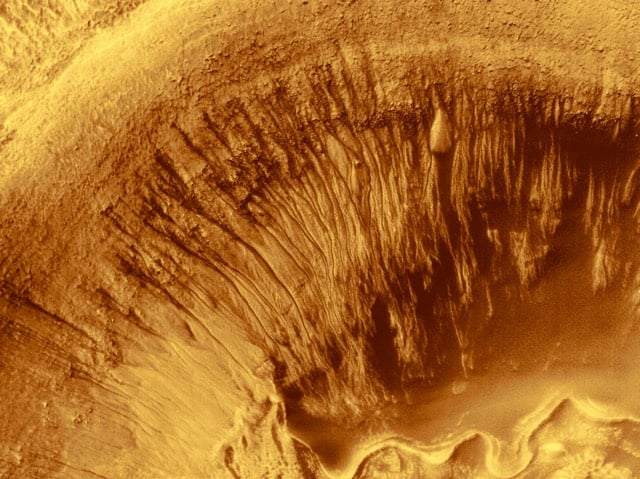
NASA’s press conference doesn’t start for a few minutes yet, but the NY Times has the scoop: NASA has found “definitive signs” of liquid water on the surface of Mars. Like, right now on Mars, not millions of years ago.
In a paper published in the journal Nature Geoscience, Dr. McEwen and other scientists identified waterlogged molecules — salts of a type known as perchlorates - in readings from orbit.
“That’s a direct detection of water in the form of hydration of salts,” Dr. McEwen said. “There pretty much has to have been liquid water recently present to produce the hydrated salt.”
By “recently,” Dr. McEwen said he meant “days, something of that order.”
This is fantastic timing for the release of The Martian movie, which comes out this weekend.
Update: And here’s the official press release from NASA.
“Our quest on Mars has been to ‘follow the water,’ in our search for life in the universe, and now we have convincing science that validates what we’ve long suspected,” said John Grunsfeld, astronaut and associate administrator of NASA’s Science Mission Directorate in Washington. “This is a significant development, as it appears to confirm that water — albeit briny — is flowing today on the surface of Mars.”
These downhill flows, known as recurring slope lineae (RSL), often have been described as possibly related to liquid water. The new findings of hydrated salts on the slopes point to what that relationship may be to these dark features. The hydrated salts would lower the freezing point of a liquid brine, just as salt on roads here on Earth causes ice and snow to melt more rapidly. Scientists say it’s likely a shallow subsurface flow, with enough water wicking to the surface to explain the darkening.
Artist and programmer Jeff Thompson has compiled 15,000 hand-drawn maps of the Sun made by astronomers into a single video, creating a mesmerizing and delightfully makeshift stop-motion animation of the Sun’s activity over the last 43 years. Astronomers have been drawing these “solar synoptic maps” since 1956 in order to keep track of the Sun’s “weather”…sunspots, flares, and the like. (via slate)
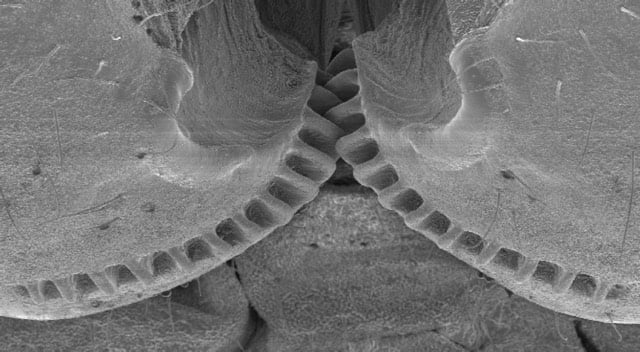
Scientists have discovered that an insect has evolved something like a gearbox to coordinate its leg movements while jumping. That’s right, nature invented mechanical gears before man got around to it.
The gears in the Issus hind-leg bear remarkable engineering resemblance to those found on every bicycle and inside every car gear-box.
Each gear tooth has a rounded corner at the point it connects to the gear strip; a feature identical to man-made gears such as bike gears — essentially a shock-absorbing mechanism to stop teeth from shearing off.
The gear teeth on the opposing hind-legs lock together like those in a car gear-box, ensuring almost complete synchronicity in leg movement — the legs always move within 30 ‘microseconds’ of each other, with one microsecond equal to a millionth of a second.
This is critical for the powerful jumps that are this insect’s primary mode of transport, as even minuscule discrepancies in synchronisation between the velocities of its legs at the point of propulsion would result in “yaw rotation” — causing the Issus to spin hopelessly out of control.
“This precise synchronisation would be impossible to achieve through a nervous system, as neural impulses would take far too long for the extraordinarily tight coordination required,” said lead author Professor Malcolm Burrows, from Cambridge’s Department of Zoology.
Edward Snowden has come up with a solution to the Fermi Paradox that I hadn’t heard of before. Maybe we haven’t discovered intelligent life elsewhere in the Universe, says Snowden, because their communications encryption is indistinguishable from cosmic background radiation.
“If you look at encrypted communication, if they are properly encrypted, there is no real way to tell that they are encrypted,” Snowden said. “You can’t distinguish a properly encrypted communication from random behaviour.”
Therefore, Snowden continued, as human and alien societies get more sophisticated and move from “open communications” to encrypted communication, the signals being broadcast will quickly stop looking like recognisable signals.
“So if you have an an alien civilization trying to listen for other civilizations,” he said, “or our civilization trying to listen for aliens, there’s only one small period in the development of their society when all their communication will be sent via the most primitive and most unprotected means.”
After that, Snowden said, alien messages would be so encrypted that it would render them unrecognisable, “indistinguishable to us from cosmic microwave background radiation”. In that case, humanity would not even realise it had received such communications.
Snowden shared his hypothesis with Neil deGrasse Tyson on Tyson’s podcast, StarTalk.
The backlit photos of Pluto just posted by NASA are breathtaking. Look at this:
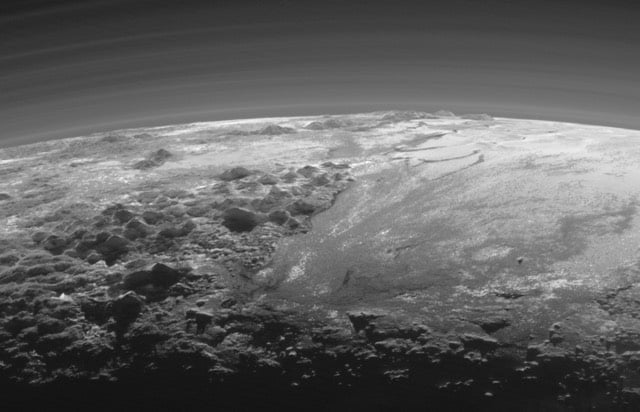
Just 15 minutes after its closest approach to Pluto on July 14, 2015, NASA’s New Horizons spacecraft looked back toward the sun and captured this near-sunset view of the rugged, icy mountains and flat ice plains extending to Pluto’s horizon. The smooth expanse of the informally named Sputnik Planum (right) is flanked to the west (left) by rugged mountains up to 11,000 feet (3,500 meters) high, including the informally named Norgay Montes in the foreground and Hillary Montes on the skyline. The backlighting highlights more than a dozen layers of haze in Pluto’s tenuous but distended atmosphere. The image was taken from a distance of 11,000 miles (18,000 kilometers) to Pluto; the scene is 230 miles (380 kilometers) across.
As they say, best viewed large. Some of those features don’t look like mountains at all, but like reptile scales or huge shards of ice pushed up into the sky. Fantastic.
Last month I shared a video showing the thousands of nuclear weapons that humans have detonated on Earth. I hadn’t really thought about it too much apart from the two dropped in Japan in WWII, but those weapons created some permanent physical changes in the landscape of the Earth. For instance, dozens of circular scars are visible at this testing range in Nevada near Area 51.
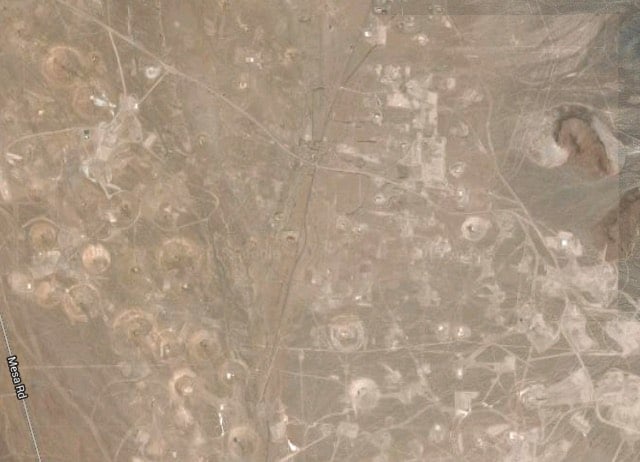
Also located in the same area is the Sedan Crater, the largest man-made crater in the United States. The crater is 320 feet deep, 1280 feet across, listed on the National Register of Historic Places, and was made by a thermonuclear device with a 104 kiloton yield detonated in 1962.
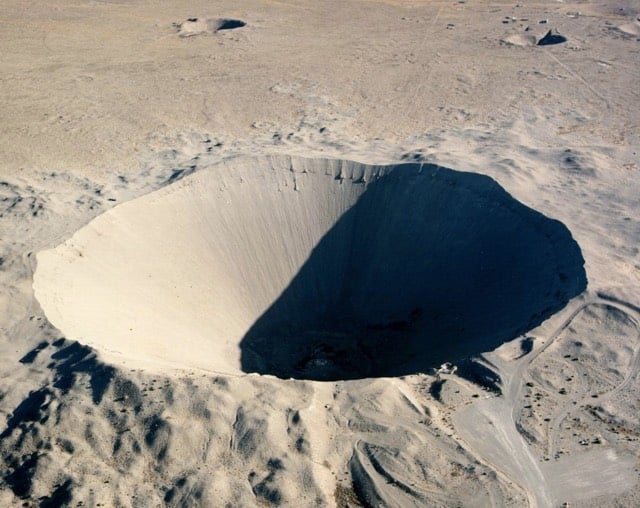
Now, I haven’t read a whole lot about nuclear tests, but this one seems particularly idiotic. The purpose of the Sedan shot was not to test a new kind of weapon or to determine the effects of the bomb, but to move earth. Yeah, no big deal, we’re just gonna use a fusion bomb like a big stick of dynamite. Sedan was part of Operation Plowshare, an effort to use nuclear devices for peaceful purposes like mining and moving earth. From Wikipedia:
Proposed uses for nuclear explosives under Project Plowshare included widening the Panama Canal, constructing a new sea-level waterway through Nicaragua nicknamed the Pan-Atomic Canal, cutting paths through mountainous areas for highways, and connecting inland river systems. Other proposals involved blasting underground caverns for water, natural gas, and petroleum storage. Serious consideration was also given to using these explosives for various mining operations. One proposal suggested using nuclear blasts to connect underground aquifers in Arizona. Another plan involved surface blasting on the western slope of California’s Sacramento Valley for a water transport project.
The Pan-Atomic Canal! This quaint US government video has more on Sedan:
In my post the other day, I said that the Soviets didn’t care about their citizenry when testing nuclear devices. Apparently the US didn’t either: the Sedan shot — the purpose of which, as a reminder, was to move a bunch of dirt — resulted in a significant amount of nuclear fallout, about 7% of the total radioactive fallout generated by all the nuclear tests in Nevada. Fallout from the test reached as far as West Virginia and was particularly high in counties in Iowa and Illinois. Buy hey, they moved 12 million tons of soil! (via @kyledenlinger)
In retrospect, it was an unlikely set of conditions that came together to produce the Space Age. Not just the postwar blend of prosperity and paranoia, but a series of scientific breakthroughs, both pure and applied, that happened in such close succession that we nearly had a surplus, one that had to be invested in something.
We had to know our world well enough to be able to escape it, but not so well that we couldn’t ignore the price we were paying. And now that window may be closing.
Here are two stories that have me in an elegiac mood. “This Used To Be the Future” is a photoessay by Rachel Sussman that looks at NASA’s Ames Research Center in Silicon Valley. Most stories about Ames focus on the cutting edge stuff, the public/private partnerships; Sussman focuses on the old stuff, the military leftovers, the junk.
Next is a piece in Scientific American on plutonium-238. NASA uses the slow-burning plutonium to power its long-range probes and interplanetary craft.
Over the past half-century, NASA has used a total of 140 kilograms of Pu-238 to push the frontiers of exploration. Coupled to one of the agency’s “thermoelectric” generators that convert heat into electricity, four kilograms of the stuff can power a spacecraft for decades. Pu-238 was used in Apollo-era science experiments on the Moon, in the Galileo mission to Jupiter and in the Pioneer and Voyager space probes now exiting our solar system. Hefty hunks of Pu-238 power the Mars Curiosity rover, the Cassini orbiter at Saturn and the New Horizons spacecraft now roaming beyond Pluto. In the future, Pu-238 could power robotic probes to burrow beneath the ice of ocean-bearing moons, planes to fly in the alien atmospheres of other worlds, ships to sail the liquid ethane seas of Saturn’s moon Titan and much, much more.
Those future missions can only occur if there’s enough plutonium to go around. Practically all of NASA’s Pu-238 stockpile was made as a byproduct of building nuclear weapons during the Cold War. As the Cold War wound down, so too did the Department of Energy’s Pu-238 production; it made its last batch in 1988, shutting off NASA’s supply save for occasional deliveries of small, lower-quality batches from Russia that ceased in 2010. At present, only about 35 kilograms of Pu-238 are left for the space agency, and radioactive decay has rendered all but 17 kilograms too weak to be readily used in NASA’s thermoelectric generators. NASA and DOE officials estimate there is only enough for four more generators, one of which is already committed to NASA’s upcoming Mars 2020 rover.
The plutonium shortfall makes it impossible for NASA to plan future missions that would require it, but in the absence of specific mission needs, nobody wants to make any more. Solar-powered craft could eventually fill in the gap, but the technology’s not there yet.
So the stars get further and further away.
Jonathan Hickman is currently writing Secret Wars for Marvel, but the roots of that story go back to his earlier run on Fantastic Four. There’s a great scene where Reed Richards, Mister Fantastic, resigns from the Singularity Conference (think TED/O’Reilly/Davos on steroids), a group of scientists he founded, as they argue for increasingly limited approaches to exploration.
The other scientists are basically correct. It is irresponsible to fund manned space missions in a global recession. Our global population may be impossible to sustain on our planet going forward. But Mister Fantastic, being a superhero, rejects the premise. “The future of man is not one billion of us fighting over limited resources on a soon-to-be-dead planet, but one trillion human beings spanning an entire galaxy,” he says. “The future of man is not here. It is out there. Because it’s our new horizon. Because it’s what’s next.”
It’s a corny, Sorkin-esque speech…. but I love it. It thrills me. And it makes me afraid.

I would like to think that that time isn’t over yet, that there is a way to reconcile what we know now with what we were willing to risk for the sake of knowledge then — that if not in outer space, then in medicine or genetics or some other field. But part of me wonders if the time for us to come together to do big things — that space age, that Marvel Age, that time of the Fantastic Four — is over. And all that’s left is how we manage our decline.
There’s a new (extinct) hominin on the block (in a cave system in Africa): Homo naledi.
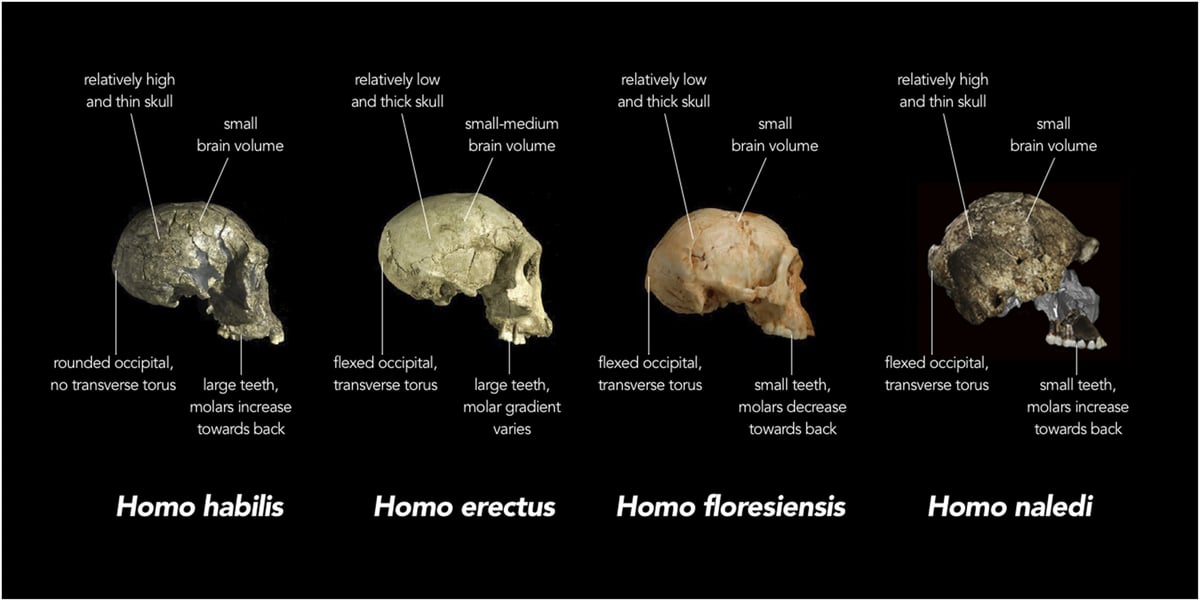
Basically, Homo naledi had humanlike hands, legs, and feet, but tiny little australopithecine skulls, i.e., brains.
And, there are a lot of them, fossil-wise: “Representing at least 15 individuals with most skeletal elements repeated multiple times, this is the largest assemblage of a single species of hominins yet discovered in Africa.”
But we don’t yet know exactly how long ago they lived: maybe two million years ago, when the Homo genus emerged, or as late as a hundred thousand years ago, when it contracted to, well, us. In an accompanying article, Chris Stringer gets a little testy about it.
Frustratingly, the rich and informative H. naledi material remains undated. Given that this hominin material could conceivably even date within the last 100,000 years, I am puzzled by the apparent lack of attempts to estimate its age. This could have been achieved directly via radiocarbon dating (even if only to test whether the material lies beyond the effective range of that method) or indirectly based on ancient DNA samples. For example, after ancient DNA was successfully recovered from the Sima de los Huesos fossils, it was used to date them to about 400,000 years old (Meyer et al., 2014). Moreover, tests on even small fragments of bone and tooth enamel could have narrowed down the possible age range and at least ruled out either a very ancient or very young age (Grün, 2006).
As Dan Cohen points out, this discovery is also unusual in that it didn’t make its splash at Science or Nature, but eLife, a free, open-access journal. Study leader Lee Berger tells Buzzfeed the article was rejected by Nature because the authors couldn’t meet the mag’s demands to squeeze the whole thing into 2500 words. Well, whatever the reason for going open-access, we of the science-following-but-not-institutional-password-having-audience approve.
Update: Ed Yong has a terrific account of the discovery, with a ripping narrative about the caving team’s expedition and an intelligent analysis of the new species and its implications. Well worth reading.
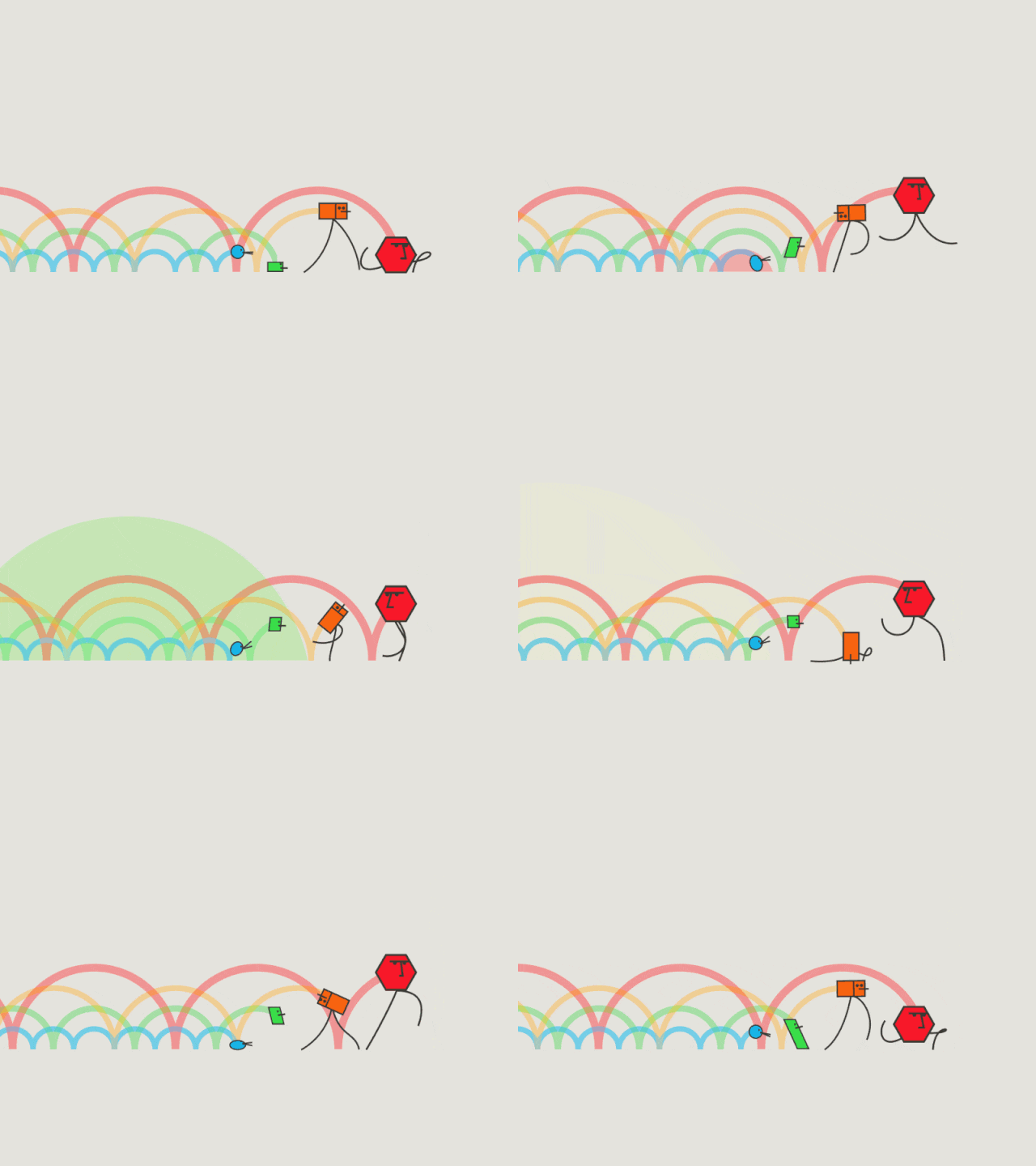
Rain-Bros by Daniel Savage is a fun visualization of the different wavelengths of light in the visible spectrum, from the loping walk of red to blue’s energetic bounce.

Oliver Sacks was a champion of one of humankind’s most admirable qualities: Curiosity. The neurologist and writer died on Monday. He wrote beautifully about his impending death in a piece published a couple weeks ago:
And now, weak, short of breath, my once-firm muscles melted away by cancer, I find my thoughts, increasingly, not on the supernatural or spiritual, but on what is meant by living a good and worthwhile life…
Longform has a collection of links to some of Sacks’ most popular essays.
Riffing on a question Richard Feynman once posed to himself, Tom Chivers asked 12 scientists:
If, in some cataclysm, all of scientific knowledge were to be destroyed, and only one sentence passed on to the next generation of creatures, what statement would contain the most information in the fewest words?
I liked the pragmatic answer by Lewis Dartnell, author of The Knowledge: How to Rebuild Civilization in the Aftermath of a Cataclysm
While Feynman’s sentence is all good and true, it isn’t particularly useful in an immediate pragmatic sense. I wrote a book recently which was intended as a guidebook for rebooting civilisation after an apocalypse, looking at the key technologies and central scientific principles that underpin our lives - the behind-the-scenes fundamentals that we all just take for granted today - and what enabled society to progress through the centuries of history. I argue how the greatest invention of history is the scientific method itself - the knowledge-generation machinery that we have been using for over 350 years now to come to understand how the world works. So if you could preserve only one single sentence, I would push for: ‘The natural world is not governed by whimsical gods, but is essentially mechanical and can therefore be understood and then predicted by people, using careful observation, experimentation, and measurement, and importantly by testing your explanations to try to refute them.’ It’s this reiterative process of refinement that sets science apart from any other system for explaining how the world works.
There are other tips that could help with immediate survival. Diarrhoeal disease kills millions of people every year - all preventable by simple means. One method recommended by the World Health Organisation in developing nations for low-tech treatment of drinking water is called SODIS, or solar disinfection. All you need to do is pour your suspect water into a plastic bottle and leave it in the sun. Ultraviolet rays in sunlight pass straight through and kill any germs. So you can come back to your bottle a day or two later and know that the water you put to your lips isn’t going to kill you.
(via @riondotnu)
Up until very recently, humans were thought to be the only animals who made and used stone tools, an era in human development that began roughly 3.3 million years ago. But according to this piece at the BBC, some chimpanzees and monkeys in various places around the globe have been using primitive stone tools for hundreds or even thousands of years.
Boesch and his colleagues had previously studied modern chimpanzee stone tool culture in the region. This research revealed that the chimpanzees have an idiosyncratic way of choosing and using their tools.
For instance, chimpanzees will often deliberately opt for particularly large and heavy stone hammers, between 1kg and 9kg, while humans prefer to use stones that weigh 1kg or less. Many of the 4300-year-old stone tools weighed more than 1kg, suggesting they were used by chimpanzees.
Chimpanzees also use their stone tools to crack open certain types of nuts that humans don’t eat. Starch residues on some of the ancient tools came from these nuts.
Together, these findings led to an obvious conclusion: chimpanzees have been using stone tools in the rainforests of Ivory Coast for at least 4300 years.
Bjorn Jonsson used the photos taken by NASA’s New Horizons spacecraft to make an animation of the probe’s flyby of Pluto.
The time covered is 09:35 to 13:35 (closest approach occurred near 11:50). Pluto’s atmosphere is included and should be fairly realistic from about 10 seconds into the animation and to the end. Earlier it is largely just guesswork that can be improved in the future once all data has been downlinked from the spacecraft. Light from Pluto’s satellite Charon illuminates Pluto’s night side but is exaggerated here, in reality it would be only barely visible or not visible at all.
Fantastic…and Pluto’s moons flying about in the background is the cherry on the top. (via @BadAstronomer)
In A Children’s Picture-book Introduction to Quantum Field Theory, Brian Skinner explains quantum field theory — “the deepest and most intimidating set of ideas in graduate-level theoretical physics” — as if you and I are five-year-old children.
The first step in creating a picture of a field is deciding how to imagine what the field is made of. Keep in mind, of course, that the following picture is mostly just an artistic device. The real fundamental fields of nature aren’t really made of physical things (as far as we can tell); physical things are made of them. But, as is common in science, the analogy is surprisingly instructive.
So let’s imagine, to start with, a ball at the end of a spring.
(via @robinsloan)
How massive are they? The Sun is 1 solar mass and as wide as 109 Earths. Sagittarius A, the black hole at the center of the Milky Way, weighs 4.3 million solar masses and is as wide as Mercury is far from the Sun. The black hole at the center of the Phoenix Cluster is one of the largest known black holes in the Universe; it’s 73 billion miles across, which is 19 times larger than our entire solar system (from the Sun to Pluto). As for how much it weighs, check this out:
I also like that if you made the Earth into a black hole, it would be the size of a peanut. (thx, reidar)
Emily Lakdawalla provides an update on all of the exploration that’s going on in our solar system this month. Here’s a quick map view of the 20+ spacecraft exploring our solar system beyond Earth:
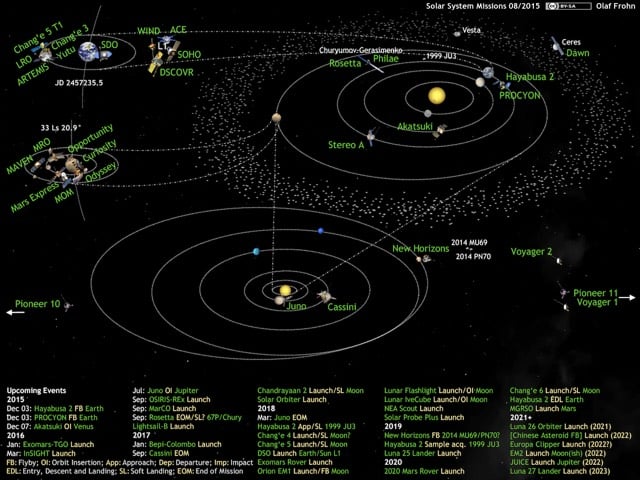
Mars remains the most active spot beyond Earth in the solar system. This week, Mars Reconnaissance Orbiter reaches its 10th anniversary of service in space, but it’s far from the oldest spacecraft in orbit at Mars; Mars Express and Mars Odyssey are still at work up there. Mars Orbiter Mission has ventured into an extended mission and is still returning photos, though apparently none of the full-disk images in a variety of phases that I had hoped for from its 4-Megapixel color camera. Even Mars’ newest resident, MAVEN, is three-quarters of the way through its one-year primary science mission, which began on November 16, 2014. MAVEN’s mission will undoubtedly be extended long beyond that, as it will be needed to support surface missions if and when Odyssey and Mars Reconnaissance Orbiter eventually fail.
Both Opportunity and Curiosity have been very active lately. Opportunity has finally reached Marathon Valley, a site identified from orbit to have signs of clay chemistry. The team is excited about the science prospects even though the rover’s memory problems persist.
Artist Sam Van Aken is using grafting to create trees that bear 40 different kinds of fruit. National Geographic recently featured Van Aken’s Tree of 40 Fruit project:
The grafting process involves slicing a bit of a branch with a bud from a tree of one of the varieties and inserting it into a slit in a branch on the “working tree,” then wrapping the wound with tape until it heals and the bud starts to grow into a new branch. Over several years he adds slices of branches from other varieties to the working tree. In the spring the “Tree of 40 Fruit” has blossoms in many hues of pink and purple, and in the summer it begins to bear the fruits in sequence — Van Aken says it’s both a work of art and a time line of the varieties’ blossoming and fruiting. He’s created more than a dozen of the trees that have been planted at sites such as museums around the U.S., which he sees as a way to spread diversity on a small scale.
(via colossal)
No hunger. No pollution. No disease. Wired’s Amy Maxmen welcomes you to the age of copy and paste DNA editing and the end of life as we know it.
Genome editing started with just a few big labs putting in lots of effort, trying something 1,000 times for one or two successes. Now it’s something that someone with a BS and a couple thousand dollars’ worth of equipment can do. What was impractical is now almost everyday. That’s a big deal.
[I recently listened to Radiolab’s show on Crispr. Recommended. -jkottke]
A company called Oxitec has genetically modified mosquito eggs so that the mosquitos born from them pass along a gene to their offspring that prohibits the mosquitos from reaching sexual maturity and mating. They release the mosquitos into the wild, they mate with the local population of mosquitos, and those born from those matings will die before mating themselves. Voila! Pest control.
Oxitec has conducted trials with its modified mosquito in dengue-ridden regions of Panama, Brazil, Malaysia, and the Cayman Islands. The results show population suppression rates above 90 percent-far greater than the typical 30 percent achieved with insecticides.
The company is currently planning a trial in Florida using this technique to curb an influx of mosquito-borne illness.
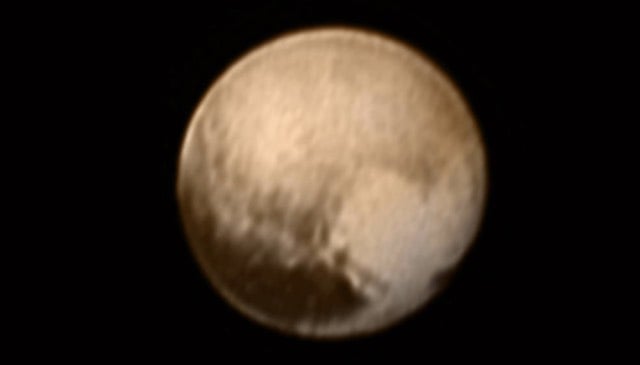
This morning, the New Horizons probe zinged safely1 past Pluto. Before it did, it transmitted the best photo we’ve seen of Pluto so far…the last one we’ll get before we get the really good stuff. Look at this:
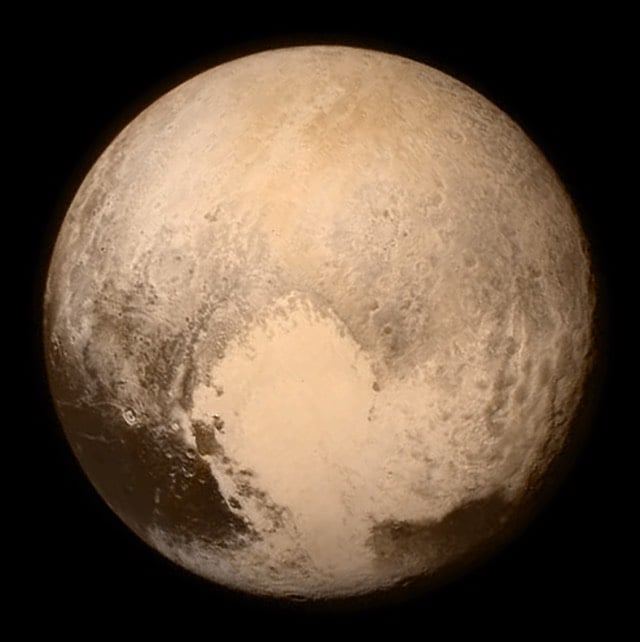
The probe’s “I’m OK!” message will reach Earth around 9pm ET tonight and we’ll start seeing photos from the flyby Wednesday afternoon…there’s a NASA press conference scheduled for 3pm ET on July 15. So exciting!
Update: The photo above is also the best full-disk image of Pluto that we will get…the rest will be close-ups and such. So that’s the official Pluto portrait from now on, folks.
CERN’s LHC (Large Hadron Collider) has discovered a new subatomic particle, the pentaquark.
“The pentaquark is not just any new particle,” said LHCb spokesperson Guy Wilkinson. “It represents a way to aggregate quarks, namely the fundamental constituents of ordinary protons and neutrons, in a pattern that has never been observed before in over fifty years of experimental searches. Studying its properties may allow us to understand better how ordinary matter, the protons and neutrons from which we’re all made, is constituted.”
Here’s the paper, with more than 680 authors. Between New Horizons zipping past Pluto earlier today (look at this pic!) and this, what a day for science.
Psychologists Dacher Keltner and Paul Ekman served as scientific consultants during the production of Pixar’s Inside Out. Keltner studies the origins of human emotion and Ekman pioneered research of microexpressions. In this NY Times piece, they discuss the science behind the movie.
Those quibbles aside, however, the movie’s portrayal of sadness successfully dramatizes two central insights from the science of emotion.
First, emotions organize — rather than disrupt — rational thinking. Traditionally, in the history of Western thought, the prevailing view has been that emotions are enemies of rationality and disruptive of cooperative social relations.
…
Second, emotions organize — rather than disrupt — our social lives. Studies have found, for example, that emotions structure (not just color) such disparate social interactions as attachment between parents and children, sibling conflicts, flirtations between young courters and negotiations between rivals.
I’ve thought about Inside Out every day since I saw it. Pixar clearly did their homework on the emotional stuff and it paid off.
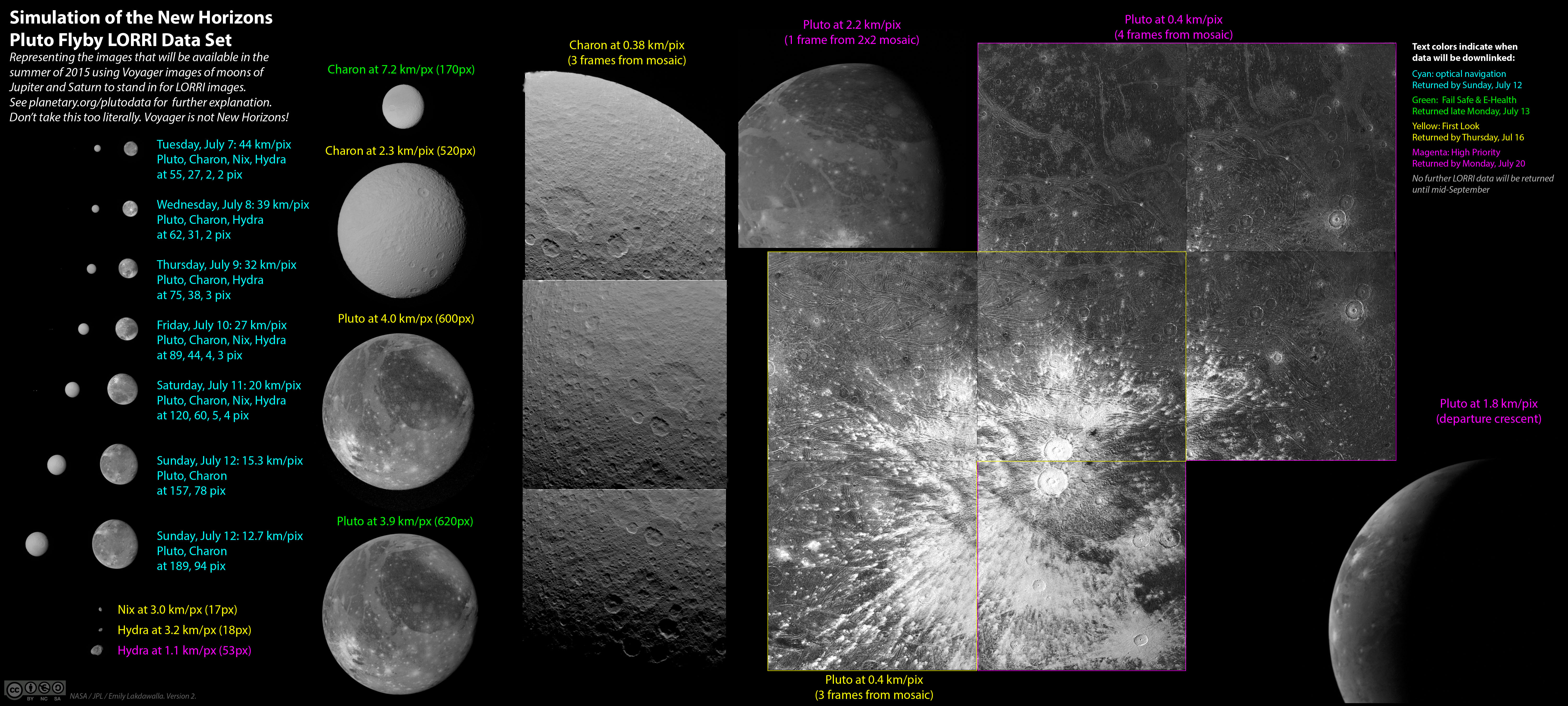
As the New Horizons probe nears Pluto, I’ve been reading a bit more about how it’s going to work and what sort of photos we’re going to get. Emily Lakdawalla has a comprehensive post about what to expect when you’re expecting a flyby of Pluto. The post contains an image of approximations of the photos New Horizon will take, using Voyager images of Jovian and Saturnian moons as stand-ins. The highest resolution photo of Pluto will be 0.4 km/pixel…it’ll have this approximate level of detail:
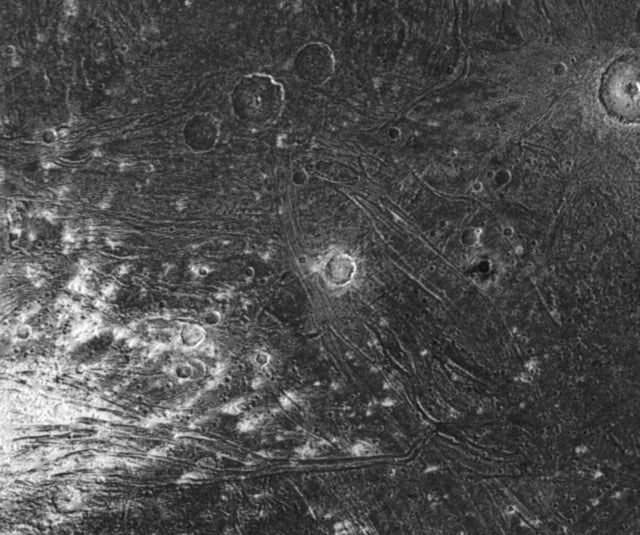
Which is pretty amazing and exciting considering that before the mission started this was our best view of Pluto:
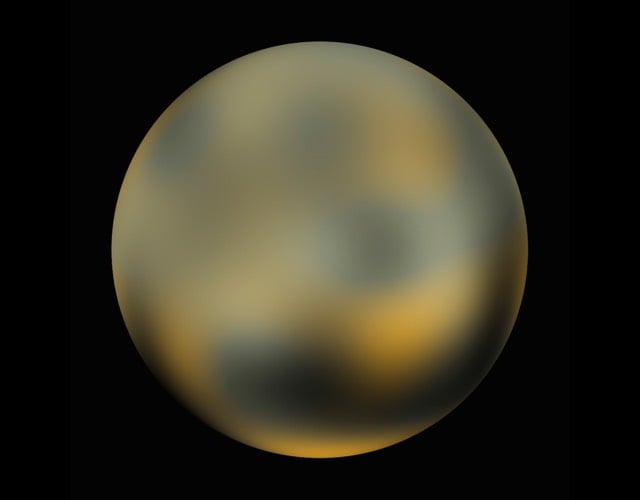
NASA’s Eyes app lets you see a simulation of the probe as it approaches Pluto, but if you don’t want to download anything, you can watch this video of the flyby instead:
I had no idea the probe spun around so much as it grabs photos & scans and then beams them back to Earth. And the flyby is so fast! New Horizons is currently moving at 32,500 mph relative to the Sun…it’s travelling just over 9 miles every second. (via @Tim_Meyer_ & @badastronomer)
Pluto is so far away that we haven’t even been able to get a good look at it, not even with the crazy-powerful Hubble telescope. But with NASA’s New Horizons mission closing in on our solar system’ ninth planet,1 we are getting a better and better view of Pluto every day.1 Here’s the latest, from just a few hours ago:
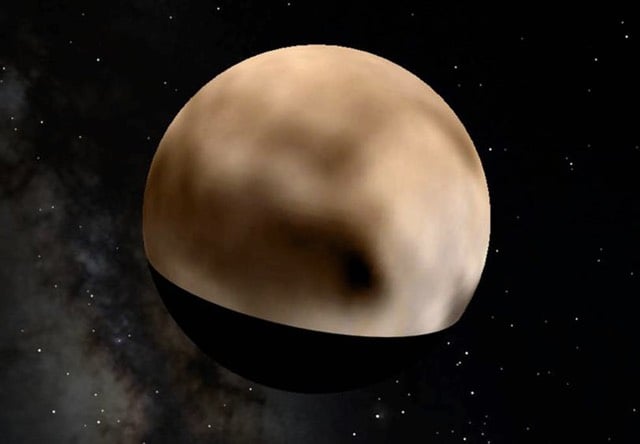
New Horizons will reach its closest approach to Pluto in just under 6 days, on July 14. The probe will pass within 7,800 miles of the surface…I can’t wait to find out what that day’s photos look like.
Update: You don’t even need to wait until tomorrow for that better image…here’s one that NASA released just a short while ago. Tune in tomorrow for an even better view.
Unlike the Earth, Mars and the Moon don’t have strong directional magnetic fields, which means traditional compasses don’t work. So how did the Apollo rovers and current Mars rovers navigate their way around? By using manually set directional gyroscope and wheel odometers.
While current un-crewed rovers don’t have to return to the comfort of a lunar module, some aspects of the Apollo systems live on in their design. Four U.S. Martian rovers have used wheel odometers that account for slippage to calculate distance traveled. They’ve also employed gyroscopes (in the form of an inertial measurement units) to determine heading and pitch/roll information.
One of the fun things about reading The Martian is you get to learn a little bit about this sort of thing. Here’s a passage about navigation on Mars where astronaut Mark Watney is trying to get to a landmark several days’ drive away.
Navigation is tricky.
The Hab’s nav beacon only reaches 40 kilometers, so it’s useless to me out here. I knew that’d be an issue when I was planning this little road trip, so I came up with a brilliant plan that didn’t work.
The computer has detailed maps, so I figured I could navigate by landmarks. I was wrong. Turns out you can’t navigate by landmarks if you can’t find any god damned landmarks.
Our landing site is at the delta of a long-gone river . NASA chose it because if there are any microscopic fossils to be had, it’s a good place to look. Also, the water would have dragged rock and soil samples from thousands of kilometers away. With some digging, we could get a broad geological history.
That’s great for science, but it means the Hab’s in a featureless wasteland.
I considered making a compass. The rover has plenty of electricity, and the med kit has a needle. Only one problem: Mars doesn’t have a magnetic field.
So I navigate by Phobos. It whips around Mars so fast it actually rises and sets twice a day, running west to east. It isn’t the most accurate system, but it works.
I wonder why the rovers in the story weren’t outfitted with directional gyroscopes and wheel odometers? (See also the operations manual for the lunar rovers.) (via @JaredCrookston)
Here’s something that I knew as a kid but had forgotten about: if you get a bike going on its own at sufficient speed, it will essentially ride itself. MinutePhysics investigates why that happens.
Interesting that the bike seems to do much of the work of staying upright when it seems like the rider is the thing that makes it work. (via devour)
While reading this otherwise excellent article written by US soccer player Christie Rampone, I discovered a type of diet I’d never heard of before, the blood type diet (italics mine).
Age and parenting make me think about longevity. I definitely believe one big reason for my longevity has to do with the dietary and fitness changes I made after being diagnosed with auto-immune conditions after giving birth to my youngest daughter Reece in 2011. For example, I’ve gone gluten-free and have started to eat to my blood-type. Also, a friend introduced me to a natural ingredient called EpiCor to help strengthen my immune system. I have taken EpiCor daily for the past three years and it has become a beneficial part of my daily routine of rest, recovery, working out, eating healthy, and being in airports and hotels more than my own house.
From Wikipedia, an overview of the diet:
The underlying theory of blood type diets is that people with different blood types digest lectins differently, and that if people eat food that is not compatible with their blood type, they will experience many health problems. On the other hand, if a person eats food that is compatible, they will be healthier.
That theory is, in turn, based on an assumption that each blood type represents a different evolutionary heritage. “Based on the ‘Blood-Type’ diet theory, group O is considered the ancestral blood group in humans so their optimal diet should resemble the high animal protein diets typical of the hunter-gatherer era. In contrast, those with group A should thrive on a vegetarian diet as this blood group was believed to have evolved when humans settled down into agrarian societies. Following the same rationale, individuals with blood group B are considered to benefit from consumption of dairy products because this blood group was believed to originate in nomadic tribes. Finally, individuals with an AB blood group are believed to benefit from a diet that is intermediate to those proposed for group A and group B.”
As you might have already guessed, there is no evidence that eating your blood type is beneficial nor do the claims of differing lectin digestion have scientific merit. Homeopathic nonsense.
Tasha Sturm, a lab technician at Cabrillo College, had her 8-year-old son put his handprint on a prepared petri dish and then incubated it for several days. This was the result:
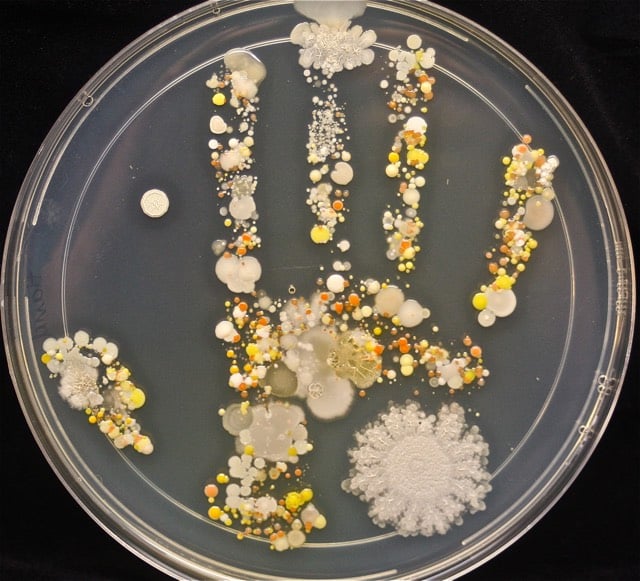
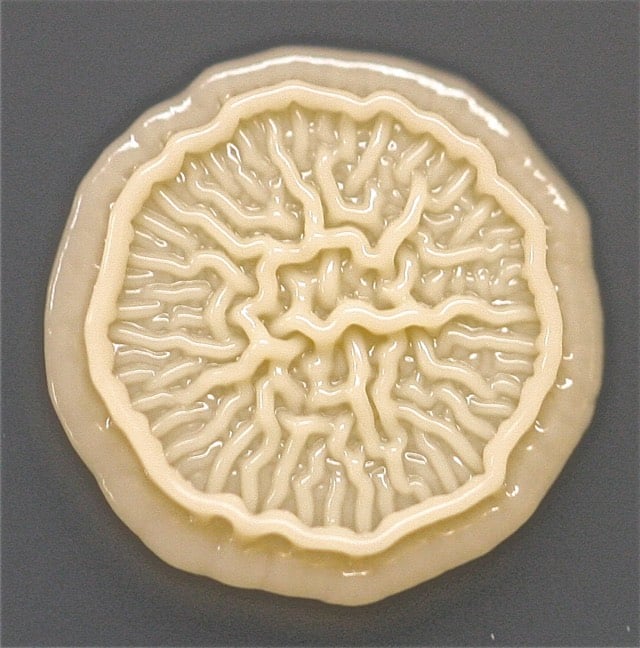
If you’ll excuse me, I have to go wash my hands about 4,000 times. Bacteria is cooooool though:
(via colossal)
Newer posts
Older posts





Socials & More