


Two Saturnian moons, lined up
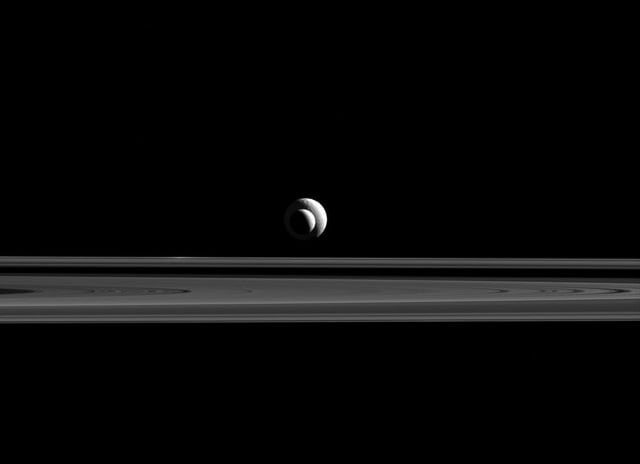
The Cassini spacecraft took a photo of two moons of Saturn, Tethys and Enceladus, beautifully aligned with each other. The cosmic ballet goes on. (via slate)

This site is made possible by member support. 💞
Big thanks to Arcustech for hosting the site and offering amazing tech support.
When you buy through links on kottke.org, I may earn an affiliate commission. Thanks for supporting the site!
kottke.org. home of fine hypertext products since 1998.
Beloved by 86.47% of the web.
The Cassini spacecraft took a photo of two moons of Saturn, Tethys and Enceladus, beautifully aligned with each other. The cosmic ballet goes on. (via slate)

You know the vodka that comes in the Crystal Skull head?1 A forensic scientist used facial reconstruction techniques to give the skull a face.
Fun fact: immediately before I went onstage at Webstock, I drank at shot of Crystal Skull vodka. Funner fact: I also took some Vicodin (left over from a dental procedure), which typically mellows me out. Neither did a damn thing to calm my nerves. ¯\_(ツ)_/¯ ↩
IUPAC, the governing body for the official periodic table of elements, has announced the addition of four new elements to the table: ununtrium, ununpentium, ununseptium, and ununoctium. Those are working names…the teams that discovered each element has been invited to name them.
The proposed names and symbols will be checked by the Inorganic Chemistry Division of IUPAC for consistency, translatability into other languages, possible prior historic use for other cases, etc. New elements can be named after a mythological concept, a mineral, a place or country, a property or a scientist.
Ununoctium is so unstable that its half-life is 0.89 milliseconds and only three or four atoms of the substance have been produced in the past 10 years.
If you’re interested in strange stories involving brain tumors, fecal bacterium, and Institutional Review Boards, Emily Eakin’s “Bacteria on the Brain” for the New Yorker should be right up your alley.
Dr. Paul Muizelaar, then chair of the neurosurgery department at U.C. Davis, undertook a daring approach to treating brain tumors. It might work, but would it help?
The previous month, he had operated on Patrick Egan, a fifty-six-year-old real-estate broker, who also suffered from glioblastoma. Egan was a friend of Muizelaar’s, and, like Terri Bradley, he had exhausted the standard therapies for the disease. The tumor had spread to his brain stem and was shortly expected to kill him. Muizelaar cut out as much of the tumor as possible. But before he replaced the “bone flap” — the section of skull that is removed to allow access to the brain — he soaked it for an hour in a solution teeming with Enterobacter aerogenes, a common fecal bacterium. Then he reattached it to Egan’s skull, using tiny metal plates and screws. Muizelaar hoped that inside Egan’s brain an infection was brewing.
Kurzgesagt makes some of the most entertaining science explainers around. Check out their most recent video on black holes.
The winner of the 2015 Small World in Motion competition is Wim van Egmond’s video of a single-celled organism consuming a smaller single-celled organism. The winners of the photomicrography contest are worth a look as well.
Over the years, there’s been a growing consensus that suggests being happy is correlated with living a long life. Well, you can wipe that smile off your face because a massive study published in The Lancent makes it clear that no such correlation exists. So what about all those studies suggesting that stress and joylessness hastened death’s arrival? According the new study’s co-author:
In our view, the previous studies haven’t been well done. All that’s going on is ill health actually was causing unhappiness and stress.
In other words, your unhappiness is going to last longer than you thought.
When you see photos of Jupiter, they’re almost always the of same view: the north pole at the top, the gaseous bands perfectly horizontal, and the Red Spot somewhere in the mix. But @robdubbin reminds us that there are other ways of looking at Jupiter. Here’s a view of the planet’s southern hemisphere:
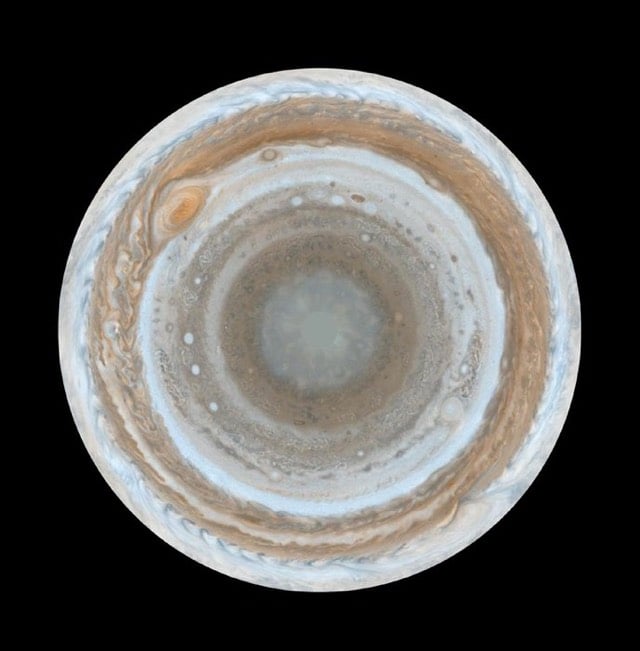
And the northern hemisphere:
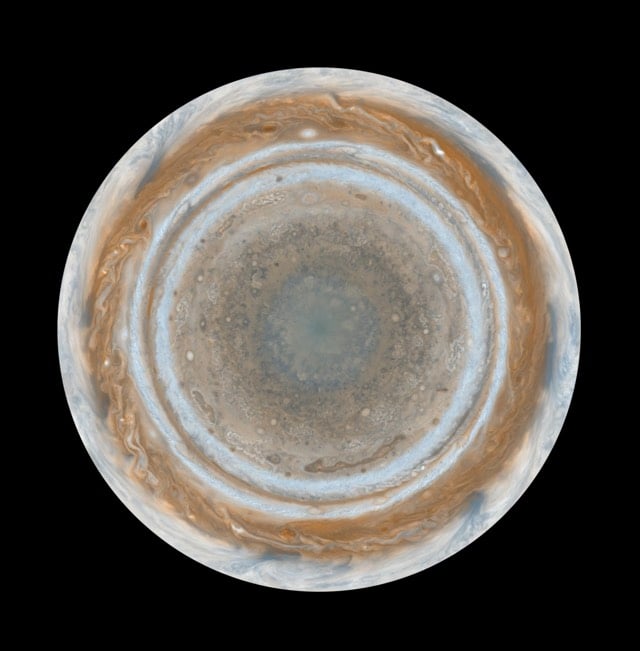
If you take photos of the whole of Jupiter’s surface and stretch it out flat, you get something like this:
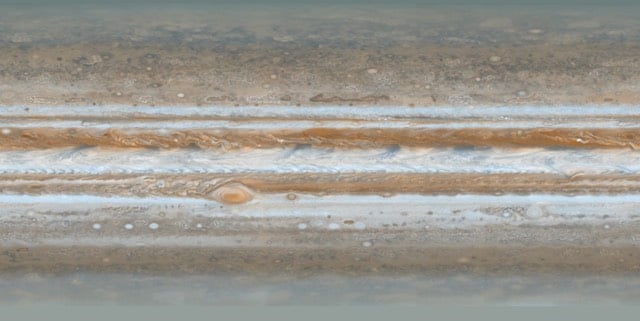
That last one in particular is worth checking out at full resolution. (via @tcarmody)
If you take two circular magnets and slap them on the ends of a AA battery, the resulting axel will drive on a road of aluminum foil. This is called a homopolar motor and it’s one of the simplest machines you can build. How does it work? Well, it’s been awhile since my last electromagnetism class, but the homopolar motor works because the combination of the flow of the electric current (from the battery) and the flow of the magnetic current produces a torque via the Lorenz force. This short video explanation should give you a good idea of the principles involved. (via digg)
A European Space Agency probe will be launched into space early next month to help test the last major prediction of Einstein’s theory of general relativity: the existence of gravitational waves.
Gravitational waves are thought to be hurled across space when stars start throwing their weight around, for example, when they collapse into black holes or when pairs of super-dense neutron stars start to spin closer and closer to each other. These processes put massive strains on the fabric of space-time, pushing and stretching it so that ripples of gravitational energy radiate across the universe. These are gravitational waves.
The Lisa Pathfinder probe won’t measure gravitational waves directly, but will test equipment that will be used for the final detector.
LISA Pathfinder will pave the way for future missions by testing in flight the very concept of gravitational wave detection: it will put two test masses in a near-perfect gravitational free-fall and control and measure their motion with unprecedented accuracy. LISA Pathfinder will use the latest technology to minimise the extra forces on the test masses, and to take measurements. The inertial sensors, the laser metrology system, the drag-free control system and an ultra-precise micro-propulsion system make this a highly unusual mission.
(via @daveg)
Why isn’t it super-fast to fly west in an airplane, given that the Earth is spinning at 700-1000 miles per hour relative to its center? This seems like a sorta-variation on the old airplane on a treadmill question, doesn’t it?
The Cassini probe, launched from Earth in 1997 (six months before I started publishing kottke.org), has been taking photos of Saturn and its moons for 11 years now. The Wall Street Journal has a great feature that shows exactly what the probe has been looking at all that time. (Note: the video above features flashing images, so beware if that sort of thing is harmful to you.)
Randall Munroe has a new book coming out called Thing Explainer: Complicated Stuff in Simple Words in which he uses the 1000 most common English words to explain interesting mostly scientific stuff. In a preview of the book, Munroe has a piece in the New Yorker explaining Einstein’s theory of relativity using the same constraint.
The problem was light. A few dozen years before the space doctor’s time, someone explained with numbers how waves of light and radio move through space. Everyone checked those numbers every way they could, and they seemed to be right. But there was trouble. The numbers said that the wave moved through space a certain distance every second. (The distance is about seven times around Earth.) They didn’t say what was sitting still. They just said a certain distance every second.
It took people a while to realize what a huge problem this was. The numbers said that everyone will see light going that same distance every second, but what happens if you go really fast in the same direction as the light? If someone drove next to a light wave in a really fast car, wouldn’t they see the light going past them slowly? The numbers said no-they would see the light going past them just as fast as if they were standing still.
It’s a fun read, but as Bill Gates observed in his review of Thing Explainer, sometimes the limited vocabulary gets in the way of true understanding:1
If I have a criticism of Thing Explainer, it’s that the clever concept sometimes gets in the way of clarity. Occasionally I found myself wishing that Munroe had allowed himself a few more terms — “Mars” instead of “red world,” or “helium” instead of “funny voice air.”
See also Albert Einstein’s Theory of Relativity In Words of Four Letters or Less. You might prefer this explanation instead, in the form of a video by high school senior Ryan Chester:
This video recently won Chester a $250,000 Breakthrough Prize college scholarship.2 Nice work!
Other quibble: I would have called Einstein the time doctor. [cue Tardis noise]↩
Which reminds me of when I was a high school senior and I showed a clip of Bill & Ted’s Excellent Adventure to my physics class for a report on time travel and wormholes. It’s been all downhill for me since then.↩
Michael Specter has a truly fascinating piece in the New Yorker about CRISPR, a relatively new genetic tool for editing genes that geneticists are very excited about.
With CRISPR, scientists can change, delete, and replace genes in any animal, including us. Working mostly with mice, researchers have already deployed the tool to correct the genetic errors responsible for sickle-cell anemia, muscular dystrophy, and the fundamental defect associated with cystic fibrosis. One group has replaced a mutation that causes cataracts; another has destroyed receptors that H.I.V. uses to infiltrate our immune system.
The story has everything: the cheap copy/paste of DNA, easily editable mice, pig Hitler, “destroyer of worlds” overtones, and an incredible tale of science that could actually revolutionize (or ruin, depending on who you talk to) the world. I was shocked at how easy it is to do genetic research nowadays.
Ordering the genetic parts required to tailor DNA isn’t as easy as buying a pair of shoes from Zappos, but it seems to be headed in that direction. Yan turned on the computer at his lab station and navigated to an order form for a company called Integrated DNA Technologies, which synthesizes biological parts. “It takes orders online, so if I want a particular sequence I can have it here in a day or two,” he said. That is not unusual. Researchers can now order online almost any biological component, including DNA, RNA, and the chemicals necessary to use them. One can buy the parts required to assemble a working version of the polio virus (it’s been done) or genes that, when put together properly, can make feces smell like wintergreen. In Cambridge, I.D.T. often makes same-day deliveries. Another organization, Addgene, was established, more than a decade ago, as a nonprofit repository that houses tens of thousands of ready-made sequences, including nearly every guide used to edit genes with CRISPR. When researchers at the Broad, and at many other institutions, create a new guide, they typically donate a copy to Addgene.
And CRISPR in particular has quickened the pace. A scientist studying lung cancer mutations said of her research:
“In the past, this would have taken the field a decade, and would have required a consortium,” Platt said. “With CRISPR, it took me four months to do it by myself.”
Also recommended: Radiolab’s podcast on CRISPR from back in June.
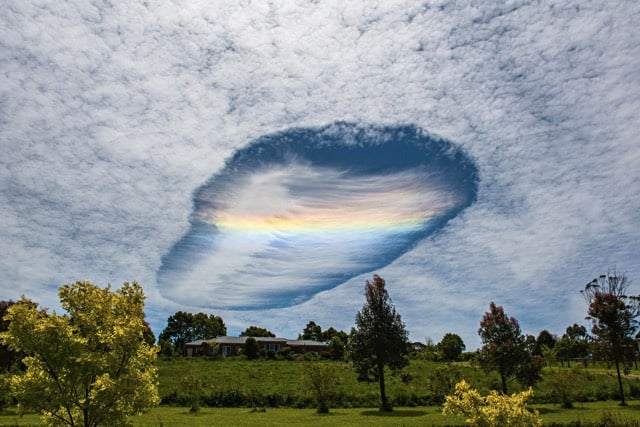
This is one of the freakiest atmospheric happenings I have ever seen: a fallstreak hole from Victoria, Aus.
It is believed that the introduction of large numbers of tiny ice crystals into the cloud layer sets off this domino effect of evaporation which creates the hole. The ice crystals can be formed by passing aircraft which often have a large reduction in pressure behind the wing- or propeller-tips. This cools the air very quickly, and can produce a ribbon of ice crystals trailing in the aircraft’s wake. These ice crystals find themselves surrounded by droplets, grow quickly by the Bergeron process, causing the droplets to evaporate and creating a hole with brush-like streaks of ice crystals below it.
More photos of this particular hole can be found here.
Here’s everything you need to know about the Earth, in a snappy 7-minute video. I am trying very hard not to watch the rest of Kurzgesagt’s videos this afternoon, but I did make time for this one on the Big Bang — key quote: “time itself becomes wibbly wobbly” — and how evolution works.
A group in Wales is testing concrete that can heal itself. Three different techniques are being pursued:
The first technique uses shape-shifting materials, known as shape-memory polymers, to repair large cracks in concrete. When these materials are heated with a small current, they can transform into a different shape that the material has ‘memorised’. The researchers believe that these materials can be embedded into concrete and used to close cracks or make them smaller.
In the second technique, researchers will pump both organic and inorganic healing agents through a network of thin tunnels in the concrete to help repair damage.
In the third technique, the team will embed tiny capsules, or lightweight aggregates, containing both bacteria and healing agents into the concrete. It is anticipated that once cracks occur, these capsules will release their cargos and, in the case of the bacteria, the nutrients that will enable them to function and produce calcium carbonate, which the researchers envisage will heal the cracks in the concrete.
Concrete-patching bacteria. Cool! (via @CharlesCMann)
Update: Dutch microbiologist Hendrik Jonkers has been working on self-healing concrete as well, with products coming to market soon.
(via digg)
A group called Kurzgesagt, in collaboration with author Johann Hari, made this video about taking a new approach to understanding addiction. You’ve probably heard of the experiments where rats in cages were given access to drugs. The rats quickly became addicted to them and used them heavily until overdosing. But perhaps the problem is not the drugs but the cage. Later experiments showed that if rats were given plenty of alternate activities, freedom, and room to roam, they were not likely to become heavy drugs users or overdose.
Human studies are more difficult to come by, but it still appears that when available, living life, family, and friends are more addictive than heroin. And so, according to Hari, who wrote a book about all this, what we should be doing is not isolating those who become addicted to drugs, alcohol, and other things. Instead, we should build a society that reconnects people to each other so that the drugs become unnecessary.
In addition to the video and the book, there’s an interactive version of the video as well as an article by Hari on Huffington Post. (via @gavinpurcell)
Update: Hari is out with a new book on the topic, Lost Connections: Uncovering the Real Causes of Depression - and the Unexpected Solutions. There’s an excerpt in The Guardian.
I started to research my book, Lost Connections: Uncovering The Real Causes of Depression — and the Unexpected Solutions, because I was puzzled by two mysteries. Why was I still depressed when I was doing everything I had been told to do? I had identified the low serotonin in my brain, and I was boosting my serotonin levels — yet I still felt awful. But there was a deeper mystery still. Why were so many other people across the western world feeling like me? Around one in five US adults are taking at least one drug for a psychiatric problem. In Britain, antidepressant prescriptions have doubled in a decade, to the point where now one in 11 of us drug ourselves to deal with these feelings. What has been causing depression and its twin, anxiety, to spiral in this way? I began to ask myself: could it really be that in our separate heads, all of us had brain chemistries that were spontaneously malfunctioning at the same time?
Update: Kurzgesagt deleted this video from their channel. You can view the deleted video (they gave people permission to repost it) and hear why they deleted it. As for Hari’s view on addiction, neuroscientist Dean Burnett addresses the controversy in a pair of posts for The Guardian and there are others within the east reach of a quick Googling.
Whoa, how have I not heard about this before today: the Cassini spacecraft is going to dive through a jet of water erupting from Enceladus, a Saturnian moon.
Discovering life was not on the agenda when Cassini was designed and launched two decades ago. Its instruments can’t capture microbes or detect life, but in a couple of dozen passes through the plumes of Enceladus, it has detected various molecules associated with life: water vapor, carbon dioxide, methane, molecular nitrogen, propane, acetylene, formaldehyde and traces of ammonia.
Wednesday’s dive will be the deepest Cassini will make through the plumes, only 30 miles above the icy surface. Scientists are especially interested in measuring the amount of hydrogen gas in the plume, which would tell them how much energy and heat are being generated by chemical reactions in hydrothermal vents at the bottom of the moon’s ocean.
That’s pretty crazy…it sounds like science fiction. NASA is doing a wonderful job producing great science with the lean budgets they are given.
Some recent science suggests that perhaps cats aren’t as domesticated as some other animals like dogs, sheep, or horses.
It appears that, following the advent of agriculture, wildcats in the Near East and Asia likely began to congregate near farms and grain stores, where mice and rats were abundant. People tolerated the volunteer exterminators, and wildcats became increasingly comfortable with people. Whether this affiliation began five or ten millennia ago, the evidence suggests that cats have not been part of our domestic domain for nearly as long as dogs, which have been our companions for perhaps forty thousand years.
After all, true house cats are only 60-ish years old, dating roughly to the invention of kitty litter.
Or, as one of my favorite short talks (by Kevin Slavin) suggests, perhaps it is humans who have been domesticated by a protozoan parasite that lives within cats, which, when transmitted to humans, makes us want to share funny cat GIFs online.
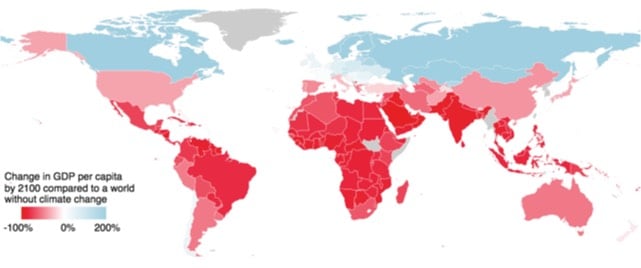
A new study from scientists and economists at Stanford and Berkeley has taken a stab at determining how climate change will affect the world’s economic activity. As part of their study, they look at which countries might benefit from climate change and which might lose out. As you might expect, countries in the Northern Hemisphere with cooler climates stand to benefit while the rest of the world will not. Here are some of the projected big winners (the Nordic countries) and losers (the Middle East):
Mongolia +1413%
Finland +516%
Iceland +513%
Russia +419%
Estonia +259%
Saudi Arabia -96%
Kuwait -96%
Oman -94%
United Arab Emirates -94%
Iraq -93%
Canada (+247%) is another one of the potential big winners while the US (-36%) stands to lose out…along with all of Africa, South America, India, and China. This quote by one of the study’s lead authors, really grabbed me by the throat:
What climate change is doing is basically devaluing all the real estate south of the United States and making the whole planet less productive. Climate change is essentially a massive transfer of value from the hot parts of the world to the cooler parts of the world. This is like taking from the poor and giving to the rich.
Among other many things, anthropogenic climate change is an issue of discrimination.1 Rich, predominantly white countries caused the problem and can do the most to limit the damage, but climate change will disproportionately affect poor countries, poor people (even in rich countries), women, and people of color. The rich need to do something about it so that the poor will not suffer. The problem is, the world’s wealthy have a long history of not being incentivized to help anyone but themselves. I hope this will turn out differently…or, as sometimes happens, the desires of the wealthy and the needs of the poor dovetail into action of joint benefit.
In fact, with no offense to those who rightly rail against causes of discrimination around the world, I would go so far to say that this is by far the largest and most important discriminatory issue the world faces today. Climate change will permanently remake the entire world and its economy, and the poor, women, and people of color stand to lose huge.↩
The scientists who conducted a study at the Delft University of Technology in the Netherlands say they have proved that quantum entanglement is a real effect.
The Delft researchers were able to entangle two electrons separated by a distance of 1.3 kilometers, slightly less than a mile, and then share information between them. Physicists use the term “entanglement” to refer to pairs of particles that are generated in such a way that they cannot be described independently. The scientists placed two diamonds on opposite sides of the Delft University campus, 1.3 kilometers apart.
Each diamond contained a tiny trap for single electrons, which have a magnetic property called a “spin.” Pulses of microwave and laser energy are then used to entangle and measure the “spin” of the electrons.
The distance — with detectors set on opposite sides of the campus — ensured that information could not be exchanged by conventional means within the time it takes to do the measurement.
The study, published in Nature, has yet to be verified, but still, exciting!
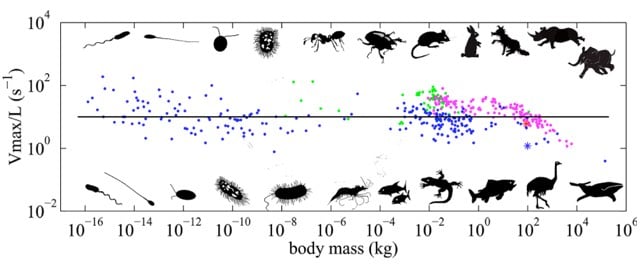
A recent paper found that the time it takes for an animal to move the length of its own body is largely independent of mass. This appears to hold from tiny bacteria on up to whales — that’s more than 20 orders of magnitude of mass. The paper’s argument as to why this happens relies on scaling laws. Alex Klotz explains.
A well-known example is the Square-Cube Law, dating back to Galileo and described quite well in the Haldane essay, On Being the Right Size. The Square-Cube Law essentially states that if something, be it a chair or a person or whatever, were made twice as tall, twice as wide, and twice as deep, its volume and mass would increase by a factor of eight, but its ability to support that mass, its cross sectional area, would only increase by a factor of four. This means as things get bigger, their own weight becomes more significant compared to their strength (ants can carry 50 times their own weight, squirrels can run up trees, and humans can do pullups).
Another example is terminal velocity: the drag force depends on the cross-sectional area, which (assuming a spherical cow) goes as the square of radius (or the two-thirds power of mass), while the weight depends on the volume, proportional to the cube of radius or the first power of mass. As Haldane graphically puts it
“You can drop a mouse down a thousand-yard mine shaft; and, on arriving at the bottom, it gets a slight shock and walks away, provided that the ground is fairly soft. A rat is killed, a man is broken, a horse splashes.”
Scaling laws also come into play in determining the limits of the size of animals: The Biology of B-Movie Monsters.
When the Incredible Shrinking Man stops shrinking, he is about an inch tall, down by a factor of about 70 in linear dimensions. Thus, the surface area of his body, through which he loses heat, has decreased by a factor of 70 x 70 or about 5,000 times, but the mass of his body, which generates the heat, has decreased by 70 x 70 x 70 or 350,000 times. He’s clearly going to have a hard time maintaining his body temperature (even though his clothes are now conveniently shrinking with him) unless his metabolic rate increases drastically.
Luckily, his lung area has only decreased by 5,000-fold, so he can get the relatively larger supply of oxygen he needs, but he’s going to have to supply his body with much more fuel; like a shrew, he’ll probably have to eat his own weight daily just to stay alive. He’ll also have to give up sleeping and eat 24 hours a day or risk starving before he wakes up in the morning (unless he can learn the trick used by hummingbirds of lowering their body temperatures while they sleep).
Hopes&Fears asked a group of scientists and researchers if reality is actually real or if it’s all an illusion or hallucination.
How do we know this is real life? The short answer is: we don’t. We can never prove that we’re not all hallucinating, or simply living in a computer simulation. But that doesn’t mean that we believe that we are.
There are two aspects to the question. The first is, “How do we know that the stuff we see around us is the real stuff of which the universe is made?” That’s the worry about the holographic principle, for example — maybe the three-dimensional space we seem to live in is actually a projection of some underlying two-dimensional reality.
Astronomers are interested in the goings-on around a star in our galaxy called KIC 8462852. There appears to be a lot of debris around it, which is a bit unusual and might have any number of causes, including that an extraterrestrial intelligence built all sorts of things around the star.
Jason Wright, an astronomer from Penn State University, is set to publish an alternative interpretation of the light pattern. SETI researchers have long suggested that we might be able to detect distant extraterrestrial civilizations, by looking for enormous technological artifacts orbiting other stars. Wright and his co-authors say the unusual star’s light pattern is consistent with a “swarm of megastructures,” perhaps stellar-light collectors, technology designed to catch energy from the star.
“When [Boyajian] showed me the data, I was fascinated by how crazy it looked,” Wright told me. “Aliens should always be the very last hypothesis you consider, but this looked like something you would expect an alien civilization to build.”
Boyajian is now working with Wright and Andrew Siemion, the Director of the SETI Research Center at the University of California, Berkeley. The three of them are writing up a proposal. They want to point a massive radio dish at the unusual star, to see if it emits radio waves at frequencies associated with technological activity.
Phil Plait has more context on this weirdo star and how the alien angle is pretty far-fetched but also worth checking out.
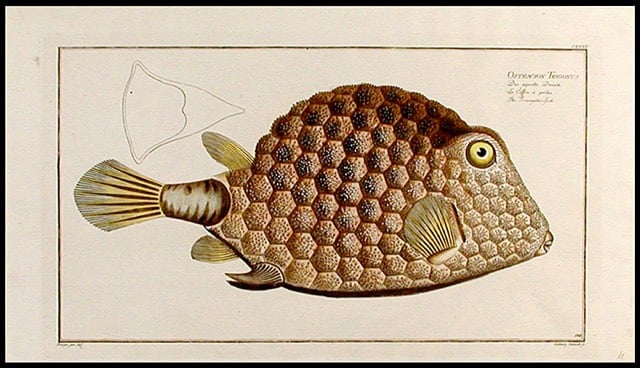
I noted the other day that since the early 1980s, the world has lost about half of its coral reefs. According to a recent study, there’s more to worry about in the sea: the ocean contains half the fish it did 45 years ago.
Professor McIntyre and his contemporaries believed that overfishing was inherently self-correcting. People might catch too much, but then they would stop fishing, letting the stock recover. They did not reckon on improvements in technology such as a monofilament line, factory trawlers, or fish finders that make it possible to catch so many fish so quickly that it can take decades for a stock to recover (if it ever does). Nor did he or his contemporaries understand food webs and ecological connections; reducing stocks of some species has more of an impact than others.
Update: Here’s a PDF copy of the actual report by the WWF. (via @RachelAronson)
It’s getting more difficult for new painkilling drugs to be approved because the rate of effectiveness vs. placebos in drug tests is falling. But oddly, the drop is only being seen in the US.
Based on patients’ ratings of their pain, the effect of trialled drugs in relieving symptoms stayed the same over the 23-year period — but placebo responses rose. In 1996, patients in clinical trials reported that drugs relieved their pain by 27% more than did a placebo. But by 2013, that gap had slipped to just 9%. The phenomenon is driven by 35 US trials; among trials in Europe, Asia and elsewhere, there was no significant change in placebo responses. The analysis is in press in the journal Pain.
(via @tomstandage)

A persistent underwater heatwave is causing corals worldwide to bleach, and scientists believe up to 5% of the world’s coral will die permanently.
Hoegh-Guldberg said he had personally observed the first signs of bleaching on Australia’s Great Barrier Reef in the past fortnight, months before the warm season begins. He said the warming pattern indicated bleaching this summer would likely affect 50% of the reef, leaving 5-10% of corals dead. Eakin said seeing bleaching on the reef at this time of year was “disturbing”.
Also, no matter how many times I read this, it never gets less scary:
Since the early 1980s the world has lost roughly half of its coral reefs.
The oceans are slowly boiling and we’re the frogs who aren’t noticing. (via @EricHolthaus)
When the Curiosity rover landed on the surface of Mars, it took high-resolution photos all the way down. Luke Fitch took those photos and stitched them together into a first-person HD video of the rover’s landing.
Update: I was wondering if someone had done a stabilized version of this video and lo:
(via @willhains)
Socials & More