kottke.org posts about photography
Photos by Taryn Simon of hidden and unfamiliar places in the US, like the marijuana crop grow room at the National Center for Natural Products Research in Mississippi. Here’s a somewhat overlapping selection of photos at Wired and another at The Morning News, which includes a great letter from Disney denying Simon access to their theme park’s underbelly.
After giving your request serious consideration, even though it is against company policy to consider such a request, it is with regret that I inform you that we are not willing to grant the permission you seek…As you are aware, our Disney characters, parks and other valuable properties have become beloved by young and old alike, and with this comes a tremendous responsibility to protect their use and the protection we currently enjoy. Should we lapse in our vigilance, we run the risk of losing this protection and the Disney characters as we know and love them…Especially during these violent times, I personally believe that the magical spell cast on guests who visit our theme parks is particularly important to protect and helps to provide them with an important fantasy they can escape to.
Richard Mosse’s Air Disaster, a series of photographs of air disaster simulations, on-the-ground training exercises for airport fire-fighting crews. BLDGBLOG has a short interview with the photographer.
The firemen have put out the fire in seconds. That’s their job, after all. They do this with decisive brevity and great courage, sometimes walking right into flames — but it doesn’t make for an easy photograph. It’s all a bit like the sexual act: the flames come up and men run in and spray everything with a high power water hose and then it’s all over.
Short interview with photographer Helmut Newton.
Q: Your about to be published autobiography stops in 1982. What have the readers missed?
A: Nothing! People who reach their goals are very uninteresting. What could I have written about the last 20 years? I met a lot of awfully boring Hollywood bimbos. I earned a lot of money. I fly only first class.
NSFW if tasteful nudes aren’t safe to view at your place of employ. Oh, and here’s another interview with Newton with a bit more about his work.
Polaroid is going to stop manufacturing film for their instant cameras, which they stopped making a year ago.
The company, which stopped making instant cameras for consumers a year ago and for commercial use a year before that, said today that as soon as it had enough instant film manufactured to last it through 2009, it would stop making that, too. Three plants that make large-format instant film will close by the end of the quarter, and two that make consumer film packets will be shut by the end of the year, Bloomberg News reports.
Hopefully someone else will pick up where they left off; Polaroid is willing to license the manufacturing technology to other companies. (via clusterflock)
Many photographers, curators, bloggers, etc. answer the question: What makes a good portrait?
I do have specific ideas of what a good portrait may consist of, but I am often amazed at the portraits I come across that do not abide by any of these “rules.” Many of these images are truly spectacular. And it further reminds me that good art is made up of many things, and this question can almost never really be answered, at least not with any certainty.
B&H is selling a used Canon Super Telephoto 1200mm lens for $99,000.
As for image quality, even wide open it’s quite lovely. Stopped down to f/8 and f/11 it’s actually quite remarkable. How remarkable? From midtown Manhattan we were able to read the street signs on the corner of JFK Boulevard East and 43rd St. in Weehawkin New Jersey when viewing image files at pixel resolution.
The lens weighs 36 pounds and there are probably less than 20 of them in existence. (thx, rob)
Update: Carl Zeiss designed a 1700mm lens for a 6x6 medium format camera. It weighs 564 pounds! (thx, jonathan, who notes that it looks like a Star Trek shuttle)
Update: There’s also a Nikon 1200-1700mm lens and a Nikon 2000mm lens. (thx, markus)
Update: Canon even made a 5000mm lens. (thx, sadat)
Update: Ok, last one and then we’re on to telescopes. (I’m kidding…please do not send me links to telescopes.) The Panavision 300x HD Lens…2100mm. (thx, philip)
Someone made a video overlay of the 134 times it took him to get through one level of hacked version of Mario World. (Note: the original video was taken down so the embed is a similar video.)
Oh, and how that relates to quantum mechanics:
But, we can kind of think of the multi-playthrough Kaizo Mario World video as a silly, sci-fi style demonstration of the Quantum Suicide experiment. At each moment of the playthrough there’s a lot of different things Mario could have done, and almost all of them lead to horrible death. The anthropic principle, in the form of the emulator’s save/restore feature, postselects for the possibilities where Mario actually survives and ensures that although a lot of possible paths have to get discarded, the camera remains fixed on the one path where after one minute and fifty-six seconds some observer still exists.
Some of my favorite art and media deals with the display of multiple time periods at once. Here are some other examples, many of which I’ve featured on kottke.org in the past.
Averaging Gradius predates the Mario World video by a couple years; it’s 15 games of Gradius layered over one another.

I found even the more pointless things incredibly interesting (and telling), like seeing when each person pressed the start button to skip the title screen from scrolling in, or watching as each Vic Viper, in sequence, would take out the red ships flying in a wave pattern, to leave behind power-ups in an almost perfect sine wave sequence. I love how the little mech-like gunpods together emerge from off screen, as a bright, white mass, and slowly break apart into a rainbow of mech clones.
According to the start screen, Cursor*10 invites the you to “cooperate by oneself”. The game applies the lessons of Averaging Gradius and multiple-playthrough Kaizo Mario World to create a playable game. The first time through, you’re on your own. On subsequent plays, the game overlays your previous attempts on the screen to help you avoid mistakes, get through faster, and collaborate on the tougher puzzles.
Moving away from games, several artists are experimenting with the compression of multiple photographs made over time into one view. Jason Salavon’s averaged Playboy centerfolds and other amalgamations, Atta Kim’s long exposures, Michael Wesley’s Open Shutter Projekt and others. I’m quite sure there are many more.
Dozens of frames of Run Lola Run racing across the giant video screen in the lobby of the IAC building.
The same kind of thing happens in this Call and Response video; 9 frames display at the same time (with audio), each a moment ahead of the previous frame.
Related, but not exactly in the same spirit, are projects like Noah Kalina’s Noah K. Everyday in which several photos of the same person (or persons) taken over time are displayed on one page, like frames of a very slow moving film. More examples: JK Keller’s The Adaption to my Generation, Nicholas Nixon’s portraits of the Brown sisters, John Stone’s fitness progress, Diego Golberg’s 32 years of family portraits, and many more.
Update: Another video game one: 1000 cars racing at the same time. (thx, matt)
Update: More games: Super Earth Defense Game, Time Raider, and Timebot. (thx, jon)
Update: Recreating Movement is a method for making time merge photos (thx, boris):
With the help of various filters and settings Recreating Movement makes it possible to extract single frames of any given film sequence and arranges them behind each other in a three-dimensional space. This creates a tube-like set of frames that “freezes” a particular time span in a film.
How You See It overlays three TV news programs covering the same story. (via waxy)
Update: James Seo’s White Glove Tracking visualizations. The Slinky one is mesmerizing once you figure out what to look for. Seo also keeps a blog on spilt-screen media.
The sound of a Leica shutter.
When you take a picture with an S.L.R., there is a distinctive sound, somewhere between a clatter and a thump; I worship my beat-up Nikon FE, but there is no denying that every snap reminds me of a cow kicking over a milk pail. With a Leica, all you hear is the shutter, which is the quietest on the market. The result — and this may be the most seductive reason for the Leica cult — is that a photograph sounds like a kiss.
That’s Anthony Lane in the New Yorker.
Leica is offering a “perpetual update program” for its M8 digital camera.
In keeping with these proud traditions, but now in the age of digital technology, Leica introduces it’s perpetual update program which makes the LEICA M8 a digital camera in which, uniquely, owners will be able to incorporate the latest refinements and developments in technology. While other digital cameras quickly become outdated and are replaced by new models, Leica’s new concept allows it’s customers to invest in the photographic equipment they need sure in the knowledge that they will not miss out on improvements and technological developments in the future.
The first upgrade adds a hard-to-scratch sapphire glass LCD screen cover and a quieter shutter.
Update: Just to be clear, the upgrade program costs money. According to Gizmodo, the first upgrade is $1800. On the plus side, each time you upgrade, they extend the warranty on the whole camera for two years.
Eddie Adams, who won a Pulitzer Prize for his famous photo of General Nguyen Ngoc Loan shooting a Viet Cong prisoner, wishes he had never taken the photo.
The general killed the Viet Cong; I killed the general with my camera. Still photographs are the most powerful weapon in the world. People believe them, but photographs do lie, even without manipulation. They are only half-truths. What the photograph didn’t say was, “What would you do if you were the general at that time and place on that hot day, and you caught the so-called bad guy after he blew away one, two or three American soldiers?”
(via times online)
A series of photos by Alexei Vassiliev, along with some introductory text about his “anonymous portraits”.
Armed with only a hand-held 35mm film camera, and using available artificial light, Russian photographer Alexei Vassiliev has created a series of stunning portraits of anonymous 21st century urban dwellers. A very slow shutter speed allows him to capture rich colors and blurred human gestures to create iconic images that evoke the essence of modern humanity without much of the detail.
Reminds me of a favorite photo of mine, a picture I took of Meg in Ireland with a fogged up lens.
The oil sands of Alberta have created an oil boom in the Canadian province.
And how much oil is there? Estimates bounced around for years until 1999, when Alberta got serious about determining its potential. Based on data from 56,000 wells and 6,000 core samples, the Energy and Utilities Board (EUB) came up with an astonishing figure: The amount of oil that could be recovered with existing technology totalled 175 billion barrels, enough to cover U.S. consumption for more than 50 years. With the new math, Canada slipped quietly into second place behind Saudi Arabia’s 265 billion barrels in oil reserves, followed by Iran and Iraq.
Edward Burtynsky took some photos of the oil sands to accompany the piece. (thx, marshall)
Update: VBS.tv did a report on the oil sands as part of the Toxic Series. Elizabeth Kolbert wrote about the oil sands for the New Yorker late last year; unfortunately only an abstract of the article is available online. (thx, meg, ben, sanj, and greg)
A cache of photographic negatives taken by Robert Capa that was presumed lost during WWII has been recently located and recovered.
Capa established a mode and the method of depicting war in these photographs, of the photographer not being an observer but being in the battle, and that became the standard that audiences and editors from then on demanded. Anything else, and it looked like you were just sitting on the sidelines. And that visual revolution he embodied took place right here, in these early pictures.
The negatives could change the way we regard Capa and his photos. There’s even speculation that they may prove or disprove that he staged his most famous photo. Here’s a close-up look at one of the suitcases and the hand-lettered negative descriptions. (thx, tammy)
Long-exposure photo of two people having sex on a bed. (It’s mostly safe for work, believe it or not.) This reminds me of two things: the timelapse threesome scene in A Clockwork Orange and Jason Salavon’s work, specifically 76 Blowjobs and Every Playboy Centerfold. Those last tow links probably NSFW. (via the h line)
Update: Atta Kim’s work is similar too, particularly his “Sex Series”. (thx, jeff)
(I saw these mentioned in a few places online a week or two ago but could never get to the web site. Looks like the site is back up.)
Annnnnnnnnyway. Alison Jackson takes fake what-if paparazzi photos: George Bush pumping gas, Bill Gates dancing around with an iPod, and Marilyn Monroe masturbating. A bit NSFW. (via the year in pictures, a recent discovery that’s going right into the daily reading list)
This happened while Choire was minding the store so apologies if you’ve seen it already, but Flickr’s new Commons program is quite interesting. For a start, the Library of Congress has put 1500 photos with “no known copyright restrictions” up on Flickr for people to tag and annotate. The LoC’s extensive online image repository has always been exceedingly difficult to use so making images available on the easy-to-use Flickr is a great step forward. The response so far has been pretty good.
Recent Pacific storms have resulted in some epic big wave surfing at Cortes Bank, a seamount located 105 miles off the California coast.
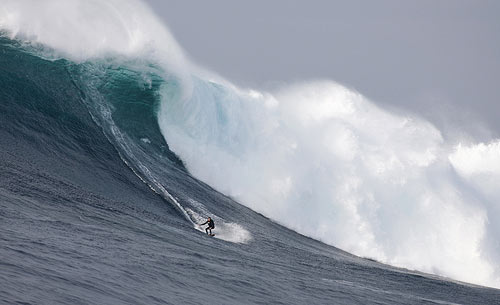
The NY Times has a nice overview:
With a second major storm bearing down, four of the most experienced big-wave surfers in the world launched a boat and two Jet Skis toward Cortes Bank, an underwater mountain range whose tallest peak rises 4,000 feet from the ocean floor to within about four feet of the surface. The perilous spot, about 100 miles off the coast of Southern California, had been surfed only a handful of times in the past decade. With just the right conditions, its shallow waters turn huge ocean swells into giant, perfect breaking waves.
On a big wave site set up by Billabong, one of the riders said that 100-foot waves will be ridden out there:
Cortes Bank veteran Mike Parsons returned from the voyage absolutely certain that larger sea monsters are awaiting around the spooky open-ocean shoal. “It’s getting closer and closer now…I guarantee you there will be a 100-foot-wave ridden out there,” said Parsons. “For sure. There were several big peaks that jumped up at the top of the reef outside of us that could not have been too far off that size. If you put yourself in the right place at the right time, it will happen. It’s only a matter of time now.”
For photos and a nice audio feature with the crew that took the trip out there, head on over to Surfline.
Graffiti Research Lab built their own camera rig to capture bullet time photography (a la The Matrix) for $5000-$8000. Here are the instructions to build your own and the music video they made using the rig.
Living in Three Centuries, Mark Story’s photos of centenarians and other aged people. (via clusterflock)
Arresting images of Benazir Bhutto’s last moments, including some shots of the suicide bomb going off nearby shortly after she was shot.
I love the way she leans every so slightly to the side as the train passes.
Newer posts
Older posts





Socials & More