kottke.org posts about movies
Trailer for The Curious Case of Benjamin Button. David Fincher, Brad Pitt, Cate Blanchett, F. Scott Fitzgerald. Pitt’s character starts off as an old man and ages backwards. Is it possible to buy tickets for this *right now*? BTW, the full text of the Fitzgerald short story on which the film is based is available online.
Interesting article on the genesis, sound design, and cinematography of Wall-E.
“We wanted it to have the feeling that it had actually been filmed,” says Morris. Using subtle details such as barrel distortion and lens flare, gave Wall.E the feel of the 70mm sci-fi films of the Seventies. For the first time Pixar also brought Academy Award-winning cinematographer Roger Deakins and special-effects don Dennis Muren onboard. “We wanted to get the nuance of a live action film, and actually put mistakes in with zooms and framing to give it a more immediate feel.”
Deakins is well-known for working with the Coen Brothers on many of their films. (thx, brian)
Mark Simonson notes that the period typography in the Indiana Jones movies is pretty good, except for that used on Indy’s travel maps.
In Raiders of the Lost Ark (1981) which is set in 1936, we see ITC Serif Gothic (designed in 1972). The wide spacing feels right, and it does have an art deco feel, but it’s 1970s art deco.
A list of the 100 best movie posters of all time. There’s a lot to disagree with on this list. American Beauty at #2?
Two is a trend: unusual movie reviews. First up was Peter Bradshaw’s review of The Incredible Hulk in Hulk-speak and now comes Christopher Orr’s review of M. Night Shyamalan’s newest stinker, The Happening. Orr hated the movie so much that his entire column is a list of spoilers so that you can mock the film without having seen it.
An upcoming film from Pixar: Andrew “Finding Nemo” Stanton’s adaptation of Edgar Rice Burroughs’ John Carter of Mars. As Binary Bonsai notes, this is a bit of a departure for Pixar, what with all the sexuality and violence.
Peter Bradshaw, film critic for The Guardian, wrote his 1-star review of The Incredible Hulk in Hulk-speak.
“Hulk. Smash!” Yes. Hulk. Smash. Yes. Smash. Big Hulk smash. Smash cars. Buildings. Army tanks. Hulk not just smash. Hulk also go rarrr! Then smash again. Smash important, obviously. Smash Hulk’s USP. What Hulk smash most? Hulk smash all hope of interesting time in cinema. Hulk take all effort of cinema, effort getting babysitter, effort finding parking, and Hulk put great green fist right through it. Hulk crush all hopes of entertainment. Hulk in boring film. Film co-written by star. Edward Norton. Norton in it. Norton write it. Norton not need gamma-radiation poisoning to get big head.
Remember when The Hulk had a blog?
(via house next door)
Rave review of a 1995 documentary on the Yugoslavian War called The Death of Yugoslavia.
Despite some criticism about the accuracy of translation, the series would be in my list of top ten documentaries of all time, I cannot recommend it highly enough. It unravels the mechanism of the sordid path of human conflict, from nationalism to genocide, like no other film before or since. It is the film that never was made about the holocaust.
Sounds like a candidate for True Films. All six parts are available on Google Video…start with part one.
Typographically inspired movie titles, including Full Meta Jacket, Bembo: First Blood, and He-Man and the Masters of the Univers.
Russian writer Maxim Gorky wrote one of the first movie reviews in 1896 after seeing a collection of Lumiere films. Film/sound editor Walter Murch introduces the piece:
It is written on a completely clear slate, by someone who had not already been taught how to regard the cinema by a thousand other writers, and the newness of it all leaps from the page. What is remarkable is Gorky’s prescience in the last two paragraphs, as he leaps ahead from his description of the first films to speculation on what directions the cinema might eventually take, toward sex and violence. How did he know?
The bulk of Gorky’s short review concerns the absence of color and sound from the films, as if he’s viewing shadows of reality.
Their smiles are lifeless, even though their movements are full of living energy and are so swift as to be almost imperceptible. Their laughter is soundless although you see the muscles contracting in their grey faces. Before you a life is surging, a life deprived of words and shorn of the living spectrum of colours — the grey, the soundless, the bleak and dismal life.
In a collection of accounts of new technology, the NY Times has a pair of film reviews, the first from the Paris debut of the Lumiere films in 1895:
Photography has ceased to record immobility. It perpetuates the image of movement. When these gadgets are in the hands of the public, when anyone can photograph the ones who are dear to them, not just in their immobile form, but with movement, action, familiar gestures and the words out of their mouths, then death will no longer be absolute, final.
And this one from the projectionist of the first Lumiere in NYC:
You had to have lived these moments of collective exaltation, have attended these thrilling screenings in order to understand just how far the excitement of the crowd could go. With the flick of a switch, I plunge several thousand spectators into darkness. Each scene passes, accompanied by tempestuous applause; after the sixth scene, I return the hall to light. The audience is shaking. Cries ring out.
The Times also has a short article previewing the debut of Thomas Edison’s vitascope1, which demonstrates the difficulty in describing this new technology to the public.
The vitascope projects upon a large area of canvas groups that appear to stand forth from the canvas, and move with great facility and agility, as though actuated by separate impulses. In this way the bare canvas before the audience becomes instantly a stage upon which living beings move about.
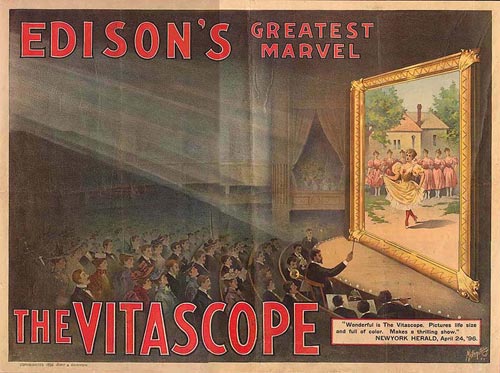
That sounds a bit boring but audiences loved it.
So enthusiastic was the appreciation of the crowd long before this exhibition was finished that vociferous cheering was heard. There were loud calls for Mr. Edison, but he made no response.
By 1898, the language of cinema was beginning to sort itself out, more or less, as this Times editorial notes.
All the resources of the word-builders see to have been exhausted in finding names for the simple but ingenious machine that throws moving pictures on a screen. The essential features in every device of this sort are the same — a brilliant light before which a long band of minute photographs is rapidly drawn, and a lens to focus and distribute the rays properly. The arrangements for the manipulation of the light, the band, and the lens are numerous, but they vary only in the inconsequential details, and for all practical purposes the machines are identical. Some mysterious impulse, however, has impelled almost every purchaser of the apparatus to buy with it, or to invent for it, a distinctive name. Vitascope and biograph are most familiar here, with cinematograph coming next at a considerable distance. These hardly begin the list that might be formed from a careful study of the amusement advertisements in the papers of this and other countries. From such sources might be taken phantoscope, criterioscope, kinematograph, wondorscope, animatoscope, vitagraph, panoramograph, cosmoscope, anarithmoscope, katoptikum, magniscope, zoeoptrotrope, phantasmagoria projectoscope, variscope, cinograph, cinnomonograph, hypnoscope, centograph, and xograph. This is far from exhausting the supply. Electroscope exists, and so do cinagraphoscope, animaloscope, theatrograph, chronophotographoscope, motograph, rayoscope, motorscope, kinotiphone, thromotrope, phenakistoscope, venetrope, vitrescope, zinematograph, vitropticon, stinnetiscope, vivrescope, diaramiscope, corminograph, kineoptoscope, craboscope, vitaletiscope, cinematoscope, mutoscope, cinoscope, kinetograph, lobsterscope, and nobody knows how many more. Here, surely, is a curious development of the managerial mind.
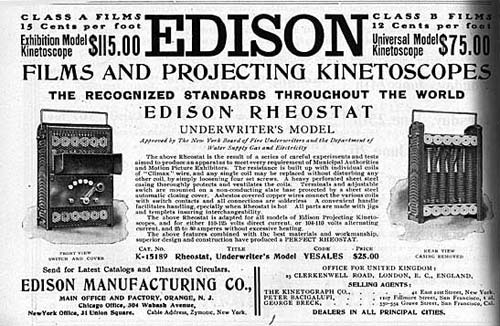
It’s difficult to read these accounts and not think about how we’ll all sound in 100 years as we now attempt to explain the internet, mobile phones, the web, blogs, and the like.
[1] Edison didn’t actually invent the vitascope. Thomas Armat sold the rights to his invention to The Edison Company on the condition that Edison could claim to have invented it. ↩
The NY Times has a look at the progress made by Disney since their 2006 acquisition of Pixar, a purchase some say Disney paid too much for.
“There is an assumption in the corporate world that you need to integrate swiftly,” Mr. Iger said. “My philosophy is exactly the opposite. You need to be respectful and patient.” Key to the successful integration, analysts say, has been Mr. Iger’s decision to give incoming talent added duties. Instead of just buying Pixar and moving on, Mr. Iger understood what made the acquisition valuable, said Mr. Price, the author. “If you are acquiring expertise,” he said, “then dispatch your newly purchased experts into other parts of the company and let them stretch their muscles.”
It also sounds as though Pixar has loosened their high standards since the acquisition…they’re outsourcing some animation, doing more sequels (Cars 2, presumably for the merchandising), and making several direct-to-DVD movies.
An interesting-sounding documentary, on a row between two schools of balloon twisters. (Some examples of the craft.) From the NYT:
“Twisted: A Balloonamentary” examines the world of professional balloon twisters, who make everything from life-size racing cars to their own wedding dresses. It also exposes the rift—who knew?—between the “gospel twisters,” who use their craft as a way to teach Bible lessons, and the “adult” twisters, who use balloons for more prurient entertainment.
“I refused to see the movie” when it first played, said Ralph Dewey, a prominent gospel twister from Deer Park, Tex. “There’s just too much unclean stuff in there.” He and several other like-minded twisters boycotted a screening of “Twisted” at a balloon convention in Texas last year.
The scenes that might make Mr. Dewey squirm take place at a gay men’s party in Las Vegas, where balloons are fashioned into parts of the male anatomy that are most logically suited for this purpose.
According to the twisters themselves, the two factions have long co-existed, however uncomfortably, at conventions and other gatherings, but the film is bringing simmering resentments to the surface.
Lucas finally does away with all those pesky human actors in an animated sequel to Episode II that no one was clamoring for. But I had to look at the trailer.
If you need a reminder of Harrison Ford’s ability to play Indiana Jones after nearly 20 years on the shelf, it comes in the movie’s opening scene. Indy is roughly extracted from a car and tumbles to the ground. We see him stumble towards his trademark hat with that walk, a graceful stuttering step, wary of booby traps even on solid ground. Even though the camera shows us only his boots, it’s unmistakably Indiana Jones.
That walk is also a signal that Lucas and Spielberg didn’t screw this whole thing up…aside from the goofy film title (although having seen the movie, anything else would have ruined the surprise). They didn’t take the bait offered by Casino Royale or The Bourne Ultimatum and attempt to shoehorn Dr. Jones into a frenetic, circa-2008 thrill-ride. Oh, there were thrills alright and plenty of swashes were buckled, but this was an action/adventure movie straight out of the 80s. Safe territory for Lucas and Spielberg perhaps, but for someone who believes that the best 80s action adventure movies have something to teach contemporary filmmakers (#1 of a long list: Don’t make the special effects the star), the film was a thoroughly enjoyable territory in which to spend an evening. (thx to nextnewnetworks for the ticket hookup)
The second trailer for Hancock, the Will-Smith-as-apathetic-superhero movie due out this summer, is up on Apple Trailers. I believe this is the same one I linked to on YouTube a month ago, but watch it again anyway. I am hoping against hope that this one isn’t going to be as stupid as I think and instead will be as awesome as I hope.
Possible collateral damage from the ascendence of HD and Blu-ray: people want their movies to look nice and clean and sharp and without film grain, even if the feel of a movie calls for it.
Unfortunately, what seems to happening right now is that the studio marketing folks are conducting focus groups with new Blu-ray consumers, who are saying they want perfect pictures every time. As a result, a few of the Hollywood studios are currently A) using excessive Digital Noise Reduction to completely scrub film grain from their Blu-ray releases, or B) not releasing as many older catalog titles as they might otherwise for fear that people will complain about grain. Some studios are even going so far as to scrub the grain out of NEW releases that have been shot on film. Case in point: New Line’s Pan’s Labyrinth Blu-ray Disc. When I saw this film in the theaters, it was dark and gritty. The grain was a deliberate stylistic choice — part of the artistic character of the film. New Line’s Blu-ray, on the other hand, is sparkly and glossy — almost entirely grain-free. So much fine detail has been removed that the faces of characters actually look waxy. Everyone looks like a plastic doll.
(via house next door)
Sixteen elusive movie object of desire, including White Castle burgers in Harold & Kumar, the Ark of the Convenant in Raiders of the Lost Ark, and the One Ring from the LOTR trilogy.
This one’s not holding up as well as one would think. The first time I saw it, in the theater in 1999, my reaction was “eh”. The second time, on DVD a few years ago, I thought it was great. Now I’m back closer to “eh” again.
Related to yesterday’s post about photo retouching is this article about how challenging high definition is to makeup artists and actors alike (via house next door) .
John Toll is an Academy Award-winning cinematographer who has had limited exposure to HD photography, but who understands the impact of it on the business. “Film tends to be more kind,” he said. “Now with HD, they’re doing things like more filtration, or softening of the light, or degrading the image so it’s not so highly defined. It’s sort of what they used to do in movie star close-ups, an over-diffused style to try to make them look glamorous. Now they do it so you don’t see every pore in a close-up on skin.”
Also related, James Danziger weighs in on the Dove/Dangin/Leibovitz controversy the latter of whom is represented by Danziger’s gallery.
Any photograph used in a magazine, a billboard, an album cover, whatever — can only be presumed to be a photo-based illustration. The issue, which Dove’s well-intentioned campaign addressed, is the effect these illustrations have on the psyche, self-esteem, and well-being of women (in particular) not to mention the unrealistic view men might have of women. It brings to mind the shock the eminent Victorian art critic John Ruskin experienced upon discovering his wife’s pubic hair, after which he was unable to consummate the marriage. Divorce followed shortly.
Ok, we’ve done books so let’s move on to movies. From the book by Steven Jay Schneider comes a list of 1001 movies you must see before you die. Since it’s less time consuming to watch movies rather than read books, I did a lot better on this list…I’ve seen 214/1001 movies on the list. My favorites are marked with an asterisk.
Nosferatu, A Symphony of Terror(1922)
The General (1927)
King Kong (1933)
Snow White and the Seven Dwarfs (1937)
The Wizard of Oz (1939)
Gone With the Wind (1939)
Pinocchio (1940)
Citizen Kane (1941)
Casablanca (1942)
It’s a Wonderful Life (1946)
On the Waterfront (1954)
Rear Window (1954)
The Seven Samurai (1954)
Touch of Evil (1958)
The 400 Blows (1959)
North by Northwest (1959)
La Jetee (1961)
West Side Story (1961)
Lolita (1962)
Goldfinger (1964)
Dr. Strangelove (1964)*
A Hard Day’s Night (1964)
The Sound of Music (1965)
Faster, Pussy Cat! Kill! Kill! (1965)
The Graduate (1967)
Cool Hand Luke (1967)
Rosemary’s Baby (1968)
2001: A Space Odyssey (1968)
Butch Cassidy and the Sundance Kid (1969)
A Clockwork Orange (1971)*
Willy Wonka and the Chocolate Factory (1971)
Harold and Maude (1971)
Dirty Harry (1971)
Deliverance (1972)
The Godfather (1972)*
The Sting (1973)
American Graffiti (1973)
The Conversation (1974)
Young Frankenstein (1974)
Chinatown (1974)
Blazing Saddles (1974)
The Godfather Part II (1974)*
Dog Day Afternoon (1975)
One Flew over the Cuckoo’s Nest (1975)
The Rocky Horror Picture Show (1975)
Monty Python and the Holy Grail (1975)
Barry Lyndon (1975)
The Outlaw Josey Wales (1976)
All the President’s Men (1976)
Rocky (1976)
Taxi Driver (1976)
Network (1976)*
Star Wars (1977)*
Close Encounters of the Third Kind (1977)
Annie Hall (1977)
Saturday Night Fever (1977)
The Deer Hunter (1978)
Grease (1978)
Alien (1979)
Life of Brian (1979)
Apocalypse Now (1979)
The Jerk (1979)
The Muppet Movie (1979)
The Shining (1980)*
Star Wars: Episode V - The Empire Strikes Back (1980)*
Airplane! (1980)
Raging Bull (1980)
Raiders of the Lost Ark (1981)*
Fast Times at Ridgemont High (1981)
E.T.: The Extra-Terestrial (1982)
Blade Runner (1982)
Tootsie (1982)
Gandhi (1982)
A Christmas Story (1983)
Star Wars: Episode VI - Return of the Jedi (1983)
The Right Stuff (1983)
Scarface (1983)
Amadeus (1984)
The Terminator (1984)
This Is Spinal Tap (1984)
Beverly Hills Cop (1984)
Ghostbusters (1984)
The Killing Fields (1984)
The Natural (1984)
The Breakfast Club (1985)
Back to the Future (1985)
Brazil (1985)
Stand By Me (1986)
Blue Velvet (1986)
Aliens (1986)
Ferris Bueller’s Day Off (1986)
A Room with a View (1986)
Platoon (1986)
Top Gun (1986)
Raising Arizona (1987)
Full Metal Jacket (1987)
Withnail and I (1987)
Good Morning, Vietnam (1987)
The Princess Bride (1987)
The Untouchables (1987)
Fatal Attraction (1987)
Women on the Verge of a Nervous Breakdown (1988)
The Thin Blue Line (1988)
Akira (1988)
A Fish Called Wanda (1988)
The Naked Gun (1988)
Big (1988)
Dangerous Liaisons (1988)
Die Hard (1988)
Who Framed Roger Rabbit (1988)
Rain Man (1988)
The Accidental Tourist (1988)
Batman (1989)
When Harry Met Sally (1989)
The Cook, the Thief, His Wife and Her Lover (1989)
Do the Right Thing (1989)
Roger & Me (1989)
Glory (1989)
Say Anything (1989)
Goodfellas (1990)
Jacob’s Ladder (1990)
Dances with Wolves (1990)
Pretty Woman (1990)
Edward Scissorhands (1990)
Total Recall (1990)
Boyz ‘n the Hood (1991)
Raise the Red Lantern (1991)
Thelma & Louise (1991)
Terminator 2: Judgment Day (1991)
The Silence of the Lambs (1991)*
JFK (1991)
Slacker (1991)
The Player (1992)
Reservoir Dogs (1992)*
Glengarry Glen Ross (1992)
Unforgiven (1992)
The Crying Game (1992)
Groundhog Day (1993)
Philadelphia (1993)
Jurassic Park (1993)
Schindler’s List (1993)
The Piano (1993)
Hoop Dreams (1994)
Forrest Gump (1994)
Clerks (1994)
Four Weddings and a Funeral (1994)
The Lion King (1994)
Natural Born Killers (1994)
Pulp Fiction (1994)*
Muriel’s Wedding (1994)
The Shawshank Redemption (1994)*
Heavenly Creatures (1994)
Casino (1995)
Babe (1995)
Toy Story (1995)
Braveheart (1995)
Clueless (1995)
Heat (1995)
Seven (1995)*
Smoke (1995)
The Usual Suspects (1995)
Fargo (1996)
Independence Day (1996)
The English Patient (1996)
Shine (1996)
Trainspotting (1996)
L.A. Confidential (1997)
Princess Mononoke (1997)*
The Butcher Boy (1997)
The Ice Storm (1997)
Boogie Nights (1997)*
Titanic (1997)*
Saving Private Ryan (1998)
Buffalo 66 (1998)
The Big Lebowski (1998)
Run Lola Run (1998)
Rushmore (1998)*
Pi (1998)
Happiness (1998)
The Thin Red Line (1998)
There’s Something About Mary (1998)
Magnolia (1999)*
The Blair Witch Project (1999)
Three Kings (1999)
Fight Club (1999)
Being John Malkovich (1999)
American Beauty (1999)
The Sixth Sense (1999)
The Matrix (1999)*
Gladiator (2000)
Requiem for a Dream (2000)
Amores Perros (2000)
Crouching Tiger, Hidden Dragon (2000)
Traffic (2000)
Memento (2000)
Dancer in the Dark (2000)
Amelie (2001)
Spirited Away (2001)
No Man’s Land (2001)
Moulin Rouge (2001)
Monsoon Wedding (2001)
Mulholland Dr. (2001)
The Royal Tenenbaums (2001)*
The Pianist (2002)
Lost in Translation (2003)
Oldboy (2003)
Good Bye Lenin! (2003)
The Lord of the Rings: The Return of the King (2003)*
Fahrenheit 9/11 (2004)
A Very Long Engagement (2004)
Sideways (2004)
Caché (2005)
Brokeback Mountain (2005)
The Constant Gardener (2005)
If you’d like to post your movie list, I used this list along with a list of additions and subtractions.
Update: The very latest edition of the book adds and subtracts some more movies to/from the list; here are the added movies that I’ve seen:
Crash (2004)
Little Miss Sunshine (2006)
The Prestige (2006)
United 93 (2006)
Children of Men (2006)
El Laberinto del Fauno (2006)
The Queen (2006)
Apocalypto (2006)
The Departed (2006)
Volver (2006)
And deleted from the list:
Monsoon Wedding (2001)
Mulholland Dr. (2001)
A Very Long Engagement (2004)
Caché (2005)
It’s interesting to watch the churn on a list like this. With the newest movies, they’re making guesses as to how they’ll age and in many cases, the guesses aren’t that good. Also, removing Caché for Apocalypto? No fucking way. (thx, jack)
A collection of videos showing directors in cameos.
Many directors at some point in their careers have stepped out from behind the camera to act. This is typically in a smaller, cameo role, and often with varying degrees of success: sometimes they’re completely natural and sometimes they bring the film to a screeching halt. And sometimes you’d never even know they were there.
YouTube user barringer82 has posted several mini-compilations of films of different eras and directors. For instance: the 1980s, Wes Anderson, Stanley Kubrick, Paul Thomas Anderson, David Lynch, the 1990s, Quentin Tarantino, and the 1970s.
Here’s the premise: taken together, this summer’s movies are bad enough that it signals the end of the summer blockbuster. The evidence in two parts.
Update: Counterpoint. (thx, patricio)
Roger Ebert + blog = subscribed. (via house next door)
To be honest, I was a little disappointed in Standard Operating Procedure…but the fault is my own, not the film’s. My expectation was that the film would start with the photos of Abu Ghraib & misdeeds of the lower ranking soldiers and then move up the chain of command, both militarily and thematically speaking, to explore the issues of truth in photography and culpability. To Morris’ credit, he didn’t do that. It’s too easy these days to attempt arguments about Iraq or the Bush Administration that connect too many dots with too little evidence…essentially propaganda that sings to the choir.
SOP has a surprisingly small depth of field; it’s the story of those infamous photos, the people who took & appeared in them, and what they have to say about the photos & the actions they purport to show. And in that, the movie succeeds. Morris leaves plenty of negative space into which the audience can insert their own questions about what the photographs ultimately depict and who’s responsible in the end.
Incidentally, Morris generated a bit of controversy recently when he admitted that he’d paid some of the interviewees in SOP. The criticism of this practice is that “the credibility of interviewees diminishes when money changes hands and that these people will provide the answers they think are desired rather than the truth”. That is a concern but no more so than every other reason for being untruthful, including not telling the truth out of spite for lack of payment. People have so many better reasons to lie than money.
Newer posts
Older posts




Socials & More